INTRODUCTION
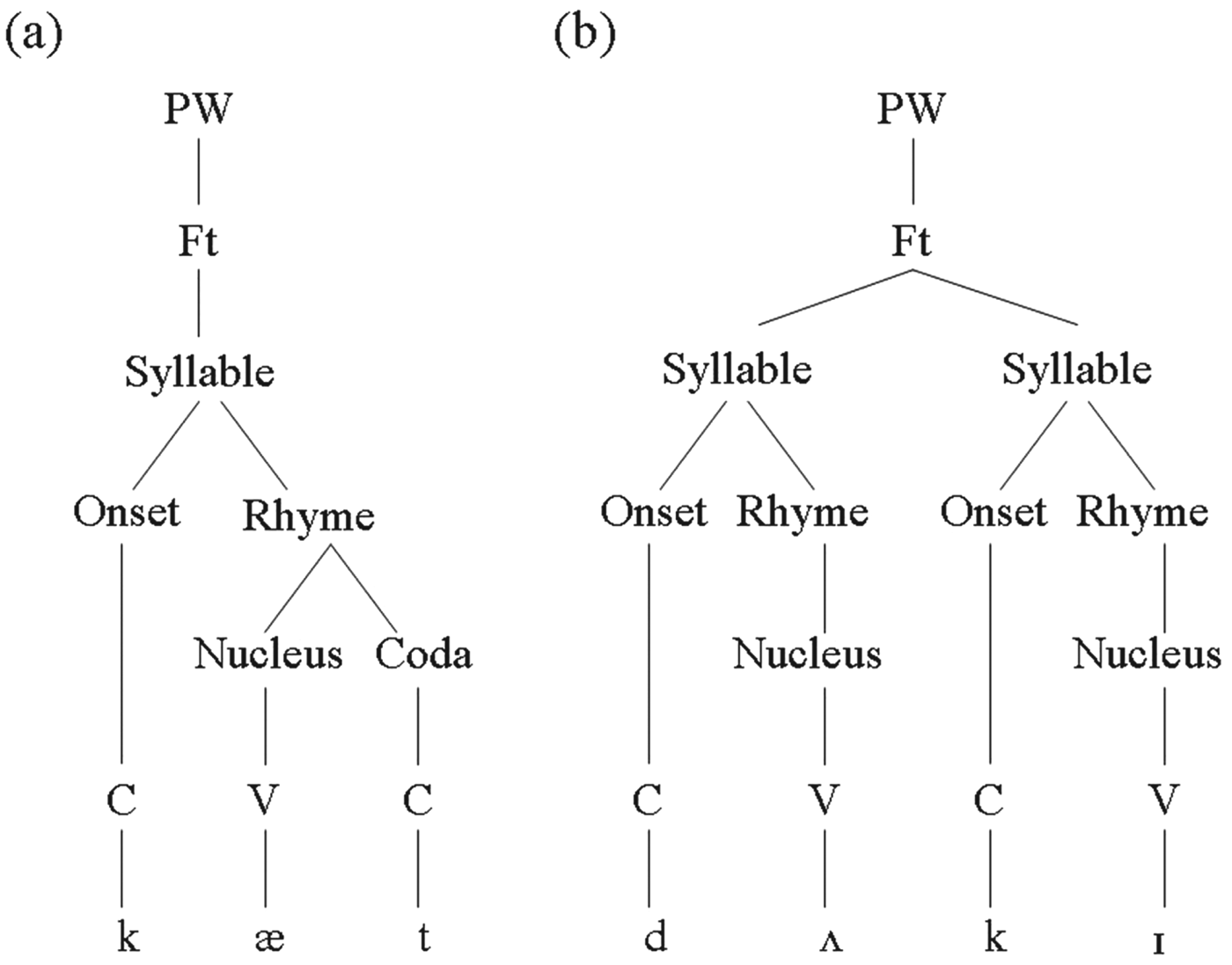
One of the challenges for young language learners is to acquire the syllable structure of the language(s) they are exposed to. There is considerable variability in how this is achieved as a function of the target language, with final (coda) consonants (Figure 1a) acquired earlier in Germanic languages compared to Romance languages like Spanish (cf. Lleó & Demuth, Reference Lleó, Demuth, Greenhill, Littlefield and Tano1999). This cross-linguistic variability in the rate at which certain syllable structures are acquired appears to be due, in part, to the frequency with which such structures occur in the target language. For example, coda consonants occur more often in English (60% of all syllables) than in Spanish (25% of all syllables) (Roark & Demuth, Reference Roark, Demuth, Howell, Fish and Keith-Lucas2000). At the same time, it is well documented that CVCV words (Figure 1b) are common in children's early speech (e.g. Dutch – Fikkert, Reference Fikkert1994; French – Demuth & Johnson, Reference Demuth and Johnson2003; English – Demuth, Culbertson & Alter, Reference Demuth, Culbertson and Alter2006), suggesting an early facility with simple, open CV syllable structures, and later acquisition of CVC syllable structures containing a coda consonant (Figure 1a).
Syllable structures for (a) the simple monosyllabic CVC word cat and (b) the disyllabic CV.CV word ducky.

Many factors have been observed to influence children's coda production. These include, amongst others, word length and location of stress (e.g. Kirk & Demuth, Reference Kirk and Demuth2006; Prieto & Bosch-Baliarda, Reference Prieto and Bosch-Baliarda2006), utterance position (Song, Demuth & Shattuck-Hufnagel, Reference Song, Demuth and Shattuck-Hufnagel2012), consonant type (Kehoe & Stoel-Gammon, Reference Kehoe and Stoel-Gammon2001; Stites, Demuth & Kirk, Reference Stites, Demuth, Kirk, Brugos, Micciulla and Smith2004), lexical frequency (Stoel-Gammon, Reference Stoel-Gammon and Paul1998), phonotactic probability (Zamuner, Gerken & Hammond, Reference Zamuner, Gerken and Hammond2004), the language-specific frequency characteristics of codas (Zamuner, Gerken & Hammond, Reference Zamuner, Gerken and Hammond2005), and phonetic considerations/constraints (Fey & Gandour, Reference Fey and Gandour1982; Davis, MacNeilage & Matyear, Reference Davis, MacNeilage and Matyear2002). In terms of English coda consonant development, voiceless obstruents appear first, followed by nasals and voiced obstruents (Kehoe & Stoel-Gammon, Reference Kehoe and Stoel-Gammon2001). Even when children can produce the codas, Zamuner and colleagues (2004) found that high phonotactic probability induced more codas than low phonotactic probability in nonword productions, suggesting a rich representation of the linguistic input. At the same time, children have been observed to produce coda consonants in a way different from adults. For instance, Fey and Gandour (Reference Fey and Gandour1982) reported that their participant produced post-nasalization with voiced coda consonants, and aspiration with voiceless consonants. This indicates that post-nasalization is linked to the voicing status of the coda consonant. Similarly, Davis and colleagues (Reference Davis, MacNeilage and Matyear2002) showed that there were co-occurring phonetic constraints between consonants and vowels in early speech, such as coronal consonants tending to pattern with front vowels, labial consonants with open vowels, and dorsal consonants with back vowels. In short, children's coda productions are variable and subject to both phonetic and linguistic factors.
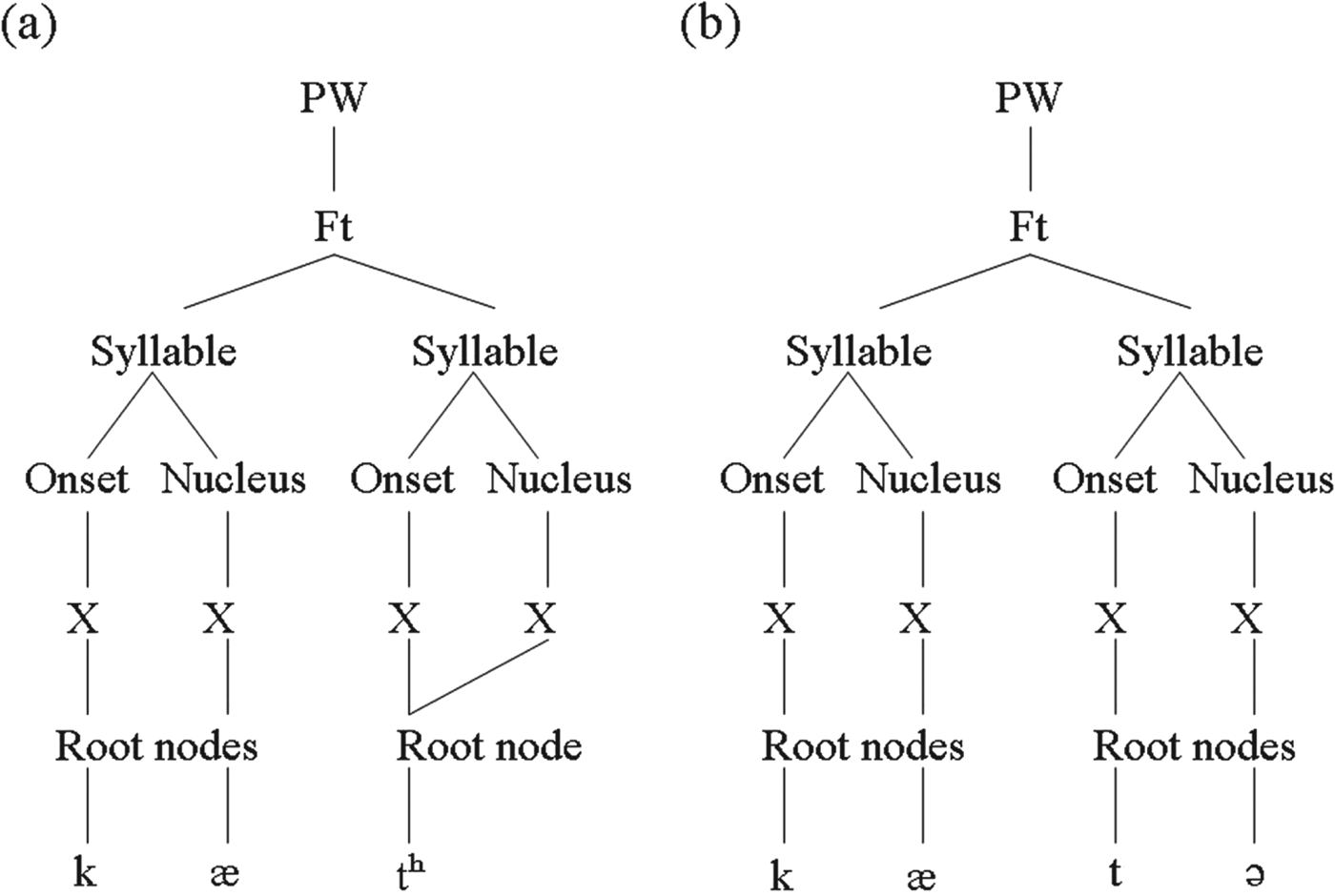
Different frameworks have also been proposed to analyze the syllabic status of the final consonant. It is commonly assumed that all word-final consonants are codas. While Kaye (Reference Kaye1990) treated the final consonant as an onset, others have treated it as a coda in CVC words, but as an onset in CVVC and CVCC words (English – Goad, Reference Goad2002; Dutch – Botma & van Oostendorp, Reference Botma and van Oostendorp2012). When young children attempt CVC words in a language like English, they often variably produce the C2 with a heavy/long aspirated release (Fey & Gandour, Reference Fey and Gandour1982; Goad, Reference Goad2002; Song et al., Reference Song, Demuth and Shattuck-Hufnagel2012), or an epenthetic vowel (Vihman & Velleman, Reference Vihman and Velleman1989; Demuth et al., Reference Demuth, Culbertson and Alter2006). This has led to a phonological analysis that interprets these early CVCh/ə forms as disyllabic CV.CV structures, where the more complex CVC syllable structures are acquired later (Goad & Brannen, Reference Goad, Brannen, van de Weijer, van Heuven and van der Hulst2003). According to this analysis, the structural representation of CVCh/ə is as illustrated in Figure 2a.
Goad and Brannen's (Reference Goad, Brannen, van de Weijer, van Heuven and van der Hulst2003) proposed analysis of (a) CVCh and (b) CV.CV words.
Following Jakobson (Reference Jakobson1941/1968) and others (e.g. Demuth Reference Demuth and Beckman1995), Goad and Brannen (Reference Goad, Brannen, van de Weijer, van Heuven and van der Hulst2003) noted that CV was the unmarked syllable structure found in early speech. They suggested that when the target word was CVC, children maintained the unmarked CV structure and treated the final consonant as an onset-nucleus sequence (CV.CV), producing the ‘final’ consonant of the target word without using more marked CVC syllable structure. This analysis was based on the release properties of the final consonant in children's CVC productions, where some children produced a voiceless final consonant with heavy aspiration. They also discussed the absence of closed syllable shortening in adult languages (even in languages where word-final consonants are syllabified as onsets), using this as further support for proposing an onset analysis of the C2 in child speech. Closed syllable shortening refers to the observation that the vowel in a CVVC syllable will be shorter than the same vowel in a CVV word (e.g. seat vs. see). Goad and Brannen (Reference Goad, Brannen, van de Weijer, van Heuven and van der Hulst2003) suggested that children's vowel durations in a CVC target word remained long, providing evidence that these were produced as open syllables.
As shown in Figure 2a, Goad and Brannen (Reference Goad, Brannen, van de Weijer, van Heuven and van der Hulst2003) posited one root node linked to two skeletal units to account for final consonants with heavy aspiration. To account for the final consonant with an epenthetic vowel, the two skeletal units are linked to two separate root nodes, as illustrated in Figure 2b. However, Goad and Brannen (Reference Goad, Brannen, van de Weijer, van Heuven and van der Hulst2003) did not conduct acoustic analyses as the recordings were not available. Recent acoustic analysis by Song et al. (Reference Song, Demuth and Shattuck-Hufnagel2012) indicated a large amount of variability in the production of C2 burst releases and aspiration on CVC target words by children aged 1;6. They attributed this finding to the relatively poor articulatory control of subglottal pressure in children of this age who have a very small oral cavity (see also Imbrie, Reference Imbrie2005). This raises the possibility that aspiration on its own might not be a sufficient cue for determining whether a consonant is in the syllable onset or not.
There has been little systematic study regarding the syllabification of final consonants in early child speech, in part because this period of aspiration and/or epenthesis tends to appear very early and only briefly, coinciding with children's first words. This period is therefore hard to capture. In a case study by Vihman and Velleman (Reference Vihman and Velleman1989), the CVC targets were variably produced as open or closed syllables at the age of 1;1. By the age of 1;2, an output pattern with a final consonant and heavy aspiration was preferred, exhibiting relatively small variability in consonant closure and release duration. This finding raises many questions about the syllabic status of the final consonant.
Demuth et al. (Reference Demuth, Culbertson and Alter2006) reported that Naima, one of the children from the Providence Corpus, showed high rates of aspiration and epenthesis between the ages of 1;3 and 1;5. As these data are linked to acoustic files, it is therefore possible to explore more closely the phonetic details of this child's aspirated and non-aspirated productions, such as the temporal organization of segments, in order to address their possible syllabic organization.
English-speaking adults lengthen the final syllable of a word at the end of a phrase (phrase-final lengthening) (Turk & Shattuck-Hufnagel, Reference Turk and Shattuck-Hufnagel2007). They also tend to adjust the duration of a syllable when more syllables are appended to it, a process known as ‘polysyllabic shortening’ (Lehiste, Reference Lehiste1972). Thus, the duration of pan is longer than the same sequence in the disyllabic word panda. Repp and Williams (Reference Repp and Williams1985) similarly reported that monosyllabic CVC words in adult English had longer closure in the C2 than in disyllabic words (CV.CV). The number of syllables within a word thus affects the duration of the C2: both the vowel and the C2 are shorter in duration in a disyllabic CVCV word than in a monosyllabic CVC word for adults. Aside from aspiration, this timing pattern might therefore be useful for investigating the status of C2 in child speech, given that phrase-final lengthening is reported in children by the age of 1;6 (Song et al., Reference Song, Demuth and Shattuck-Hufnagel2012) and before 2;0 (Snow, Reference Snow1994).
The goal of the present study was to determine, through acoustic analysis of the temporal organization of one child's CVC, CVCh, and CVCV word productions, the nature of the child's representation of the final consonant in a word like cat. We compared vowel length and C2 closure durations in the child's CVC vs. CVCV target words to assess polysyllabic shortening. We predicted that, if the vowel and C2 in both the CVC and CVCh productions have the same durations, we would have evidence for a coda representation.
METHOD
Subject and database
The data examined in this study were from Naima, a typically developing, monolingual child learning American English. Speech samples were drawn from the Providence Corpus (http://childes.psy.cmu.edu/) (Demuth et al., Reference Demuth, Culbertson and Alter2006), where the child was engaged in spontaneous speech interactions with her mother between the ages of 1;3 and 1;5. During this period of development, Naima exhibited aspiration and some epenthesis when producing many of her CVC target words (see Demuth et al., Reference Demuth, Culbertson and Alter2006, for more detail). Digital audio-/video-recordings were collected in the child's home for approximately an hour every 1 or 2 weeks. Both mother and child wore a wireless Azden WLT/PRO VHF lavalier microphone positioned on the lapel, which gave them the freedom to carry out their typical daily activities as they conversed. A Panasonic PV-DV601D-K mini digital video-recorder captured the context when they were on screen. The recordings were sampled at a rate of 44·1 kHz and analyzed off-line.
Data
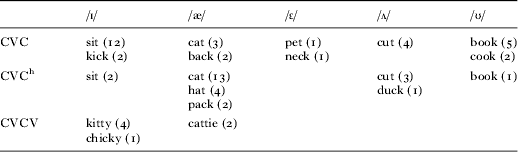
We first extracted utterance-final target monosyllabic CVC and disyllabic CVCV words from the database. All the CVCV items had initial stress, both in the target word and in the child's production. The second author then checked these for acoustic quality. Items with any clipping, overlapped speech or breathy productions were excluded. Any items containing onset /r/,/w/, or /l/ were also excluded since the boundaries of these onset consonants are difficult to determine, and therefore difficult to accurately separate from the vowel. Voicing of the coda consonant was controlled for, as this can influence the duration of the previous vowel (House & Fairbanks, Reference House and Fairbanks1953). Thus, for all the words analyzed, the C2 was a voiceless stop. Given that bilabial stops tend to exhibit longer closure duration than alveolar and velar stops (Repp, Reference Repp1984), we excluded items that contained a bilabial stop in the C2 position (cap, cup, puppy) to avoid any potential confound. All words contained lax (short) vowels (see Ladefoged, Reference Ladefoged1993), further controlling for issues of vowel duration. This allowed us to investigate the presence of acoustic cues to syllable structure other than aspiration, such as C2 consonant closure duration and the duration of the preceding vowel.
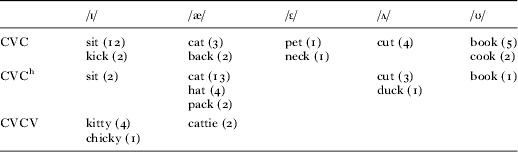
The final dataset consisted of the following number of word types: 9 CVC, 7 CVCh, 3 CVCV; and tokens: 32 CVC, 26 CVCh, 7 CVCV; for a total of 65 items as shown in Table 1. Because most of the high-frequency lexical items in English are monosyllabic, many of the disyllabic words the child was using at this age were diminutives. The average closure duration of the medial /t/ consonant was 100 ms, which was the same as that of the medial /k/ consonant. This suggests that the intervocalic /t/ consonants in this child's diminutives were not produced as flaps.
Dataset: target words (number of tokens) as a function of word shape and vowel
Acoustic coding
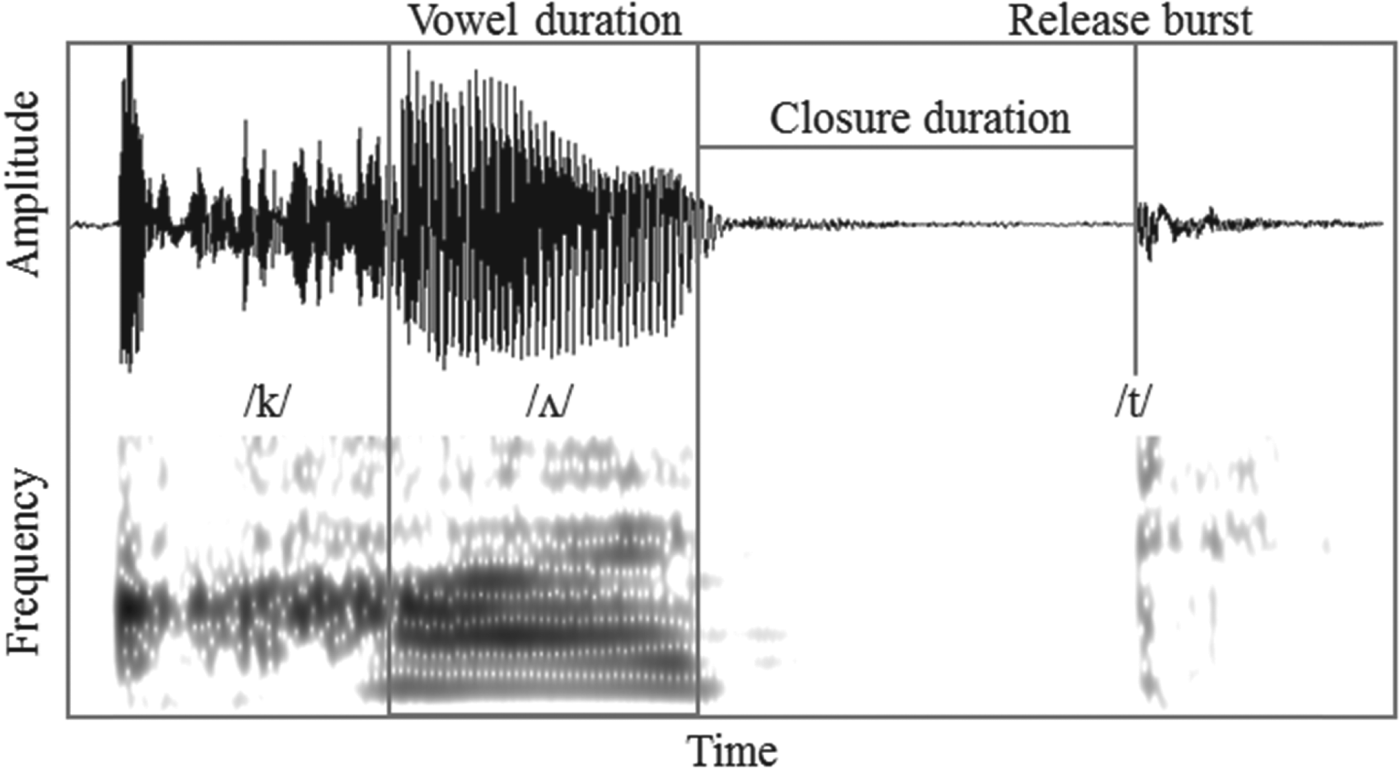
The second author used Praat software (Boersma & Weenink, Reference Boersma and Weenink2005) to code all the tokens for acoustic landmarks (cf. Stevens, Reference Stevens2002), using visual information from the waveform and spectrogram. The following acoustic events were identified, as illustrated in Figure 3: (1) vowel duration: high-amplitude regularity in the waveform and a strong F2 in the spectrogram were used to determine the vowel beginning, and a drop in F2 to determine the vowel end; (2) closure duration: low/no-amplitude in the waveform and silence in the spectrogram were used to identify the beginning of closure (this also coincided with the F2 drop in the vowel). A sudden spike in the waveform and spectrogram was used to identify closure end; (3) release burst: the sudden amplitude spike in the waveform was used to identify the beginning of the burst, and the onset of aperiodic noise was used to determine the burst end; and (4) post-release noise/aspiration: this was identified as presence/absence of aperiodicity following the release burst.
Spectrogram of the word cut /kʌt/ at age 1;3.
Ten percent of the tokens were randomly selected across the entire dataset and recoded by the first author, with 93% inter-coder reliability. Further analysis was based on the original transcriber's annotation. On the basis of these labelled acoustic landmarks, vowel and closure durations were automatically extracted in Praat for statistical analysis (Boersma & Weenink, Reference Boersma and Weenink2005). Three independent t-tests were conducted to make the following comparisons: (1) CVC vs. CVCV, (2) CVCh vs. CVCV, and (3) CVC vs. CVCh, using the duration of the first vowel (V1) and closure duration of the second consonant (C2) as the dependent variables.
RESULTS
On the basis of polysyllabic shortening, we predicted a longer V1 and C2 in the CVC words than in the CVCV words. If the C2 of the CVCh forms was being treated as a coda consonant, we expected the duration of C2 to be longer in the CVCh productions than in the CVCV words. If C2 had the same syllabic status (i.e. a coda) in both the CVC and CVCh forms, we predicted no difference in the durations of V1 and C2 from these two forms.
We first present the comparison between the CVC words and the CVCV words. An independent t-test revealed no statistically significant difference in vowel duration (t(10) = 1·558 with equal variance assumed, p = ·15, two-tailed); however, closure duration reached statistical significance (t(10) = 3·385, with equal variance assumed, p = ·007, two-tailed), with the C2 being longer in the CVC words. Thus, as predicted, C2 closure duration was longer in the monosyllabic CVC words than in the disyllabic CVCV words, indicating polysyllabic shortening.
We then evaluated the syllabic status of the C2 in the CVCh vs. CVCV words. If the C2 in these two word types had a different syllabic status, V1 length and C2 closure duration should differ. An independent t-test again revealed no statistical difference for vowel duration (t(8) = 0·993 with equal variance assumed, p = ·35, two-tailed). However, closure duration once again reached statistical difference (t(8) = 2·853 with equal variances assumed, p = ·021, two-tailed), with longer closure duration for the C2 in the CVCh words.
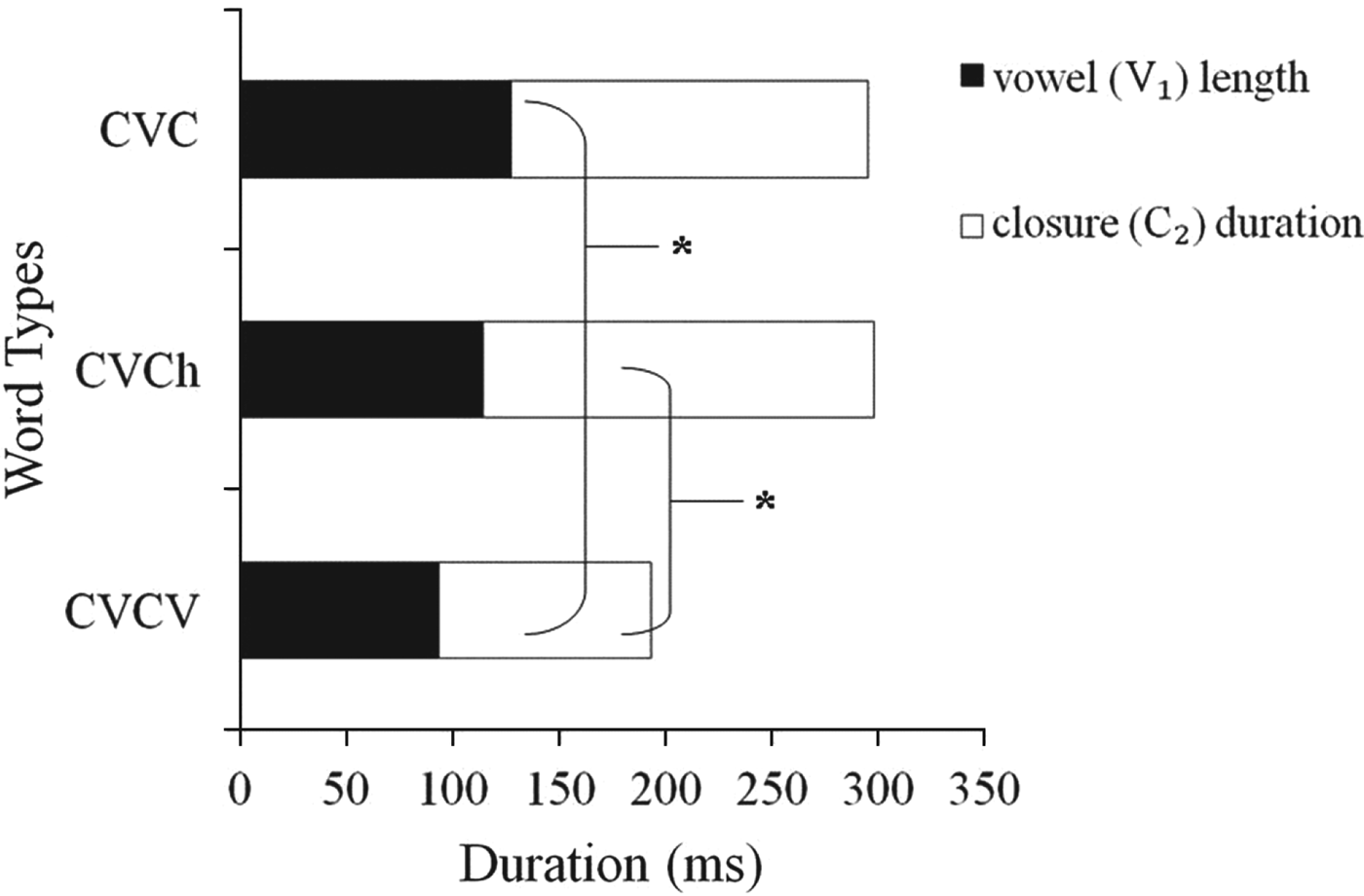
Finally, we compared the child's vowel and closure durations between the CVC and CVCh productions. As predicted, independent t-tests showed that there was no significant difference in either vowel duration (t(14) = 0·729 with equal variances assumed, p = ·478, two-tailed), or closure duration (t(14) = −0·8 with equal variances assumed, p = ·437, two-tailed). This finding suggests that this child's early CVC and CVCh productions represent slightly different surface realizations of the release burst of the final consonant, but that they share the same basic syllable structure on the basis of closure duration within a monosyllabic word.
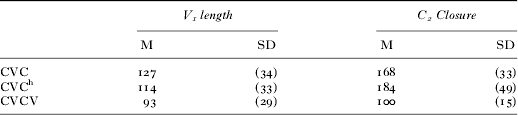
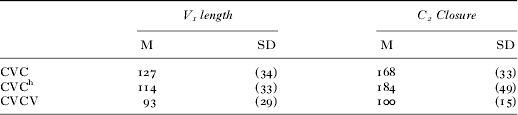
These durational measures are presented in Table 2, and illustrated graphically in Figure 4. Note that there is a tendency for closure duration to be longer in the CVCh compared to the CVC forms, suggesting an emphatic production of the CVC target word (see Demuth et al., Reference Demuth, Culbertson and Alter2006, for similar observations).
Average vowel (V1) length and C2 closure durations (ms) across word types.
Average vowel (V1) length and C2 closure durations (ms) for different word types
To summarize, the closure duration patterns revealed no significant differences between the final consonant in CVC and CVCh words. However, both exhibited a difference in closure duration compared to the intervocalic C2 in the CVCV words. Thus, it appears that aspirated CVCh words are syllabified in the same way as monosyllabic CVC words, and not as disyllables.
DISCUSSION
The goal of this study was to determine whether young children who produce word-final consonants with aspiration represent these as having disyllabic structure. The acoustic analysis of one child's early CVC, CVCh, and CVCV productions shows that she was treating the C2 of the CVC and CVCV target words in very different ways, with longer closure durations for the monosyllables than for the disyllables, in line with similar findings for adults (Lehiste, Reference Lehiste1972). Critically, the aspirated CVCh productions patterned much more closely with the monosyllabic CVC forms than with the disyllabic CVCV forms. These findings therefore provide some acoustic/phonetic evidence that at least some English-speaking children have early coda consonant representations, producing CVC syllable structure before the age of 1;6, even in cases of heavy aspiration. This finding is consistent with recent observations from Song et al. (Reference Song, Demuth and Shattuck-Hufnagel2012), who noted that the coda releases of children aged 1;6 are much ‘noisier’ than those of their mothers, with much more in the way of coda-release bursts and post-release aspiration noise. The authors suggest that this may be because children at this age are overall less consistent than adults in controlling and coordinating their articulatory gestures.
Although there was no significant difference in vowel duration between CVC and CVCV forms in this study, the direction of the difference between the two forms was as predicted. Thus, vowel duration tended to be shorter in the disyllabic words compared to the monosyllabic words. Together with the significant difference in C2 closure duration, this finding provides support for polysyllabic shortening in the child's productions.
Note that the C2 under investigation here is within the stressed syllable in the CVC target words, but within the unstressed syllable in the CVCV targets. Stressed syllables tend to be longer than unstressed syllables. If the C2 is a coda in the monosyllabic word and an onset in the disyllabic word, it follows that the C2 in the CVC target words would be longer than the corresponding consonant in the weaker unstressed syllable in the CVCV target. Our findings therefore provide evidence for this predicted difference in closure duration, supporting our interpretation of the different syllabic status of the C2 between the monosyllabic and disyllabic target words.
As the C2 is intervocalic in the CVCV words, perhaps the syllable affiliation of this second consonant might have influenced our interpretation of the results. Recall that the disyllables we examined here were hypocoristics, with the final ‘y’ as a diminutive morpheme. This might have influenced the morphological structure of the disyllabic targets. If we had assumed a one-to-one correspondence between morphological structure and syllable structure, this would have led us to question whether the disyllabic words might have a CVC.V structure. This assumption would have led us to the interpretation that the C2 in the disyllable might have shared similar syllable structure with the CVCh forms. However, we suggest that this interpretation is not likely, at least under certain analyses of syllable structure that propose a maximal onset principle in the phonological analysis of adult speech (Pulgram, Reference Pulgram1970; Treiman & Zukowski, Reference Treiman and Zukowski1990). Although it is not clear if this is also observed in early child speech, we suspect it probably is, as open syllable forms are typically considered less marked and therefore earlier acquired (e.g. Jakobson, Reference Jakobson1941/1968; Demuth, Reference Demuth and Beckman1995).
The pattern of standard deviation among the CVC, CVCh, and CVCV forms corroborates our interpretation of the CVCh productions as being structurally monosyllabic. The variability found in the durations of the C2s from the CVC and CVCh productions was greater than in CVCV words, suggesting that the disyllables are much more stable in their representations than the forms with (more recently acquired) coda consonants. The smaller variation in the disyllables might be related to their small sample size. However, these CVCV words were also highly frequent diminutives and might therefore be more practised, thereby exhibiting more stable motor control (Davis & MacNeilage, Reference Davis and MacNeilage1990). However, as some of the monosyllabic CVC forms examined in this study are also high-frequency words, occurring regularly in this child's spontaneous speech, we suspect that the difference in variability between the monosyllables and disyllables cannot be attributed solely to the difference in lexical frequency.
Another possible explanation for some of the greater variability found in the duration in the monosyllabic CVC targets might be their different segmental composition. The disyllabic words contained mostly front vowels, whereas the CVC words were more evenly spread across both front and back vowels. However, the variability in the closure duration could not be attributed to the inclusion of different consonant types, as both monosyllabic and disyllabic words contained only alveolar and velar stops. Therefore, the variability found in the closure duration for the CVCh forms may reflect a general challenge found with acquiring CVC syllable structure. Recall that, even at 1;6 and at 2;0, and with a larger sample of children and more data, Song et al. (Reference Song, Demuth and Shattuck-Hufnagel2012) found that children were overall ‘noisier’ and more variable in both vowel duration and coda release bursts than their mothers when producing CVC target words. Thus, although stops are some of the first coda consonants to appear in English, and /t/ is the most frequent English coda consonant (Kehoe & Stoel-Gammon, Reference Kehoe and Stoel-Gammon2001; Stites et al., Reference Stites, Demuth, Kirk, Brugos, Micciulla and Smith2004; Zamuner et al., Reference Zamuner, Gerken and Hammond2005), our findings suggest that children of this age are still learning to refine their articulatory control of releasing a coda consonant – a language-specific phenomenon that must be learned (Song et al., Reference Song, Demuth and Shattuck-Hufnagel2012).
Although the current study is based on a relatively small dataset from a single child with restricted phonetic forms (i.e. C2 being either /t/ or /k/ and V1 being lax), it provides an initial exploration of the question at hand. However, a larger dataset from more speakers will be needed to evaluate generalization of the existing findings to more phonetically diverse forms.
CONCLUSION
The purpose of the present study was to investigate the emergence of complex syllable structure with reference to word-final consonants that exhibit heavy aspiration in the spontaneous speech of a young child under age 1;6. The results showed that the child's aspirated CVCh forms patterned acoustically with CVC monosyllabic words rather than with CVCV disyllabic words. This finding suggests that these aspirated consonants are syllabified as coda consonants, and not onsets to another syllable. Thus, at least some English-speaking cn have early coda representations, even if they exhibit variable surface forms.