Introduction
While arthropod generalist predators can be important biological control agents (Symondson et al., Reference Symondson, Sunderland and Greenstone2002; Tscharntke et al., Reference Tscharntke, Bommarco, Clough, Crist, Kleijn, Rand, Tylianakis, van Nouhuys and Vidal2007; Heimpel and Mills, Reference Heimpel and Mills2017; Michalko et al., Reference Michalko, Pekár and Entling2019), the extent to which the consumption of different prey species impacts their performance (development and reproduction) can influence their ability to establish in cropping areas and suppress pest populations (Bilde and Toft, Reference Bilde and Toft2001; van Driesche et al., Reference van Driesche, Hoddle and Center2008). Different prey species can vary in nutritional value, with the consumption of suboptimal prey species leading to impaired development and/or reduced reproduction of predatory individuals. Additionally, some prey species can exhibit behavioural or chemical defences, which may impair predator performance as well as limiting consumption (Rana et al., Reference Rana, Dixon and Jarosik2002; Toft, Reference Toft2005).
Specializing on a prey species (or on a prey type more generally) can be advantageous if the specialist predator is able to better utilize a prey species than a generalist predator would. This is a reflection of the classical trade-off between diet breadth and the efficiency of prey use (Asplen et al., Reference Asplen, Bruns, David, Denison, Epstein, Kaiser, Lacroix, Mohl, Quiram, Prescott, Stanton-Geddes, Vincent, Wragg and May2012) in which generalist predators need to balance the benefits of having a broad host range with potentially inferior per-prey suitability (Futuyma and Moreno, Reference Futuyma and Moreno1988; Rana et al., Reference Rana, Dixon and Jarosik2002; Straub et al., Reference Straub, Ives and Gratton2011; Forister et al., Reference Forister, Dyer, Singer, Stireman and Lill2012; Gordon and Weirauch, Reference Gordon and Weirauch2016). The term ‘specialist’ need not to apply only to monophagous predators (or parasitoids), however, and prey (or host) species that are more closely related to one another may have more similar suitable traits for a given predator species than prey species that are more distantly related, leading to oligophagy (or ‘stenophagy’) (Agrawal and Kotanen, Reference Agrawal and Kotanen2003; Desneux et al., Reference Desneux, Blahnik, Delebecque and Heimpel2012; Eklof and Stouffer, Reference Eklof and Stouffer2016; Brousseau et al., Reference Brousseau, Gravel and Handa2018; Monticelli et al., Reference Monticelli, Le Thu Ha, Amiens-Desneux, Luo, Lavoir, Gatti and Desneux2019; Heimpel et al., Reference Heimpel, Abram and Brodeur2021). Thus, the phylogeny of prey species may provide information on various aspects of predator–prey relationships, including predictions of possible food web interactions that may drive species distribution and ecological processes (Cavender-Bares et al., Reference Cavender-Bares, Kozak, Fine and Kembel2009; Brousseau et al., Reference Brousseau, Gravel and Handa2018).
The green lacewing Chrysoperla rufilabris Burmeister (1839) (Neuroptera: Chrysopidae) is a Nearctic predator that can be naturally found in various crops (Brooks, Reference Brooks1994). The larvae of this species prey on several species of soft-bodied pests, including eggs and nymphs/larvae from Hemiptera, Lepidoptera, Coleoptera, Thysanoptera and Acari, while adults feed on nectar, pollen and honeydew (Hydorn and Whitcomb, Reference Hydorn and Whitcomb1979; Woolfolk et al., Reference Woolfolk, Cohen and Inglis2004). Despite this, Chr. rufilabris is known mainly as aphidophagous (Legaspi et al., Reference Legaspi, Carruthers and Nordlund1994; Albuquerque, Reference Albuquerque, Panizzi and Parra2009; Dhandapani et al., Reference Dhandapani, Pallavi, Mishra and Omkar2016), and it is commercialized as a biological control agent of aphids in North America and Europe (Tauber et al., Reference Tauber, Tauber, Daane and Hagen2000; Pappas et al., Reference Pappas, Broufas and Koveos2011; van Lenteren, Reference van Lenteren2012; Leppla et al., Reference Leppla, Johnson, Merritt, Zalom, Wakil, Brust and Perring2018; Perring et al., Reference Perring, Stansly, Liu, Smith, Andreason, Wakil, Brust and Perring2018). Although Chr. rufilabris is often described as a generalist aphid feeder, not much is known about the phylogenetic relations among species within its diet breadth, and most studies on Chr. rufilabris diet are restricted to a few aphid species (Legaspi et al., Reference Legaspi, Carruthers and Nordlund1994; Giles et al., Reference Giles, Madden, Payton and Dillwith2000; Chen and Liu, Reference Chen and Liu2001). Usually, the diet breadth of so-called generalist species comprises distantly phylogenetically related prey/host species, while specialists tend to feed on closely related ones, and closely related species are presumed to share characters that can make them suitable for a given consumer (Futuyma and Moreno, Reference Futuyma and Moreno1988; Straub et al., Reference Straub, Ives and Gratton2011; Desneux et al., Reference Desneux, Blahnik, Delebecque and Heimpel2012, Gordon and Weirauch, Reference Gordon and Weirauch2016; Monticelli et al., Reference Monticelli, Le Thu Ha, Amiens-Desneux, Luo, Lavoir, Gatti and Desneux2019; Heimpel et al., Reference Heimpel, Abram and Brodeur2021).
Our aim was to evaluate the diet breadth of Chr. rufilabris over 16 species of aphids and to assess the effects of each aphid species on the developmental time of larvae and the egg load of adult females. We also determined whether these traits are more similar for more closely related aphid species, and thus verified to what extend Chr. rufilabris is a generalist aphid predator, or if there is a trend towards oligophagy in this species.
Material and methods
Insect cultures
Chrysoperla rufilabris eggs were acquired from Beneficial Insectary Inc. (Redding, California, USA) in shipments that arrived every 15 days over the course of the study. Eggs were transferred to transparent plastic containers (5 cm height, 11 cm diameter) that contained layers of paper towel and monitored daily until hatch. Newly emerged larvae were kept individually in plastic vials (2.5 cm diameter, 7 cm height), provided with Ephestia kuehniella (Zeller, 1879) (Lepidoptera: Pyralidae) eggs, acquired from Beneficial Insectary Inc., ad libitum and kept in a growth chamber at 25°C, 60% relative humidity (RH) and 16:8 h light:dark (L:D), until reaching the second instar. Eggs of E. kuehniella are known to be an optimal food source for Chrysoperla spp. larvae (Tauber et al., Reference Tauber, Tauber, Daane and Hagen2000; Pappas et al., Reference Pappas, Broufas and Koveos2007). Second-instar larvae were used for the experiments because they exhibited higher survivorship than first-instar larvae (M.C.B., pers. obs.).
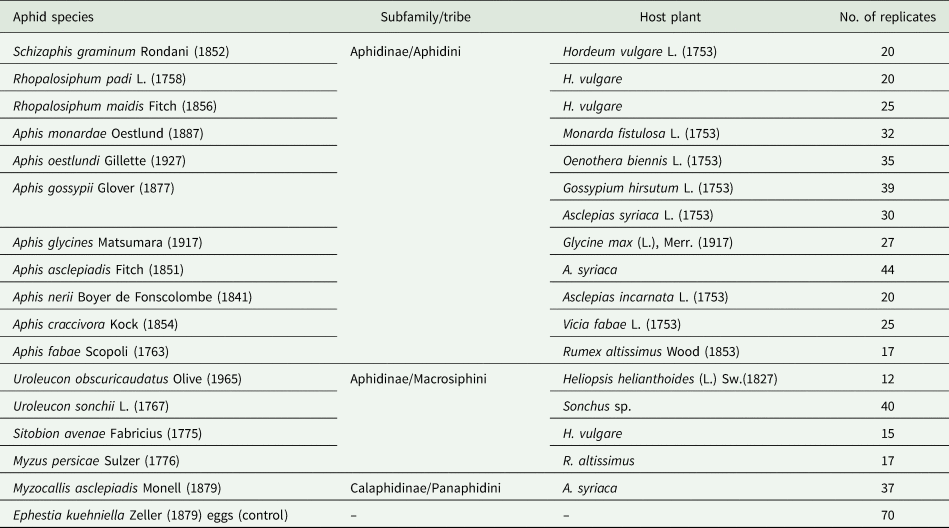
Sixteen aphid species (Hemiptera: Aphididae) (table 1) were tested as prey for Chr. rufilabris larvae. All aphid species were reared in plant growth chambers on their respective host plants at 25°C, 65% RH and 16:8 h L:D. These species were chosen to encompass a wide breadth of aphid taxonomy and contained species in two subfamilies – Aphidinae and Calaphidinae – including members of two aphidine tribes (Aphidini and Macrosiphini). To test the impact of host plant on prey suitability, we compared the survival and performance of Chr. rufilabris fed on the cotton aphid, Aphis gossypii (Glover, 1877) reared on two different host plant species, cotton (Gossypium hirsutum L., 1763) and milkweed (Asclepias syriaca L., 1753), the latter of which produces toxic cardenolides (Martel and Malcolm, Reference Martel and Malcolm2004).
Aphid species and host plants on which they were cultured, and number of replicates

Control replicates included.
Experimental procedure
A plastic Petri dish (9 cm diameter) was lined with filter paper and a young leaf of the host plant was placed inside the dish with a wet cotton pad around its petiole to keep it turgid. This leaf was infested with ad libitum (about 300 individuals) 1st–4th instars of the appropriate aphid species as well as a single newly moulted second instar Chr. rufilabris larva that had been fed previously only on E. kuehniella. The Petri dish was then sealed with Parafilm (Bemis Company Inc., Wisconsin, USA) to maintain humidity and to prevent lacewing larvae or aphids from escaping. Each dish containing a single predator individual and multiple aphid individuals was considered the sampling unit for the experiment and replicated at least 12 times. Lacewing larvae were checked daily for survival and aphids were replenished every other day by adding a new infested leaf. Excess humidity inside the Petri dish was dried with a Kimwipe (Kimberly-Clark Corporation, Wisconsin, USA) if necessary, during daily evaluations. The Petri dish was cleaned and provided with fresh filter paper whenever necessary. Daily observations were made until Chr. rufilabris pupation.
The experiment was carried out in two groups of eight aphids. Every 10 days (the average time until pupation) a new group of eight aphid species was set up with two replicates per group. Aphid species for which more than 50% of larvae died before adulthood after 12 replicates were not used for further replicates. Additional replicates of the more suitable species were obtained until the emergence of ten females to obtain information on egg load (see below). Two control replicates in which 50 mg of frozen E. kuehniella eggs are a food source instead of aphids were established for each block of treatments.
Evaluations
Aphid consumption
We counted the number of aphids killed per Chr. rufilabris larva for a subsample of ten replicates of each aphid-species treatment. We observed larvae killing aphids in a preliminary trial to note the appearance of aphids consumed by Chr. rufilabris for each aphid species. These observations allowed us to recognize aphids that were preyed upon rather than dying of background mortality. Lacewing larvae feed by piercing the prey with both mandibles, injecting salivary secretions into the prey to liquefy the internal tissues, and then extracting the resulting fluid (Canard and Volkovich, Reference Canard, Volkovich, Mcewen, New and Whittington2001). This feeding process makes the attacked prey appear dry and shrivelled. Thus, dried and shrivelled aphids similar to the ones observed in the preliminary trial were considered attacked by Chr. rufilabris. Counting was carried out under a dissecting microscope (40× magnification, Leica Microsystems, Wetzlar, Germany) every 3 days until Chr. rufilabris pupation.
Survival, development time and pupal mass
Chrysoperla rufilabris larvae were checked daily for survival and the durations of three stages (second larval instar, third larval instar and pupa) were recorded. Additionally, pupae were removed from the Petri dish using a fine brush and weighed using an analytical scale (precision 0.1 mg). Only individuals that reached adulthood were considered for analysis of complete development (see below).
Egg load
In order to determine the effect of larval diet on the egg load of adult Chr. rufilabris, ten females that had been offered aphid species supporting at least 35% survivorship to adulthood were placed individually inside plastic vials (2.5 cm diameter, 7 cm height) upon eclosion. These females were provided honey (brushed on the side of the vial) and water (a piece of wet cotton placed in the bottom of the vial). Honey and water were replenished every other day and after 10 days, females were frozen and dissected to count the egg load. Mature eggs (fully yolked and chorionated oocytes) were green and of approximately the same size as deposited eggs, while immature eggs with yolk (yolked oocytes) were also green, but smaller. The sum of mature and immature eggs was used for statistical analyses.
Statistical analyses
The experiment took 225 days and so the data were separated into three blocks comprising 75 days each. The total aphid consumption was fitted using a Generalized Linear Mixed Model (GLMM) with Quasi-Poisson regression with block as a random variable. The effect of aphid species on the proportion of Chr. rufilabris reaching to adulthood was analysed using GLMMs with Binomial regression with block as a random variable (Crawley, Reference Crawley2013). To determine whether the effects of aphid species on lacewing survival were also influenced by aphid consumption, we regressed the per-aphid species survival rate on the average per-day aphid consumption rate using a linear model. Effects of aphid species on the number of days for the 2nd larval instar, 3rd larval instar, pupal stage and the sum of these times were analysed using separate GLMMs, with Poisson regression, with block as a random variable. We also assessed the effect of per-day aphid consumption on these times using linear models. The effect of aphid species on egg load of the adult lacewings (the sum or immature and mature eggs) was also fitted using a GLMM, with Quasi-Poisson regression with block as a random variable. We then performed separate regressions testing the effects of average per-day consumption rates and total development time on the egg load using linear models. Finally, the effect of aphid species on pupal mass was fitted using a linear model with Gaussian error distribution and experimental block included as a factor. We performed residue analyses to assess the appropriateness of models and error distributions for all analyses. Differences among treatments were compared via a posteriori contrast (Crawley, Reference Crawley2013). All statistical analyses were conducted in R (R Development Core Team, 2020).
Phylogenetic analyses
A phylogeny of the 16 aphid species assessed in the study was used to determine whether some of the experimental outcomes showed phylogenetic signal. The phylogeny used for these analyses was pruned from the one presented by Desneux et al. (Reference Desneux, Blahnik, Delebecque and Heimpel2012), although branch lengths are not included in the analyses reported here. Experimental outcomes analysed for aphid phylogenetic signal were: (i) survivorship of Chr. rufilabris from the 2nd instar to the adult stage, (ii) number of aphids consumed by Chr. rufilabris larvae per day, (iii) the development time of Chr. rufilabris larvae and pupae combined, and (iv) the egg load of Chr. rufilabris females. Since not all aphid species contributed to all data sets, the number of aphid species analysed (and therefore the phylogeny) was not the same for all of these analyses. Thus, the test on survivorship and aphid consumption included all 16 aphid species, but the test on development time included 11 species and the test on egg load included only eight. Tests of phylogenetic signal were conducted using the ‘multiPhylosignal’ function module in the R package Picante. This procedure randomizes trait values across the tips of the phylogeny and calculates Blomberg et al.'s (Reference Blomberg, Garland and Ives2003) K statistic as an indicator of conservatism of traits (phylogenetic signal). We ran 10,000 randomizations for each analysis. Ephestia kuehniella was not included in the phylogenetic analyses but it is presented in the figures to facilitate comparison.
Results
Aphid consumption and lacewing survival
All aphid species offered to Chr. rufilabris were accepted as prey, but the total number of aphids consumed differed significantly among species (fig. 1; F 16,155 = 164.058, P < 0.001). The aphid species Aphis monardae (Oestlund, 1887) and Aphis oestlundi (Gillette, 1927) were consumed in highest numbers, followed by A. gossypii (both from cotton and milkweed), Aphis glycines (Matsumara, 1917), Aphis nerii (Boyer de Fonscolombe, 1841), Aphis craccivora (Kock, 1854) and Aphis fabae (Scopoli, 1763). Consumption of Schizaphis graminum (Rondani, 1852), Rhopalosiphum padi (L., 1758), Aphis asclepiadis (Fitch, 1851), Sitobion avenae (Fabricius, 1775), Myzus persicae (Sulzer, 1776) and Myzocallis asclepiadis (Monell, 1879) were intermediate while the lowest consumption was observed for Rhopalosiphum maidis (Fitch 1856), Uroleucon obscuricaudatus (Olive, 1965) and Uroleucon sonchii (L., 1767) (fig. 1). We detected significant phylogenetic clustering for aphid consumption (K = 1.24; P < 0.001). Measuring daily as opposed to lifetime aphid consumption provides almost identical results, with a highly significant linear regression of daily on lifetime consumption indicating across species (F 1 = 7.05, P < 0.0001, r 2 = 0.87) reflecting an overall average of 58.4 ± 6.7 (SEM) aphids consumed per day across species.
Mean number of total aphids consumed by Chrysoperla rufilabris larvae during the second and third instars. Means ± standard error are presented. Different letters indicate statistical differences among treatments (a posteriori contrasts P < 0.05). Phylogeny pruned from the one presented by Desneux et al. (Reference Desneux, Blahnik, Delebecque and Heimpel2012).

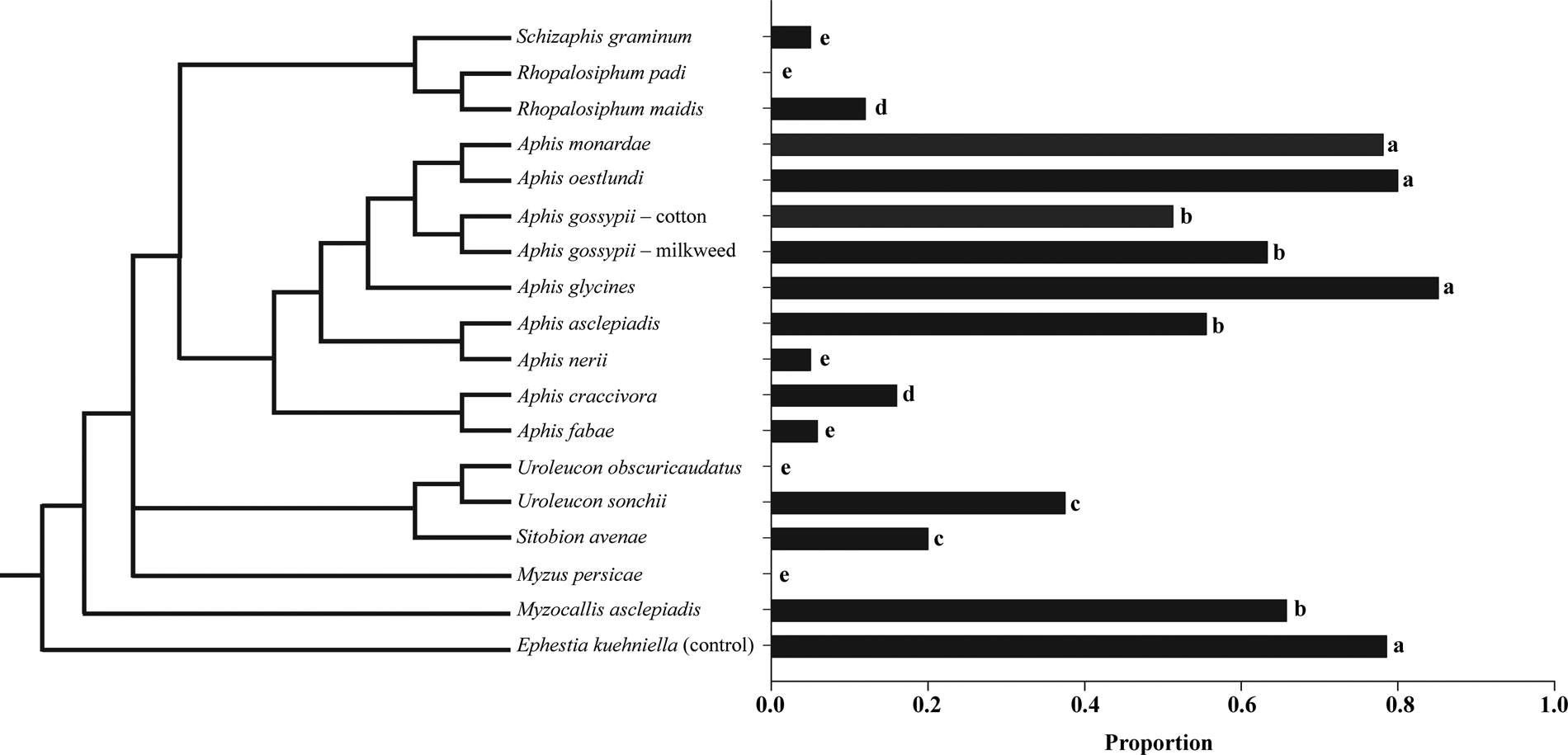
Developmental survival of Chr. rufilabris was significantly affected by the aphid species treatment (X 216,155 = 122.22, P < 0.0001) with the highest survival achieved on the aphids A. glycines, A. oestlundi, A. monardae and E. kuehniella eggs (fig. 2). These three aphid species are closely related (fig. 2). Rhopalosiphum padi, U. obscuricaudatus, Mzu. persicae, S. graminum, A. fabae and A. nerii had the lowest survival proportion, with the three first species named above exhibiting larval survival rates of zero.
Proportion of individuals of Chrysoperla rufilabris larvae provided different aphid species which reached adulthood. Different letters indicate statistical differences among treatments (a posteriori contrasts P < 0.05). Phylogeny pruned from the one presented by Desneux et al. (Reference Desneux, Blahnik, Delebecque and Heimpel2012). Ephestia kuehniella was not included in the phylogenetic analysis but it was included in the statistics and is presented in the figure to facilitate comparison.

Larval-adult survival of the lacewings showed significant clustering on the aphid phylogeny (K = 0.69; P < 0.001; note that E. kuehniella was not included in the phylogenetic analysis but is included in fig. 2 and the contrast analysis to facilitate comparison).
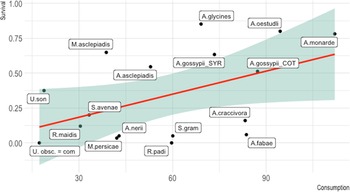
There was a marginally significant positive effect of daily aphid consumption on Chr. rufilabris survival (F 1,15 = 4.53, P = 0.0504, r 2 = 0.232, fig. 3)
Linear regression of survival to adulthood of Chrsysoperla rufilabris on the number of aphids consumed for 16 species of aphids. See text for statistical details.

Development time and pupal mass
Out of the 16 aphid species tested, only 11 allowed for the complete development of Chr. rufilabris from 2nd instar until adult emergence. There were no significant effects of aphid species on development times (2nd instar: X 212,232 = 5.104, P > 0.1; 3rd instar: X 212,232 = 18.279, P > 0.1; pupa: X 212,232 = 4.233; P > 0.1; sum of all three stages: X 212,232 = 8.3716; P < 0.1), and we could detect no significant effect of average daily aphid consumption on development times of any of the three stages (P > 0.30 for all analyses). Overall average development times were 3.33 ± 0.04 days for 2nd instar, 4.20 ± 0.06 days for 3rd instar, 11.89 ± 0.09 days for pupae and 19.42 ± 0.12 days for total development time. We also detected no significant phylogenetic signal of aphid development times of any of the three stages (K = 0.45, 0.65, 0.44 for 2nd instar, 3rd instar and pupa, respectively; P > 0.2 for all three).
Pupal mass of Chr. rufilabris did not differ significantly in association with aphid species consumed (mean = 10.48 ± 0.09 g, F 12,232 = 1.426, P > 0.1) and no phylogenetic clustering was found for pupal mass (K = 0.42; P > 0.05).
Egg load
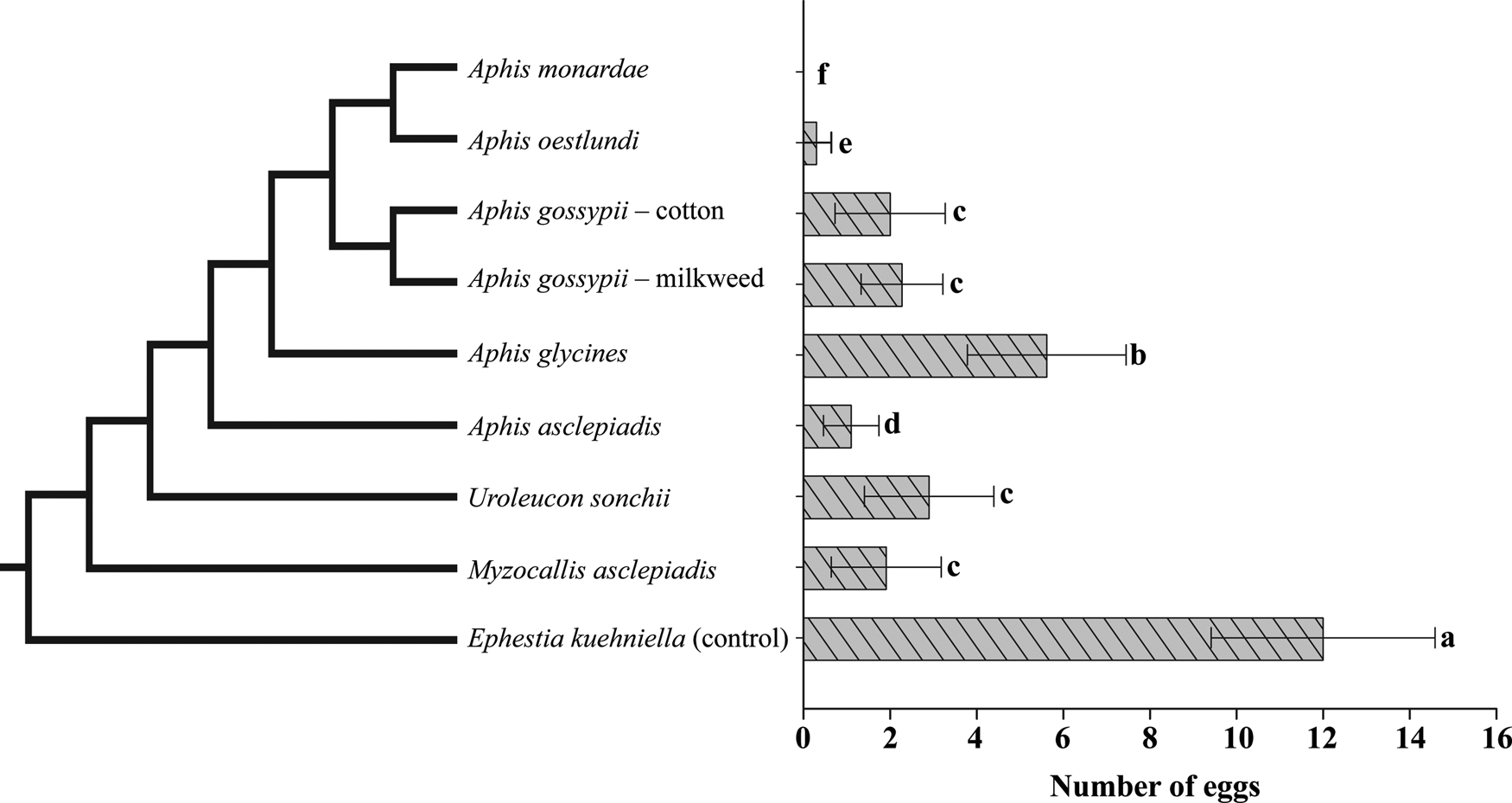
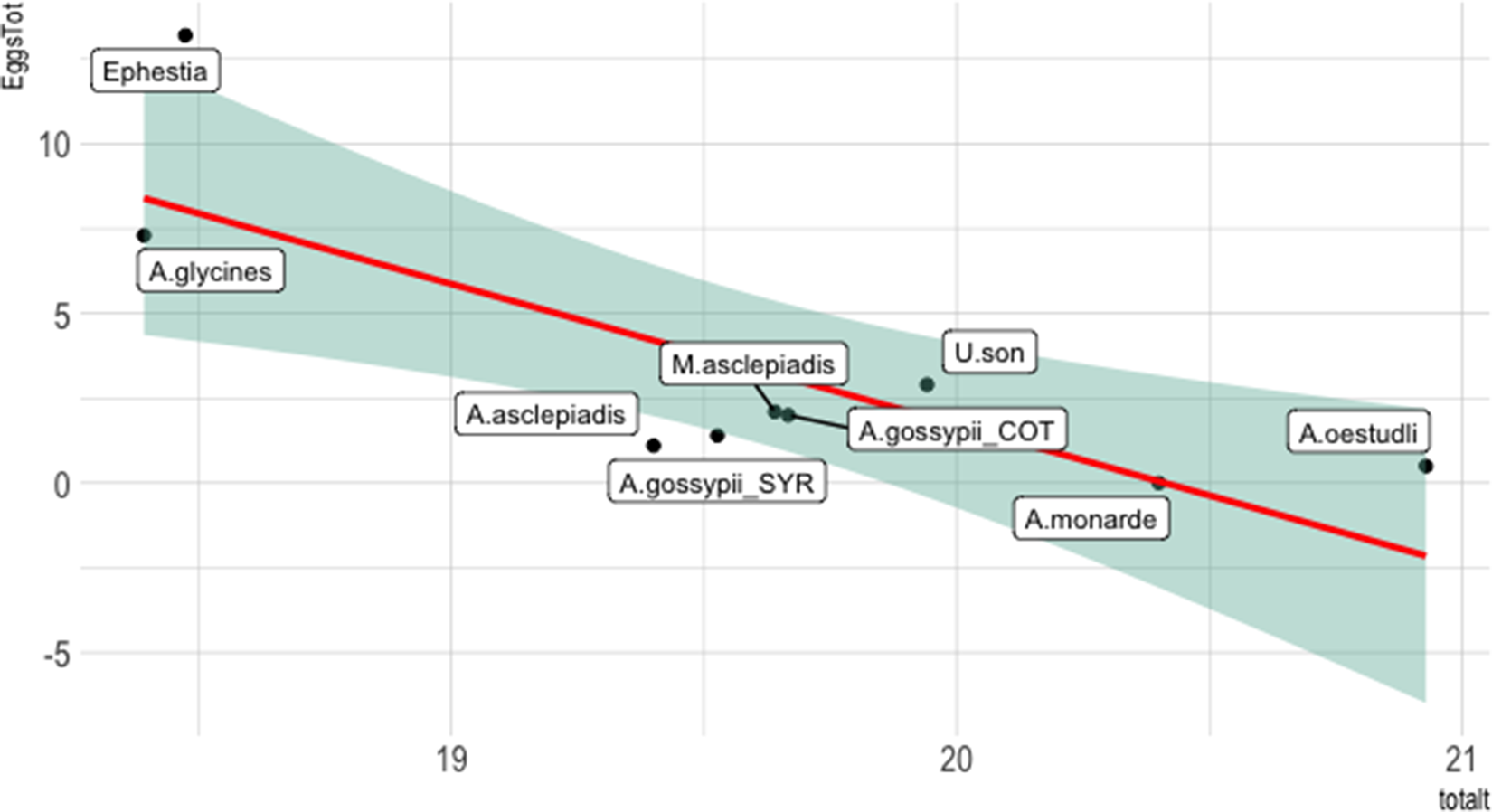
Total egg load (i.e. the sum of immature eggs with yolk and mature eggs) for emerged females was significantly affected by aphid species (fig. 4; F 8,95 = 8.556, P < 0.001) but we detected no significant phylogenetic clustering Chr. rufilabris egg load-associated aphid species (K = 0.43; P > 0.312). The highest egg load was found for Chr. rufilabris females that had fed on E. kuehniella eggs as larvae and for Chr. rufilabris females that had fed on aphids as larvae, the soybean aphid, A. glycines, led to the highest egg loads while A. oestlundi, A. gossypii, A. asclepiadis and U. sonchii led to the lowest egg loads recorded (fig. 4). Chrysoperla rufilabris females that had fed on A. monardae as larvae produced no eggs. While we detected no significant effect of daily aphid consumption on Chr. rufilabris egg load (F 1,6 = 0.720, P = 0.429), there was a significant negative effect of total development time on egg load (F 1,7 = 12.140, P = 0.010; fig. 5).
Mean number of eggs (the sum of yolked immature and mature eggs) counted in the ovaries of dissected females of Chrysoperla rufilabris. Mean ± standard errors are presented. Different letters indicate statistical differences among treatments (a posteriori contrasts P < 0.05). Phylogeny pruned from the one presented by Desneux et al. (Reference Desneux, Blahnik, Delebecque and Heimpel2012). Ephestia kuehniella was not included in the phylogenetic analysis but it was included in the statistical analysis of egg load.

Linear regression of total egg load of Chrsysoperla rufilabris females (mature + immature eggs) on the total immature development time for eight species of aphids. See text for statistical details.

Discussion
Although the green lacewing Chr. rufilabris is considered a generalist aphid predator and can indeed prey on a broad range of aphid species under laboratory conditions, our results demonstrate that the survival and performance of this species is limited by a relatively narrow aphid prey range. As a general pattern, the best survival rates and performance results were observed in association with species in the genus Aphis, which is a narrower prey range than has been reported so far (Legaspi et al., Reference Legaspi, Carruthers and Nordlund1994; Cohen and Smith, Reference Cohen and Smith1998; Tauber et al., Reference Tauber, Tauber, Daane and Hagen2000), but even within Aphis, there were strong and significant differences in performance.
Survival and consumption rates
The highest survival and consumption rates of Chr. rufilabris were achieved when larvae were fed on a clade within Aphis that includes the soybean aphid A. glycines, and the cotton aphid A. gossypii. Outside of this clade, feeding on the milkweed-feeding aphid M. asclepiadis also led to high survival rates. Chen and Liu (Reference Chen and Liu2001) found higher Chr. rufilabris survival and consumption rates for A. gossypii and Mzu. persicae than for Lypaphis erysimi (Kalt., 1843) (Hemiptera: Aphididae). In our study, except for U. sonchii, species that experienced lower consumption rates were also the ones associated with lower larval survival of Chr. rufilabris, such as R. maidis and R. padi. Surprisingly, some species that had been previously considered suitable prey species for Chr. rufilabris and other green lacewing species, such as Mzu. persicae and R. padi (Chen and Liu, Reference Chen and Liu2001; Daane, Reference Daane, Mcewen, New and Whittington2001; Pappas et al., Reference Pappas, Broufas and Koveos2007; Khuhro et al., Reference Khuhro, Chen, Zhang, Zhang and Wang2012) did not support high survival of Chr. rufilabris survival in our study. Chrysoperla rufilabris could not complete its development in five aphid species: A. fabae, A. nerii, Mzu. persicae, R. padi and U. obscuricaudatus. Both A. fabae and A. nerii are known to be inadequate for the development of other lacewing species, so failure to complete larval development was not unexpected (Daane, Reference Daane, Mcewen, New and Whittington2001; Pappas et al., Reference Pappas, Broufas and Koveos2007). In fact, A. fabae and R. padi are considered a poor feeding resource to other aphid predators that have been termed ‘generalists’ such as coccinellid beetles (Rana et al., Reference Rana, Dixon and Jarosik2002; Toft, Reference Toft2005).
Some aphid species can sequester secondary metabolites from their host plants and thus affect the survival and development of their natural enemies (Helms et al., Reference Helms, Connelly and Hunter2004; Desneux et al., Reference Desneux, Barta, Hoelmer, Hopper and Heimpel2009; Erb and Robert, Reference Erb and Robert2016; Mohl et al., Reference Mohl, Stenoien and Heimpel2020; Monticelli et al., Reference Monticelli, Desneux and Heimpel2021). To test this possibility, we evaluated the performance of Chr. rufilabris larvae on A. gossypii reared in cotton and in milkweed; there were no significant differences between the two host plants for larval survival, total aphid consumption, developmental time or egg load. In fact, Chr. rufilabris exhibited high performance on three out of four aphid species reared on milkweed, cardenolide-producing plant species which may be sequestered by some herbivores, including some aphids (Helms et al., Reference Helms, Connelly and Hunter2004; Mooney et al., Reference Mooney, Jones and Agrawal2008; Opitz and Müller, Reference Opitz and Müller2009). However, Chr. rufilabris performance was slightly worse when feeding on aphids reared on milkweed than when compared to when fed on A. glycines. Although some studies have demonstrated that A. asclepiadis and A. gossypii can concentrate plant allelochemicals in their bodies, such as cardenolides and terpenoids (Mooney et al., Reference Mooney, Jones and Agrawal2008; Hagenbucher et al., Reference Hagenbucher, Wäckers and Romeis2014), it seems that such chemicals do not interfere with the palatability or suitability of these species for Chr. rufilabris. Interestingly, for some herbivore species, secondary metabolite sequestration has a role in protecting immature stages from negative effects of host plant chemicals while offering no reduction in mortality caused by natural enemies (Poreddy et al., Reference Poreddy, Mitra, Schöttner, Chandran, Schneider, Baldwin, Kumar and Pandit2015). Our study suggests such a pattern in the case of A. gossypii, A. asclepiadis and M. asclepiadis.
Larval development and egg load
The larval developmental times of Chr. rufilabris were not affected by aphid species consumed. Other studies on green lacewings, such as Dichochrysa prasina (Burmeister, 1839), have found that suitable prey species may increase the survival rates of these predators and promote a shorter preimaginal development compared to nutritionally poor prey species (Canard and Volkovich, Reference Canard, Volkovich, Mcewen, New and Whittington2001; Pappas et al., Reference Pappas, Broufas and Koveos2007). Surprisingly, we found no such pattern in our study.
Finally, of all 16 aphid species tested, only seven could be assessed for egg load, based on their survival rates. Five of those species were in the genus Aphis and closely related to A. glycines, the species that provided for the highest egg load in Chr. rufilabris. It is worth mentioning though that female Chr. rufilabris that fed on E. kuehniella eggs as larvae presented the highest egg loads recorded in this study, indicating that food sources other than aphids can be highly nutritious.
Prey phylogeny and its implications
Information on prey phylogeny has been used in several studies as a tool to understand and predict predator–prey interactions and food webs for generalist predators in different ecosystems (Gordon and Weirauch, Reference Gordon and Weirauch2016; Goodheart et al., Reference Goodheart, Bazinet, Valdés, Collins and Cummings2017; Brousseau et al., Reference Brousseau, Gravel and Handa2018). Including phylogeny in predator–prey studies can help, for instance, to understand how fitness cost in generalist species may be more related to taxonomic range than to the number of hosts/prey species avalilable (Straub et al., Reference Straub, Ives and Gratton2011) or to predict possible food web interactions that may drive species distribution and ecological processes (Brousseau et al., Reference Brousseau, Gravel and Handa2018).
Our significant results of phylogenetic signal for survival, aphid consumption and egg load with the clustering on the genus Aphis indicate that Chr. rufilabris have a more restricted diet than was previously assumed (Cohen and Smith, Reference Cohen and Smith1998; Legaspi et al., Reference Legaspi, Carruthers and Nordlund1994; Tauber et al., Reference Tauber, Tauber, Daane and Hagen2000). Closely related species are presumed to share characters that can make them suitable for a given consumer, being an indication of a certain level of specialization. In fact, it is expected that specialists feed on closely related species, while generalists feed on more distantly related ones (Futuyma and Moreno, Reference Futuyma and Moreno1988; Bulgarella and Heimpel, Reference Bulgarella and Heimpel2015; Eklof and Stouffer, Reference Eklof and Stouffer2016; Brousseau et al., Reference Brousseau, Gravel and Handa2018; Monticelli et al., Reference Monticelli, Le Thu Ha, Amiens-Desneux, Luo, Lavoir, Gatti and Desneux2019; Abram et al., Reference Abram, Labbe and Mason2021; Heimpel et al., Reference Heimpel, Abram and Brodeur2021).
Although Chr. rufilabris fed on all aphid species tested, development could not be completed on all of those species, which limits the extent to which a broad prey range can benefit this green lacewing species. Such a finding can be important to help understand the interaction of this species in agroecological food webs, where it is commonly found, and provides insights into why natural or conservation biological control may succeed or fail. For instance, although Chr. rufilabris may be present in a crop, it might not be able to prevent or suppress outbreaks of S. avenae, S. graminum, R. maidis or A. craccivora, even if farmers take measures to benefit Chr. rufilabris populations such as increasing vegetational diversity. From this standpoint, our findings are also relevant for planning the use of this green lacewing species in biological control programmes, especially those based on augmentative releases. Insectaries usually market Chr. rufilabris as biological control agents against aphids in general without regard to the species that may be present at the crop/home garden. As we demonstrate in this study, aphid consumption by Chr. rufilabris varies according to the aphid species and thus the success of releases will vary depending on the target species.
Acknowledgements
We thank Jonathan Dregni for help in rearing aphids, and the following organization for funding assistance: the Coordenação de Aperfeiçoamento de Pessoal de Nível Superior (CAPES) in Brazil, Conselho Nacional de Desenvolvimento Científico e Tecnológico (CNPq) in Brazil, Fundação de Amparo a Pequisa do Estado de Minas Gerais (FAPEMIG) in Brazil, and Minnesota Agricultural Experiment Station in the United States.
Conflict of interest
None.