Introduction
Otitis media with effusion (OME) is defined as fluid accumulation in the middle-ear mucosa due to inflammation, but without signs or symptoms of acute infection.Reference Casselbrant, Brostoff and Cantekin1 However, OME remains an important health issue and one of the leading causes of hearing loss in children. Between 35 per cent and 70 per cent of pre-school children experience at least one episode of OME.Reference Casselbrant, Brostoff and Cantekin1, Reference Birch and Elbrønd2
Otitis media with effusion is distinct from acute otitis media. Acute otitis media is characterised by the acute onset of signs and symptoms of middle-ear inflammation, such as ear pain and fever. In contrast, OME is frequently associated with recurrent acute otitis media and often follows an episode of acute otitis media.Reference Minovi and Dazert3 From a medical perspective, OME is a severe disease that can cause hearing loss. From a socio-economic perspective, hearing loss may lead to difficulties in the child's education and social life, in addition to costing the family in both time and financial resources.Reference Hizalan and Basut4
Long-lasting middle-ear effusion decreases both tympanic membrane mobility and sound conduction. This can lead to a hearing loss of 15–40 dB. Hearing loss caused by recurrent middle-ear effusion may result in speech and language impairment, which may consequently decrease the quality of the child's social life.Reference Cantekin, Bluestone, Fria, Stool, Beery and Sabo5
Any decrease in tympanic membrane mobility should be confirmed by pneumatic otoscopy and tympanography. Pneumatic otoscopy has a sensitivity of 94 per cent and a specificity of 74–78 per cent in experienced hands.Reference Toner and Mains6, Reference Vaughan-Jones and Mills7 For equivocal physical examination findings, current clinical guidelines recommend either 226-Hz tympanometry or acoustic reflectometry as an adjunct to pneumatic otoscopy. Tympanometry with a standard 226-Hz probe tone is reliable in infants aged 4 months or older and shows good inter-observer agreement in routine clinical practice. Younger infants require specialised equipment with a higher probe tone frequency.Reference Rosenfeld, Culpepper, Doyle, Grundfast, Hoberman and Kenna8, Reference Margolis, Hunter and Giebink9
Wideband immittance testing was developed to evaluate the external ear-canal and middle-ear function using wideband frequencies. Wideband immittance (which includes absorbance and acoustic admittance) is measured at the external ear canal and enables analysis of the acoustic transfer functions of the ear canal and middle ear. Wideband acoustic absorbance values range from 0 to 100, where 0 represents the whole energy being reflected back to the microphone and 100 represents the whole energy being absorbed by the middle ear. Advantages of wideband acoustic absorbance include short duration, a continuous broad frequency response between 0.25 and 8 kHz, the option to measure pressurised or ambient responses, and the ability to measure reflectance independent of changes in ear-canal pressure.Reference Liu, Sanford, Ellison, Fitzpatrick, Gorga and Keefe10, Reference Hunter, Tubaugh, Jackson and Propes11 Several studies have reported that wideband immittance is more sensitive to middle-ear dysfunction compared with 226-Hz tympanometry.Reference Beers, Shahnaz, Westerberg and Kozak12–Reference Ellison, Gorga, Cohn, Fitzpatrick, Sanford and Keefe17
There are two brands of wideband acoustic absorbance equipment: the Middle-Ear Power Analyzer (Hear ID; Mimosa Acoustic, Champaign, Illinois, USA), which works at 0.2–6 kHz; and the Titan test platform (Interacoustics, Assens, Denmark), which works at 0.226–8 kHz.
This study aimed to evaluate the diagnostic value of wideband acoustic absorbance in OME diagnosis compared with classical 226-Hz tympanometry, and to determine useful threshold values.
Materials and methods
Patient recruitment
This study was approved by the local research ethics committee. After obtaining written informed consent, otitis media with effusion (OME) patients scheduled for operation were included in this study. Surgical criteria included a history of recurrent acute otitis media, persistent OME (no recovery within four months after diagnosis) or hearing loss, or a learning, speech or behavioural abnormality. Children with a history of previous ventilation tube surgery, congenital hearing loss or syndromes causing hearing loss were excluded.
Study groups
Patients who had been diagnosed with otitis media and had undergone pre-operative tympanometry and wideband acoustic absorbance testing were divided into two study groups. The OME group comprised 68 ears of 44 patients who showed middle-ear effusion during surgery and were treated by both myringotomy and ventilation tube insertion. The otitis media group comprised 44 ears of 28 patients who had no signs of middle-ear effusion during surgery and were treated by myringotomy only.
Some patients had undergone myringotomy to both ears and some to only a single ear because only ears which were suspected of having chronic effusion were myringotomised. However, not all myringotomised ears showed effusion. Consequently, myringotomised ears which showed effusion were included in the OME group; those which did not show effusion were included in the otitis media group.
Control group
Control patients presented to our clinic with no ear or hearing complaints. This group comprised 60 ears of 34 healthy volunteers who showed normal transient-evoked otoacoustic emission and tympanometric peak pressure values, with normal otoscopic findings for the external and middle ear at examination by an otolaryngologist. Some participants in the control group underwent wideband acoustic absorbance testing of their second ear. Therefore, there were only 60 control ears for 34 volunteers.
Tympanometry and wideband acoustic absorbance analysis
Wideband acoustic absorbance and 226-Hz tympanometry were performed by a certified audiologist using the Titan instrument platform (Interacoustics). A probe suitable for the patient's age and external ear canal size was used, and a 90 ± 3 dB sound pressure stimulus was applied. Absorbance rates of 0.25–8 kHz, ambient pressure and maximal absorbance rates were measured. The 0.375–2 kHz averaged mean absorbance was calculated. Data were recorded using Otoaccess version 1.2.1 software (Interacoustics).
Statistical analysis
Statistical analysis was performed using IBM SPSS software version 15.0 (Chicago, Illinois, USA). The absorbance rates were not normally distributed; therefore, the Kruskal–Wallis test was used for inter-group comparisons. The Mann–Whitney U test was used to test the significance of pairwise differences, using Bonferroni correction to adjust for multiple comparisons.
The diagnostic value of absorbance testing was analysed using the receiver operating characteristic test. The area under the receiver operating characteristic curve was used to summarise statistical data to quantify test accuracy; a p value less than 0.05 was considered statistically significant. Area under the receiver operating characteristic curve values ranged between 0.5 and 1: values close to 1 represent a good correlation; and values around 0.5 or below represent a poor relationship. Receiver operating characteristic analysis was used to calculate the cut-off points by likelihood ratios. Where a significant cut-off value was observed, the sensitivity, specificity, and positive and negative predictive values are presented with 95 per cent confidence intervals.
Results
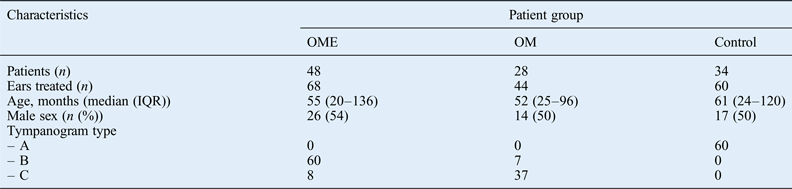
Patient demographics such as age, sex and tympanogram type are shown in Table I. Groups did not differ significantly in terms of age or sex (p > 0.05). Most ears with a type B tympanogram had middle-ear effusion (60 out of 68 ears; 88 per cent), whereas most ears with a type C tympanogram had no effusion (37 out of 44 ears; 84 per cent). All ears with a type A tympanogram were in the control group. The 226-Hz tympanogram had 88.2 per cent sensitivity, 84 per cent specificity, an 89 per cent positive predictive value and an 82 per cent negative predictive value.
Demographic characteristics of patient groups*

* Groups did not significantly differ regarding age or sex. OME = otitis media with effusion; OM = otitis media (no effusion); IQR = interquartile range
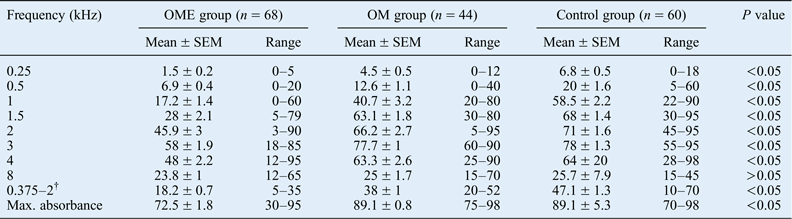
Table II summarises the mean wideband acoustic absorbance rates of all groups. The mean wideband acoustic absorbance rates differed significantly at between 0.25 and 4 kHz (p < 0.05), but were similar for all groups at 8 kHz. The otitis media with effusion (OME) group showed significantly lower absorbance at all measured frequencies and significantly lower 0.375–2 kHz averaged mean absorbance values compared with the otitis media and control groups (p < 0.017 and p < 0.001, respectively). The otitis media group had significantly lower absorbance at 0.5, 1 and 1.5 kHz and a significantly lower 0.375–2 kHz averaged mean compared with the control group (p < 0.017). Regarding the mean absorbance rates, Figure 1 shows that the OME group clearly differs from the other groups, and that the otitis media and control groups are similar. Notably, a small but significant difference was seen between the otitis media and control groups in the 0.375–2 kHz region. Figure 2 shows a typical three-dimensional wideband acoustic absorbance graph for an ear with effusion.
Graph showing the mean absorbance rates for all three patient groups. * = otitis media with effusion; ** = otitis media
Graph showing typical three-dimensional wideband acoustic absorbance data for an ear with effusion.
Wideband acoustic absorbance rates for all patient groups*
* 0 = worst; 100 = best. †Averaged mean. OME = otitis media with effusion; OM = otitis media (no effusion); Max. = maximum
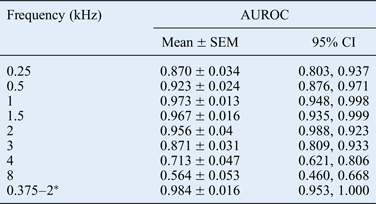
Table III summarises the area under the receiver operating characteristic curve values; the distinction between the OME and control groups is shown. The area under the receiver operating characteristic curve value obtained from the 0.375–2 kHz averaged mean absorbance had the highest diagnostic value (0.984), followed by those obtained at 1 and 1.5 kHz (0.973 and 0.967, respectively). The diagnostic value decreased sharply at 2 kHz and for the higher frequencies.
Comparison of ome and control group data
Statistical data were obtained from the receiver operator analysis of the absorbance rates between 0.25 and 8 kHz. *Averaged mean. OME = otitis media with effusion; AUROC = area under the receiver operating characteristic curve; SEM = standard error of the mean; CI = confidence interval
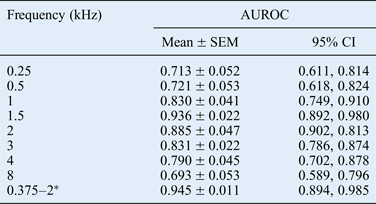
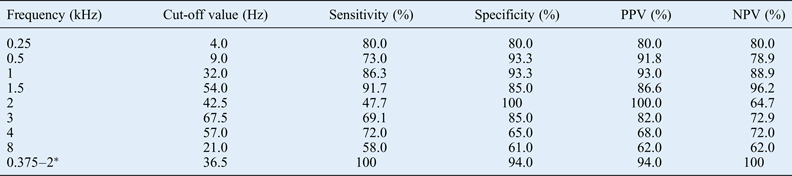
Table IV summarises the area under the receiver operating characteristic curve values; the distinction between the OME and otitis media groups is shown. The area under the receiver operating characteristic curve value obtained for the 0.375–2 kHz averaged mean absorbance has the highest diagnostic value (0.945), followed by that obtained at 1.5 kHz (0.936). The optimal threshold was found by measuring the closest distance from the ideal point on the receiver operating characteristic analysis of absorbance at 0.25–8 kHz. The cut-off value, sensitivity, specificity, and positive and negative predictive values for each frequency are shown in Table V. The 0.375–2 kHz averaged mean absorbance with a cut-off point of 36.5 Hz showed 100 per cent sensitivity and 94 per cent specificity.
Comparison of ome and om group data
Statistical data were obtained from the receiver operator analysis of the absorbance rates between 0.25 and 8 kHz. *Averaged mean. OME = otitis media with effusion; OM = otitis media; AUROC = area under the receiver operating characteristic curve; SEM = standard error of the mean; CI = confidence interval
Performance values for wideband acoustic absorbance testing
*Averaged mean. PPV = positive predictive value; NPV = negative predictive value
Discussion
The ability of wideband acoustic absorbance to differentiate between normal paediatric middle ears, middle ears with otitis media with no effusion and middle ears with effusion proven by myringotomy was assessed. The best diagnosis was obtained by calculating the 0.375–2 kHz averaged mean absorbance value: this method had 100 per cent sensitivity and 94 per cent specificity.
No single diagnostic test has 100 per cent sensitivity and specificity for diagnosing otitis media with effusion (OME). Clinical guidelines state that the best diagnostic test for OME is pneumatic otoscopy.Reference Rosenfeld, Culpepper, Doyle, Grundfast, Hoberman and Kenna8 In a meta-analysis, Takata et al. systematically reviewed the sensitivity, specificity, and predictive values of nine OME diagnostic methods. They reported that pneumatic otoscopy had the best balance of sensitivity and specificity, with a pooled sensitivity of 94 per cent and specificity of 80 per cent for validated observers using pneumatic otoscopy alone vs myringotomy.Reference Takata, Chan, Morphew, Mangione-Smith, Morton and Shekelle18 Gates et al. reported that combined pneumatic otoscopy and classical tympanometry was 97 per cent sensitive and more than 90 per cent specific in OME diagnosis.Reference Gates, Avery, Cooper, Hearne and Holt19 However, we do not favour pneumatic otoscopy owing to its subjective nature. In addition, wideband acoustic absorbance seems to be as sensitive and specific as pneumatic otoscopy, and is an objective test that can be performed very quickly.
Another tool used for OME diagnosis is conventional 226-Hz tympanometry. Clinical guidelines state that if the results of pneumatic otoscopy are dubious, then 226-Hz tympanometry may be also used.Reference Rosenfeld, Culpepper, Doyle, Grundfast, Hoberman and Kenna8 Single-frequency 226-Hz tympanometry has been used for many years as a simple, reliable tool for evaluating middle-ear function. However, it uses a single frequency and cannot therefore detect subtle changes in middle-ear mechanics.Reference Margolis, Hunter and Giebink9 Different investigators have reported 226-Hz tympanography to have 70–90 per cent sensitivity and 80–90 per cent specificity.Reference Watters, Jones and Freeland20, Reference Williams and Haughton21 We similarly found wideband acoustic absorbance to have 88.2 per cent sensitivity and 84 per cent specificity. The absorbance at 1 and 1.5 kHz and the 0.375–2 kHz averaged mean value were much better at distinguishing middle-ear effusion compared with conventional 226-Hz tympanometry. The test could also be used to evaluate the middle ear within a broad frequency range (0.25–8 kHz).
Wideband acoustic absorbance is a diagnostic test which has become popular in recent years owing to its ability to evaluate middle-ear function in the 0.25–8 kHz range. Keefe et al. compared absorbances at 0.25 and 8 kHz at ambient pressure with the same measurement obtained using sweep tympanography.Reference Keefe, Sanford, Ellison, Fitzpatrick and Gorga16 They found no significant difference at either pressure. As we could not measure the peak tympanometric pressure in most middle-ear effusion patients, we decided to conduct the measurements at ambient pressure.
Many studies have investigated the efficiency of wideband immittance in patients with normal and impaired ears from several age groups.Reference Feeney, Grant and Marryott15, Reference Voss and Allen22–Reference Shahnaz, Bork, Polka, Longridge, Bell and Westerberg27 Most used a computer, a 24-bit soundcard and a pressure pump to obtain reflectance measurements. We tested the performance of wideband acoustic absorbance by measuring frequency-specific absorbance rates.
The accuracy of wideband immittance measurements in OME patients has been investigated previously. In 2010, Beers et al. compared the reflectance measurements of 64 children (mean age 6.3 years; 30 ears with mildly negative middle-ear pressure, 24 with severely negative middle-ear pressure and 42 with middle-ear effusion) with those of 144 ears of 78 children with no middle-ear disease (mean age 6.1 years).Reference Beers, Shahnaz, Westerberg and Kozak12 They reported that reflectance inversely correlated with middle-ear pressure. The area under the receiver operating characteristic curve was 0.9 for the 0.8–5 kHz range, and the highest area under the receiver operating characteristic curve reported was 0.97 in the 1–1.6 kHz range. They obtained the best result at 1.25 kHz: 96 per cent sensitivity and 95 per cent specificity at an absorbance rate cut-off value of 71.7 per cent. They suggested that reflectance was a significantly better test than traditional 226-Hz tympanometry for distinguishing between an OME and a normal middle ear.
In 2012, Ellison et al. compared the efficacy of wideband acoustic transfer functions (including ambient pressure absorbance, admittance magnitude and phase measurements) in OME diagnosis by pneumatic otoscopy and classic tympanography.Reference Ellison, Gorga, Cohn, Fitzpatrick, Sanford and Keefe17 The median age of their patient population was 1.3 years: 53 ears diagnosed with OME using myringotomy were compared with 59 age-matched healthy ears. They found the absorbance rate to be lower in ears with OME; it had an area under the receiver operating characteristic curve value of 0.93 for diagnosing effusion. Moreover, the most sensitive frequencies were suggested to be between 0.8 and 2 kHz. They reported that wideband acoustic transfer functions testing is more accurate than pneumatic otoscopy.
The results of this study were similar: the best area under the receiver operating characteristic curve values were obtained at 1 and 1.5 kHz (0.97 and 0.96, respectively). However, averaging the mean absorbance rates at frequencies between 0.375 and 2 kHz (area under the receiver operating characteristic curve 0.98) was found to yield the best correlation with the presence of effusion. This method also identified the presence or absence of effusion in abnormal middle ears of patients who underwent myringotomy.
• Wideband acoustic absorbance measurement is an accurate method of otitis media with effusion diagnosis
• It may be a useful adjunct to classical tympanometry
• Its best overall performance was obtained using 0.375–2 kHz averaged mean absorbance values
• It can rapidly evaluate middle-ear function over a wide frequency range
Shaver and Sun investigated the effect of middle-ear pressure on the acoustic absorbance rate and reported that the presence of negative middle-ear pressure increases the reflectance ratio from low frequencies up to 3 kHz and decreases the reflectance in the 4–6 kHz range.Reference Shaver and Sun28 We did not study a homogenous group of ears with negative middle-ear pressure; however, middle-ear pressure was significantly lower in the otitis media group than in the control group, although the acoustic absorbance rates of the otitis media group were lower than in the control group and higher than in the OME group.
Our main finding is that the 0.375–2 kHz averaged mean absorbance rate obtained by measuring wideband acoustic absorbance may identify the presence of middle-ear effusion. The main limitations of our study are the absence of different age groups and different middle-ear pressure conditions such as tympanosclerosis or conductive hearing loss.
Conclusion
An accurate, practical diagnostic tool is needed for otitis media with effusion (OME). The ideal test should be objective, reliable and practical. It should be able to accurately determine middle-ear function in both impaired and healthy ears. Wideband acoustic absorbance is an additional tool for diagnosing middle-ear effusion with the following advantages: it is non-invasive and quick, and can measure pressure values between –400 and +200 daPa, evaluate middle-ear function over a wide frequency range, and show frequency-specific absorbance and tympanometry waves. The capability of wideband acoustic absorbance to diagnose OME was similar to that of classical tympanometry. Therefore, wideband acoustic absorbance may be a useful adjunct to tympanometry for diagnosing OME. However, cut-off and normative values for wideband acoustic absorbance do not currently exist. Therefore, it should be tested more widely to assess its potential for clinical use. The best cut-off values should be investigated in a wide range of aetiologies such as cholesteatoma, ossicular erosion and ossicular fixation, and in patients of all ages.