Introduction
Violent behavior associated with mental disorders is a common reason for admission to a psychiatric inpatient unit. Once hospitalized, patients may continue to be intermittently agitated and have persistent aggressive behaviors, preventing their discharge back into the community.
The pharmacological management of agitated, aggressive, and violent behavior can be conceptualized as having 2 parts: acute and preventative. Acute treatment options are plentiful and generally efficacious. Preventative treatment aims to decrease the frequency and intensity of future acute episodes of agitated, aggressive, and violent behavior, and although effective therapeutic options do exist, they are far from being “one size fits all,” and are highly dependent on the root causes of the dangerous behaviors. With few exceptions, most of the clinically relevant research in the longer-term management of violence has been conducted in psychotic individuals with schizophrenia.
Definitions and Scales
Agitation (excessive motor or verbal activity) can further escalate into aggressive behavior. Agitation can be associated with a number of conditions, including schizophrenia and bipolar disorder. Acute agitation in its severest forms is a medical emergency that requires immediate intervention to alleviate personal distress and to prevent harm to the individual and/or others.
Specific rating scales have been developed to measure agitation, such as the single-item Behavioral Activity Rating Scale (BARS).Reference Swift, Harrigan, Cappelleri, Kramer and Chandler 1 Also commonly used in the development of anti-agitation agents is the Positive and Negative Syndrome Scale (PANSS) Excited Component (EC), or “PEC,” which consists of the 5 PANSS items considered relevant in this regard: excitement, hostility, tension, uncooperativeness, and poor impulse control.Reference Lindenmayer, Brown and Baker 2 The PEC and BARS have been successfully used as the primary outcome measures to garner regulatory approval for several agents for the indication of agitation associated with schizophrenia and/or bipolar mania.
Aggressive behaviors can be verbal, against objects, against self, or against other persons. Physical aggression against other persons is frequently called violence. Aggressive behaviors have been assessed in research using questionnaires such as the Overt Aggression Scale (OAS).Reference Yudofsky, Silver, Jackson, Endicott and Williams 3 In clinical settings with acutely ill psychiatric patients, the Brøset Violence Checklist (BVC) can be used to predict in-patient violence in the short-termReference Björkdahl, Olsson and Palmstierna 4 ; this instrument assesses the presence or absence of behaviors or states frequently observed before a violent incident, including confusion/disorientation, irritability, and threats. The goal of longer-term treatment is to minimize the future occurrence of aggressive behaviors. There are no agents specifically approved for aggression or violence per se. However, there is a substantial body of research examining these longer-term treatment options.
Of special note, the PANSS item of “hostility” is also used to measure effect of interventions over time but is loosely defined as “verbal and nonverbal expressions of anger and resentment, including sarcasm, passive-aggressive behavior, verbal abuse, and assaultiveness.”Reference Kay, Opler and Fiszbein 5 Rated on a scale of 1 (absent) to 7 (extreme), mild hostility (a rating of 3) is defined as follows: “The patient shows indirect or restrained communication of anger, such as sarcasm, disrespect, hostile expressions and occasional irritability.” More serious behaviors are not captured until the higher end of the scale.
Agitation
In addition to the early offering of medications, acute interventions that target agitation ordinarily also involve environmental and behavioral approaches, discussed elsewhere.Reference Citrome and Green 6 Goals include calming the agitated patient as rapidly as possible, decreasing the likelihood of harm to self or others, allowing the taking place of diagnostic tests and procedures, attenuating psychosis, and decreasing the need for seclusion or restraint (a time where staff and patient injury can occur). The induction of sleep is not desirable when evaluating a patient; sedation that necessitates constant observation and assistance in toileting places an excessive burden on staff time.Reference Citrome 7
Diagnostic considerations center on ruling out somatic causes of the change in mental status; somatic causes may preclude the use of antipsychotic medication. An example would be acute withdrawal from alcohol or benzodiazepines where the preferred medication intervention would be a benzodiazepine such as lorazepam. This is not a trivial consideration, as it is estimated that approximately half of all patients with schizophrenia have a comorbid drug or alcohol abuse problem.Reference Regier, Farmer and Rae 8 More unusual, but problematic, would be the presence of an underlying metabolic, toxic, or infectious process resulting in agitated behavior in a person otherwise well-known to the provider as a person with a chronic psychotic disorder.
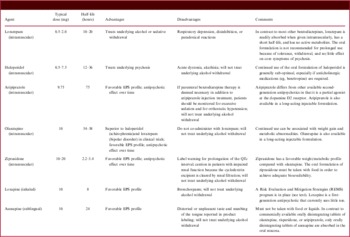
Medication approaches usually involve drugs and formulations that have a rapid onset of action. This usually means that the therapeutic agent has a short Tmax and high Cmax; this often, but not always, requires parenteral administration. Interventions that have a high response rate for inducing calm without oversedation or other problematic adverse effects are desirable. Interventions that are easy to use, and for which clinicians have experience with, are often reached for first—even though patient acceptability may not be optimal. Commonly used in emergency departments to treat acute agitation are the intramuscular (IM) formulations of haloperidol or lorazepam, or the combination of both agents, often in the same syringe. This combination may be more efficacious and faster-acting than haloperidol or lorazepam alone, and may be associated with fewer problems with extrapyramidal symptoms and akathisia than haloperidol alone.Reference Battaglia, Moss and Rush 9 However it is unlikely that this regimen would be used as a long-term treatment option, given the availability of better tolerated second-generation antipsychotics. Moreover, it is not desirable to chronically administer benzodiazepines because of problems of physiological tolerance, risk of withdrawal, and no or little effect on the core symptoms of psychosis.Reference Citrome 7 Table 1 provides an outline of additional considerations for haloperidol and lorazepam, and for the alternative agents discussed below.
Psychopharmacology of acute agitation—current options

The second-generation antipsychotics ziprasidone, olanzapine, and aripiprazole are available in short-acting intramuscular formulations. They are U.S. Food and Drug Administration (FDA)-approved for the indication of agitation associated with schizophrenia (all 3) and agitation associated with bipolar mania (olanzapine and aripiprazole). Akathisia and dystonia can be avoided by using these agents rather than haloperidol, and all 3 agents allow for smooth transition to long-term oral therapy, as tested in IM-to-oral transition studies.Reference Brook, Lucey and Gunn 10 – Reference Andrezina, Marcus and Oren 14
Ziprasidone IM
There are 2 pivotal studies, each comparing a therapeutic dose of ziprasidone vs. 2 mg.Reference Lesem, Zajecka, Swift, Reeves and Harrigan 15 , Reference Daniel, Potkin, Reeves, Swift and Harrigan 16 There appears to be a dose response with 20 mg IM being superior to 10 mg IM, as measured by change in BARS scores,Reference Citrome 17 where the number needed to treat (NNT) for response vs 2 mg at 2 hours after injection was 4 for 10 mg and 2 for 20 mg.NNT for response for the pooled doses (10 mg and 20 mg) was 3. Somnolence, nausea, and dizziness were more common with 20 mg than with 10 mg or placebo. 18
Olanzapine IM
The short-acting IM formulation was evaluated in 4 randomized, double-blind placebo and active comparator studies in patients with schizophrenia,Reference Wright, Birkett and David 19 , Reference Breier, Meehan and Birkett 20 bipolar mania,Reference Meehan, Zhang and David 21 and dementiaReference Meehan, Wang and David 22 (not FDA-approved for this indication). Superior onset of efficacy to haloperidol IM and lorazepam IM was observed with no adverse event significantly more frequent for IM olanzapine vs IM haloperidol or IM lorazepam. The optimal dose is 10 mg (2.5 to 5.0 mg for vulnerable patients, eg, elderly). NNT for response vs placebo as measured by the PEC at 2 hours after injection is 3.Reference Citrome 17
Aripiprazole IM
The short-acting IM formulation was evaluated in 4 randomized, double-blind placebo and active comparator studies in schizophrenia,Reference Andrezina, Josiassen and Marcus 23 , Reference Tran-Johnson, Sack and Marcus 24 bipolar mania,Reference Zimbroff, Marcus and Manos 25 and dementiaReference Rappaport, Marcus, Manos, McQuade and Oren 26 (not FDA-approved for this indication). The optimal dose is 9.75 mg (5.25 mg for vulnerable patients, eg, elderly). The NNT for response vs placebo as measured by the PEC at 2 hours after injection is 5, which although is not as favorable as for ziprasidone (NNT 3) or olanzapine (NNT 3), is similar to that observed with haloperidol IM or lorazepam IM from pooled data (NNT 4), with 95% confidence intervals that overlap.Reference Citrome 17
Inhaled loxapine
This product received approval in 2013 for the acute treatment of agitation associated with schizophrenia or bipolar I disorder in adults. Inhaled loxapine was evaluated in 3 double-blind, placebo-controlled, randomized trials in patients with schizophreniaReference Allen, Feifel and Lesem 27 , Reference Lesem, Tran-Johnson and Riesenberg 28 and bipolar mania.Reference Kwentus, Riesenberg and Marandi 29 It is the first nonparenteral agent approved for such a purpose, and potentially represents a less intrusive and stigmatizing means of delivering an anti-agitation agent. The optimal dose is 10 mg. Efficacy was noted as early as 10 minutes post-administration, which was the earliest time point measured. NNT for response for 10 mg vs placebo at 2 hours after administration as measured by the PEC in the Phase III studies was 4 for patients with schizophrenia and 3 for patients with bipolar mania.Reference Citrome 30 , Reference Citrome 31 In the U.S., the recommended dose is 10 mg with only a single dose within a 24-hour period permitted. At the present time, inhaled loxapine can be administered only by a healthcare professional in an enrolled healthcare facility. Because of the risk of bronchospasm, a Risk Evaluation and Mitigation Strategies (REMS) program is in place, and prior to administering inhaled loxapine, patients must be screened for a history of pulmonary disease and examined by chest auscultation for respiratory abnormalities such as wheezing. After administration, patients are required to be monitored for signs and symptoms of bronchospasm at least every 15 minutes for at least 1 hour.
Sublingual asenapine
Asenapine is a second-generation antipsychotic indicated for the treatment of schizophrenia, and for the acute treatment of manic or mixed episodes associated with bipolar I disorder. 32 The only available formulation of asenapine is as an orally disintegrating tablet. In contrast to the orally disintegrating tablets of olanzapine, risperidone, and aripiprazole, asenapine is administered sublingually and is absorbed in the oral mucosa, bypassing first-pass metabolism.Reference Citrome 33 In a double-blind, placebo-controlled, randomized study of agitated adults presenting for treatment in an emergency department, sublingual asenapine 10 mg was efficacious in the treatment of agitation with an effect size comparable to that observed in prior studies of intramuscular antipsychotics. 34 NNT for response vs placebo as measured by the PEC at 2 hours after administration was 3. At the present time, asenapine does not have regulatory approval for this indication, but the relative ease of use merits further consideration.
What do guidelines say?
For psychosis-driven agitation in a patient with a known psychiatric disorder (eg, schizophrenia, schizoaffective disorder, bipolar disorder), current guidelines for the management of agitation recommend that antipsychotics be used instead of benzodiazepines because antipsychotics address the underlying psychosis.Reference Wilson, Pepper, Currier, Holloman and Feifel 35 In addition, second-generation antipsychotics with data supporting their use in acute treatment of agitation are preferred over haloperidol and other standard neuroleptics administered either alone or with an adjunctive medication.
Persistent Aggressive Behavior
Persistent aggressive behavior may be related to psychosis, psychopathy, impulsivity, co-occurring substance or alcohol use, cognitive impairments, or underlying somatic conditions. Adverse drug reactions such as akathisia can be subtle and are often missed. Thus effective treatment approaches can vary considerably depending on the specific characteristics of the individual being treated.Reference Volavka and Citrome 36
Patients with schizophrenia who are aggressive can exhibit greater severity of positive symptoms than non-aggressive patients, as observed experimentally using the PANSS.Reference Nolan, Volavka and Czobor 37
Psychopathy can also be a predictor of violence and recidivism in offenders and is usually associated with “instrumental aggression” (ie, aggression that is planned and goal-directed).Reference Nolan, Volavka, Mohr and Czobor 38 Psychopathy, as defined by an arrogant/deceitful interpersonal style, deficient affective experience, and impulsive/irresponsible behavioral style,Reference Cooke and Michie 39 can be measured using a specially designed checklist, and persons with schizophrenia who are violent score significantly higher on this checklist than those who are not violent.Reference Nolan, Volavka, Mohr and Czobor 38
Impulsivity can further complicate a clinical picture. Substances/conditions (alcohol, attention deficit disorder, traumatic brain injury) that diminish behavioral inhibition are linked with increased aggression. Violent subjects make more impulsive errors on experimental tasks and score higher on self-ratings of impulsivity.Reference Volavka and Citrome 36 Impulsive or “affective” aggression is ordinarily unplanned, unprovoked, or out of proportion to the provocation (“hair-trigger” response), and there is often subsequent remorse.
When using an assault interview checklist to attempt to tease out psychotic, psychopathic, and impulsive factors among psychiatric inpatients who were involved in aggressive incidents, it was apparent that multiple factors are often present in a single event, and that individuals sometimes assault for different reasons at different times.Reference Nolan, Czobor and Roy 40 This heterogeneity renders treatment of aggression challenging. Although hallucinations, delusions, and psychotic misinterpretation can be treated with antipsychotics, impulsivity is more difficult to control despite best efforts with adjunctive anticonvulsants, and psychopathy has no known effective pharmacological treatment.
Within this context, oral antipsychotics that were used for acute treatment in an individual are logical choices for maintenance treatment. It is useful to have multiple formulations, including long-acting injectables.Reference Citrome 41 If aggressivity persists, there is a limited array of evidence-based pharmacological interventions, of which clozapine has the most support.
Clozapine
A specific anti-aggressive effect was first demonstrated in a retrospective analysis of data that were collected among 223 inpatients where reductions in the Brief Psychiatric Rating Scale hostility item score were statistically independent of changes in conceptual disorganization, suspiciousness, hallucinatory behavior, and unusual thought content.Reference Volavka, Zito, Vitrai and Czobor 42 Subsequently, 2 randomized, double-blind, controlled trials demonstrated this effect as well. The first was a study of 157 hospitalized patients with schizophrenia or schizoaffective disorder and a history of suboptimal treatment response randomized to receive clozapine, olanzapine, risperidone, or haloperidol for 14 weeks.Reference Citrome, Volavka and Czobor 43 The PANSS hostility item scores of patients taking clozapine demonstrated significantly greater improvement than those of patients taking haloperidol or risperidone, and this effect was independent of the antipsychotic effect of clozapine on other rating scale items that reflect delusional thinking, a formal thought disorder, or hallucinations and independent of sedation. In the same study, clozapine also evidenced superiority regarding reduction of number and severity of incidents of overt aggression.Reference Volavka, Czobor and Nolan 44 Confirming these findings were the results of a double-blind, 12-week study of 110 hospitalized patients with schizophrenia selected because they exhibited violent behaviors and where subjects randomized to clozapine had greater reductions compared to olanzapine and haloperidol in the number and severity of physical assaults.Reference Krakowski, Czobor, Citrome, Bark and Cooper 45 Olanzapine was also superior to haloperidol in reducing the number and severity of aggressive incidents on these measures. These effects were independent of antipsychotic effects as measured by the PANSS.
Clozapine, although potentially a life-saving treatment, can also be life-threatening.Reference Citrome 46 Because of clozapine's risk for agranulocytosis, patients receiving clozapine require enrollment in a registry, and frequent white blood cell count monitoring is required. Other safety concerns include myocarditis, seizures, and weight gain/metabolic abnormalities. Nonetheless, despite clozapine's perceived dangerousness, data on control of aggressive behavior make this antipsychotic a compelling choice for many patients with schizophrenia. Moreover, although clozapine was initially approved for treatment-resistant schizophrenia, clozapine subsequently received approval for reduction in the risk of recurrent suicidal behavior in schizophrenia or schizoaffective disorders.
Olanzapine
Support for the use of olanzapine for aggressive behavior has emerged from the randomized controlled study described above,Reference Krakowski, Czobor, Citrome, Bark and Cooper 45 and through post-hoc analyses of 2 large effectiveness trials, EUFESTReference Volavka, Czobor and Derks 47 for patients in their early phase of their illness, and CATIE,Reference Volavka, Czobor, Citrome and Van Dorn 48 for more chronically ill patients with schizophrenia. Additional post hoc analyses for olanzapine included a published report where olanzapine was superior to haloperidol on measures of agitation, but selectivity of effect was not reported.Reference Kinon, Roychowdhury, Milton and Hill 49 The long-term use of olanzapine must involve close monitoring of weight and metabolic variables..
Other second-generation antipsychotics
Limited information is available supporting the use of risperidone, quetiapine, ziprasidone, and aripiprazole, as reported in post-hoc analyses examining anti-hostility effects.Reference Citrome and Volavka 50 .
Augmentation strategies
Augmentation strategies where non-antipsychotic medications are added to an antipsychotic in order to reduce the frequency of aggressive or violent behavior are also used, but the evidence base is mixed.Reference Citrome 51 For example, although the use of adjunctive valproate is commonly encountered,Reference Citrome, Levine and Allingham 52 presumably for its potential effect on hostility or impulsivity, no significant differences between risperidone monotherapy vs. combination treatment with risperidone and valproate were observed on any of the rating scale outcomes among patients with schizophrenia and hostile behavior who were enrolled in a small (N = 33), 8-week, open-label, randomized controlled trial.Reference Citrome, Shope, Nolan, Czobor and Volavka 53 In a Cochrane review of antiepileptics for aggression and associated impulsivity,Reference Huband, Ferriter, Nathan and Jones 54 valproate was superior to placebo for outpatient men with recurrent impulsive aggression, for impulsively aggressive adults with cluster B personality disorders, and for youths with conduct disorder, but not for children and adolescents with pervasive developmental disorder.
Although primarily tested in patients with organic brain disease, beta adrenergic blockers, such as propranolol, metoprolol, nadolol, and pindolol, represent another category of potentially useful augmenting agents in patients with schizophrenia. This is supported by case reports, as well as specifically by double-blind, placebo-controlled trials of adjunctive nadololReference Ratey, Sorgi and O'Driscoll 55 , Reference Alpert, Allan and Citrome 56 and a double-blind, cross-over study of adjunctive pindolol.Reference Caspi, Modai and Barak 57
Conclusions
Acutely managing agitation is relatively straightforward, and there are several options, many of them FDA-approved, from which to choose. Second-generation antipsychotics are preferred over older agents because of their superior acute tolerability profile; the risk of acute dystonia and akathisia is considerably less than with haloperidol. Prevention of future episodes of agitation is more complex and is dependent on the root cause of the persistent aggressive behavior. This can be difficult to determine, as multiple factors are often present in a single event, and individuals sometimes assault for different reasons at different times. Presently, the best option for a specific antihostility medication is clozapine, followed by olanzapine. Both of these agents require careful monitoring for weight and metabolic abnormalities, with clozapine also requiring monitoring for potential untoward effects on the production of neutrophils and on heart muscle. Although the real-world extent of use of agents such as adjunctive valproate in patients with schizophrenia is not justified given the weakness of the supportive evidence, time-limited “N = 1” trials in individual persons remain a reasonable option in the face of failure of other strategies.
Disclosures
This review was written without any external financial or editorial support. In the past 12 months, L. Citrome was a consultant for, has received honoraria from, owns a small number of shares of common stock in, or has engaged in collaborative research supported by the following: Alexza, Alkermes, AstraZeneca, Bristol-Myers Squibb, Eli Lilly, Envivo, Forest, Genentech, Janssen, Lundbeck, Merck, Mylan, Novartis, Noven, Otsuka, Pfizer, Reckitt Benckiser, Reviva, Shire, Sunovion, and Takeda. J. Volavka has nothing to disclose.