Introduction
Mental disorders are common at many stages of life yet international research has indicated that such disorders disproportionately affect people during adolescent years and the transition period into adulthood (Kim-Cohen et al. Reference Kim-Cohen, Caspi, Moffitt, Harrington, Milne and Poulton2003; Kessler et al. Reference Kessler, Berglund, Demler, Jin, Merikangas and Walters2005). According to the World Health Organization (WHO), adolescent mental health is defined as ‘the capacity to achieve and maintain optimal psychological functioning and well-being’. It is directly related to the level reached and competence achieved in psychological and social functioning‘ (2005). Recent research, has recognised mental disorders as being the leading cause of disability for 10–24-year-old people worldwide, attributable for almost half of the total morbidity of this age group within a global context (Gore et al. Reference Gore, Bloem, Patton, Ferguson, Joseph, Coffey, Sawyer and Mathers2011). Within Ireland, a high number of young Irish people experience mental disorders with one-third of Irish adolescents experience some form of disorder by the age of 13 years and this increases to 50% by age 24 years (Cannon et al. Reference Cannon, Coughlan, Clarke, Harley and Kelleher2013). Factors such as risk-taking behaviours, familial conflict, developmental-behavioural difficulties, peer problems and problems in schools have been noted as being particularly influential in the development of mental disorders in younger children (Kieling et al. Reference Kieling, Baker-Henningham, Belfer, Conti, Ertem, Omigbodun, Rohde, Srinath, Ulkuer and Rahman2011). Few studies to-date have investigated the individual and combined effects of these stressful life events on mental disorder in migrant youths.
Although the global proportion of childhood migration since 1990 has remained surprisingly stable at slightly over 1%, the rise in the global population has resulted in a higher absolute number of child migrants in recent years. Data from 2015 have shown that of the 244 million international migrants (i.e. people residing in area that is outside their country of birth), 31 million were children (United Nations International Children’s Emergency Fund, 2015). The ethnic diversification in Ireland in recent decades has greatly increased with a total of 79 300 immigrants being recorded for the year leading up to April 2016 which is a 15% annual rise from the previous year (Skokauskas & Clarke, Reference Skokauskas and Clarke2009; Central Statistics Office, 2016). When the Growing up in Ireland (GUI) study began in 2006, the Central Statistics Office (2007) recorded that Ireland was the fastest growing population within the European Union (EU). Within the year of April 2006 to April 2007, there was a net decrease in migration of 4500 yet in the year ending April 2016, however, the change in immigration and emigration numbers gave rise to a net inward migration to Ireland of +3100, for the first time since 2009 (Central Statistics Office, 2016).
Although many individuals migrate in the hope of enhancing their quality of life, the process of migration and re-adjustment to a new culture can have a potentially negative impact on their mental health (Bhugra & Jones Reference Bhugra and Jones2001). The WHO claimed that migration often does not enhance social well-being but in reality can actually result in ‘exposing migrants to social stress and increased risk of mental disorders’ (WHO, 2001). These processes may be particularly difficult in migrant youths as it exposes them to the stressful migration process and may elevate their risk of mental disorders. Difficulties for migrant youths include substantial sociocultural and linguistic challenges which must be overcome to successfully integrate into a new setting (Fazel et al. Reference Fazel, Reed, Panter-Brick and Stein2012). Additionally, the adaptation to a routine and new education system can prove daunting as can the ethnic discrimination or bullying which migrant youth may be subjected to. Considering the numerous potential psychological, social and physical stressors that children are exposed to during migration, the complex interplay between migration and other stressors may be considered as heavily influencing the mental health of young migrants (Chan et al. Reference Chan, Mercer, Yue, Wong and Griffiths2009).
Several elements have been suggested as explaining the variation in mental health outcomes between migrant and non-migrant youths including migrant selection, specific sociocultural background and ethnic minority status (Stevens & Vollebergh, Reference Stevens and Vollebergh2008). Many migrant youths face language barriers which is likely to impact on their social competence, limit their academic achievements and leading to social isolation (Kouider et al. Reference Kouider, Koglin and Petermann2014). Whilst there are many risk factors for negative health outcomes, in high-income countries, some protective factors have also been identified, including parental participation and the opportunity to partake in decision making regarding various aspects of their lives (Bates et al. Reference Bates, Larizgoitia, Prasopa-Plaizier and Jha2009). Certain studies have in fact suggested a lower incidence of mental disorder amongst young migrants due to resilient attitudes and familial support (Bates et al. Reference Bates, Larizgoitia, Prasopa-Plaizier and Jha2009). The so-called ‘healthy migrant’ effect supposes that surviving immigration obstacles prior to migration promotes adaptive and resilience mechanisms. The promotion of these mechanisms results in many migrants having a mental and physical health status equivalent or better than non-migrants (Bhugra, Reference Bhugra2004). The high prevalence of mental disorders in Irish youths along with the rise in emigration to Ireland warrants further investigation.
The aims of this study were to: (1) compare the prevalence of child and adolescence psychopathology between migrant and non-migrant youths; (2) to determine whether migrant youths experience more early life stressors than non-migrant youths; and (3) to investigate whether there are differences in the prevalence of child and adolescent psychopathology between migrant and non-migrant youths in those who report a high number of early life stressors.
Methods
Participants
This investigation was a secondary analysis of the child cohort from the GUI study. The GUI Study is a longitudinal national representative sample of children from the general population of Ireland (Williams et al. Reference Williams, Greene, Doyle, Harris, Layte, McCoy, McCrory, Murray, Nixon, O’Dowd and O’Moore2011). The GUI study consists of two cohorts: an infant cohort (Cohort‘08) and a child cohort (Cohort‘98). The GUI study involved a two-stage sampling design which randomly selected 900 schools in Ireland to recruit participants for the child cohort. The final sample for analysis included 8568 participants, 8110 of whom were native Irish (non-migrants) and 458 were migrants. A follow-up rate for the second wave in 2010 was 88%, when the sample were age of 13 years (Morgan et al. Reference Morgan, Thornton and McCrory2016). The GUI study has an open access (AMF) and a restricted access (RMF) data sets. The restricted access data set contains information deemed sensitive by the research ethics committee and access is granted through the Central Statistics Office. For the purpose of this investigation we only had access to the AMF. The sample survey data were re-weighted prior to analysis, to ensure the sample was representative of the population in Ireland as recorded by the Central Statistics Office’s 2006 Census of Population (Williams et al. Reference Williams, Greene, Doyle, Harris, Layte, McCoy, McCrory, Murray, Nixon, O’Dowd and O’Moore2011).
Measures
Demographics
We examined the demographic characteristic of migrant and non-migrant youths including gender, socio-economic status (SES), parental marital status and the language spoken to the participant at home. In line with previous research for the GUI study, maternal education levels were used as an indicator of SES for the study children as it was shown that the level of maternal education increases in parallel to an increase in family social class (Williams et al. Reference Williams, Greene, Doyle, Harris, Layte, McCoy, McCrory, Murray, Nixon, O’Dowd and O’Moore2011). The level of education achieved was categorised by GUI into: (1) Primary school, (2) Inter/Junior certificate, (3) Leaving certificate, (4) Diploma/Certificate, (5) Primary degree, (6) Postgraduate/Higher degree. Parental marital status was dichotomised into married and living with spouse and other. Other parental marital status encompassed various family circumstances such as married and separated from husband/wife, divorced, widowed and never married. Finally, we report the language spoken by the primary care giver to the participant in the family home. Responses to this question were given by the primary care giver. This variable was dichotomised into languages natively spoken in Ireland (English or Irish) and other (any other language that was the primary language spoken to the participant within the family home).
Migrant status
Migrant status was defined based on the study child’s citizenship. During the first wave of the child cohort (Cohort‘98, age 9), the participating child’s primary care giver was asked if ‘the study child was a citizen of Ireland'. Responses were coded Yes or No. Additionally, the primary care giver was asked, ‘How long ago did the study child come to live in Ireland‘. Responses were coded into ‘1–5 years ago' and ‘6–10 years ago'.
Outcomes
Psychopathology
Psychopathology was measured using the SDQ (Goodman, Reference Goodman1997). The SDQ scores were based on the questionnaires completed by the primary care giver (PCG). Scores can be broken down into five subscales:
1. Peer relationships (e.g. ‘child is rather solitary, tends to play alone’).
2. Prosocial behaviour (e.g. ‘child is considerate of other people’s feelings’).
3. Hyperactivity (‘child is constantly fidgeting or squirming’).
4. Conduct problems (e.g. ‘child often fights with other children or bullies them’).
5. Emotional difficulties (e.g. ‘child has many fears, is easily scared’).
Each subsale consists of five items (each subscale scores range: 0–10) with each item generating a score of 0–2. Four of these subscales can be further group into two higher order psychological domains: internalising problems – combining scores from peer relationships and emotional difficulties (range: 0–20); externalising problems – combining scores from hyperactivity and conduct problems (range: 0–20). Scores from all domains except the prosocial category were combined to produce a total difficulties score (Murray et al. Reference Murray, McCrory, Thornton, Williams, Quail, Swords, Doyle and Harris2011). Psychopathology was defined as scoring ≥17 on the SDQ total score. Cut-off scores were based on the work of Goodman in using the 90th percentile as cut-off scores (Goodman, Reference Goodman1997). Similar cut-offs were derived for each subscale.
Early life stressors
At wave 1 of the study (age 9), data was gathered on 13 early life stressors which the participant may have been exposed to, for example, death of a parent, death of a close family member, death of a close friend, separation/divorce of parents, stay in foster home, moving home, moving country, serious illness/injury, serious illness/injury of a family member, drug abuse or alcoholism in the immediate family, mental disorder in family, conflict between parents, parent in prison. Responses were given by the PCG and we used a binary cut-off of reporting three or more stressors (>93 percentile) as indicative of having experienced an excessive number of stressors.
Analysis
Statistical analysis of the data were carried out using SPSS Statistics 22.
Descriptive statistics
Descriptive statistics for the demographic and clinical data was initially investigated using means, standard deviations and percentages. Parametric t-tests and χ 2 tests were used to investigate the difference between migrant and non-migrant youths in demographic variables. Additionally, we investigated whether there were differences in demographic characteristic, psychopathology and early life stressors between more recent migrants (within the last 5 years) and earlier migrants (within 6–10 years). All subsequent analysis was adjusted for differences in demographics between Irish and migrant children.
Psychopathology
We examined differences in childhood (age 9) and adolescent (age 13) psychopathology (as measured by the SDQ total and subscale scores) between migrant and non-migrant youths. χ 2 testing and logistic regression (adjusted for confounding demographic factors) were used to examine these differences.
Early life stress
χ 2 test and logistic regression (adjusted for confounding demographic factors) was used to investigate differences between migrant and non-migrant youths in the proportion of those who had experienced three or more early life stressors by age 9. Additionally, we investigated the individual early life stressors that a participant may have experienced adjusting for demographic differences and all other early life stressors.
Psychopathology in those reporting a high number of early life stress
Logistic regression was used to investigate differences in childhood and adolescent SDQ total scores between migrants and non-migrant youth in those who were exposed to three or more early life stressors.
Results
Demographics
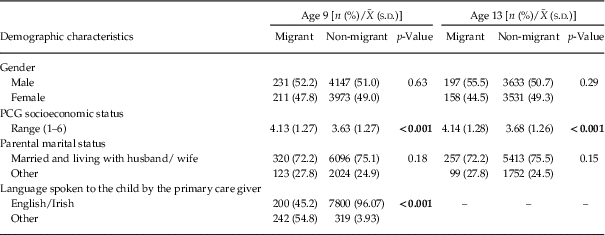
There were 8568 children and their PCG participated in the first wave of the study, 94.8% of whom were Irish and 5.2% who were classed as migrant children. Characteristics of the migrant and Irish children are presented in Table 1.
Characteristics of the migrant and non-migrant youths at age 9 and 13 years

PCG, Primary Care Giver; –, Unavailable in the Anonymised Micro file data set.
Emboldened metrics denote significant differences (p<0.05).
There was no significant difference in gender (p = 0.73) and age (p = 0.07) between migrant and non-migrant youths. The mean level of education completed by the PCG of the migrant youths (X̄ = 4.13, s.d.: 1.27) was significantly higher (p<0.001) than those of the non-migrant (X̄ = 3.63, s.d.: 1.27). A greater proportion of the PCGs of migrant youths spoke a non-native language (neither English nor Irish) to their children relative to non-migrant PCGs (p<0.001). There was no significant difference (p = 0.18) between the parental marital status of the migrant and non-migrant youths. In total, 44.0% of migrant youths had moved to Ireland within the last 5 years (recent) and 55.8% had arrived within 6–10 years. There were no significant differences in the demographic or outcome variables between recent migrants or migrants who arrived earlier (all p>0.05) with the exception of language spoken by the PCG to the participant at home. PCGs were three times more likely to speak to their child in a non-native language if they had arrived in the country within the last 5 years [odds ratio (OR): 3.05, confidence interval (CI): 2.31–4.03, p<0.001].
Psychopathology in childhood
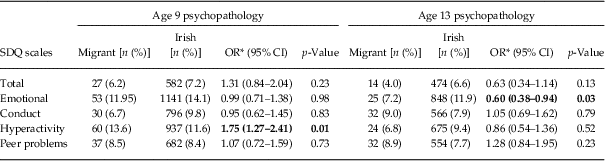
In total, 7.15% of participants met criteria for psychopathology in childhood (see Table 2). Based on total scores, internalising scores and externalising scores, there were no significant differences in the prevalence of childhood psychopathology between migrant and non-migrant youths (p = 0.89, p = 0.58 and p = 0.25, respectively). Examination of the subscale scores revealed that a significantly greater proportion of migrant had abnormal levels of hyperactivity (p = 0.03) when compared to non-migrants. No significant differences were found between migrant and non-migrant youths for all other subscale scores.
Prevalence and odds ratios (OR) of child and adolescent psychopathology in migrant and non-migrant youths

SDQ, Strengths and Difficulties questionnaire; CI, confidence interval.
Emboldened metrics denote significant differences (p<0.05).
* Adjusted for socio-economic status and language spoken at home between the child and the primary care giver.
Psychopathology in adolescence
In total, 6.50% of participants met criteria for psychopathology in adolescence. As shown in Table 2, there were no significant differences in the prevalence of adolescents psychopathology (based on SDQ total: p = 0.18, internalising: p = 0.06 and externalising scores: p = 0.18) between the two groups. Examination of the SDQ subscales revealed that a greater proportion of the non-migrants youths had emotional difficulties in adolescence when compared to migrant youths (p = 0.04). There was no significant difference in any other adolescent SDQ subscale between migrant and non-migrant youths.
Early life stress
In total, 20.16% of participants reported three or more stressors at age 9. There was a significant difference (z = −19.17, p<0.001) between the median number of stressors in migrant (median = 2, interquartile range = 1) and non-migrant youths (median = 1, interquartile range = 1). A significantly greater (OR: 2.73, CI: 2.18–3.43, p<0.001) proportion of migrant youths (42.7%) reported experiencing ≥3 stressors relative to non-migrant youths (18.9%). However, once direct migrancy-related stressors (moving house and country) were removed from the cumulative stressor score the statistical differences were not retained (OR: 1.17, CI: 0.81–1.69, p = 0.376).
When investigating specific early life stressors, a significantly greater proportion of non-migrant youths reported death of a close family member (OR: 1.80, CI: 1.42–2.28, p<0.001) and drug use or alcoholism in the immediate family (OR: 3.41, CI: 1.39–8.37, p=0.007). Following adjustment for all other stressors this pattern remained, with a significantly greater proportion of non-migrant youths having experienced both of these stressors (death of a close family member: OR: 1.31, CI: 1.02–1.69, p = 0.03; and drug use or alcoholism in the immediate family: OR: 5.23, CI: 1.85–14.73, p = 0.002). A significantly greater proportion of migrant children had a parent in prison (OR: 2.40, CI: 1.15–5.02, p = 0.019), however the percentage of parents in prison was low in both migrant (1.85%) and non-migrant (0.87%) youths. This difference was somewhat retained after adjustment for all other stressors (OR: 2.56, CI: 0.90–7.30, p = 0.078). There was no significant difference between the groups in the proportion of participants reporting other stressors.
Psychopathology in those with high numbers of early life stressors
Reporting three or more stressors at age 9 was associated with an increased odds of psychopathology in childhood (11.41%, OR: 1.99, CI: 1.66–2.38) and adolescence (11.19%, OR: 2.23, CI: 1.83–2.71). Of those who reported three or more stressors, there was no significant difference between the migrants and non-migrants youths in the prevalence of psychopathology in childhood (OR: 0.81, CI: 0.46–1.41, p = 0.463). This was also observed when migrancy relevant stressors were removed (OR: 0.98, CI: 0.38–2.49).
Non-migrant youths who reported three or more stressors had increased prevalence of psychopathology in adolescence relative to their migrant counterparts (OR: 3.90, CI: 1.52–10.00, p = 0.004). However, this results was not retained after removing migrancy relevant stressors (OR: 3.90, CI: 0.61–24.65, p<0.147).
Discussion
The first aim of this study was to investigate whether there are differences in the prevalence of child and adolescent psychopathology in migrant and non-migrant youths. Second, we investigated whether migrant youths experienced more early life stressors than non-migrant youths. Finally, we investigated, in those with a high numbers of early life stressor, whether migrant youths had a higher prevalence of psychopathology in childhood and adolescence than non-migrant youths. Contrary to expectation, migrant and non-migrant youths had similar prevalence’s of child and adolescent psychopathology. Subscale analysis suggests that migrant youths have slightly elevated levels of hyperactivity in childhood but this is not noted in adolescence. Interestingly, a greater proportion of non-migrant youths had emotional problems in adolescence. Migrant youths experienced a greater number of early stressful life events than non-migrant youths but moving stressors primarily accounted for these differences. Specifically, a greater proportion non-migrant youths had reported the death in the close family member and had family members with substance abuse problems. A greater proportion of migrant youths had a parent in prison, however this finding should be interpreted with caution given the low numbers of parents in prison within the sample. There were limited differences in the prevalence of psychopathology between the two groups in those who reported exposure to three or more stressors, particularly after accounting for moving-related stressors.
The similarities in psychopathology between migrant and non-migrant youths may reflect the fact that at the time of the GUI study, Ireland was welcoming economic migrants more so than conflict-driven migrants, with a lot of the previous literature being based on the latter. From 2000–2008, Ireland experienced an economic boom primarily because of significant foreign investment, social partnerships and EU-supported investment in Irish infrastructure (Taguma et al. Reference Taguma, Kim, Wurzburg and Kelly2009). In fact, the foreign-born proportion of the Irish labour workforce more than doubled to almost 14% in the decade leading up to 2006 and employment rates rose by almost 80% around the same time, with asylum seekers representing only a minor and declining proportion of the foreign-born cohort. The 2006 census also indicated that the migrant citizens, on average, held higher levels of education compared to their Irish counterparts (Taguma et al. Reference Taguma, Kim, Wurzburg and Kelly2009). Indeed, the analysis of baseline characteristics showed significantly higher levels of maternal education in migrant youths when compared to their non-migrant counterparts. This observation suggest that, on average, migrants within this sample migrated from countries of similar or better social equality. Social inequality is known to affect the rates of mental disorder (Wilkinson & Pickett, Reference Wilkinson and Pickett2009). As such, this may partly explain the similarities in the prevalence of child and adolescence psychopathology between migrant and non-migrant youths.
Ireland’s national profile at the time of the first wave of the GUI study indicated that the largest non-national group in Ireland was composed of people originating from the United Kingdom (~27% of the migrant nationals), with the remainder being from various other areas including Central and Eastern European countries, Asia, Africa and the Americas (Central Statistics Office, 2006). Furthermore, considering the magnitude of this immigrant group in Ireland, a significant proportion of them were also considered to be of Irish heritage. The potential Irish background of the many UK immigrants may also have positively impacted the children’s cultural integration and sense of ‘belonging’ which in turn may have helped their mental health and psychological functioning.
Previous European studies have indicated that childhood migrancy may contribute to the increase in likelihood of internalising problems whereas the prevalence of externalising problems in migrant children is similar to that of native children (Kouider et al. Reference Kouider, Koglin and Petermann2014). Our current study, however, identified no significant difference in the reporting of abnormal internalising or externalising behaviours in childhood between migrant and non-migrant youths. During the economic boom, there was increasing migration into Ireland (Central Statistics Office, 2018) and this may have lessened the discrimination experienced by migrant youths. Reductions in discrimination may have resulted in fewer internalising problems in the migrant group. In childhood, a significantly greater proportion of migrant youths demonstrated abnormal hyperactivity levels when compared to their non-migrant youths. The higher levels of childhood hyperactivity in migrant youths may reflect their difficulty in settling into a new environment a need to seek acceptance and affirmation from their new peer groups. Considering that psychopathology was based on SDQ scores derived from PCG questionnaires, there is also room for variation in how parents of various migrant groups and cultures interpret their children’s behaviours. However, a review of the cross-cultural assessment of child and adolescent psychopathology suggested that psychopathology 'scores vary more within than between populations, and distributions of scores overlap greatly among different populations' (Achenbach et al. Reference Achenbach, Becker, Döpfner, Heiervang, Roessner, Steinhausen and Rothenberger2008).
By adolescence, there was no significant difference in the individual subscales apart from the emotional domain, in which non-migrant youths had elevated levels relative to their migrant counterparts. The stress associated with the migration process frequently declines with time as immigrants often integrate both culturally and economically into their new society (Alba & Nee, Reference Alba and Nee2009). The fact that a significantly greater proportion of migrant youths did not have abnormal scores in any of the SDQ subscales at age 13 years, suggests successful assimilation of these children into Irish culture.
At age 9 and 13, there was no significant difference in the total abnormal SDQ scores. The ‘healthy migrant effect’, as mentioned previously, is a concept that describes immigrants as having a mental health advantage over native members of a country. Indeed, there are numerous possible explanations for the potential mental health advantage that immigrants may demonstrate, including particular selection factors that may favour immigrants such as the ability to overcome challenging situations- a so-called ‘positive selection’ of migrants (Jass & Massey, Reference Jass and Massey2004). Positively selected migrants may have great drive, ambition, human capital and good health and they may be better able to adapt and deal with any adverse circumstances or various social stresses within their new environment. Furthermore, social comparison has been put forward as a potential explanation for the ‘immigrant health paradox’ which suggests that immigrants may be of healthier mentalities due to their ability to evaluate their current circumstances as being of higher quality than their previous situation, presuming their situation has improved (Markides & Rote, Reference Markides and Rote2015).
Strengths and limitations
The use of data from the GUI study offered a large nationally representative sample population and was efficient in both a timely and economic sense. The wide range of variables collected as part of the data set allowed for thorough investigation of potential confounding factors.
Limitations to this study included the inability to access the ethnicity of the migrant children and the stressors that the children experienced at age 13 years within the time period due to its inclusion in the sensitive data files (RMF). In keeping with previous GUI studies, maternal education was used as a proxy measure for SES. This, however, may not be the most accurate indicator, in that lower levels of maternal education may not necessarily have been associated with children from a lower SES. Furthermore, for the purposes of this study the ‘citizenship’ variable was used as a proxy for migrant status thus meaning that we could not distinguish economic migrants from those seeking refugee status. This distinction between economic migrant and those with refugee status is an important one as those with refugee status are more likely to have experienced hardship and more likely to report psychopathology (Heeran et al. Reference Heeran, Wittmann, Ehlert, Schnyder, Maier and Muller2014). Unfortunately, it was not possible for this study to address this point and it is likely that migrants with refugee status in the current study are only a small percentage of the migrant sample. However, because this study comes from a community sample the results are likely to present an estimate of the experiences of majority of migrant youths in Ireland during this period. In addition, psychopathology was determined by SDQ scores reported by the PCG, rather than through clinical diagnoses or interviews with the children themselves. SDQ scores may been prone to social desirability bias with migrant parents wanting to answer favourably or not fully comprehending the meaning of certain questions considering language difficulties. However, language difficulties are unlikely responsible for the results as the questionnaires in the GUI were translated in to several languages prior to testing with translators provided when necessary.
Recommendations for practice and future research
It is hoped that significant findings in this area could spur a new wave of primary research into the psychological development of young people within Ireland. The GUI’s infant cohort are now of similar age to the original child cohort and may enable further analysis of the progress that has been made in the area of youth mental health in Ireland in recent years. Furthermore, the implementation of qualitative research within the mental health field is becoming increasingly prominent in the form of mixed methods studies and its use could aid deeper understanding of young people’s perceptions of various early life stressors and the impact of such on their psychological functioning. Research into the ethnicities of migrant adolescents to determine whether particular migrant groups are at particular risk of psychopathology or the potential social influences which act as protective factors in certain cultures was beyond the scope of this study but is an area worth investigation. Exploration of factors which lead to vulnerabilities in certain children and resilience in others within the same ethnic group, could help to outline the underlying influences and mediating aspects which determine mental health outcomes in spite of exposure to similar early life stressors or social disadvantage.
Conclusion
In conclusion, this study provided insight into the psychological well-being of migrant and non-migrant youths in Ireland during an economically diverse period, indicating no significant difference in mental health outcomes between these groups.
Acknowledgements
The authors acknowledge the help of Dr Gonnie Klabbers and Dr Vivian Bruls FHML/Health Sciences Maastricht University who commented on earlier drafts of this manuscript. The authors acknowledge the help of Professor James Williams, Economic and Social Research Institute, Ireland who is the Director of the GUI Study. The authors would like to thank all the study participants and their parents.
Financial Support
This study was funded by a European Research Council Consolidator Award to M Cannon (724809 iHEAR) and a Health Research Award (HRA-PHR-2015-1323) from the Health Research Board Ireland. DC, was funded by the Royal College of Surgeons in Ireland Summer studentship programme. The funders played no part in the design, conduct and analysis or submission process of this manuscript.
Ethical Standards
The author assert that all procedures contributing to this work comply with the ethical standards of the relevant national and institutional committee on human experimentation with the Helsinki Declaration of 1975 as revised in 2008. The GUI study received ethical approval from the Health Research Board’s research ethics committee in Ireland.
Conflicts of Interest
None.