I. INTRODUCTION
With the rapid development of science and technology, all kinds of electrical and electronic devices (e.g., mobile phone, local area network, radar systems, etc.) have been widely used. The abundance of these electronic devices has resulted in increasingly serious problems of electromagnetic (EM) interference. Reference Tong, Guan, Xiao, Mou, Wang and Yan1–Reference Fan, Guan, Li, Mou, Tong and Wang3 Thus, numerous studies have currently focused on EM wave absorbing materials because they can effectively absorb EM wave by converting EM energy into heat or interference. To date, various absorbents (i.e., magnetic metals Reference Tong, Wu, Hu, Yuan and Qian4 and ferrite Reference Tong, Wu, Qiao, Yuan, Guan and Qian5 ) have been studied. However, these absorbents present disadvantages such as high density, narrow bandwidth, and low absorptivity, which limit their extensive applications.
ZnO nanomaterials are considered promising microwave absorption materials in civilian and military applications because of their light weight, low cost, simple synthesis, light color, and strong absorption ability.
Reference Hu, Tong, Wu, Liu, Qian, Guan and Hong6
ZnO is a dielectric loss medium. A normal dipole moment and spontaneous polarization along the c-axis generally originate from the oppositely charged ions, producing positively charged (001) Zn-polar and negatively charged (00
 $\overline 1$
) O-polar surfaces.
Reference Tong, Du, Liang, Hu, Wu, Guan and Hu7
Additionally, the relaxation polarization and loss can also form via a back and forth migration of the electrons from polar planes or oxygen vacancies under an alternating EM field.
Reference Huang, Cao, Li, Jiang, Wang and Li8
To date, most of the investigations on microwave-absorbing behavior mainly focus on nanocombs,
Reference Zhuo, Feng, Liang, Liu, Chen, Yan, Feng, Li, Cheng, Geng, Xu, Wang, Wu, Yan and Yue9
nanotetraneedle ZnO,
Reference Yuan, Song, Fang, Shi, Hou and Cao10
nanotrees, nanorods, dendritic nanostructures,
Reference Zhuo, Feng, Chen, Yan, Feng, Li, Geng, Cheng, Xu and Yan11
nanowires,
Reference Chen, Cao, Wang and Wan12
and net-like structures.
Reference Li, Huang, Sun, Yan, Yang, Wang and Zhang13
For example, Zhuo et al.
Reference Zhuo, Feng, Liang, Liu, Chen, Yan, Feng, Li, Cheng, Geng, Xu, Wang, Wu, Yan and Yue9
reported that the strong absorption of the ZnO nanocomb composite reached −12 dB at 11 GHz with a thickness of 2.5 mm. Cao et al.
Reference Cao, Shi, Fang, Jin, Hou, Wei and Chen14
found that the microwave attenuation of the cage-like ZnO/silica nanocomposites with a weight ratio of 20% was as high as −10.68 dB at the frequency of 12.79 GHz. Li et al.
Reference Li, Huang, Sun, Yan, Yang, Wang and Zhang13
investigated the microwave absorption property of crossed ZnO net-like micro/nanostructures and found that the value of minimum reflection loss was −37 dB at 6.2 GHz with a thickness of 4.0 mm. However, these ZnO nanomaterials were mainly synthesized by metal-vapor deposition, which requires a large amount of energy. Only a few studies have analyzed the flower-like nano/microstructures obtained through a simple and energy efficient hydrothermal process.
In this study, we developed an easy one-pot hydrothermal approach without any template or organic additive for the selective preparation of flower-like ZnO nano/microstructures. Morphological variations of the resulting products were facilitated by changing only the base type and base/Zn2+ molar ratio. The shape-dependent microwave-absorbing properties of complex ZnO nano/microstructures were also systematically investigated.
II. EXPERIMENTAL
A. Preparation
All chemicals were obtained from Sinopharm Chemical Reagent Co., Ltd. (Shanghai, P.R. China). All were of analytical grade and used as received without any further purification.
Polymorphic ZnO samples were prepared by a hydrothermal process. Typically, 0.952 g of zinc nitrate and 0.128 g of NaOH were mixed with 80 mL of deionized water. The entire mixture was placed in a 100 mL Teflon stainless autoclave and tightly sealed. The hydrothermal reaction was performed at 120 °C for 2.0 h. After that, the precipitate was filtered, washed with deionized water, and dried at 80 °C for 8 h. Morphological modulation of the ZnO products was achieved by changing only the base/Zn2+ molar ratio (α = 1.0 and 3.0) and base type (NaOH, ethanediamine [C2H8N2, en], NH3·H2O).
B. Characterization
The surface morphologies of the as-prepared samples were observed by a field-emission scanning electron microscope (Hitachi S-4800, Hitachi, Japan), operated at 10.0 kV. The transmission electron microscope (TEM) images and the corresponding selected-area electron diffraction (SAED) pattern were captured on JEM-2100F TEM (JEOL, Tokyo, Japan) operating at 200 kV. The phase analysis of the samples was performed by an x-ray diffraction (XRD; Model D/MAX-RB, Rigaku, Tokyo, Japan), with Cu Kα radiation with 2θ from 10° to 70°. The Brunauer-Emmer-Teller (BET) specific surface area (S BET) was measured using a surface area analyzer (Autosorb-1, Quantachrome Co., Syosset, NY).
C. Measurement of EM parameters
Using the coaxial line method, the relative complex permittivity (ε = ε′ − jε″) of the sample–wax composites was tested through an Agilent N5230 vector network analyzer system (Agilent, Santa Clara, CA). The cylindrical toroidal samples with 3.0 mm of inner diameter, 7.0 mm of outer diameter, and a thickness of about 3.5 mm were prepared by uniformly mixing wax with the absorbents in various mass fractions of 20–60% and then pressed into cylindrical compacts. Reflection loss (R L) represents the microwave absorption property and can be calculated from the relative permeability and permittivity at a given frequency (f) and coating thickness (d) using the following equations Reference Tong, Hu, Wu, Li, Qian and Liang2 :
 $${R_{\rm{L}}}({\rm{dB}}) = 20{\log _{10}}\left| {({Z_{{\rm{in}}}} - {Z_0})/({Z_{{\rm{in}}}} + {Z_0})} \right|\quad ,$$
 $${Z_{{\rm{in}}}} = {Z_0}\sqrt {{{\rm{\mu }} \mathord{\left/ {\vphantom {{\rm{\mu }} {\rm{\varepsilon }}}} \right. \kern-\nulldelimiterspace} {\rm{\varepsilon }}}} \tan h\left[ {j(2{\rm{\pi }}fd/c)\sqrt {{{\rm{\mu }} \mathord{\left/ {\vphantom {{\rm{\mu }} {\rm{\varepsilon }}}} \right. \kern-\nulldelimiterspace} {\rm{\varepsilon }}}} } \right]\quad ,$$
 $${Z_0} = \sqrt {{{{{\rm{\mu }}_{\rm{0}}}} \mathord{\left/ {\vphantom {{{{\rm{\mu }}_{\rm{0}}}} {{{\rm{\varepsilon }}_{\rm{0}}}}}} \right. \kern-\nulldelimiterspace} {{{\rm{\varepsilon }}_{\rm{0}}}}}} \quad ,$$
where c is the light velocity, Z0 is the characteristic impedance of free space, and Zin is the input impedance between the free space and the materials.
III. RESULTS AND DISCUSSION
A. Results from SEM and TEM
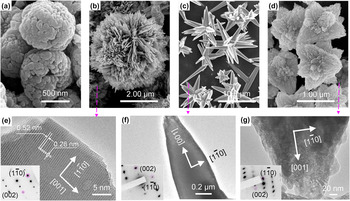
SEM, TEM, and SAED were used to reveal the influence of the base/Zn2+ molar ratio and base type on the surface morphologies and microstructures of the samples. As shown in Fig. 1(a), using NaOH as base with α = 1.0, the as-prepared products were 0.5- to 1.0-µm diameter microspheres consisting of nanoparticles with several tens of nanometers in size. When α was increased to 3.0, the products were monodispersed and uniform microspheres were formed with a diameter ranging from 4 to 5 µm [Fig. 1(b)]. These microspheres were composed of numerous densely arranged nanosheets that radially spread and formed well-defined flower-like architectures. Periodical lattice stripes can be observed in almost the whole HRTEM visual field [Fig. 1(e)]. The crystal plane distance was measured with a length of 0.52 nm, which corresponded to the [001] direction of ZnO. The strong and clear diffuse spots in the SAED pattern [inset in Fig. 1(e)] illustrate the single crystal nanosheets.
(a–d) SEM and (e–g) TEM images of polymorphous ZnO samples produced at various base/Zn2+ molar ratios (α) and base types. (a) Spherical aggregates, α = 1.0 (NaOH/Zn2+); (b and e) nanosheet-based flowers, α =3.0 (NaOH/Zn2+); (c and f) microrod-composed flowers, α =1.0 (en/Zn2+); and (d and g) nanopetal-built flowers, α = 2.0 (NH3·H2O/Zn2+). The insets in e, f, and g are the corresponding SAED patterns.

When en was used at an en/Zn2+molar ratio of 1.0, the hydrothermal precipitates formed a radial structure with microrods projected outwards, exhibiting a flower-like configuration [Fig. 1(c)]. The diameters of the flowers ranged from 8.0 to 10.0 µm. These microrods had aspect ratios of approximately 5.0, and their diameters slightly decreased from 1.0 µm on the body to approximately 600 nm at the tip. The sharp diffraction spots in the SAED pattern [inset of Fig. 1(f)], taken from individual ZnO microrods [Fig. 1(f)], further demonstrated that the [001] direction was the preferred growth direction of crystal formation with a perfect single crystalline nature.
Substituting NaOH with NH3·H2O still resulted in the flower-like shape of the ZnO samples, with diameters of about 1.0 µm to 1.5 µm [Figs. 1(d) and 1(g)]. Each flower comprised several petals approximately 1.0 in aspect ratio, radially projecting from one center. The surfaces of the ZnO flowers were not smooth and covered by large amounts of nanoparticles. The irregular SAED pattern in the inset of Fig. 1(g) indicated the polycrystalline nature of the nanopetal and the existence of shear defects. We showed in our previous study Reference Hu, Tong, Wu, Liu, Qian, Guan and Hong6,Reference Tong, Du, Liang, Hu, Wu, Guan and Hu7 that the initially formed nanoparticles can rapidly grow preferentially along the [001] direction and subsequently act as “pioneer crystals” to direct the formation of the nanopetals. The nanoparticles that grew on the nanopetal surface eventually remained parallel to the [001] direction by rotating under hydrothermal conditions. In the present study, the growth of the flower-like ZnO architectures was due to the polar surface-induced oriented attachment growth. When various bases and base/Zn2+ molar ratios were introduced to the reaction system, different coordination agents react with Zn2+ ions to form zinc coordination compounds with various unstable constant values. These variations affected the attachment and growth behavior of [Zn(OH)4]2− on the (001) polar planes as well as the nucleation and growth rates of ZnO nanocrystals. Reference Hu, Tong, Wu, Liu, Qian, Guan and Hong6,Reference Tong, Du, Liang, Hu, Wu, Guan and Hu7,Reference Li, Xiong and Xie15
B. XRD analysis
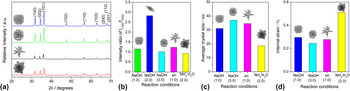
XRD was used to further study the effects of the base/Zn2+ molar ratio and base type on phase structure, intensity ratio of I
(100)/I
(002), crystal size, and internal strain of the products. The XRD patterns in Fig. 2(a) showed that all peaks can be indexed to the hexagonal ZnO with wurtzite structure (space group P6
3
mc; a = 3.2498 Å, c = 5.2066 Å; JCPDS 36-1451). No characteristic impurity peaks, such as ZnCO3·2Zn(OH)2·H2O, were observed, indicating that all samples were pure ZnO phases. However, the change in the α and base types initiated an increase in intensities of all diffraction peaks at various degrees. This phenomenon is generally related to the enhanced crystallization, formation of large crystallites, or well-ordered orientation.
Reference Tong, Guan and Zhang16
From Fig. 2(b), NaOH displayed the highest intensity ratio of I
(100)/I
(002) among the bases used in this study while keeping the stoichiometric ratio of Zn2+ to OH– unchanged (i.e., at 2.0). With NaOH as base, the intensity ratio of I
(100)/I
(002) peaked at α = 2.0. In general, a small I
(100)/I
(002) ratio corresponds to an intense (002) peak, indicating the preferential growth of rods along the c-axis with (001) or (00
 $\overline 1$
) end faces. Conversely, a very large I
(100)/I
(002) ratio indicated the prior growth of rods along the a-axis ([100] direction).
Reference Mclaren, Valdes-Solis, Li and Tsang17
Such variations implied that changing bases and base/Zn2+ molar ratios (α) could modulate the growth direction of ZnO nanocrystals. The average crystallite sizes and the internal strain of the samples were determined according to the Hall–Williamson equation:
 ${\rm{\beta }}\cos {\rm{\theta }} = {\textstyle{{K{\rm{\lambda }}} \over {\rm{\delta }}}} + {\rm{2\varepsilon si}}n{\rm{\theta }}$
, where β is the full width at half-maximum (FWHM) of the samples, λ is the x-ray wave length used, δ is the grain size, K is Scherrer constant, ε is the internal strain, and θ is Bragg angle. β can be given as
 ${{\rm{\beta }}^2} = {\rm{\beta }}_{\exp }^2 - {\rm{\beta }}_{{\rm{inst}}}^{\rm{2}}$
, where βinst is the FWHM of the Si powder used for calibration and βexp is the evaluated FWHM. Figures 2(c)and 2(d) show that microrod- and nanosheet-based flowers had larger crystal size and lower internal strain than spherical aggregates and nanopetal-built flowers. The data indicated that increasing α and using en or NaOH as the base enhanced crystal size and crystallinity.
(a) XRD patterns, (b) intensity ratio of I (100)/I (002), (c) average crystal size, and (d) internal strain of polymorphous ZnO samples formed at various base/Zn2+ molar ratios (α) and base types.

C. BET study
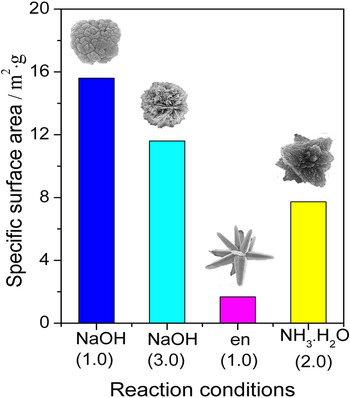
In addition to the morphological and structural modulation, base/Zn2+ molar ratio and base type also considerably influenced the specific surface area (S BET) of the products. The BET S BET was determined by a multipoint BET method using the adsorption data in a relative pressure (P/P 0) range from 0.05 to 0.25. Figure 3 shows that the S BET of the spherical aggregates was as large as 15.60 m2/g, which was much higher than those of nanosheet-based-flowers (11.60 m2/g), microrod-composed flowers (1.68 m2/g), and nanopetal-built flowers (7.73 m2/g). The difference was mainly ascribed to the mode of assembly and crystal size of nanocrystals.
Specific surface area (S BET) of the samples obtained at the various base/Zn2+molar ratios (α) and bases.

D. Dielectric properties
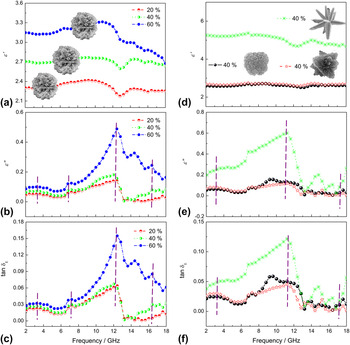
Figure 4 showed the frequency dependence of the relative complex permittivity and dielectric loss for the wax-composites containing the various mass fractions and morphologies of ZnO. As shown in Figs. 4(a)–4(c), the ε′, ε″, and tan δE values of the nanosheet-built flowers fluctuated within small ranges of 2.1–3.4, 0–0.5, and 0–0.17, respectively. As the mass fraction increased, the ε′ value gradually increased; the ε″ and tan δE values also showed less variation from 20 to 40% with a steep increase at 60%. This sharp variation may be related to the formation of the percolation semiconductive network in the matrix under a high mass fraction. Reference Tong, Wu, Hua, Miao, Guan and Qian18 Contrastive analysis (Fig. 4) revealed that the ε′, ε″, and tan δE values of nanosheet-built flowers were almost as same as those of the spherical aggregates and nanopetal-composed flowers and conspicuously lower than those of microrod-based flowers. Thus, the flowers composed by high aspect ratio microrods had a higher capacity for storage and loss of electrical energy.
Frequency dependence of the real (ε′) and imaginary (ε″) parts of the complex permittivity and the dielectric loss (tan δE = ε″/ε′) for the ZnO wax composites: (a–c) various mass fractions of the nanosheet-built flowers and (d) 40% ZnO spherical aggregates, (e) microrod-composed flowers, and (f) nanopetal-built flowers.

The microwave responses of complex nano/microstructures are usually associated with dielectric relaxation, microcurrent attenuation, interface scattering, and microantenna radiation.
Reference Fang, Cao, Shi, Hou, Song and Yuan19
First, the dielectric relaxation is a result of the orientation, interfacial, atomic, and space charge polarizations. These types of polarizations strongly depend on the material shapes and microstructures. ZnO is considered as a dielectric loss medium, and its dielectric relaxation is usually related to the characteristic of its polar surfaces. The ZnO polar monomer contains oppositely charged ions. The positively charged (001) Zn-polar and negatively charged (00
 $\overline 1$
) O-polar surfaces generate a normal dipole moment and spontaneous polarization along the c axis. Under an alternating EM field, the electrons from the polar planes or oxygen vacancies migrate back and forth to form relaxation polarization and loss, respectively.
Reference Huang, Cao, Li, Jiang, Wang and Li8
According to our previous studies,
Reference Tong, Ma, Wu, Hua, Qiao and Qian20
the increased ε′, ε″, and tan δE values were due to the enhancement of space charge polarization from the increasing defects, interface polarization from increasing surface area, or orientation polarization from significantly increasing aspect ratio. Thus, the ZnO samples with large S
BET and high internal strain (corresponding to high defects) should display large ε′, ε″, and tan δE values. But this was not observed in the permittivity of nanopetal-built flowers and spherical aggregates. Therefore, it can be inferred that the orientation polarization from the significantly increasing aspect ratio is one of the crucial factors for the enhanced permittivity of the microrod-based flowers.
Second, continuous semiconductive micronetworks in the matrix may induce large-scale vibrating microcurrent attenuation when the EM wave travels into the ZnO wax composites. The mass fraction and shape of the ZnO particles are the two key factors in the formation of the nets. Compared with the nanosheet-built flowers, spherical aggregates, and nanopetal-built flowers, the microrod-based flowers with the large aspect ratio are more prone to form such nets in the matrix by linking with one another at a low mass fraction. The nets can also form by elevating the mass fraction of the ZnO particles within certain limits. Flower-like architectures randomly distributed in the matrix can also generate multiple interface scattering and further increase the attenuation of the EM wave. The multiple interface scattering strengthens as the mass fraction and the interface increase.
Third and last, discontinuous flower-like architectures can act as isotropic quasi-antennas, which produce microantenna radiation. The behavior induces EM energy into becoming a dissipative current. With the increasing mass fraction, the discontinuous flower-like architectures decrease and the continuous micronetworks gradually form. Thus, the former decreases the microantenna radiation and the latter enhances the microcurrent attenuation. Overall, increasing mass fraction from 20 to 40% leads to the similar permittivity, as a result of the cooperative effect of the reduced microantenna radiation, the increased interface scattering and dielectric relaxation. However, steeply increased permittivity in the high mass fraction and shape of ZnO microrod-based flowers results from the microcurrent attenuation and interface scattering.
The ε″ and tan δE plots presented highly complex nonlinear resonant behaviors relative to the EM energy loss, with a strong and wide peak over 10–14 GHz but low resonant peaks of 2–5, 6–8, and 16–18 GHz. Similar multiresonance behaviors have been found in ZnO nanocombs, Reference Zhuo, Feng, Liang, Liu, Chen, Yan, Feng, Li, Cheng, Geng, Xu, Wang, Wu, Yan and Yue9 ZnO dendritic nanostructures, Reference Zhuo, Feng, Chen, Yan, Feng, Li, Geng, Cheng, Xu and Yan11 nanotrees, Reference Zhuo, Qiao, Feng, Chen, Yan, Wu and Yan21 and micro/nanorod networks, Reference Li, Huang, Sun, Yan, Yang, Wang and Zhang13 which were generally associated with highly conductive and skin effects, Reference Langarkov and Sarychev22 electronic spin and charge polarizations caused by point effects, and polarized centers. Reference Watts, Hsu, Barnet and Chambers23,Reference Che, Peng, Duan, Chen and Liang24 In the present study, two weak resonant peaks at 6–8 and 16–18 GHz were derived from microantenna radiation, whereas a strong wide peak at approximately 12 GHz was caused by the cooperative action of interface scattering, microcurrent attenuation, and dielectric relaxation. Reference Fang, Cao, Shi, Hou, Song and Yuan19 Obviously, a strong resonance peak usually corresponded to a strong reflection loss, which was exhibited by high mass fraction and/or the shape of microrod-composed flowers (Fig. 4).
E. Microwave absorption properties
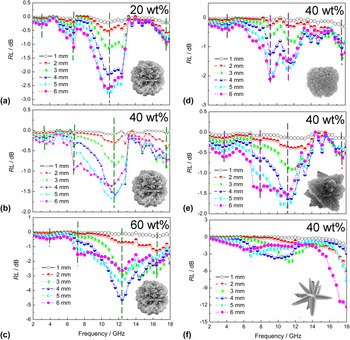
Figure 5 shows the R L curves of the wax composites containing the flower-like ZnO powders with various mass ratios and morphologies. Several evident resonance absorbing peaks were observed on all R L plots of the ZnO wax composites including 20 wt% nanosheet-built ZnO flowers [Fig. 5(a)]. A strong and broad peak was located at 11.0 GHz and two weak ones were situated at approximately 3.0 and 17.0 GHz, respectively. As the sample thickness increased from 1.0 to 6.0 mm, the intensities of three absorption peaks gradually increased and their positions remained almost the same (i.e., no movement to lower frequencies). The nesting absorption peaks also still existed not only at 40 and 60 wt% [Figs. 5(a)–5(c)] but also in spherical aggregates and nanopetal-built flowers [Figs. 5(d)–5(f)]. The peaks gradually broadened and their positions slightly moved to a higher frequency with the increased mass fraction [Figs. 5(a)–5(c)].
Reflection loss curves for the ZnO wax composites including various mass fractions and morphologies of ZnO powders. (a–c) Various mass fractions of the nanosheet-built ZnO flowers and (d) 40% ZnO spherical aggregates, (e) nanopetal-built flowers, and (f) microrod-composed flowers.

A similar phenomenon has been reported in spherical Co, hollow Co nanochains, and MWCNTs/ZnO samples, which were ascribed to the effect of dual nonlinear dielectric resonance and negative permeability Reference Shi, Cao, Yuan and Fang25 or the resonant behavior caused by interface and skin effect. Reference Shi, Cao, Yuan and Fang25 In our previous studies, urchin-like Fe2O3 took on a nesting absorption peak at approximately 16.5 GHz. Reference Tong, Wu, Guan, Qian, Yuan and Li26 Three nesting absorbing peaks at approximately 12.5, 14.8, and 16.5 GHz can be observed in flower-like Co superstructures, originating from frequency-selective surface-absorption properties. Reference Tong, Yuan, Wu, Hu, Qian, Li and Shen27 The present data showed that the positions of multiresonance absorbing peaks were unexpectedly similar to the resonance peaks on ε″ and tan δE plots. This result indicated that the microwave absorption of ZnO flowers originated from the multiresonance loss. By contrast, the absorption peaks of microrod-composed flowers did not remain at a stable frequency but gradually moved to lower frequencies with increased coating thickness. The change is due to the resonant absorption caused by the quarter-wave length attenuation when the reflected waves and incident waves meet in a material. Reference Song, Cao, Wen, Hou, Cheng and Yuan28 Compared with dielectric relaxation and microantenna radiation, microcurrent attenuation and interface scattering are highly important microwave responses for improving the dielectric and microwave absorption properties of ZnO architectures. Obviously, a flower-like architecture built by large aspect ratio microrods is a promising configuration for designing novel microwave absorbing materials.
IV. CONCLUSION
In summary, various ZnO architectures, including spherical aggregates and flowers (composed by nanosheets, microrods, and nanopetals), have been synthesized by an easy one-pot hydrothermal approach in the absence of any template or organic additive. The morphology and structure of ZnO architectures were easily manipulated by merely changing the base type and the molar ratio of base to Zn2+ (α). Compared with dielectric relaxation and microantenna radiation, microcurrent attenuation and interface scattering are more important microwave responses for improving the dielectric and microwave absorption properties of the ZnO architectures. Several stable nesting absorption peaks were exhibited by nanosheet-built flowers, spherical aggregates, and nanopetal-built flowers because of multiresonance loss. However, flowers built by large-aspect-ratio microrods present enhanced absorption peaks because of the quarter-wave length attenuation, and thus is a promising configuration for designing novel microwave-absorbing materials.
ACKNOWLEDGMENTS
This work was financially supported by the Natural Scientific Foundation of China (51102215), Chinese Scholarship Council (201208330114), Natural Scientific Foundation of Zhejiang Province (Y4100022), Teacher Training Project of Zhejiang Normal University (KYJ06Y12134), and National Innovation and Entrepreneurship Training Program of Undergraduates (201310345016).