Introduction
In modern radiotherapy (RT), intensity modulation using volumetric modulated arc therapy (VMAT) is a common technique to deliver highly conformal dose to the target volume while the surrounding tissue receives relatively low dose. VMAT technique requires modulation of several machine parameters, including multileaf collimator (MLC) and collimator jaw movements, dose rate and gantry speed. Reference van der Merwe, Van Dyk and Healy1 The planning is computed inversely in the optimiser to achieve the best possible dose distribution by varying the beam aperture while changing the dose rate and rotating the gantry.
Increased beam modulation allows better sparing of organs at risk (OAR) while treating the planning target volume (PTV) to a highly conformal dose. The amount of modulation can be enhanced in Eclipse treatment planning system (TPS) by changing the Convergence Mode (CM) settings in the optimiser. This enables the user to define to what extent the minimisation of the cost function of the optimisation parameters is continued. Minimising of the cost function for a longer time may result in better OAR sparing and higher PTV conformity and homogeneity while making the beam delivery more complex.
The degree of plan complexity may have an effect on dose calculation accuracy, treatment time, and treatment delivery repeatability. Reference Masi, Doro, Favuzza, Cipressi and Livi2 Plan complexity and uncertainties in the beam delivery are associated with complex MLC movements and calculation accuracy of the small beamlets through MLC openings resulting from increased beam modulation. Depending on the optimisation strategies used in VMAT planning, relatively similar dose distributions can be resulted while the plan complexity may differ remarkably. To reduce the modulation, the Aperture Shape Controller (ASC) tool can be used in Eclipse TPS (Varian Medical Systems [VMS], Palo Alto, US) version 15·6 onwards. 3 The ASC has been shown to reduce plan complexity slightly in some but not all cases, with minor impact on plan quality up to moderate level with 10 patients with various tumour sites Reference Binny, Spalding and Crowe4 and 20 patients with nasopharyngeal cancer. Reference Kamima, Murakami, Arima, Sato, Yoshioka and Sato5 The CM has not been studied earlier, and besides the user manual, there is little information if and how the CM and ASC work together in real patient planning. The potential is that ASC reduces plan complexity while the CM improves the target coverage and OAR sparing. Their interplay effect however has not been studied earlier.
The aim of this study was to investigate the benefits and costs of beam modulation in terms of PTV coverage, OAR savings, plan complexity and optimisation time with the different ASC and CM settings used in the VMAT planning of prostate, prostate with pelvic lymph nodes, breast or chest wall and head & neck (H&N) patients.
Materials and Methods
This retrospective study was approved by the hospital local ethical committee (R19595). The study included VMAT planning for four different treatment sites: prostate, prostate with lymph nodes (LN), breast/chest wall with axillary LN and H&N. For each plan type ten consecutive, previously treated patients were included. The plans were generated for Varian Clinac iX linear accelerator (Varian Medical Systems [VMS], Palo Alto, US) with Millennium 120 MLC. The plans were optimised with External Beam Planning Photon Optimiser (PO) v15.6.03, and calculated with Analytic Anisotropic Algorithm (AAA) v15.6.03 and grid size of 0·25 cm. The treatment technique, prescription and plan normalisation followed departmental protocols for the given treatment site. With this comparative study, the normalisation method has minor influence on the results, and the results are closely similar despite having different dosage protocols.
1) The prostate plans were optimised with two full arcs with collimator angles (CA) of 30 and 330° to the dose of 78 Gy in 2-Gy fractions. The dose normalisation of 78 Gy to V98% of the prostate was used as in the departmental protocol to achieve near-minimum dose V95 > 98% for the PTV.
2) The prostate plans with LN were optimised with two full arcs with CA of 10 and 350° to the dose of 50 Gy in 2-Gy fractions. The collimator jaws were restricted asymmetrically to a maximum jaw opening of 15 cm or less in the x-direction, for example the direction of MLC movements. The dose normalisation of 78 Gy to V98% of the prostate was used.
3) The breast/chest wall plans were designed with tangential partial arcs with arc length of 60–70° each, two laterally and two medially, and optimised to the dose of 50 Gy in 2-Gy fractions. The CAs were 10 and 20° for the medial arcs and 350 and 340° for the lateral arcs for left-sided treatments (n = 5); and the complement angles for the right-sided treatments (n = 5). A fifth arc from gantry angles (GA) between 300 and 60° with a CA of 80 or 100° for left- and right-sided cases, respectively, to the axillary LN area. Reference Rossi, Boman and Kapanen6 All fields were restricted to a maximum jaw opening of 16 cm or less in the x-direction. The dose normalisation to PTV mean for target structure cropped 5 mm from the skin was used as in the departmental protocol.
4) The H&N plans were optimised with two full arcs with CA of 10 and 350°. The collimator jaws were restricted asymmetrically to a maximum jaw opening of 15 cm or less in the x-direction. A third half or full arc was designed with CA 280° to the area with parotids and oral cavity with jaw opening of 15 cm or less as in the departmental protocol. Simultaneously integrated boost (SIB) to the dose of 70/63/56 Gy in 2/1.8/1.6-Gy fractions was used in the planning. The dose normalisation to PTV mean for 70-Gy target structure cropped 3 mm from the skin was used as in the departmental protocol.
In the optimiser, the ASC has six options: ‘off’, ‘very low’, ‘low’, ‘moderate’, ‘high’ and ‘very high’. The CM has three options: ‘off’, ‘on’ and ‘extended’. To limit the number of comparisons, the number of ASC settings was limited to three: ‘off’, ‘moderate’ and ‘very high’. The first optimisation for each patient was initiated with the mid-settings to find appropriate optimisation parameters for the patient: the CM set ‘on’ and the ASC set on ‘moderate’. After adjusting the optimisation settings, the optimisation was started from the beginning for each of the studied ASC and CM setting. The plans were optimised with one intermediate dose calculation after which optimisation was restarted at level 3. All plans were normalised according to plan protocol after the optimisation.
All plans were evaluated for the PTV using the homogeneity index (HI) as in ICRU-83 7
 $${\rm{HI}} = {{{\rm{D}}2{\rm{\% }}\left( {{\rm{PTV}}} \right) - {\rm{D}}98{\rm{\% }}\left( {{\rm{PTV}}} \right)} \over {{\rm{D}}50\left( {{\rm{PTV}}} \right)}}\comma $$
and van’t Riet’s conformity index (CI) Reference van’t Riet, Mak, Moerland, Elders and van der Zee8
 $${\rm{CI}} = {{{\rm{V}}95\left( {{\rm{PTV}}} \right)\left( {{\rm{cc}}} \right)} \over {{\rm{V}}\left( {{\rm{PTV}}} \right)\left( {{\rm{cc}}} \right)}}{{{\rm{V}}95\left( {{\rm{PTV}}} \right)\left( {{\rm{cc}}} \right)} \over {{\rm{V}}95\left( {{\rm{cc}}} \right)}}{\hbox {\hbox {\hbox {\hbox {\hbox {\hbox {\hbox .}}}}}}}$$
In addition, the V95% [%] and D2cc [Gy] were recorded for the PTV. Lower HI values indicate better homogeneity. With the CI, the values range from 0 to 1, and higher values indicate better conformity.
For the OARs several dose parameters were included in the plan comparisons to aid the comparisons of plan quality. The dose-volume histogram (DVH) parameters were based on our departmental protocols.
1) For the prostate plans, values in the bladder (V65Gy, V50Gy), rectum (V75Gy, V70Gy, V60Gy, V50Gy), the hips (V30Gy, D2cc) were used.
2) For the prostate + LN treatments, the same parameters for the hips (V30Gy, D2cc) were recorded, and for the bladder and rectum, the same parameters in percentage were chosen as in the prostate-only plans. In addition, the small bowel (V45Gy) was analysed.
3) For the breast/chest wall, the ipsilateral lung (V5Gy, V20Gy), heart (V5Gy, V20Gy, D2cc), humeral head (V15Gy, D2cc), contralateral lung (V5Gy), contralateral breast (V5Gy, D2cc) and the mean values for ipsi- and contralateral lung, contralateral breast and heart were analysed.
4) For the H&N, brain (V45Gy), back neck (V30Gy), spinal canal (D2cc), brain stem (D1cc) and the mean values for right and left parotid (parotid R and parotid L, respectively), submandibular glands (submands), oral cavity, larynx, and oesophagus were analysed. The back neck dose is visually evaluated at our department. It consisted of the neck volume 1·5 cm behind the high-dose PTV, and 1 cm behind the mid- and low-dose PTV. One or both of the submandibular glands were inside the PTV, and they were combined due to the small number of samples.
The time required for optimisation was evaluated. The optimisation was performed on a single computer, and the optimisation time was measured from the start of the optimisation to the end of first optimisation at level four. The time from the intermediate dose calculation was excluded due to distributed calculation network that depended on other simultaneous users, not only on the complexity of the current plan.
The plan complexity was analysed by calculating the various modulation indexes using a Matlab code (The MathWorks, Inc. Natick, MA, USA, Matlab® v. 17b) from Hernandez et al. Reference Hernandez, Saez, Pasler, Jurado-Bruggeman and Jornete9
1) The Modulation Complexity Score (MCS) describes the variations in the shape and area of segments. The values range from 0 to 1, with lower value indicating higher complexity. Reference McNiven, Sharpe and Purdie10
2) Modulation index total (MItotal) describes the extent the plan modulates the MLC speed, gantry speed and dose rate, with higher value indicating higher complexity. Reference Park, Park, Kim, Kim, Carlson and Ye11
3) The plan irregularity (PI) describes how much the shape of a segment differs from a circle, with the value 1 indicating a perfect circle, and higher values more complex shapes. Reference Du, Cho, Zhang, Hoffman and Kudchadker12
4) Plan modulation (PM) describes how much there are several small MLC openings instead of one large opening. The values range from 0 to 1, with higher value indicating higher complexity. Reference Du, Cho, Zhang, Hoffman and Kudchadker12
5) The Edge Metric (EM) describes the ratio between the MLC side length and irradiation area. It is thus sensitive for large differences in the positions between adjacent leafs, with higher value indicating higher complexity. Reference Younge, Matuszak, Moran, McShan, Fraass and Roberts13
6) The leaf travel per arc length (LT/AL) describes the distance that the leafs travel on average during the arc(s), again with higher value indicating higher complexity. Reference Masi, Doro, Favuzza, Cipressi and Livi2
7) In addition, the number of monitor units (MU) in the plan was included in the analyses.
The plans were compared using paired t-test with SPSS (v22, IBM corp., USA) to test the differences between the dose parameters for the PTV and OAR. The Bonferroni correction was used for all results. Statistical significance was considered when p < 0·05.
Results
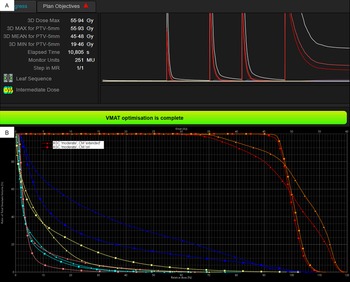
The total number of plans reviewed was 200: four plan types with ten cases each, and five different CM/ASC settings for each case. In 40% of the prostate (4/10 plans) and breast/chest wall (4/10 plans) cases, the CM ‘extended’ did not achieve appropriate dose distribution, as the optimisation did not converge after the intermediate dose calculation. The penalty function (white line in Figure 1a) did not decrease close to the x-axis in the final stages of optimisation. The PTV coverage was lost especially in the breast/chest wall plans, but also in the prostate plans high dose heterogeneity was seen in the PTV, while the OAR doses were increased. One example of the resulting dose volume histograms is shown in Figure 1b for a breast case, comparing the CM ‘on’ and ‘extended’, while the ASC was set ‘moderate’ in both plans. Furthermore, with CM ‘extended’ the optimisation times for simple prostate cases were on average more than 1 hour, and for the other plans from 2 to 4·5 hours. Thus, the CM ‘extended’ option was excluded in the comparisons.
(a) The optimiser did not find solutions in 4/10 cases of breast/chest wall and prostate cases after the intermediate dose calculation with the ‘extended’ CM. The white line represents the total penalty function, and it stays high above the x-axis after the final stage of optimisation. (b) The resulting DVH curve from the ‘extended’ CM (triangle) compared to ‘on’ CM (square), both plans optimised with ‘moderate’ ASC. The plan with ‘extended’ CM has unacceptably inhomogeneous PTV coverage, and the OAR doses are increased compared to CM ‘on’. The structures shown are PTV-5 (red), clinical target volume (orange), ipsilateral lung (dark blue), contralateral lung (cyan), heart (pink) and contralateral breast (yellow).

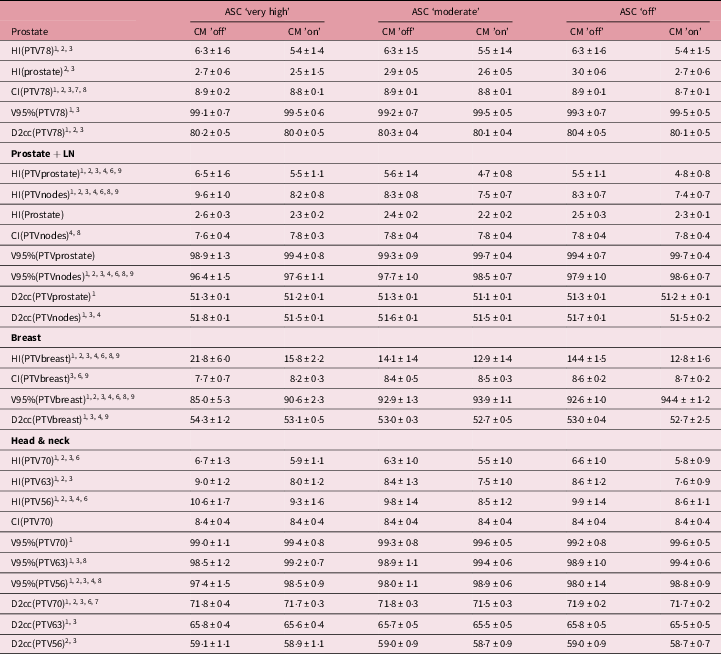
For the PTV, the HI, V95% and D2cc were improved with CM ‘on’, when compared to CM ‘off’ for all plans and for all settings of ASC (Table 1, comparisons 1–3). The choice on ASC between ‘off’ and ‘moderate’ (comparisons 5,7) had no considerable effect on PTV dose parameters, meaning that only few comparisons were statistically significant, and even in these the difference was small. With ASC ‘very high’, HI was worsened for prostate + LN, breast/chest wall and in some cases in H&N plans when compared to ASC ‘moderate’ (comparisons 4,6) or ‘off’ (comparisons 8,9). The CI was not affected considerably by changes in the CM and ASC.
The parameters of the target volumes using different settings for the CM and ASC. The comparisons 1–3 (see footnotes) are comparisons between CM ‘on and ‘off’, comparisons 4–5 (CM ‘off’) and 6–7 (CM ‘on’) are comparisons between small changes in ASC, and comparisons 8 (CM ‘off’) and 9 (CM ‘on’) are large changes in ASC

1ASC ‘very high’ – CM ‘off’ versus ‘on’; 2ASC ‘moderate’ – CM ‘off’ versus ‘on’; 3ASC ‘off’ – CM ‘off’ versus ‘on’; 4CM ‘off’ – ASC ‘very high’ versus ’moderate’; 5CM ‘off’ – ASC ‘moderate’ versus ’off’; 6CM ‘on’ – ASC ‘very high’ versus ’moderate’; 7CM ‘on’ – ASC ‘moderate’ versus ’off’; 8CM ‘off’ – ASC ‘very high’ versus ’off’; 9CM ‘on’ – ASC ‘very high’ versus ’off’
Significant differences (p < 0•05).
Abbreviations: CM, convergence mode; ASC, aperture shape controller; HI, homogeneity index; CI, conformity index; PTV, planning target volume.
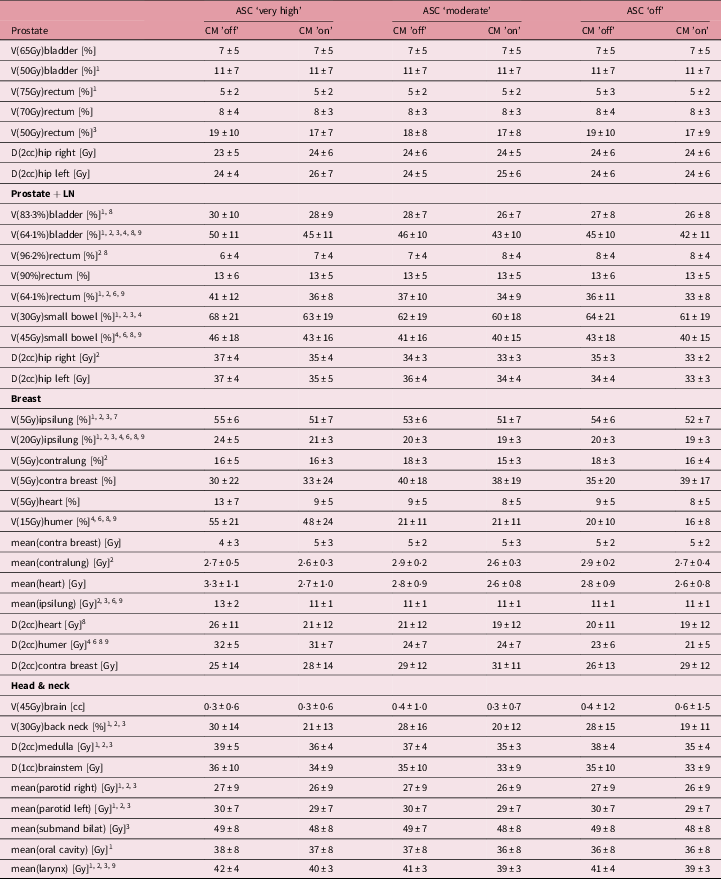
On average, the dose parameters for the OARs were slightly decreased with CM ‘on’ compared to CM ‘off’, at least for low doses (Table 2, comparisons 1–3). However, the high doses were mainly not reduced in organs included in the PTV-margin, such as the bladder, rectum or oesophagus. For OARs outside the PTV the maximum doses were slightly reduced, shown in H&N for the medulla. For the prostate plans, the changes in the OAR doses were mainly statistically insignificant. The choice on ASC between ‘off’ or ‘moderate’ had no considerable effect (comparisons 5,7), but with ASC ‘very high’ the OAR doses increased compared to ‘moderate (comparisons 4,6) or ‘off’ (comparisons 8,9).
The parameters of the organs at risk using different settings for the CM and ASC. The comparisons 1–3 (see footnotes) are comparisons between CM ‘on and ‘off’, comparisons 4–5 (CM ‘off’) and 6–7 (CM ‘on’) are comparisons between small changes in ASC, and comparisons 8 (CM ‘off’) and 9 (CM ‘on’) are large changes in ASC

Notes: 1ASC ‘very high’ – CM ‘off’ versus ‘on’; 2ASC ‘moderate’ – CM ‘off’ versus ‘on’; 3ASC ‘off’ – CM ‘off’ versus ‘on’; 4CM ‘off’ – ASC ‘very high’ versus ’moderate’; 5CM ‘off’ – ASC ‘moderate’ versus ’off’; 6CM ‘on’ – ASC ‘very high’ versus ’moderate’; 7CM ‘on’ – ASC ‘moderate’ versus ’off’; 8CM ‘off’ – ASC ‘very high’ versus ’off’; 9CM ‘on’ – ASC ‘very high’ versus ’off’
Significant differences (p < 0•05).
Abbreviations: CM, convergence mode; ASC, aperture shape controller.
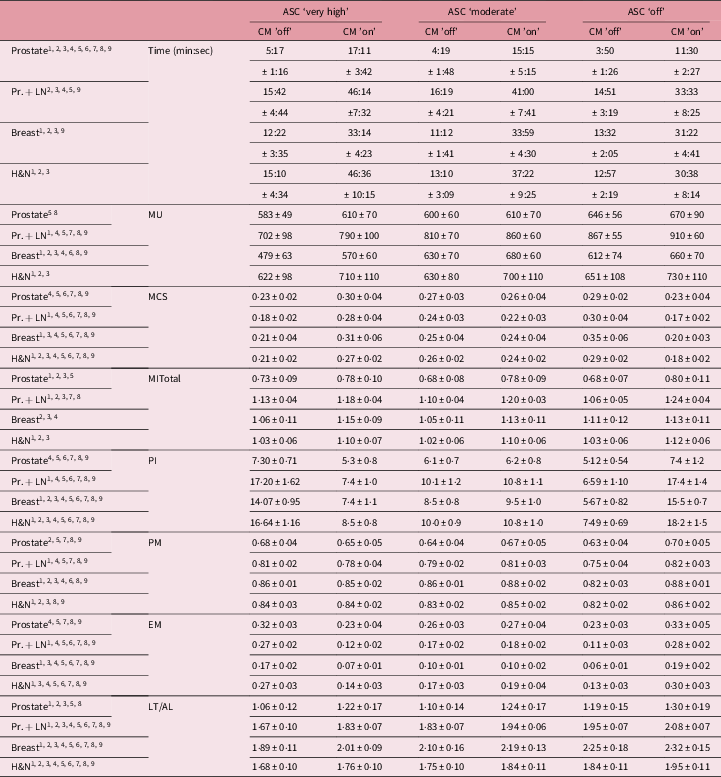
The average time spent on the optimiser was 172% times longer with CM ‘on’ when compared to CM ‘off’ (Table 3). With increasing ASC setting the time increase was 21%. The number of MUs was increased with CM ‘on’ when compared to CM ‘off’ and decreased with ASC ‘off’ or ‘moderate’ compared to ‘very high’. Also the plan complexity grew with CM ‘on’ compared with ‘off’ (Table 3).
Indicators of plan complexity using different settings for the CM and ASC. The comparisons 1–3 (see footnotes) are comparisons between CM ‘on and ‘off’, comparisons 4–5 (CM ‘off’) and 6–7 (CM ‘on’) are comparisons between small changes in ASC, and comparisons 8 (CM ‘off’) and 9 (CM ‘on’) are large changes in ASC

Notes: 1ASC ‘very high’ – CM ‘off’ versus ‘on’; 2ASC ‘moderate’ – CM ‘off’ versus ‘on’; 3ASC ‘off’ – CM ‘off’ versus ‘on’; 4CM ‘off’ – ASC ‘very high’ versus ’moderate’; 5CM ‘off’ – ASC ‘moderate’ versus ’off’; 6CM ‘on’ – ASC ‘very high’ versus ’moderate’; 7CM ‘on’ – ASC ‘moderate’ versus ’off’; 8CM ‘off’ – ASC ‘very high’ versus ’off’; 9CM ‘on’ – ASC ‘very high’ versus ’off’.
Significant differences (p < 0•05).
Abbreviations: CM, convergence mode; ASC, aperture shape controller.
With CM ‘on’, changes in ASC from ‘off’ to ‘moderate’ (comparison 7) and ‘very high’ (comparisons 6,9) decreased the plan complexity. However, with CM ‘off’ changes in ASC from ‘off’ to ‘moderate’ (comparison 5) and ‘very high’ (comparisons 4,8) decreased the plan complexity only according to MU. Instead, changes in ASC from ‘off’ to ‘moderate’ and ‘very high’ increased plan complexity as shown by MCS, PI, EM, LT/AL and slightly PM. In PM, the changes were mainly small except from CM ‘off’ to ‘on’ with ASC ‘off’. In MItotal, mainly the change in CM (comparisons 1,2,3) but not considerably in ASC (comparisons 4–9) seemed to have an effect on complexity. Most of the complexity parameters, but not MU and not in all comparisons in MItotal, were indicating lowest plan complexity when both the CM and ASC settings were ‘off’.
Discussion
Radiotherapy plan quality can be described in terms of target dose coverage and the sparing of healthy tissue. In addition, it is influenced by a plan complexity. In complex plans, the correct delivery to the patient may be impaired by errors in gantry mechanics, dosimetric errors in small subfields and increased sensitivity to patient positioning errors.
This study investigated the optimisation settings for CM and ASC. The CM allows the optimiser run longer to minimise the cost function. This was shown to improve plan quality in terms of dose distribution, but lengthen the optimisation time and in some cases also increase the plan complexity. The ASC on the other hand is restricting the MLC movements and patterns, allowing only larger beam openings for the MLCs and thus decreasing the plan complexity. These CM and ASC options are slightly but not strictly opposite, and the aim of this study was to find the best usable settings in clinical environment for four different treatment sites. To limit the amount of data, we chose only three modes of the ASC, although there are six alternatives in the planning system.
To the authors’ knowledge, the CM has not been studied earlier. The results showed that the PTV homogeneity was improved with CM ‘on’ compared to CM ‘off’ with all of the studied ASC settings, but CI was not significantly changed. Also the OAR doses were slightly reduced with CM ‘on’ compared to CM ‘off’, but more for the complicated cases (H&N, breast/chest wall and prostate + LN) than easier cases (prostate), and only for the lower doses. The high doses to OAR were similar, as CM ‘on’ did not compromise the PTV coverage to decrease the OAR doses.
In accordance with previous studies Reference Binny, Spalding and Crowe4–Reference Kamima, Murakami, Arima, Sato, Yoshioka and Sato5 the ASC worked also as expected, as the setting for the simpler aperture shapes (ASC ‘moderate’ or ‘very high’) decreased the plan quality in terms of PTV homogeneity and resulted higher OAR doses at the ‘very high’ ASC level. From ‘off’ to ‘moderate’ ASC level the effect on dose distribution was insignificant, as described also by Kamima et al. for nasopharyngeal cancer. Reference Kamima, Murakami, Arima, Sato, Yoshioka and Sato5
The least complex plans were created by turning both the ASC and CM ‘off’. This was seen in the complexity indices MSC, PI, PM, EM and slightly in MItotal for all four treatment sites. However, the MUs were not the smallest when both ASC and CM were off. This discrepancy suggests that trusting the MUs alone might not always be a true indicator of plan complexity. In a review of various complexity metrics by Chiavassa et al., the complexity indices have been divided into fluence metrics (mainly for IMRT, omitted in this study), deliverability metrics and accuracy metrics. The deliverability metrics include indices describing mechanic and dosimetric complexity of the plan that may compromise the correct delivery of the planned dose. Reference Chiavassa, Bessieres, Edouard, Mathot and Moignier14 In the current study, the MU, PI, MCS, MItotal and LT/AL were included to describe deliverability metrics. In the current study, these were sensitive to changes in both CM and ASC. The MItotal was the only parameter that included the analysis of gantry speed and dose rate. The MItotal was slightly influenced by the CM but not considerably by the ASC, indicating that increasing convergence time may utilise also variations in gantry speed and dose rate. The accuracy metrics describe the problems with complex MLC designs, associated with the uncertainties of small-field dosimetry. Reference Chiavassa, Bessieres, Edouard, Mathot and Moignier14 The EM of this study is included in the accuracy metrics. The ASC setting seemed to work in this study when the CM was turned ‘on’ as the EM was sensitive to changes in the ASC, but reversely when the CM was turned ‘off’.
In EM, PI and MCS, the complexity decreased with increasing ASC if CM was set ‘on’ as expected; but unexpectedly the complexity increased with increasing ASC if CM was set ‘off’. Therefore it seems that the ASC needs more time to work properly. However, not all parameters agreed to this, such as the MU and LT/AL, and in PM and MItotal the changes were small. Due to this discrepancy between MU and the majority of other complexity indexes, the MU cannot always be considered a truly reliable measure of plan complexity. The DVH parameters did not show such adverse behaviour while CM was ‘off’. With the expected behaviour of the ASC while using the CM, but partly even adverse effects on plan complexity while not using the CM, the use of aperture shape controller is only advised, if the convergence mode ‘on’ is used.
The use of CM ‘extended’ is not recommended in simple cases as it failed in 40% of the prostate and breast/chest wall cases to fulfil the planning criteria. The reason for this is unknown, but hopefully the problem will be fixed in future updates. In the complicated cases (prostate + LN and H&N) the extended mode improved the plan slightly, but the time required increased unacceptably long for clinical use. The increasing time with the ‘on’ CM compared to ‘off’ was not as long, but the CM also affects the time required for possible further optimisation runs. CM may however be turned ‘off’ after the first optimisation to get good starting point, and the further optimisation runs which will be then faster. From clinical experience this will improve plan quality; but whether this would affect plan complexity was outside the scope of this study.
This was a single-centre study and the recommendations given are based on the time available for planning in this centre only. The plans created followed the departmental protocols and are considered to have only minor influence on the results of this comparative study, which consisted of four treatment sites. The simultaneous use of ASC and CM is suggested at least for complicated cases such as H&N, breast cancer and irregularly shaped PTVs such as the pelvic lymph nodes. In these cases the level of ASC may vary while the CM is used with the ‘on’ setting. However, for simple, round PTVs, such as the prostate, both of their use may be omitted. For time savings, their use is however decided for each clinic individually, and based on this study, only the use of CM at ‘very high’ level and the use of ASC without using CM ‘on’ is not advised in any situations.
Conclusions
The use of convergence mode resulted in higher plan quality with better PTV homogeneity and lower OAR doses. With CM ‘on’, the use of aperture shape controller from ‘off’ to ‘moderate’ decreased plan complexity, but the ‘very high’ mode started to decrease plan quality. The combination of setting both the ASC and CM ‘off’ resulted in the simplest plans according to several complexity indices, and can be recommended for simple cases, such as the prostate, or for cases where low MLC-complexity is prioritised due to expected intrafractional movement. In these simple cases no considerable losses in plan quality are expected, but for more complex plans, the simultaneous use of both ASC ‘moderate’ and CM ‘on’ produced good plan quality in terms of PTV coverage, OAR sparing and plan simplicity. With CM ‘off’, the use of ASC is not recommended as it may simultaneously decrease plan quality and increase plan complexity. The ‘extended’ CM was extremely slow and raised problems in several prostate and breast cases and the use is not advised.
Acknowledgements
The authors thank Dr. Victor Hernandez for kindly providing the in-house built software for the calculation of complexity indices.
Financial Support
This research received no specific grant from any funding agency, commercial or not-for-profit sectors.
Conflict of Interest Statement
The authors declare no conflicts of interest.