Introduction
Christmas trees are very sensitive to weed competition during the early establishment years. Weeds, if left uncontrolled—particularly during the dry summers––may cause as high as 80% mortality of the new transplants (Kuhns and Harpster Reference Kuhns and Harpster2003). PRE herbicides are critical for successful weed management, although there is a potential for herbicide injury in newly transplanted trees (Ahrens and Newton Reference Ahrens, Newton, LeBaron, McFarland and Burnside2008; Brown et al. Reference Brown, Spetich and Heiligmann1989; Peachey et al., Reference Peachey, Landgren and Miller2017). Christmas tree sensitivity to PRE herbicides varies depending upon tree species, age of the transplant, growth stage, establishment year, herbicide chemistry, and such variables as rate, time, and method of application. For example, Douglas fir [Pseudotsuga menzeisii var. menziesii (Mirb.) Franco] is more sensitive to injury from oryzalin herbicide than most true firs, pines, and spruces. Tolerance of Colorado blue spruce (Picea pungens Engelm.), Douglas fir, true firs (Abies spp.), Fraser fir [Abies fraseri (Pursh) Poir], and white pine (Pinus strobus L.) to hexazinone plus sulfometuron methyl varied with the age of transplant and application rate (Ahrens and Mervosh Reference Ahrens and Mervosh2000; Ahrens Reference Ahrens2005; Ahrens and Newton Reference Ahrens, Newton, LeBaron, McFarland and Burnside2008; Kuhns and Harpster Reference Kuhns and Harpster2005a; Weston et al. Reference Weston, Barlow and Ganske2005). In Connecticut and Pennsylvania research trials, 4 yr or older transplants of Fraser fir and white pine tolerated hexazinone plus sulfometuron methyl up to 421 g ai ha−1 when applied over the top before bud break (Ahrens Reference Ahrens2007; Ahrens and Mervosh Reference Ahrens and Mervosh2000; Kuhns and Harpster Reference Kuhns and Harpster2005a; Rick et al Reference Rick, Martin, Ganske, Holm and Turner2005), whereas newly planted Christmas trees of diverse species and age groups tolerated flumioxazin up to 429 g ai ha−1 very well when it was applied over the top before bud break (Ahrens and Mervosh Reference Ahrens and Mervosh2013; Kuhns and Harpster Reference Kuhns and Harpster2002, Reference Kuhns and Harpster2005b; Richardson and Zandstra Reference Richardson and Zandstra2009). In addition, flumioxazin controlled a broader spectrum of weed species for longer durations compared with the most widely used combinations of simazine and oryzalin or pendimethalin (Fausey Reference Fausey2003; Kuhns and Harpster Reference Kuhns and Harpster2005b).
Only a few PRE herbicides are registered for weed control in Christmas trees. Commonly used PRE herbicides in Christmas tree production control weeds by targeting only one or two sites of action. For example, atrazine and simazine inhibit photosynthesis (PS II); dimethenamid and S-metolachlor prevent long-chain fatty acid synthesis; flumioxazin and oxyfluorfen inhibit protoporphyrinogen oxidase; and hexazinone plus sulfometuron methyl interfere with both acetolactate synthesis (ALS) and PS II. Oryzalin, pendimethalin, prodiamine, and trifluralin inhibit microtubule formation. Isoxaben disrupts root and hypocotyl development by inhibiting cell wall synthesis. Indaziflam, a relatively newer addition to the Christmas tree PRE weed control products, is an alkylazine herbicide that controls annual grasses and broadleaf weeds by inhibiting cellulose biosynthesis in susceptible weed species (Ahrens and Mervosh Reference Ahrens and Mervosh2013; Brabham and Debolt Reference Brabham and Debolt2013). Selection pressure for herbicide resistance in plantation crops is increasing, mostly as a result of lack of herbicide rotation or mixing herbicides with different modes of action (Fausey Reference Fausey2003; Kuhns and Harpster Reference Kuhns and Harpster2005b; Sosnoskie and Hansen Reference Sosnoskie and Hansen2015).
Currently in New England, common lambsquarters (Chenopodium album L.) and redroot pigweed are two widespread weed species with confirmed resistance to PS II inhibitors (Heap Reference Heap2019). Some Christmas tree growers also suspect that PS II-resistant horseweed and common ragweed (Ambrosia artemisiifolia L.) are resistant to ALS-inhibitor herbicides. In Connecticut Christmas tree plantations, a major weed shift has happened toward biennial and perennial weed species that are naturally tolerant to many of the currently available PRE and POST herbicides. Example weed species include Asiatic dayflower (Commelina communis L.), European blackberry (Rubus fruticosis L.), common evening primrose (Oenothera biennis L.), field bindweed (Convolvulus arvensis L.), hedge bindweed (Calystegia sepium L.), horsenettle (Solanum carolinense L.), red sorrel (Rumex acetosella L.), wild carrot (Daucus carota L.), and many non-native invasive shrubs and woody vines (personal observation, 2016). The main reasons for the weed shift in Christmas tree plantations are limited safe and effective PRE and POST herbicides as well as the lack of herbicide rotation (Fausey Reference Fausey2003). Of the currently available PRE herbicides, only hexazinone plus sulfometuron methyl has the potential for PRE and early-POST control or suppression of biennial and perennial weeds such as bramble (Rubus spp.), Canada thistle (Cirsium arvense L.), quackgrass (Agropyron repens L.), red sorrel, and wild carrot. Earlier research also indicated high risk for needle burn, leader deformation, chlorosis, and stunting with hexazinone plus sulfometuron at rates exceeding 526 g ai ha−1 (Ahrens Reference Ahrens2005, Reference Ahrens2007; Kuhns and Harpster Reference Kuhns and Harpster2005a; Rick et al. Reference Rick, Martin, Ganske, Holm and Turner2005). Douglas fir and Fraser fir have even been injured with the labeled rates of hexazinone plus sulfometuron (Kuhns and Harpster Reference Kuhns and Harpster2005a).
To effectively deal with rising problems of herbicide-resistant weeds and weed species shift, Christmas tree growers throughout the Northeast and Midwest are looking for more robust and safer weed management options (Fausey Reference Fausey2003). Mixtures of herbicides with different sites of action have been recommended as one of the best management practices for reducing the risk for herbicide resistance as well as for broadening the weed control spectrum (Diggle et al. Reference Diggle, Neveand and Smith2003). The objective of this study was to evaluate different PRE herbicides applied alone or as mixtures for weed control efficacy and tolerance of Canaan fir.
Materials and Methods
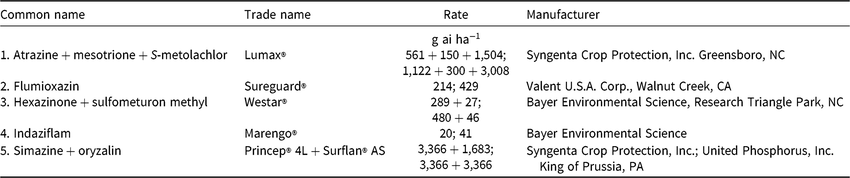
A 2-yr field experiment was conducted at a commercial Christmas tree farm in Hamden, CT (41°26.32.2N, 72°56.24.2W) during 2016 and 2017. The soil at the experiment site was a Wilbraham and Menlo poorly drained, stony, silt loam with 63% silt, 28% sand, 9% clay, 2.5% organic matter, and 5.1 pH. The entire row zone (a strip 30.5 cm wide) was treated with glyphosate (Roundup Pro, 1,260 g ae ha−1; Monsanto Co., St. Louis, MO) in the fall of 2015. Canaan fir trees 20 to 30 cm tall (plug + 2) were planted in the spring of 2016 at 150-cm spacing between plants in rows 180 cm apart. The term “plug” is used to designate the container portion of seedling production, and the following number indicates the time spent in the bare-root transplant bed. Therefore, a plug + 2 was grown for 1 yr in a container, then transplanted into a bare-root bed and grown for two additional years. The experiment design was a randomized complete block with three replications. Each experimental unit consisted of one row of eight plants. Treatments consisted of factorial combinations of four herbicides and two application rates (Table 1). A nontreated control was included for comparison. Emerged weeds were controlled with a semidirected application of glyphosate (Roundup Pro, 630 g ae ha−1; Monsanto Co., St. Louis, MO) using a single OC-2 nozzle at 187 L ha−1. Herbicide treatments were applied before bud break, in a 90-cm band, with a compressed CO2 backpack sprayer delivering 187 L ha−1 at 207 kPa and 3.5 kph through a single off-center flat-spray OC-2 nozzle (TeeJet Technologies, Springfield, IL) sprayer in 2016 and with a two-nozzle boom sprayer through two 45-cm spaced Teejet 8002 nozzles (TeeJet Technologies, Springfield, IL) in 2017. Herbicides were applied as a semidirected application on April 19, 2016, and both sides of each row were sprayed, allowing herbicide contact with the lower 15 to 30 cm of all trees. In 2017, herbicides were applied over the top of trees on April 27, 2017. A semidirected application of glyphosate (Roundup Pro, 630 g ae ha−1; Monsanto Co., St. Louis, MO) was made a week prior to PRE application in 2017 to control emerged weeds. The soil was moist, relative humidity was around 55%, and air temperature was 14 C at the time of treatment application during both years. A weed suppression program consisting of low rates of glyphosate (Roundup original; Monsanto Co., St. Louis, MO) applied at 237 g ae ha−1 in late April, 118 g ae ha-1 in late June, and again at 237 g ae ha−1 in late July was followed to manage weeds between the rows. Weed suppression treatments were applied using a TK-2 nozzle (Sprayer Supplies, Herndon, KY) at 84 L ha−1 with a Solo backpack sprayer (Solo Inc., Newport News, VA). Weed control and Christmas tree injury were assessed visually at 4, 8, 12, and 16 wk after treatment (WAT) using a scale ranging from 0 (no control) to 100% (complete control) for weed control and a scale of 0 (no injury) to 10 (dead plant) for injury. Visual control estimates were based on chlorosis, necrosis, and stunting of the weeds compared with the weeds in the nontreated control plots. Injury estimates were based on chlorosis, necrosis, and stunting of the new growth of Christmas trees compared with the trees in the nontreated control plot. Weed species density was determined at 16 WAT by counting the number of weeds within two 0.5-m2 quadrats randomly placed over the treated row. Christmas tree leader length was recorded at 16 WAT.
Herbicides, products, and application rates of PRE herbicides used in the field study at Hamden, CT, during 2016 and 2017.

Statistical Analysis
Data were subjected to ANOVA using the PROC GLIMMIX procedure in SAS (Version 9.4, SAS Institute, Cary, NC). For weed control, weed density, and leader length data, year, and herbicide treatment were treated as fixed effects, whereas replication and its interactions with year and herbicide treatment were considered as random effects. For weed control and density data, only the herbicide treatment effect was significant. Therefore, data were combined over the years after a nonsignificant F test. Residuals were analyzed individually for each variable using the UNIVARIATE procedure for normality, homogeneity of variance, and independence of errors. Weed control data were arcsine square root–transformed to improve the normality and homogeneity of variance assumptions, but the nontransformed means are presented in the tables. Weed density data were analyzed using a log-normal distribution function, and back-transformed means are reported. Multiple means comparisons of significant effects were made using the “Adj = simulate” option in SAS PROC GLIMMIX at the 5% significance level.
Results and Discussion
The mean weekly air temperature and cumulative weekly rainfall data indicated similar weather conditions during each experimental year. Mean weekly air temperatures from April to August were in the range of 9 to 23 C during each year. Although the cumulative rainfall from April through August was around 40 cm in both study years, there was some variation in the amount of weekly rainfall received during the summers of 2016 and 2017.
Canaan Fir Injury
None of the PRE treatments caused noticeable injury to Canaan fir in either study year. However, the year effect for leader length was significant because of a relatively slow growth rate in the transplanting year. The average leader lengths of Canaan fir were 11 cm and 30 cm in 2016 and 2017, respectively. Wei et al (Reference Wei, Morrice, Tocco and Zandstra2013) reported no significant differences in Fraser fir stem diameter, leader length, and number of leader buds with hexazinone plus sulfometuron methyl applied at 473 g ai ha−1 for three consecutive years compared to the nontreated control. Ahrens (Reference Ahrens2007) also observed no injury in established Douglas fir with hexazinone plus sulfometuron methyl (384 + 37 g ai ha−1).
Annual Grass Weed Control
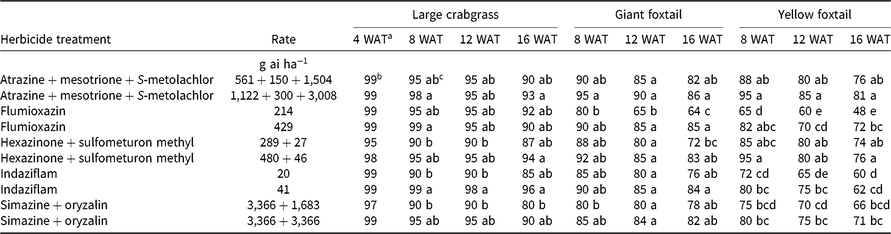
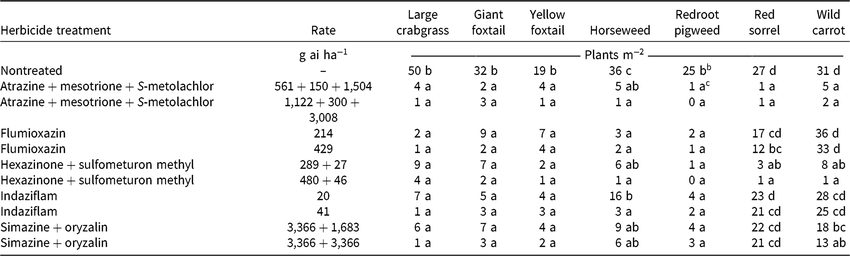
For large crabgrass, herbicide treatment differences were significant only at 8, 12, and 16 WAT (Table 2). By 8 WAT, atrazine plus mesotrione plus S-metolachlor (1,122 + 300 + 3,008 g ai ha−1), flumioxazin (429 g ai ha−1), and indaziflam (41 g ai ha−1) controlled large crabgrass at least 98%, higher than 90% with hexazinone plus sulfometuron methyl (289 + 27 g ai ha−1), indaziflam (20 g ai ha−1), and simazine + oryzalin (3,366 + 1,683 g ai ha−1). Similar treatment differences occurred later in the season, when large crabgrass control ranged from 90% to 99% at 12 WAT and 80% to 96% at 16 WAT. Indaziflam at 41 g ai ha−1 controlled large crabgrass at least 96% throughout the summer. Large crabgrass density data at 16 WAT also revealed 80% to 98% reduction compared to the nontreated control (Table 3). Ahrens and Mervosh (Reference Ahrens and Mervosh2013) reported excellent control of large crabgrass with indaziflam at 80 g ai ha−1. Whaley et al (Reference Whaley, Armel, Wilson and Himes2006) obtained 90% control of large crabgrass in corn (Zea mays L.) at 12 WAT with atrazine plus S-metolachlor (1,120 + 870 g ai ha−1).
Annual grass weed control with different PRE treatments at Hamden, CT.

a Abbreviations: ai, active ingredient; WAT, weeks after treatment.
b Means averaged over 2 yr.
c Means within a column followed by the same letter are not significantly different according to the “Adj = simulate” option in SAS PROC. GLIMMIX at P = 0.05.
Weed species density within tree row at 16 WAT under different PRE treatments at Hamden, CT.a

a Abbreviations: ai, active ingredient; WAT, weeks after treatment.
b Means averaged over 2 yr.
c Means within a column followed by the same letter are not significantly different according to the “Adj = simulate” option in SAS PROC. GLIMMIX at P = 0.05.
Giant and yellow foxtail control was assessed at 8, 12, and 16 WAT because of their late emergence (Table 2). By 8 WAT, maximum giant foxtail control (95%) occurred with atrazine plus mesotrione plus S-metolachlor (1,122 + 300 + 3,008 g ai ha−1), which was higher than 80% with flumioxazin (214 g ai ha−1) and simazine plus oryzalin (3,366 + 1,683 g ai ha−1). Similar treatment differences were observed by 12 WAT. By 16 WAT, all PRE treatments except for flumioxazin (214 g ai ha−1), hexazinone plus sulfometuron methyl (289 + 27 g ai ha−1), indaziflam (20 g ai ha−1), and simazine plus oryzalin (3,366 + 1,683 g ai ha−1) controlled giant foxtail at least 82%. Ritter and Kaufman (Reference Ritter and Kaufman1989) also observed reduction in giant foxtail control in soybean from 78% in June to 51% in August with PRE application of oryzalin (2,200 g ai ha−1). In another field study, giant foxtail was controlled ≥81% by 12 WAT with atrazine plus S-metolachlor at 1,120 +870 g ai ha−1 (Whaley et al. Reference Whaley, Armel, Wilson and Himes2006).
Yellow foxtail was controlled ≥82% by 8 WAT with atrazine plus mesotrione plus S-metolachlor or hexazinone plus sulfometuron methyl, regardless of application rate, and flumioxazin at 429 g ai ha−1 (Table 2). Minimal yellow foxtail control of 65% occurred with flumioxazin (214 g ai ha−1), similar to ≤75% with indaziflam (20 g ai ha−1) or simazine plus oryzalin (3,366 + 1,683 g ai ha−1). At 12 WAT, yellow foxtail control varied from 60% to 85%. Atrazine plus mesotrione plus S-metolachlor and hexazinone plus sulfometuron methyl, regardless of application rate, maintained ≥80% control. Similar treatment differences occurred at 16 WAT, when atrazine plus mesotrione plus S-metolachlor (1,122 + 300 + 3,008 g ai ha−1) was still highly effective PRE treatment with 81% control of yellow foxtail. All PRE treatments by 16 WAT reduced within-row densities ≥63% for yellow foxtail and ≥72% for giant foxtail compared with the nontreated control (Table 3).
Although the control of annual grasses was numerically higher with atrazine plus mesotrione plus S-metolachlor (1,122 + 300 + 3,008 g ai ha−1) than with simazine plus oryzalin (3,366 + 3,366 g ai ha−1), significant differences occurred only with respect to yellow foxtail. This result could be due to the more persistent nature of S-metolachlor, which has a half-life of >200 d (US EPA 1980) compared with oryzalin with a half-life of 20 d (PMEP 1993). Previous researchers also reported improved control of many weed species by herbicide mixtures with multiple modes of action (Colby Reference Colby1967).) Additionally, a synergistic effect of atrazine plus mesotrione has been reported on several weed species (Abendroth et al. Reference Abendroth, Martin and Roeth2006; Armel et al. Reference Armel, Wilson, Richardson and Himes2003; Bollman et al. Reference Bollman, Kells and Penner2006).
Annual Broadleaf Weed Control
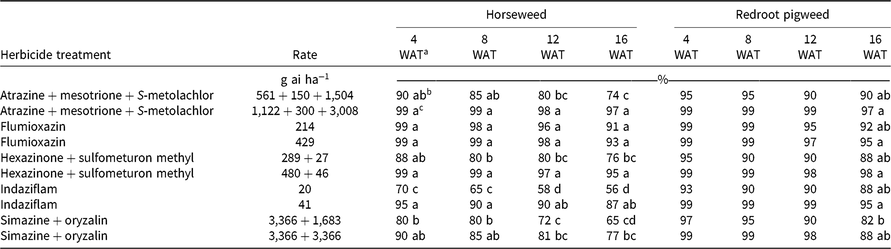
Horseweed was controlled >85% throughout the summer with atrazine plus mesotrione plus S-metolachlor (1,122 + 300 + 3,008 g ai ha−1), flumioxazin (≥214 g ai ha−1), hexazinone plus sulfometuron methyl (480 + 46 g ai ha−1), and indaziflam (41 g ai ha−1) (Table 4). Low rates of both atrazine plus mesotrione plus S-metolachlor (561 + 150 + 1,504 g ai ha−1) and hexazinone plus sulfometuron methyl (289 + 27 g ai ha−1), and the higher rate of simazine plus oryzalin (3,366 + 3,366 g ai ha−1) provided at least 80% horseweed control through 12 WAT, after which control was reduced to approximately 75%. With indaziflam (20 g ai ha−1) and simazine plus oryzalin (3,366 + 1,683 g ai ha−1), horseweed control did not exceed 80% and 65% by 4 and 16 WAT, respectively. Horseweed density data at 16 WAT also corresponded with percent control, indicating a reduction of 55% to 97% compared to the nontreated control, depending upon herbicide treatment and application rate (Table 3). Ahrens (Reference Ahrens2005) reported excellent (>90%) control of horseweed at 12 WAT with hexazinone plus sulfometuron methyl (572 + 55 g ai ha−1). Weston et al. (Reference Weston, Barlow and Ganske2005) documented more effective control of annual broadleaf and grassy weeds 12 WAT with hexazinone plus sulfometuron-methyl at 63 to 253 g ai ha−1 than simazine plus oryzalin (2,240 + 1,120 g ai ha−1).
Annual broadleaf weed control with different PRE treatments at Hamden, CT.

a Abbreviations: ai, active ingredient; WAT, weeks after treatment.
b Means averaged over 2 yr.
c Means within a column followed by the same letter are not significantly different according to the “Adj = simulate” option in SAS PROC. GLIMMIX at P = 0.05.
Redroot pigweed was controlled ≥90% from 4 through 12 WAT without significant treatment differences (Table 4). At 16 WAT, atrazine plus mesotrione plus S-metolachlor and flumioxazin, regardless of application rate, hexazinone plus sulfometuron methyl (480 + 46 g ai ha−1), and indaziflam (41 g ai ha−1), controlled redroot pigweed ≥90%, significantly higher than 82% with simazine plus oryzalin (3,366 + 1,683 g ai ha−1). Within-row density of redroot pigweed was reduced 84% to 100% compared with the nontreated control at 16 WAT (Table 3). The high level of redroot pigweed control with atrazine plus mesotrione plus S-metolachlor or flumioxazin agrees with reports by Bijenzadeh and Ghadiri (Reference Bijenzadeh and Ghadiri2006) and Mahoney et al. (Reference Mahoney, Shropshire and Sikkema2014).
Biennial and Perennial Broadleaf Control
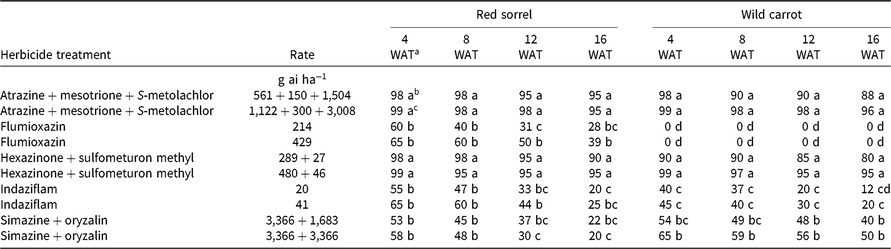
Atrazine plus mesotrione plus S-metolachlor and hexazinone plus sulfometuron methyl, regardless of application rate, provided >80% PRE control of red sorrel and wild carrot throughout the summer (Table 5). Flumioxazin had no effect on PRE control of wild carrot, whereas PRE control of red sorrel with flumioxazin did not exceed 65%. With any application rate of indaziflam or simazine plus oryzalin, PRE control of red sorrel and wild carrot did not exceed 65% at any evaluation time. Both red sorrel and wild carrot density data also revealed similar reduction compared to the nontreated control (Table 3).
PRE control of biennial and perennial broadleaf weeds with different PRE treatments at Hamden, CT.

a Abbreviations: ai, active ingredient; WAT, weeks after treatment.
b Means averaged over 2 yr.
c Means within a column followed by the same letter are not significantly different according to the “Adj = simulate” option in SAS PROC. GLIMMIX at P = 0.05.
In this study, Canaan fir has demonstrated excellent levels of tolerance to all PRE treatments. Prepackaged mixtures of atrazine plus mesotrione plus S-metolachlor or hexazinone plus sulfometuron methyl, regardless of application rate, effectively controlled most of the weed species evaluated in this study. Flumioxazin (≥214 g ai ha−1), indaziflam (41 g ai ha−1), and mixtures of simazine plus oryzalin, regardless of application rate, were effective on horseweed, large crabgrass, and redroot pigweed, whereas the PRE control of green and yellow foxtails, red sorrel, and wild carrot was in the poor to fair range, depending upon the application rate. The prepackaged mixture of atrazine plus mesotrione plus S-metolachlor is currently not labeled for weed control in Christmas trees. Therefore, further research is required to evaluate this prepackaged mixture for tolerance of other Christmas tree species.
Acknowledgments
The author acknowledges Richard Jaynes, Sally Jaynes, and Burton Jaynes for providing the research site, and Katherine Diehl for her help in data collection on this project. Partial funding from the Connecticut Christmas Tree Growers Association is greatly appreciated. No conflicts of interest have been declared.