Introduction
Before the advent of Griseofulvin between the 1920s and 1950s, radiation therapy for hair removal was widely used for the treatment of tinea capitis of the scalp. The number of children who have undergone this treatment is estimated at 200,000 worldwide. Reference Rebollo, López-Barcenas and Arenas1
In Tunisia, given the frequency of ringworm during this period, radiotherapy has been widely used. It was often administered by poorly qualified technicians and poorly supervised in local dispensaries, which could be the cause of exceeding the recommended doses and/or excessive exposure time. The number of patients irradiated in Tunisia for ringworm in the sixties would be 12,500 cases. Reference Maalej, Frikha, Kochbati, Bouaouina, Sellami and Benna2
It is known that the first irradiation for ringworm was carried out in 1922 and that the last was delivered in 1963. It was carried out using non-standardised machines with an arbitrary choice of the doses delivered. Reference Maalej, Frikha, Kochbati, Bouaouina, Sellami and Benna2
According to Tunisian studies, radiation-induced skin carcinomas represent 4·6–8·5% of all skin carcinomas. Reference Maalej, Frikha, Kochbati, Bouaouina, Sellami and Benna2–Reference Fazaa, Cribier, Zaraa, Zermani, Maalej and Zouari4 The occurrence of skin tumours of the scalp in patients who underwent radiation hair removal therapy in childhood was more common than in non-irradiated subjects. Reference Maalej, Frikha, Kochbati, Bouaouina, Sellami and Benna2,Reference Shore, Moseson, Xue, Tse, Harley and Pasternack5,Reference Albert and Omran6
We therefore propose, through this work, to study the epidemiological–clinical profile as well as the different therapeutic modalities of malignant skin tumours of the scalp occurring in patients who underwent radiotherapy for ringworm during childhood.
We believe that our study, reporting 137 patients presenting 200 tumours of the scalp, is among the largest series of radioactive tumours induced on the scalp ever reported.
Methods
This is a bi-centric retrospective study, extending over a period of 41 years, which collected 137 patients with 200 tumours of the scalp treated in the Dermatology Department of Charles Nicolle Hospital and/or in the Radiotherapy Department of the Salah Azaiz Institute between January 1970 and December 2010, that is, over a period of 41 years.
These patients were selected after noting a history of depilatory radiotherapy for ringworm in childhood in the clinical records of all patients with scalp tumours. We studied the epidemiological, clinical, therapeutic and evolving characteristics of this population.
The collected data were analysed with Microsoft Excel® software. We calculated simple frequencies and relative frequencies for the qualitative variables (percentages), as well as means, medians and extreme values (minimum and maximum) for the quantitative variables.
Results
Over a period of 41 years from January 1970 to December 2010, 1,546 malignant skin tumours of the scalp were identified, with 38·6 cases per year. Among the 1,546 malignant scalp tumours, 137 cases had a history of hair removal radiotherapy for ringworm in childhood or 3·4 cases/year. They represent 8·8% of patients with scalp tumours.
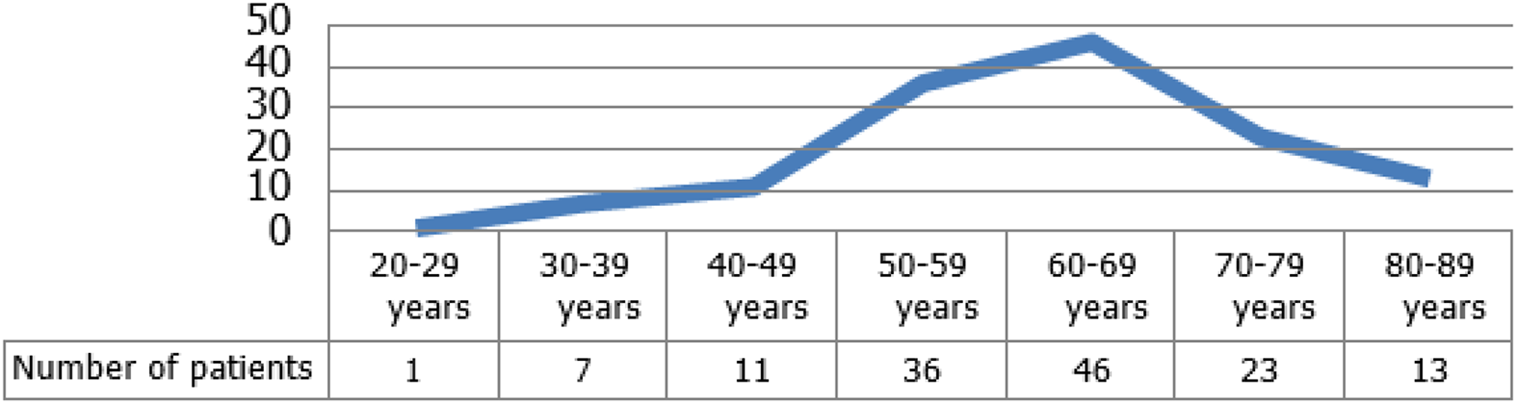
The average age of consultation was 56·6 years, and the peak frequency was between 60 and 69 years (Figure 1).
Distribution of patients by age group.

The sex ratio M/F was 3. The average age of the patient during hair removal radiotherapy was 8 years, with an extreme of 5–12 years. The main parameters of hair removal radiotherapy administered to patients could not be specified, namely the technique, energy and nature of the radiation used as well as the total dose and the dose per fraction administered. The number of sessions was specified in 98 patients (71%). Eighty-one patients (82%) had a single session. Ten patients (10%) had two sessions. Only seven patients had more than two sessions (7%).
The first irradiation for ringworm took place in 1922, and the last was in 1963. The average latency between depilatory radiotherapy and the appearance of radiation-induced tumours was 42·6 years.
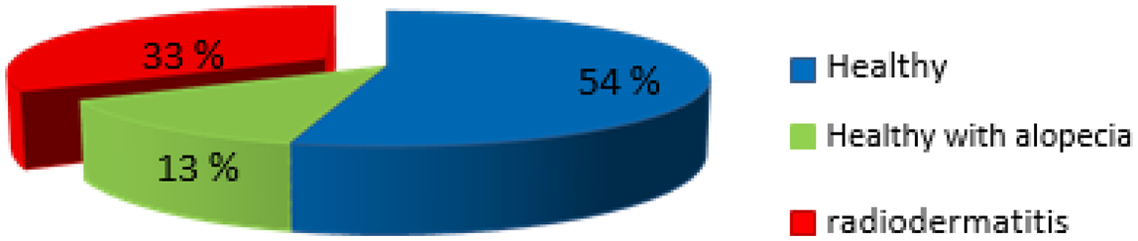
Radiation dermatitis was found in 33% of cases. Radiodermatitis was associated in all the cases with alopecia (Figure 2).
Distribution according to the condition of the scalp.

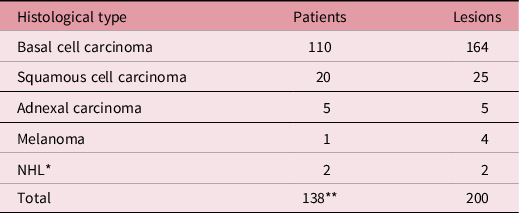
For the 137 patients reported in our work, we have recorded 200 lesions, that is, 1·45 lesions/patient. These lesions were unique in 105 patients (76·6%) and multiple (2 tumours) in 32 patients (23·3%) of cases. They were mainly located at the temporal and parietal levels (40·6% and 38%, respectively). In 73% of cases, ulceration was the most frequent macroscopic aspect. The predominant histological type was basal cell carcinoma in 82% of cases. In 12·5% of cases, it was a squamous cell carcinoma (25 cases). The remainder of the tumours were adnexal, melanoma and non-Hodgkin’s malignant lymphoma (Table 1).
Histological types

* Non-Hodgkin’s malignant lymphoma.
** One patient simultaneously had two basal cell carcinomas and one squamous cell carcinoma.
The treatment modalities were specified for 127 patients (92·7%). The therapeutic modalities used were surgery, radiotherapy and chemotherapy, exclusively or in combination.
Radiation therapy has been the main treatment modality in 77·3% of cases, followed by surgery in 43% of cases. The radiotherapy techniques used were high energy external radiotherapy (RT) using Cobalt 60 (Co60) Gamma photons and/or electrons; external RT of low energy using X photons; contact RT (contact therapy) and/or low-dose brachytherapy.
In our series of 106 patients, 72 patients had external radiotherapy (68%), 24 patients had contact radiotherapy (22·6%) and 31 patients had low-dose brachytherapy (29·2%).
The prescribed doses were 64 Gy for post-operative RT of non-basal cell carcinomas with healthy excisional limits and 70–74 Gy for exclusive RT (tumour in place) and post-operative radiotherapy with tumour excisional limits.
Skin toxicity was categorised according to the Radiation Therapy Oncology Group (RTOG) grading scale. The adverse effects of radiotherapy were graded as 2–3 radiodermatitis in 42% of cases. No grade 4 radiodermatitis was observed.
The follow-up could be specified for 73 patients. The median follow-up was 34 months, with extremes ranging from 0 months to 124 months.
Four of our patients were progressing at the end of treatment, and nine presented local recurrences. The average time to recurrence was 36 months. The salvage treatment was surgery for local recurrences. The patients who had salvage surgery were in remission. Six distant recurrences were observed. All of these recurrences were basal cell carcinomas treated by surgery. No metastasis was recorded in our patients.
Discussion
Treatment of ringworm consisted of quarantining infested children and applying various preparations, followed by tearing the hair. This treatment could last from several months to a few years without being very effective. Reference Tilles, Cribier, Halioua, Revuz and Tilles7,Reference Cipollaro and Brodey8
Radiation therapy has been a revolution and a standard in the treatment of ringworm. X-rays were an effective treatment for more than half a century, from 1904 until the 1960s. Reference Tilles, Cribier, Halioua, Revuz and Tilles7 However, with the discovery of Griseofulvin, but above all, with the discovery of the formidable carcinogenic effects of ionising radiation, hair removal radiotherapy was completely abandoned. Reference Rebollo, López-Barcenas and Arenas1
Unfortunately, it is difficult to estimate the incidence of radiation-induced skin cancers of the scalp in Tunisia due to the absence of useful records. The patients were often treated with non-standardised machines and arbitrary doses were frequently delivered. Reference Maalej, Frikha, Kochbati, Bouaouina, Sellami and Benna2 The various Tunisian publications concerned patients with scalp tumours in whom the history revealed a history of ringworm treated with radiotherapy. Reference Maalej, Frikha, Kochbati, Bouaouina, Sellami and Benna2–Reference Fazaa, Cribier, Zaraa, Zermani, Maalej and Zouari4,Reference Mseddi, Bouassida, Marrekchi, Khemakhem, Gargouri and Turki9,Reference Frikha, Boudaya, Sellami, Bahloul, Mseddi and Turki10 Therefore, in our institute, it is customary to systematically look for a history of ringworm treated with radiotherapy and to consider the possibility of radiation-induced cancer.
The radiation-induced character is often easy to evoke in the presence of signs of radiodermatitis. In the absence of such lesions, the diagnosis can be retained in the presence of a history of radiotherapy, the occurrence of the tumour in the area of irradiation, and especially in the presence of multiple tumours. Reference Zaraa, Ben Taazayet, Zribi, Chelly, El Euch and Trojjet11
In our study, we report 137 patients with 200 radio-induced tumours of the scalp.
Radiation hair removal therapy has been undergone during childhood or adolescence with an average age of 8 years and extremes ranging from 5 to 12 years. The average age found in our work is comparable to that reported in other Tunisian series but slightly higher than that of foreign series (7·5 to 7·9 years). This difference could be explained by the earlier treatment of scalp ringworms in developed countries. Reference Maalej, Frikha, Kochbati, Bouaouina, Sellami and Benna2,Reference Fazaa, Cribier, Zaraa, Zermani, Zeglaoui and Zouari3,Reference Shore, Moseson, Xue, Tse, Harley and Pasternack5,Reference Albert and Omran6,Reference Ron, Modan, Preston, Alfandary, Stovall and Boice John12,Reference Boaventura, Oliveira, Pereira, Soares and Teixeira-Gomes13
We also observed a long latency period between hair removal radiotherapy and the onset of scalp lesions with an average of 42·6 years and extremes of 22 and 69 years. Reference Shore, Moseson, Xue, Tse, Harley and Pasternack5–Reference Cipollaro and Brodey8 This is explained by the so-called stochastic or random effect of ionising radiation, to which is added a relatively long consultation period, which is itself attributable to the slow development of skin tumours, and in particular basel cell carcinoma (BCC), which is the most frequent.
In our study, the average consultation age was 56·5 years, with a peak frequency between 60 and 69 years. A Tunisian series by Zaraa et al. reported that the mean age was over 50 years and the peak frequency was between 60 and 70 years. Reference Zaraa, Ben Taazayet, Zribi, Chelly, El Euch and Trojjet11 These results contrast with the results of the literature. In fact, the occurrence of radiation-induced skin tumours is reported at an earlier age, often less than 50 years, while sporadic tumours are described at an older age, often greater than 65 years. Reference Shore, Moseson, Xue, Tse, Harley and Pasternack5,Reference Frikha, Boudaya, Sellami, Bahloul, Mseddi and Turki10,Reference Ron, Modan, Preston, Alfandary, Stovall and Boice John12
This could be explained by the ageing of the cohort studied and the fact that most patients in Tunisia often consult late compared to other developed countries, due to a lack of awareness of the nature of the lesions and possible inaccessibility to health care services, especially in rural zones. It would have been more accurate to specify the age of the onset of the lesion. However, this parameter was not systematically included in the files and records consulted.
Our results are consistent with those of the Tunisian literature concerning the male predominance with a sex ratio of H/F of 3. Reference Maalej, Frikha, Kochbati, Bouaouina, Sellami and Benna2,Reference Frikha, Boudaya, Sellami, Bahloul, Mseddi and Turki10,Reference Zaraa, Ben Taazayet, Zribi, Chelly, El Euch and Trojjet11 This is explained by the higher exposure to sunlight, which was most often occupational, and the higher rate of schooling among boys in the 1960s.
Clinically, the radiation-induced tumours reported in our series were in 73% of cases in the form of ulceration. In the literature, an often pigmented nodular appearance has been reported, which is specific to both primary and radio-induced BCCs. Reference Fazaa, Cribier, Zaraa, Zermani, Maalej and Zouari4,Reference Zargari14
All the authors agree that BCC is the predominant histological type for both radiation-induced skin tumours and primary skin tumours. Reference Shore, Moseson, Xue, Tse, Harley and Pasternack5,Reference Mseddi, Bouassida, Marrekchi, Khemakhem, Gargouri and Turki9,Reference Ron, Modan, Preston, Alfandary, Stovall and Boice John12–Reference Zargari14 Our series nevertheless reported a good number of squamous cell carcinomas, that is, 25 lesions in 20 patients (12·5%). We have even reported cases of adnexal tumours. We also reported two cases of cutaneous lymphoma and one case of scalp melanoma.
Radiation-induced cancer of the scalp is treated with radiation therapy, surgery or a combination of the two. This decision is made on a case-by-case basis within a multidisciplinary consultation meeting.
The majority of studies have used surgery alone as a therapeutic modality. Reference Fazaa, Cribier, Zaraa, Zermani, Maalej and Zouari4,Reference Sloane15–Reference Karagas, McDonald, Greenberg, Stukel, Weiss and Baron17
In the series by Maalej et al., radiotherapy was the treatment of choice for 98 patients with radiation-induced scalp tumours. Radiotherapy was administered to 74 patients (75%). Reference Maalej, Frikha, Kochbati, Bouaouina, Sellami and Benna2 Short et al. also reported a case with multiple radiation-induced BCC’s of the scalp treated by radiotherapy with satisfactory therapeutic and aesthetic results. Reference Short, Calman, Ross and du Vivier18 In our series, radiotherapy was the modality of choice for the treatment of scalp lesions. About 77% of our patients had radiotherapy; it was post-operative in 29% of cases and exclusive in 48·9% of cases. The radiotherapy treatment in our study was well tolerated considering that the scalp had already been irradiated in the past. Indeed, no grade 4 radiodermatitis was observed.
Our study suffered from shortcomings in tracking. A majority of our patients were lost to follow-up at the end of treatment. Among the patients monitored, there were nine local recurrences which could be treated and six newly appearing basal cell carcinomas distant from the first tumour which could be operated on.
This risk of new basal cell carcinomas is classic for sporadic basal cell carcinomas and is increased for radio-induced BCCs. Reference Zargari14,Reference Ekmekçi, Bostanci, Anadolu, Erdem and Gürgey19 Karagas et al. reported a relative risk (RR) equal to three for developing a new lesion in subjects irradiated for ringworm. Reference Karagas, McDonald, Greenberg, Stukel, Weiss and Baron17 It therefore seems essential to us to stress to patients the importance of regular follow-up with careful clinical monitoring in order to diagnose any relapses in time and thus ensure the patient is receiving adequate treatment.
Conclusion
Radiation-induced skin tumours of the scalp seem clinically and pathologically comparable to non-radiation-induced tumours, said to be sporadic or primary. These differences appear to be limited to certain epidemiological characteristics, including frequency and age of onset, sex ratio and multiplicity. However, therapeutic radiation-induced tumours appear to be more difficult to manage because of the frequency of radiodermatitis and the multiplicity of lesions. Furthermore, patients who have developed a scalp tumor, in particular those with a history of radiotherapy for ringworm, which should systematically be looked for in the face of any lesion of the scalp, require regular monitoring by careful clinical examination and more particularly of the scalp.
Funding Statement
This research received no specific grant from any funding agency, commercial or not-for-profit sectors.
Conflict of Interest
This manuscript has not been previously published and is not currently under consideration by any other journal. Additionally, all of the authors have approved the contents of this paper and have agreed to the submission policies. Each named author has substantially contributed to conducting the underlying research and drafting this manuscript.
Additionally, to the best of our knowledge, the named authors have no conflict of interest, financial or otherwise.