As is well known, the cooperative dairying movement in Denmark was extremely successful, not just in terms of increasing production and quality, but also in terms of the number of cooperatives and their size.Footnote 1 Recent work has reaffirmed the crucial role of cooperatives for this expansion.Footnote 2 Moreover, this development was apparent from a far earlier date than in most other countries, taking off already in the 1880s.
We explore the role of contracts and enforcement through the legal system as a facilitator of this success, and thus contribute to an extensive literature on the interaction between law and economics and the institution of cooperatives in particular. A large body of primary archival material, covering the minutes of meetings for 215 creameries over a period of about 30 years,Footnote 3 enables us to delve inside the black box of how the cooperatives actually worked in practice.Footnote 4 It used to be a popular belief in Denmark that the cooperatives preferred to be “masters of their own houses” without resort to the legal system at large.Footnote 5 We demonstrate to the contrary that the Danish cooperatives frequently resorted to legal advice and the court system. To our knowledge, no other study clearly and unambiguously documents the practical role of contracts and the law in an institutional system which for many decades defined the economic success of a country, and became the envy of dairy farmers around the world.
ECONOMICS OF INSTITUTIONS

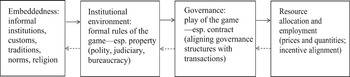
We base our analysis within the framework offered by Williamson and the “new institutional economics.” We reproduce in a simplified form his Figure 1 here for illustrative purposes.Footnote 6 Within this framework, previous work by Kevin O'Rourke has focused on the first level and shown that it was a lack of social capital which meant that Ireland, Denmark's main competitor for the important British market, largely failed to create working cooperatives.Footnote 7 The peace-loving, homogeneous nature of the Danes, by contrast, led to their success.Footnote 8
However, a number of things lead us to look for more reasons for the success in Denmark than those attributed to the failure in Ireland. First, some have criticized the emphasis on necessarily rather intangible concepts such as trust in an economic context, in particular Williamson, who points out that it is simply a new name for information and enforcement, which are well understood in economics.Footnote 9 Second, Pelle Ahlerup, Ola Olsson, and David Yanagizawa have shown that the marginal effect of social capital decreases with institutional strength, and in fact vanishes when institutions are very strong. So the contrast O'Rourke describes between Denmark and Ireland is certainly informative, and the social capital of the Danes was certainly a necessary condition for the success of the Danish dairy industry. It was not, however, sufficient, as the Williamson framework shows.
Thus, in terms of Williamson's model, between the first level associated with human capital and the fourth, where standard profit maximization is necessary for the working institution, there are two more stages which Denmark also had to get right: the “formal rules of the game” and the “play of the game.” We first consider the latter. Using minute books of a large sample of Danish cooperative creameries, we document in detail that contracts and their formal enforcement were critical. These were necessary to avoid various incentive problems inherent in cooperative dairying. Our sources allow us to show that the Danish legal system enforced these contracts. We end with a discussion of this, including a brief comparison to other countries, including of course Ireland, where it was an important legal distinction with Denmark which made such contracts unworkable.
PLAY OF THE GAME: CONTRACTS, MONITORING, AND ENFORCEMENT
Incentive Problems
New technology can lead to such radical changes to the mode of production that new governance structures are required to deal with the resulting incentive problems. One such example is the steam driven continuous cream separator invented in 1878 and improved over the next few years. The invention had a revolutionary impact on the production of butter in Denmark. Herds were generally small and because previous technology was not well suited to extracting cream from milk which had been transported by road, butter was generally produced directly on the farm.Footnote 10 Wholesalers, however, preferred large homogeneous batches of butter as these fetched higher prices in world markets—even if an individual peasant produced high-quality butter, she could rarely obtain a good price for it.Footnote 11 The continuous cream separator could however extract cream from milk efficiently even when it had been transported some distance. Thus, by collecting the output of many herds, large homogeneous batches of butter could be produced economically. However, the shift from a system where the farmer made her own butter and received the rent thus created, to large-scale manufacturing of butter from milk supplied by many farms, created new incentive problems. Indeed, the new process separated the supplier of raw milk and the producer of butter.
The minimum efficient scale for the new technology corresponded to milk supplied by about 400 cows.Footnote 12 Building a creamery which made use of the new technology and procured its input from many herds required a considerable investment in assets which were relatively specific. As the creamery had to be built first, the threat of holdup by suppliers was real. Anyone building a creamery would want to secure an adequate supply of milk until the investment was amortized. The solution that came to dominate in Denmark was to form a cooperative, whereby a group of herdowners collectively owned and financed the creamery and hired a manager. Most importantly, members were bound to deliver their cows’ output to the cooperative, even if it could possibly buy milk from outsiders.
Even with a cooperative, however, certain incentive problems remained, which the Danish cooperatives solved through the use and enforcement of statutes. The governance structure of a cooperative was defined by its articles of association which all members approved. In effect, the articles created a contract between each member and the cooperative. The statutes were similar in structure and content and generally committed each member to (a) supply all his milk not used in his own household to the cooperative; (b) for a given period of time, typically the length of the loan period, and (c) without adulteration; (d) observe certain specified standards of cleanliness; (e) observe certain standards of feeding the cows; (f) share in the profits according to a specific formula, typically the amount of milk delivered in the year; but also (g) share in any losses which might arise and any outstanding debt, both according to a formula. In many cases, fines for breach of items (a) through (e) were put in writing.
We concentrate on the way the cooperatives mitigated two particular incentive problems: the risk of exit, and members’ temptation to adulterate the milk they delivered to the creamery. Our analysis relies on information extracted from the books of minutes of the general meeting and the board meetings of 215 cooperative creameries, roughly one-fifth of the 1100 that existed around 1900. Although these records vary considerably in detail from creamery to creamery, they generally reveal both what contracts were signed and how they were used; in particular, they document instances of breach, enforcement, and renegotiation. In the vast majority of cases, the names of the cooperative members are recorded in the minutes. They thus served as the collective memory of the cooperatives and, by recording evidence of collectively binding decisions in court cases, complemented the statutes and helped shape the future behavior of members.
Most of the cooperatives in our sample, 138 of 215, were established during the latter half of the 1880s, a period of strong growth both of the economy in general and Danish agriculture in particular. Where possible, we follow them up to World War I. For 160 creameries, we have access to the minute books from foundation until 1915. For a further 25, we have the books from the foundation, but some later years are missing. From 1888 onwards we have the minute books from more than 85 percent of the creameries in our sample that had started production.
In addition to the archival material on each creamery, we also make use of another data set compiled from the Mejeri-Driftsstatistikken (or Operational Statistics of the Creameries, henceforth MDS). This annual national survey of creameries was first published in 1898 and contains accounting data from the previous year. The publication was based on cooperatives’ voluntary reports about their financial and technical performance. At least 140 of the 215 creameries in our sample are represented at least once in MDS between 1897 and 1904. Finally, we have made use of newspapers and court transcripts where available.
We cannot guarantee that our sample is representative. There is some overlap between our sample of minute books and MDS. Ninety-eight of the creameries in our sample are represented among the 523 creameries who returned accounts for the period November 1903–November 1904. We compare the 98 that are in our sample with the remaining 424 creameries in terms of means and variance of year of formation, raw milk processed, and butter produced and find them to be quite similar. The only significant difference is for the variance of the year of formation: it is larger among the creameries not in the sample. On the other hand, the difference between the mean of those not in MDS but in our sample and the others is statistically insignificant. This offers at least some comfort, but it should be kept in mind that those creameries where the minute books have been kept are not necessarily the ones that were active and open minded enough to supply statistical material to the annual national survey.
In the following discussion, it will be useful sometimes to consider incidence levels in order to get an idea of, for example, the frequency of the types of fraud discussed. Calculating these presents some difficulties, however. We have, of course, the number of creameries included in the sample for each year. Fraud is not, however, usually committed by creameries, but rather by their members, the number of which we do not know, since it was rarely recorded in the handwritten minutes from the meetings. Occasionally, it was written down when the creamery began a new contractual period, but far from always. At the establishment of a cooperative the founders often set a goal for the number of members (or rather cows—usually 350–400) necessary. Having achieved this, however, they often went on to try to attract more members by offering a “rebate” in the form of a lower entrance fee. As a result, even the number of members recorded from foundation is often not very precise. So we cannot investigate the relative failure of cooperatives by reporting incidence per member, although it is worth noting that since a cooperative might easily have dozens of members the incidence expressed in this way would usually have been rather small—reinforcing our impression about the success of the contracts and the power of example for deterring misbehavior. What we then do is to consider the cooperative as a unit and report incidences per creamery in order to get some idea of how frequently individual cooperatives had to deal with the various issues we discuss below.
THE DANGER OF EXIT
A cooperative's future viability was threatened by member exit in three distinct ways. First, because of the fixed cost of building the creamery, exit would increase average costs, lowering the return to remaining members (this would be particularly true if exiting members were not replaced or when there was no milk to buy from nonmembers). Second, as members were jointly liable for the existing debt, exit would increase the liability of those who remained.Footnote 13 These two effects could potentially combine to lead to a wave of exits as decreased profits and increased liability made the option of leaving the cooperative ever more appealing. Such a wave, in the extreme, would threaten the survival of the cooperative.Footnote 14 A third effect is more specific and relates to the collection and carting of the milk to the creamery. The vast majority of creameries organized this collectively by agreeing on the number and shape of collection routes. Where you were on the collection route mattered to the individual farmer for two reasons. It determined when your milk would be collected and hence when you had to start milking and it determined when you would get the skimmed milk returned to feed to your pigs and calves. Being the furthest away from the creamery was thus clearly not an attractive proposition, and the design of the routes was the source of much debate and ruction in the cooperatives.
The entry condition for a creamery thus depended on its future viability, that is its ability to obtain sufficient quantities of milk for a long enough period to pay back the necessary loans. The cooperatives attempted to secure such a supply in their statutes. They required members to supply their entire output to the creamery for the whole of the loan period, typically ten years. We have complete records of the statutes for 49 of the creameries in our sample.Footnote 15 Exit was either not allowed or required the permission of the board or a general meeting. We observe a large number of different rules, but they all fall in one of two categories: exit is either forbidden or costly (only two creameries are very vague about exit).Footnote 16 Among the 49 in our sample, 19 explicitly prohibit exit within the loan period and 28 allow exit upon payment of a fee.
Those statutes that allowed exit typically specified a “fine.” The cost of exit almost always included the payment of the exiting member's share of any remaining debt and the loss of his share in the assets of the cooperative, and frequently an additional monetary compensation. A payment per cow was only mentioned in two cases. At least part of the costs of exit and in particular the payment of the debt and the forfeit of the assets are almost certainly a penalty rather than simply compensation for damages caused by the exit, a conclusion reached by a court in a fraud case.Footnote 17 However, since Danish law, unlike English (and thus Irish) law, allows penalty clauses in contracts, as discussed in the next section, the court also enforced this perceived penalty.
Despite the penalties, exits did actually occur. One hundred and eighteen creameries out of the 215 in our sample, i.e., 55 percent, experienced a total of 257 cases of exits. These cases include both requests to leave a cooperative and refusals to deliver milk, but they exclude members who exercised their right to leave at the end of a loan period. Exit attempts sometimes concerned an individual and sometimes entire groups as large as 112. The level of detail recorded for each of these cases also varies considerably, partly we suspect because the laws were so precisely written that they were simply implemented as a matter of routine.
Apart from two cases which are hard to classify, exits fall into one of three categories.Footnote 18 The first and most numerous consists of members who requested permission to leave the creamery and where the request was granted. There are a total of 142 such instances, corresponding to 55 percent of all cases. The second group consists of those who made a similar request but were rejected, making up 50 (19 percent) of all occurrences. Many times exit was either prevented or at least postponed. The third set consists of illegal exits, where members breached the terms by withholding all or part of their milk. These make up 63 (25 percent) of the observed cases and mostly lead to permanent exit.
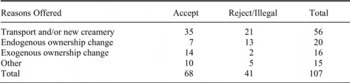
Since leaving a cooperative during the loan period was more costly than at its end, members must have had strong reasons for wanting to exit early. One hundred and seven of the cases provide a reason for the attempted separation. Table 1, where the illegal exits and the rejected requests have been merged, summarizes the information about the reason for exit.
REASON FOR EXIT

Notes:
The table shows the 107 cases in which a reason for exit was provided in the minutes.
Sources:
See the text.
Clearly transportation problems played a central role, and given that transportation costs accounted for 25–30 percent of the running costs of a creamery, this is not surprising. Disputes often arose with the formation of a new, more conveniently located, cooperative. Some peripheral members had to deliver their milk directly to the creamery or to a nearby road, or simply had to start milking very early. A new nearby creamery that would pick up at the farm and at a more convenient time would then be an attractive alternative. This argument is made in more than half of the cases (53 percent) and is successful in two thirds of these. Distant members rarely represented a great loss to the creamery since they contributed significantly to transportation costs, nor was their exit likely to lead to further exits.Footnote 19 Still, in one third of the cases, the request was rejected, typically because of the problems which the exit would cause for the collection routes.
A third of the cases in Table 1 arose because ownership of the herd had been transferred. They have been divided into those where the property was sold, referred to as endogenous, and those where the transfer of ownership was exogenous because the member was a tenant, because the herd came with the job such as teachers and priests, or because the owner died. In the endogenous cases, only a third of the cases were accepted whereas the vast majority of exogenous cases were accepted. The statutes typically allowed the transfer of membership in the relatively rare instances when properties were sold and one might have expected a higher degree of acceptances. However, it may be that new owners were less creditworthy and hence the liability of others would have been increased by accepting a new member. Although one can imagine potential contractual solutions to this, such as asking them to put up collateral, in reality someone who has just purchased a farm would be unlikely to be able to offer such assurances.
TIMING OF EXITS

Note:
The last five-year period is misleading because there are a relative small number of creameries where we have 30 years of observations.
It is notable that there are very few cases (3 out of 59) where dairy farmers breached the statutes by selling their produce outside a creamery. Such “exits” are given prominent place in David McCabe's paper, but upon closer consideration, they must be rare. Indeed only those relatively few members located close to market towns could find such alternative customers. We find a few cases of exit as a protest against a change in the statutes or a reaction to a perceived wrong.Footnote 20 Finally, the threat of exit was used proactively in a few cases in order to influence the decision of the creamery. A letter of September 1890 from a large dairy farmer to the board of a newly started cooperative is illustrative of the latter:
By checking the fat content of my milk and by comparing it to that of other cooperative members, I have become aware of the fact that the fat content of the milk supplied from many of the members is so low that it can only be explained by adulteration or by other kind of inadmissible conduct. I assume that the esteemed board will act vigorously upon this information now that I have called its attention to it so that it will not be necessary for me to carry the matter any further.Footnote 21
He continued by threatening to withhold his supply of milk, and the cooperative board took action in order to make this large member stay.
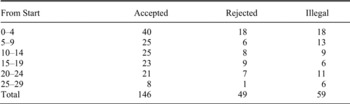
Table 2 gives exits in relation to the number of years since the founding of a creamery. Exits were clearly more common in the early years of membership of creameries—particularly in the first ten years, and even more so in the first five years. This seems evidence of a collective learning effect where members observe how others have been treated in the past.
DAMAGES IN CASE OF EXIT

Sources:
See the text.
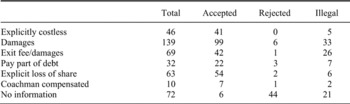
We have information about potential monetary sanctions in 185 cases. In only 46 of these was exit costless. Interestingly, creameries where at least one member left without penalty also faced relatively more requests for exit. The 37 creameries where at least one departure was free had on average 2.78 requested or actual exits, much higher than the 1.18 average for the whole sample. The remaining 139 withdrawals involved some form of compensation. Table 3 summarizes the information on damages.
Given that only a few of the statutes from the creameries in our sample include an exit fee or damages, it is interesting to see that this is the most common form of compensation. The actual size of the exit fee varies considerably from an almost symbolic amount to, in one case 50 kroner per cow, and in another, a total of 500 kroner.Footnote 22 There are also cases where the coachmen collecting the milk are explicitly compensated. Finally, there are some rejected exits where exit nonetheless happens and hence compensation is due.
THE RISK OF ADULTERATION
Beyond exit, cooperatives had to cope with the risk that the milk supply would be adulterated. In the mid-1880s, when cooperatives where in their infancy, M.C. Pedersen, an agricultural economist, stated that many dairy farmers spontaneously mentioned adulteration as the biggest threat to the creameries.Footnote 23 Another contemporary academic, Bernhard Bøggild, then Consulting Dairy Chemist to the Royal Agricultural Society of Denmark, identifies three broad types of adulteration of the raw milk supplied to the creamery: (a) the addition of something, such as water or skimmed milk, to the milk, (b) the extraction of cream from the milk, either by skimming or by taking milk from the cans after the milk had settled, and (c) not milking the cows clean by getting the last drop from the udder.Footnote 24 The consequence of all three forms of adulteration is that the amount of butter fat per pound of raw milk is reduced. Depending on how the cooperative compensated farmers, consequences could be dire.
During the early period and certainly before 1887, no reliable technology to test the “quality” of the raw milk in terms of its fat content was available, so members and other suppliers were simply paid by weight. A member would receive a fixed price for what he brought to the cooperative and a part of the surplus according to his share of the annual supply of raw milk.Footnote 25 With such a compensation scheme, adding water or the like increased the farmer's revenue from supplying milk and gave him a larger share of profits. Because the cost of producing butter depends mostly on the quantity of milk processed, such dilution also increased costs and consequently decreased profits. Skimming or not milking the cows clean only had a significant effect on the amount of butter produced, while the benefits to the fraudsters depended on what they did with the cream or milk.Footnote 26 Intuitively, others were harmed most by dilution and one might therefore expect punishment for this to be harsher.Footnote 27
The creameries gradually first introduced spot-checks on quality and then moved to payment based on cream content. Once they had converted fully to pay for quality, the concern about fraud was much reduced, since the fraudster would simply be paid less for his milk. Nonetheless, introduction of devices to measure the fat content of milk batches was slow and not completed until well after 1905.Footnote 28
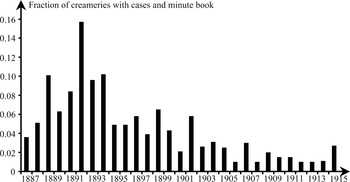
FRACTION OF CREAMERIES WITH RECORDED FRAUD CASES, 1887–1915

From our sample of 215 creameries, 102 have at least one case of fraud recorded (47 percent of creameries) and we find a total of 275 cases of fraud. We divide the number of cases in a given year by the number of creameries for which we had a minute book for that year to account for cooperative entry into the sample and incomplete survival of minutes (see Figure 2).
We see that most of the detected fraud takes place in the early years, between 1888 and 1894; by 1902 cases of fraud are trivial. This suggests either that suppliers became more honest over time, that the cooperatives became less successful in detecting fraud, or that this type of fraud simply became less relevant as the creameries all switched to paying according to quality—which however took many years after the invention of N. J. Fjord's control centrifuge in 1881. In Henriksen and Hviid, we illustrate, based on the present sample, the adoption of pay by cream or fat percent in the creameries.Footnote 29 Of the 134 cases for which we have evidence of this, only 62 percent had adopted quality pay in 1902, and thus regular testing of the milk at the creamery. The awareness of everyday use of a control device must have been the ultimate deterrent to fraud, but only if experience had taught the members that fraud was punished. This explains, we believe, the decline in the incidence of fraud.
The success of statutes in deterring fraud depended on the sanctions available in case of breach. Depending on the articles of association, these could include damages, penalties, and expulsion. Eighty-eight of the statutes in our sample made sanction explicit; of these, 45 percent include all three elements: damages, penalties, and exclusion. A full 80 percent allow for exclusion. Only one provides no information about sanctions.
The minutes rarely record how sanctions were decided or what was to be paid as penalty versus damages. Penalties are mentioned in 51 percent of the cases while damages are mentioned in 45 percent. One thing that can usually be observed is the size of the monetary amount to be paid, which was generally high. We find 70 cases where the member was excluded, the fine together with damages exceeded 500 kroner (the price of two or three cows at a time when herds were not usually larger than ten cows), or both of these. To some people such a penalty was likely ruinous. Fifty-nine of the 275 cases of fraud scattered in 42 cooperatives led to exclusion. Such highly visible actions may have had a profound impact in reducing future misbehavior by the creamery's members and beyond.
Looking specifically at exclusion as a possible sanction, Danish legal practice took the view that exclusion was justified in case of a “substantial breach of contract,” but not by an ordinary conflict of interest between the member and the cooperative. Also, exclusion of a member had to be sanctioned by the general meeting, if not explicitly delegated to others, for example, the board. The legal consequence of exclusion was, in principle, the same as in the case of illegal exit.Footnote 30
We rarely see cases of lenient treatment. The 1888 minutes of a cooperative in Funen tell us that a member was let off with a caution “because he is a poor man with many children.” But such forbearance was exceptional. The norm appears to be that if you have signed the rules, you abide by them or face the consequences. It might be that such cases were simply not usually recorded, but we find such a bias unlikely given the importance of the minutes as a record of the creamery, and moreover a record which might be (and sometimes was) used in court cases.
THE USE OF OUTSIDE ENFORCEMENT

Sources:
See the text.
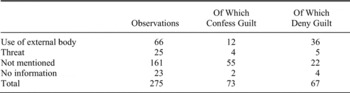
This is equally true when it comes to reliance on formal legal institutions, courts, lawyers, and the like, when milk was adulterated. Table 4 summarizes the information about outside involvement. In a small number of cases, 23, the record is so brief that we have no useful information. Of the 252 instances of fraud where the description is more substantial, some 161 simply do not mentions lawyers, the police or the courts (it could be of course that the accused were aware that such outsiders might be called upon). That leaves a third of the cases, where the cooperative's board either decided to or threatened to consult a lawyer, the police, or file a complaint with a court. Between 1895 where the first case appeared and up to 1915, 27 complaints involving cooperatives got as far as the High Court or one of the two Country Courts in Denmark, the vast majority of cases being dealt with in the local lower courts.Footnote 31
Precisely because cooperatives were able and willing to seek enforcement through the courts if necessary, it may seem remarkable that there are so few reported cases of fraud. However, with a clear set of rules which are cheaply and willingly imposed by the courts, potential wrongdoers would have a fairly clear idea of the consequences if they were caught. Members may have been willing to impose these strict rules on each other for cultural reasons, but it was more likely because fraud affected the creamery's profits and long-term survival. Members were probably not tolerant of wrongdoers because the cooperative had unlimited liability of the cooperative and problems there could put their investments in their herds at risk. This view is echoed by a report from the Department of Agriculture and Technical Instruction for Ireland, 1903:
The most interesting feature in every form of cooperation in Denmark is the extraordinary fidelity universally observed towards their own institutions by the people who participate in them. A member of a Danish Cooperative Society, deliberately violating the rules, would have certainly a very uncomfortable time of it in his district. Everyone feels that the creamery (or the slaughtery) has been organized to develop the people's industry, and that with its success or failure the welfare of the people must stand or fall, and it is really astonishing the extremely few cases in which expulsion of members took place because of fraud perpetrated upon their society. In this way, cooperation has materially assisted in the development of Danish character.Footnote 32
Relationships among suppliers were not the only ones mediated by contracts. As demonstrated elsewhere, contracts also structured the relationship between the cooperative and its manager.Footnote 33 The position of the manager as a hired specialist employee would create principle-agent problems in the cooperatives. These problems were partly addressed by a combination of annual employment contracts and board monitoring and partly by a job market where each managerial opening could expect a large number of applications. Nonetheless, most creameries went much further and included incentive measures in the manager's contract. These did not just relate to pay. For example, in 21 cases the manager had to provide a bond, with amounts ranging from 500 to 3,000 kroner. The contracts and the payment methods left very little room for fraud by the manager and in all our 215 dairies over the entire period, only 17 such cases are recorded in the minutes. Most of these were “small” transgressions such as using more milk or cream for his own household than was allowed by the contract. Other cases involved irregularities in the accounts. The modest frequency and size confirms the observation by Henry Hansman: “Boards scrutinize managerial performance closely and not uncommonly replace managers who are not performing well.” As with the other contracts, the cooperative stuck to the terms agreed even where this led to unexpected hardship for the manager. Cooperatives who were concerned with the risk shifted to the manager through the incentive schemes solved it by introducing a minimum wage in the contract.Footnote 34
The contracts drawn up by the cooperatives were thus of crucial importance because they mitigated incentive problems. Effective long-term contractual requirements to supply the cooperative exclusively reduced the temptation to exit. Specifying penalty clauses for adulteration made cheating less likely even if detection was uncertain. To have any effect, however, such contracts had to be enforceable, and it is here that the Danish legal environment played a crucial role.
RULES OF THE GAME: THE LAW AND COOPERATIVES IN DENMARK
The Danes, according to the Constitution of 1849, were guaranteed freedom of assembly and the freedom to form associations. Moreover, freedom to contract in regard to the law of property (aftalefrihed i formueretlige forhold) was a pillar of Danish law. Thus, the courts would tend to accept even statutes written by a cooperative with the toughest punishments. This could be relevant in cases where members wanted to exit.Footnote 35 Additionally, cooperatives involved what in the twentieth century were to become the Business Law, the Competition Law, and the Sale of Goods Act. The first two laws presented no obstacles to the cooperatives, unlike in some other countries as explained below, and the latter was supportive and for example relevant in cases where they had been supplied adulterated milk.Footnote 36
Despite this, Denmark had in fact no specific cooperative law by name until as late as 1999. In its place, a supplementary/complementary case law (udfyldende retsregler) developed over time to form the basis of court decisions. Although we find that the courts considered the merits of individual cases, they often referred to precedent created by earlier cases. This in itself was of course not so very different from the situation under other legal systems. What was different was the extent to which the Danish legal system seems to have treated the cooperatives as separate legal entities, thus giving them more options under the law than in most other countries.Footnote 37
Since there was no formal law incorporating the cooperatives, the Danish constitution's freedom to form associations enabled a group of people to write and enforce their own bylaws or statutes, as described above. The courts interpreted the statutes exactly as the kind of contractual terms they were meant to be and in almost all cases enforced them, the sole exception being clauses which precluded members from appealing decisions of the general meeting to the courts where the appeal concerned the application of the statutes. A cooperative in Denmark is then best seen as a nexus of long-term contracts, where the terms of the contract are given in its statutes.Footnote 38 Interestingly, the definition of a cooperative according to Danish case law contains only two paragraphs. These are (1) that the purpose of the cooperative should be to pursue a common goal. In the statutes of our creameries, we typically find formulations like “this cooperative is established in order to bring out the highest possible profit to the members from their production of milk,” (2) the dividend from the cooperative should be allocated to the members according to the value of their transactions with the cooperative.
Danish courts enforced contracts which committed a member to supply all his milk to the same creamery for a well-defined, but possibly long, period of time (usually ten, but sometimes seven years). Legally, a cooperative could prevent exit for any length of time it chose to specify in its statutes. It was, however, important that the statutes specified a period. If nothing was specifically mentioned, then the court would then apply some reasonable criteria from the period of notice. If a creamery had no rule at all against untimely exit, its legal position was weak.Footnote 39
When it comes to breach of contract for which the parties can include damages in the contract, one can distinguish between liquidated damages and penalties. As a High Court case illustrates, penalty clauses were enforceable in Danish law. One important issue with respect to the size of the liquidated damages is the extent to which they can include a consequential loss. This again turns on how remote and foreseeable the cost of the breach is to the defendant and may be considerably lower than the expected losses. Indeed, in the aforementioned High Court case, the court seems to have taken the view that that the size of the penalty is of no concern once it is established that it is a penalty. This was relevant in all cases of breach of contract (for example, early exit or adulteration).
In fact, judges often showed remarkable understanding of the incentive problems facing the cooperatives. Mælkeritidende, (the leading Danish dairy journal) reports on an arbitration court case from 1909 regarding a delivery stop by a large landowner, referred to as I.T., who as a member of the cooperative had committed himself to supply milk from 40 cows to a creamery which in total received milk from 484 cows. Losing almost 10 percent of the milk was serious for a creamery of this size and it is not surprising that the cooperative attempted to force I.T. to resume supply and also to pay compensation. Advocate of the High Court, Fritz Bülow was the arbitrator and found that, although the statutes did not expressly forbid such nondelivery, it was clear from the statutes that this was the intention. Hence, he found that I.T. was in breach and should resume deliveries and followed the requested restitution, namely performance. The argument for requiring performance under the agreement was that determining the monetary loss was very difficult. In particular,
if a member ceases to deliver his milk to the creamery, the effect may be negligible, … especially if the member is small, however if more members follow suit, at some point in time the effect on the cooperative may become fatal…and the damage is, of course, not caused by the last member to leave the creamery for which reason he cannot be held responsible for the loss. It will probably be too late to look to the members who left early since the legal question in their cases may have been settled long before.Footnote 40
Thus, the legal system and the courts were generally supportive of the cooperatives to the point of understanding what it was they were trying to achieve.
So far, we have dealt with the support for contractual solutions to the incentive problems. It is, however, important to see the stipulations against untimely exit in connection with the need to raise capital for the establishment of the creamery. However the necessary funds were raised, the investors would be reassured by the knowledge that the dairy would survive for at least the length of the loan.
The formation of a dairy cooperative typically involved the investment of a large sum at the outset even when, as it sometimes happened, they bought the buildings and machinery from a former private dairy. In the late 1880s and 1890s the loan capital was usually guaranteed by collateral in the property of all members. According to Leon Buch, 73 percent of the initial costs were raised by loans from savings banks and 9 percent by banks, with the rest coming from other sources including down payment from the initial member.Footnote 41
The initial investment costs of establishment could, in principle, be borne by a variety of organizational forms: limited companies, partnerships, and cooperatives. Limited companies have been praised in the literature as a superior form of business organization. As pointed out by Timothy Guinnane, Ron Harris, Naomi Lamoreaux, and Jean-Laurent Rosenthal, however, the success of this form relied on other forces.Footnote 42 Typically, it was suitable for big transportation and communication firms and banks. There was, in Denmark as elsewhere in the Western world, a vibrant market for shares in these companies from the late 1870s, while shares in manufacturing, especially in small and medium-sized companies, were uncommon and not widely traded. As for partnerships, they were normally closed to new partners and the number of partners was small. Cooperatives were known in the form of credit associations from the 1850s and consumer cooperatives from the 1870s.
In Denmark, these cooperatives were founded on the principle of unlimited liability joint and several (ubegrænset ansvar med solidarisk hæftelse) until the latter half of the twentieth century. The exact meaning of this is best illustrated with an example:
§1. A loan will be raised, sufficiently large for the building of the creamery. We all guarantee for the loan according to the number of cows each of us has subscribed for. Regarding the guarantee of the individual member for the loan, the creamery building with equipment, machinery etc., as a matter of course, always serves as first mortgage, secondly, the individual member according to the number of cows subscribed for, and only in case an individual member is insolvent, all members are liable joint and several for the share of this individual, though always according to their number of cows subscribed for. The loan is paid off from the surplus of the creamery with about 1,000 kroner a year and when the loan is paid down, every member owns a share in the creamery according to the quantity of milk he has supplied since its establishment.
Statutes of the Dairy Cooperative Fruedal, Eastern Zealand, signed 1889.(Archive of Fruedal Andelsmejeri, Herfølge Lokalhistoriske Arkiv)One reason why the Danes kept this organizational form could be because of their relatively favorable financial position. This in turn owed much to the early transition from tenant to owner-occupied farming in Denmark. Consequently, at least the owners of large and middle-sized farms had land to mortgage, given the opportunity. Moreover, the risk of unlimited liability was, in practice, nonexistent. We have no records in our sample or otherwise, of cooperatives that went bankrupt. Moreover, in the case of the individual farmer, it was clearly stated, and accepted by the courts, that the value of the membership share of a dairy farmer would never be forfeit in the case of bankruptcy. In other words, the cooperative stood to lose its supply (unless a buyer of the farm continued supplying), but the other members did not have to compensate for the loss of his share.
In order to better assess the importance of the formal legal environment for Danish creameries, it is useful to compare the Danish situation to that of other countries. To our knowledge, there are, however, few examples in the literature of studies that systematically relate legal systems to cooperative performance. One exception is C. R. Fay's “Appendix on Cooperative Law,” covering most of Western Europe.Footnote 43 A number of modern studies contain two-country comparisons: Guinnane and Eoin McLaughin compare Ireland with Germany, Guinnane and Susana Martínez-Rodríguez compare Spain with France.Footnote 44 When it comes to the actual effects of the judiciary on the operation of the cooperatives, evidence is even thinner, although a relatively prominent exception is the literature on anti-competitive practices in Ireland and the United States.Footnote 45
One of the difficulties associated with a comparative study of legal systems in relation to cooperatives is that these institutions were actually performing rather different activities in different countries. Thus, in Germany, France, Italy, and Spain, the first cooperatives served the need for easier access to capital. In the United States, Switzerland, Ireland, the Netherlands, Sweden, Denmark, and the Danish-speaking part of Germany, however, cooperatives other than credit cooperatives started first or worked alongside but independently of them. In Germany, credit cooperatives later on expanded their field of operation to include the purchase of supplies to farmers and the processing and marketing of their produce. The impact of the legal system presented slightly different challenges depending on the activities of the cooperatives. In our brief survey of laws, we will, therefore, limit ourselves to examine some broader legal issues that had an effect on the formation of cooperatives in general, which we divide into three categories.
First of all, the prospective members had to obtain freedom to form cooperatives at all, which implied freedom of association. This right was granted in most Western European countries in the second half of the nineteenth century. Britain and the United States were, of course, special cases with a long tradition of civil rights, but in most other countries the right to form associations followed from their constitutions, such as the Dutch from 1855. This basic right did not necessarily imply the right to form associations for an economic purpose, however. Typically this required public registration, meaning authorities had to approve their founding. In Britain, this happened with the 1855 law on general incorporation. The emblematic Prussian law of 1867, the basis of the later Reich cooperative act of 1889, inspired cooperative laws in other parts of Europe. The law allowed registered cooperatives the status of legal entities. That is they could borrow and lend, buy and sell, sue and recover debts, and be sued. This law was emulated, for example, by Austria in 1873 and the Netherlands in 1876. Switzerland, which is sometimes mentioned as the cradle of dairy cooperation in the form of the so-called fruitières, included cooperative law in a special section of the federal code on contracts as late as 1881.Footnote 46 In France, the trade union law of 1884 for entities that “promoted common interest” lead to the formation of organizations that were cooperatives in all but name and the Law on Agrarian Syndicates of 1906 created a framework, the syndicat, in which agricultural cooperatives could thrive.Footnote 47 In this context, Denmark was certainly exceptional in having no cooperative law until 1999, but it is clear that there were no serious legal obstacles to the formation of cooperatives in Western Europe and North America by the end of the nineteenth century.
Secondly, the right to bind the members to transact with the firm for a period of time was of crucial importance as explained above. We have some evidence of a negative impact from Common Law countries in which contract law forbade vertically binding contracts, notably for Ireland as recognized more than a century ago by McCabe in a comparison with Denmark:
The Danish dairying societies, recognizing that a regular supply of milk is a sine qua non of successful cooperative dairying, bind their members to send all their milk to the societies to which they belong under penalty of the payment of a heavy forfeit.∗ As such agreements have been declared non-enforceable at law in Ireland, the dairy associations are called upon to take stringent measures to protect the great majority of the members from injury at the hands of the few.
∗In Denmark, the members of cooperative societies take no shares, unlimited liability and agreements to deal with no other parties being the rule. This, of course, gives the societies more solidarity than is possible under the Irish system, where everything is based on the farmer's interest as milk supplier rather than his obligations as a member of a society.Footnote 48
McCabe's argument is that the contractual term is important in Denmark and unavailable in Ireland. The reason for the latter is that it is a form of restraint of trade and contract terms implying a restraint of trade are typically void and may even be prohibited in English law—either because restraints are deemed to be against the public interest or because they are deemed unfair.
In the United States, the Sherman Antitrust Act of 1890 led to some large cooperatives being punished, the first case being in 1908. At the state level, however, cooperation thrived from the late 1880s, not least in states like Wisconsin and Minnesota where immigrants of Scandinavian descent founded cooperatives based on those of their native countries.Footnote 49 Likewise, Californian orange growers’ cooperatives and the Canadian cooperative grain elevators were able to oblige members to supply their entire output for a numbers of years.Footnote 50
Fay did not seem to blame national failures on Common Law legislation alone though he found its interpretation by the Irish Registrar “regrettable.” Fay hypothesized that “unless there is among its members, as in Denmark, a strong corporate loyalty backing up the dairy, strict enforcement would merely lead to the dissolution of the society.” But as we argue above, enforcement of the dairy statutes did not in fact operate in a legal void in Denmark.
Interestingly, from our perspective, the Prussian law of 1867 was cast in the mold of the Raiffeisen credit cooperatives originating in the 1860s. These laws strongly emphasized the Treuepflicht, the obligation of members to continue transactions with the enterprise for a stipulated period of time. Consequently, we venture the guess that it mattered less whether there was a cooperative law in name, as in Germany and the Netherlands, than whether the principle of member loyalty could be incorporated freely in the statutes, as in Denmark. The important issue was whether binding members would conflict with national competition law.
Third, the issue of liability was of importance. Here, the basic assumption among economists is that unlimited liability acts as a strong incentive for community-based peer monitoring and that the cooperative's structure must create incentives for its members to monitor one another. Abjihit Banerjee, Timothy Besley, and Timothy Guinnane in their work on nineteenth-century German credit cooperatives, emphasize the peer monitoring element.Footnote 51 Empirical evidence is, however, generally ambiguous on the issue as to whether or not unlimited liability was necessary for the proliferation of cooperatives. The main contributions deal with credit cooperatives and banks. Guinnane and Martínez-Rodríguez, when writing about continental Europe in the nineteenth and early-twentieth centuries, state that “many cooperative leaders saw the limited liability form as crucial to their movement's health.”Footnote 52
The 1889 cooperative law of the German Reich introduced the option of limited liability for cooperative members. Under the former law of 1867 cooperative members had unlimited, joint and several liability for the cooperative's debt. Nevertheless, as Guinnane demonstrates, most cooperatives formed in the first years after the act (including production cooperatives) chose unlimited liability and few cooperatives already established before 1889 switched to limited liability.Footnote 53 This we might interpret as support for the arguments in favor of unlimited liability.
Ronald Rommes, on the other hand, finds that the main explanation for the small number of credit cooperatives registered in the Netherlands under the law of 1876 was the principle of unlimited liability of the members. In an environment of restricted lending capital and poorly developed banking, limited liability was seen as a more effective way of attracting funds to rural areas with an unequal distribution of wealth. The response to the need for credit in the Dutch countryside was, instead, to form associations (vereningen, zedelijke lichnamen) under the freedom of association granted by the 1855 constitution.Footnote 54
The first Dutch dairy cooperative under the 1876 law was formed in Friesland in 1886 and the principle of cooperation spread in the next two decades to make up 75 percent of all dairies in 1903. At that time, according to two Irish observers, James Adams and James Fant, the dairy farmers of Friesland ran their cooperatives with unlimited liability, joint and several, like their Danish peers.Footnote 55
The Dutch experience with credit cooperatives draws attention to a fundamental issue when discussing liability, namely the possible conflict of interest between wealthy and poor members. Joseph Stiglitz, when he explained the success of the Grameen Bank, pointed to the strong incentives for groups with similar risk characteristics to form cooperatives: “if some individuals are more prone to default than others, he is being subsidized. When groups are identical, there is no subsidy (at least in the ex ante sense).” This might lead to peer selection by self-formed groups.Footnote 56 Along this line, Francesco Galassi found that the success of the Casse Rurali of Northern Italy was due to their strict membership selection criteria which diminished the burden of peer monitoring.Footnote 57 Lastly, McLaughin finds that legislation forcing unlimited liability upon cooperators became a hindrance to the spread of credit cooperatives in Ireland. Rural Ireland was by no means a homogenous society and the wealthier landowners had no incentive to be members when the liability of the debts, in the event of a crash, would fall heaviest upon them.Footnote 58
When summing up the influence of legislation on liability, limited or unlimited, we find that whenever unlimited liability was forced by law upon credit cooperatives, such as in the Dutch and the Irish case, it had a negative impact. The reason it had worked in German credit cooperatives after the Prussian law of 1867 was by all accounts the homogeneity of members. The recruitment base of the Raiffeissen Kassen was a segment of similarly poor people in rural areas.
What we see in the case of dairy cooperatives in the Netherlands and in Denmark is when a cooperative-owned significant assets it might be viewed as a good borrower by banks. From the point of view of the wealthier farmers, their economic risk in case of default was substantially diminished. Subsequently, wealthier members had no strong incentive to keep poor members with little land from joining the cooperative. The creditors would first sell the cooperative assets to satisfy their claim.
This brief survey suggests that the legal environment presented no legal obstacles to the spread of Danish cooperative creameries: freedom of association, binding vertical contracts and limited liability were all permitted. Other countries failed on one or more count.
CONCLUSION
In this article, we have shown that formal institutions were important for the success of the Danish cooperatives. Contracts that bound members to their cooperative were both legal and enforced. We cannot and do not, however, reject the notion that culture (informal institutions, customs, traditions and norms) was also important. Our evidence demonstrates that the Danish legal system was complemented by culture through the norm of monitoring and strictly enforcing contract terms written by the cooperatives themselves. From an early stage, litigation involving Danish cooperatives served to form supplementary case law. This enabled the courts to refer to precedent in the conflicts that followed. Thus, the play of the game fed back on the formal rules of the game. Moreover, the judiciary actively supported the cooperatives in their aims to maintain the coherence of the membership and the quality of the milk that was delivered. Time and again, the law was called upon when local enforcement was considered insufficient. This surely suggests a very different picture of Danish rural culture from the prevailing ideal framed in terms of solidarity and coherence.