Introduction
In April 2006, the United Kingdom (UK) Pensions Commission published its recommendations for future pensions provision, among which it suggested that the state pension age (SPA) be increased ‘gradually, broadly in proportion to the increase in life expectancy, for instance to 66 years by 2030, 67 by 2040 and 68 by 2050’ (Pensions Commission 2006: 21). This would follow the alignment of the pensionable age for women with that of men at 65 years, which it has been agreed will come into force in 2020. The Commission was not alone in calling for the UK state pension age (SPA) to be raised. Other organisations have suggested more far-reaching and earlier reforms. The National Association of Pension Funds (NAPF 2005) suggested an increase of the SPA to 70 years for both genders in the ‘medium term’, while the Pensions Policy Institute (PPI 2003: 2) has made the case for a ‘significant hike in SPA’ which it considered ‘overdue’. Like the NAPF, the PPI envisages an increase in the pension age to 70 years and argues that this happens in stages between 2020 and 2030.
The UK, of course, is not alone in its efforts to reform the state pension system and in fostering the acceptance that future generations may need to retire later than has been the case (Association of British Insurers 2004). To manage current state-pension provision and to safeguard future provision, countries in the European Union and, further afield, the Organisation for Economic Co-operation and Development (OECD), have put in place various combinations of policies to reduce state-pension entitlements, increase employee and/or employer contributions to these schemes, induce greater co-reliance on private-pension provision, and to curtail early retirement (European Commission 2006; Whiteford and Whitehouse Reference Whitehouse and Whitehouse2006). Germany is the latest country in the OECD to legislate for a universal phased extension of the SPA, in its case, from 65 to 67 years from 2012. Only Iceland, Norway and the United States already have the SPA at 67 years. In addition to raised SPAs, a progressive reduction in the value of state pensions observable across many OECD countries, effectively raising the minimum contribution periods that secure adequate pension entitlements, looks set to force workers elsewhere to delay their retirement even in the absence of a rise in the threshold age of entitlement to the SPA. The OECD has been a prominent advocate of pension reform, delayed retirement and increased employment rates among older workers, particularly for European countries. It has stressed that training, improved employment services and family-friendly workplace policies, such as flexible working, will help overcome older workers' barriers to continued and sustained employment (Organisation for Economic Co-operation and Development 2006).
Drawing on the theme of family-friendly working practices, this paper explores the contemporary working and living conditions of individuals who have remained in work after they had reached the state pension age in the UK, and questions, among other things, the conventional focus on the workplace at the expense of exploring relationships in the home. Whereas research in the UK to date has focused mostly on those aged 50 or more years, there has been very little on ‘post-SPA workers' even though they now account for over one million of Britain's employees and self-employed; and the number is rising (Office of National Statistics (ONS) 2004). The reported study explored the extent to which the current experiences of these ‘oldest workers' were similar to or different from those of workers who were nearing but had not yet reached the SPA. Through the comparison, it is possible to establish the extent to which the SPA represents a break in the continuity of the ways in which we work and live our lives and whether, for this reason, extending working life may entail more than an adjustment of the legal retirement age. The research was particularly concerned with two pertinent issues for new policies towards older workers. First, the extent to which post-SPA workers already take advantage of flexible working options, their most common types, and their role in facilitating work in older age. Second, the extent to which working beyond the SPA affects domestic relationships.
Current evidence about working in later life
Research concerned with the interface between work and retirement has focused on the factors and decisions that increase a person's propensity to withdraw from the labour market and retire early (e.g. Humphrey et al. Reference Humphrey, Costigan, Pickering, Stratford and Barnes2003; Meadows Reference Meadows2003). The incentives to retirement have thus been well documented. Above all else, retirement decisions are strongly affected by the individual's health status, income levels and pension rights. Poor health, high income or wealth, and access to occupational pensions all increase the likelihood that someone aged 50 or more years and in employment decides to retire at the current state pension age or, indeed, retire early (Emmerson and Tetlow Reference Emmerson, Tetlow, Banks, Breeze, Lessof and Nazroo2006; PPI 2003; Smeaton and McKay Reference Smeaton and McKay2003; Phillipson and Smith Reference Phillipson and Smith2005). Financial need may also act as an incentive to working beyond the SPA, but the effect varies with income and savings levels (Meadows Reference Meadows2003). The likelihood of working beyond the state pension age decreases with low savings, but increases for those on particularly low or particularly high incomes (Smeaton and McKay Reference Smeaton and McKay2003). Those on median incomes are most likely to retire early (Emerson and Tetlow Reference Emmerson, Tetlow, Banks, Breeze, Lessof and Nazroo2006). But retirement decisions are not just driven by financial considerations and tend to be more complex than some economic analyses of retirement processes suggest. They are shaped by the extent to which employees have marketable skills that enable them to remain in paid work (in particular, the ‘choosers’ in McNair Reference McNair2006), and by the extent to which employers seek and are willing to accommodate older workers who have these skills (Vickerstaff et al. Reference Vickerstaff, Baldock, Cox and Keen2004, Meadows Reference Meadows2003). Domestic and family considerations also influence retirement behaviour (Vickerstaff Reference Vickerstaff2006).
There is a broad consensus among researchers and in public policy that, in order to promote working longer in life, older workers must be given the opportunity to retire gradually, for instance, by allowing older workers to reduce their time at work or manage it more independently. For some older workers, the real or perceived lack of working time and workplace flexibility at their current place of employment results in their retiring involuntarily, while others change employers in order to be able to remain in paid work after they have reached the SPA (Loretto, Vickerstaff and White Reference Loretto, Vickerstaff and White2005; Centre for Research into the Older Workforce 2004). The shift towards seemingly more flexible or self-determined forms of working among older workers is well documented, in particular for workers aged 50 or more years. Most notably, compared to their younger peers, this group is more likely to work part-time or to be self-employed, but they are no more likely to be in temporary jobs. On the other hand, workers aged 50 or over are less likely to do shift work than their younger peers, while both are equally likely (or rather unlikely) to take advantage of working time flexibility, such as flexi-time, term-time working or job sharing. Only about one-quarter of men and one-sixth of female workers are aged above 50 years (Loretto, Vickerstaff and White Reference Loretto, Vickerstaff and White2005: Table 2.12).
Our study sought to establish whether the limited use of working time flexibility other than part-time working was still apparent in the years just before and just after employees had reached the SPA, whether this could be explained with respect to job or skill characteristics, and whether other factors were also influential. In addition, we wished to explore the effect that working beyond the SPA has on personal lives. Whereas part-time working has typically been seen to be the most obvious means for extending working lives and promoting ‘flexible retirement’, other mechanisms for restructuring the traditional, full-time working day, and to accommodate the changed social and physical needs of older workers, are rarely considered. Similarly, unlike the coverage that older workers' workplace conditions and working-time flexibility receive in the research literature, much less has been said about the repercussions of working longer and to a later age on private lives. Yeandle (Reference Yeandle2005: 12) pointed to the risk of ‘work-life tensions for the older workforce’ that may result from changes in the ability to manage work tasks and to ‘a growing awareness that the lifespan is finite and that time may be running out for undertaking desired activities’ (2005: 13). Using data from two different surveys, we provide evidence that domestic relationships are, indeed, affected by working longer in life.
Data
Although several surveys have been commissioned in recent years to study the transitions into retirement, particularly early retirement, and projects have undertaken secondary analyses of large-scale national datasets, to the authors' knowledge no research has studied the working and living conditions of the post-SPA workforce. Moreover, the lack of panel data on sufficiently large samples of post-SPA workers in either the British Household Panel Survey or the panel element of the Labour Force Survey prevents the longitudinal analysis of the working and living conditions of this group. However, the development of the English Longitudinal Study of Ageing (ELSA) should, with time, provide new and improved opportunities for investigating the conditions and effects of work in later life.
Meanwhile, the reported analyses relied on four national datasets, representative of the adult population of England and Great Britain, namely the Labour Force Survey, the Workplace Employee Relations Survey, the British Household Panel Study, and the European Social Survey. The Labour Force Survey (LFS) is a representative sample survey of UK household members aged 16 or more years. It was first conducted in 1973; since 1992 some 60,000 individuals have been interviewed every quarter of the year. It is primarily concerned with establishing the economic activities and employment status of respondents, and with collecting detailed information about workplace conditions as well as the respondent's personal characteristics and his or her activities relating to work, such as training, lifelong learning and job satisfaction. Most important in the context of the present analysis, the survey asks respondents about their take-up of flexible working options at the workplace. The present analysis used the survey of 2005, which included some 1,200 individuals aged over the SPA.
The Workplace Employee Relations Survey (WERS) collects details about the workplace conditions of over 22,000 employees from nearly 1,000 businesses in Great Britain, including over 200 individuals aged over the SPA. Participating employees are asked about their working hours, job satisfaction, the influence they have over their job's contents, training and skills, employee representation and their employer's working arrangements, including flexible working options. Unlike in the LFS, however, the respondents are not asked about their take-up of flexible working, but only about their understanding of the provisions made available by their employer. Setting LFS and WERS side by side permits comparisons of the availability and the use of flexible working. The most recently conducted WERS of 2004 was analysed for this study.
The British Household Panel Survey (BHPS) is an annual panel survey of UK households and was first conducted in 1991. While above all an instrument for observing changing household compositions and the economic, social and political activities and attitudes of UK households, the BHPS also collects information about the division of labour in multi-person households, which was a particular interest. We analysed the 2004 BHPS, which included over 250 men and women working beyond the state pension age. The last of the four surveys, the European Social Survey (ESS), was first conducted in 2002 and holds information about employed and self-employed men and women in 22 countries. The present analysis was restricted to the UK data from the 2004 survey. This survey had the smallest sample of the four exploited surveys, with just over 70 men and women working beyond the SPA. Like the BHPS, the ESS collects information about the respondents' domestic circumstances. As it also asked respondents specifically about sharing household chores and the extent of agreement or disagreement over such tasks among couples, the ESS has otherwise unavailable variables, which was the primary reason for its inclusion. The datasets were obtained from the UK Data Archive, where more detailed descriptions of the surveys and the resulting datasets can be found (www.data-archive.ac.uk).
Defining ‘older workers’
In the absence of robust and thematically diverse longitudinal data with sufficient cases of pre- and post-SPA workers whose transitions into and beyond the SPA could be followed over time, we constructed two comparison groups from cross-sectional data. The first group was composed of older workers within five years of the SPA, that is, men aged 60–64 years and women aged 55–59 years (the ‘pre-SPA workers'). Analogously, the second group consisted of older workers no older than five years more than the SPA, that is men aged 65–69 years and women aged 60–64 years (the ‘post-SPA workers'). In some instances, in order to increase the numbers of post-SPA workers, it was necessary to discard the upper age limits for the post-SPA workers.
As is well documented, the circumstances and motivations for retirement of men and women tend to differ. This is particularly apparent when women delay their retirement until their husbands or partners retire and, for this reason, remain in paid-work well after the current SPA for women of 60 years. For this reason, we analysed male and female workers separately wherever the data allowed. We defined ‘work’ as at least five hours of paid-employment during the previous week. We chose this low threshold for two reasons. First, imposing a minimum number of hours of paid work captured cases of genuine post-SPA work commitment. We chose five hours somewhat arbitrarily, except that, in most instances, it ensured a comparatively small attrition from the sample. Secondly, we included only paid work, since extending the working life in order to secure present and future pension entitlement assumes contributions to National Insurance and, by implication, paid work.
The personal characteristics of pre- and post-SPA workers
With its large sample size, the Labour Force Survey (LFS) was the most robust source for statistics of the characteristics of pre- and post-SPA workers. In 2005, 51 per cent of those aged up to five years less than the SPA were in employment, compared to just eight per cent of those aged up to five years more than the SPA. The contrast reflects the sharp decline in employment rates around the SPA, as well as the low employment rate in the run-up to the SPA. These figures, however, hide differential employment rates between men and women. The pre-SPA employment rate for women (53%) was slightly higher than for men (48%). By contrast, post-SPA employment rates were identical at eight per cent for both men and women.
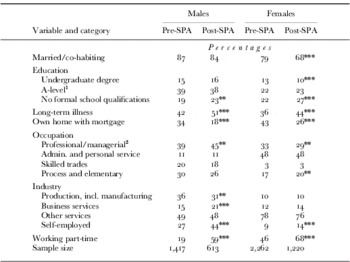
The socio-economic characteristics of pre- and post-SPA workers differed, partly reflecting their age differences. Statistically-significant differences included the lower marriage rate among post-SPA workers (and a correspondingly higher prevalence of widowhood), and the higher proportion of workers with long-term illnesses (Table 1). There were also gender differences. Whereas pre-SPA women were less likely to be married or co-habiting than men (79% versus 87%), and both men and women experienced a drop in marriage and co-habitation rates in the years following the SPA, the decrease was more marked for women (by nine percentage points to 68%) than for men (by three percentage points to 84%). Fewer women than men were educated to degree level, while more reported no formal educational qualifications, and these gender differences were greater among post-SPA workers. The proportion reporting no formal educational qualification was by current standards high, and most probably reflected the older age of the respondents. This group of respondents was born just before, during or just after the Second World War, when achieving formal educational qualifications was less prevalent than today.
Socio-economic characteristics of pre- and post-State Pension Age employees, men and women, United Kingdom 2005

Notes: Numbers may not add to 100 due to rounding. 1. Advanced level General Certificate of Education, normally taken around 18 years-of-age. 2. And associated occupations.
Source: Authors' calculations from the Labour Force Survey 2005.
Significance levels:*** p<0.01
** p<0.05.
Proportionately fewer women reported a long-term illness than men, but for both the proportion that did so was greater among the post-SPA than the pre-SPA group. Conversely, proportionately more women than men lived in a home owned with a mortgage, but for both genders, this proportion was smaller post-SPA than pre-SPA. Mirroring the differences in educational qualifications, proportionately fewer women than men had professional or managerial occupations, held skilled trade positions or process and elementary jobs, but more women worked in administration and the personal services. There were related differences with respect to the industrial sector. Whereas about one-third of male workers were employed in manufacturing, only one-tenth of female workers were, while three-quarters of women were working in ‘other services’ (compared to about one-half of male workers). The industrial profiles of pre- and post-SPA differed women little, but the proportion of male workers in manufacturing was lower post-SPA than pre-SPA; the reverse was the case for men working in business services. Markedly fewer women (9%) than men (27%) were self-employed pre-SPA. Although self-employed women were more prevalent (14%) post-SPA, the percentage remained well below the figure for men (44%). The majority of post-SPA male and female workers worked part time (59% and 68% respectively), the increase from before SPA being particularly strong among men.
The data considered thus far have shown many statistically significant differences in the characteristics of older workers aged below and above the SPA. The differences may arise from either age or cohort effects and be accentuated by gender differences, that is by different labour-force participation histories as well as life cycle stages. In addition, the differences reflect the greater propensity of some middle- and high-income 0occupational groups to retire on or before reaching the SPA, and the need for post-SPA workers to seek alternative employers, change their work pattern or become self-employed to remain ‘in work’ (Lissenburgh and Smeaton Reference Lissenburgh and Smeaton2003). The availability and accessibility of suitable employment and self-employment options can play a significant part in those adjustments.
Working-time flexibility
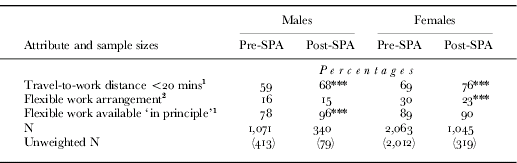
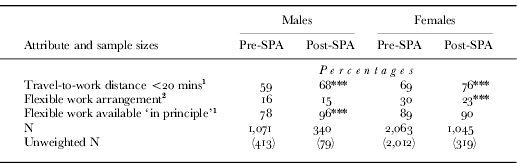
As a person approaches and passes the SPA, it would appear inevitable that the focus of work in his or her life changes. To accommodate an older workforce, the workplace may increasingly be required (and perhaps expected) to adapt to and meet the needs of the employee, rather than vice versa. The evidence on the extent to which this has occurred is inconsistent. Table 2 shows that a significantly greater proportion of post-SPA men and women travel short distances to work than do pre-SPA workers. Sixty-eight per cent of post-SPA men and 76 per cent of post-SPA women had journeys to work of no more than 20 minutes. This may indicate the importance of workplace locations to post-SPA employment decisions and the consideration given to time-use in later (working) life (see Yeandle Reference Yeandle2005). Job opportunities may need to be closer to the home to be considered for post-SPA employment, but beyond this and the greater use of part-time working, there was no similarly strong evidence of a growing importance of changing time-uses in the workplace.
Travel-to-work distances and working time flexibility, male and female pre- and post-State-Pension-Age workers, UK and GB, 2004–05
Notes: Base: all employed (WERS and LFS) and self-employed (Labour Force Survey only) pre- and post-SPA workers. The WERS statistics refer to GB, LFS to UK (see also endnote Footnote 3).
Sources: 1. WERS 2004 (unweighted base in brackets; pre-SPA women aged 50–59 years). 2. Labour Force Survey 2005 – own calculations.
Significance level: *** p<0.01.
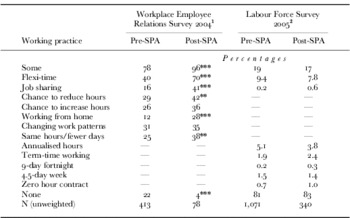
The most widely available and adopted forms of flexible working in the UK economy, other than changes to the number of hours worked, were flexi-time, job sharing, home working and changed ‘normal’ work patterns. These forms of flexible working tend to provide employees with additional means for dividing the working day into segments and sequences that may be more adaptable to the changing social and personal needs and preferences, and that help to create a better work-life balance. But they were rarely drawn upon by older workers. As Table 2 shows, the proportion of post-SPA workers who had agreed flexible work arrangements with their employers other than, or in addition to, part-time working, which as will be further illustrated in Table 3 is not included in the LFS statistics, was very similar to that of pre-SPA workers. In fact, among women, the proportion that had such arrangements, bar part-time working, was lower among post-SPA than among pre-SPA workers.
Flexible working practices of male workers aged less than or more than State Pension Age, UK and GB, 2004–05

Notes: SPA=State Pension Age. Base: all employed pre- and post-SPA workers. 1. Data collected at workplaces. 2. Data collected from individual respondents.
Sources: Authors' calculations from the Workplace Employee Relations Survey 2004 and the Labour Force Survey 2005.
Significance levels:*** p<0.01
** p<0.05.
About one-in-six (15%) post-SPA men and fewer than one-in-four (23%) post-SPA women reported having agreed a flexible work pattern contractually with their employer. These statistics, which were estimated from the Labour Force Survey, covered, among others, flexi-time, term-time working and annualised contracts. The WERS covers different types of working-time flexibility, only two of which matched those referred to in the LFS (flexi-time and job-sharing). This said, two other types of working-time flexibility investigated in the WERS, ‘changing work pattern’ and working ‘same hours/fewer days’, conceptually correspond with most of the more specific options recorded in the LFS (e.g. annualised hours or nine-day fortnight). The crucial difference between the two surveys is, however, that whereas the LFS records workers' contractual agreements with their employers, the WERS only records the availability in principle of flexible work options at a workplace. It does not establish their uptake by the employee. WERS statistics revealed a much higher proportion of workers in establishments with flexible working options than with personally arranged working-time flexibility, even if the absence of reduce working hours, i.e. part-time working, in the LFS statistics is taken into account. Ninety-six per cent of post-SPA men and 90 per cent of post-SPA women worked in establishments that offered flexible working as an option to their workforce.Footnote 1
Whereas for women, the proportion in such establishments was almost identical pre- and post-SPA, a significantly greater proportion of post-SPA men than pre-SPA men worked in such establishments. However, there was no evidence of a higher take-up of flexible working among post-SPA workers – at least, in the form that the LFS captured it, that is, excluding part-time working. If anything, at least among women, flexible working was less prevalent post-SPA than pre-SPA. As noted in the table, however, the women included in the analysis of the WERS were aged 50–59 years because the WERS only provided age ranges rather than the actual ages of the respondents, and for female respondents below the SPA, these ages did not correspond to our five-year range. For this reason, we based subsequent comparisons on male respondents only, whose age ranges matched in both surveys.Footnote 2
What type of flexible work?
Other differences between the LFS and the WERS required further alignments to the analysis samples to ensure that like was compared with like. Thus, we excluded LFS respondents who worked in establishments with fewer than five employees, as this was the basis of the WERS sample. LFS participants who were self-employed were also excluded as not covered by the WERS, and the further analyses focused on the male workforce in the UK.Footnote 3
The changes to the analysis sample from the LFS had only a small effect on the flexible-work statistics: the proportion of pre- and post-SPA male workers with a contractually agreed flexible-work arrangement increased only slightly, respectively from 16 and 15 to 19 and 17 per cent (Table 3). The re-based statistics, therefore, confirmed the earlier conclusion that older workers were more likely to work in establishments offering flexible working practices than they were to take up these options themselves. This would still hold if the incidence of part-time working were taken into account. Looking more closely at the types of flexible working that may be available to employees, flexi-time was by far the most frequent option, available to about 70 per cent of post-SPA employees (as well as to 40 per cent of pre-SPA employees). Other forms of flexible working, such as job sharing or working from home, were available to from one-third to two-fifths of the employed workforce. Flexi-time was also the type of working-time flexibility that employees had most frequently taken up, although the proportion doing so remained small in comparison to its availability (7.8%). Working annualised hours and term-time working were the next most frequently adopted flexible working-time options (3.8 and 2.4% respectively).
The finding that the availability typically exceeded the uptake of flexible work options is, by itself, not unusual (cf. Loretto, Vickerstaff and White Reference Loretto, Vickerstaff and White2005). In this case, the gap between availability and take-up was exaggerated by the exclusion of the part-time working option in the LFS statistics. This is critical because the take-up of part-time working may well reduce the need for other, additional or alternative, forms of flexible working. The inclusion of part-time working in the LFS statistics would have narrowed the availability to take-up gap but would not have closed it. This said, the data show that whereas there was no statistically significant difference in the take-up of specific flexible options among employees, post-SPA employees were significantly more likely to be e+mployed in an establishment that offered, in principle, any one of the working time flexibilities, except for the opportunity to ‘increase hours’ or to ‘change work pattern’. In multivariate analyses, these differences remained even after controlling for some key employment and employee characteristics, such as occupation, industry, part-time employment and contractual terms of employment (permanent or temporary).
Although direct cross-survey comparisons should be interpreted cautiously because the data were not based on the same sample population, the statistics hint at the importance of employer flexibility as well as employee flexibility for accommodating older workers in the workplace. Beyond part-time working and short travel-to-work distances, formal working-time flexibility appears no more crucial for the continued employment of today's post-SPA workers than it is for pre-SPA workers. This is not to dismiss the importance of working-time flexibility, but to highlight its current under-use as a resource for accommodating older workers and, indeed, workers of any age. The apparent disproportionate presence of post-SPA workers in businesses with a greater range of flexible working options is also indicative of a ‘correlation’ between these employers offering part-time working, which is prevalent among post-SPA workers, and other flexible working options. Conversely, there is a small, yet sizeable, group of employers in the UK economy that offers few if any flexible working options, including part-time working, thus effectively reducing the employment opportunities for older workers.
Although post-SPA workers are currently most frequently employed by businesses whose employment practices include a larger than typical range of flexible working options, other than part-time working, they tend not to take up the additional flexible working options and do not do so more than pre-SPA workers. They may, of course, not need to, if part-time working already provides the necessary flexibility required to accommodate work and private lives in older age. This said, there is good reason to explore more closely the reasons for the limited appeal to older workers of some of the forms of flexible working with currently low take-up, in particular, if a more effective use of these could be shown to improve older workers' employment opportunities. In addition, as the following section suggests, knowing more about the use and the perceived and real benefits of other forms of flexible working than part-time working may help address some of the domestic challenges that post-SPA workers continue to face.
The home
Working later in life may not only require formal and informal workplace arrangements, it may also require adjustments in the home. To explore the experiences of older workers in their domestic environments, we draw on the BHPS and the ESS, for both asked questions about the division of labour between couples in households, about agreement over these divisions, and about general attitudes towards housework. Of the two, the BHPS is the more robust source as it had a large sample and produces more reliable estimates. The ESS is, however, more resourceful in the issues it covers and the range of relevant questions.
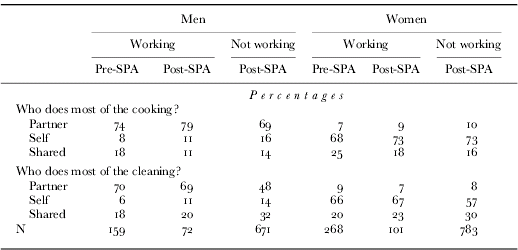
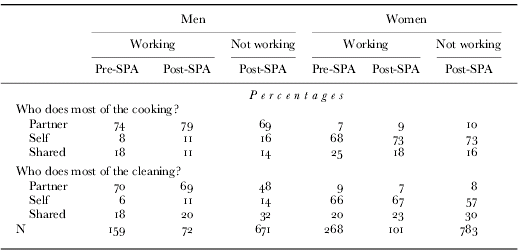
The analyses focused almost exclusively on pre- and post-SPA workers living in couple households, which allowed the observation of variations in the domestic divisions of labour between these groups of employees. In addition, comparisons were drawn with other individuals beyond the SPA who were retired or not in paid work for other reasons. Tables 4 and 5 summarise the results from the analyses of both surveys. They tell similar stories. Turning first to domestic divisions of labour, the vast majority of men in couple households acknowledged that their partners undertook the main share of domestic cooking and cleaning (Table 4). Likewise, women pointed out that it was typically they who did most of this work. There were few differences in the responses of pre- and post-SPA male workers. The main differences occurred between post-SPA non-workers and workers, regardless of the latter's pre- or post-SPA status. A greater proportion of non-working post-SPA men shared domestic chores with their partners than did either pre- or post-SPA men in paid work. The proportion of men who acknowledged that their partner did most of the work declined correspondingly, although arguably remained sizeable. Women were also more likely to report more shared responsibilities when they had passed the SPA and were not in paid work, although the only statistically significant difference was for cleaning. Much less difference was observed for cooking for which, if any change, sharing the task declined post-SPA and with non-working status.
Domestic divisions of labour by age in relation to SPA and gender, 2004
Notes: SPA State Pension Age. Base: pre- and post-SPA employees and self-employed in couple households, and total post-SPA non-working population in couple households.
Sources: Authors' calculations from the British Household Panel Survey 2004.
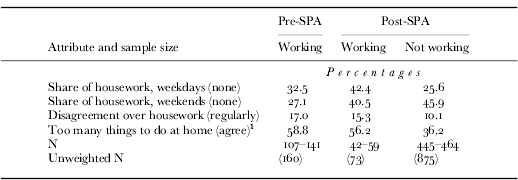
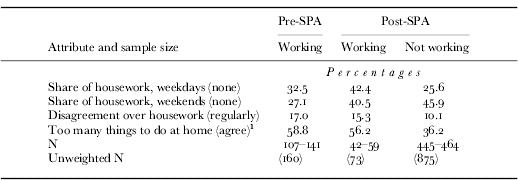
Estimates from the ESS data shed further light on the issue of the potential association between working later in life and domestic relationships. As the ESS had far fewer cases than the BHPS, the responses of men and women were aggregated. The statistics showed that post-SPA workers were less likely to share housework with their partners during the week or at the weekend than pre-SPA workers, although these differences were not statistically significant (Table 5). Compared to their age peers who were not in paid work, the higher proportion of post-SPA workers who did not share in weekday housework was statistically significant (p<0.01). At the same time, post-SPA workers were a little less likely not to share housework at the weekend than were post-SPA non-workers, but the difference was not significant. There were no statistically significant differences in the reported prevalence of ‘regular’ disagreement with partners over housework, except for the difference between pre-SPA workers and post-SPA non-workers (p<0.05). Across all respondents in private households, whether coupled or otherwise, over one-half of pre- and post-SPA workers agreed that there were ‘too many things to do at home’. By contrast, at only about one-third, post-SPA non-workers were statistically significantly less likely to agree with this statement (p<0.01).
Housework sharing by age in relation to SPA and work status, men and women combined, UK 2004
Notes: SPA State Pension Age. Base: pre- and post-SPA employees and self-employed aged under 76, and total post-SPA non-working population, living with a partner. 1. Living with a partner or alone (unweighted base in brackets).
Sources: Authors' calculations from the European Social Survey 2004.
In terms of their domestic contributions to housework chores, therefore, post-SPA workers more closely resembled pre-SPA workers than their non-working peers. In particular, gender divisions, which appeared to be less pronounced in non-working post-SPA couple households, were retained beyond the SPA among those who remained in paid work. The far greater prevalence of the belief, that there was too much housework among pre- and post-SPA workers than post-SPA non-workers, may indicate that work did indeed compete with domestic tasks. Here, we must take into account that post-SPA workers already worked on average fewer hours than pre-SPA workers, but this did not appear to affect their perception that domestic workloads were heavy and demanding.
Conclusions
This paper has documented the limited take-up of flexible working practices other than part-time working among older workers in the United Kingdom, despite a relative prevalence of working in ‘flexible businesses’. This appears counter-intuitive, for much of the public debate stresses the importance of flexible working as a condition of flexible retirement. Rather than challenge or dismiss the assumption that formal flexible labour arrangements are a prerequisite of working later in life, we suggest that the limited take-up of alternative or additional forms of flexible working be investigated further. This would establish whether their greater use might offer new opportunities for accommodating post-SPA workers. Structured quantitative surveys, such as LFS and WERS, are imperfect tools for capturing employers' flexible working arrangements. Inevitably, they fail to detect the less visible but nonetheless equally meaningful informal, ad-hoc and ‘personalised’ agreements on flexible working between employers and employees.
In the United States, studies of employers’ family-friendly policies and their effect on employees’ work-life balance have revealed the importance of informality in integrating the workforce, and led the authors to conclude that this informality alongside formal flexible working arrangements ensured ‘the ability to take advantage of the [formal] policies without fear of reprisals’ (Falter Mennino, Rubin and Brayfield Reference Falter Mennino, Rubin and Brayfield2005: 118). The formal availability of working-time flexibility, in other words, can only be effective if employees feel genuinely free to take up this option. In the UK, a study by Cebulla et al. (Reference Cebulla, Heaver, Smith and Sutton2004) on the employment barriers faced by drug and alcohol users highlighted the difficulties that recovering drug users encountered in workplaces that were unable to accommodate the specific and sometimes erratic needs of their employees, such as the need to attend clinics or to have recovery periods during the working day, and to work in irregular patterns and at unpredictable times. Drug and alcohol users felt most integrated and productive in businesses that acknowledged openly their specific needs and had made provisions that would help these to be accommodated. Unfortunately, neither study considered the implications of inflexibility at the workplace on domestic life. In the UK, there is at present considerable variation in the extent to which employers and business management are sensitive to and capable of responding to such special needs, and more generally to supporting family-friendly work patterns and facilitating a better work-life balance among their employees (Yeandle et al. Reference Yeandle, Phillips, Scheibl, Wigfield and Wise2003).
Yeandle and colleagues' analyses raise the pertinence of the present study's findings about a link between longer working lives and domestic relationships. Our evidence suggests that working longer in life may well lead to an extension or perpetuation of unequal domestic divisions of labour, which among post-SPA non-working households appear to erode, while older workers may well continue to experience paid work as competing with the need to attend to domestic tasks. More study, reflection and effort appear to be needed for improving work-life balance in later life. A starting point would be to make the link between work patterns and domestic relationships explicit, by exploring the potential impact on personal wellbeing and household relationships of a greater use of formal but seemingly under-used flexible working arrangements and of their informal but incompletely understood forms.
What does this research tell us about the future older workforce and its needs?
Future retirees will have quite different attributes and life histories from those captured by surveys conducted during the first few years of the third millennium. Those retiring today have had more experience of training and flexible working than their parents, and these differences may well become more visible in the future. The current younger generations of workers are also more determined than previous generations to influence, shape and design their work and work patterns (Reday-Mulvey Reference Reday-Mulvey2005). They are better educated and trained, especially in new technologies, but they are also adopting new consumer and leisure values. The people retiring in the next 10 to 15 years will indeed be very different from those currently in retirement or about to retire.
In this changing economic and cultural environment, a focus on formal flexible working arrangements as a prerequisite to flexible retirement is unlikely to be sufficient for devising successful strategies for working later in life. Flexibility may well be increasingly negotiated at the individual level between managers and employees. It may thus be management styles rather than (just) formal procedures that most strongly determine the scope for flexible working and the integration of older workers. If so, age discrimination legislation may have a greater effect on changing the work environments for older workers than formal flex-work initiatives, as has indeed been demonstrated in the United States (cf. Meadows Reference Meadows2003). Employees may also more fervently reject the intrusion of work into their private lives and prefer a clearer separation of the two, as has been documented in a recent study (Kaur Reference Kaur2004). These are strong arguments for taking a broader overview of the opportunities and challenges that extending the SPA may present to policy and to the employers and employees affected by such change; this recommendation applies to the recent report by the OECD (2006).
Acknowledgements
The authors would like to acknowledge the funding provided by The Nuffield Foundation (UK), which allowed us to undertake this study. We would also like to thank the two anonymous referees for their helpful comments. Any remaining errors remain entirely the authors' responsibility.