Introduction
Absconsion or unauthorized leave from psychiatric services is a major problem with wide-reaching implications on public safety and patient care.1–5 Serious concerns are often raised when patients with mental illness abscond, particularly when a forensic patient is involved.Reference Campagnolo, Furimsky and Chaimowitz5 Several consequences, including negative media scrutiny of the affected hospital and loss of public confidence in psychiatric services, can result when patients leave unauthorized.Reference Wolber and Karanian4, Reference Campagnolo, Furimsky and Chaimowitz5 Importantly, absconsion can have negative impacts on the patient (eg, worsening mental/physical conditions, injuries, suicide, etc.), the hospital (eg, direct/indirect costs, stress on staff, bad publicity, etc.), the police (eg, time demand, resources to arrest the absconder, injuries, etc.), and the public (eg, worry, stress, high-risk behaviors, etc.).Reference Brumbles and Meister2, 6–8
Forensic psychiatric services are designed to provide care to patients with mental illnesses at the interface of the criminal justice system.Reference Arboleda-Flórez9 While recovery and community reintegration of patients are important goals of forensic mental health services, safeguarding the public from harm posed by forensic patients remains a core objective of forensic psychiatry.9–13 Implicitly, forensic psychiatric services are expected to maintain a “secure” therapeutic milieu for patients on admission or out-patients with community access, and be “absconsion-proof” while mitigating the risk posed by such patients. Notwithstanding the level of security (namely: minimum, medium, and maximum), and the measures in place, addressing the risk of absconsion in forensic populations remains imperative for public and patient safety.Reference Brumbles and Meister2, 14–18
Given the significance of absconsion, accurate risk assessment and analysis become extremely critical to facilitate discussion about risk-associated behaviors (including violence, suicide, re-offending) and appraise the degree to which harm is likely to occur in the future.Reference Chaimowitz, Mamak, Moulden, Furimsky and Olagunju19 In this regard, the analytic synthesis of existing literature to understand risk scenarios for absconsion, attributes of absconders (including personal, clinical, and legal-criminogenic characteristics), and service or setting-related factors that are proximal to absconsion incidents are necessary for evidence-informed assessment and management. However, there is a paucity of review literature on absconsion, especially reviews describing forensic psychiatric populations. The limited number of reviews on absconsion are mostly focused on general psychiatric service settings,Reference Bowers, Jarrett and Clark1, Reference Brumbles and Meister2, Reference Wolber and Karanian4, Reference Skipworth20, Reference Stewart and Bowers21 thus, they are limited in scope regarding the unique risk-issues in forensic patients as well as the nuances related to the forensic psychiatric services.Reference Campagnolo, Furimsky and Chaimowitz5, Reference Simpson and Penney12 For example, forensic patients are detained compulsorily, many of them for a prolonged time, unlike patients in other mental health settings. Further, the majority of forensic patients tend to have severe and persistent mental illnesses or personality disorders, substance use problems, and poor engagement with care in the absence of court-mandated treatment.Reference Simpson and Penney12, Reference Simpson, Penney, Fernane and Wilkie22 These unique risk issues in forensic patients suggest potentially increased risk of absconsion, especially with the promotion of “humane” and least restrictive therapeutic environments in forensic psychiatric services, to balance public safety with patient rights and needs.Reference Urheim, Rypdal, Palmstierna and Mykletun23
To our knowledge, only two literature reviews have looked at absconsion in the forensic psychiatric population.Reference Wolber and Karanian4, Reference Campagnolo, Furimsky and Chaimowitz5 While Wolber and KaranianReference Wolber and Karanian4 presented a broad thematic perspective on assessing the risk of absconsion in forensic and other psychiatric inpatients, Campagnolo et alReference Campagnolo, Furimsky and Chaimowitz5 conducted a qualitative description of risk factors and motivation for absconsion in forensic psychiatry in 19 studies, including three review papers. In their report, Wolber and Karanian highlighted the need for a comprehensive assessment of the risk of absconsion, particularly in those with prior attempts, current verbalization of intent to abscond, and who represent a serious threat to self and others. Notably, the level of threat to the public and patient safety is an important factor which must be considered in the risk assessment process.Reference Wolber and Karanian4 On the other hand, Campagnolo et alReference Campagnolo, Furimsky and Chaimowitz5 noted that absconsion can be goal-directed, accidental, related to active symptoms, and motivated to deal with boredom or frustration. In addition, the most common risk factors for absconsion were history of absconsion, high score on risk-of-violence assessment tools, substance misuse, acute mental state, and socio-environmental factors.Reference Campagnolo, Furimsky and Chaimowitz5 Notwithstanding, these reviews were not exhaustive, nor did they address particular issues that are relevant to clinical and research practice, including case-definition of absconsion, rates of absconsion and re-absconsion, attributes of absconders, and complications or negative outcomes of absconsion in a forensic psychiatric setting. Additionally, none of the reviews were entirely consistent with the principles recommended in guidelines for reporting a systematic review of original research reports. Hence, we pursued this systematic review to improve the current understanding of absconsion in forensic psychiatric services, employing the guideline for reporting a systematic review of original studies.Reference Liberati, Altman and Tetzlaff24, Reference Moher, Liberati, Tetzlaff and Altman25
The specific study objectives are to:
-
• describe study-defined construct or case-definition of absconsion in forensic patients,
-
• estimate per study rates of absconsion, re-absconsion, and recidivism in absconders,
-
• investigate the factors associated with absconsion with predictive value, and
-
• assess the quality of existing research evidence on absconsion in forensic psychiatric settings and make relevant recommendations.
Methods
Eligibility criteria
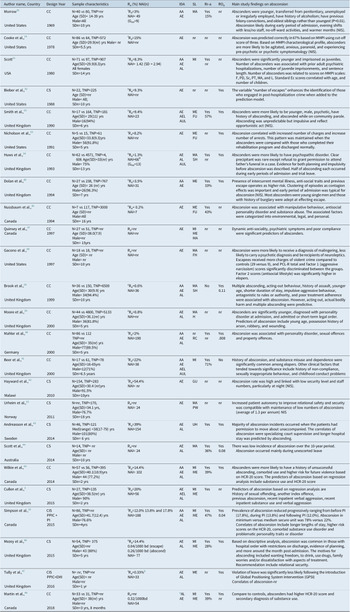
We followed the preferred reporting items for systematic reviews and meta-analyses guidelines in conducting this review.Reference Liberati, Altman and Tetzlaff24, Reference Moher, Liberati, Tetzlaff and Altman25 All literature on absconsion events in forensic psychiatric settings until May 2020 was searched without language limits. The eligibility criteria for study selection were broad to be comprehensive and appraise as much research as was available. Thus, we included all study designs but excluded conference abstracts that were only published in abstract form. Other inclusion criteria were all study-defined constructs of absconsion,Reference Morrow26 including an attempt to escape, breach in trial leave or security, and escape from inpatient admission or during escorted or indirectly supervised privileges (Information included in Table 1).
Characteristics of Included Studies in Chronological Order.

Abbreviations: AA, attempted absconsion; AE, absconsion inform of escape; AEL, absconsion during escorted leave; AL, absconsion during leave; AUL, absconsion during unescorted leave; bd, bed days; CC, case-control; CD, clear definition of absconsion was provided; CS, cross sectional; Ec, escape; EMI, electronic monitoring intervention; FU, forensic unit; G ea, group episode of absconsion; HCR-20, historical clinical risk management-20; IDA, incidents defining absconsion; IF, Infrequency; L, Lie; MA, hypomania; MA, maximum; ME, medium; MI, minimum; MMPI, Minnesota Multiphasic Personality Inventory; N, number of patients that absconded vs control; NAI, number of absconsion incidents/episodes; NIS, no inferential statistics; nr, not reported; OR, odds ratio; PCLR, psychopathy checklist-revised; PCS, prospective cohort study; PD, psychopathic deviate; PI, policy intervention study; PPIC, prepost intervention cross sectional; PT, psychasthenia; PW, private ward; R a, rate of absconsion; cR a, calculated rate of absconsion; rR a, reported rate of absconsion; Rr-a, rate of re-absconsion; RC, regional centre; ROa, re-offending during absconsion; Sc, schizophrenia; SD, standard deviation; SDn, study duration; SH, special hospital; SL, security level; TNP, total number of patients at risk of absconsion; UH, University Hospital, yrs, years; %, percent; 95% CI, 95% confidence Interval.
a AL, unauthorized leave greater than 30 minutes.
b Event-based absconsion rate.
Information sources
We searched databases including Medline/PubMed, PsycINFO, CINAHL, EMBASE, and Web of Sciences for all years through May 2020 for eligible reports. The bibliographies of the included studies and relevant reviews were snowball searched for additional studies, and study authors were contacted to request their work where necessary. Our institution’s library service was utilized to procure full-text copies of any reports the research team could not retrieve themselves. In one study conducted in Germany, a library staff member (KC) with German language fluency assisted in translating the article to extract relevant information on our study objectives.
Search strategy
We utilized a search strategy addressing the following concepts, translated into appropriate database descriptors and free-text terms, using a multitude of synonyms: absconsion, forensic patients, and psychiatry (the detailed search strategy and search terms for databases through OVID is included in Appendix A).
Study selection
Titles and abstracts were screened independently by at least two authors (ATO, SLB, and TOO) to shortlist studies for further review. The full texts of the shortlisted studies were reviewed by at least two authors independently (ATO, SLB, and TOO) according to the inclusion criteria. Disagreement about inclusion or exclusion of studies was resolved by discussion between authors and consultation with the senior author (GAC) to reach consensus.
Data collection process and analyses
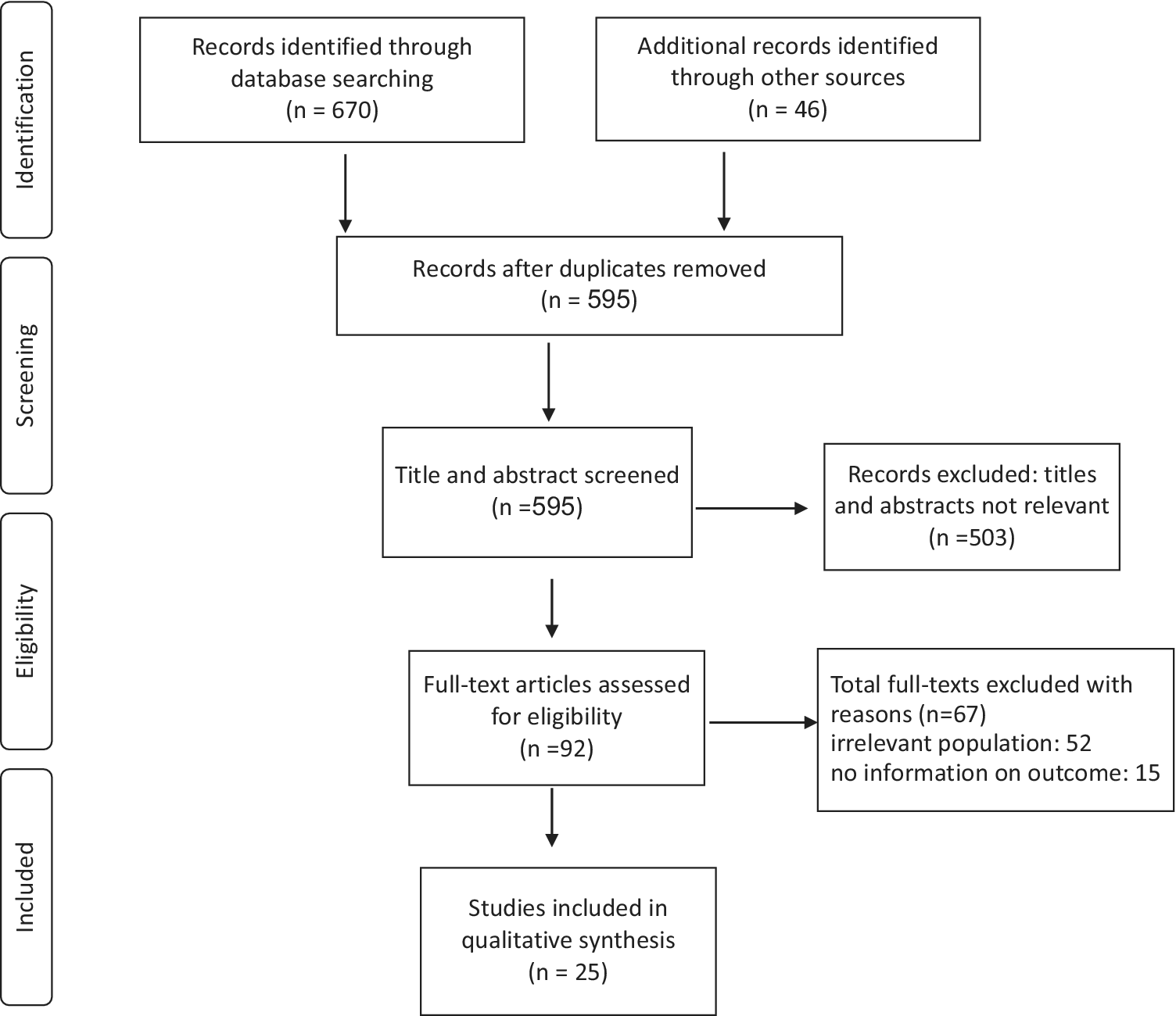
In total, we screened 595 titles and abstracts to produce a shortlist of 92 potential reports for full-text review. Of these 92 reports, 25 studies were selected for inclusion in the final review (see Figure 1). Data items collected from the selected reports (n = 25) are presented in the study tables and supplementary material. Briefly, we collected information from each eligible report on author’s name, publication year, country where study was conducted, study design, sample size, sample age distribution, gender distribution, security levels, number of absconders, number of absconsion incidents, rate of absconsion, factors associated with absconsion on univariate analysis, predictive factors of absconsion on multivariate analysis, complications or outcome of absconsion, and the assessment scales used to evaluate absconders. The information on the different security levels (minimum, medium, and low) was based on the information presented in each report. Generally, security levels in the forensic system are based on multidimensional matrices that involve environmental, relational, and procedural security composites.Reference Crichton16, Reference Kennedy17 Detailed information on the incidents (including attempted absconsion [AA], absconsion that was actual escape [AE], absconsion during escorted leave [AEL], absconsion during leave [AL], and absconsion during unescorted leave [AUL]) used in defining cases of absconsion were included. Three metrics including person, event, and bed-days rates were used to report the rate of absconsion, albeit we placed emphasis on the person-based estimate of absconsion in this study in line with extant literature.Reference Molnar27–Reference Brook, Dolan and Coorey29 In studies where the rate of absconsion (R a) was not reported, we calculated the percent rate of absconsion by dividing the number of patients that absconded [N a] by the total number of patients at risk [N pr] multiplied by 100 [N a/N pr × 100] based on the formula used in previous studies.Reference Molnar27–Reference Brook, Dolan and Coorey29 This was supplemented by reporting the total number of absconsion incidents that were reported during the study period in each eligible report with this information. In studies where relevant data were available, we estimated the rate of re-absconsion (Rr-a) by dividing the number of absconders with two or more episodes of absconsion by the total number of absconders multiply by 100. In addition, the re-offending rate post absconsion was estimated in studies that reported relevant information by dividing the number of absconders who re-offended during unauthorized leave by the total number of absconders. Re-offence broadly included any breach of a law or rule or an illegal act during unauthorized leave that was serious enough that criminal charges were or could have been laid. Relevant information on the complications or negative consequences of absconsion, including a description of the nature of offence during the episodes of unauthorized leave was provided as described in the included reports.
Flow of studies through the systematic review.

Quality/bias assessment
Overall, 25 eligible studies on absconsion in forensic patients with different designs were included. Study quality assessment tools of the National Institutes of Health (NIH) for the assessment of Observational Cohort and Cross-Sectional Studies, Case-Control, and Controlled Intervention Studies were used to assess the quality of the included studies.30 We evaluated each individual study on a range of 12 to 14 items based on the study design to produce a comprehensive overview of the quality/bias in each of the eligible study, and highlighted relevant overall quality limitations.
Results
Study characteristics
A total of 25 eligible studiesReference Cullen, Jewell, Tully, Coghlan, Dean and Fahy3, Reference Cooke and Thorwarth14, Reference Smith and Quaynor15, Reference Simpson, Penney, Fernane and Wilkie22, Reference Urheim, Rypdal, Palmstierna and Mykletun23, Reference Morrow26, Reference Brook, Dolan and Coorey29, Reference Scott31–Reference Martin, McGeown, Whitehouse and Stanyon48 on absconsion spanning about five decades from 1969 through May 2020 were included in this review. Of the 25 included studies, two were interventional,Reference Simpson, Penney, Fernane and Wilkie22, Reference Tully, Cullen, Hearn and Fahy47 seven were cross-sectional,Reference Cullen, Jewell, Tully, Coghlan, Dean and Fahy3, Reference Urheim, Rypdal, Palmstierna and Mykletun23, Reference Bieber, Pasewark, Bosten and Steadman32, Reference Hayward, White and Kauye42–Reference Scott, Goel, Neillie, Stedman and Meehan44, Reference Mezey, Durkin, Dodge and White46 and the remaining 16 were case-control studies.Reference Cooke and Thorwarth14, Reference Smith and Quaynor15, Reference Morrow26, Reference Brook, Dolan and Coorey29, Reference Scott31, Reference Nicholson, Norwood and Enyart33–Reference Beer, Muthukumaraswamy, Khan and Musabbir41, Reference Wilkie, Penney, Fernane and Simpson45, Reference Martin, McGeown, Whitehouse and Stanyon48 The study settings in the included reports (n = 25) were distributed across eight different countries representing several jurisdictions. However the majority of the studies (n = 24) were conducted in developed countries, including the United Kingdom (n = 9),Reference Cullen, Jewell, Tully, Coghlan, Dean and Fahy3, Reference Smith and Quaynor15, Reference Brook, Dolan and Coorey29, Reference Huws and Shubsachs34, Reference Dolan and Snowden35, Reference Moore and Hammond39, Reference Beer, Muthukumaraswamy, Khan and Musabbir41, Reference Mezey, Durkin, Dodge and White46, Reference Tully, Cullen, Hearn and Fahy47 United States (n = 6),Reference Cooke and Thorwarth14, Reference Morrow26, Reference Scott31–Reference Huws and Shubsachs33, Reference Gacono, Meloy, Speth and Roske38 Canada (n = 5),Reference Simpson, Penney, Fernane and Wilkie22, Reference Nussbaum, Lang, Chan and Riviere36, Reference Quinsey, Coleman, Jones and Altrows37, Reference Wilkie, Penney, Fernane and Simpson45, Reference Martin, McGeown, Whitehouse and Stanyon48 and one study each was conducted in Germany,Reference Mahler, Pokomy and Pfafflin40 Sweden,Reference Andreasson, Nyman, Krona, Meyer, Anckarsäter, Nilsson and Hofvander43 Norway,Reference Urheim, Rypdal, Palmstierna and Mykletun23 and Australia.Reference Scott, Goel, Neillie, Stedman and Meehan44 Only one study from Malawi was conducted in a developing country.Reference Hayward, White and Kauye42
Considering all 25 eligible studies, 1 036 patients with unauthorized leave from forensic psychiatric services covering different periods and study durations were studied. The study duration ranged from oneReference Tully, Cullen, Hearn and Fahy47 to 18Reference Urheim, Rypdal, Palmstierna and Mykletun23 years. The study sample size for each of the 25 reports ranged between five and 154. The three types of security levels, including minimum, medium, and maximum that have been described in forensic psychiatric services based on environmental, relational, and procedural security multidimensional matricesReference Crichton16, Reference Kennedy17 were covered in the eligible reports. Notably, 14Reference Smith and Quaynor15, Reference Simpson, Penney, Fernane and Wilkie22, Reference Urheim, Rypdal, Palmstierna and Mykletun23, Reference Brook, Dolan and Coorey29, Reference Nicholson, Norwood and Enyart33, Reference Huws and Shubsachs34, Reference Nussbaum, Lang, Chan and Riviere36–Reference Moore and Hammond39, Reference Wilkie, Penney, Fernane and Simpson45–Reference Martin, McGeown, Whitehouse and Stanyon48 reports described studies that conducted analysis using data on absconders in more than one type of security level. Majority of the study samples in the 25 reports were males in their fourth decade of life.
Construct of absconsion
The incidents of unauthorized leave that defined the cases of absconsion in the included studies (n = 25) varied, including AA, AE, AEL, AL, and AUL. While some studies were broadly inclusive in their construct by defining absconsion as an attempt to escape, breach in leave, and actual escape (n = 17),Reference Cullen, Jewell, Tully, Coghlan, Dean and Fahy3, Reference Smith and Quaynor15, Reference Simpson, Penney, Fernane and Wilkie22, Reference Morrow26, Reference Brook, Dolan and Coorey29, Reference Scott31, Reference Huws and Shubsachs34, Reference Dolan and Snowden35, Reference Moore and Hammond39–Reference Beer, Muthukumaraswamy, Khan and Musabbir41, Reference Andreasson, Nyman, Krona, Meyer, Anckarsäter, Nilsson and Hofvander43–Reference Martin, McGeown, Whitehouse and Stanyon48 other studies restricted absconsion to only the cases of patients with “actual escapes” from the treating facility (n = 8).Reference Cooke and Thorwarth14, Reference Urheim, Rypdal, Palmstierna and Mykletun23, Reference Bieber, Pasewark, Bosten and Steadman32, Reference Nicholson, Norwood and Enyart33, Reference Nussbaum, Lang, Chan and Riviere36–Reference Gacono, Meloy, Speth and Roske38, Reference Hayward, White and Kauye42 Specifically, “actual escape” was defined as unauthorized leave involving a breach or failure of physical and procedural security in which a patient breached the secure perimeter of the hospital or unit. On the other hand, absconsion was more of a failure of relational as well as procedural securityReference Exworthy and Wilson49 For example, Mesey et al noted that escape: “is if a patient gets outside the fence, wall, reception or other declared hospital boundary without the knowledge or permission of the staff, and absconding is when a patient takes unauthorized liberty during leave outside the perimeter of the unit/hospital by breaking away from the supervision of staff.”Reference Mezey, Durkin, Dodge and White46
Eleven reportsReference Cullen, Jewell, Tully, Coghlan, Dean and Fahy3, Reference Smith and Quaynor15, Reference Simpson, Penney, Fernane and Wilkie22, Reference Brook, Dolan and Coorey29, Reference Huws and Shubsachs34, Reference Dolan and Snowden35, Reference Moore and Hammond39, Reference Beer, Muthukumaraswamy, Khan and Musabbir41, Reference Scott, Goel, Neillie, Stedman and Meehan44, Reference Mezey, Durkin, Dodge and White46, Reference Martin, McGeown, Whitehouse and Stanyon48 included a clear description of the construct of absconsion, only three studiesReference Scott, Goel, Neillie, Stedman and Meehan44, Reference Wilkie, Penney, Fernane and Simpson45, Reference Martin, McGeown, Whitehouse and Stanyon48, considered “time” in the construct of absconsion to exclude mere lateness from leave, while one study specified the amount of time by categorizing only unauthorized leave greater than 30 minutes as incidents of absconsion.Reference Martin, McGeown, Whitehouse and Stanyon48 Scott et alReference Scott, Goel, Neillie, Stedman and Meehan44 introduced the term “technical absences without permission” to describe incidents of absconsion reported by patients of their volition to their mental health service about a delay (eg, from vehicle breakdown or missed public transport), and returned to the service voluntarily, although outside the designated time (see Table 1).
Rate of absconsion
Three rates of absconsion (including person, event, and empty-bed-days rates) were reported, albeit we placed emphasis on the person-based estimate of absconsion in the present study in line with extant literature.Reference Dolan and Snowden27–Reference Brook, Dolan and Coorey29 The rates of person-based absconsion ranged from 0.2% to 54.4% in all the studies (n = 20)Reference Cullen, Jewell, Tully, Coghlan, Dean and Fahy3, Reference Cooke and Thorwarth14, Reference Smith and Quaynor15, Reference Simpson, Penney, Fernane and Wilkie22, Reference Morrow26, Reference Brook, Dolan and Coorey29–Reference Nussbaum, Lang, Chan and Riviere36, Reference Moore and Hammond39–Reference Andreasson, Nyman, Krona, Meyer, Anckarsäter, Nilsson and Hofvander43, Reference Wilkie, Penney, Fernane and Simpson45–Reference Tully, Cullen, Hearn and Fahy47 that reported or included the relevant data for estimating the rates of absconsion using the method described above.Reference Dolan and Snowden27–Reference Brook, Dolan and Coorey29 Five studiesReference Urheim, Rypdal, Palmstierna and Mykletun23, Reference Quinsey, Coleman, Jones and Altrows37, Reference Gacono, Meloy, Speth and Roske38, Reference Scott, Goel, Neillie, Stedman and Meehan44, Reference Martin, McGeown, Whitehouse and Stanyon48 did not report the rates of absconsion and lacked data to estimate a person-based rate. In total, 18 studiesReference Cullen, Jewell, Tully, Coghlan, Dean and Fahy3, Reference Smith and Quaynor15, Reference Simpson, Penney, Fernane and Wilkie22, Reference Urheim, Rypdal, Palmstierna and Mykletun23, Reference Morrow26, Reference Brook, Dolan and Coorey29, Reference Scott31, Reference Huws and Shubsachs34–Reference Nussbaum, Lang, Chan and Riviere36, Reference Mahler, Pokomy and Pfafflin40, Reference Beer, Muthukumaraswamy, Khan and Musabbir41, Reference Andreasson, Nyman, Krona, Meyer, Anckarsäter, Nilsson and Hofvander43–Reference Martin, McGeown, Whitehouse and Stanyon48 described event-based absconsion rates that ranged between 7 and 190 events across all the studies with appropriate information (n = 18). In a similar vein, two studiesReference Mezey, Durkin, Dodge and White46, Reference Martin, McGeown, Whitehouse and Stanyon48 reported absconsion rates per 1 000 bed days, with Mezey et alReference Mezey, Durkin, Dodge and White46 differentiating between the rate for actual escape (0.04/1000 bed days) from the rates of absconding (0.26/1000 bed days),Reference Mezey, Durkin, Dodge and White46 while Martin et alReference Martin, McGeown, Whitehouse and Stanyon48 reported 0.32/1000 bed days for absconding.
Of the two intervention studies, one study examined the impacts of electronic monitoring intervention (EMI)Reference Mezey, Durkin, Dodge and White46 on absconsion and reported the rates of absconsion across three study phases, including 0.33%, 0.14%, and 0.07% during preEMI, within EMI, and post-EMI, respectively. On the other hand, Simpson et alReference Simpson, Penney, Fernane and Wilkie22 reported about a one-third reduction in both person and event-based index of absconsion with the implementation of a structured professional judgement (rates of 12.0% and 17.8%, post and preintervention respectively) (see Table 1).
Factors associated with absconsion and risk assessment scales
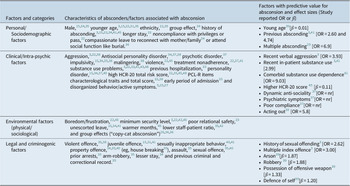
Four scales, including Minnesota Multiphasic Personality Inventory (MMPI)Reference Beall and Panton50 Bell-Panton escape scale (n = 2),Reference Cooke and Thorwarth14, Reference Scott31 Historical Clinical Risk Management-20 (HCR-20)Reference Hare51 (n = 3),Reference Simpson, Penney, Fernane and Wilkie22, Reference Wilkie, Penney, Fernane and Simpson45, Reference Martin, McGeown, Whitehouse and Stanyon48 Psychopathy Checklist-Revised (PCL-R)Reference Douglas, Hart, Webster and Belfrage52 (n = 2)Reference Gacono, Meloy, Speth and Roske38, Reference Wilkie, Penney, Fernane and Simpson45, and Violent Risk Appraisal GuideReference Harris, Rice and Quinsey53 (n = 1)Reference Nicholson, Norwood and Enyart37 were used to categorize the risk in the absconders in some of the included studies. Additionally, several attributes of patients who absconded were described in the included studies (n = 25). For clarity, we outlined the factors that were significantly associated with absconsion on univariate analysis into subcategories, including personal, clinical, environmental, and legal/criminogenic factors (see Table 2).
Factors Associated with Absconsion in Included Studies.

Abbreviations: HCR-20, historical clinical risk management-20; nr, not reported; OR, odds ratio; PCL-R, psychopathy checklist-revised; ß, standardized [regression] coefficient.
Personal/sociodemographic factors that were associated with absconsion include male gender,Reference Smith and Quaynor15, Reference Nicholson, Norwood and Enyart33, Reference Huws and Shubsachs34 younger age,Reference Cullen, Jewell, Tully, Coghlan, Dean and Fahy3, Reference Smith and Quaynor15, Reference Simpson, Penney, Fernane and Wilkie22, Reference Scott31, Reference Dolan and Snowden35 history of absconding,Reference Cullen, Jewell, Tully, Coghlan, Dean and Fahy3, Reference Smith and Quaynor15, Reference Simpson, Penney, Fernane and Wilkie22, Reference Huws and Shubsachs34, Reference Beer, Muthukumaraswamy, Khan and Musabbir41, Reference Wilkie, Penney, Fernane and Simpson45 longer stay,Reference Simpson, Penney, Fernane and Wilkie22 and noncompliance with privileges or passReference Simpson, Penney, Fernane and Wilkie22 among others. One studyReference Huws and Shubsachs34 also reported that social needs, such as compassionate leave for burial or reconnection with mother were related with absconsion.
Clinical and “intra-psychic” attributes of absconders include aggression,Reference Cullen, Jewell, Tully, Coghlan, Dean and Fahy3, Reference Simpson, Penney, Fernane and Wilkie22, Reference Gacono, Meloy, Speth and Roske38 antisocial personality disorder,Reference Huws and Shubsachs34, Reference Quinsey, Coleman, Jones and Altrows37, Reference Gacono, Meloy, Speth and Roske38 psychotic disorder,Reference Quinsey, Coleman, Jones and Altrows37 and impulsivity.Reference Smith and Quaynor15, Reference Huws and Shubsachs34, Reference Dolan and Snowden35, Reference Gacono, Meloy, Speth and Roske38 In addition, malingering,Reference Gacono, Meloy, Speth and Roske38 violence,Reference Simpson, Penney, Fernane and Wilkie22, Reference Wilkie, Penney, Fernane and Simpson45 treatment nonadherence,Reference Simpson, Penney, Fernane and Wilkie22, Reference Quinsey, Coleman, Jones and Altrows37, Reference Beer, Muthukumaraswamy, Khan and Musabbir41 substance use problems,Reference Cullen, Jewell, Tully, Coghlan, Dean and Fahy3, Reference Simpson, Penney, Fernane and Wilkie22, Reference Nicholson, Norwood and Enyart33, Reference Beer, Muthukumaraswamy, Khan and Musabbir41, Reference Wilkie, Penney, Fernane and Simpson45, Reference Martin, McGeown, Whitehouse and Stanyon48 and previous hospitalizationReference Nicholson, Norwood and Enyart33 were significantly common in absconders. A high HCR-20 total risk score,Reference Simpson, Penney, Fernane and Wilkie22, Reference Dolan and Snowden35, Reference Wilkie, Penney, Fernane and Simpson45, Reference Martin, McGeown, Whitehouse and Stanyon48 and PCL-R items characterological traits and total score,Reference Simpson, Penney, Fernane and Wilkie22, Reference Gacono, Meloy, Speth and Roske38 were significantly associated with absconsion.
Environmental and security-issues, such as boredom/frustration,Reference Simpson, Penney, Fernane and Wilkie22, Reference Wilkie, Penney, Fernane and Simpson45 minimum security level,Reference Cullen, Jewell, Tully, Coghlan, Dean and Fahy3, Reference Simpson, Penney, Fernane and Wilkie22, Reference Hayward, White and Kauye42, Reference Wilkie, Penney, Fernane and Simpson45 poor relational safety,Reference Urheim, Rypdal, Palmstierna and Mykletun23 unescorted leave,Reference Smith and Quaynor15, Reference Huws and Shubsachs34, Reference Beer, Muthukumaraswamy, Khan and Musabbir41 warmer months,Reference Wilkie, Penney, Fernane and Simpson45 and lower staff-patient ratioReference Dolan and Snowden35, Reference Hayward, White and Kauye42 were associated with absconsion.
Legal/criminogenic attributes of absconders that were outlined across the included studies include violent offence,Reference Dolan and Snowden35, Reference Gacono, Meloy, Speth and Roske38 juvenile offence,Reference Smith and Quaynor15, Reference Scott31, Reference Beer, Muthukumaraswamy, Khan and Musabbir41 sexually inappropriate behavior,Reference Mahler, Pokomy and Pfafflin40, Reference Beer, Muthukumaraswamy, Khan and Musabbir41property offence,Reference Huws and Shubsachs34, Reference Dolan and Snowden35, Reference Mahler, Pokomy and Pfafflin40 (eg, house breakingReference Dolan and Snowden35), assault,Reference Dolan and Snowden35 sexual offence,Reference Dolan and Snowden35, Reference Mahler, Pokomy and Pfafflin40 prior arrests,Reference Nicholson, Norwood and Enyart33 arm-robbery,Reference Dolan and Snowden35 lesser stay,Reference Huws and Shubsachs34 and previous criminal and correctional record.Reference Dolan and Snowden35
Factors with predictive value for absconsion based on multivariate analysis—a range of factors with a degree of predictive value (associated with a higher likelihood) for absconsion was reported in the included studies based on multivariate analysis that allowed controlling for confounders. The effect sizes reported in the studies (n = 7) with information on predictorsReference Cullen, Jewell, Tully, Coghlan, Dean and Fahy3, Reference Stewart and Bowers21, Reference Brook, Dolan and Coorey29, Reference Quinsey, Coleman, Jones and Altrows37, Reference Moore and Hammond39, Reference Beer, Muthukumaraswamy, Khan and Musabbir41, Reference Wilkie, Penney, Fernane and Simpson45 ranged from 0.01 for young age to 9.03 for substance use/dependence.Reference Stewart and Bowers21, Reference Moore and Hammond39 The predictive factors for absconsion included recent verbal aggression,Reference Cullen, Jewell, Tully, Coghlan, Dean and Fahy3 active psychiatric symptoms,Reference Quinsey, Coleman, Jones and Altrows37 recent in-patient substance use,Reference Cullen, Jewell, Tully, Coghlan, Dean and Fahy3, Reference Beer, Muthukumaraswamy, Khan and Musabbir41 dynamic anti-sociality (included items on lack of remorse and empathy, procriminal sentiments [modifiable], and unrealistic discharge plan that were dynamic within the time frame investigated),Reference Quinsey, Coleman, Jones and Altrows37comorbidity of substance use,Reference Wilkie, Penney, Fernane and Simpson45 poor treatment compliance,Reference Quinsey, Coleman, Jones and Altrows37 and a higher HCR-20 score.Reference Quinsey, Coleman, Jones and Altrows37, Reference Wilkie, Penney, Fernane and Simpson45
Re-absconsion and negative consequences of absconsion
Information on the occurrence of re-absconsion was reported in 14 studies,Reference Cullen, Jewell, Tully, Coghlan, Dean and Fahy3, Reference Smith and Quaynor15, Reference Simpson, Penney, Fernane and Wilkie22, Reference Morrow26, Reference Scott31, Reference Huws and Shubsachs34–Reference Nussbaum, Lang, Chan and Riviere36, Reference Beer, Muthukumaraswamy, Khan and Musabbir41, Reference Andreasson, Nyman, Krona, Meyer, Anckarsäter, Nilsson and Hofvander43–Reference Mezey, Durkin, Dodge and White46, Reference Martin, McGeown, Whitehouse and Stanyon48 and the estimated rates of re-absconsion in studies (n = 10)Reference Smith and Quaynor15, Reference Simpson, Penney, Fernane and Wilkie22, Reference Morrow26, Reference Dolan and Snowden35, Reference Nussbaum, Lang, Chan and Riviere36, Reference Wilkie, Penney, Fernane and Simpson41, Reference Scott, Goel, Neillie, Stedman and Meehan44–Reference Mezey, Durkin, Dodge and White46, Reference Martin, McGeown, Whitehouse and Stanyon48 with appropriate data ranged between 15% and 71%. Of all the included studies (n = 25), 14 studiesReference Cullen, Jewell, Tully, Coghlan, Dean and Fahy3, Reference Smith and Quaynor15, Reference Simpson, Penney, Fernane and Wilkie22, Reference Brook, Dolan and Coorey29, Reference Bieber, Pasewark, Bosten and Steadman32, Reference Nicholson, Norwood and Enyart33, Reference Huws and Shubsachs34, Reference Dolan and Snowden35, Reference Mahler, Pokomy and Pfafflin40, Reference Andreasson, Nyman, Krona, Meyer, Anckarsäter, Nilsson and Hofvander43–Reference Martin, McGeown, Whitehouse and Stanyon48 reported incidents of recidivism in patients during unauthorized leave. While the rates of recidivism were generally low (rate as much as 0.11) in the few studies (n = 4)Reference Simpson, Penney, Fernane and Wilkie22, Reference Brook, Dolan and Coorey29, Reference Mahler, Pokomy and Pfafflin40, Reference Scott, Goel, Neillie, Stedman and Meehan44 with relevant data, serious re-offending behaviors were reported in patients while on unauthorized leave. The common examples of re-offending behaviors during unauthorized leave include criminal offences,Reference Smith and Quaynor15, Reference Simpson, Penney, Fernane and Wilkie22, Reference Nicholson, Norwood and Enyart33–Reference Dolan and Snowden35, Reference Wilkie, Penney, Fernane and Simpson45, Reference Mezey, Durkin, Dodge and White46 violence,Reference Simpson, Penney, Fernane and Wilkie22, Reference Nicholson, Norwood and Enyart33, Reference Huws and Shubsachs34, Reference Wilkie, Penney, Fernane and Simpson45, Reference Tully, Cullen, Hearn and Fahy47, Reference Martin, McGeown, Whitehouse and Stanyon48 (both perpetrator or the victim was described in one patientReference Wilkie, Penney, Fernane and Simpson45), aggression,Reference Simpson, Penney, Fernane and Wilkie22 substance use,Reference Simpson, Penney, Fernane and Wilkie22, Reference Nicholson, Norwood and Enyart33, Reference Huws and Shubsachs34, Reference Wilkie, Penney, Fernane and Simpson45, Reference Mezey, Durkin, Dodge and White46, Reference Martin, McGeown, Whitehouse and Stanyon48 sexual behavior,Reference Martin, McGeown, Whitehouse and Stanyon48 suicide/self-harm,Reference Huws and Shubsachs34, Reference Mezey, Durkin, Dodge and White46, Reference Martin, McGeown, Whitehouse and Stanyon48 arm robbery,Reference Nicholson, Norwood and Enyart33, Reference Mezey, Durkin, Dodge and White46 theft,Reference Smith and Quaynor15, Reference Huws and Shubsachs34 assault,Reference Smith and Quaynor15, Reference Nicholson, Norwood and Enyart33 arrests,Reference Nicholson, Norwood and Enyart33 threat with knife,Reference Huws and Shubsachs34 rape,Reference Huws and Shubsachs34 and manslaughter of police during arm robbery abroad.Reference Huws and Shubsachs34
Assessment of study quality
The results of the study quality are presented in the Supplementary material Appendix B. Overall, the quality of all included studies (n = 25) was rated poor (n = 2),Reference Bieber, Pasewark, Bosten and Steadman32, Reference Andreasson, Nyman, Krona, Meyer, Anckarsäter, Nilsson and Hofvander43 fair (n = 8)Reference Cooke and Thorwarth14, Reference Smith and Quaynor15, Reference Nicholson, Norwood and Enyart33, Reference Nussbaum, Lang, Chan and Riviere36–Reference Gacono, Meloy, Speth and Roske38, Reference Scott, Goel, Neillie, Stedman and Meehan44, Reference Mezey, Durkin, Dodge and White46 and good (n = 15)Reference Cullen, Jewell, Tully, Coghlan, Dean and Fahy3, Reference Simpson, Penney, Fernane and Wilkie22, Reference Urheim, Rypdal, Palmstierna and Mykletun23, Reference Morrow26, Reference Brook, Dolan and Coorey29, Reference Scott31, Reference Huws and Shubsachs34, Reference Dolan and Snowden35, Reference Moore and Hammond39–Reference Hayward, White and Kauye42, Reference Wilkie, Penney, Fernane and Simpson45, Reference Tully, Cullen, Hearn and Fahy47, Reference Martin, McGeown, Whitehouse and Stanyon48 based on the risk of bias items contained in the National Institute of Health risk assessment tool.30 The high degree of heterogeneity in the construct of absconsion, the limited number of intervention studies, and lack of power calculation were the major source of bias to the overall study quality. Notwithstanding these limitations in the quality of the studies, the design, outcome measures of absconsion in the eligible studies were considered the best available evidence for the recommendations made (study quality assessment outcome is included in Appendix B in the supplementary material).
Discussion
Absconsion in patients with mental illness can disrupt their treatment, and raise serious safety concern,Reference Wolber and Karanian4 especially if such a patient was an offender with mental illness.9–13 However, absconsion in forensic psychiatric services is still relatively understudied, and extant literature is inconclusive on the construct, rates, and predictors of absconsion in forensic patients. Considering the significant heterogeneity on the findings on absconsion in forensic patients across empirical studies, we conducted this systematic synthesis of extant literature with the overarching aim of increasing current knowledge on absconsion. Importantly, we were able to include 25 original studiesReference Cullen, Jewell, Tully, Coghlan, Dean and Fahy3, Reference Cooke and Thorwarth14, Reference Smith and Quaynor15, Reference Simpson, Penney, Fernane and Wilkie22, Reference Urheim, Rypdal, Palmstierna and Mykletun23, Reference Morrow26, Reference Brook, Dolan and Coorey29, Reference Scott31–Reference Martin, McGeown, Whitehouse and Stanyon48 conducted in multiple international and legal jurisdictions spanning five decades. It is hoped that this systematic review will facilitate better assessment and documentation of absconsion events, promote the development of protocol to standardize the management of absconsion, and form the foundation for new hypotheses-driven studies.
All included studies except one were conducted in well-resourced countries with advanced forensic mental health and criminal justice systems.Reference Velinov and Marinov13, Reference Bartlett, Jenkins and Kiima54, 55 While the scanty research from less-resourced countries in this review is concerning, it seems to reflect the rudimentary nature of forensic psychiatric practice in these developing countries due to the lack of dedicated mental health legislations, poor judicial practices, and limited mental health resources.Reference Olagunju, Oluwaniyi, Fadipe, Ogunnubi, Oni, Aina and Chaimowitz11, Reference Bartlett, Jenkins and Kiima54 For instance, only 59% of the world’s population live in a country where dedicated mental health legislation exists, and this is particularly so in several developing countries.Reference Olagunju, Oluwaniyi, Fadipe, Ogunnubi, Oni, Aina and Chaimowitz11, Reference Bartlett, Jenkins and Kiima54, 55 The age span of the included studies also speaks to the fact that absconsion is a long-standing problem in forensic psychiatric practice,Reference Morrow26 and revisits the need for novel efforts to advance the assessment, risk analysis, and management of absconsion. Taking together, the lack of equitable forensic mental health services globally, and the disproportionately poor research practice on forensic mental health issues in the less developed countries are far from ideal given the several decades of forensic psychiatric practice.
Construct and definition of absconsion
There was notable heterogeneity in the construct of absconsion in the included studies. While some authorsReference Cooke and Thorwarth14, Reference Urheim, Rypdal, Palmstierna and Mykletun23, Reference Bieber, Pasewark, Bosten and Steadman32, Reference Nicholson, Norwood and Enyart33, Reference Nussbaum, Lang, Chan and Riviere36–Reference Gacono, Meloy, Speth and Roske38, Reference Hayward, White and Kauye42 strictly define absconsion as actual escapes from forensic psychiatric services, other studiesReference Cullen, Jewell, Tully, Coghlan, Dean and Fahy3, Reference Smith and Quaynor15, Reference Simpson, Penney, Fernane and Wilkie22, Reference Morrow26, Reference Brook, Dolan and Coorey29, Reference Scott31, Reference Huws and Shubsachs34, Reference Dolan and Snowden35, Reference Moore and Hammond39–Reference Beer, Muthukumaraswamy, Khan and Musabbir41, Reference Andreasson, Nyman, Krona, Meyer, Anckarsäter, Nilsson and Hofvander43–Reference Martin, McGeown, Whitehouse and Stanyon48 allowed a degree of flexibility in the definition of absconsion by including patients with any attempt to abscond or breach in their leave. The heterogeneity in the construct of absconsion may partly explain the high degree of variability in the rates of absconsion across the included studies, although contributions from other factors (eg, differences in study duration, context, and security level) are also very likely. Besides, three different estimates and metrics of absconsion rates were reported in the included studies, including estimates based on the number of persons who absconded,Reference Cullen, Jewell, Tully, Coghlan, Dean and Fahy3, Reference Cooke and Thorwarth14, Reference Smith and Quaynor15, Reference Simpson, Penney, Fernane and Wilkie22, Reference Morrow26, Reference Brook, Dolan and Coorey29–Reference Scott31–Reference Nussbaum, Lang, Chan and Riviere36, Reference Moore and Hammond39–Reference Andreasson, Nyman, Krona, Meyer, Anckarsäter, Nilsson and Hofvander43, Reference Wilkie, Penney, Fernane and Simpson45–Reference Tully, Cullen, Hearn and Fahy47 the number of absconsion events,Reference Cullen, Jewell, Tully, Coghlan, Dean and Fahy3, Reference Smith and Quaynor15, Reference Simpson, Penney, Fernane and Wilkie22, Reference Urheim, Rypdal, Palmstierna and Mykletun23, Reference Morrow26, Reference Brook, Dolan and Coorey29, Reference Scott31, Reference Huws and Shubsachs34–Reference Nussbaum, Lang, Chan and Riviere36, Reference Mahler, Pokomy and Pfafflin40, Reference Beer, Muthukumaraswamy, Khan and Musabbir41, Reference Andreasson, Nyman, Krona, Meyer, Anckarsäter, Nilsson and Hofvander43–Reference Martin, McGeown, Whitehouse and Stanyon48 and the number of bed-days since patient left unauthorized.Reference Mezey, Durkin, Dodge and White46, Reference Martin, McGeown, Whitehouse and Stanyon48 However, the person-based absconsion rate was the most common estimates reported in studies. Compared to event-based absconsion rate, a person-based estimate can facilitate easy linkage of risk analysis and management with individual patient risk factors, and may be less influenced by repeated counting bias due to re-absconsion events perpetrated by the same patient. Nevertheless, the absconsion rates based on the number of absconsion events and the number of empty bed-days are important information for hospital statistics, health financing purposes, and risk management if reported in composite with the person-based absconsion rate. A pooled analysis of absconsion rates in form of a meta-analysis was not possible given the degree of heterogeneity in the construct of absconsion across the included studies, and other methodological limitations outlined above. For example, the study duration in the individual report was strikingly different, ranging from one to 18 years.Reference Imrey56
It is possible that notable clinical and research benefits would result from the development of a structured construct of absconsion by experts. For example, several improvements were reported in the field of suicidology with re-constructing of suicide-risk associated behaviors (including “para-suicide”)Reference Kreitman57as occurring in a spectrum. A construct that operationalized absconsion-related events or risk-behaviors as occurring in a spectrum may allow disaggregation of absconsion events into those representing “gesture or signal” events, including attempted absconsion, or a breach in leave as “para-absconsion” and absconsion in form of an actual escape or leaving without permission or failure to return. This may help to appropriately categorize variant behaviors that do not totally fit the definition of absconsion. As an example, Scott et alReference Scott, Goel, Neillie, Stedman and Meehan44 introduced the term “technical absconsion” to describe a variant absconsion behavior caused by a delayed absence that was reported by patients voluntarily due to unforeseen circumstances (eg, accident, transportation problems, and bad weather, etc.). Notwithstanding the approach adopted, there is a need for clarity in the definition of terms and construct of absconsion for better categorization, assessment, and documentation of absconsion events or any related risk-behaviors to facilitate comparative analysis.
Rates of absconsion and re-absconsion
The rates of absconsion in the studies (n = 20) with relevant information ranged from 0.2% to 54.4%.Reference Cullen, Jewell, Tully, Coghlan, Dean and Fahy3, Reference Cooke and Thorwarth14, Reference Smith and Quaynor15, Reference Simpson, Penney, Fernane and Wilkie22, Reference Morrow26, Reference Brook, Dolan and Coorey29, Reference Scott31–Reference Nussbaum, Lang, Chan and Riviere36, Reference Moore and Hammond39–Reference Andreasson, Nyman, Krona, Meyer, Anckarsäter, Nilsson and Hofvander43, Reference Wilkie, Penney, Fernane and Simpson45–Reference Tully, Cullen, Hearn and Fahy47 Notably higher rates of absconsion were reported among forensic patients managed in minimum secure forensic or general psychiatric units.Reference Hayward, White and Kauye42, Reference Andreasson, Nyman, Krona, Meyer, Anckarsäter, Nilsson and Hofvander43 For instance, the highest rate of absconsion (54.4%) in all the included studies was reported among forensic patients managed in a nonforensic general psychiatric unit in Malawi.Reference Hayward, White and Kauye42 Compared to the present study, relatively lower rates of absconsion have been reported in reviews of studies conducted in general psychiatric units, with an average of 12.6%1 (range: 2%-44%),Reference Bowers, Jarrett and Clark1, Reference Muir-Cochrane and Mosel58 and the rates in nonpsychiatric general hospitals ranged between 0.27% and 2.4%.Reference Anisi, Zarei, Kariman, Kazemi and Chehrazi59 While a comparative study on absconsion is currently limited due to the methodological issues outlined earlier (eg, variability in construct, study duration, and contextual factors), it is conceivable that higher rates of absconsion are possible in forensic patients due to unique risk issues described above, especially if they are managed in nonsecure units.Reference Hayward, White and Kauye42, Reference Andreasson, Nyman, Krona, Meyer, Anckarsäter, Nilsson and Hofvander43 Similarly, higher rates of absconsion may also be because forensic units are likely to be better with documentation and reporting of absconsion events due to mandatory reporting to relevant authorities or stakeholders (eg, police, review board, potential victims, etc.) to mitigate public risk. On the other hand, low rates of absconsion are consistent with studies conducted in maximum secure forensic units with very stringent measures in granting little or no leave privileges. However, this trend does not suggest a zero risk of absconsion or that unauthorized leave is less of a problem in more restrictive or secure forensic setting.Reference Morrow26, Reference Scott, Goel, Neillie, Stedman and Meehan44
The re-absconsion rates in the included studies ranged between 0.15 and 0.71,Reference Smith and Quaynor15, Reference Simpson, Penney, Fernane and Wilkie22, Reference Morrow26, Reference Dolan and Snowden35, Reference Nussbaum, Lang, Chan and Riviere36, Reference Beer, Muthukumaraswamy, Khan and Musabbir41, Reference Scott, Goel, Neillie, Stedman and Meehan44–Reference Mezey, Durkin, Dodge and White46, Reference Martin, McGeown, Whitehouse and Stanyon48 underscoring the likelihood of an increased risk of repeated absconsion in forensic patients with the previous history of absconsion or even an attempt. Nevertheless, future comparative studies using study reports with similar construct and better design might help clarify several clinical issues on re-absconsion in forensic psychiatry. It will be interesting if future studies describe the attributes and motivations of repeated absconders.
Assessment tools for absconsion
Four scales were employed in assessing absconders in some of the included studies, although recommendation regarding their clinical utility was limited due to mixed findings. For instance, the MMPI Bell-Panton escape indexReference Cooke and Thorwarth14, Reference Scott31 did not differentiate absconders from nonabsconders, however several of its clinical and validity scales, including Infrequency (F), Psychopathic Deviate (PD), Psychasthenia (PT), Schizophrenia (SC), Hypomania (MA), and Lie (L) showed significant differences between absconders vs nonabsconders when considered separately.Reference Scott31 Cooke et alReference Cooke and Thorwarth14 also reported that MMPI-Es was able to predict absconders correctly in only 68% and yielded 35% false-positive rate. In a similar trend, some studies reported the relatedness of the risk of absconsion with HCR-20 and PCL-R scores.Reference Simpson, Penney, Fernane and Wilkie22, Reference Gacono, Meloy, Speth and Roske38, Reference Wilkie, Penney, Fernane and Simpson45, Reference Martin, McGeown, Whitehouse and Stanyon48 Interestingly, all these scales are generic tools used for assessment in psychiatry, thereby suggesting the potential benefits and broad clinical application of scales that allow multidimensional assessment of multiple risk and problematic behaviors, including violence, absconsion, reoffending, and other associated problematic behaviors in forensic patients.Reference Wong, Gordon and Gu60 In this regard, the Short-Term Assessment of Risk and Treatability scale was designed to allow the assessment of multiple risk factors, including violence to others, self-harm, suicide, substance abuse, victimization, unauthorized leave, and self-neglect.Reference Webster, Martin, Brink, Nicholls and Desmarais61 Additionally, there is an ongoing effort to develop tools (eg, Leave/abscond risk assessment,Reference Hearn, Ndegwa, Norman, Hammond and Chaplin62 Booth elopement assessment tool,Reference Booth, Michel, Watson and Dufour63and Hamilton anatomy of risk managementReference Cook, Moulden, Mamak, Lalani, Messina and Chaimowitz64) to improve the assessment, documentation, and management of absconsion.Reference Kennedy17, 61–64
Factors associated with absconsion
Several characteristics of absconders were described across the included studies, however, only previous absconsion,Reference Cullen, Jewell, Tully, Coghlan, Dean and Fahy3, Reference Beer, Muthukumaraswamy, Khan and Musabbir41 verbal aggression,Reference Cullen, Jewell, Tully, Coghlan, Dean and Fahy3 active psychiatric symptoms,Reference Quinsey, Coleman, Jones and Altrows37 recent in-patient substance use,Reference Cullen, Jewell, Tully, Coghlan, Dean and Fahy3, Reference Beer, Muthukumaraswamy, Khan and Musabbir41 dynamic anti-sociality,Reference Quinsey, Coleman, Jones and Altrows37 comorbidity of substance use,Reference Wilkie, Penney, Fernane and Simpson45 poor treatment compliance,Reference Quinsey, Coleman, Jones and Altrows37 sexual offendingReference Cullen, Jewell, Tully, Coghlan, Dean and Fahy3, and a higher HCR-20 scoreReference Quinsey, Coleman, Jones and Altrows37, Reference Wilkie, Penney, Fernane and Simpson45 were identified as factors with a higher likelihood (a degree of predictive value) for absconsion. Emphasis was also given to factors that were proximal to the absconsion events, especially acting out behaviors,Reference Brook, Dolan and Coorey29 and patients’ motivation for absconding.Reference Bowers, Simpson and Alexander28 Further, several factors including, impulsivity,Reference Smith and Quaynor15, Reference Huws and Shubsachs34, Reference Dolan and Snowden35, Reference Gacono, Meloy, Speth and Roske38 violence,Reference Simpson, Penney, Fernane and Wilkie22, Reference Wilkie, Penney, Fernane and Simpson45 treatment nonadherence,Reference Simpson, Penney, Fernane and Wilkie22, Reference Quinsey, Coleman, Jones and Altrows37, Reference Beer, Muthukumaraswamy, Khan and Musabbir41 staff-patient ratio,Reference Dolan and Snowden35, Reference Hayward, White and Kauye42 and relational safety remain critical risk factors for absconsion despite the lack of statistical information on their predictive value. Appropriate management of patients during the immediate period around an absconsion event is very important to mitigate any contagion effects of absconsion or group absconsion that may result in “copycat absconsion,” where other patients copy maladaptive behavior of an absconder.Reference Morrow26, Reference Huws and Shubsachs34, Reference Nussbaum, Lang, Chan and Riviere36
Overall, the quality of evidence for a model with a good prediction of absconsion is currently limited due to poor construct fidelity, methodological/ethical constraints of performing clinical trials with absconsion as the a priori endpoint, and high false-positive bias, although a false positive bias is common with rare events in general.Reference Cooke and Thorwarth14, Reference Monahan65 For instance, as much as 29% false-positive rates were reported in studies that were included in this review,Reference Cooke and Thorwarth14, Reference Morrow26, Reference Brook, Dolan and Coorey29 and MorrowReference Morrow26 observed only 61% accurate prediction of high risk of absconsion in patients before the incident of unauthorized leave. The prediction of absconsion remains a critical issue yet to be addressed sufficiently in both the clinical and research arena. In this respect, exploring the role of structural professional judgement tools in absconsion risk management is gaining traction, although the dynamic nature of risk associated behaviors and scenarios of absconsion are major challenges.Reference Kennedy17, Reference Hearn, Ndegwa, Norman, Hammond and Chaplin62, Reference Booth, Michel, Watson and Dufour63
Complications and negative outcome of absconsion
Several serious negative incidents (including violence, crimes suicide/self-harm,Reference Huws and Shubsachs34, Reference Mezey, Durkin, Dodge and White46, Reference Martin, McGeown, Whitehouse and Stanyon48 arm robbery,Reference Nicholson, Norwood and Enyart33, Reference Mezey, Durkin, Dodge and White46 theft,Reference Smith and Quaynor15, Reference Huws and Shubsachs34 among others) were reported during the period of unauthorized leave among patients. It is also very likely that patient’s mental wellbeing would be compromised with prolonged treatment disruption, and absence from a therapeutic milieu. However, the rates of recidivism (rate as much as 0.11) were generally low.Reference Simpson, Penney, Fernane and Wilkie22 That said, any incident of absconsion remains significant given the potential increase in the risk of serious or lethal outcome when a patient absconds from psychiatric services.
Study limitations and quality assessment
Several study limitations were identified in this review and with the quality assessment of the individual study included in the review. For example, the construct of absconsion was not consistent across all the included studies, rigorous statistical analysis to explore predictive factors was limited and no sample size or power calculation was conducted in the included studies. The problem of duplicate counting of absconsion events from the same patient was not adequately addressed in few of the included studies. Majority of the included studies employed retrospective study design, and an interventional clinical trial was limited. These limitations are important areas that should be addressed in future empirical studies.
Conclusion
Considering the findings in this review, several lessons for clinical and research practice are implied. The lack of consensus on the definition of absconsion and absence of a clear-cut protocol to standardize the assessment and documentation of absconsion events/behaviors are critical issues to be addressed to improve clinical management and promote well-designed future research.
The development of a structured protocol for absconsion can facilitate better reporting, informed clinical decision, transparency, and standardized assessment as well as documentation. The use of standardized or structured protocol can yield more defensible information and limit liability in case of any legal issues arising from an absconsion. Again, a standardized protocol can enhance the application of current technological advancements (viz: machine learning, data mining, and artificial intelligence, etc.) to deliver comprehensive assessment and analysis of absconsion risk scenarios to make a better clinical decision. A structured description of the essential elements of absconsion risk scenario in terms of likelihood, imminence, frequency, and magnitude (what will happen) is necessary to allow analytical risk evaluation and informative communication with relevant authorities.
While the development of structured tools and statistical prediction model for absconsion should be promoted, evidence for the multidimensional assessment of multiple risk factors is increasingly becoming apparent for further exploration. In terms of future research, pooled analysis may become possible with a clearer definition of absconsion-related events/behaviors, improved construct, and an increasing number of studies adopting comparable research protocol. Future research should also explore any potential benefits of idiographic assessments to promote personalized assessment.
In sum, every incident of absconsion involving forensic patients constitutes a major public safety and patient care issues. There is a need for consensus on the definition of absconsion to standardize assessment and documentation, improve evidence-based management, and promote cutting-edge future research. Furthermore, it is necessary to develop a structured guideline for defining absconsion, and a protocol that operationalizes all absconsion-related behaviors/events to promote reliable assessment, and evidence-informed management.
Acknowledgments
We wish to express our profound gratitude to Karin Dearness, Melanie Chiarot, and Kaitryn Campbell of St Joseph’s Healthcare Hamilton library services for their support. We are grateful for all the feedback received when the abstract was presented at the 24th annual conference Canadian Academy of Psychiatry and the Law (CAPL), Montréal, Québec, Canada, and the 50th annual meeting American Academy of Psychiatry and the Law (AAPL), Baltimore, Maryland, USA, in 2019.
Disclosures
Andrew Olagunju, Stephanie Bouskill, Tinuke Olagunju, Sebastien Prat, Mini Mamak, and Gary Chaimowitz do not have anything to disclose.
Supplementary Materials
To view supplementary material for this article, please visit http://dx.doi.org/10.1017/S1092852920001881.