Introduction
Epiphragma Osten Sacken (Diptera) contains some of the most strikingly marked members of the Tipulidae s.l. Epiphragma is distributed world-wide except the Afrotropical Region, and includes 143 species in four subgenera (Oosterbroek Reference Oosterbroek2010). The New World includes 63 recognized species, all in the subgenus Epiphragma, with the majority of species in South America (Alexander Reference Alexander1948; Alexander and Alexander Reference Alexander and Alexander1970), Central America (Gelhaus Reference Gelhaus2009) and the Caribbean (Oosterbroek Reference Oosterbroek2010).
Previous to this paper, four described species were known from North America north of Mexico, with four in Mexico (Alexander and Alexander Reference Alexander and Alexander1970) (three of which are endemic). In addition, at least 20 undescribed species are known from Mexico (Contreras-Ramos and Gelhaus Reference Contreras-Ramos and Gelhaus2002) but are not dealt with further in this paper. Our examination of specimens collected in northern Mexico and the southwestern United States of America indicates that the ranges of several described species are much greater than previously suspected and prompted this review of the described species.
Epiphragma was described as a subgenus of Limnophila Macquart (Osten Sacken Reference Osten Sacken1859), type-species Limnophila pavonina Osten Sacken (= fasciapenne (Say)) and subsequently elevated to genus (Osten Sacken Reference Osten Sacken1869). For the New World species, important references include Alexander (Reference Alexander1913, Reference Alexander1919, Reference Alexander1920, Reference Alexander1943, Reference Alexander1948 [key to New World species, key to eastern Nearctic species, adult and larval biology, key to eastern Nearctic species, and generic description and species list, respectively]), Alexander and Byers (Reference Alexander and Byers1981 [generic key for Nearctic Region]), and Gelhaus (Reference Gelhaus2009 [generic key for Central America and summary]). Mao and Yang (Reference Mao and Yang2009) provided an excellent diagnosis of the subgenus.
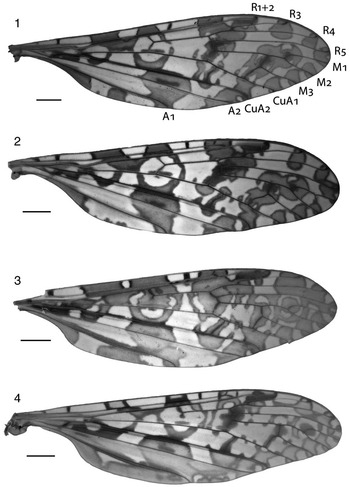
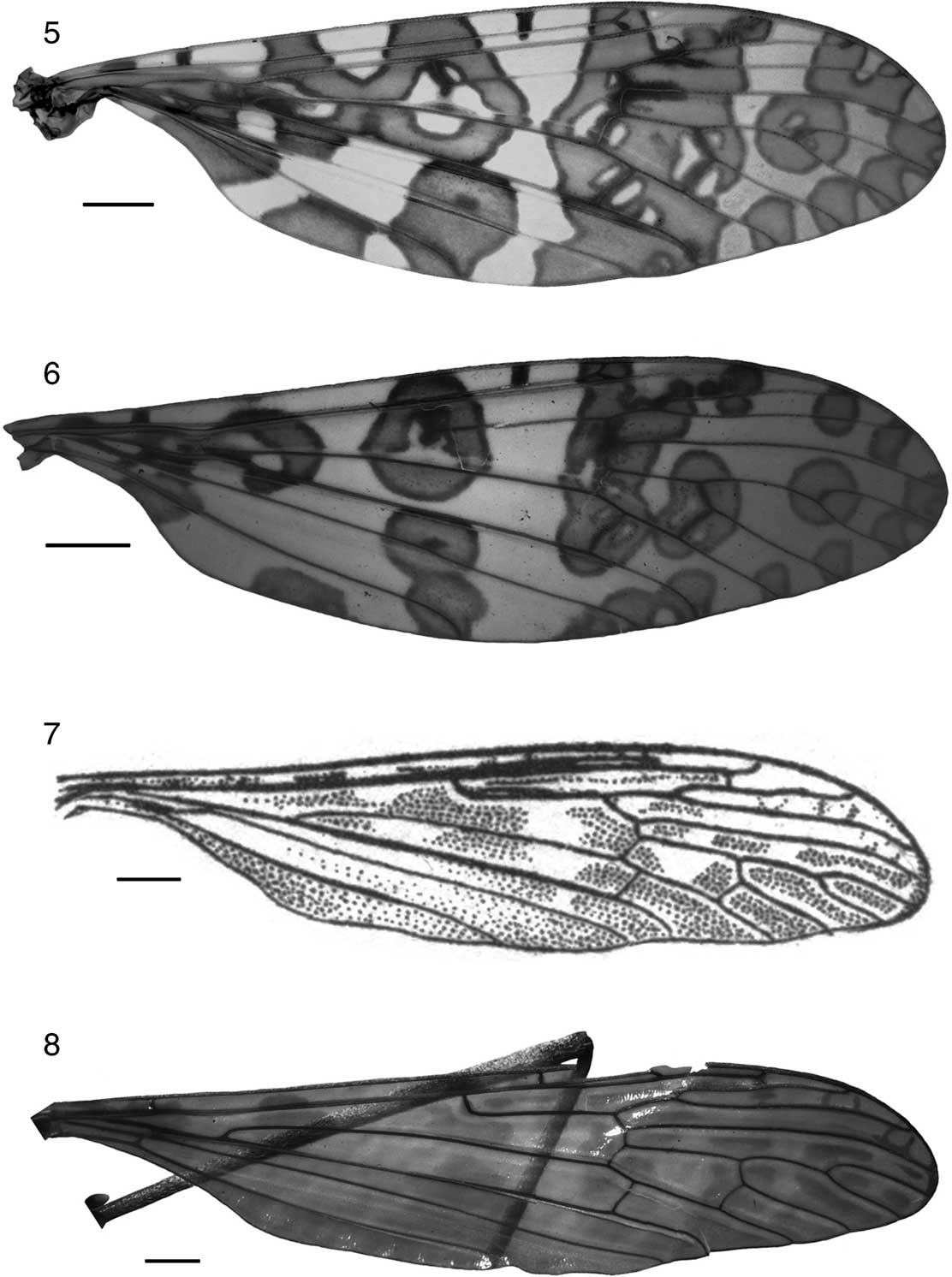
The main distinguishing wing venational character of the genus is one or more supernumerary crossveins in the costal cell above Rs, with a single extra crossvein found in subgenus Epiphragma (Alexander Reference Alexander1948; Fig. 1). This extra crossvein is located approximately opposite midlength of vein Rs in the species reviewed here. Most species have a distinctive wing pattern consisting of multiple ocelli (ring pattern) along with spots and irregular patches (Alexander and Byers Reference Alexander and Byers1981; Figs. 1, 3, 5), and in some species these markings, including the ocelli markings, have an “ocellate” patterning (pattern color ringed or edged with a darker color) (Fig. 30). Also characteristic, and giving the genus its name, are the transverse markings on the abdominal terga (Alexander Reference Alexander1948).
Epiphragma spp. wings. 1.Epiphragma arizonense (holotype, United States of America, Arizona, Coconino Co.), veins labeled. 2.Epiphragma arizonense (United States of America, Arizona, Pima Co. Bog Springs). 3.Epiphragma celator (holotype, Mexico, Michoacan). 4.Epiphragma celator (Mexico, Chihuahua). Scale line = 1 mm.

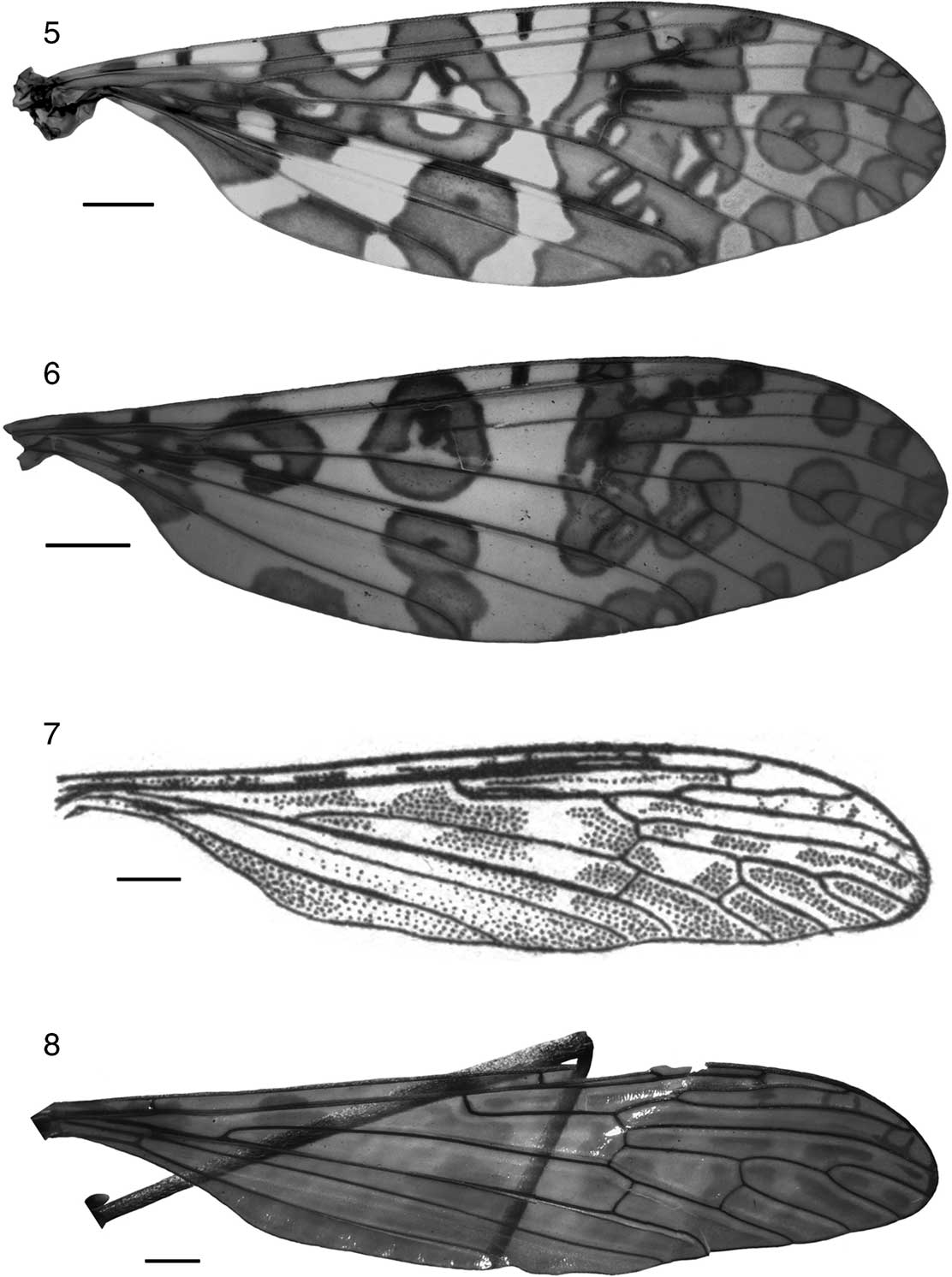
Epiphragma spp. wings. 5.Epiphragma fasciapenne (United States of America, Kansas, Douglas Co.). 6.Epiphragma fasciapenne (United States of America, New York, Herkimer Co.). 7.Epiphragma nebulosum (reprinted from Bellardi Reference Bellardi1859). 8.Epiphragma nebulosum (Mexico, San Luis Potosi). Scale line = 1 mm.
Species are of moderate size for the Tipulidae, with most 10 or 12 mm in body length. The antenna has the first two flagellomeres fused or partly so, although these are separate in some species (e.g., Epiphragma celator Alexander, discussed in this paper). Antennal length varies from 2 mm to more than 5 mm, and in those species studied here there is one group with short (2.5 mm or less) and one group with relatively long antennae (4 mm or more).
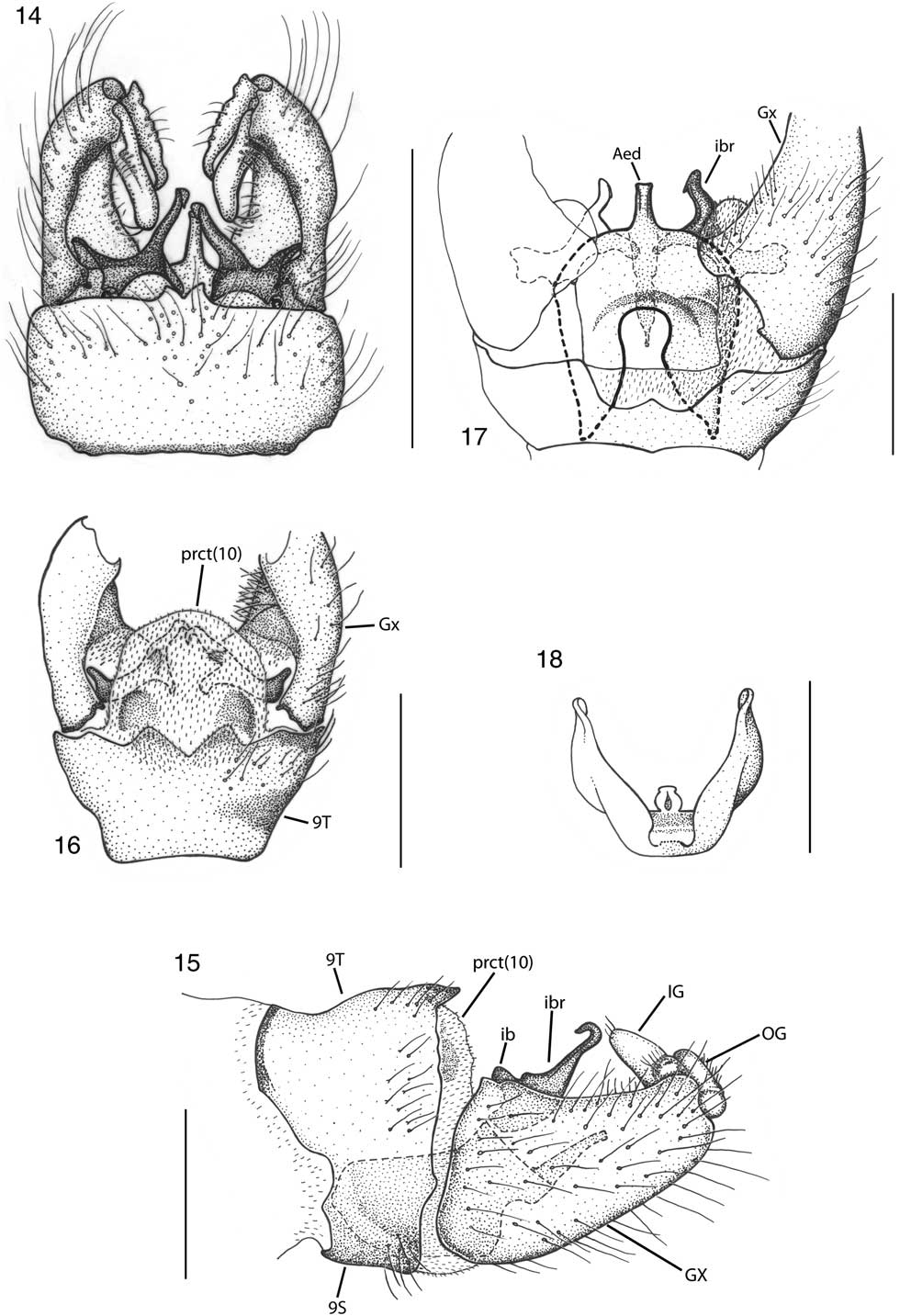
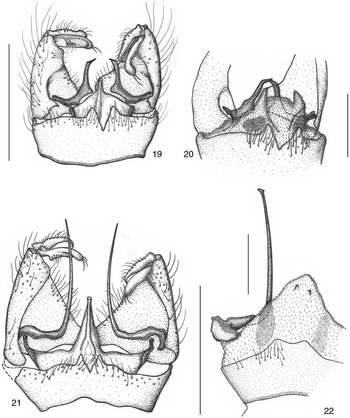
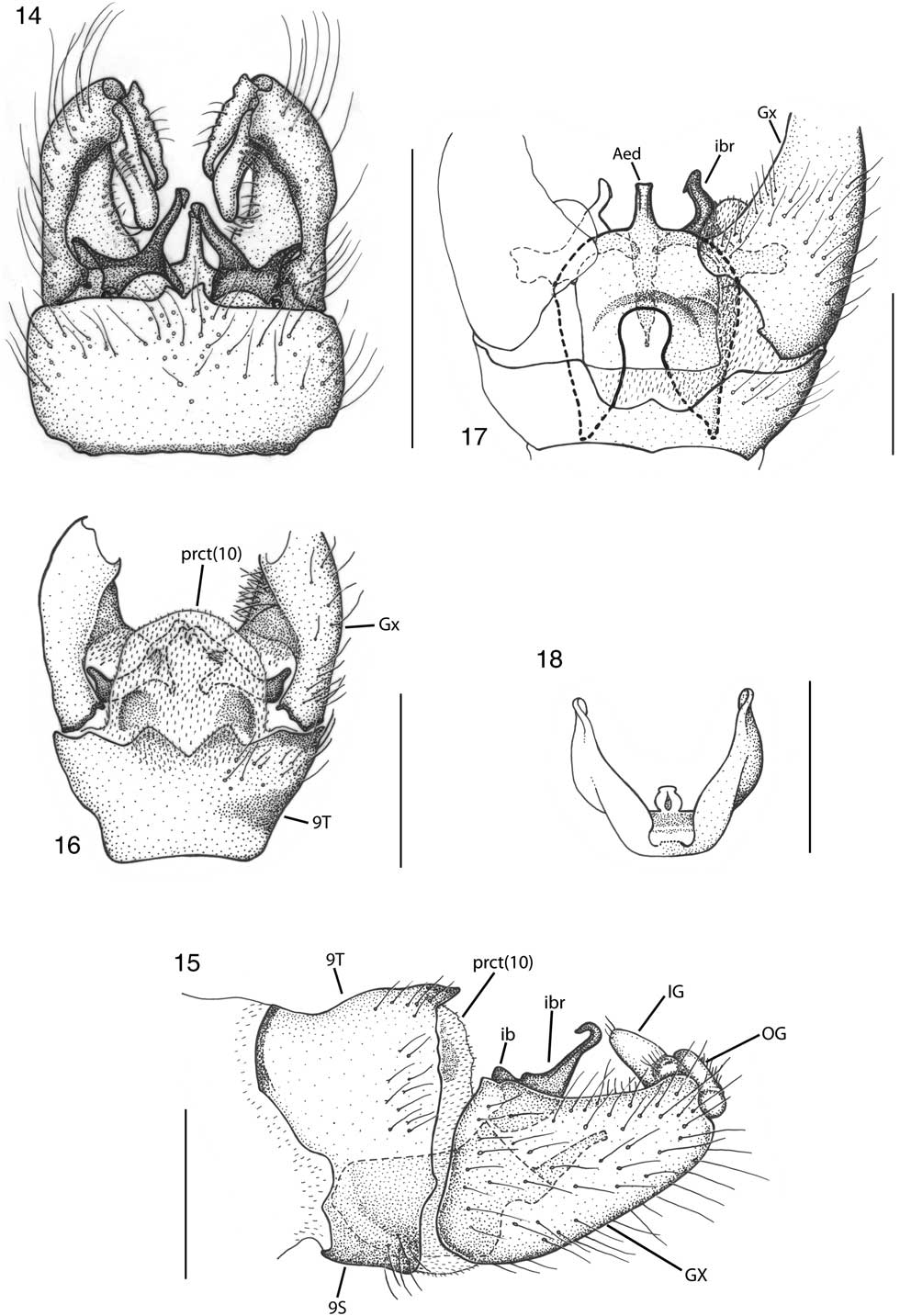
The male hypopygium also does not vary significantly among these species, with the exception of the rods of the interbase, which can be useful for specific identification (Fig. 15). We have distinguished these structures from parameres following Alexander (Reference Alexander1967: 62), Alexander and Byers (Reference Alexander and Byers1981: 154, fig. 6) and the detailed treatment in Ribeiro (Reference Ribeiro2008). The lobes of the ninth tergite (epandrium) located submedially are fairly uniformly triangular in shape (Fig. 16). The proctiger shows some differences among the Nearctic species, possibly of phylogenetic importance, and is worth studying among a wider range of taxa (Figs. 16, 20, 22). The inner and outer gonostyli are quite homogenous among the species studied here, although basal patches of hairs on the inner gonostylus are seen in the species illustrated here (e.g., Fig. 19) and not in the illustrations of Mao and Yang (Reference Mao and Yang2009) and may represent distinct regional or cladistic differences. Alexander (Reference Alexander1948) cited certain Neotropical species with unusual genitalic modifications. The ninth sternite (hypandrium) is usually divided ventrally and unmodified (Fig. 17), but that of Epiphragma fasciapenne is distinctive, being complete and with a protuberance, and this feature is worthy of further survey within the genus. The female genitalia also do not vary appreciably among species and have not been examined in detail here.
In the last century the genus was traditionally classified as a primitive group, subtribe Epiphragmaria, in the tribe Hexatomini sensu Alexander (e.g., Alexander Reference Alexander1943, Reference Alexander1948). Subsequently its position in this clade was questioned based on characters of the immature stages (Oosterbroek and Theowald Reference Oosterbroek and Theowald1991); Epiphragma and Austrolimnophila Alexander were supported as sister groups and a basal lineage of Tipuloidea along with Limoniinae s.s., Tipulidae s.s., Cylindrotomidae and some other isolated genera, and not placed with the traditional Hexatomini. The phylogenetic analyses of Ribeiro (Reference Ribeiro2008), using adult morphological characters, confirmed the monophyly of Epiphragma (E.) based on the fusion of the flagellomeres and the supernumerary costal crossvein and suggested a sister-group relationship with the endemic genus Acantholimnophila Alexander of New Zealand. His preferred phylogenetic hypothesis confirmed that of Oosterbroek and Theowald (Reference Oosterbroek and Theowald1991) that Epiphragma is a basal lineage within Tipuloidea. Petersen et al. (Reference Petersen, Bertone, Wiegmann and Courtney2010), using a combined dataset of molecular and morphological (immature and adult) characters, did not find congruence for the placement of Epiphragma, but their consensus of relationships and proposed classification placed the genus in its own subfamily Epiphragminae within Tipulidae s.l. (including all groups except the Pediciidae). Petersen et al. (Reference Petersen, Bertone, Wiegmann and Courtney2010) found several larval head capsule characters were synapomorphies for the genus. We have followed the classification of Petersen et al. in this paper, recognizing Epiphragma not as part of a paraphyletic “Limoniidae” but of a broader, monophyletic Tipulidae s.l.
Most species of Epiphragma occur in woodland habitats as adults. The larvae, where their habits are known (as in E. fasciapenne, Epiphragma solatrix (Osten Sacken), and Epiphragma ocellare (L.)), develop in decaying (sometimes damp or saturated) wood (Alexander Reference Alexander1920, Reference Alexander1948; Krivosheina Reference Krivosheina2009).
Material and methods
Specimens for this study came from the following institutions:
ANSP = Academy of Natural Sciences of Philadelphia, Pennsylvania, United States of America
BYU = M.L. Bean Museum, Brigham Young University, Provo, Utah, United States of America
CAS = California Academy of Sciences, San Francisco, California, United States of America
CNC = Canadian National Collection, Ottawa, Ontario, Canada
KU = Snow Entomological Museum, University of Kansas, Lawrence, Kansas, United States of America
NCSU = North Carolina State University, Raleigh, North Carolina, United States of America
UCD = Bohart Museum of Entomology, University of California at Davis, Davis, California, United States of America
USNM = National Museum of Natural History, Smithsonian Institution, Washington District of Columbia, United States of America.
Terminology naturally followed that of McAlpine et al. (Reference McAlpine, Peterson, Shewell, Teskey, Vockeroth and Wood1981) and Brown et al. (Reference Brown, Borkent, Cumming, Wood, Woodley and Zumbado2009). We follow the recent classification of Petersen et al. (Reference Petersen, Bertone, Wiegmann and Courtney2010) recognizing only two monophyletic lineages at family level, Pediciidae and Tipulidae s.l.; “Limoniidae” as presently constituted is clearly paraphyletic based on several lines of evidence (e.g., Ribeiro Reference Ribeiro2008; Petersen et al. Reference Petersen, Bertone, Wiegmann and Courtney2010).
Photographs of wings were made from existing slide mounted specimens and newly prepared slides; the latter were mounted in Euparal (BioQuip Products Inc., Rancho Dominguez, California, United States of America). The male hypopygium was prepared for study by clearing in a dilute, heated sodium hydroxide solution, and studied in glycerin or glycerin jelly slide mounts. The mostly membranous proctiger, in dried and alcoholic specimens, may be adhered to the wall under the ninth tergal lobes, or over the aedeagus; we studied it where it was inflated in ethanol-preserved specimens but it can be observed in gently cleared specimens.
Drawings of the male hypopygium were made by senior author (JKG), and inked by Susan Trammel. Photos of wings and legs were made by JKG using a Leica EZ4 built-in camera system (Leica Microsystems, Wetzlar, Germany), and images cropped and cleaned by Stephen Kuhn. Stephen Kuhn also prepared all the illustrations for publication.

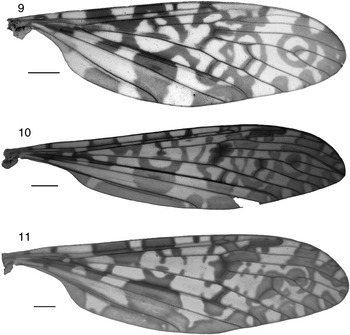
Epiphragma spp. wings. 9.Epiphragma ocellare (Germany, Udingen). 10.Epiphragma oreonympha (holotype, Mexico, Chiapas). 11.Epiphragma oreonympha (Mexico, Chiapas, Porvenir). Scale line = 1 mm.

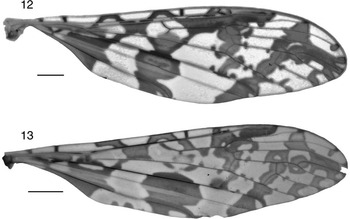
Epiphragma spp. wings. 12.Epiphragma solatrix wing (United States of America, Tennessee, Great Smoky Mtns.). 13.Epiphragma solatrix wing (Argentina). Scale line = 1 mm.

Epiphragma arizonense Alexander, male hypopygium. 14. Dorsal view (proctiger removed) (United States of America, Arizona, Pima Co.). 15. Lateral view (United States of America, Arizona, Pima Co.). 16. Dorsal view (detail of proctiger) (Mexico, Sinaloa). 17. Ventral view (United States of America, Arizona, Pima Co.). 18. Detail of aedeagus, anterior view (United States of America, Arizona, Pima Co.). Abbreviations: Aed = aedeagus; 9T = ninth tergite; 9S = ninth sternite; prct(10) = proctiger; ib = interbase; ibr = interbase rod; IG = inner gonostylus; OG = outer gonostylus; Gx = gonocoxite. Scale line = 1 mm, except where indicated.
Species descriptions Epiphragma (Epiphragma) arizonense Alexander
Epiphragma (Epiphragma) arizonensis Alexander, Reference Alexander1946a: 517; Figs. 14 (wing venation), 17 (male hypopygium).
Description
Body length about 10–14 mm, wing length 12.5–13.5 mm, antennae about 2.3–3.3 mm.
Head. Dark brown with grayish pruinosity. Antennae. Scape and pedicel dark brown; first flagellomere bright yellow, large, about size of pedicel, second flagellar segment and remaining flagellum much thinner, yellow to light brown, remainder fading from light yellow to light brown.
Thorax. Mesonotum largely reddish brown, with strong gray pruinosity centrally, reddish brown along edges, scutellum with yellowish areas; antepronotum with yellow highlights. Pleuron mostly dark brown, mottled with gray pruinosity, without longitudinal dark band as in E. fasciapenne. Wing (Figs. 1, 2). Clear with irregular brown mottling (markings “ocellate,” brown with darker brown borders), with a transverse band just beyond base, another just before midlength, half band just beyond midlength, and angled band before apex; second and third bands separated by clear markings in middle of cell R1 (this area brown in E. solatrix). Anterior margin of wing with two connected, brown, circular markings, one near base of cell M, another centered over origin of vein Rs. Apical third of wing with angled, clear band (cell R1+2 through cell A1) followed by irregular “L”-shaped, brown band; this subapical transverse brown wing band angled and (through outer end of cell M1+2) complete or nearly so, ending in cells R5 and M1; spots at ends of veins R3 through CuA1 small and circular, and mostly separated from “L”-shaped band. Posterior margin of wing with isolated, brown patches (posterior ends of brown bands); no semblance of a brown band extending longitudinally along posterior border of wing. Legs. Brownish yellow, femur with apical (not subapical) pale brown band, scarcely distinct.
Abdomen. Tergites 1–7 yellowish brown. Segments 3–7 with anterolateral margins dark brown, lateral and posterior margin of tergites narrowly edged with gray pruinosity. Bases of setae distinctly marked in brown. Sternites yellow with brown lateral margins. Male hypopygium (Figs. 14–18). Ninth tergite. Apical margin with two distinct rounded lobes, emargination between lobes “V”-shaped, all easily visible in dried specimens (Fig. 14). Ninth sternite. Flat, membranous medially, without conical protuberance (Fig. 15, 17). Interbase. End of interbase visible at 9th tergite appearing as narrow bar (Fig. 16). Rod of interbase slightly sinuous, with terminal hook small, with short bend, apex triangular (Figs. 14, 15). Proctiger. (visible in ethanol-preserved specimens) as in E. solatrix, broad, membranous, with two broad lightly sclerotized bars laterally near base, two conical, membranous lobes submedially with cluster of hairs at apex (similar to E. celator), distal margin curved (Fig. 16).
Type material
Holotype. ♂. UNITED STATES.Arizona: Coconino Co., Oak Creek Canyon, el. 5180 ft (1580 m), 12.vi.1942, C.P. Alexander; wing, antennae, two anterior legs, and ♂ hypopygium on slide (USNM). Allotype. ♀. Same data as holotype; head, hind leg, and wing on slide. Paratype. ♂. Same data as holotype.
Additional material examined
UNITED STATES.Arizona: Cochise Co., Southwest Research Station, 5 mi (8 km) W. Portal, el. 5400 ft (1650 m) 14.vii.1963, D.K. Oliver and J.G. Rosen, 2 ♂♂, 1 ♀, 1 slide (USNM); same but 26.ix.1966, P.H. Arnaud, Jr., 1 ♂ (CAS); same but Oak Creek, 5.vi.1949, N. Cricknar, 1 ♂, 1 slide (USNM); same but 23.v to 5.vi.1967, Malaise trap, C.W. Sabrosky, 1 ♂ (USNM); Ramsey Canyon, Huachuca Mountains, 15 mi S. Sierra Vista, el. 5200 ft, 10.v.1967, R.F. Sternitsky, 1 ♂ (CNC); Pima Co., Santa Rita Mountains, Madera Canyon, Bog Springs Campground, T19S.R14E.35; el. 1700 m, 5.vi.1991, at dusk in rock crevice, in copula, J. Gelhaus #522, C.R. Nelson, 1 ♂, 1 ♀, ♂ wing on slide (ANSP #6888). MEXICO: Chihuahua: Cuiteco, 20.vii.1969, T.A. Sears, R.C. Gardner, C.S. Glaser, 1 ♀ (CAS). Sinaloa: 18.5 km E. Copala on MX. Hwy. #40, oak-pine hillside, 17.iii.1990, J. Gelhaus #460, 1 ♂ (ANSP #6887).
Discussion
This species was previously known from the type series from Oak Creek Canyon in Arizona; the additional Arizona and Mexico specimens expand the range to about 1400 km north to south. The angled, clear, brown bands on the apical third of the wing, and the hooked tip of the male interbase rod, among other features, distinguish this species and E. solatrix from other Nearctic Epiphragma; the clear R1 cell and small hook of the rod of interbase along with other characters in the key separate E. arizonense from E. solatrix.
Range
Southern Arizona, United States of America, south to Sinaloa, Mexico. Elevation range: 1500–1800 m.
Habitat
Alexander collected the type series along Oak Creek (permanent flow) in streamside vegetation under sycamore (Platanus L. (Platanaceae)) and boxelder (Acer negundo L. (Aceraceae)) at the bottom of the steep-sided canyon (Alexander Reference Alexander1946a). In the Santa Rita Mountains, a mating pair was collected at dusk resting on a rock in a seepage area along a mostly dry arroyo; the hillsides were forested with pine (Pinus L. (Pinaceae)), juniper (Juniperus L. (Cupressaceae)) and manzanita (Arctostaphylos Adans. (Ericaceae)) (Gelhaus, unpublished data). The Sinaloa specimen was collected at light in an area of steep hillsides forested by pine and oak (Quercus L. (Fagaceae)); the light was near seepage areas with a small stream far below in the canyon (Gelhaus, unpublished data). Based on specimens examined, the adults are present in Arizona from mid-May to mid-July and in September and in Mexico in March and July.
Epiphragma (Epiphragma) celator Alexander
Epiphragma (Epiphragma) celator Alexander, Reference Alexander1946b: 238.
Description
Body length 10–13 mm; wing length 10–14 mm; antennal length about 5 mm in ♂. Holotype ♀ antennal length 3.6 mm (Alexander Reference Alexander1946b).
Head.Antennae. Scape and pedicel very dark brown to black, scape 2× longer than pedicel, evenly slender; ♂ length reaching beyond abdominal segment 2. First flagellomere 1–1.5× as long as second flagellomere, yellow (light brown at base in some specimens), flagellomeres 1 and 2 not fused. Remaining flagellomeres bicolored, each mostly brown basally, yellow apically; amount of yellow decreasing from flagellomeres 2 to 9.
Thorax. Mesonotum largely reddish brown, with strong gray pruinosity on posterior half, an indistinct border between red-brown and gray extending transversely across prescutal pits; a pair of small brown oval markings just anterior to transverse suture along setal row; scutellum with anterior half gray, posterior half brown, a distinct transverse boundary between these colors; mediotergite gray dorsally, reddish brown along edges; antepronotum and prescutal pit area with yellow highlights. (Holotype's thorax broken and discolored – appears to have the contrast noted anteriorly, scutellum with brown laterally, not posteriorly.) Pleuron mottled with dark brown and gray pruinosity, without distinct longitudinal dark band, posterior half mostly gray or mottled gray and brown. Wing (Figs. 3, 4). Clear with irregular brown mottling, ocelli brown with darker brown borders, no clearly defined transverse pale or brown banding. Anterior margin of wing with two connected, brown, circular markings, one near base of cell M, another centered over origin of vein Rs; a poorly defined ocellus centered at outer end of cell R. Apical third of wing with elongate, narrow, dark stigma, ocellus centered over split of veins M1 and M2, spots at end of veins R3 through CuA1 brown and irregular, and mostly connected. Large brown spot at center of cells Cu and A1 (below R cell ocellus), separated or connected to brown markings in A2. Posterior margin of wing with brown patches extensive and mostly connected in some specimens (Fig. 4), cell A2 and wing margin of cell A1 mostly brown, reduced and not so connected in holotype (Fig. 3) and specimens from Radiola Springs. Legs. Coxa and trochanter of legs dark brown (holotype yellowish), femur, tibia and tarsomeres bright brownish yellow, femur with indistinct, light brown band apically or subapically in Arizona specimens and type (Mexico), femur brown basally with yellow bands at midlength and apex surrounding a brown band, in most Mexico specimens.
Abdomen. Sternites of abdomen uniformly dark brown (holotype uniformly yellow). Tergites mottled dark brown to grayish yellow, median longitudinal, dark brown, broken band most evident on anterior half of each segment, mostly dark brown on posterior half, bordered with grayish yellow; lateral margins dark brown anteriorly, posteriorly bright grayish yellow. Male hypopygium (Figs. 19, 20). Ninth tergite. Apical margin with two prominent, triangular lobes, emargination between lobes “V”-shaped, easily visible in dried specimens (Fig. 19). Ninth sternite. Slightly protruded medially, but without distinct conical protuberance. Interbase. Rod extended approximately half way from 9th tergite to base of dististyle, with distal third angled, flattened, apex acute but no hook (Fig. 19). Proctiger. (visible in ethanol-preserved specimens) as in E. solatrix, broad, membranous, with two broad lightly sclerotized bars laterally near base, two conical, membranous lobes submedially, distal margin curved (Fig. 20).
Type material
Holotype. ♀. MEXICO. Michoacan: Cerro Tancitaro, alt. 7700 ft (2350 m), 27.vi.1941, in damp ravine, H. Hoogstraal #16; wing, antennae, and leg on slide (USNM).
Additional material examined
MEXICO. Chiapas: Sierra Madre, elev. 2000 m, 6.xii.1932, A. Dampf, 1 ♂ (USNM); same but Finca Prusia, Sierra Madre, el. 1440–1780 m, 6.xii.1932, A. Dampf, 1 ♂ (USNM). Chihuahua: Radiola Spring, tributary of Rio Chuhuichupa, 26.vi.1987, Baumann, Sargent, Kondratieff, Wells, 1 ♂ (BYU); Arroyo Toro, 25.vi.1987, Baumann, Sargent, Kondratieff, Wells, 1 ♂, 1 slide (BYU); no further locality information, M. B. no. 352, Coll. A. Dampf, 1 ♂, 1 ♀ (USNM). Durango: 10 mi W. El Salto, el. 9000 ft, 12.vi.1964, W.R.M. Mason, 1 ♂ (CNC). Michoacan: Cerro Tancitaro, 2 km N. Apo, el. 2600–2700 m, 29.vi.1947, T.H. Hubbell, one sex unknown (USNM). UNITED STATES.Arizona: Cochise Co., Chiricahua Mountains, Turkey Creek, 4.8 km SW Paradise, T27S.R30E.35; el. 1950 m, 1.vi.1991, J. Gelhaus #514, C. Nelson #5702, 1 ♂, 2 slides (ANSP #6882); Cochise Co., Chiricahua Mountains, Rucker Creek at Rucker Forest Campground, el. 1981 m, 109°15′00″, 31°45′00″, 24.v.1993; at light; J. Gelhaus #596, C. Nelson, D. Koenig, 1 ♂ (ANSP #6881); Pima Co., Mount Lemmon, 9000 ft (2743 m), 26.vii.1924, E.P. Van Duzee, 1 ♂ (CAS).
Discussion
The holotype female was the only previously known specimen; the male is described here for the first time. Although differences are noted in wing patterning (cells C, A1, and A2 – compare Figs. 3 and 4) and sternite color in the above redescription, the overall wing pattern and bicolorous antennae indicate the additional specimens from northern Mexico and Arizona and the holotype female from Michoacan are conspecific. The distribution is expanded nearly 1700 km northward from the type locality, similar to that of E. arizonense, and south also to Chiapas. As noted in the key, the important distinguishing features of the species are the bicolorous antennae, wing pattern, and form of the rod of the interbase, particularly the flattened, acute apex.
Range
Southern Arizona, United States of America south to Michoacan and Chiapas, Mexico. Elevation range: 1950–2743 m.
Habitat
The holotype was collected in a “damp ravine” (Alexander Reference Alexander1946b). The specimen from the Chiricahua Mountains was collected along a permanent stream in a steep ravine, with hillside vegetation of oak, Ponderosa pine (Pinus ponderosa C. Lawson), alligator-bark juniper (Juniperus deppeana Steud.) and Douglas-fir (Pseudotsuga Carrière (Pinaceae)) (Gelhaus, unpublished data). Most adult specimens were captured from late May to late June, with a late July record at the highest elevation.
Epiphragma (Epiphragma) fasciapenne (Say)
Epiphragma spp. male hypopygium. 19.Epiphragma celator, dorsal view (proctiger removed) (United States of America, Arizona, Pima Co.). 20.Epiphragma celator, dorsal view (detail of proctiger) (United States of America, Arizona, Pima Co.). 21.Epiphragma fasciapenne, dorsal view (United States of America, Maryland, Baltimore). 22.Epiphragma fasciapenne, dorsal view, proctiger (United States of America, Maryland, Baltimore). Scale line = 1 mm, except where indicated.

Limnobia fasciapennis Say, 1823: 19
Limnophila (Epiphragma) pavonina Osten Sacken, Reference Osten Sacken1859: 239.
Other important references
Alexander (Reference Alexander1919, pl. XLI, fig. 158); Snodgrass (Reference Snodgrass1904, pl. 9, figs. 13, 15); Ribeiro (Reference Ribeiro2008: fig. 8 [antennae], fig. 94 [male hypopygium]).
Description
Body length: 9–13 mm; wing length 10–12.5 mm.
Head. Dark brown with gray pruinosity. Antennae. Length 2.2–2.9 mm, reaching end of thorax to first abdominal segment. Scape and pedicel dark brown, first two flagellomeres yellow, next two yellow to light brown, remaining flagellomeres light brown.
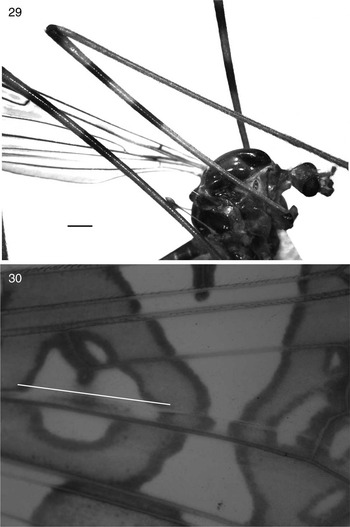
Thorax. Mesonotum brown with largely gray pruinosity, margins without gray pruinosity and reddish brown. Brown longitudinal stripe across middle of pleura. Wing (Figs. 5, 6, 30). With generally four brown, transverse bands, interspersed with three clear, transverse bands; clear band at midlength and brown band following most distinct as bands. Transverse clear band across midlength of wing nearly always complete (band interrupted in some specimens, e.g., Hazleton Pennsylvania, Millville Newfoundland), bordering a fairly broad, recognizable, brown transverse band, brown band width from just before end of Sc1+2 and extending through end of vein R1 at wing margin (atypical pattern Fig. 6). Brown markings with obvious darker border clearly visible (“ocellate”), all markings fairly dark and well defined (Fig. 30). Apex with distinct, irregular spots on apical margin from R3 to CuA1, sometimes connected as chain of markings. Distinct brown, circular or ocellus markings centered at origin of vein M (arculus area), origin of vein Rs, midlength of vein Cu (smaller and connected to Rs ocellus), surrounding discal cell and base of M1 and M2. Ocelli grown together in many specimens, clearly separated in others, total wing patterning variable. Legs. Brownish yellow, femur with broad darker brown apical band (not subapical as in arizonense), some specimens with additional brown band near midlength blending gradually to yellow basally.
Abdomen. Tergites 1–7 yellowish brown, first two segments and posterior half of succeeding tergites with grayish pruinosity, lateral margins often darker brown, a median, longitudinal, brown band sometimes present; posterior margins of tergites narrowly pale. Sternites uniformly yellow. Male hypopygium (Figs. 21, 22). Ninth tergite. Apical margin with median fourth produced forward with shallow emargination between two slight lobes (Fig. 22). (Apical “margin” in dry specimens most often straight because the lobes are often folded under and not observable.) Base of each interbase large, visible on lateral margins of tergite. Ninth sternite evenly sclerotized with conical protuberance medially. Interbase. Very long and thin, extending past end of gonostyle, with a slight apical protuberance (Figs. 21, 22). Proctiger. (observable in ethanol specimens) conical, with two small protuberances near apex (Fig. 22), a pair of slightly sclerotized bands at midlength.
Material examined
CANADA.Alberta: Bilby, 22.vi.1924, O. Bryant, 1 ♂ (CAS); Manitoba, Aweme, 25.vi.1913, E. Criddle, 1 ♂ 1? (ANSP #3309, 3330). Newfoundland: Millville, mouth of Codroy River, 12.vii.1959, D.C. Ferguson, 1 ♀ (USNM). Nova Scotia: S. Milford, 27.vi.1934, J. McDunnough, 1 ♀ (USNM); Richmond Co., Mill Brook, Hwy. #4, Kempt Rd, 4.vii.1998, Baumann and Kondratieff, 1 ♂ (in ethanol) (BYU); Ontario, Ottawa, 14.v.–17.vi.1993, J.R. Vockeroth, 1 ♂ 1 ♀ det. F. Brodo (ANSP #3326–3327); Ottawa, 30.v.1912, 1 ♀ (ANSP #3328); Ottawa, 10.vi.1990, swept over bare path, Acer woods, 1 ♀ det. F. Brodo (ANSP #3329); Smoky Falls, Mattagami River, 13–16.vi.1934, G.S. Walley, 2 ♂♂ (USNM). Quebec: Montreal, 17.vi.1906, 1 ♂ (ANSP #3331); Old Chelsea, 16.v.1991, J.R. Vockeroth, 1 ♂ det. F. Brodo (ANSP #3332); Cottage Beaulieu, 18.vii.1908, Beaulieu, 1 ♂ (ANSP #3358); unknown province, Gull Lake, vi.1921, 3 ♂♂, 1 ♀ (CAS). UNITED STATES.Kansas: Douglas Co., Breidenthal Reserve, 2 mi N Baldwin City, 23.vi.1982, S.A. Teale, 1 ♂ (ANSP #6834); University of Kansas Natural History Reservation, 23.v.1980, reared adults 24.v.1980, J. Gelhaus #86, 1 ♂, 3 ♀♀ (in ethanol), 1 slide (ANSP #6867); Lawrence, 25.v.1981, S.A. Teale, 1 ♀ (ANSP #6835). Maryland: Baltimore Co., Baltimore, 14.vi, no year, 1 ♂ (ANSP #6846); Montgomery Co., Colesville, 24.iv.–14.vi (1975–1979), A.S. Menke, 8 ♂♂, 7 ♀♀ (UCD). Michigan: Berrien Co., St. Joseph, 15.vi.1975, D.D. Wilder, 2 ♂♂, 1 ♀ (CAS); Clinton Co., Rose Lake Wildlife Area, 23.vi.1975, D.D. Wilder, 1 ♂ (CAS). Maine: Penobscot Co., Orono, 5.vi.1913, 1 ♂ det. C.P. Alexander (ANSP #3333). North Carolina: Black Mts, 1.v.–17.vi.1912, W.G. Dietz, 4 ♂♂, 5 ♀♀, 1? (ANSP #3318–3325, 3357, 3364). New Jersey: Burlington Co., Woodland Township; Franklin Parker Preserve, ∼2 km W Chatsworth, red maple bog btw. Wading River and airfield (Malaise trap site #6) N39.80686°, W74.54385°; el. 9 m, 3.vi.2007, J.K. Gelhaus, 1 ♂ (ANSP #6915); Camden Co., Clementon, 30.v.190? (year uncertain), 1 ♂ (ANSP #3355); Mercer Co., Trenton, 24.v.1908, 1 ♂ det. Coquillett (ANSP #3354); New Jersey, no further locality, 1 ♂ (ANSP #6843). New York: Hamilton Co., 10 km E. Indian Lake, 74°10′14″; 43°45′30″; el. 555 m, 31.v.–15.vii.1980, T.L. McCabe & S.A. Teale, 11 ♂♂, 13 ♀♀ (ANSP #3188–3189, 6826–6832, 6844); Herkimer Co., Indian Castle, 10.vi.1915, C.P. Alexander, sex?, 1 slide (USNM); County unknown, Rock City, 8.vi.1915, C.R. Crosby, 3 ♂♂, 1 ♀ on slide (USNM). North Carolina: Buncombe Co., Swannanoa, 26.V.1923, C.S. Brimley, 1 ♂ (NCSU); Durham Co., Near Ellerbe Ck, 15.vi.1968, 1 ♂ (NCSU); Haywood Co., Sunburst, late May, C.S. Brimley, 1 ♂ (NCSU); Wake Co., Raleigh, 22.v.1939, C.S. Brimley, 2 ♂♂ (NCSU). Ohio: Hamilton Co., Cincinnati, 25.iv.–15.vi (1901–1904, 1927), A.F. Braun, 6 ♂♂, 4 ♀♀ (ANSP #6836–6842). Pennsylvania: Bucks Co., New Hope, 10.vii.1907, 1 ♀ (ANSP #3353); Carbon Co., Palmerton, 9–18.vi.1920, 2 ♂♂, 1 ♀ (ANSP #3316–3317, 3349); Centre Co., State College, 19–22.vi.1973, D.D. Wilder, 1 ♂, 2 ♀♀ (CAS); Delaware Co., 27–28.v.1905, E.T. Cresson Jr., 2 ♂♂ (ANSP #3350–3351); Castle Rock, 9.vi.1907, 1 ♀ (ANSP #3352); Swarthmore, 13–23.v. (1905–1906), E.T. Cresson Jr., 1 ♂, 1 ♀ (ANSP #3344, 3346); Swarthmore, along Crum Creek, 19.vi.1910, E.T. Cresson Jr., 1 ♂ (ANSP #3345); Luzerne Co., Hazleton, 24.v.23.vi (from 1912 to 1921), W.G. Dietz, 6 ♂♂, 1 ♀, 1?, 1 slide (ANSP #3187, 3313–3315, 3347–3348, 6845); Montgomery Co., John Audubon Center at Mill Grove, Lower Perkiomen Valley, 3.4 km NE Valley Forge, 75°26′39.3″; 40°7′24.5″; el. 37 m, 8.v.2009, at light, J. Gruber, L. Henderson, J. Weintraub, 1 ♀ (ANSP #6862); Philadelphia Co., Philadelphia, 18.vi (year unknown), 1 ♂ (ANSP #3335); Roxborough, 22–29.v (from 1909 to 1910), F. Haimbach, 3 ♂♂ (ANSP #3336, 3337, 3339); Roxborough, 9.v.–7.vi (from 1904 to 1908), 3 ♂♂, 5 ♀♀ (ANSP #3338, 3340–3342). Pennsylvania: no further information, 2 ♂♂ (ANSP #3334). Tennessee: Johnson Co., Roan Ck, on U.S. Hwy. #421, 2.8 mi S, 1.25 mi E, Mountain City, 81°46′45″N 36°25′45″W, el. 2360 ft (719 m), 25.v.1984, P. Liechti, D. Huggins, J. Gelhaus, B. Coler, #104, 2 ♂♂, 1 ♀ (1 ♂ in ethanol) (ANSP #6833, 6866); Knox Co., Knoxville, 3.vi.1916, G.G. Ainslie, 1 ♂ (ANSP #3356). Virginia: Rockbridge Co., 1.1 km E. Vesuvius on VA Hwy. #56, George Washington National Forest border, el. 475 m, 18.v.1992, J. Gelhaus #532 & D. Koenig, 1 ♀ (ANSP #3185). Wisconsin: Dodge Co., Beaver Dam, 4–5.vi.1910, 5 ♂♂, 2 ♀♀ (ANSP #3310–3312).
Questionable record
UNITED STATES.California: Mono Co., Twin Lakes, S. of Mammoth Lakes, 2130 m, 19.vii.1966, P.H. Arnaud Jr., 1 ♂ (CAS).
Discussion
Epiphragma fasciapenne is distributed in the eastern Nearctic Region, and is broadly sympatric with E. solatrix. Its elongate, straight interbase is very different from all other Nearctic species, and seems most closely related to the eastern Palearctic Epiphragma subfasciapenne and Chinese Epiphragma elongatum Mao and Yang (Mao and Yang Reference Mao and Yang2009). The unique wing pattern and interbase structure easily identify this species.
Range
Alberta to Newfoundland, Canada, south to Kansas, Louisiana and Florida, United States of America (Oosterbroek Reference Oosterbroek2010). The California record is probably a mislabeled specimen; it is 2000 km outside of the species’ confirmed range, and in a western montane habitat. Alexander (Reference Alexander1949) mentions similar dubious records for characteristically eastern Nearctic crane flies in western North America.
Habitat
In Kansas, the species was common in bottomland woods and around a swamp, with adults found on the ground or in vegetation less than 2 ft high (Young Reference Young1978). In Michigan, this species was also abundant in floodplain woods, swamps, and adjoining wooded ecotones. Larvae were found in sodden or submerged hardwood of all sizes and were able to survive partial desiccation of the wood (Rogers Reference Rogers1942). Unlike the sympatric E. solatrix, E. fasciapenne is univoltine with adults found from late April to late July, with most specimens in May and June (Young and Gelhaus Reference Young and Gelhaus2000).
Epiphragma (Epiphragma) nebulosum (Bellardi)
Tipula nebulosa Bellardi, Reference Bellardi1859: 6; plate I, Figure 4, left wing.
Notes on type
This species was described by Bellardi as a Tipula from a single specimen captured somewhere in Mexico by August Salle in the 1830s (Bellardi Reference Bellardi1859; Alexander Reference Alexander1946b). Alexander (Reference Alexander1913, Reference Alexander1946b) did not examine the type and saw no further specimens attributable to the species. A single male specimen from San Luis Potosi was determined by G.W. Byers and R. Schorr to represent this species, and notes and illustrations of the type and this second specimen, along with a translation of Bellardi's description, were shared with us by Byers. We have examined the second specimen (with one wing and male hypopygium removed and not available) and based on that specimen, the notes of Byers and Schorr, and Bellardi's original description, the species can be characterized. For completeness of our work, we have included reproductions of Bellardi's original drawing of the holotype wing, and of Byers’ and Schorr's illustrations of the male hypopygium of the second nontype specimen.
Description
Based on the nontype male specimen from San Luis Potosi (comments on type specimen from translation of Bellardi):
Body length 16.2 mm (type 15 mm), wing length 16.8 mm.
Head. Yellowish brown with reddish setae. Antennae. Scape and pedicel yellow, rest of antennae missing. (Type: “antenna yellowish, pale at base, obscure at apex”.)
Thorax. Mesonotum largely reddish brown. Antepronotum evenly reddish brown, postpronotum creamy yellow, mesonotum with dark mahogany-brown markings along anterior border, and paired spots laterally (Fig. 29), remainder of mesonotum evenly reddish brown, with grayish pruinosity on scutellum and median section of mediotergite, darker posteriorly. Pleuron mottled grayish yellow and reddish brown, distinct reddish brown band across median of episternum, also katatergite, and coxae. Legs. Coxae reddish brown at base, trochanter yellowish, femur bright yellow with three brown bands, at midlength, at apex and equally between, the apical band narrowest (Fig. 29), tibia and tarsus light reddish brown (Type: “feet dark, femora subferrugineous, row of three bands apically; dark equidistant bands, first in middle of femur, second towards knee”). Wing (Figs. 7, 8). Pale brown patterning, scarcely distinguished from background, color mostly limited to interior of cells, not extending across veins; brown spot centered over base of cell R, base of cell M, fragmented transverse band from base of vein Rs to end of cell A2, another along cord and outer part of cell dm. Partial circular marking centered over cell M1, and small circular marks at ends of cells R3 and R4; caudal half of wing mostly pale brown, from cell A2 through outer end of CuA1 (Type: “in middle of cells light sooty, at veins mostly clear”, Fig. 7).
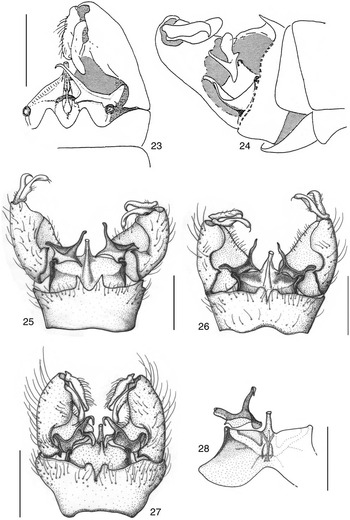
Abdomen. Segments 1–5 present, tergite 1 yellowish white, remaining tergites with anterior half reddish brown, transverse impressions contrastingly yellow, posterior half yellowish. Male hypopygium. Not observed, but illustrations from Byers (Figs. 23, 24). Ninth tergite. Apical margin with two median distinct lobes, emargination between lobes “U”-shaped. Interbase. Rod relatively straight, with apex a gently curved hook.
Epiphragma spp. male hypopygium. 23.Epiphragma nebulosum, dorsal view (Mexico, San Luis Potosi). 24.Epiphragma nebulosum, lateral view (Mexico, San Luis Potosi). 25.Epiphragma ocellare, dorsal view (Latvia). 26.Epiphragma oreonympha, dorsal view (Mexico, Chiapas, Porvenir). 27.Epiphragma solatrix, dorsal view (United States of America, Virginia, Fairfax Co.). 28.Epiphragma solatrix, dorsal view, aedeagal plate and interbase (United States of America, Tennessee, Great Smoky Mtns.). Scale line = 1 mm, except where indicated.

Epiphragma spp. 29.Epiphragma nebulosum, lateral view, thorax and head (Mexico, San Luis Potosi). 30.Epiphragma fasciapenne, detail of wing (United States of America, Kansas, Douglas Co.). Scale line = 1 mm.

Material examined
MEXICO.San Luis Potosi: Tamazunchale, 14.vi.1932, H.M. Smith, E.H. Taylor, under bark of dead log, “compared with type Tipula nebulosa Bellardi, R.W. Schorr, 1968” 1 ♂ (KU).
Discussion
Of the described Epiphragma from Mexico and North America, E. nebulosum is distinctive due to its large size, vaguely patterned wing, and femur with three brown bands. The interbase rod, particularly the slightly curved apical hook, is similar but distinct from those of E. arizonense and E. solatrix.
Range
West central Mexico (San Luis Potosi); type specimen “Mexico.” The elevation of the town of Tamazunchale is ∼100–150 m, with low hills surrounding the town.
Habitat
There is no habitat information with the Tamazunchale specimen. The label notation “under bark of dead log” may refer to collection of the larva and rearing of the adult.
Epiphragma (Epiphragma) ocellare (L.)
Tipula ocellaris Linnaeus, 1761: 433.
Tipula picta Fabricius, 1798: 550.
Limnobia punctata Meigen, 1818: 122.
Epiphragma ocellaris var. decolorata Lackschewitz, 1940: 71.
Selected references
Edwards (Reference Edwards1938), Podenas et al. (Reference Podenas, Geiger, Haenni and Gonseth2006), Savchenko (Reference Savchenko1989), and numerous others (see Oosterbroek Reference Oosterbroek2010).
Description
Body length 10–13 mm; wing length 9.5–12.5 mm.
Head.Antennae. Length 2.5–3 mm, when bent back scarcely reaching anterior mesonotum. Scape moderately brown and shining, hairs more distinct than in other species, pedicel darker brown, duller; flagellum apparently 13 segmented, flagellomeres 1–2 bright yellow, mostly fused (see Ribeiro Reference Ribeiro2008, fig. 8), length about equal to succeeding two flagellomeres, yellow extending into flagellomeres 3–4, remaining flagellum grading to light brown.
Thorax. Antepronotum yellowish brown, postpronotum bright yellow, mesonotum largely brown with gray pruinosity, anterior border yellow-brown, color extending along longitudinal row of setae; scutellum chestnut-brown centrally, mediotergite gray-brown, with chestnut-brown around edges. Wing (Fig. 9). Markings uniformly brown, well defined without darker margins. Generally with three brown transverse bands, interspersed with two clear transverse bands, the apical two brown ones and one clear one most distinct as bands. Median brown band extending from just before end of Sc1+2 through end of vein R1 at wing margin. Five brown ocelli: two connected ocelli, one near base of cell M, and another centered over origin of vein Rs; a poorly defined ocellus centered at outer end of cell R and extending around anterior branch CuA1; ocellus over apical end of cell dm; and fifth ocellus centered over separation of veins M1 and M2. Legs. Yellow to light brown, femur with two distinct brown bands, one just beyond midlength (faint in Lithuania specimen), one subapical, apex of femur yellowish; tibia and tarsus yellow.
Abdomen. Tergites uniformly bright yellow-brown, covered with hairs (more obviously than in other species), with median brown line on each segment, forming median longitudinal line along abdomen, lateral margins of tergites brown. Sternites yellow, last one or two segments darker basally. Male hypopygium (Fig. 25). Ninth tergite. Median lobes along apical margin relatively long with acute apices. Interbase. Rod short, extending approximately one-third from tergite to apex of dististyle, straight, fairly uniform in thickness, slight bend subapically, apex rounded and slightly paler.
Material examined
AUSTRIA. Admont, Strobl, 1 ♀ (USNM). GERMANY. Berlin, 17.v.1891, coll. Oldenberg, 1 ♂, 1?, 2 slides only (USNM); 19.v.1891, 1 ♂, slide only (USNM); Jungferheide, 19.v.1899, 1 ♂ (USNM); Urdingen, Niederrhein, 28.vi.1911, M.P. Riedel 1 ♂, slide only (USNM). LATVIA. Curonia, Langen, 18.vi.1922, P. Lackschewitz 1 ♂, slide only (USNM). LITHUANIA. Taurage district, Viesvile Reserve, Buveiniai Lake environs, 22–30.v.2001, Malaise trap, S. Podenas, 1 ♂ (ANSP #6893). SWEDEN. Brigjo?, 29.vi (year unknown), Hagl, 1 ♀ (USNM).
Discussion
In North America, this widely distributed Palearctic species is found only in British Columbia (Alexander Reference Alexander1965) and is the only species of Epiphragma known from the northwest. We have not found specimens from British Columbia that document this record, despite searching the collections listed in the “Material and methods” section, as well as making inquiries to the Spencer Entomological Collection (University of British Columbia, Vancouver, British Columbia), and the Royal British Columbia Museum (Victoria, British Columbia). The distinctive wing markings and structure of the interbase rod, as well as the distribution of the species, are the best characters for its identification.
Range
Widespread Palearctic, also Canada (British Columbia) (Oosterbroek Reference Oosterbroek2010).
Habitat
Adults are common in damp woodland in Britain (Brindle Reference Brindle1967) with adults occurring from early May to early June in Germany (Heydemann et al. Reference Heydemann, Hofmann and Irmler1991) and most European locations (Oosterbroek Reference Oosterbroek2010), although Podenas et al. (Reference Podenas, Geiger, Haenni and Gonseth2006) listed May–September for Switzerland. Larvae are reported in rotting wood of a variety of species (Krivosheina Reference Krivosheina2009; Oosterbroek Reference Oosterbroek2010). Krivosheina (Reference Krivosheina2009) described and illustrated the immature stages of E. ocellare and provided a key separating these from those of eastern Palearctic E. subfasciapenne Alexander.
Epiphragma (Epiphragma) oreonympha Alexander
Epiphragma (Epiphragma) oreonympha Alexander, Reference Alexander1928: 110; no illustrations.
Description
Body length ♂ 9–10 mm, ♀ 12.5–15 mm; wing length ♂ 10–15 mm, ♀ 16 mm.
Head.Antennae. Length 3.6–4.4 mm ♂, 3.1 mm ♀; if bent back reaching abdominal tergites 1–2. Scape and pedicel dark brown to black, first flagellar segment yellow, oval and similar in shape to pedicel, as long or only slightly longer than flagellum 1, remaining flagellomeres slender, brown to dark brown, first few flagellomeres yellower in specimens from Porvenir.
Thorax. Antepronotum brown, yellowish laterally, postpronotum bright yellow. Mesonotal prescutum with dark brown anterior margins, followed by a band of bright yellowish brown, brown medially extending posteriorly on presutural scutum, two yellowish patches laterally at midlength of mesonotum. Postsutural scutum mostly brown with grayish pruinosity around borders and extending over scutellum and mediotergite. Posterior edges of mediotergite brown. Pleura with broad brown band extending longitudinally from just below anterior spiracle to mediotergite. A band of grayish pruinosity extending below brown band above coxae and across katepisternum. Ventral parts of katepisternum and meron brown to yellowish brown. Legs. Coxae and trochanters yellowish brown, basal half to two-third of femur brown, followed by yellow and brown bands of equal width, apex a yellow band, extending onto base of tibia, remainder of tibia and entire tarsus brown. Wing (Figs. 10, 11). Clear with irregular brown mottling, no clearly defined transverse pale or brown banding, markings with darker brown borders. Anterior margin of wing with two connected, brown, ocelli, one near base of cell M, another centered over origin of vein Rs; three other ocelli on wing: poorly defined ocellus centered at outer end of cell R and extending around anterior branch CuA1, another over apical end of cell dm, and third at separation of veins M1 and M2. Apical third of wing with elongate, narrow, dark stigma, spots at ends of veins R3 through CuA1 brown and irregular, and mostly connected, spots on R3 and R4 the largest, M1 and M2 the smallest. Large brown spot at center of cells Cu and A1 (below cell R ocellus). Posterior margin of wing (cell A2 and wing margin of cell A1) with extensive brown patches forming connected band or nearly so. Legs. Legs mostly pale brown. Femur with two dark bands, one subapical and distinct (apical band in one specimen from Porvenir), one near midpoint and blending into yellow basally. Basal tip of tibia yellow, rest of tibia brown.
Abdomen. Tergites dark brown, with transverse yellow impressions approximately at midpoint on each segment, yellow patches laterally on posterior half of each segment, extending along posterior margin; female allotype more mottled, with more yellowish medially. Sternites uniformly bright yellow, unmarked. Male hypopygium (Fig. 26). Ninth tergite. Median pair of lobes along distal margin relatively short with rounded apices. Interbase. Short rod slightly sinuous, apex tapered and pointed. Proctiger. As in E. arizonense.
Type material
Holotype. ♂. MEXICO.Chiapas: near S. Cristobal, 17.vii.1926, M. Dampf M. B. 190a, 1 slide (USNM). Allotype. ♀. MEXICO.Chiapas, Huixtan, el. 2700 m, 7.vii.1926, M. Dampf, M. F. 1022. (USNM). Paratype. ♂. Same data as allotype ♀.
Additional material examined
MEXICO. Porvenir, el. 2500 m, 10.v.1935, J. Parra (Dampf #131) 1 ♂, 2 ♀♀, ♂ slide (USNM); (Dampf 4131), 1 ♀, 1 ♂, slides only (USNM). 3 mi N. San Cristobal, el. 7000 ft, 29.v.1969, H.J. Teskey, 2 ♂♂ (CNC); same but 8.vi.1969, H.J. Teskey, 2 ♂♂ (CNC); 10 mi NE. San Cristobal, el. 7500 ft, 13.v.1969, H.J. Teskey, 1 ♂ (CNC).
Discussion
We present the first illustrations of the wing and male hypopygium for E. oreonympha. This species has only been collected in Mexico; the recent discovery of E. celator in Arizona and E. arizonense in Mexico may indicate that this fly has a greater range. Alexander noted that elongate antennae were seen similarly in Epiphragma circinatum Osten Sacken from Costa Rica (Alexander Reference Alexander1928; see also Osten Sacken Reference Osten Sacken1886). The antennal coloration and length, wing pattern, and the structure of the rod of the interbase are the best distinguishing characters of this species.
Range
Mexico (Chiapas). Elevation range: 2100–2700 m.
Habitat
Alexander (Reference Alexander1927) stated that the type locality of San Cristobal at 2100 m elevation was a “very narrow, shadowy ravine of a small mountain brook, falling in cascades from the Moshbiquil mountain to the valley of San Cristobal, arising from a spring some 75 m higher.” The allotype and paratype were noted as “in virgin forest” at 2700 m elevation.
Epiphragma (Epiphragma) solatrix (Osten Sacken)
Limnophila solatrix Osten Sacken, Reference Osten Sacken1859: 238.
Important references
Alexander Reference Alexander1919, pl. XLI, fig. 159; Osten Sacken Reference Osten Sacken1869, pl. 2, fig. 8.
Description
Body length 10–14 mm. Wing length 8.5–13 mm.
Head. Dark brown with grayish pruinosity, edge around eyes yellowish to reddish brown. Antennae. Length 3 mm. Scape and pedicel dark brown; first flagellomere bright yellow, about size of pedicel, second flagellar segment yellow to light brown, remainder fading from light yellow to light brown.
Thorax. Mesonotum largely bright reddish brown, strongly contrasted with gray pruinosity on posterior half, a distinct border between red-brown and gray extending transversely, anterior to transverse suture and midlength of mediotergite; antepronotum and prescutal pit area with yellow highlights. Pleuron with anterior half mottled dark brown and gray pruinosity, without distinct longitudinal dark band as in E. fasciapenne, posterior half mostly gray or mottled gray and brown (darkest brown in Veracruz specimen). Wing (Figs. 12, 13). Clear with irregular brown mottling, with a transverse band just beyond base, another just before midlength, half band just beyond midlength (sometimes just isolated markings), and angled band before apex; second and third bands connected through brown markings in middle of cell R1 (this area clear in E. arizonense and E. fasciapenne), markings brown with darker brown borders. Anterior margin of wing with two, connected, brown ocelli, one near base of cell M, another centered over origin of vein Rs. Apical third of wing with angled clear band (Cell R1+2 through cell A1) followed by mostly complete brown band; this subapical, transverse, brown wing band angled and (through outer end of cell M1+2) complete or nearly so (Fig. 12, but see Argentina specimen Fig. 13), connected with longitudinal band in cells R5 and M1 (reaching wing margin) forming “T”-shaped marking, spots at end of veins R4 through CuA1 small and circular, or irregular in shape, and/or connected to longitudinal band. Posterior margin of wing with isolated brown patches (posterior ends of brown bands), no semblance of a brown band extending longitudinally along posterior border of wing. Legs. Brownish yellow, femur with subapical, pale brown to brown band (legs unicolorous yellowish brown in Veracruz specimen).
Abdomen. Tergites 1–7 yellowish brown to brown, segments 3–7 with anterior (base) margins dark brown, a median, longitudinal, brown band sometimes present, lateral and posterior margins of tergites narrowly edged with gray pruinosity. Sternites uniformly brown. Male hypopygium: (Figs. 27, 28). Ninth tergite. Apical margin with two distinct, triangular lobes, emargination between lobes “V”-shaped, all easily visible in dried specimens. Ninth sternite. Flat, poorly sclerotized medially, without conical protuberance. Interbase. End of base as visible at 9th tergite appearing as a narrow bar. Rod slightly sinuous, extending half way from 9th tergite to top of dististyle, apex with elongate, evenly curved hook easily visible from above. Proctiger (visible in ethanol-preserved specimens). Broad, membranous, distal margin curved, with two broad, lightly sclerotized bars laterally near base, two conical membranous lobes submedially with cluster of hairs at apex (similar to E. celator).
Material examined
ARGENTINA. Palo Blanco, 23.x.1923, Carlos Bruch, 5 ♂♂, 1 slide (USNM). MEXICO.Chiapas: Vergel, el. 1000 m, 19.v.1935, Dampf #4206, 1 ♂, 1 slide (USNM); same but el. 800 m, 23.v.1935, Dampf #4268A, 1 ♂ (USNM). Veracruz: Chocaman, N. of Fortin, 4210 ft, 8.vi.1948; coffee and pasture, 1 ♂ (USNM). UNITED STATES.District of Columbia: Little Falls, 22.viii.1915, W.L. McAtee, 1 slide (USNM). Indiana: Jefferson Co., Hanover, 17.viii.1919, J.S. Rogers, 1 ♂ (ANSP #3359). Kansas: Douglas Co., Breidenthal Reserve, 2 mi N. Baldwin, 27.ix.1978, larvae collected from rotting branch, J. Gelhaus, #78-3a, 1 ♀ (ANSP #6869); same but 26.v.1988, J. Gelhaus, 1 ♂, 1 ♀ (ANSP #3194a); University of Kansas Natural History Reservation, iv.1974, C. Young, 1 ♂, 2 ♀♀ (ANSP #6880); Leavenworth Co., Leavenworth Co. State Lake, 7.x.1978, collected larvae, adult emerged, 18.iii.1979, 1 pupal exuvia, J. Gelhaus #78-8a (ANSP #6880). Louisiana: Rapides Co., Camp Claiborne, 10.ix.1941, E. Burgess, 1 ♀ slide only (USNM). Maryland: Montgomery Co., Colesville, 25.v.–25.vi (1973–1977), A.S. Menke, 7 ♂♂, 5 ♀♀ (UCD). New Jersey: Burlington Co.: Woodland Township; Franklin Parker Preserve, ∼2 km W Chatsworth, red maple bog btw. Wading River and airfield (Malaise trap site #6) N39.80686°, W74.54385°; el. 9 m, 3.vi.2007, J.K. Gelhaus, 5 ♂♂ (ANSP #6914); Camden Co., Voorhees, near junction Co. Hwys. #561 & #544, N39.85734°, W74.99979°, 16.vi, 23–24.viii.1992, at light, J.K. Gelhaus, 5 ♀♀ (ANSP #3190–3192); Cape May Co., Cape May, 4.viii.1937, W. Stone, 1 ♂ (ANSP #3193). New York: Nassau Co., Sea Cliff, Long Island, June, no year, 1? (USNM). North Carolina: Wake Co., Raleigh, 16.viii.1940, R.G. Barnes, 1 ♂ (NCSU); Yancey Co.?, Black Mts, 23.v.–2.vi.1912, W.G. Dietz, 2? (ANSP #3362–3363). Ohio: Cincinnati, 20.viii.1950, A.F. Braun, 1 ♂ (ANSP #6870); Hocking Co., Hocking Hills State Park, 15.vii.1974, at light, PSB, 1 ♀ (CAS). Pennsylvania: Philadelphia Co., Philadelphia, West Fairmount Park, woodland SW of Chamounix Mansion, el. ∼32 m, 40.00′.12″N 75.11′.47″W, Malaise trap, 22.vii.–16.viii.1998, J. Gelhaus #792, 10 ♂♂, 6 ♀♀, in ethanol (ANSP #5429). Tennessee: Hamilton Co., Chattanooga, SW edge on U.S. Hwy. #11, elev. ∼183 m, 19.v.1992, J. Gelhaus #535 & D. Koenig, 2 ♀♀ (ANSP #3184); Knox Co., Knoxville, 15–16.vi.1916, At light, G.G. Ainslie, 2 ♂♂ (ANSP #3360–3361); Maury Co., Little Bigby Creek, SW Columbia, elev. 188 m, ex. riparian woods, 20.v.1984, J. Gelhaus #291, 3 ♀♀ (ANSP #3183); Perry Co., Coon Ck, 4.8 mi W, Perry/Lewis county line on TN Hwy. #20, 87°42′30″, 35°36′30″, el. 680 ft, 20.v.1984, J. Gelhaus, P. Liechti, D. Huggins, B.G. Coler #100, JKG #290, 1 ♀, 1 slide (ANSP #6879); Sevier Co., Greenbrier Cove, Great Smoky Mountains, el. 2000 ft, 15.v.1938, I. Williams, 1 ♂ slide only (USNM). Texas: Angelina Co., Graham Creek, Upland Island Wilderness, Angelina National Forest, el. 45 m, 16.v.1993, J. Gelhaus #588, C. Nelson, D. Koenig, 4 ♂♂ (ANSP #6871). Virginia: Fairfax Co., Springfield, 28.v.–4.vi.1989, J. Gelhaus, 4 ♂♂, 2 ♀♀ (ANSP #6867–6868).
Discussion
Of the two species in eastern North America, E. solatrix is not found as far north as E. fasciapenne (not reaching Canada) and extends much further south, into the Neotropics. The southern extent of its range has been the subject of some controversy. Osten Sacken (Reference Osten Sacken1869) mentioned a Brazilian specimen, and C.P. Alexander contradicted himself, giving “south to Argentina” (Alexander Reference Alexander1948) and Mexico only (Alexander and Alexander Reference Alexander and Alexander1970). We have examined specimens from Argentina (Fig. 13) in the Alexander collection and confirm the species there. Of the species reviewed in this paper, E. solatrix is most similar to E. arizonense in wing coloration and structure of interbase, and can be distinguished by the details given in the key. As presently known (2012), the two species are not sympatric, with their distribution separated by the Sierra Madre mountain range in central Mexico. The mesonotum coloration pattern (in E. solatrix, strongly contrasted reddish anteriorly, grayish posteriorly) and wing pattern, along with the interbase rod structure, easily separate this species from the sympatric E. fasciapenne in eastern North America.
Range
United States of America, Kansas to New York, south to Louisiana and Florida, Cuba, Mexico (Oosterbroek Reference Oosterbroek2010); also Argentina, possibly Brazil. See “Discussion”.
Habitat
Adults were common in bottomland forests, swamp margins, and moist thickets in Kansas (Young Reference Young1978), and the adult flight season in Kansas showed a bivoltine pattern, in May to mid-June, and mid-July to mid-September. In Pennsylvania, adults were found from early May through mid-October, with peaks in late May through early July, and again in late August (Young and Gelhaus Reference Young and Gelhaus2000). Rogers (Reference Rogers1933) noted that adults in Florida were active mostly at night, resting during the day in low vegetation, and often on moist logs. Larvae are found in rotting and sodden wood (Rogers Reference Rogers1933; Alexander Reference Alexander1948; Young Reference Young1978).
Acknowledgments
We dedicate this paper to the coordinators of the Manual of Nearctic Diptera, J.F. McAlpine, B.V. Peterson, G.E. Shewell, H.J. Teskey, J.R. Vockeroth, and D.M. Wood for providing the most important tool for understanding North American Diptera. For tipulidologists, the Manual provided the venue for chapter authors C.P. Alexander and G.W. Byers to produce the first comprehensive generic identification key for adults and immatures of crane flies in North America.
We thank George Byers (KU) for generously sharing his and his former student Ron Schorr's notes and illustrations of E. nebulosum and E. celator, and for the loan of the specimen of E. nebulosum; he also carefully reviewed the manuscript. We thank two other anonymous reviewers for their considered comments. We thank Dr. Alain Maasri for his help in preparation of the French language abstract. We especially thank R.W. Baumann (BYU) for the loan of several specimens from Mexico, Wayne Mathis and the late Hollis (Holly) Williams (USNM) for providing us the types and other specimens of many of these species in the Alexander Collection, and Jerry and Christine Louton (then also of USNM) for their hospitality during the authors’ stay in Washington some years ago. We thank all the other curators and collection managers who loaned us material, and Rob Cannings (Royal British Columbia Museum), Karen Needham (Spencer Entomological Collection), and Bradley Sinclair and Fenja Brodo (CNC) for checking their collections for E. ocellare from Canada. The Southwest Research Station, Portal, Arizona, kindly provided housing and laboratory space during the North American Dipterists Society Meeting in 1991, when some of this fieldwork was completed.