Annelys Devet is the co-founder of Disarming Design from Palestine, a non-profit organization with a mission to contribute through design to international solidary and social justice surrounding the Palestinian cause. Although the organization performs as a design label that promotes Palestinian voices, it also functions as a network that collects and archives “the traces of exchange.” The organization opened a physical “relational library” when it was operated a facility, Hosh Jalsa, in the Old City of Birzeit. The space had to close due to Covid, but the organization and the (now digital) library have continued the overall mission. The organization's website can be found at www.disarmingdesign.com.
(Art libraries journal) Could you provide an overview of Disarming Design from Palestine, its mission, how it got started, etc.?
The connection with Palestine and my practice as a designer based in the Netherlands and Belgium, started with making the Subjective Atlas of Palestine in 2007 together with the International Academy of Arts Palestine in Ramallah. Together with artist Khaled Hourani and curator Reem Fadda we made the subjective atlas with around 30 to 40 Palestinian artists contributing their perspectives. I was guiding the process and designing the final publication. Making this book fundamentally informed my understanding of colonialism, of Palestinian history, of illegal military occupation, and particularly of what art practices can do to build other worlds, stimulate different ways of being, and imagining other futures. It completely changed my practice as a designer and as a citizen in this world in locating artistic practice in relation to struggles towards social justice and equality.
Years later a Dutch NGO approached me to think about Palestinian products, particularly crafted items, and situate them within a Dutch and broader context. I had already worked with Khaled Hourani and the academy, and asked them if they could imagine a collaboration focused on artisanal designs, with a similar approach to the subjective atlas where Palestinian artists and designers tell their own narratives, their daily life struggles, and beauty – but instead of doing it through alternative cartography, doing it through materialized objects. This is how it started. We organized workshops in Palestine with students of the International Academy of Art. At the time, I was heading a Master of Design in Amsterdam and asked interested students to join this workshop. For them it often became a life-changing experience to be in Palestine and understand what is happening and understanding our European position in the creation and maintenance of the occupation. Together with a group of 10–15 local and international designers, we visited different artisans and learned what are the local resources, what are the products being made, and how we can work with existing techniques and processes and tell contemporary stories – acknowledging the cultural heritage, and tell what it means, at this moment in time, to live in Palestine or to be Palestinian. How can we make quality products – textiles, ceramics, fashion – that can be expressions of these realities? This is how it started.
It became a design label with ‘useful’ products that stimulate critical thinking. You can carry, wear, or seed them. And by engaging with the items, it is an invitation to Palestinian history and future. It is a way to share stories, to reflect on narratives of identity, of belonging. Products can speak a different language than words can do.
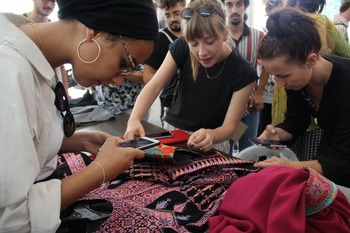
Summer School 2019 ‘Intimate terrains’, Palestine Museum and Disarming Design from Palestine. Photo by Francisca Giocoman, courtesy of Disarming Design from Palestine.

From 2011 to 2019 we organized yearly collaborative workshops, first with the Internaltional Academy of Arts in Ramallah, and later with other cultural institutes in Jerusalem, Bethlehem, Gaza, and in Amman with the Palestinian diaspora. Each time there was a different institutional collaboration in developing these products, and then with our team in Belgium, setting up an infrastructure, so the items can be distributed internationally to other audiences.
What became most valuable was the knowledge exchange and the sharing of narratives – thinking through design and building cultural and political bridges while making, by doing together. We engaged in acts of making, visited workshops, were together in small artisanal spaces, understanding how things are made, where the resources come from, what are the social constructions, what do the local realities entail, and how does the occupation change all these aspects. This knowledge became the core of the project. Even though it is a design label, and we sell products, above all it is an instrument to bring people together and learn from each other. That's when a longing for the library arrived, in tracing somehow this exchange of knowledge and the need to capture what happens as part of these collaborations.
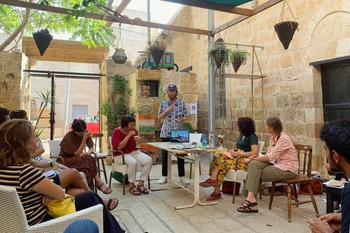
Workshop ’The real and absent’ by Francisca Khamis, Hosh Jalsa, 2019.
Photo by Francisca Khamis, courtesy of Disarming Design from Palestine.

(Alj) I first became aware of Disarming Design when it was housed at the Hosh Jalsa. How did that facility shape the activities of Disarming Design?
When we started with Disarming Design from Palestine, we were a project within the Academy. Developing further fed the need to become an independent project. So, we founded a non-profit foundation in Palestine, as well as a non-profit foundation in Belgium for international distribution. So that was sort of the administrative registration for the project. We also needed to have our own space, not only for the stock and presentation of the products, but also to build towards a hub where designers can meet, where we could keep all the resources and build a material library rooted in all the different prototypes we were experimenting with.
We first had a space in Ramallah, but it was a bit small, and we couldn't turn it into a more public space. We had to invest in an economic model to make this project and space sustainable. We were funded sometimes on project-base, but we didn't have structural funding. Raed Hamouri joined the team in 2018, and he felt that we should establish the space in the old city of Birzeit, it's close to Ramallah, has beautiful architecture and that location is more focused on cultural events. The old center is, architecturally, very beautiful and rather intact. There are some old houses and hoshes (court yards). There was one place available. Raed negotiated with the local community and we were able to get the space. We imagined it to become a place where we present the products. It had a professional kitchen and we wanted to establish a restaurant there, as well as the library, guest rooms, so it could become a vivid place around design – the aspect that binds all these activities and communities together.
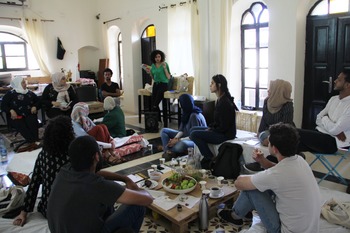
Summer School 2019 ‘Intimate terrains’, Palestine Museum and Disarming Design from Palestine. At Hosh Jalsa. Photo by Francisca Khamis, courtesy of Disarming Design from Palestine.

We started a relational library; where books entered through a relation, like gift by someone or related to a topic or material we were working with. We didn't envision a certain collection, but it's a library that built itself through the experiences, through working together, through books that were given, through materials that stayed, so we could capture these traces of exchange and of knowledge. Hosh Jalsa became a community center where we reflect through design in the broadest sense on the local culture and reality. Birzeit is a student town, there are a lot of young people. We collaborated with the Architecture Department and the Design Department of Birzeit University and set up small workshops. There were story-telling events, film screenings and other gatherings. We had visitors. We had a lot of initiatives to make it a vivid program, but it was very hard to maintain, in particularly when Covid hit us. We had to close the space and stop our activities, scale down and focus on our digital presence, archive, and international distribution.
(Alj) You talked a little bit about the library. It seemed like the library was a core component of the facility. What was the library's role within the structure of the community?
Anytime we had international or professional visitors, we asked them to donate books. We thought of it as a relational library. We wanted a build our own collection of books; it started very small. We also kept the materials and resources of the different workshops and have that available – to make it alive and use it during different activities. There were amazing ideas, but we were always under financial pressure, and constantly operating in a survival mode. With several unpaid bills, it became hard to focus on anything else. Then Covid hit in 2020 and it wasn't possible to maintain. We had to scale down and reorganize the way we worked and focus on decentralized collaborations. To maintain the library, it would require an institutional relationship with an organization that has better sustainability within the field – like with a library of a design department or museum.
(Alj) Does a design library have a unique role within the context of Palestine that is different than, say, in Europe or America?
As I'm not Palestinian, I can only speak from an outsider perspective. Due to the occupation, there are hardly any bookshops in the West Bank. In addition, most contemporary design discourse is rooted in an Anglo Saxon discourse, in its verbal and conceptual approach and translation. English books are dominant. There is a lot of terminology embedded in contemporary design discourse defined or performed in a Western (and often Eurocentric) reality. There is a lack of publications about Arabic contemporary design; although a lot is happening in this field; for instance, the book by Bahia Shahab A history of Arab graphic design. Libraries, particularly with a focus on Arabic design discourse, are highly important to support other voices and other spaces.
It's interesting to see what we consider valuable. Books function as a validating system. The moment work is represented in a catalog, it exists in our memory. Then, to think of value, we need to talk about design and language, we need other examples and other books. What is a local design, how can we place it in a more political dimension and how can we build other discourses around it?
(Alj) Since you had to close the Hosh Jalsa facility, what is the current status of Disarming Design?
Now the main structure is based here in Belgium, and we continue working with many Palestinian designers and producers. The main mission is to contribute to international solidarity to the Palestinian cause and investigate how design can engage in struggles for social justice.
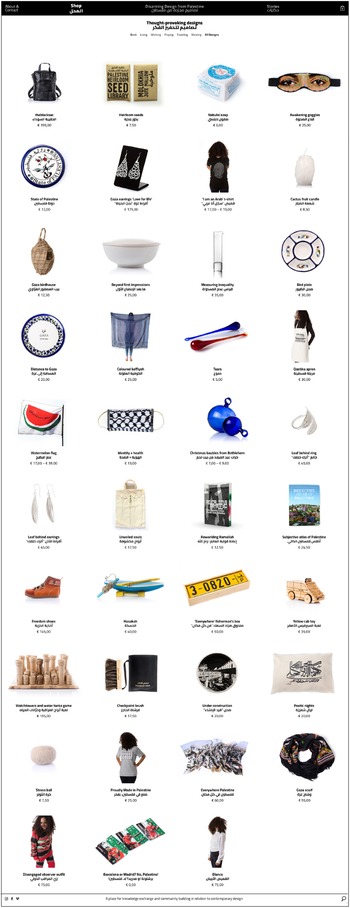
Overview of designs by Disarming Design from Palestine, see www.disarmingdesign.com.

(Alj) So, do you see something like the former facility opening again?
That would be a dream, but as we are organized now, we can't take such a responsibility. It can only grow out of collaborations and partnerships. We're an independent organization and don't have structural funding. We support our activities through the sales of the products and mostly voluntary work. Whitin this scope it was impossible to maintain such a space by ourselves. If the restaurant, café, guesthouse, and library would have worked well, it could have been sustainable, but it was so hard and impossibly to continue when the lockdown came. We can't go through that vulnerability, that precarity, again. There are several amazing initiatives on the ground, and we want to contribute with them to the local dynamics through design.
Library of exchanges with Disarming Design from Palestine, see www.disarmingdesign.com.

(Alj) What about the library within this current iteration of Disarming Design?
AD: It has currently transformed to a digital library or more an archive. We are a network-based organization; we work with people in Gaza, in Nablus, in Ramallah, in Jerusalem, and mobility there is violently disrupted. In addition, our audiences are very international, spread over continents. The digital reality is important in maintaining these relationships, exchanging knowledge, sharing information. For instance, video and social media have become indispensable mediums of capturing knowledge. We make videos of all the products, of people producing items and showing how they are made. It's often recorded just with a smart phone video of an artisan, and then we can edit it with an interview with the designer. I don't know if you can consider that a library, but I do consider it as part of the dynamic of knowledge development.
(Alj) I definitely consider that a library, and I think your website is terrific.
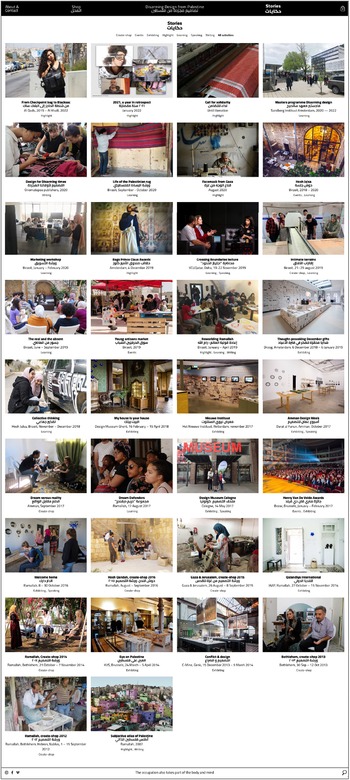
AD: Thank you. We've worked hard on the archive. Under “stories” the visitor can learn a lot, and experience that we're not just a design label selling Palestinian products. It is this distribution of products that is a way to make other things happen, to learn from each other. The products are catalysts for sharing narratives and making connections. The sales are a way to be independent in our funding, give back to the artisans and designers and invest in further development. Being independent from funding is critical as funding structures in Palestine have created an unsettled reality that is not always in support of local agency. So that's one of our aims – that we can be financially independent and socially interdependent. We sell products to maintain, to distribute meaningful stories. All of these aspects, they feed each other.