Introduction
Advances in cancer treatment have, in general, helped prolong the life expectancy of cancer patients. As such, the quality of life (QOL) of cancer patients has emerged as an increasingly important outcome of cancer treatment. Indeed, a positive relationship between patient QOL and cancer survival has been reported (De Aguiar et al., Reference De Aguiar, Bergmann and Mattos2014; Montazeri, Reference Montazeri2009). Among various factors contributing to the QOL of cancer patients, spiritual well-being has garnered increasing attention (Bovero et al., Reference Bovero, Leombruni and Miniotti2016).
In a broad manner, spirituality is defined as how people find meaning and their purpose in life, in addition to how they are connected with the self, significant others, or a higher power, in their respective cultural area (Puchalski, Reference Puchalski2012). The concept of the biopsychosocial-spiritual model as it pertains to patient assessment and treatment planning has been proposed and accepted (Sulmasy, Reference Sulmasy2002). In the model, spirituality is considered to underlie the conventional biological, psychological, and social dimensions core to humanity. Accordingly, a high level of spirituality has been shown to play protective roles on well-being in cancer patients. Many studies have demonstrated that higher scores in spirituality measurement scales are correlated with better QOL and contribute to more enjoyment and peace in life, regardless of the presence of cancer-related symptoms, such as pain and fatigue (Visser et al., Reference Visser, Garssen and Vingerhoets2010). Moreover, spirituality has also been documented as a clinically significant need among patients (Puchalski, Reference Puchalski2012). Ferrell (Reference Ferrell2007) emphasized that 88% of cancer patients reported spirituality as an important consideration in their treatment decision-making, and Hocker et al. (Reference Hocker, Krull and Koch2014) indicated that 94% of cancer outpatients expressed needs for spiritual well-being. Interestingly, spiritual well-being appears to be particularly important to individuals suffering from cancer, providing, to a certain degree, protective effects against depression (McClain et al., Reference McClain, Rosenfeld and Breitbart2003).
The current concept in spiritual well-being is not limited to religiosity. Rather, it encompasses meaning and purpose in life as well as a sense of peace. Meaning and peace are considered as separate constructs that make up spiritual well-being. Accordingly, the 12-item Functional Assessment of Chronic Illness Therapy-Spiritual Well-being Scale (FACIT-Sp-12) developed by Peterman et al. (Reference Peterman, Fitchett and Brady2002) addresses the two constructs in individual subscales. In this scale, meaning refers to a sense of purpose and significance from a connection to something larger than the self, and peace reflects a sense of harmony and peace derived from a connection to something larger than the self. There is a report that higher meaning and peace in spirituality predicted better QOL, decreased anxiety and depression, and increased hope and coping scores (Brown et al., Reference Brown, Sun and Urbauer2015).
Coping is another important factor for QOL in cancer patients. It is interpreted as attitudes, thoughts, and behaviors that patients use to handle stressful demands, conflicts, and problems faced in the course of cancer treatment. Coping strategies can be classified into several domains: for example, “problem-focused coping” is directed at problem-solving measures, such as active coping, planning, seeking instrumental support, or suppression of emotions. Meanwhile, “emotion-focused coping” refers to changes in emotional reactions to situations, including various defensive and avoidant strategies, such as seeking social (emotional) support, turning to religious support, or denial of problems (Mehrabi et al., Reference Mehrabi, Hajian and Simbar2015). Studies have investigated specific coping strategies in cancer patients and their correlation with mental health outcomes, reporting more active types of coping methods (e.g., positive reframing, active, problem-focused coping, seeking support) to be more favorable to outcomes than passive and detaching types (e.g., denial, avoidance strategies) (Aarts et al., Reference Aarts, Deckx and van Abbema2015; Spiegel, Reference Spiegel2001).
Spirituality may contribute to a cancer patient's capacity to maintain satisfying social relationships and to feel meaningfully connected with others (Sherman et al., Reference Sherman, Merluzzi and Pustejovsky2015), which is a critical aspect of QOL. Spirituality may also offer a sense of secure attachment and social identity during a patient's experiences with cancer. To date, however, few studies have attempted to determine which components of spirituality and interpersonal coping are related with QOL. Meanwhile, depression and anxiety, well-known comorbid distresses, have been found to be common in cancer survivors and to be correlated with poor QOL and worsening of other psychosocial and physical distress outcomes (Noorani & Montagnini, Reference Noorani and Montagnini2007; Wilson et al., Reference Wilson, Chochinov and Skirko2007). Moreover, they are also associated with lower survival and poor spirituality (Chan et al., Reference Chan, Wan Ahmad and Yusof2015; Munoz et al., Reference Munoz, Salsman and Stein2015). To precisely assess psychosocial status and expected outcomes in cancer patients, psychiatric comorbidities, such as depression and anxiety, should be included in models of spirituality and QOL.
In light of these factors, we suggest that explorations of the specific relationships between QOL and the components of spirituality and coping, particularly in relation to depression and anxiety, are needed to better understand the suffering experienced by cancer patients and to improve care thereof. In the literature, how spirituality and coping are related to QOL has been reported for other chronic conditions: Biccheri et al. (Reference Biccheri, Roussiau and Mambet-Doue2016) indicated that problem-focused coping strategies and coping through social support seeking mediate the relationship between a higher level of spirituality and QOL in fibromyalgia patients. Studies have yet to clarify relationships among spirituality, coping strategies, mental health, and QOL in a composite model for cancer patients, however.
In the present study of cancer patients who visited a psycho-oncology clinic, we aimed to investigate (1) the associations of spirituality (meaning/peace and faith), cancer coping (positive reframing, active coping, planning, and interpersonal coping), and QOL and (2) the influences of depression and anxiety on spirituality, coping, and QOL. To do so, we first identified which components of spirituality and coping are significantly associated with QOL in cancer patients; we then evaluated whether the selected component of coping exerts a mediating role between the selected component of spirituality and QOL. Finally, we investigated in which ways depression and anxiety impacted these variables. We presumed that these investigations would help with understanding of the effects and interactions of these psychosocial variables on QOL in cancer patients and, subsequently, with developing therapeutic interventions targeting them for improved patient care.
Methods
Participants
All of the participants in this study had visited a psycho-oncology clinic. A total of 237 cancer patients who visited a psycho-oncology clinic at a university hospital in Korea between March 2014 and July 2016 participated in this study. Participants were included if they were older than 18 years. Among the 252 patients recruited, 15 were excluded because of (1) a primary psychotic diagnosis or cognitive impairment or (2) missing data for study variables. Written informed consent was obtained from each subject, and the study was approved by the institutional review board of the university hospital.
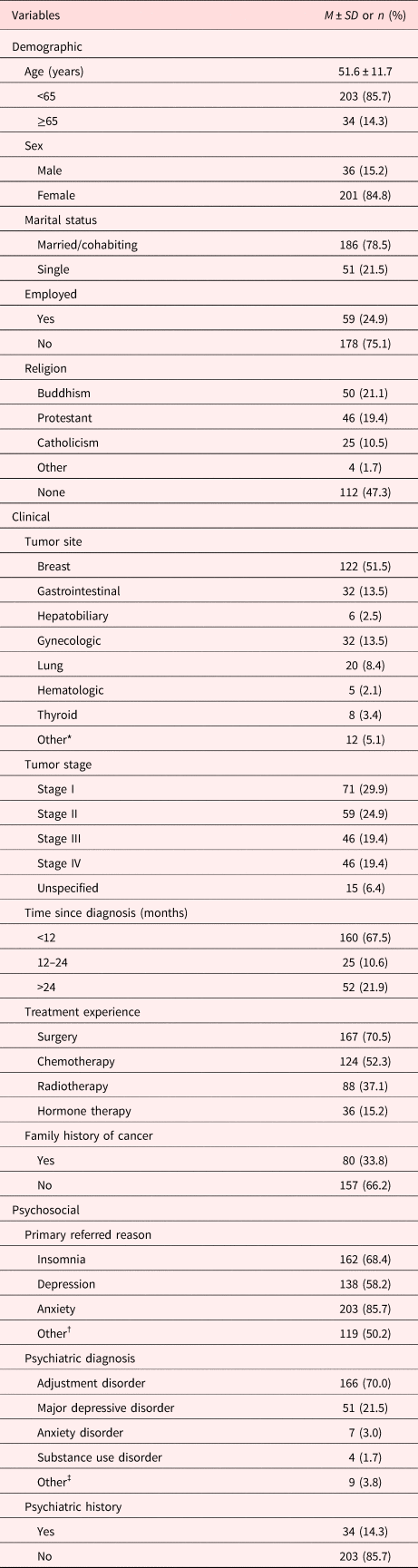
The mean age of the patients was 51.6 years (SD = 11.7), and the majority of patients were female (84.8%), married or cohabiting (78.5%), and unemployed (75.1%). Regarding religious backgrounds, 47.3% had no religious affiliation, and 21.1% believed in Buddhism, followed by Protestant (19.4%) and Catholic (10.5%) Christianity. Among clinical characteristics, tumor types were as follows: 51.5% were breast cancers, followed by gastrointestinal (13.5%), gynecologic (13.5%), lung (8.4%), and thyroid (3.4%) cancers. The median time since diagnosis of cancer was 16.1 months, and the majority of patients (78.1%) had visited the psycho-oncology clinic within 2 years after their cancer diagnosis (Table 1).
Demographic, clinical, and psychosocial characteristics (n = 237)

*Other: brain, pancreas, head and neck, or skin.
†Other: cognitive impairment, somatic symptom, etc.
‡Other: acute stress reaction and nonorganic insomnia.
Measures
We collected demographic and medical data from participants via questionnaires and from their hospital charts. For the primary tumor, we obtained detailed information on tumor site, stage of disease, presence of metastasis, time since diagnosis, types of treatment, and family history of cancer. Two experienced psychiatrists also recorded primary reasons for referral to the psycho-oncology clinic, psychiatric history, and psychiatric diagnosis by the Diagnostic Manual of Mental Disorder–Fifth Edition. Finally, participants were asked to complete four self-reported questionnaires, including the Hospital Anxiety and Depression Scale (HADS), Functional Assessment of Cancer Therapy-General (FACT-G), FACIT-Sp-12, and Korean-Cancer Coping Questionnaire (K-CCQ).
Anxiety and depression
Anxiety and depression were measured with HADS (Zigmond & Snaith, Reference Zigmond and Snaith1983), which is a 14-item self-measure that was specifically developed for assessing anxiety and depression in people with medical illnesses. The screening measure has been widely used in cancer patients (Vodermaier & Millman, Reference Vodermaier and Millman2011). The scale is divided into a seven-question anxiety subscale (HADS-A) and a seven-question depression subscale (HADS-D). In the absence of a cutoff score validated with Korean cancer patients, we used the Korean version of the HADS with a cutoff score of 8 for each anxiety and depression event, which has previously been shown to offer good sensitivity and specificity in Korean patients with anxiety and depression and the general population (Shim et al., Reference Shim, Shin and Jeon2008). In the present sample, the Cronbach's alpha coefficients of anxiety and depression were 0.90 and 0.78, respectively.
QOL
The FACT-G scale was used to assess multidimensional QOL in patients with cancer (Cella et al., Reference Cella, Tulsky and Gray1993). The FACT-G consists of 27 items in four subscales: physical well-being, social/family well-being, emotional well-being, and functional well-being. All individual items are rated on a 5-point Likert scale (0 = not at all, 4 = very much) and summed for a total score, with higher total scores indicating higher QOL. We used the Korean version of FACT-G, which shows good sensitivity and specificity (Lee et al., Reference Lee, Chun and Kang2004). Cronbach's alpha coefficients in the present sample were acceptable, ranging from 0.74 to 0.86.
Spirituality
Spirituality was measured with FACIT-Sp-12 as developed by Peterman et al. (Reference Peterman, Fitchett and Brady2002); it2 is widely used to measure spiritual well-being in cancer patients (Munoz et al., Reference Munoz, Salsman and Stein2015). The scale consists of meaning/peace (eight items) and faith (four items) subscales, in accordance with conceptual models of spiritual well-being. All individual items are rated on a 5-point Likert scale (0 = not at all, 4 = very much), with higher scores indicating higher spirituality. We used linguistically validated Korean version of the FACIT-Sp-12 (Bredle et al., Reference Bredle, Salsman and Debb2011); the Cronbach's alpha coefficients of meaning/peace and faith were 0.73 and 0.91, respectively.
Cancer coping
Cancer coping was measured with K-CCQ (Kim et al., Reference Kim, Kwon and Kim2004), a validated version of CCQ (Moorey et al., Reference Moorey, Frampton and Greer2003) for use in assessing cancer patients in Korea. CCQ has been widely used in cognitive-behavioral approaches to boost coping strategies that are considered desirable to cancer patients. This is a 23-item questionnaire that assesses four subscales: positive reframing, active coping, planning, and interpersonal coping scales. All items are rated on a 4-point Likert scale (1 = not at all, 4 = very often) and summed to provide a total score ranging from 23 to 92, with higher scores indicating better coping. K-CCQ shows good reliability and validity (Kim et al., Reference Kim, Kwon and Kim2004). In the present sample, the Cronbach's alpha coefficient was 0.90.
Statistical analysis
First, variables to be included in the model of QOL were selected after univariate and multiple linear regression analysis through stepwise selection methods, with QOL (FACT-G) as a dependent variable and spirituality (FACIT-Sp-12), cancer coping (K-CCQ), depression (HADS-D), and anxiety (HADS-A) as independent variables. Spirituality (FACIT-Sp-12) comprised two components (meaning/peace and faith), and cancer coping (K-CCQ) comprised four subcategories (positive reframing, active coping, planning, and interpersonal coping). Pearson's product-moment correlations of factors affecting QOL and hierarchical regression analyses with adjustment for age and sex were conducted. Then, path analysis and structural modeling were applied to estimate the relationships between the selected variables; namely, the meaning/peace component of spirituality, interpersonal coping, and QOL; and to investigate whether interpersonal coping plays a mediating role between the meaning/peace component of spirituality and QOL. We also investigated how depression and anxiety affect the meaning/peace component of spirituality, interpersonal coping, and QOL.
Path analysis satisfied all the assumptions typically made by regression models. Overall model fit was examined using goodness-of-fit indices: comparative fit index (CFI), goodness-of-fit statistic (GFI), and standardized root mean square residual (SRMR). CFI and GFI values ≥0.90 and an SRMR value ≤0.09 are indicative of good model fit (Hooper et al., Reference Hooper, Coughlan and Mullen2008). The level of statistical significance was set at p < 0.05. Statistical data analyses were carried out using SPSS, version 22.0, for Windows (SPSS, Inc., Chicago, IL) and SAS, version 9.4 (SAS Institute Inc., Cary, NC).
Results
Psychosocial characteristics and study variables
Most patients reported more than one psychological symptom, and anxiety was the most common primary complaint (85.7%). Among psychiatric diagnoses, adjustment disorder was most common (70.0%), followed by major depressive disorder (21.5%) (Table 1).
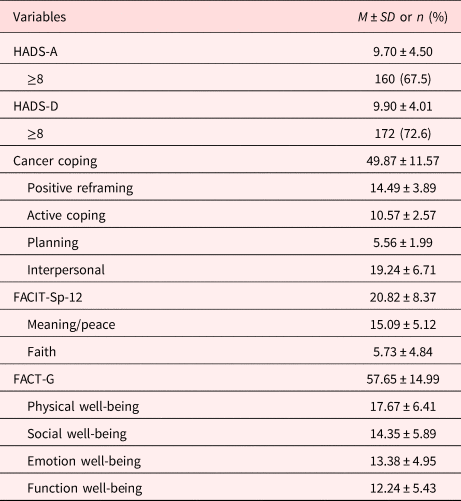
Table 2 shows the M and SD of scores for depression and anxiety (HADS-D and HADS-A), cancer coping (K-CCQ), spirituality (FACIT-Sp-12), and QOL (FACT-G). According to the given cutoff scores, the majority of the cancer patients reported high levels of anxiety (HADS-A score ≥8, 67.5%) (M = 9.70, SD = 4.50) and depression (HADS-D score ≥8, 72.6%) (M = 9.90, SD = 4.01). Concerning cancer coping, participants reported the highest scores on the interpersonal subscale (19.24 ± 6.71), followed by positive reframing (14.49 ± 3.89), active coping (10.57 ± 2.57), and planning (5.56 ± 1.99). The mean total FACIT-Sp-12 score was 20.82 ± 8.37, with mean meaning/peace and faith subscale scores of 15.09 ± 5.12 and 5.73 ± 4.84, respectively. The mean total FACT-G score was 57.65 ± 14.99, with physical, social/family, emotional, and functional subscale scores of 17.67 ± 6.41, 14.35 ± 5.89, 13.38 ± 4.95, and 12.24 ± 5.43, respectively.
Study variables (n = 237)

FACIT-Sp-12 = 12-item functional assessment of chronic illness therapy-spiritual well-being scale; FACT-G = functional assessment of cancer therapy-general; HADS-A = hospital anxiety and depression scale-anxiety; HADS-D = hospital anxiety and depression scale-depression.
Selected variables predictive of QOL
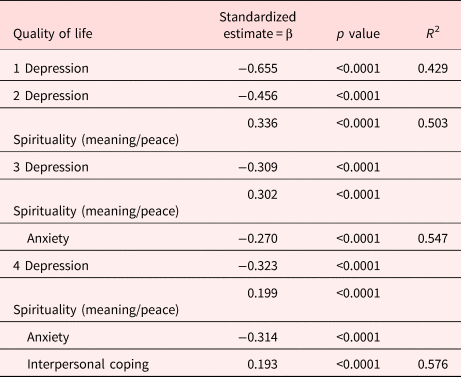
The influences of spirituality (meaning/peace and faith), depression, anxiety, and cancer coping (positive reframing, active coping, planning, and interpersonal coping) variables on patient QOL were explored using regression analysis. The selected predictors of QOL included the meaning/peace component of spirituality, depression, anxiety, and interpersonal coping. Only the meaning/peace component of spirituality and interpersonal coping in cancer coping were selected as significant predictors of patient QOL. In a univariate regression model of depression, spirituality (meaning/peace), anxiety, and interpersonal coping explained 42.9%, 36.7%, 35.6%, and 8.5% of patient QOL, respectively. The direct model of spirituality (meaning/peace), depression, anxiety, and interpersonal coping explained 57.6% (p < 0.0001) of patient QOL (Table 3).
Regression coefficients of variables predicting quality of life (n = 237)

Path analysis
All of the hypothesized effects of the path model were in the predicted direction, and all coefficients were significant (Figure 1). The model showed good fit to the data (CFI = 0.90, GFI = 0.93, and SRMR = 0.09). Spirituality (meaning/peace) had a direct positive effect on patient QOL (β = 0.199, p < 0.0001) and a greater positive effect on interpersonal coping (β = 0.535, p < 0.0001). In the indirect model, interpersonal coping acted as a positive mediator of the relationship between spirituality (meaning/peace) and patient QOL (β = 0.113, p < 0.0001). Depression had the largest negative effect on spirituality (meaning/peace) (β = –0.510, p < 0.0001) and exerted negative effects on interpersonal coping (β = –0.199, p = 0.016) and QOL (β = –0.323, p < 0.0001). Anxiety also had negative effects on spirituality (β = –0.132, p = 0.049) and patient QOL (β = –0.314, p < 0.0001), although, unlike depression, it showed a positive effect on interpersonal coping (β = 0.159, p = 0.045).
Hypothesized structural model with standardized path coefficients from our results of the mediating effect of interpersonal coping on the relationship between spirituality and QOL (the indirect pathway coefficient = 0.113, p < 0.0001), as well as the impact of depression and anxiety on each variable in cancer patients. CCQ = cancer coping questionnaire; FACIT-Sp-12 = 12-item functional assessment of chronic illness therapy-spiritual well-being scale; FACT-G = functional assessment of cancer therapy-general; HADS-A = hospital anxiety and depression scale-anxiety; HADS-D = hospital anxiety and depression scale-depression; QOL = quality of life. *p < 0.05, **p < 0.0001.

Discussion
The major findings of the present study can be summarized as follows. Among the subcomponents of spirituality and coping style, only the meaning/peace subscales of spirituality and only interpersonal cancer coping were deemed to significantly explain QOL in cancer patients. We noted a partial mediating effect of interpersonal coping between spirituality (meaning/peace) and QOL. Depression negatively influenced all three investigated variables, carrying the largest negative effects on spirituality (meaning/peace) and patient QOL. Although anxiety also negatively affected spirituality and QOL, it positively affected interpersonal coping. Of note, the combined effect size of spirituality (meaning/peace), interpersonal coping, depression, and anxiety reached a total explanation power of 57.6% for patient QOL, which is considerably large. This implies our selected variables are crucial factors affecting the QOL of cancer patients.
Until recently, the faith aspect of spirituality has garnered most of the attention in studies of patients coping with cancer. Previous research in the psycho-oncology field have focused primarily on how the religious aspect of spirituality is related to mental health and QOL outcomes, mainly by offering ceremonial or parallel support from clerics of each respective religion (Bovero et al., Reference Bovero, Leombruni and Miniotti2016; Vallurupalli et al., Reference Vallurupalli, Lauderdale and Balboni2012); however, different levels of religiosity do not imply different levels of spirituality. As researchers in science of politics and religion have discussed, secularization does not mean a decline in the spiritual need nor a decline in spirituality (Ahmadi et al., Reference Ahmadi, Park and Kim2016). In addition, the religious aspect of spirituality lies beyond the scope of which a therapist could approach or modify if needed. Accordingly, more flexible and universally applicable factors that hold potential as therapeutic targets warrant greater focus. Our results suggest that the nonreligious components of spirituality, represented as “meaning” and “peace,” which respectively suggest cognitive and emotional aspects of spirituality, could hold value as modifiable factors affecting QOL (Bredle et al., Reference Bredle, Salsman and Debb2011).
In the same line of thought, we focused on interpersonal, relationship-based coping strategies in this study. Although several authors have made attempts to determine whether a patient's coping styles are active, problem-solving, or avoiding and to outline their associations with mental health outcomes and QOL, the results do not exactly coincide with one another (Garssen, Reference Garssen2004). Meanwhile, coping through interpersonal connectedness, such as social support seeking or boosting communication with caregivers, has shown stronger associations with QOL in previous studies (Michael et al., Reference Michael, Berkman and Colditz2002). As examples, one study deemed emotional social support seeking to be predictive of higher QOL and lower depression scores in female patients with ovarian cancer (Hill, Reference Hill2016), and in other studies, social relatedness was found to be an important predictor of spiritual well-being in early stages of breast cancer (Swinton et al., Reference Swinton, Bain and Ingram2011) and advanced cancer patients (Lo et al., Reference Lo, Zimmermann and Gagliese2011). Accordingly, social relatedness, comprising both perceived social support and the ability to trust and rely on others, in times of need may be an important source of spiritual well-being in cancer patients. Our results coincide with these studies and support interpersonal coping as a mediator between spirituality and QOL in cancer patients. In addition, these findings are clinically meaningful in that evidence of social support is related with survival outcomes in cancer trajectories. One study indicated that socially isolated breast cancer patients show increased all-cause mortality (Hinzey et al., Reference Hinzey, Gaudier-Diaz and Lustberg2016); another stressed that emotional social support can offer beneficial effects on long-term survival outcomes in ovarian cancer patients (Lutgendorf et al., Reference Lutgendorf, De Geest and Bender2012).
The present study holds useful clinical implications in the care of cancer patients. First, our results indicate that approaches to address the meaning/peace component of spirituality warrant greater attention as means to improve QOL in cancer patients. Therapeutic approaches targeting the faith component of spirituality, such as supporting religious rituals, in cancer patients have been found to successfully decrease levels of psychological distress (Musarezaie et al., Reference Musarezaie, Moeini and Taleghani2014). In a study that compared the faith component to the meaning/peace component, however, Gonzalez et al. (Reference Gonzalez, Castaneda and Dale2014) demonstrated that meaning/peace subscale scores were significant predictors of depressive symptoms after adjusting for sociodemographics, cancer stage, and time since diagnosis and that meaning/peace had better protective effects on preventing depressive symptoms in cancer survivors compared with faith. Moreover, Bai and Lazenby's meta-analysis (Reference Bai and Lazenby2015) reported, in accordance with our findings, that meaning/peace was consistently and significantly associated with overall QOL, regardless of ethnic group or specific religion, whereas faith was not. In view of these results and ours, we suggest that spirituality as it pertains to meaning and peace may be a better clinical target for improving QOL in cancer patients than spirituality in terms of faith. As an example of one potential clinical therapeutic application, Thomas et al. (Reference Thomas, Meier and Irwin2014) demonstrated that meaning-centered psychotherapy offered benefits of reducing distress symptoms and increasing spiritual well-being and QOL in cancer patients. In their study, meaning-centered psychotherapy could be implemented both individually and in groups, striving to enhance a sense of meaning by focusing on awareness of one's attitudes and their connectedness with others. The pursuit of meaning in life through connectedness mirrors the concept of meaning in relation to spirituality, in that it deeply involves interpersonal relationships. Reflective communication in consideration of a patient's own goals and values that aims to reconstruct their sense of self and connection to others may provide an understanding and personal context for decisions on illness trajectories (Lo et al., Reference Lo, Zimmermann and Gagliese2011) and may improve QOL in cancer patients.
Second, clinicians may help cancer patients cope better with their distress by using interpersonal connectedness, in accordance with the implications discussed previously concerning meaning. The positive influence of higher anxiety on interpersonal coping implies that patients experience a need for more relatedness with others. A meta-analysis with breast cancer patients supported this point, presenting that seeking social support was the most frequent coping strategy (Mehrabi et al., Reference Mehrabi, Hajian and Simbar2015). This coincides with existing evidence that suggests cancer patients seek more social support after being diagnosed or in a presurgery state, facing increased distress and anxiety (Silva et al., Reference Silva, Crespo and Canavarro2012). Disengagement in a relationship or avoiding communication with significant others was also found to be correlated with negative outcomes (Figueiredo et al., Reference Figueiredo, Fries and Ingram2004; Manne & Badr, Reference Manne and Badr2008). Findings that highlight quality connections with others as a source of meaning in life among cancer survivors (van der Spek et al., Reference van der Spek, Vos and van Uden-Kraan2013) and that suggest the meaning subscale holds the strongest association with social well-being are congruent with our results on the relationship between meaning and interpersonal coping. Indeed, interventions applying interpersonal counseling for breast cancer patients have proven to improve outcomes related to QOL (Badger et al., Reference Badger, Segrin and Hepworth2013).
Third, early and meticulous psychiatric evaluation and management for suspected depressive symptoms are needed. In a previous study, cancer patients who used certain types of coping mechanisms, including social support seeking, were inversely correlated with depression (Sorato & Osorio, Reference Sorato and Osorio2015). Our study adds value in support of this issue because we found that depression exerted the largest negative effects on spiritual well-being, interpersonal coping, and QOL.
There are several limitations to our findings. First, we did not subdivide the study cohort into more specific subgroups according to cancer stage, origin, or treatment status, yielding some degree of heterogeneity. In our study, one-half of the participants were breast cancer patients. Studies have found that QOL, mental health, and respective coping strategies can differ among cancer stages, cancer types, or treatment responses. Second, although our path analysis modeling implicates possible causal relationships among the variables, the study design is basically cross-sectional, which limits us from drawing clear causalities from the model. Third, although other factors, such as pain, disease burden from comorbidities, or affected performance status, can influence outcomes, these factors were not included in our model. Fourth, one should be cautious of generalizing our results to other cultural groups or other cancer patients who have not been referred to a psycho-oncology clinic. To address these limitations, future research should be conducted with larger samples and apply target-specific subgroup analyses in conjunction with a prospective design.
In conclusion, our results achieved a high power of explanation in regards to factors affecting QOL in cancer patients referred to a psycho-oncology clinic. This study indicated that seeking meaning and peace aspects of spirituality and that coping through improved interpersonal relationships and social support are vital to ensuring a higher QOL among cancer patients. Additionally, we found that depression and anxiety are major negative factors that should be carefully evaluated and managed, with the notion that anxiety could reflect an increased need for improved social connectedness as a means of coping. We expect our findings will help contribute to further identification of the structural connections between QOL, spiritual well-being, coping methods, and mental health in cancer patients. On the basis of deeper understanding of these relationships, eventual developments through which to design more efficient approaches for cancer patient care are expected.
Author ORCIDs
Nam Hee Kim http://orcid.org/0000-0002-9381-0613.
Acknowledgments
We would like to thank the patients for participating in the study.
Conflicts of interest
None.