


Schilling and colleagues (Reference Schilling, Ritter, Kühner, Hirschberger, Zacher and Kauffeld2026) argue that I-O psychology theories of intra- and interorganizational cooperation offer essential yet still missing contributions toward the implementation of circular economy (CE) practices, recasting the CE transition as a “fundamentally a behavioral and cooperative one” (p. 321). However, in advocating for I-O psychology’s role in the circular economy, Schilling et al. overlook a crucial reverse insight: our field must itself function as a circular economy of knowledge production. Recognizing this parallel is not just metaphorical; it is essential for I-O psychology to operate as an applied science. This commentary argues that only by circularizing our own knowledge flows can I-O psychology meaningfully contribute to CE implementation. We first explain the parallel between material and knowledge circularity, then identify key stakeholders in the I-O knowledge value chain, and finally offer concrete recommendations for making our field more circular.
Circularity of knowledge in applied science
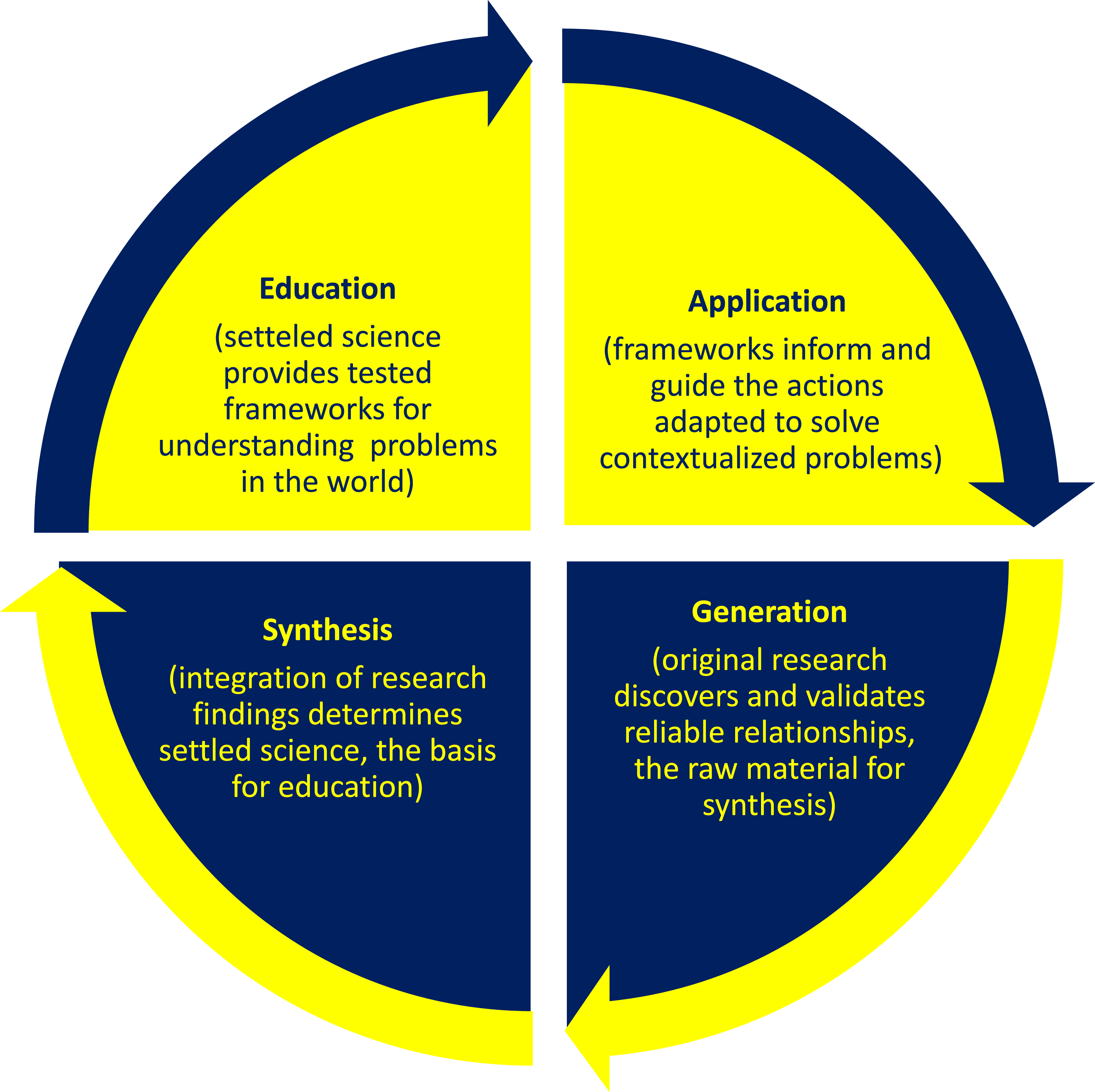
Cronin et al. (Reference Cronin, Galvin, George, Gruber, Lindebaum, Markman, Miller, Rose, Thatcher and Wood2025) recently articulated an integrated “knowledge production system,” explaining how different types of contributions flow within and between different types of contributions. Their model (see Figure 1) describes a value cycle moving through four interconnected phases: generation (findings that explain phenomena), synthesis (integrating findings into coherent frameworks), education (teaching frameworks to students and managers), and application (enabling practitioners to solve specific organizational problems using those frameworks). Their model displays a circular value chain of knowledge production, where the scientific process discovers and integrates findings into teachable information that is delivered, refined, and improved through the interaction of scholars, students, and practitioners. To be effective, knowledge needs to be effectively “cycled,” whereby its education and/or application bring about new questions for generation (Augustine et al., Reference Augustine, Hedberg, Choi and Lounsbury2025; Shiefling & Soderstrom, Reference Schifeling and Soderstrom2022). Not only is the presence of circular knowledge flows essential (Kaplan et al., Reference Kaplan and Schwartz Cowan2017), but its absence can be profoundly detrimental (Lobbedez et al., Reference Lobbedez, Pascucci and Panico2025).
The knowledge production value chain.

The parallel between material circularity and knowledge circularity is striking. Just as the CE seeks to eliminate waste by keeping materials in productive use through multiple cycles, applied science eliminates wasted knowledge by ensuring findings circulate through generation, synthesis, education, and application. Just as CE systems fail when materials become “stuck’ at one stage (e.g., collected but not recovered), knowledge systems fail when findings remain trapped in academic journals or in “file drawers” (Rosenthal, Reference Rosenthal1979) without moving through the full cycle. Applying CE to I-O psychology, we are arguably trapped in the production phases (generation and, to a lesser degree, synthesis), without fully completing the cycle through education and application. We agree cooperation and collaboration between multiple organizational stakeholders is crucial antecedent to CE implementation, but unfortunately, we ourselves as a field are not doing this well.
Research on individuals (micro level) within teams (meso level) embedded within organizations (macro level) has already begun to model how knowledge flows can bring, and keep, sustainability practices into business as usual (e.g., Kay et al., Reference Kay, Kay and Tuinanga2018; Shifeling & Soderstrom, Reference Schifeling and Soderstrom2022; Sonenshein et al., Reference Sonenshein, DeCelles and Dutton2014). These knowledge flows are not merely conceptual, however. They reveal integrative, practical, and pedagogical (Marcon & Sehnem, Reference Marcon and Sehnem2026) “how tos” that may be just as relevant to create and populate the meaningful intersection between I-O psychology and CE that Schilling et al. depict. Yet circularizing how knowledge flows is still missing from Schilling et al.’s argument, as well as the broader landscape of knowledge production in all the disciplines informing CEs. Our claim and call to circularizing knowledge flows can thus be embraced more broadly by other teams reading their respective fields from contributing to CEs.
Concrete steps for circularizing I-O psychology
How can I-O psychology circularize its own knowledge flows? We offer three concrete steps particularly relevant for Schilling et al.’s intention to ready core concepts for implementation in CEs.
Establish feedback loops between research, teaching, and practice
First, clarify and qualify the intended contribution of knowledge flows. Cronin et al. (Reference Cronin, Galvin, George, Gruber, Lindebaum, Markman, Miller, Rose, Thatcher and Wood2025) argue that papers should clarify their function in the knowledge production cycle and explicitly connect to work in other phases. Not every paper should attempt all phases—that expectation fosters superficiality. For example, adding “practical implications” sections to conceptual papers serves neither science nor practice. Circularity obliges authors to think through their contributions to synthetic bodies of knowledge, spelling out their (un)intended applications to practice, and outlining pedagogies and educational practices. These approaches have been enshrined in Ellen MacArthur Foundation intrinsically circular view of knowledge flows, which we believe offers a great example of the power of Cronin et al.’s (Reference Cronin, Galvin, George, Gruber, Lindebaum, Markman, Miller, Rose, Thatcher and Wood2025) plight. If I-O psychologists are serious about contributing to CEs, we strongly recommend landscaping a more circular view of the field and examining how each concept cycles through the synthesis, education, or application quadrants as it regenerates theories of increasingly circular economies. Circularizing I-O psychology concepts is especially important given the applied history and nature of CEs, whereby both students and practitioners are looking for concrete practices rather than abstract hypotheticals. It is also generative: reconsidering how concepts may need to adapt as they transfer to the context of CEs can reveal new boundaries and motivate extensions.
Reward contributions to education and application phases
Second, deliberately incentivize an explicitly circular view of knowledge production for each conceptual contribution. The field is already defensive enough about our impact (or lack thereof, see Tinsley et al., Reference Tinsley, Kathawalla and Cronin2023), and many deride anything that is not in an “A” journal to the detriment of scientific progress (Aguinis et al., Reference Aguinis, Cummings, Ramani and Cummings2020); Cronin et al., Reference Cronin, Stouten and van Knippenberg2021). Meanwhile, contributions to education and application phases receive limited recognition in hiring, tenure, and promotion decisions compared to generation-phase empirical studies. Until we reward completing the cycle, it will remain incomplete. The very premise of Schilling et al., is that the value of core I-O concepts increases through their applicability to the CE. The very questions being asked in Table 1 (p. 23), for example, encourage us to rethink, perhaps radically, what multiteam systems could or should do as they interconnect entire value chains. The authors raise issues of training, interaction design, and evolution of mental models in multiteam systems; although not claimed as a contribution, we nod at the result of circularizing core concepts as they ready the field for their application.
Enable practitioners to shape research priorities
Finally, embrace the bidirectionality inherent in circular knowledge flows by taking a leaf out of the CE book. The CE knowledge cycle does not only flow from researchers to educators and practitioners but even more so from practitioners or educators to researchers. Letʼs take seriously that knowledge may be wasted unless research can understand why failures happen in translation to practice, and even new understandings would be wasted unless the lessons of what science/practice got wrong are taught to the next generation of professionals (i.e., education). The field should even consider how the process might start with educators. Take the example of the cycle model (European Commission, 2018), which places a pedagogical model at the center of a lifelong model of educating lifelong learners. I-O psychology education often emphasizes skepticism over practical confidence, perhaps because some concepts are perceived as lacking immediate applicability (Aguinis & Cronin, Reference Aguinis and Cronin2022). CEs do not merely rely on application. Most of the knowledge generation is practically motivated by what practitioners need or by what educators ought to teach. The intersections between I-O psychology and CEs question and perhaps even dissolve the artificial divides between the four types of knowledge production described by Cronin et al. (Reference Cronin, Galvin, George, Gruber, Lindebaum, Markman, Miller, Rose, Thatcher and Wood2025) by illustrating how interlinking research, teaching, and practice enhances their separate and especially their joint effectiveness. We need systematic mechanisms, such as practitioner advisory boards, industry partnerships, and practice-focused outlets, to capture insights from implementation attempts and education attempts that can be fed back into the research system.
Conclusion: Embracing our circular nature
Schilling et al., conclude that “sustainable circular transformation depends on understanding and practically shaping how individuals work, cooperate, influence each other, and make meaning of circularity in their workplaces and everyday organizational lives” (p. 322). We wholeheartedly agree. Now what?
Let’s not be hypocritical. Can our field really help organizations implement circular economy principles if our own knowledge economy remains largely linear? If the hegemony of the conceptual trumps the urgency of the pedagogical and/or the practical? If research continues to be “produced” and published without systematic, even programmatic, cycling through education and application phases as we see and show in the context of CEs? Just as the CE calls for redesigning material flows, I-O psychology’s contribution to CE requires redesigning our knowledge flows. Will we complete the cycle? Will we create the educational frameworks that help future managers understand I-O principles? Will we develop the application tools that enable current practitioners to implement those principles? Will we establish feedback mechanisms to learn from implementation attempts and restart the cycle with new discoveries?
Letʼs embrace the circular nature of I-O psychology and perhaps even reimagine the field as circular economy of knowledge flows, where the very same tenets of intra- and interorganizational collaboration posited by Schilling et al. keep cycling through Cronin et al.’s (Reference Cronin, Galvin, George, Gruber, Lindebaum, Markman, Miller, Rose, Thatcher and Wood2025) four quadrants of generation, synthesis, education, and application. Only if we take seriously our field’s own (need for) circularity can we hope to contribute, urgently and meaningfully, to circularizing our economies.

 Open access

