Introduction
Dysthymic disorder (DD) is the most common childhood depressive disorder, especially in clinically referred samples (Kovacs et al. Reference Kovacs, Akiskal, Gatsonis and Parrone1994). In addition to the core diagnostic symptom of chronically depressed and/or irritable mood, DD is associated with impairing levels of inattention according to DSM-IV-R criteria (APA, 2000). Poor attention, difficulty concentrating and difficulty with decision making have been observed clinically in children with DD (Mitchell et al. Reference Mitchell, McCauley, Burke and Moss1988; Ferro et al. Reference Ferro, Carlson, Grayson and Klein1994; Kovacs et al. Reference Kovacs, Akiskal, Gatsonis and Parrone1994; Masi et al. Reference Masi, Favilla, Mucci, Poli and Romano2001). These symptoms of DD are thought to impair cognitive development and functioning in academic domains (Kovacs & Goldston, Reference Kovacs and Goldston1991).
Deficits in neuropsychological measures of attention (Livingston et al. Reference Livingston, Stark, Haak and Jennings1996; Cataldo et al. Reference Cataldo, Nobile, Lorusso, Battaglia and Molteni2005) and memory (Lauer et al. Reference Lauer, Giordani, Boivin, Halle, Glasgow, Alessi and Berent1994) have been reported in children and adolescents with major depressive disorder (MDD) with or without DD, although MDD and DD have not been examined separately. Adolescents with MDD have shown an affective attentional bias and evidence of cognitive impulsivity (Kyte et al. Reference Kyte, Goodyer and Sahakian2005) and impaired performance on visual memory tasks (Matthews et al. Reference Matthews, Coghill and Rhodes2008). Furthermore, there are known associations of inattentive symptoms with impaired performance on neuropsychological measures such as visuospatial working memory (VSWM) (Kempton et al. Reference Kempton, Vance, Maruff, Luk, Costin and Pantelis1999; Barnett et al. Reference Barnett, Maruff, Vance, Luk, Costin, Wood and Pantelis2001). This is consistent with the known overlap of the neural substrates that subserve visuospatial attention and VSWM (Smyth, Reference Smyth1996; Awh et al. Reference Awh, Vogel and Oh2006), specifically right hemisphere dominant activation in frontal and parietal brain regions (Awh & Jonides, Reference Awh, Jonides and Parasuraman1998). A recent study found that adolescents with MDD displayed VSWM performance deficits on the Cambridge Neuropsychological Test Automated Battery (CANTAB) spatial working memory task, including significantly more between-search errors (BSEs) and poorer use of strategy compared to healthy control participants (Matthews et al. Reference Matthews, Coghill and Rhodes2008). The depressed group did not display performance deficits on the CANTAB Spatial Span measure. This suggests impairment to ‘executive’ aspects of neuropsychological functioning in adolescent MDD. Evidence of ‘executive’ deficits associated with DD in children and adolescents include poor decision making (Ferro et al. Reference Ferro, Carlson, Grayson and Klein1994) and poor performance on the Stroop Task (Cataldo et al. Reference Cataldo, Nobile, Lorusso, Battaglia and Molteni2005). Adults with DD have shown performance deficits on the Trail Making Task B (Airaksinen et al. Reference Airaksinen, Larsson, Lundberg and Forsell2004) and the Wisconsin Card Sorting Task (Martin et al. Reference Martin, Oren and Boone1991). However, to date, VSWM has not been investigated in children and adolescents with DD. This is important so that it can be ascertained whether VSWM impairments are developmental stage independent.
Further examination of the neuropsychological profile of DD using measures of VSWM is supported by the following findings: disruption to fronto-striatal neural networks has been associated with impairments in attention (Lange et al. Reference Lange, Robbins, Marsden, James, Owen and Paul1992; Lawrence et al. Reference Lawrence, Watkins, Sahakian, Hodges and Robbins2000; Barnett et al. Reference Barnett, Maruff, Vance, Luk, Costin, Wood and Pantelis2001) and VSWM (Owen et al. Reference Owen, Sahakian, Semple, Polkey and Robbins1995; Pantelis et al. Reference Pantelis, Barnes, Nelson, Tanner, Weatherley, Owen and Robbins1997). In addition, models of the brain–behaviour relationship between VSWM and the prefrontal cortex (PFC) are well evidenced by single neuronal firing rates in alert primates (Goldman-Rakic, Reference Goldman-Rakic and Plum1987; Goldman-Rakic & Selemon, Reference Goldman-Rakic and Selemon1997), studies of behaviour following focal PFC lesions in adult humans (Owen et al. Reference Owen, Roberts, Hodges, Summers, Polkey and Robbins1993) and studies of patterns of regional cerebral blood flow in healthy humans performing VSWM tests (D'Esposito et al. Reference D'Esposito, Detre, Alsop, Shin, Atlas and Grossman1995). The experimental VSWM paradigm can be applied to studies of children and adolescents without modification (Barnett et al. Reference Barnett, Maruff, Vance, Luk, Costin, Wood and Pantelis2001). VSWM is largely non-verbal, so that deficits in verbal functioning observed in children with depressive disorders (Kovacs & Goldston, Reference Kovacs and Goldston1991) do not confound testing. From a clinical viewpoint, the majority of children with DD develop MDD (i.e. 76%), suggesting that childhood DD is a ‘window of opportunity’ for early identification of and intervention for the development of MDD (Kovacs et al. Reference Kovacs, Akiskal, Gatsonis and Parrone1994). This suggests the importance of specific studies that characterize DD in children, including clarifying associated neuropsychological impairments such as VSWM.
The CANTAB (Owen et al. Reference Owen, Evans and Petrides1996) VSWM task provides an overall measure of VSWM, measured as BSE performance, in addition to measures of two key components of VSWM: (1) the ability to maintain information ‘online’ in a visuospatial sketchpad (Baddeley, Reference Baddeley1986), measured as ‘spatial span’, and (2) the ability to develop a systematic search strategy during task performance, measured as ‘strategy’ (Owen et al. Reference Owen, Downes, Sahakian, Polkey and Robbins1990; Robbins et al. Reference Robbins, James, Owen, Sahakian, McInnes and Rabbitt1994; Pantelis et al. Reference Pantelis, Barnes, Nelson, Tanner, Weatherley, Owen and Robbins1997; Vance et al. Reference Vance, Hall, Bellgrove, Casey and Karsz2006b). This approach allows analysis of the contribution of either or both components of VSWM to observed poor BSE performance (Pantelis et al. Reference Pantelis, Barnes, Nelson, Tanner, Weatherley, Owen and Robbins1997; Barnett et al. Reference Barnett, Maruff, Vance, Luk, Costin, Wood and Pantelis2001; Vance et al. Reference Vance, Hall, Bellgrove, Casey and Karsz2006b) and has informed the analysis of functional neural networks that subserve the construct of VSWM and its two key components. In a functional imaging study of healthy adult human subjects, Owen et al. (Reference Owen, Evans and Petrides1996) found that two functionally distinct subdivisions of the lateral frontal cortex subserve different components of VSWM. During the ‘online’ maintenance of visuospatial information in working memory, assessed using a task identical to the CANTAB measure of spatial span, there was significant activation in the ventrolateral PFC (Brodmann Area 47), whereas the active monitoring and manipulation of spatial information within working memory was associated with significant activation in mid-dorsolateral prefrontal cortical areas 9 and 46.
Hence, the present study investigated the association of DD with VSWM in pre-pubertal children aged 6–12 years by examining the VSWM performance of medication-naïve, pre-pubertal children with DD. The CANTAB VSWM task was used to measure overall VSWM ability, and also the strategy component of VSWM, whereas the CANTAB Spatial Span task allowed a measure of the spatial span component of VSWM. It was hypothesized that VSWM performance would be impaired in the DD group compared to a healthy control group, with additional impairments in the strategy but not in the spatial span components of VSWM in the DD group.
Method
Participants
The total sample comprised 54 children aged 6–12 years. There were 28 children in the healthy control group and a group of 26 children with medication-naïve DD. The DD group children were identified from 92 children with DD referred to an out-patient clinic at a large metropolitan child psychiatry unit. They had been referred to the clinic for diagnostic review and treatment initiation from school support staff at local primary schools. These 26 male and female pre-pubertal [Tanner stage I (Tanner, Reference Tanner1966)] children aged 6–12 years [mean (s.d.) 9.96 (1.73) years] were identified with medication-naïve DD according to DSM-IV-R criteria (APA, 2000) during their initial clinical evaluation. These patients had no other known medical, neurological or endocrine disorders, MDD, attention deficit hyperactivity disorder, combined type (ADHD-CT), conduct disorder, developmental coordination disorder or reading/spelling learning disorders [Wide Range Achievement Test, 3rd Edition (WRAT-3); Wilkinson, Reference Wilkinson1993]. These specific psychiatric disorders were excluded because of their known independent association with VSWM.
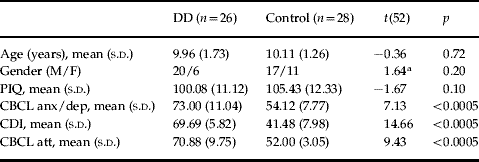
A diagnosis of DD was defined through separate semi-structured clinical interviews with parent(s) and child [Anxiety Disorders Interview Schedule for Children (A-DISC); Silverman & Albano, Reference Silverman and Albano1996]. Symptoms of DD were also evaluated using parent report [Child Behavior Checklist (CBCL) anxiety depression subscale; Achenbach & Edelbrock, Reference Achenbach and Edelbrock1983] and child report [Children's Depression Inventory (CDI) total depression scale; Kovacs, Reference Kovacs1992], where clinical-level DD symptoms were observed to be greater than 1.5 s.d. above the mean for a child's age and gender (Table 1). Inattention was also measured as part of the standard clinical assessment, through parent report of child inattentive symptoms (CBCL attention scale; Achenbach & Edelbrock, Reference Achenbach and Edelbrock1983).
Group characteristics

DD, Dysthymic disorder; M, male; F, female; PIQ, perceptual reasoning index using the Wechsler Intelligence Scale for Children, version 4; CBCL anx/dep, Child Behavior Checklist anxiety depression subscale; CDI, Children's Depression Inventory total depression scale; CBCL att, Child Behavior Checklist attention subscale; s.d., standard deviation.
a χ2 test used for categorical variables.
Children in the healthy control group did not meet the diagnostic criteria for DD, as defined using the same clinical measures. The healthy control children were recruited from local primary schools and volunteered to participate in the study. These 28 pre-pubertal (Tanner stage I) male and female healthy control participants did not meet criteria for any other psychiatric, neurological or endocrine disorder. They did not differ from the clinical group in age, gender or ‘performance IQ’ (PIQ), as assessed by the perceptual reasoning index from the Wechsler Intelligence Test for Children – 4th edition (WISC-IV; Wechsler, Reference Wechsler2003) (Table 1). All of the healthy control children were tested at home.
Computerized neuropsychological tasks
VSWM was assessed through measurement of performance on the Spatial Working Memory and Spatial Span tasks selected from the CANTAB (Owen et al. Reference Owen, Evans and Petrides1996). The computerized tests were presented on a high-resolution IBM monitor with a touch-sensitive screen. All the children reported previous experience with computers and were tested using the same apparatus.
The CANTAB Spatial Span task is a computerized version of the Corsi block-tapping test that assesses visuospatial short-memory capacity (Milner, Reference Milner1971). This task measures the ability to remember a sequence of squares presented on the screen. After an incorrect attempt at choosing the squares in sequence, the next trial remains at the same difficulty level. A Spatial Span score was calculated as the highest level at which the participant successfully remembered at least one sequence of boxes.
The CANTAB Spatial Working Memory task is a self-ordered search task that measures working memory for spatial stimuli and requires the subject to use mnemonic information to work towards a goal. Participants are required to search through boxes that appear on the screen with the aim of finding the blue tokens hidden inside. The key instruction is that once a token has been taken out of a box, that box will not be used again to hide a token. There were four test trials with each of three, four, six and eight boxes. Returning to an ‘empty’ box, already opened and a token removed on a previous search, constituted a ‘forgetting’ or BSE. Performance accuracy was defined as the total number of BSEs (i.e. higher BSE rates indicate lower accuracy of VSWM performance). This was the key functional measure of VSWM. Response latencies, measured in milliseconds (ms), were obtained for each trial. This recorded the time difference between the presentation of boxes on the screen and the end of the trial when all the blue tokens have been found.
A Strategy score was calculated from each participant's performance on the six and eight box levels, to reflect how often a searching sequence was initiated from the same box during a given trial. Higher Strategy scores represent low use of strategy (i.e. many sequences beginning with a different box in a given trial). Lower scores represent efficient use of strategy (i.e. many sequences starting with the same box in a given trial).
Data analysis
Performance on (1) the Spatial Working Memory BSE variable, including both the accuracy and response latency variables, and (2) the Strategy and Spatial Span variables was compared between groups using respective (1) repeated-measures and (2) one-way analysis of covariance (ANCOVA), covarying for the effects of age and PIQ, given the known sensitivity of these VSWM measures to these variables (Kravariti, Reference Kravariti, Morris, Rabe-Hesketh, Murray and Frangou2003a, Reference Kravariti, Morris, Rabe-Hesketh, Murray and Frangoub; Barnett et al. Reference Barnett, Maruff and Vance2005). Then, the Spatial Working Memory BSE variable was compared between groups using a repeated-measures ANCOVA, covarying for the effects of spatial span. To estimate effect sizes, Cohen's d calculation for unequal sample sizes was used to examine differences between group performance on both accuracy and latency measures. To investigate the contribution of Spatial Span and Strategy to overall VSWM, the correlations between BSE and Spatial Span and between BSE and Strategy were computed using the total number of BSEs (across all levels of difficulty). To investigate the association of VSWM with inattentive symptoms, the correlation between the total number of BSEs and inattention symptom scores was computed. Each of these correlations examined the relationships between variables in the combined sample, including healthy control and clinical participants.
Results
Descriptive statistics
Table 1 shows the mean age and PIQ for the healthy control group and the DD group. Independent samples t tests showed that the two groups did not differ significantly with respect to mean PIQ [t(52)=−1.67, p=0.10] and age [t(52)=−0.36, p=0.72]. Pearson χ2 tests showed that the two groups did not differ significantly with respect to gender [χ2(1)=1.64, p=0.20]. In the DD group, 77% of participants were male and 23% were female. In the healthy control group, 61% of participants were male and 39% were female. DD patients exhibited significantly higher depressive symptoms according to both parent [t(52)=7.13, p<0.0005] and child [t(52)=14.66, p<0.0005] reports, and also higher inattentive symptoms [t(52)=9.43, p<0.0005] (Table 1).
VSWM task accuracy (BSEs)
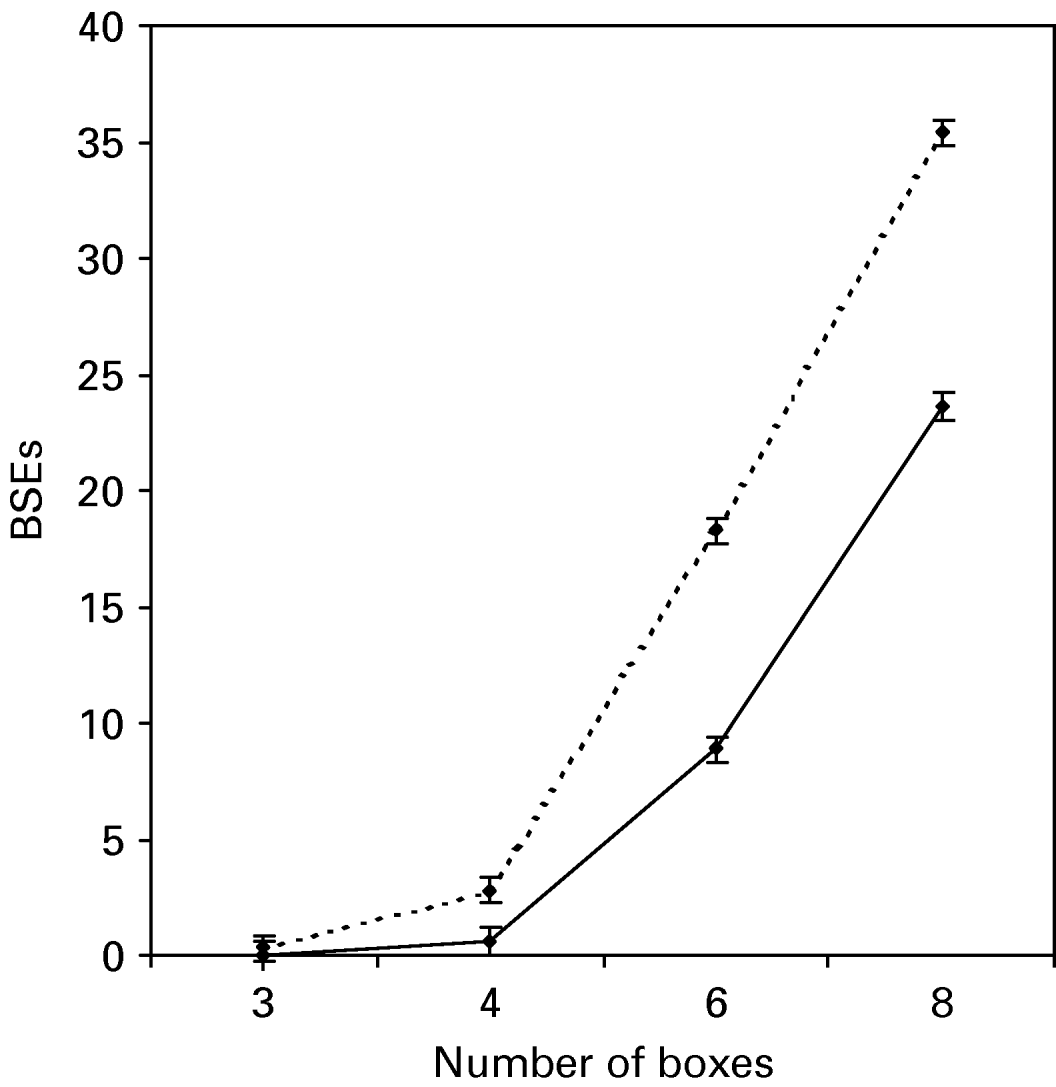
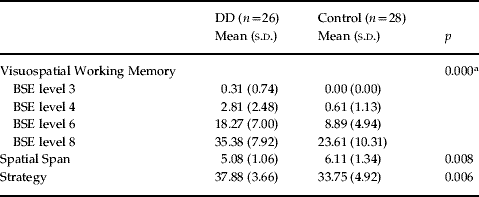
Differences in accuracy of performance (BSEs) across diagnostic group were analysed using a 2 (group)×4 (level) repeated-measures ANCOVA. Table 2 shows the mean BSEs for each group at each difficulty level on the VSWM task. There was a significant effect of condition (number of boxes) [Wilks' λ=0.50, F(3, 48)=16.30, p<0.0005] and diagnostic group [F(1, 50)=37.78, p<0.0005, partial η2=0.43] on the number of BSEs, after covarying for age [F(1, 50)=8.64, p=0.005, partial η2=0.15] and PIQ [F(1, 50)=18.98, p<0.0005, partial η2=0.28], both of which had a significant independent association with the number of BSEs. The DD group made significantly more errors than the healthy control group (see Fig. 1). Cohen's d (1.67) showed a large effect size. There was also a significant interaction between condition and group [Wilks' λ=0.57, F(3, 48)=11.98, p<0.0005] after covarying for age and PIQ. The difference between the number of BSEs for each group increased with increasing level of task difficulty (Fig. 1). Significant independent interactions were also found between condition and age [Wilks' λ=0.85, F(3, 48)=2.84, p=0.048] and condition and PIQ [Wilks' λ=0.73, F(3, 48)=5.93, p=0.002].
The number of between-search errors (BSEs) at each level of difficulty of the visuospatial working memory task, for the healthy control group (–◆–) and dysthymic disorder group (···◆···) (standard error bars included).

Group performance on the Spatial Span task and the Visuospatial Working Memory (VWSM) task, including the between-search errors (BSEs) and the Strategy components

DD, Dysthymic disorder; s.d., standard deviation.
a The significance of the repeated-measures ANCOVA across BSE levels of difficulty p<0.0005.
None of these associations differed after the additional covariate, spatial span, was added to the analysis. There was a significant effect of condition (number of boxes) [Wilks' λ=0.49, F(3, 47)=16.46, p<0.0005] and diagnostic group [F(1, 49)=28.21, p<0.0005, partial η2=0.37] on the number of BSEs after covarying for age and PIQ. There was also a significant interaction between condition and group [Wilks' λ=0.63, F(3, 47)=9.06, p<0.0005] after covarying for age and PIQ.
VSWM task response latency
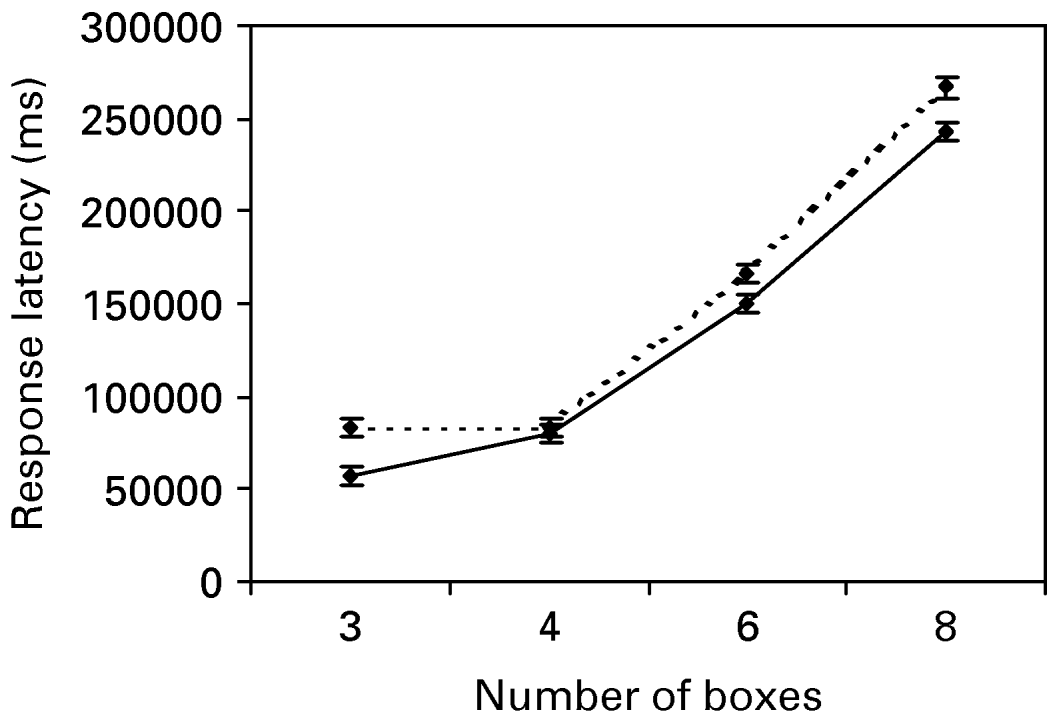
Differences in the response latency (ms) on the VSWM task across diagnostic group were analysed using a 2 (group)×4 (level) repeated-measures ANCOVA. There was a significant effect of condition [Wilks' λ=0.72, F(3, 48)=6.21, p=0.001] and diagnostic group [F(1, 50)=4.24, p=0.045, partial η2=0.08] after covarying for age [F(1, 50)=6.095, p=0.017, partial η2=0.11] and PIQ [F(1, 50)=0.74, p=0.39, partial η2=0.02]. Only age had a significant independent association with response latency. The DD group displayed longer response latencies than the healthy control group (see Fig. 2). Cohen's d (0.64) showed a medium effect size. There was also a significant interaction between latency and diagnostic group [Wilks' λ=0.72, F(3, 48)=6.38, p=0.001] after covarying for age and PIQ. The difference in latency between groups differed with increasing level of difficulty (see Fig. 2). No significant interactions were found between latency and PIQ [Wilks' λ=0.902, F(3, 48)=1.73, p=0.17] or between latency and age [Wilks' λ=0.899, F(3, 48)=1.803, p=0.16].
Response latency on the visuospatial working memory task at each difficulty level for each group (standard error bars included). –◆–, Healthy control group; ···◆···, dysthymic disorder group.

Spatial span
A univariate ANCOVA was used to analyse the difference between the mean spatial span for each diagnostic group. There was a significant difference between the two diagnostic groups in spatial span performance [F(1, 50)=7.727, p=0.008, partial η2=0.13] (see Table 2) after covarying for age [F(1, 50)=9.09, p=0.004, partial η2=0.15] and PIQ [F(1, 50)=2.17, p=0.15, partial η2=0.04]. Only age had a significant independent association with spatial span performance. The spatial span for the DD group (mean=5.08, s.d.=1.06) was lower than for the healthy control group (mean=6.11, s.d.=1.34). Cohen's d (0.85) indicated that this was a large effect.
Strategy
Univariate ANCOVA was used to analyse the difference between the mean strategy score for each diagnostic group. There was a significant difference between the two diagnostic groups in search strategy used during the VSWM task [F(1, 50)=8.27, p=0.006, partial η2=0.14] (see Table 2) after covarying for age [F(1, 50)=4.02, p=0.05, partial η2=0.07] and PIQ [F(1, 50)=13.45, p=0.001, partial η2=0.21]. Only PIQ had a significant independent association with search strategy performance. The strategy score for the DD group (mean=37.88, s.d.=3.66) was higher, indicating a less efficient search, than for the healthy control group (mean=33.75, s.d.=4.92). Cohen's d (0.95) again showed a large effect size.
Correlations between VSWM, span and strategy
The relationships between VSWM (BSEs) and the spatial span and strategy components of VSWM were assessed in the combined sample. There was a significant negative correlation between total BSEs and spatial span (r=−0.57, p<0.0005) and a significant positive correlation between total BSEs and strategy (r=0.67, p<0.0005).
Correlation between symptoms of inattention and VSWM
The relationship between symptoms of inattention and VSWM performance was examined in the combined sample. The VSWM total accuracy score (as defined by the number of BSEs across all VSWM task levels) had a large positive correlation with the parent report of child inattentive symptoms (CBCL inattentive subscale score) (r=0.62, p<0.0005).
Discussion
Pre-pubertal children with DD demonstrated impaired VSWM performance that worsened as the cognitive demands of the VSWM task increased. Deficits were also evident in both the spatial span and strategy components of VSWM in the DD group. These findings suggest that children with DD are impaired in their ability to maintain spatial information ‘online’ in VSWM and in their ability to develop a systematic search strategy during task performance. Correlational analyses implied that deficits in the maintenance and manipulation of spatial information in VSWM contribute to the impairment in overall VSWM ability displayed by the DD group. Furthermore, the VSWM impairment remained after covarying for spatial span. This implies that the executive component of VSWM is dysfunctional in children with DD.
These results extend Matthews et al.'s (Reference Matthews, Coghill and Rhodes2008) findings in adolescent girls with MDD: first, pre-pubertal children, males and females, with DD also manifest impaired VSWM performance. Second, spatial span is also impaired in this younger group, unlike the adolescent sample. Third, the executive component of VSWM is also dysfunctional in this younger group, despite their spatial span deficits. Fourth, these further cross-sectional findings in a younger group may reflect depressive disorder-related processes rather than pre-morbid vulnerability alone.
Additional analyses revealed longer response times on the VSWM task for children with DD, evident at levels 3, 6 and 8 of the task. This may be due to their clinically significant inattention and manifest orienting to task difficulties (e.g. their longer response times on level 3). The similar response times between groups on level 4 suggest that motor dysfunction is unlikely to be associated with DD in pre-pubertal children. Finally, the longer response times and the lower accuracy of performance on levels 6 and 8 are consistent with the use of less efficient search strategies by the DD group. This further suggests that children with DD had difficulties with manipulating information held ‘online’ in VSWM.
It is known that dysfunction to fronto-striatal–parietal neural networks is associated with impaired abilities in the manipulation of spatial information in VSWM (Owen et al. Reference Owen, Sahakian, Semple, Polkey and Robbins1995; Braver et al. Reference Braver, Cohen, Nystrom, Jonides, Smith and Noll1997, Reference Braver, Barch, Kelley, Buckner, Cohen, Miezen, Snyder, Ollinger, Akbudak, Conturo and Petersen2001; Pantelis et al. Reference Pantelis, Barnes, Nelson, Tanner, Weatherley, Owen and Robbins1997; Vance et al. Reference Vance, Silk, Casey, Rinehart, Bradshaw, Bellgrove and Cunnington2007). The VSWM, especially strategy, performance deficits suggest that DD in children is associated with dysfunction to these fronto-striatal–parietal neural networks. In addition, deficits in spatial span ability suggest there is dysfunction involving mid-ventrolateral prefrontal and posterior parietal cortical regions in DD (Owen et al. Reference Owen, Evans and Petrides1996; Smith et al. Reference Smith, Jonides and Koeppe1996; Carlson et al. Reference Carlson, Martinkauppi, Rama, Salli, Korvenoja and Aronen1998).
Fronto-striatal–parietal dysfunction is also associated with clinically significant inattention (Barnett et al. Reference Barnett, Maruff, Vance, Luk, Costin, Wood and Pantelis2001; Vance et al. Reference Vance, Silk, Casey, Rinehart, Bradshaw, Bellgrove and Cunnington2007). Furthermore, dysfunction of neural networks involving the dorsolateral PFC (DLPFC), anterior cingulate cortex and striatal brain regions (Cannon et al. Reference Cannon, Glahn, Kim, Van Erp, Karlsgot, Cohen, Nuechterlein, Bava and Shirinyan2005; Castellanos et al. Reference Castellanos, Sonuga-Barke, Milham and Tannock2006) are thought to underpin the association of inattention and working memory. Given that the children with DD were significantly more inattentive and that inattentive symptoms were significantly associated with VSWM impairments, dysfunction to DLPFC-linked fronto-striatal neural networks is implicated in childhood DD. However, the observed deficits of VSWM may be linked to symptoms of inattention in general, rather than DD specifically (Vance et al. Reference Vance, Arduca, Sanders, Karamitsios, Hall and Hetrick2006a). Further studies should delineate whether or not VSWM deficits are associated with the neurobiology of DD per se, for example by examining VSWM in children with DD and no inattentive symptoms. In addition, there is need for further research examining whether dysfunction to DLPFC-linked fronto-striatal neural networks and also their connections with limbic regions (Carmichael & Price, Reference Carmichael and Price1995; Mayberg et al. Reference Mayberg, Liotti, Brannan, McGinnis, Mahurin, Jerbek, Silva, Tekell, Martin, Lancaster and Fox1999; Haber, Reference Haber2003) are associated with the cognitive and affective symptoms of DD.
Clinical implications
Inattentive symptoms may contribute to the learning difficulties and impairments in academic functioning that have been observed in children with DD (Kovacs & Goldston, Reference Kovacs and Goldston1991; Friedman et al. Reference Friedman, Markowitz, Parides and Kocsis1995). Interventions targeting inattention may thus be helpful. The observed VSWM deficits also suggest that children with DD have trouble with holding spatial information ‘online’ in working memory, and manipulating this information. This may have implications for the presentation of information. For example, when children with DD are learning or receiving instructions, they may respond better to smaller, more simple pieces of information that are presented repeatedly, particularly in high-stimulus, novel environments such as the school classroom. These interventions may also be useful in the home or in clinical settings. Stimulant medication may be helpful for this group of children, who can become severely oppositional and defiant in these contexts (Vance et al. Reference Vance, Arduca and Sanders2005); however, future randomized controlled trials are needed.
Poor academic performance may exacerbate the symptoms of low self-esteem displayed by children with DD (Masi et al. Reference Masi, Favilla, Mucci, Poli and Romano2001). Low self-esteem is also likely to contribute to the impaired peer relationships frequently observed during the symptomatic period of DD (Klein et al. Reference Klein, Schwartz, Rose and Leader2000). Clearly, addressing cognitive, academic and social functioning is important in the treatment of childhood DD.
Study limitations
The levels of the VSWM task were presented in order of increasing cognitive demand, rather than randomized. This may suggest that the poor performance of children with DD on levels 6 and 8 of the task reflects increases in cognitive fatigue, inattention or low motivation as the task progressed. However, the order of presentation was controlled for between the two diagnostic groups. Furthermore, the CANTAB has been validated in developmental studies of children and adolescents (Luciana & Nelson, Reference Luciana and Nelson1998; De Luca et al. Reference De Luca, Wood, Anderson, Buchanan, Proffitt, Mahony and Pantelis2003), and used in previous clinical studies of children with psychiatric disorders featuring inattentive symptoms, such as ADHD (Williams et al. Reference Williams, Stott, Goodyer and Sahakian2000; Barnett et al. Reference Barnett, Maruff, Vance, Luk, Costin, Wood and Pantelis2001; Cairney et al. Reference Cairney, Maruff, Vance, Barnett, Luk and Currie2001; Vance et al. Reference Vance, Maruff and Barnett2003) and early onset schizophrenia (Vance et al. Reference Vance, Hall, Bellgrove, Casey and Karsz2006b). Thus, the present findings are more likely to reflect actual deficits of VSWM and the impact of poor spatial span and strategy abilities on VSWM performance. Another limitation is that the present study was a clinical study of children with ‘pure’ DD. It is not certain whether the findings may be generalized to the wider community or to patients with DD and a further diagnosed co-morbid disorder. Future research should examine the neuropsychological profile of children with DD and key co-morbid disorders, particularly MDD (Kovacs et al. Reference Kovacs, Akiskal, Gatsonis and Parrone1994).
Conclusions
In summary, the present findings support an association between VSWM and DD in pre-pubertal children. VSWM deficits, including deficits to both the spatial span and strategy components of VSWM, and also associated symptoms of inattention, taken together, imply dysfunction to dorsolateral and ventrolateral fronto-striatal–parietal neural networks. Further neuropsychological and functional neuroimaging studies are required to extend these findings.
Acknowledgements
This research was supported by project grants obtained from the University of Melbourne, Murdoch Childrens Research Institute and the Royal Children's Hospital. We thank the staff and patients at the Royal Children's Hospital.
Declaration of Interest
None.