Introduction
Following cochlear implantation, cochlear implant device failure and medical complications are the commonest causes of revision surgery. Cochlear implantation is now proven to be the procedure of choice for rehabilitation of bilateral, severe to profound sensorineural hearing loss. Therefore, analysis of failures, and reduction of their incidence, is important. ‘Hard device failure’ refers to a malfunctioning device, e.g. complete failure of the internal device after an impact. ‘Soft device failure’ refers to unpleasant symptoms, declining performance or intermittent function during which communication between external and internal parts is maintained.Reference Balkany, Hodges, Buchman, Luxford, Pillsbury and Roland1 Medical complications of cochlear implantation include acute or chronic suppurative otitis media (CSOM), skin infection, device misplacement, electrode extrusion, and implantation cholesteatoma.
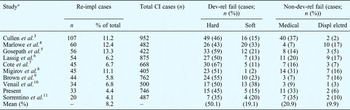
As the total number of implanted patients increases to over 180 000 worldwide, long term studies from cochlear implantation clinics are needed to complement manufacturers' data on reliability and safety.2 Published reviews of cochlear re-implantation have revealed the surgery to be safe, with maintenance of audiological performance most of the time.Reference Cullen, Fayad, Luxford and Buchman3, Reference Marlowe, Chinnici, Rivas, Niparko and Francis4 The re-implantation incidence in our unit appears to reflect the findings of the wider literature (Table I).
Literature on cochlear re-implantation

*Technology upgrade data excluded. Re-impl = cochlear re-implantation; CI = cochlear implantation; Dev-rel fail = device-related failure; Non-dev-rel fail = non-device-related failure; Displ elctrd = displaced electrode
This paper aims to share our centre's 25-year cumulative experience, by presenting a series of lessons learned from cochlear implant failure.
Methods
We conducted a prospective study of cochlear implant failures from 1998 to 2010, and also included retrospective data gathered for the period 1986–1998. In total, we had 33 failed cochlear implantations, taken from a cohort of 746 cochlear implantations.
We searched our in-house database and medical records to identify these patients' aetiology of deafness, age at implantation and type of device originally inserted. We also collected information on reasons for re-implantation, symptoms leading to revision surgery, the new cochlear implant device used, and the number of electrodes reinserted. The causes of revision were classified as device failure (hard and soft), medical or electrode misplacement. We calculated device failure rates for each manufacturer. We also compared patients' peak audiological performance before and after revision implantation.
In our centre, cochlear implantation is performed using a standard technique of cortical mastoidectomy followed by posterior tympanotomy via a postauricular incision. The receiver-stimulator package is secured in a square well down to an island of thin bone covering the dura. Due to our experience of stitch granuloma, we no longer use any sutures to secure the package.Reference Djalilian, King and Faust12 In children, the peri-operative neural response threshold and stapedial reflex are tested dependent on device type.
Our re-implantation policy consists of using the ipsilateral side whenever possible, unless the contralateral side is expected to offer greater benefit. The presence of active infection that is refractory to medical treatment will usually require the device to be removed and a new implant placed on the contralateral side, or on the same side after infection is extinguished.
Statistical calculations were performed using Stata software (version 10.1 SE; Stata, College Station, Texas, USA). The chi-square test was used to analyse differences in proportionate data. Descriptive statistics were utilised where appropriate.
Results
From March 1986 to October 2010, 746 cochlear implant procedures were carried out in Cambridge: 345 in children and 401 in adults. From this cohort, we performed 12 re-implantation procedures in children (3.5 per cent) and a further 17 procedures in adults (4.2 per cent). It should be noted that one adult underwent re-implantation twice. At the time of writing, a further three patients were awaiting cochlear re-implantation after a registered device failure, and another patient was awaiting re-implantation after being explanted for acute infection; these four patients were also included in the current analysis.
Exclusions from this study included eight patients implanted with either a single-channel (UCH/RNID) or four-channel (Ineraid Mk II) device, who were upgraded in order to benefit from improved technology (however, audiological performance data recorded before and after re-implantation were utilised in the final analysis of this study). One patient was explanted without re-implantation due to severe depression, and was not included in our analysis.
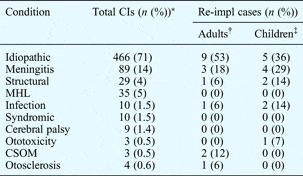
In our paediatric patients, the mean age at initial implantation was four years in the early part of the study; however, the later introduction of a national neonatal screening programme lowered this figure. Table II describes the underlying cause of hearing loss necessitating a cochlear implant in our paediatric and adult patients. A disproportionate number of children requiring re-implantation had a structural deformity (e.g. Mondini deformity or large vestibular aqueduct syndrome) or had been affected by bacterial meningitis or congenital infection (e.g. cytomegalovirus or German measles). The mean paediatric age at re-implantation was 10.5 years. The median time from cochlear implant failure to re-implantation was six months. In our centre, 35 per cent of children underwent bilateral simultaneous cochlear implantation, made possible by new guidance from the National Institute for Health and Clinical Excellence.
Patients' aetiology of deafness

*n = 746; †n = 17; ‡n = 12. CIs = cochlear implantations; Re-impl = cochlear re-implantation; MHL = monogenic hearing loss; CSOM = chronic suppurative otitis media
In adults, the underlying causes of hearing loss necessitating cochlear re-implantation largely mirrored those for the whole patient cohort, although CSOM, otosclerosis and congenital infection occurred more frequently than expected (Table II). In adults, the mean age at implantation was 45 years, and the median time from cochlear implant failure to re-implantation was five months.
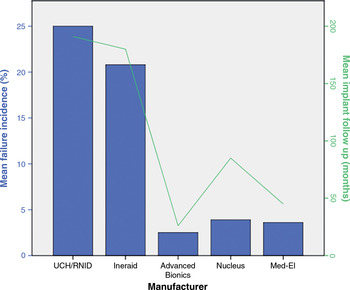
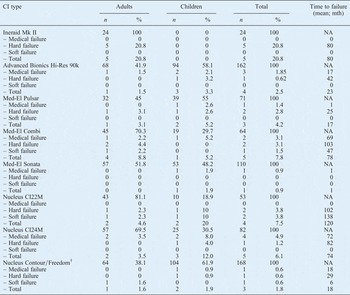
The cochlear implant failure rate for each device type and manufacturer is shown in Figure 1 and Table III. Five soft device failures were diagnosed, according to the criteria of the Cochlear Implant Soft Failures Consensus Development Conference Statement.Reference Balkany, Hodges, Buchman, Luxford, Pillsbury and Roland1 All these five patients suffered a decrease in performance. One patient experienced a small electrical shock with loud sounds, while another felt a sensation of increased pressure on stimulation.
Incidence of device failure (excluding upgrade re-implantation data) and mean follow up by manufacturer.

Cochlear implantation failure type by device*

Results exclude data for single-channel cochlear implants (i.e. six UCH/RNID devices) and upgrade re-implantations. *1986–2010. †Incorporates models CIC, R(A), RE(CA), RE (ST) and CI152. Mth = months; NA = Non-Applicable; Hard failure = hard device failure; Soft failure = soft device failure
There were 15 documented hard device failures. The technical reports were only available for nine of these 15 patients, due to closure of the company that produced the Ineraid Mk II device. The six patients without technical reports were likely to have suffered a hard device failure, based on their clinical assessment notes, but there was no direct evidence to support this assumption. Trauma as a causative factor for hard device failure showed a non-significant trend towards greater prevalence in the paediatric population (p = 0.26) compared with the adult population.
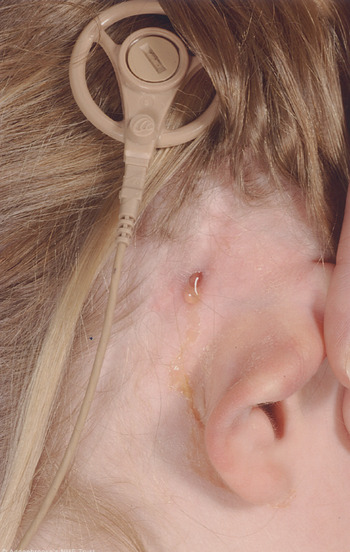
A medical cause for revision surgery was apparent in 10 patients. Two patients developed chronic otitis media (mucosal type) requiring eventual re-implantation. Six children developed a post-auricular abscess requiring explantation, despite initial treatment with needle aspiration or incision and drainage. One of the patients developed a non-healing, discharging sinus due to a foreign body reaction (Figure 2). The one iatrogenic cholesteatoma in this series was an incidental finding noted after explantation of a device with hard device failure. One patient, with a diagnosis of Langerhans cell histiocytosis, developed an acute inflammatory reaction around the region of the VIIIth cranial nerve, with subsequent rapid decrease in electrode array response. Patients originally implanted after bacterial meningitis were no more likely to develop infection as a cause of failure, compared with patients with other clinical backgrounds.
Clinical photograph showing a discharging sinus overlying the electrode array.

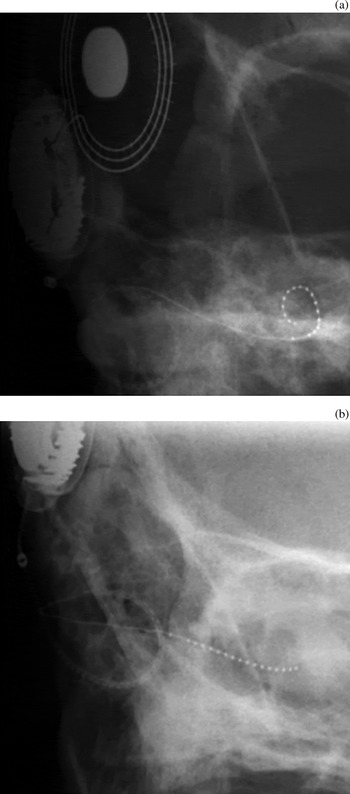
We had one case of electrode array extrusion after a patient sneezed vigorously; a decision was subsequently taken to re-implant a new electrode due to coexistent non-auditory stimulation. A further case of electrode array displacement happened as a direct consequence of skin flap revision surgery (Figure 3).
Posterior-anterior skull X-ray taken (a) before and (b) after skin flap revision surgery, showing post-operative electrode array displacement.

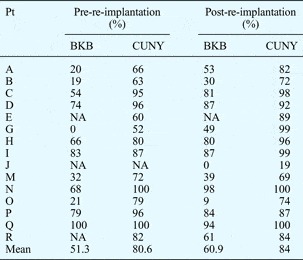
In adults, the Bamford Kowal Bench (BKB) open set sentence and the City University of New York open set lip-reading tests were used to measure peak audiological performance before and after re-implantation. Findings revealed hearing to be stable or improved in the majority of patients implanted on the same side (Table IV).
Adult audiological performance

Pt = patient; BKB = Bamford Kowal Bench open set sentences; CUNY = City University of New York open set lip-reading and aided hearing; NA = raw data not available
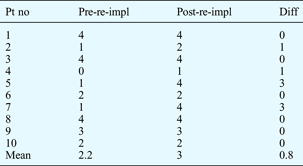
Due to the diversity of age-appropriate tests available for children, a modified Category of Auditory Performance questionnaire was completed by the key-worker in each case. Of the 10 children undergoing ipsilateral cochlear implantation, all had improved or stable communication scores (Table V).
Paediatric audiological performance
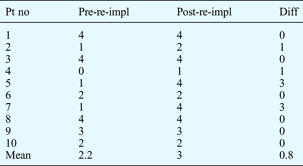
Data represent scores for Modified Category of Audiological Performance (0 = none; 1 = can detect sounds; 2 = can identify (closed set); 3 = can recognise (open set); 4 = can understand (e.g. answer a question)), unless specified otherwise. Pt no = patient number; Pre-re-impl = pre-re-implantation; Post-re-impl = post-re-implantation; Diff = difference
The choice to re-implant on the contralateral side was made in nine patients. Three of these patients had an active infection. One patient presented to the department after a traumatic hard device failure, and was found to have contralateral cholesteatoma. The patient with an inflammatory reaction affecting the VIIIth cranial nerve was discussed at a national level, due to the rare nature of the disease. A further patient was transferred into the unit after two previously documented hard device failures on the same side. Two patients were given a choice as to which side to implant. The last patient had a previous history of meningitis, with marked ossification around the basal turn of the cochlear duct.
There were 18 complete electrode array insertions in the 20 ipsilateral re-implantations (90 per cent). The two partial electrode insertion patients had a background of cochlear otosclerosis and meningitis, variously, with no obvious difficulty encountered at the original operation.
Discussion
Lesson one: devices are now more reliable
Improved device construction and reliability is expected to reduce the incidence of cochlear implant failure over time. In our series, 20.8 per cent of the early model Ineraid Mk II devices experienced a hard failure. In comparison, none of the 110 new generation Med-El Sonata devices developed a similar complication. However, as the total number of cochlear implants increases with time, we can expect most cochlear implantation centres to be challenged with a population of former recipients requiring revision.
The cochlear re-implantation incidence in this series is comparable to those reported by other studies.Reference Cullen, Fayad, Luxford and Buchman3–Reference Sorrentino, Cote, Eter, Laborde, Cochard and Deguine11 However, the incidence of total device failure may be higher than figures published by some cochlear implant manufacturers. Indeed, the 3.9 per cent rate found in Nucleus patients was higher than the 0.2–2.4 per cent rate reported by the manufacturer.Reference Gibben and Raine13 The 2.5 per cent rate among the Advanced Bionics patients was marginally closer to the 1.7 per cent three-year device failure rate reported by the manufacturer.Reference Gibben and Raine13 Such discrepancies may be related to failures of earlier technology and the longer follow-up period of the current study.
• The incidence of cochlear implant failure is increasing
• This study assessed cochlear re-implantation survival, safety and efficacy
• Failure rates have decreased with newer implants
• ‘Hard device failure’ was the commonest reason for re-implantation, frequently following head trauma in children
• Despite encouraging re-implantation outcomes, worsened hearing is also possible; patients should be counselled accordingly
To understand the reasons leading to hard device failure, the majority of devices were removed, utilising an atraumatic technique, and sent to the manufacturer (preserving the ground lead and the transducer coil). We believe good collaboration with manufacturers can lead to improved clinical practice, and may help to enhance the design of future implants.
Lesson two: regular review of patients will aid early detection of device failure
The number of young implantees in this study increased markedly over time (there were 21 paediatric patients for the period 1990–99, compared with 258 for the period 2000–10). Therefore, close monitoring is required to discover potential failure. Partial device failure in a child may be more difficult to detect behaviourally, due to the inability of many young children to report adverse symptoms, as well as the variability in language and hearing development.Reference Balkany, Hodges, Buchman, Luxford, Pillsbury and Roland1 Making a decision to perform a second cochlear implantation procedure in a patient with decreased speech recognition performance is often more difficult than in patients with documented hard device failure. Decreased implant performance is generally reported by the patient (or their parent), in the form of a sudden change in response to sounds, a change in behaviour and/or reduced quality of life. Clinical examination is generally normal, but audiological testing will demonstrate malfunction. A decision to re-implant should be made as swiftly as possible, after all potential reprogramming options have been exhausted. Decreasing performance can be substantiated if longitudinal speech recognition data are available for the patient.Reference Gosepath, Lippert, Keilmann and Mann5 This can only be achieved if patients are reviewed regularly and have open access to the cochlear implantation unit.
Lesson three: children have a larger hard failure rate, mainly due to head trauma
In this study, the total number of hard device failures attributed to head injury was 67 per cent. A higher incidence of trauma in children was detected, but was not proven to be significant on statistical analysis. Previous studies have demonstrated a similarly increased incidence, and have concluded that this is a consequence of child-play and learning to walk.Reference Cote, Ferron, Bergeron and Bussiere7, Reference Weise, Muller-Deile, Brademann, Meyer, Ambrosch and Maune14 The mean age for traumatic failure in our study was 4.2 years. It is of interest to note that some manufacturers exclude traumatic device failure data from cumulative survival reporting. In concordance with the wider literature, we included all available data in our study (including traumatic failure), as not to do so may have introduced a source of bias.
The technical report for one explanted device in our study suggested inadequate immobilisation. Some manufacturers recommend that cochlear implants and wires be tied down securely with bony holes and non-absorbable sutures. This is because some failures are at the junction of wires and encapsulated electronics. In our centre, perichondrium is utilised at the site of the cochleostomy, or bone cement at the level of the posterior tympanotomy, to prevent the electrode array slipping out. We also secure the electrode array by passing it through a bony tunnel in the region of the sinodural angle (provided bone cement is not utilised as above).
We had one case of subdural haematoma after drilling ‘rat-bite’ holes through the calvarium in order to secure the receiver-stimulator unit.Reference Sunkaraneni, Banerjee and Gray15 This subdural haematoma was due to bleeding from the emissary veins. The senior authors now advocate the creation of a deep bone well, as described above.
Lesson four: bilateral implantees do not have greater co-morbidity
In the UK, bilateral cochlear implantation in children has become increasingly accepted.Reference Bond, Mealing, Anderson, Elston, Weiner and Taylor16 More procedures are now carried out simultaneously, as this has the inherent advantages of more efficient rehabilitation and a lower anaesthetic risk.Reference Sparreboom, van Schoonhoven and van Zanten17 A further advantage may comprise sparing the child prolonged hearing loss should one side fail. The wider literature supports bilateral implantation in terms of audiological outcome, but is not conclusive on the issue of potential morbidity (i.e. vestibular effects and bilateral chorda tympani nerve injury).Reference Bond, Mealing, Anderson, Elston, Weiner and Taylor16, Reference Sparreboom, van Schoonhoven and van Zanten17 Acute blood loss may represent a theoretical problem; however, in practice this did not adversely affect any of the 60 patients bilaterally implanted in our centre.
Lesson five: early symptoms of infection should be treated aggressively
Putative symptoms of infection must be considered significant, and clinicians should have a low threshold for admission and intravenous antibiotic therapy. Of our 32 patients admitted with acute infection, 13 had a fluctuant abscess. Six patients underwent needle aspiration, and seven were taken directly to the operating theatre for incision and drainage. The eventual explantation rate was 33 per cent for needle aspiration, 57 per cent for incision and drainage, and 11 per cent for patients without a fluctuant abscess. This amounts to a 1:3 chance of explantation in patients with post-aural abscess, which reduces to 1:10 for acute otitis media.
In our study, scalp flap infection was not a major problem in either children or adults. Such infection can be due to inadequate recessing of the implant package into the skull.Reference Hoffman and Cohen18 Other factors which may reduce skin flap complications include the decreased use of percutaneous plugs (the Ineraid Mk II device became obsolete in 1997) and the adoption of a simplified curvilinear incision (avoiding a large scalp flap).Reference Clark, Cohen and Shepherd19, Reference Telian, El-Kashlan and Arts20
Lesson six: speech perception after re-implantation is generally improved or stable
In 1997, Miyamoto et al. evaluated 17 patients who had undergone revision cochlear implantation.Reference Miyamoto, Svirsky, Myres, Kirk and Schulte21 This report was at variance with previous studies, finding a statistically significant drop in the electrode insertion depth and the number of active channels after re-implantation.Reference Cullen, Fayad, Luxford and Buchman3–Reference Brown, Connell, Balkany, Eshraghi, Telischi and Angeli9 Our experience suggests that speech perception will either increase or follow a stable course for the large majority of patients (80 per cent). However, during the consent procedure we routinely discuss the possibility of suboptimal device performance after revision surgery.
Study strengths and weakness
This report describes the largest UK experience of cochlear re-implantation to date, with a cohort of 746 patients and procedures. Our cumulative review of similar studies complements the information collected in our centre, and may help to address the growing need for data on the overall survival, safety and efficacy of revision procedures.
We acknowledge the inherent limitations of retrospective data collection for the period 1986–1998.
Conclusion
Management of cochlear implant failure and assessment of the efficacy of revision surgery are becoming increasingly important. The cochlear implant failure rates observed in this study were comparable with the wider literature, but were higher than those published by cochlear implant manufacturers. There is a tendency towards decreased failure with newer technology, as demonstrated by the Med-El Sonata device. However, longer term data are required to substantiate this analysis. Children had a greater tendency to suffer hard device failure secondary to trauma. Bilateral implantation was not associated with added morbidity. In general, cochlear re-implantation is safe and effective, given that audiological perception is largely maintained and medical complications are low.
Acknowledgement
We would like to acknowledge the valuable contributions made by Marjan Adlington, Frances Harris, Cay Jackson, Lesley Shipgood and all the rest of the staff at the Emmeline Hearing Implant Centre.