INTRODUCTION
The research on the Levantine bathybenthic molluscs began auspiciously with the voyages of the ‘Pola' in the late 19th Century (Sturany, Reference Sturany1896), but was followed by a century-long hiatus (Janssen, Reference Janssen1989). Thus, when discussing the Mediterranean deep sea gastropod fauna Bouchet & Taviani (Reference Bouchet and Taviani1992) rightly declared ‘the Eastern Mediterranean is the least adequately sampled region'. During a series of cruises conducted by Israel Oceanographic and Limnological Research (IOLR) in the 1990s, a total of 4580 specimens identified to 43 species were collected off the coast of Israel at depths ranging from 734 to 1558 m (Bogi & Galil, Reference Bogi and Galil2004).
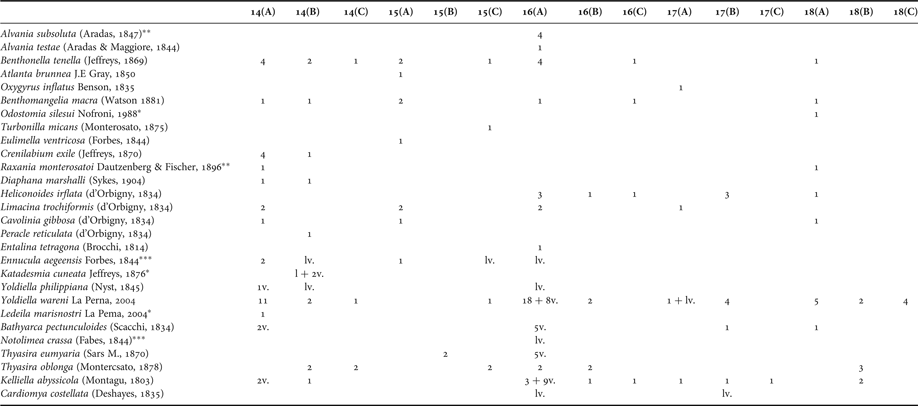
The specimens described in the present study were obtained from samples collected during a cruise by IOLR conducted in 2011 as part of a pollution-monitoring survey of a bathyal waste-dumping site. The species were collected at stations located at depths between 1264 and 1325 m. Twenty-eight species were identified, of which three, Odostomia silesui, Ledella marisnostri and Katadesmia cuneata are new records to the eastern Mediterranean, whereas Roxania monterosatoi and Alvania subsoluta are new records for the Levantine Basin and an additional two species are new records for the Israeli coast. The material examined consisted of empty shells.
Recently, extensive sub-salt natural gas fields were discovered in the Levant Basin, off the coast of Israel, in waters deeper than 1500 m. The US Geological Survey estimates that one field alone, Leviathan, holds approximately 600 million barrels of recoverable oil and 17 trillion cubic feet of recoverable gas (www.offshore-technology.com). To evaluate the likely impacts of exploration and production, knowledge about the biology, ecology and biogeography of the fauna is needed, and as this short survey attests—we know but little.
MATERIALS AND METHODS
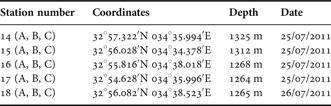
The samples were collected on 25–26 July 2011, during a cruise aboard the RV ‘Shikmona', using a 0.062 m2 box-corer with an effective penetration of 40 cm (Ocean Instruments model 700 AL) (Table 1). The samples were preserved in 10% buffered formalin aboard ship. In the laboratory, samples were washed and sieved through a 250 µm mesh, preserved in 70% ethanol, stained in rose Bengal and sorted. The shells are in an excellent state of freshness. The specimens are deposited in the collection of the senior author (C.B.), Livorno, Italy (Table 2).
Details of the sampling stations.

List of species and number of specimens per station. v., single valve; *, new record for the Eastern Mediterranean; **, new record for the Levantine Basin; ***, new record for Israel.

TAXONOMY
SYSTEMATICS
Class BIVALVIA Linnaeus, 1758
Order NUCULANOIDA Carter, Campbell & Campbell, 2000
Family MALLETIDAE Adams H.&A., 1858
Genus Katadesmia Dall, 1908
Katadesmia cuneata (Jeffreys, 1876)
(Figure 1.4, 5)
MATERIAL EXAMINED
A single shell (9.3 mm), two valves (10.1 mm and 7.6 mm), Station 14B.
1, Diaphana marshalli height 1.7 mm; 2, Roxania monterosatoi height 2.4 mm; 3, Odostomia silesui height 2.1 mm; 4–5, Katadesmia cuneata, right valve, length 9.3 mm; 6–7, Ledella marisnostri, right valve, length 2.3 mm.

DIAGNOSIS
Valves slightly convex, rostrated posterior part three times as long as rounded anterior, ventral margin curved. External ligament well developed, internal ligament lacking. Size 10 mm.
REMARKS
Widely distributed Atlantic species, recorded off the Atlantic coast of the Iberian Peninsula (as Malletia cuneata, Salas, Reference Salas1996) at great depths (890–1523 m). As nuculanoid bivalves possess short-lived non-planktotrophic larvae, it was believed that the shallow sill at Gibraltar precludes their crossing into the Mediterranean Sea (La Perna, Reference La Perna2003). Though its shells were recorded in the southern Tyrrhenian Sea (Di Geronimo et al., Reference Di Geronimo, Rosso, La Perna, Sanfilippo, Faranda, Guglielmo and Spezie2001), thus far no living specimens were recorded from the Mediterranean (La Perna, personal communication). First record for the eastern Mediterranean.
Family NUCULANIDAE Adams H. & A., 1858
Genus Ledella Verril & Bush, 1897
Ledella marisnostri La Perna, Reference La Perna2004
(Figure 1.6, 7)
MATERIAL EXAMINED
A single shell in excellent condition with traces of fresh and shiny periostracum (antero-posterior diameter 2.30 mm, umbo-ventral 1.65 mm), Station 14A.
DIAGNOSIS
Shell ovate, moderately convex, elongate, thin-walled. Umbo rather large. Antero-dorsal margin slightly convex, curving into a well-rounded anterior margin. Postero-dorsal margin curving into a moderately developed blunt rostrum at shell height midline. Ventral margin wide, evenly rounded except for posterior sinuosity marking out rostrum. Hinge, making a 130° angle, with rows of similar length. Dentition taxodont, seven teeth anteriorly, six posteriorly. Ligamental pit rather deep, triangular. Periostracum thin, shiny, yellowish. Its congener, L. messanensis (Jeffreys, 1870), is larger, its hinge composed of a greater number of teeth, the concavity at its postero-ventral margin is more pronounced and its beak is pointed.
REMARKS
Ledella marisnostri has been recently described from the southern Adriatic Sea, at 976 m (La Perna, Reference La Perna2004), and subsequently reported off Fiumicino, the Tyrrhenian coast of Italy, at 400 m depth (Campani & Spanu, Reference Campani and Spanu2007). First record for the eastern Mediterranean, and a significant extension of its known bathymetric range.
Class GASTROPODA Cuvier, 1795
Order HETEROSTROPHA Fischer P., 1885
Family PYRAMIDELLIDAE Gray, 1840
Genus Odostomia Fleming, 1813
Odostomia silesui Nofroni, Reference Nofroni1988
(Figure 1.3)
MATERIAL EXAMINED
A single shell (2.1 mm), Station 18A.
DIAGNOSIS
Odostomia silesui is characterized by a heterostrophic protoconch (type B: Aartsen, Reference Aartsen van1987), forming an angle of approximately 135° with the axis of teleoconch, and an arcuate columellar lip lacking a tooth or a fold (unique in the genus Odostomia). The growth lines on the teleoconch whorls are clearly opisthocline and slightly flexuous. The last whorl is about 2/3 of the total height, the mouth is thin lipped, a small and narrow umbilical groove. The present specimen bears a fine spiral striation over the entire surface of the teleoconch whorls.
REMARKS
A rare species, described from two specimens collected off southern Sardinia (800/950 m) (Nofroni, Reference Nofroni1988), and off Civitavecchia, the Tyrrhenian coast of Italy (550 m) (Tringali & Ardovini, Reference Tringali and Ardovini1992). First record for the eastern Mediterranean, a significant extension of its bathymetric range.
Order CEPHALASPIDEA P. Fischer, 1883
Family DIAPHANIDAE Odhner, 1914
Genus Diaphana Brown, 1827
Diaphana marshalli (Sykes, 1904)
(Figure 1.1)
MATERIAL EXAMINED
Two adult shells (1.8, 1.7 mm), Stations 14A, B.
DIAGNOSIS
Transparent oval shell, with an umbilicus. Spire flat with projecting protoconch with more than 1.5 whorls. Rhinophores simple, triangular flaps in front corners of headshield.
REMARKS
Diaphana marshalli, a rare Atlantic bathyal diaphanid gastropod, has been recently reported off the coast of Israel at depths of 1227–1454 m (Campani et al., Reference Campani, Bogi and Galil2011). The present finding of shells in excellent condition confirms the presence of a population of this rare species in the eastern Mediterranean. The size of its larval shell indicates planktotrophic larval development (Bouchet & Warèn, Reference Bouchet and Warèn1979), which may have facilitated its passage to the Levantine Sea.
Family CYLICHNIDAE Adams H.&A., 1854
Genus Roxania Leach in Gray, 1847
Roxania monterosatoi Dautzenberg & Fischer H., 1896
(Figure 1.2)
MATERIAL EXAMINED
An adult shell (2.8 mm), Station 14A; an adult shell (2.4 mm), Station 18A.
DIAGNOSIS
Shell globular, rounded, outer lip simple, overlooking plane of spire, columella straight and evident umbilicus, opening wider at the bottom. Shell porcelain white, surface entirely crossed by thin spiral incisions, closer at poles.
REMARKS
Roxania monterosatoi was first recorded off the Azores (1165–2102 m) (Dautzenberg & Fischer, Reference Dautzenberg and Fischer1896), and subsequently in the Mediterranean Sea from the Aegean at 2300 m (Parenzan, Reference Parenzan1970), and in the Gulf of Taranto, Italy (210–1958 m) (Di Geronimo & Panetta, Reference Di Geronimo and Panetta1973). First record for the Levantine Basin.
DISCUSSION
The deep water fauna of the Levantine Sea had long been considered the most impoverished in the Mediterranean Sea (Fredj, Reference Fredj1974; Fredj & Laubier Reference Fredj, Laubier, Moraitou-Apostolopoulou and Kiortsis1985). Yet, each survey adds to the list of Levantine bathyal biota (Galil, Reference Galil2004). A comprehensive study of the bathyal molluscs off the Israeli coast listed 43 species, of which five were new records for the eastern Mediterranean and 8 newly recorded from the Levantine Basin (Bogi & Galil, Reference Bogi and Galil2004). The present collection, consisting of merely 15 box core samples, resulted in 28 species being recorded, three new records for the eastern Mediterranean, and two new records for the Levant Basin (Table 2). Two species are newly added records for the Israeli coast: Ennucula aegeensis Forbes, 1844, previously recorded from Greece (Sturany, Reference Sturany1896; Koutsoubas et al., Reference Koutsoubas, Tselepides and Eleftheriou2000) and Turkey (Demir, Reference Demir2003); and Notolimea crassa (Forbes, 1844), previously recorded from Crete, Greece (Koutsoubas et al., Reference Koutsoubas, Tselepides and Eleftheriou2000). The growing list of bathybenthic mollusc species, owing to expanding research efforts, challenges the conventional view of the Levant deep-sea biodiversity.
Marenzeller (Reference Marenzeller1893) reported that species occur deeper in the Levant than elsewhere in the Mediterranean. Recent studies (Ben Eliahu & Fiege, Reference Ben Eliahu and Fiege1996; Goren & Galil, Reference Goren and Galil1997, Reference Goren and Galil2002; Sorbe & Galil, Reference Sorbe and Galil2002; Bogi & Galil, Reference Bogi and Galil2004), as well as the present one, confirm his findings: bathymetric parcelling of the Levantine populations differs from those of the western Mediterranean deep water assemblages.
ACKNOWLEDGEMENTS
The authors thank Captain G. Boxer, and the crew of the RV ‘Shikmona’, for their untiring efforts, Dr R. La Perna (Dipartimento di Geologia e Geofisica, Università di Bari, Italia) for his valuable suggestions, and Mr S. Bartolini for taking the digital photographs. The cruise was funded by the Israeli Ports Authority.