When preparing for a surge of casualties resulting from a large-scale public health emergency,1 2 health facility disaster plans tend to focus on physical casualties,Reference Dayton, Ibrahim and Augenbraun3 with little guidance for responding to large numbers of people with psychological needs, including emotional, behavioral, and cognitive reactions or health-related concerns following disasters.Reference Terhakopian and Benedek4 Reference Hawley, Hawley, St Romain and Ablah5 Reference Lemyre, Clément and Corneil6 A large-scale event would increase demands for health and mental health services from survivors, family of survivors, and staff in these facilities.Reference DiMaggio, Galea and Richardson7 Although people usually do not panic during a disaster or large-scale emergency,Reference DiGiovanni, Conley, Chiu and Zaborski8 much of this surge may be from people fearful that they have been exposed to a harmful agentReference Shaffer, Armstrong and Higgins9 and unexposed patients who have somatic symptoms mimicking exposure symptoms.Reference Hassett and Sigal10 Reference Diamond, Pastor and McIntosh11 Reference Gurwitch, Kees, Becker, Schreiber, Pfefferbaum and Diamond12 For example, when a radioactive substance in Brazil contaminated 250 people in 1987, 5000 of the first 60 000 persons screened had symptoms of acute radiation sickness (eg, vomiting, diarrhea, and neck or facial rash), but none were actually contaminated.
This initial mental health surge has the potential to overwhelm the medical system for as long as the public health crisis continues. Initially it may deplete valuable medical resources, strain staff, and create workflow bottlenecks at health facilities. Mental health issues will remain at the forefront if the disaster is prolonged. In the event of a contagious disease, quarantine measures to control the spread of disease may generate further behaviors based on fear and lack of trust, including noncompliance. Health care workers will not be immune to the same stressors affecting the people for whom they are caring. In the Toronto (Ontario, Canada) severe acute respiratory syndrome (or SARS) epidemic, 40% of the 20 000 quarantined people were health care workers with high rates of mental health symptoms.Reference Tansey, Louie and Loeb13 Reference Styra, Hawryluck, Robinson, Kasapinovic, Fones and Gold14 Staff may have obstacles to work, especially after disasters caused by humans (eg, a radioactive bomb or a biologic agent),Reference Veenema, Walden, Feinstein and Williams15 Reference Masterson, Steffen, Brin, Kordick and Christos16 Reference Cone and Cummings17 further stressing the response capabilities.Reference Veenema, Walden, Feinstein and Williams15 Reference Masterson, Steffen, Brin, Kordick and Christos16 Reference Cone and Cummings17 A systematic review of the literature indicated that concerns for family, personal safety, and pet care are barriers to willingness to work.Reference Chaffee18 Preparedness that addresses these issues may reduce role strain among personnel.
Health care staff may lack training in responding to such psychological consequences of a surge.Reference Locke19 Reference Hawley, Hawley, Ablah, St Romain, Molgaard and Orr20 Equipping staff with information about what to expect, how to protect themselves, and how they can provide assistance during disasters, as well as training backup personnel, are essential to planning.Reference Veenema, Walden, Feinstein and Williams15 Reference Becker and Middleton21 Many hospitals and clinics have on-site mental health professionals well-suited for providing psychological interventions, but they may not be appropriately trained and integrated into disaster planning efforts. Strategies for obtaining mutual aid from other facilities or redeploying personnel to new functions may offset the consequences of a surge.Reference Parker, Barnett, Everly and Links22 Still, we know of no models to guide facilities in how this information should be incorporated into planning and response. For example, the national Hospital Incident Command System (HICS) for emergency management includes mental health job action sheets for health care workers but does not give specific details on responding to psychological casualties.Reference Parker, Barnett, Everly and Links22 Reference Parker, Everly, Barnett and Links23
This article describes 2 frameworks that provide guidance for appropriate disaster response to address the needs of health care workers and the patients and families who seek health care in hospitals and clinics. One framework illustrates the antecedents of psychological and behavioral consequences (“psychological triggers”) of disasters. Another framework provides the foundation for the structures and processes needed to address the consequences of reactions to these psychological triggers. Our approach focused on facility-based mental health surge capacity or the ability of a health care facility to appropriately expand its operations to treat an unusually large influx of patients in response to the incident.Reference Bonnett, Peery and Cantrill24 Reference Barbera and Macintyre25 26 Reference Hick, Hanfling and Burstein27 Reference Rubinson, Nuzzo, Talmor, O’Toole, Kramer and Inglesby28 Reference Davis, Poste, Hicks, Polk, Rymer and Jacoby29 The frameworks informed the development of a training program for hospitals and clinics throughout Los Angeles County.Reference Meredith, Eisenman, Tanielian, Taylor and Basurto30
ANTECEDENTS OF EMOTIONAL, BEHAVIORAL, AND COGNITIVE EFFECTS: PSYCHOLOGICAL TRIGGERS
Based on a review of the literature, we identified factors that were associated with psychological reactions among survivors, responders, and staff that are common across disasters, whether natural or caused by humans. These elements were reviewed and then categorized into 1 of 5 key antecedents or “psychological triggers” that have been shown to be associated with emotional, behavioral and cognitive reactions during large-scale emergencies. These triggers, depending on the context and magnitude, may contribute to adaptive or maladaptive reactions and in each area offer opportunities for targeting response activities. With appropriate preparation, anticipation, and response to these triggers, the consequences of the triggers can be moderated or mitigated in a manner that seeks to move the reactions from maladaptive to adaptive. In the following sections, we describe the 5 trigger areas in more detail.
Restricted Movement
During a large-scale disaster, emergency responders may need to impose movement restrictions on individuals or groups. These response actions affect how people interact physically and verbally with others and include isolation, shelter-in-place, decontamination, quarantine, increased social distance, and evacuation. Because these response actions may limit how people interact, it may limit a person's ability to rely on natural social support systems for coping opportunities. As such, potential reactions to these restrictions on movement may include sadness, anger, fear, and maladaptive behavior such as noncompliance with public health recommendations.Reference Hawryluck, Gold, Robinson, Pogorski, Galea and Styra31 Reference Maunder, Hunter and Vincent32
Limited Resources
During a response to disasters, people may also react to how resources or services are delivered or issued. If people perceive their needs to be met, they may have confidence in the response and feel a sense of safety and security; however, limited resources and supplies can decrease a person's sense of safety. Such situations include places where access to care, resources, or support is denied, limited (eg, if medical countermeasures are delivered to only part of the population exposed or at risk), or temporarily suspended (eg, if routine medical care is denied during an emergency). Reactions might include anger, feelings of being stigmatized, agitation, and hostility due to actual or perceived inequitable distribution of supplies or services and can exacerbate preexisting psychological symptoms.Reference Jayasinghe, Giosan, Evans, Spielman and Difede33
Trauma Exposure
By their very nature, disasters, public health emergencies, and terrorism are traumatic incidents. Research has repeatedly demonstrated that exposure to traumatic events can elicit psychological and behavioral responses among people. As such, trauma exposure is an important trigger to monitor in patients, their families, and in staff, and it may be a primary predictor of long-term psychological consequences.Reference Norris, Friedman, Watson, Byrne, Diaz and Kaniasty34 Reference Laugharne, Janca and Widiger35 Reference DiGrande, Perrin and Thorpe36 People with particularly intense or prolonged direct exposure to a trauma (including witnessing the incident or encountering grotesque images of people who are injured or ill) are most likely to experience psychological consequences. Indirect and repeated vivid exposure to trauma through the media can also have significant psychological consequences.Reference Silver, Holman, McIntosh, Poulin and Gil-Rivas37 Many people might seek care even if not directly exposed to a traumatic event or will seek care for their loved ones. In response to these experiences, people might exhibit a range of emotions—including grief, anger, and worry and, for staff, psychological distress from compassion fatigue or from burnout due to adverse work conditions that persist for weeks or months.Reference Schaufeli and Buunk38 Reference Shiao, Koh, Lo, Lim and Guo39 Reference Maunder, Lancee and Balderson40 These reactions can exacerbate existing psychological symptoms or psychiatric illness and may also lead to maladaptive behaviors such as inadequate or unhealthy coping (eg, smoking, drinking, or risk taking) or absenteeism.
Limited Information
This trigger refers to any actual or perceived lack of appropriate information about risks, potential consequences (symptoms), and appropriate response actions (what to do or where to go for help). Limited information can occur when there is no information disseminated or when risk communication is inefficient or insufficient. Conflicting information is another way in which this trigger may lead to psychological reactions including fear, anxiety, frustration, and even hostility.Reference Meredith, Eisenman, Rhodes, Ryan and Long41 People may also seek information from nonauthoritative sources, which could lead to maladaptive behavioral responses (eg, taking the wrong action, becoming withdrawn, noncompliance with public orders, and spreading rumors that proliferate the wrong information).
Perceived Personal or Family Risk
This trigger includes fear and concern about one's own safety and well-being and the safety and well-being of family and loved ones. People who perceive a personal or family risk, such as being exposed to harmful agents or becoming ill, may be motivated to take appropriate self-protective action and adaptive responses such as obtaining vaccination, complying with movement restrictions, or moving or staying out of harm's way, but the perception of risk may also cause people to become fearful and anxious, angry, or hostile, particularly if they believe the risk is being imposed intentionally. Potential reactions to such perceptions include inappropriate response such as not taking precautionary measures to avoid exposure or avert illness.
Psychological Triggers Apply Across Hazards
When planners think about preparing for large-scale emergencies, they often use specific scenarios. Before the September 11, 2001 terrorist attacks, these scenarios focused on natural disasters, not taking into account events that had the potential to generate fears of contagions and infectious disease. Scenarios such as smallpox, SARS, H1N1, a sarin gas attack, or a radiological incident highlight examples of more recent concerns about acts of bioterrorism and emerging infectious disease. Although the idiosyncrasies and differences in these events are important for understanding appropriate medical responses, psychological reactions are similar across all types of hazards. Therefore, it is important to use an “all-hazards” approach when creating appropriate preparedness and response plans and programs, drawing on generalizations across types of emergencies that will stimulate similar psychological reactions. It is important to note, however, that although an all-hazards perspective applies to psychological reactions across situations, planners and first responders will still need to be flexible about and may need to adapt processes and plans for the particular situational circumstances. For example, events that involve significant uncertainty, present possibility of loss of life, present vivid and dreaded consequences, and require difficult actions for self-protection (eg, deliberate acts with weapons of mass destruction) may require different responses compared with more “ordinary” disasters (eg, earthquake).
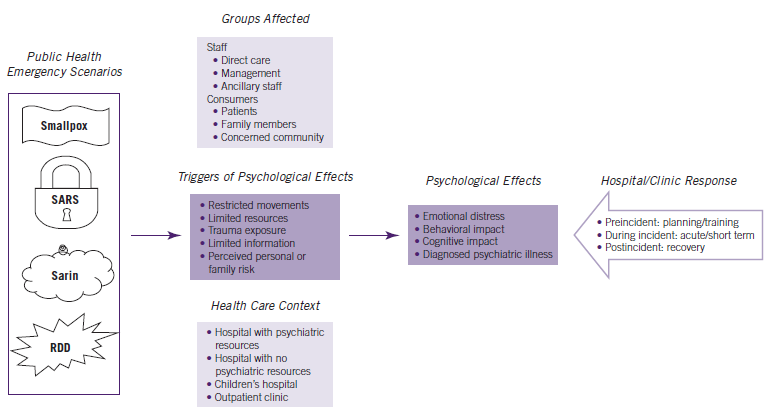
The framework for antecedents of psychological triggers as the critical psychological feature that drives demand for health facility response (Figure 1) includes 5 overlapping dimensions: (1) the type of terrorist incident (these examples of terrorist events were dictated by the agency that funded the present work, although this framework is useful for a broad range of public health emergencies, particularly those involving a surge of people reporting to health care facilities for assistance); (2) the persons who or groups that may be affected by such incidents, including consumers and health care workers; (3) the health care settings in which affected people will seek care; (4) the triggers of psychological and behavioral reactions; and (5) the psychological and behavioral consequences that could occur. Figure 1 illustrates how these 5 dimensions come together to determine the types of hospital and clinic responses that might be required: (1) preincident, which involves appropriate planning and training activities; (2) during incident, which concerns the acute and short-term responses; and (3) postincident, which is necessary to facilitate recovery.42
Framework for understanding the antecedents of psychological consequences (“psychological triggers”) of public health emergencies using scenarios of intentional (terrorism) and naturally occurring events

CONSEQUENCES OF PSYCHOLOGICAL REACTIONS: APPROPRIATE DISASTER RESPONSE
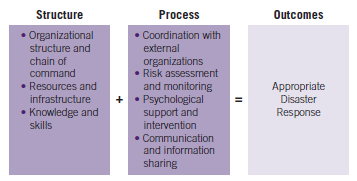
An understanding of these psychological triggers allows us to develop better disaster planning curricula for hospitals and clinics. To that end, we adapted Donebedian’sReference Donabedian43 framework of effective health services delivery (structure + process = outcome) in which, in this case, outcome refers to appropriate mental health disaster response by hospitals and clinics. Structure includes all of the resources, skills, and setting characteristics that are necessary for successful planning for the psychological impact of disasters to take place. Process refers here to the different types of (evidence-informed) organizational activities in which individuals or groups can engage. When the right structures are paired with the right processes, an organization will produce an appropriate response. Based on the disaster preparedness and response literature and input from experts, we developed a framework (Figure 2) consisting of 3 structural elements and 4 process elements critical to appropriate disaster response.
Framework for addressing the consequences of reactions to psychological triggers: recommendations to guide appropriate disaster response

Structure
Organizational Structure and Chain of Command. Hospitals and clinics must have the right organizational structures in place to coordinate activities and execute plans for effective response to a surge of psychological casualties. The structures may be those that the hospital or clinic uses to oversee and manage day-to-day activities, or additional structures such as the HICS or interorganizational structures that can be activated during an event. The structures should identify responsible parties for overall mental health response for patients and staff, how mental health will be integrated into the HICS, and the number and type of facility staff who will be involved in the response and their roles and responsibilities.
Resources and Infrastructure. Resources might include the appropriate number of staff, the ability to arrange in advance for mutual aid from partner health facilities or other appropriate community resources with mental health staff, the space to screen and treat people who are in emotional distress, and necessary supplies such as toys for children and disaster mental health brochures.
Knowledge and Skills. Hospital and clinic staff should have the appropriate knowledge and skills to assist with the psychological needs of patient, family, and staff following disasters. Evidence-informed practices such as psychological first aidReference Parker, Everly, Barnett and Links23 42 should be offered by a broad spectrum of facility staff. If mental health professionals are not accessible within the facility, non–mental health staff (such as chaplains, child life specialists, and volunteers) may need to be trained in advance to identify people experiencing emotional trauma.
Process
Coordination With External Organizations. Hospitals and clinics should coordinate with external organizations, making use of interorganizational structures to respond to organizational needs before and following disasters. Health facilities may want to make mutual aid agreements with other hospitals, clinics, or other community organizations to loan mental health staff following a disaster. Facilities may also want to forge relationships with their local governmental mental health department because this entity will be responsible for coordinating mental health services to the community following disasters, including longer term mental health care for people most affected. Other governmental partners may include emergency medical services authorities and offices of emergency management. These organizations will help the health facility become familiar with existing governmental disaster resources, ongoing disaster planning efforts, and incident management systems (such as that National Incident Management System)44 that health facilities may need to access information and resources.
Risk Assessment and Monitoring. A major clinical component of an appropriate disaster response involves triage to identify people needing immediate medical attention due to exposure or contamination and assessing and monitoring them for negative psychological outcomes. This triage may take the form of various screening activities for patients and staff during an event and longer-term monitoring after the event.
Psychological Support and Intervention. Hospitals and clinics need to provide psychological support to address the needs of patients and staff who are at risk of negative psychological outcomes. Support could include short-term interventions (eg, psychological first aid45 and crisis intervention) or longer term interventions such as cognitive behavioral therapy for postdisaster distress.Reference Hamblen, Gibson, Mueser and Norris46
Communication and Information Sharing. During and after an event, facilities should ensure they are proactively communicating accurate disaster information to patients and staff. Facilities should consider what type of information needs to be communicated, how it should be presented, and which specific audiences should receive the information. Health facilities should include mental health professionals in regular briefing meetings in which internal and external communication plans are discussed. Messages must be communicated in the appropriate languages at the right reading level and must be disseminated through multiple channels.
One way to overcome the impact of perceived risk with hospital and clinic staff is for facilities to meet and communicate frequently with all staff regarding accurate information about the disaster, current impact on the facility, any necessary disease- and contamination-related procedures, and where staff can ask questions and obtain additional information. Including information on the positive staff accomplishments during the disaster also helps staff realize their presence is making a difference in the recovery of their community.
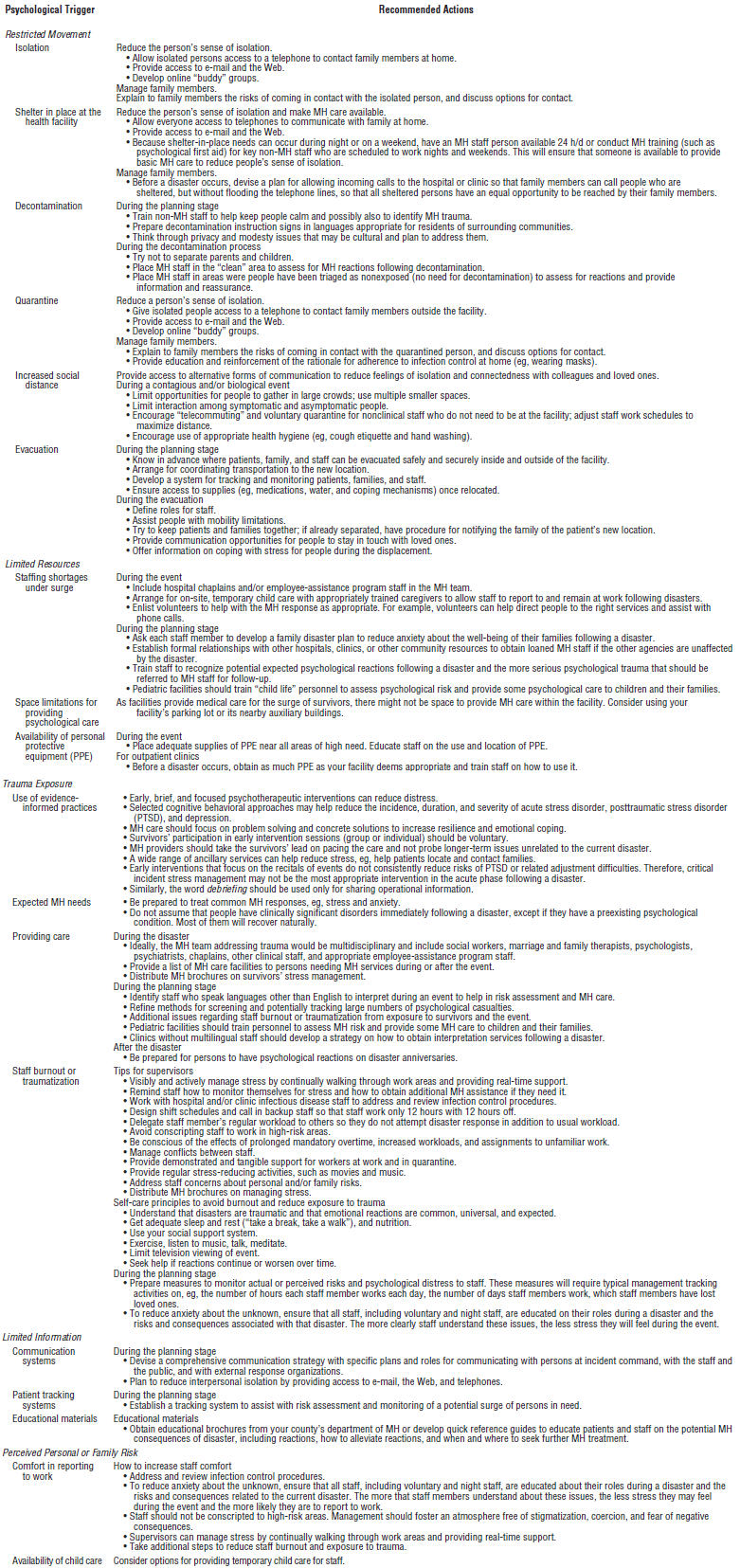
Table 1 illustrates how the 5 types of psychological triggers are associated with particular types of responses from the health system. Specifically, it lists a wide range of actions that health care facilities could take to reduce the psychological consequences of large-scale disasters. This material was included with the Los Angeles County training materials in the form of a booklet, along with other tools such as disaster scenarios, that can be used to better prepare the staff at health care facilities before a disaster.Reference Meredith, Eisenman, Tanielian, Taylor and Basurto30
Psychological Triggers and Associated Recommended Actions for Responding to Psychological Surge

DISCUSSION
We identified a number of implications for psychological preparedness response. One major implication was that rather than giving detailed guidance on how to respond to various types of events, it may be more constructive to focus on a set of triggers that drive the types of emotional, cognitive, and behavioral responses that people will exhibit, not the events themselves. This is consistent with the concept of an all-hazards approach to public health and emergency preparedness, which has gained acceptance in recent years.
We also outlined a strategy for integrating psychological needs into existing hospital and clinic preparedness and response plans and activities. The people responsible for emergency and disaster preparedness in health care facilities should ensure that the appropriate structural elements are implemented and exercised before an event so that the facility is prepared to respond to the surge of psychological concerns during disaster and public health emergencies. Such preparations will equip health care organizations with the capabilities to address the psychological consequences of these disasters for patients, their families, and staff.
CONCLUSIONS
This theory-based approach to hospital and clinic preparedness and response highlights the importance of psychological triggers and facilitates an all-hazards approach for addressing the psychological consequences of large-scale disasters. Putting structural elements in place before an event and during and after an event helps ensure that the needs of victims, their families, and hospital and clinic staff are met. Essential to hospital and clinical preparedness for a large-scale disaster involving a surge of psychological casualties is the need to integrate mental health services into existing hospital and clinic preparedness plans and activities.
Author Disclosures:
The author reports no conflicts of interest.
Funding/Support: Funding for this study was provided by the Hospital Preparedness Program grant (US Department of Health and Human Services).