Introduction
Ross 128 is a low-mass red dwarf star (M4 V) and one of the nearest stars to the solar system at a distance of only 10.9 light-years (3.3 pc). It has been known as a flare star in the optical for more than four decades (Lee & Hoxie, Reference Lee and Hoxie1972). Nonetheless, we are not aware of any radio detections of Ross 128 presented in the literature, although radio observations yielding upper limits have been reported (White et al., Reference White, Jackson and Kundu1989, and others). It may still be possible that non-thermal radio emission is originating from this star and could even be detectable given the star's close proximity to us. Also, radio flares from other M dwarfs have previosly been seen, the most well-known example is AD Leo (Osten & Bastian, Reference Osten and Bastian2006), a young M dwarf at 5 pc away.
On 12 May 2017 (Mendez, Reference Mendez2017) observed a group of red dwarfs (including Ross 128) with the 300 m telescope at the Arecibo Observatory (AO), in a search for non-thermal emission possibly associated with exoplanets in these systems. We note that no exoplanets were known in the Ross 128 system at the time of the observations, nevertheless, it was recently discovered to host an exo-Earth orbiting at the inner edge of the habitable zone (Bonfils et al., Reference Bonfils, Astudillo-Defru, Díaz, Almenara, Forveille, Bouchy, Delfosse, Lovis, Mayor, Murgas, Pepe, Santos, Ségransan, Udry and Wünsche2017). Mendez (Reference Mendez2017) detected anomalous unpolarized radio emission during the observation of Ross 128 lasting for the full 10 min observation and spanning frequencies between 4.6 and 4.8 GHz. The observed emission has similar morphology and dispersive-like features to those presented by Osten & Bastian (Reference Osten and Bastian2008) on AD Leo, but those emissions were between 1100 and 1600 MHz and were highly circularly polarized.
Mendez (Reference Mendez2017) suggested that the emission was not likely to be local radio frequency interference (RFI) since it was not detected during observations of other stars preceding and following Ross 128. However, Mendez (Reference Mendez2017) was unable to determine conclusively whether the emission seen during the observation of Ross 128 was either associated with the star, was due to another source along the line of sight or was caused by RFI. The serendipitous potential detection of radio emission from this source encouraged a re-observation by the Mendez group. New observations were carried out on 16 July with Arecibo.
In order to investigate the possible stellar nature of the Ross 128 emission, the Breakthrough Listen Team joined in this campaign and observed Ross 128 simultaneously with Arecibo using the Green Bank Telescope (GBT) and its C-band receiver (4–8 GHz). Here, we briefly report on the observations carried out with the GBT during this campaign. We also present the analysis of Breakthrough Listen archival data on this same source using the L-band receiver (1.1–1.9 GHz) of the GBT that has recently been submitted for publication (Enriquez et al., Reference Enriquez, Siemion, Foster, Gajjar, Hellbourg, Hickish, Isaacson, Price, Croft, DeBoer, Lebofsky, MacMahon and Werthimer2017). The data used for this work, along with plots of spectra across the full GBT bandwidth, are available onlineFootnote 1.
BL observations
On 16 July 2017, the Breakthrough Listen Team conducted C-band (4–8 GHz) observations of Ross 128 using the GBT. The current Breakthrough Listen digital back-end (MacMahon et al., Reference MacMahon, Price, Lebofsky, Siemion, Croft, DeBoer, Enriquez, Gajjar, Hellbourg, Isaacson, Werthimer, Abdurashidova, Bloss, Brandt, Creager, Ford, Lynch, Maddalena, McCullough, Ray, Whitehead and Woody2017) is capable of operating over the full 4 GHz span of the receiver simultaneously. The Breakthrough Listen back-end is unique in the sense that it can record time-series voltage data across the full band, allowing arbitrary time and frequency resolution depending on science needs. For the case of C-band observations, the storage needs correspond to 120 Gbps for the raw data.
During the campaign we conducted three 5 min observations of Ross 128 interleaved by 5 min observations of an OFF source star (Hipparcos 55848). This set of observations was followed by a 15 min on-source observation of Ross 128.
Currently, three standard data products are produced from each observation (Lebofsky et al., Reference Lebofsky, Siemion, Price, Enriquez, Croft, DeBoer, Gajjar, Hellbourg, Isaacson and Werthimer2017); one high-frequency resolution product primarily for SETI analysis, one high-time resolution product for broadband fast transient applications, and one intermediate frequency resolution for other astrophysical radio emission. The high-resolution filterbank products are about 50 times smaller than the raw voltage data, and the intermediate resolution products are about seven times smaller still. All the different data products are stored permanently and will be publicly available onlineFootnote 2.
For this analysis, we have used the intermediate frequency resolution product, which has a 1 s time resolution and 3 kHz frequency resolution, both well matched to the phenomena under investigation. The bandpass of the C-band and polyphase filter applied to the raw data for channelization was removed by simply dividing by the median value of the time variations for a given frequency channel.
The current Breakthrough Listen SETI search pipeline, as described by Enriquez et al. (Reference Enriquez, Siemion, Foster, Gajjar, Hellbourg, Hickish, Isaacson, Price, Croft, DeBoer, Lebofsky, MacMahon and Werthimer2017), is optimized for the detection of narrow-band Doppler-drifting signals. Since the emission reported by Mendez (Reference Mendez2017) is broader and more complex in nature, we perform a by-eye comparison of the ON and OFF observations, in a search for emission uniquely coming from the direction of Ross 128. No such emission is seen in our data.
Based on a conservative estimate of sensitivity from a typical C-band system equivalent flux density of 10 Jy, we calculate a 3σ upper limit of ~500 mJy for impulsive emission at these time and frequency scales. The sensitivity of the GBT at C band is comparable with that of Arecibo. Mendez (private communication) reported a 1σ sensitivity of 0.12 Jy for impulsive emission.
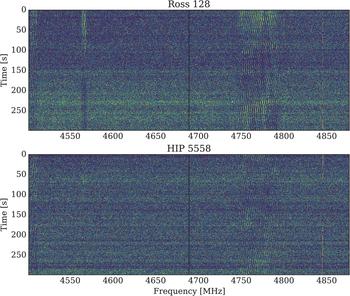
Figure 1 shows a representative example of our observations of Ross 128 and the off-source HIP 55848. We show here the frequency range between 4.5 and 4.9 GHz, which corresponds to part of the region where Mendez (private communication) detected the emission (4.6–4.8 GHz). The common spectral features seen on both Ross 128 and HIP 55848 are examples of interference and instrumental effects. From our observations it is evident that there is no distinct presence of any emission isolated to Ross 128. We point out that the morphology of the emission seen between 4.75 and 4.8 GHz is similar to that of a Single Sideband Suppressed Carrier (Proesch, Reference Proesch2017), widely used for communications applications.
Waterfall (time/frequency, Stokes I) plots from representative 5 min observations of Ross 128 and HIP 55848 from the GBT campaign discussed herein. The two frequency ranges shown correspond to two 187.5 MHz subsets of the total 4 GHz band observed.

Archival data
Ross 128 was observed on 16 May 2016 with the L-band receiver on GBT as part of the regular Breakthrough Listen targeted search for extraterrestrial artificial radio emission (Enriquez et al., Reference Enriquez, Siemion, Foster, Gajjar, Hellbourg, Hickish, Isaacson, Price, Croft, DeBoer, Lebofsky, MacMahon and Werthimer2017; Isaacson et al., Reference Isaacson, Siemion, Marcy, Lebofsky, Price, MacMahon, Croft, DeBoer, Hickish, Werthimer, Sheikh, Hellbourg and Enriquez2017). These observations were carried out using a similar ON–OFF approach as the one used for the C-band observations.
We took the available data at the optimal frequency resolution (same as described here for C band) for this project and inspected these data for broadband emission as well. No such emission was found in our observations at similar sensitivity to the C-band observations.
Discussion and conclusion
We see no evidence for any non-thermal radio emission during either our recent GBT C-band observations of Ross 128, or in archival GBT L-band data. However, our observations were of limited duration and we cannot constrain the emission observed in the Mendez (Reference Mendez2017) observations to be either astrophysical in nature or RFI. If Ross 128 does indeed produce detectable non-thermal radio emission, it could well be intermittent and require substantial follow-up to confirm.
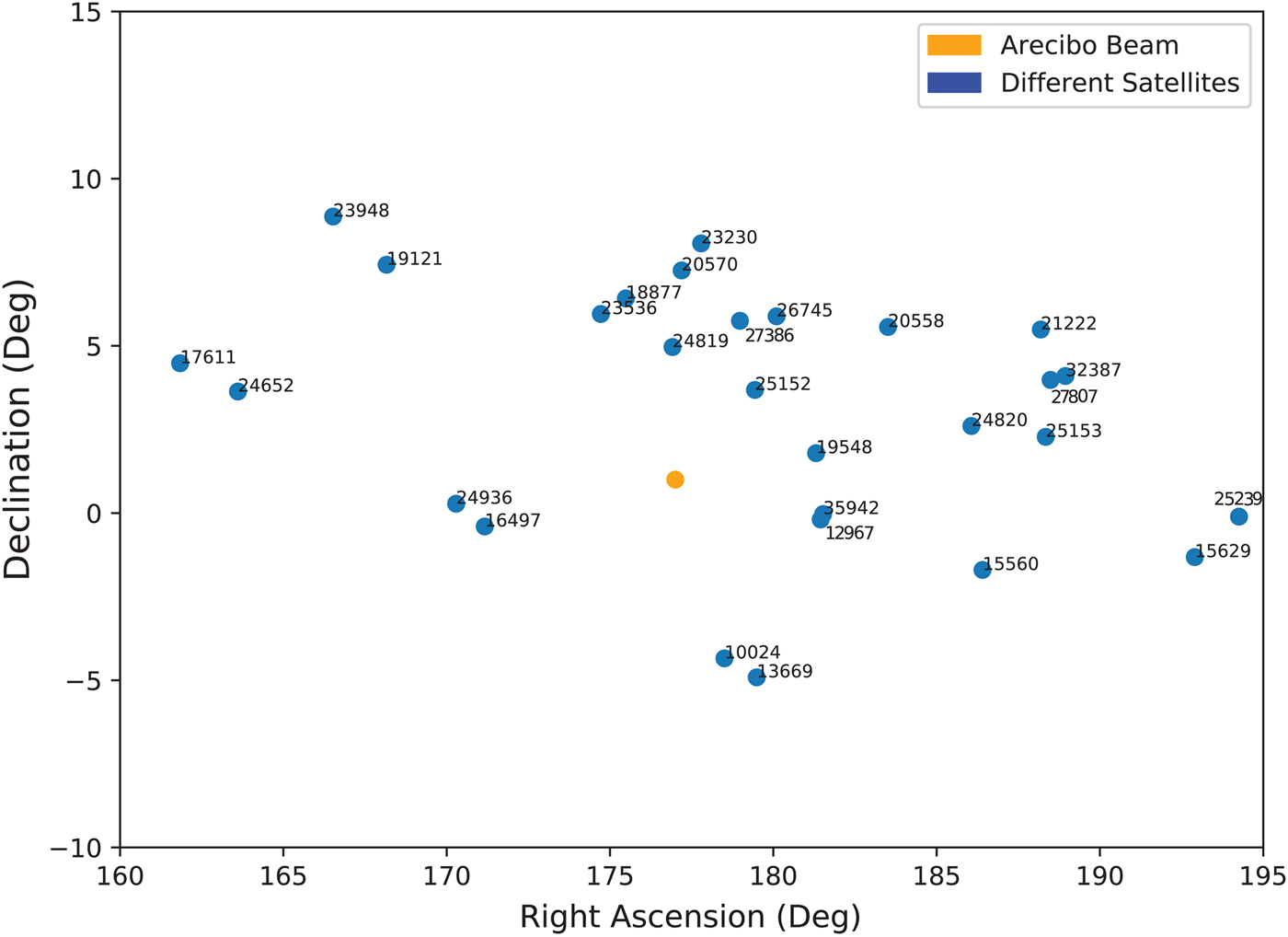
We note that one possible source for the emission detected by Mendez (Reference Mendez2017) could be a broadband radio signal from an artificial satellite. Figure 2 shows the position of geosynchronous satellites around the direction of Ross 128. The satellite locations were derived from Two Line Element(TLE)Footnote 3 sources provided by the online space situational awareness (SSA) services, open to the public, provided by the US Strategic Command (USSTRATCOM)Footnote 4. The position of the AO was used as observing reference. Only those satellites specifically emitting in C-band frequencies are shown.
Position of the known satellites with radio transmitters operating between 4 and 8 GHz. The location of Ross 128 is (ra, dec) ~ (177°, 1°). Each blue symbol has a Satellite Catalog Number from the NORAD Catalog (also known as the NASA Catalog), information on individual satellites can be found here: https://nssdc.gsfc.nasa.gov/nmc/.

We note that the presence of RFI within the same band observed in the Mendez (Reference Mendez2017) work shows that this band is (at least at the time of the observations) occupied by interference, and raises the likelihood that the Mendez (Reference Mendez2017) emission is indeed due to RFI.
This work shows the potential for using the Breakthrough Listen backend as well as existing observations to look for flare emission from nearby stars. Access to the raw voltage time-series data enables us to optimize the frequency and time resolution of the filterbank data products to match the needs of the analysis. In future work, we plan to look for flare emission in all the existing Breakthrough Listen data
Acknowledgements
Breakthrough Listen is managed by the Breakthrough Initiatives, sponsored by the Breakthrough Prize FoundationFootnote 5.