1. Introduction
1.1. the case of marbury v. madison (1803)
On February 24, 1803, Chief Justice John Marshall delivered a unanimous opinion of the Supreme Court in the case of William Marbury v. James Madison, then Secretary of State. The particular facts of the case itself are convoluted and reflect the heated political climate between the Federalists and Democratic Republican parties. William Marbury was one of four ‘midnight’ judicial appointments made by the outgoing Federalist president: John Adams. After appointment as Justice of the Peace for the District of Columbia and consent from the Senate in March of 1801, Marbury and his fellow appointees (Dennis Ramsay, Robert Townsend Hooe, and William Harper) expected to receive their commissions – documents confirming the five-year appointment – signed and sealed by the Secretary of State, a post occupied during the time of the appointments by none other than John Marshall. Marshall exited the office without delivering the commissions. The newly inaugurated Democratic Republican president, Thomas Jefferson, instructed his new Secretary of State, James Madison, to refuse delivery of their commissions, de facto nullifying the commissions of these rival Federalist Party appointees.
Represented by Charles Lee, Esq., the plaintiff petitioned the Court to deliver a writ of mandamus Footnote 1 compelling Madison to deliver Marbury his commission. The Court ruled in favor of Madison (and Jefferson), not because they thought Madison was legally within his rights to refuse delivery of the commission, but because the Supreme Court lacked proper jurisdiction in this case. The Court thus found Section 13 of the Judiciary Act of 1789, permitting the Supreme Court to issue writs of mandamus in cases not within its jurisdiction, unconstitutional. With this decision, Marshall produces the first official court opinion of the Supreme Court on the matter of judicial review, establishing the Court as the final arbiter over matters constitutional and making the judiciary branch an equal partner with the executive and legislative branches, declaring that “[i]t is emphatically the province of the Judicial branch to say what the law is” (1803, p. 177).
Cited in at least 112 subsequent Supreme Court cases, Marbury v. Madison holds sway as the most influential decision in Supreme Court history. Its reasoning was used in voiding the Missouri Compromise of 1820 (Dred Scott v. Sandford), in striking down the Income Tax Act of 1894, in demanding the desegregation of public schools in 1955,Footnote 2 and in denying President Richard M. Nixon executive privilege and compelling him to turn over the incriminating Watergate tapes. In essence, this text represents the dramatic codification (some commentators, particularly Jefferson, would call it arrogation or usurpation) of power by an institution that, until that time, was by far the weakest of the three established branches of government. The decision established the idea of ‘checks and balances’ as a fundamental principle of representative democracies.
The decision also features a distinctive, recurring stylistic and linguistic element: running through each of the three sections of the opinion is a series of rhetorical questions, constructions that have the form of a question whose answer is thought to be entirely obvious. As will be explained in greater detail below (see Section 3), rhetorical questions are prime invokers of fictive interaction, conceptualizations that are underwritten by a particular and pervasive conceptual blend in which a situation is imaginatively reconstructed in terms of a canonical conversation frame (cf. Brandt, 2008; Pascual, 2002, Reference Pascual2006, Reference Pascual, Oakley and Hougaard2008). In fact, there are twenty-seven rhetorical questions in the entire document, comprising 610 of its nearly 10,000 words (approximately 6.5% of total verbiage), more than any other Marshall opinion, and indeed more than any other significant Supreme Court opinion.Footnote 3 Meanwhile, almost none of these questions survives in the substantial citation record of the case. In other words, with a very few exceptions, they are not quoted, referenced, or paraphrased, in whole or in part, in subsequent opinions.
1.2. plan
We offer the broad outlines of a cognitive-linguistic theory of document acts by focusing attention on the history of the influential United States Supreme Court decision in Marbury v. Madison (1803), the case widely regarded as codifying the Court’s practice of judicial review: the power to declare laws and statutes unconstitutional, rendering them null and void. This study focuses on one peculiar feature of the text: a superabundance of rhetorical questions. Despite their token frequency, these rhetorical questions almost never appear as quoted material in subsequent Supreme Court opinions, even though Marbury stands as the most cited opinion issuing from the Court. The disparity between the number of rhetorical questions comprising the linguistic structure of the text proper and the paucity of their ‘uptake’4 within the system of legal documents presents a potential challenge for explanatory models of meaning construction, motivated often by the notion that the whole is greater than the sum of its parts, where every construction is consequential to its meaning.
Our analysis follows this trajectory: first, we outline a theory of joint attention and joint commitments, arguing that it is the base condition of human sociality and meaning construction. After dispensing with these theoretical prerequisites, we focus on rhetorical questions as a distinct construction type (a family of rhetorical figures known as erotima) that are best regarded as redundant interrogatives. We then apply these findings to text of Marbury and their relationship to the whole argument. We proceed to elucidate the tripartite ontology of construction, artifact, and system as the three pragmatically relevant strata of meaning capable of accounting for the various functions of Marbury as a document that acts in the world of United States law and politics.
We contend, throughout, that documents constitute a necessary unit of analysis in the cognitive sciences, a contention consistent with recent work by Chemero (Reference Chemero2009), Clark and Chalmers (Reference Clark and Chalmers1998), Hutchins (Reference Hutchins1995), Menary (Reference Menary2007), Noë (Reference Noë2004), Rowlands (Reference Rowlands2003), Varela, Thompson, and Rosch (Reference Verela, Thompson and Rosch1991), and Wheeler (Reference Wheeler2005), all of whom defend some version of distributed, enactive, externalist, or extended mind theory of human higher-order cognition. Most of the extended mind literature focuses on basic philosophical positions on the metaphysical boundaries of res cogitans. Our goal is to extend the extended mind account to show how document systems work as part of the greater cognitive system: we want to see how an extended mind framework can be applied to specific situations.
2. Theoretical prerequisites
2.1. regarding documents
For human beings who live in literate societies, documents are not just a product or performance of cognition. Literacy is a behavior, but it is also an environment. Civilization and bureaucracy themselves are not just things that humans implement, but – once they have been implemented – are constitutional features of the way we think and act. Those of us who inhabit the complex, document-laden societies of bureaucratic civilization are born into and are thoroughly acculturated to an environment filled with and shaped by documents and their circulation. This environment makes literacy a central feature of modern cognition in three important ways:
• Because documents and the systems in which they circulate and have significance are ubiquitous and fundamental features of the environment surrounding us from birth, they have major effects on cognitive development over the lifetime of a single person. As Andy Clark and David Chalmers put it in their original article on ‘The Extended Mind’, when it grows up surrounded by such material artifacts, their routine use, and the social-symbolic systems that artifacts and their uses fit into, “the brain develops in a way that complements the external structures, and learns to play its role within a unified, densely coupled system” (1998, p. 11).
• The written word and technologies for producing, saving, and sharing written artifacts are tools for extending thought and agency into the world. They are not just the outcome of cognition, but a site in which thinking and meaning take place.
• As durable, reproducible, and quotable linguistic artifacts, embedded in social structures of circulation, documents enact cultural practices across time and space.
If documents and their circulatory systems are at the very heart of modern cognition, then a theory of document acts reflecting an artifact–body–mind–world causal loop is a logical and necessary step for the study of language and cognition.
2.2. joint attention and joint commitments
Between the ages of nine and twelve months, something very special begins to happen with human infants. The dyadic interactions (i.e., primary intersubjectivity) with their adult caretakers morph into triadic interactions (Melser, 2004; Tomasello, 1999, Reference Tomasello2003). The infant, parent, and objectFootnote 5 comprise a new social-pragmatic unit, such that the child begins to pay attention not so much to her parent but to her parent’s interaction with an object of mutual engagement. As the child’s ability to participate in these triadic interactions develops, the participants come to mutually recognize that the attention is shared and that it can be intentionally directed. To be able to participate in a joint attentional scene, then, one must be able to understand both oneself and the other participant in some way ‘from the outside’, as intentional agents. This kind of joint engagement, or triangulation of intentional perception, establishes a joint attentional frame (Tomasello, 2000) within which communication may take place. The child is in fact integrating two perspectives: her own interaction with an object or artifact and the adult’s interaction with the same object or artifact. These two facets of the joint attentional scene come to constitute, in adult cognition, a full-fledged ability to understand intentionality from first-, second-, and third-person perspectives.
This ability is at the heart of referential understanding. Language serves both as a tool for achieving joint attention, in that it is a means of directing and shaping the attentions of one’s interlocutor to bring them in line with one’s own, and as a highly underspecified system underlying the joint activity of communication, which relies on the support of joint attention to function. Any person can use a linguistic symbol to intend that her interlocutor follow her attention to some external entity, aspect of an external entity, or conceptual structure; that is, to share attention to it.
Language use of all kinds relies on the ability to engage in scenes of joint attention and to represent and comprehend multiple perspectives of various things, actions, and ideas. On top of this, literacy gives us the means to produce non-ephemeral, stable proxies for joint attention. Between six to ten thousand years ago, groups of Homo sapiens in Mesopotamia (present-day Iraq) developed symbolic systems for accountancy that later came to represent spoken language, which could then be used to express just about any state of affairs (Schmandt-Besserat, 1996). With writing, multiple people can attend to the same expressive material at different times and in different places, while still in some sense jointly attending to both that material and the things and ideas to which it refers. Thus joint attention and the presumption and inference of the intentions lying behind the visible traces of other people’s activities are among the basic foundations of not only spoken language but of all the products and processes derived therefrom.
The development of alphanumeric literacy can only have come about via exploitation of the basic, ontogenetic joint-attentional capacity for representing first-, second-, and third-person perspectives about something else. This socio-historical perspective is important for our project because the development of alphanumeric literacy suggests widespread development of tertiary intersubjectivity – the ability to represent these triadic interactions across space and time (cf. Bråten & Trevarthen, Reference Bråtan and Trevarthen2007).
The document that is Marbury v. Madison is, like any document, an information-bearing artifact, and as such it occupies a special place in the human cognitive ecology. Readers of this text take their place within a particular cognitive ecology that defines itself (though not in so many words) in terms of joint attention and joint commitments. As we shall argue in the sections that follow, an account of this opinion’s place in the larger system of American jurisprudence and politics requires a theory of document acts with joint attention as a basic cognitive prerequisite, a special type of activity that can also be represented globally and thus embedded in the very language practices that comprise the information artifact itself – joint-attention is therefore recursive.
We have the capacity to represent a situation in which we are taking part as one of shared minds, tracking the global structure of the scene while at the same time playing a particular role within it in real time. Part of the necessary background of any linguistic act is the metalinguistic joint attentional stance of you and i are attending to this artifact together, and we can take this stance synchronically or diachronically, with the first implying proximal spatial and temporal relations and the latter implying distal spatial and temporal relations. (Advances in communications technologies now allow for a hybrid form of proximal temporality with distal spatiality.) In the case of written, archived, and searchable Supreme Court opinions, the asynchronous and diachronic view holds sway.
Document acts also depend crucially on the (immediate or putative) joint commitments that arise from joint attentional engagement. Joint commitments, as described by Moll and Tomasello (2007, p. 310), necessarily possess three features: first, the participants share a common goal, to which all are jointly committed, with conscious mental access to this commitment, such that any one of them can indicate what each ‘is doing now’ in a way that is easily visible to the others. Second, the participants take complementary and reciprocal roles designed to achieve this common goal, be it to satisfy a pragmatic or ludic end. That is, if two participants are engaging in sustained conversation about a third object, or if the goal is simply to keep the conversation going without a specific agenda, then at different times both participants take the complementary roles of speaker and hearer, and the same resources used by the speaker can (in principle at least) be used by the hearer when it is his turn to speak. Third, the participants are motivated and willing to help one another accomplish the intended goal. If two participants are trying to keep the conversation going, one participant may help the other by introducing a new topic for conversation. This joint commitment and cooperative endeavor is distinctly human, and entails the emergence of an ethical imperative to pay attention to the attentional and intentional state of one’s co-participants, such that opting out of the endeavor exacts a toll.
As should be clear by now, we think the joint attentional scene and the joint commitments resulting from it are more than another ‘cool app’ added to an otherwise already developed set of mental modules (although there is nothing that would rule this possibility out in principle). Rather, the importance of this social-pragmatic activity calls for a great widening of what counts as ‘mind’. It is through social interactions with others in specific cultural niches that we gather unto ourselves the riches of the world. Minds are as they are because cognition is distributed among persons, environment, and artifacts.
3. Rhetorical questions as joint commitments
The joint-attentional scene is the basic human cooperative situation in which two or more interlocutors narrow the focus of attention onto an object, entity, or being. This object of attention can be another person; a group; an event that is past, present, or future; or hypothetical and otherwise imaginary. It may be in the here-and-now of the discourse or in the there-and-then with respect to the present unfolding discourse. This triangulation of attention comprises the day-to-day responses and counter-responses by human agents to a third object that both agents each identify as ‘common cause’. In this view, rhetorical questions are unique construction types, for their primary functional purpose is to synchronize speaker and addressee commitments (cf. Rohde, 2006).
The classical rhetorical traditions of Aristotle, Cicero, Quintilian, and their medieval, early modern, and modern avatars, have famously classified rhetorical questions as figurative language that deviates from a literal, assertive counterpart. Known as erotima, or ‘questioning’, this figure has been identified by rhetorical theorists since Aristotle as a question in appearance only. In speech act terms, its interrogative force is purely locutionary; its illocutionary force is, in fact, assertive. This standard account leads Chien and Harris (Reference Chien and Harris2012) to offer a new general category of figure, chroma, or ‘color’, for these types of construction, which they suggest are united by presenting a kind of deviation of intention, where stylistic surface and intended meaning diverge – what appears as a question is really an assertive statement. The view that rhetorical questions are ‘disguised assertions’ also jibes with the many standard linguistic accounts offered by Borkin (Reference Borkin1971), Han (Reference Han1998), Krifka (Reference Krifka, Fery and Sternefeld2001), Laudusaw (Reference Laudusaw2003), Lee (Reference Lee1994), and Sadock (Reference Sadock1971) in which the question selects and asserts a positive, negative, or null answer from a presupposed answer set of bona fide interrogatives.
Researchers working in the ethnomethodological and conversation analysis (EMCA) traditions also consider rhetorical questions as disguised assertions, but, in contrast to the rhetorical tradition that treats them as uncommon deviations from a norm, EMCA researchers consider them as one of many ordinary means of structuring interaction-in-talk. For Koshik (Reference Koshik2005), rhetorical questions are used in a variety of interactive situations in which speakers wish to assert opinions and regulate subsequent behavior and thought. These questions, argues Koshik, function as “reverse polarity items”, such that an affirmatively phrased question (e.g., Shall I be allowed to withhold the commission?) will elicit a negative response (e.g., No, you shall not) and a negatively phrased question (e.g., Shall I have no remedy) will elicit a positive response (e.g., Yes, you shall have remedy).
In our view, however, rhetorical questions as constructions actually do have real interrogative properties in which an addressee really is invited to respond – often in the form of back channeling in spoken conversation or an entirely implicit answer in written communication – and thus a fictive dialogical scene is embedded in the actual communicative situation. Thus we agree with Rohde’s (Reference Rohde2006) classification of rhetorical questions as ‘redundant interrogatives’ for reasons specified below.
While traditional linguistic and conversational analysis accounts posit only positive, negative, or null responses, Rohde provides evidence that rhetorical questions often elicit a wider range of answers from the yes/no/null variety. Rohde (2006, p. 135) expands the range of answers to include positive/negative, null/non-null, and single/multiple. For instance,
(1) Who always shows up late for his appointment?
may, in fact, refer to a specific person known to both speaker and addresses. Likewise,
(2) What is going to happen if we go over the fiscal cliff?
may elicit multiple related answers that specify an extreme end on a pragmatic scale. Rohde argues that rhetorical questions are best categorized as ‘redundant interrogatives’, for they still are designed to elicit an answer that must be either (A) obvious to both speaker and addressee, (B) uniform in not requiring any updates to discourse participant commitments or beliefs, or (C) sufficiently similar between the two. Thus, the presence of an obvious answer, say Ben, to (1) would satisfy conditions A and B, while answers to (2), such as, Taxes will go through the roof, or The Pentagon will need to start holding bake sales, satisfies conditions B and C, if the discourse participants’ commitments are in sync.
This example from Marbury ((14) in the ‘Appendix’) is a particularly piquant example of a rhetorical question that, in addition to eliciting a negative answer, implicitly holds the sitting Secretary of State, James Madison, up for ridicule:
(3) If the Secretary of State should choose to withhold this patent, or, the patent being lost, should refuse a copy of it, can it be imagined that the law furnishes to the injured person no remedy?
This question falls into the category rhetoricians call epiplexis, or ‘rebuke’ (cf. Lanham, 1991, p. 69). These typically include markers of disbelief or other articulations of extremity such as who on earth or for heaven’s sake, and, here, can it be imagined. The decision thus presents this scenario as hypothetical and outrageous on its face by embedding it in the protasis of a conditional within such a construction, while the case brief makes it clear that the sitting Secretary of State undertook precisely this action at the direction of the president. The hypothetical circumstances in which he might petulantly choose not to perform his ministerial duty immediately call to mind the petty tyrannies associated with the pre-Revolutionary era that was, after all, a matter of recent memory at the time of this writing. In this way, this rhetorical question not only invites the reader to agree to the legal principle that actions of this sort require remedy, it also, in making that case, invites the reader to condemn Madison as capricious and monarchical. Discourse participants ‘close’ the joint attentional triangle by focusing on a particular office, its holder, and the assessment that it and he are subject to the common law.
Like Rhode, we consider rhetorical questions to be redundant interrogatives requiring minimal information adjustment between discourse participants. Like EMCA, we also view rhetorical questions as one of many common construction types prevalent throughout talk-in-interaction. And like the rhetorical tradition, particularly the theory of argumentation articulated by Perelman and Olbrechts-Tyteca (1969), we consider them as types of rhetorical figures whose function is to increase ‘presence’, specific language maneuvers designed to increase an audience’s attention toward a particular facet of the real or imagined objects or states-of-affairs by means of verbal highlighting, in this case by making salient the joint-attentional scene complete with a strong conformity bias.
As a class of grammatical constructions that cannot be easily distinguished in form or prosody from informational questions, rhetorical questions keep their interrogative status, for the important point is that they really do invoke the participation of the addressee in harmonic synchrony with the speaker/author. As a class, rhetorical questions are pragmatically salient constructions that imply a level of assumed common cause and commitment between the participants. The implied answer, which the hearer or reader is supposed to supply, invokes at least a minimal joint commitment to follow the reasoning process initiated by the speaker or writer. The sheer act of correctly inferring the intended answer to the question thus places the interpreter in a state of at least temporary joint commitment with the questioner. The sense of joint commitment tends toward the maximum the more closely the supplied answer fits both the preferred implied answer and the addressee’s own conclusion.
With Marbury, one can imagine that Marshall was, in effect, lecturing Jefferson in particular, daring him to answer back with “Well, actually …”, itself a construction for noting the failure of a rhetorical question usage – and often used as a test for rhetorical questions (cf. Rohde, 2006, p. 162).
4. Toward a theory of document acts
4.1 documents and dialogicity
Rhetorical questions comprise a significant part of Marbury, so much so that to excise each instance from the original text would markedly change the reading experience, and may even change the way readers think about the case (a claim that cannot yet be empirically substantiated, but appears to be a reasonable working hypothesis).Footnote 6 The problem, to reiterate, is this: for all their significance as constituent parts of the decision, almost no instances of rhetorical questions become part of Marbury’s citation history in later Supreme Court Opinions. It is the most cited opinion, yet these constructions do not survive in the citation record, except in one majority opinion, Mugler v. Kansas (123 US, 661 (1887)), and in Chief Justice Warren Burger’s dissenting opinion in Nixon v. Administrator (1977).
That these rhetorical questions on the one hand are integral to the overall expository coherence of Marbury, but on the other all but fall out of the subsequent jurisprudential record, leaves an explanatory gap. As Clark and Gerrig (Reference Clark and Gerrig1990, pp. 767−769) point out, all quotations are selective depictions that portray only certain aspects of their referents. The points of interest here are how this selectivity plays out in terms of what is chosen to be left out (and how), and how to incorporate these facts into our understanding of what a document ‘means’ in its actual context of use. What is it about utterances ‘said along the way’ that are almost preemptively deemed ‘insignificant’? We suggest that a theory of documents acts needs to account for the phenomenon of obiter dicta – a legal term of art that nevertheless has manifold implications for understanding, describing, and explaining the role written artifacts play in the social world.
The legal record overall is in fact comprised of documents that are often strikingly different from the original discursive events they purport to present, in ways that parallel the patterns we see here.Footnote 7 Witness statements, for example, look (as their name suggests) like statements, and like monologues. In reality, they are edited and constructed texts that are the product of highly interactive discourse events, but the dialogic nature of the source interview is largely erased from the record. Questions in particular tend to disappear, as Rock explains: “When statements are used … these contexts and processes of production are rarely mentioned, for example juries are not typically urged to consider what questions might have been asked by a police officer during the taking of a statement” (2001, p. 47). Following the precept that the record must be as much as possible in the witness’s ‘own words’, interrogators routinely reconstruct question-and-answer exchanges so that questions are elided entirely or transformed into statements in the record: “Questions are sometimes completely left out (monologue style), or they have been rephrased as if they were spoken by the suspect whereas they were actually uttered by the officer” (van Charldorp, Reference van Charldorp2011, p. 224).
Research on this part of the legal record is, of course, concerned with issues of veracity and social justice – the disappearance of interrogation questions is part of an essentially deceptive process in which crucial information is left out or misrepresented, yet the resulting document is treated in court as a veridical representation of talk in the interview room, with material consequences for all concerned (Komter, 2002, Reference Komter2006). In the case of obiter dicta, there seems, at least on the face of it, to be less at stake in terms of potential misrepresentations and miscarriages of justice. Both phenomena, however, point to interesting patterns in our habits of document creation: a tendency to move from greater interactivity to less, and a sort of document-based forgetfulness, in which even when we know that the document to hand is limited, abridged, or compressed, we nonetheless take it as the complete and proper object of analysis. The document has its own power.
4.2 constructions, systems, and artifacts
As a legal document, Marbury functions within an Information Artifact Ontology (defined in more detail in Section 5) where some constructions are inconsequential or ineffective in terms of their effect on official law of the land, while others are legally binding and highly influential. However, these ‘inconsequential’ constructions might very well make the reading experience substantially different, even incoherent, if absent. Along dimensions of local expository coherence, the whole is indeed greater than the sum of its parts, but a document-as-artifact often operates on strata where this is decidedly not the case.
The theory of document acts outlined here offers a heuristic model for capturing meaning construction at various strata. Each of these levels produces different effects. One may interact with a document as a seamless whole, say as a whole poem or as a travelogue. One may, instead, or at different times, interact with a document as a seamed whole, focusing on diction or syntactic structure. One might also interact with it as a type of document, or as one of several million administrative documents, or as the most influential document of its kind. Regardless of the manifold ways of interacting with these artifacts, all, as we will describe, rely on some form of evoked scene of joint attention, but each has different participants and objects. We propose three ontological strata to capture these different configurations: the levels of construction, artifact, and systems (cf. Oakley and Kaufer, 2008, for a similar treatment).
4.2.1. Construction
At the construction level, the joint-attentional scene resembles the primordial spoken conversation with accessible deictic coordinates (a speaker ‘I’, a hearer ‘you’, and a time and place of speaking ‘here and now’). As constructions, rhetorical questions display a particular meaning with a dominant pragmatic point: incongruity judgment on the part of the addressor toward some already accessible object or topic. At this stratum, the structure of written communication is strongly analogical to spoken communication: the communicative ‘moves’ native to the former survive and are used in the latter as virtual conversational turns (as discussed in, for example, Brandt, 2008, Herman, 1999, and Pascual, 2008).Footnote 8
4.2.2. System
At the much higher-level system stratum, meanwhile, the joint-attentional scene shifts from the heavily interactive and interpersonal dimensions that encompass much of our experience with spoken and written discourse to what the constitutional lawyers call ‘holdings’ – in the case of a Supreme Court decision, those findings of the Court that place subsequent jurists, legislators, and executives under specific obligations to decide or act one way rather than another on subsequent occasions. Only a very small portion of Marbury (or any other such decision) has this status function.Footnote 9 It takes years of training for readers to identify, comprehend, and apply it to this thing they call ‘the Law’.
4.2.3. Artifact
Between the assemblage of constructions that make up a document and the systems in which the document moves, where is the document itself? There is on the one hand the immediacy of construction-level interactions with documents, and the vast, regulated social interdependencies within which documents ‘mean’ in systems on the other; between these fall any number of important document acts in which meaning accrues to a document with respect to its status as an artifact. When Todd leaves a note under Vera’s office door, for instance, she is likely to engage with it primarily on the construction level, reading it line-by-line as a message from Todd that contains things like assertions, questions, offers, and requests, all of live interest and directed to her. But it is not just a collection of constructions. It is also an artifact:
• It can be taken as a single, unitary object intentionally created by another person, who intended it to be recognized as an object of that type. When Vera first encounters the note, before she has read even one word of it, it is as an artifact in this sense. “Someone has left me a note.”
• It is a tangible physical object with physical characteristics. This aspect of a document is preeminent when we do carbon dating, or handwriting analysis. The particular material affordances of different kinds of documents also affect their use as material anchors for problem solving, social coordination, and other cognitive activities.
• It is a type of document, and this quality is a question of both formal and social facts about the object. The same written words may signify differently when delivered in a letter than they do when delivered in a postcard.
• It can exist and be interpreted outside the relatively immediate deictic situation of its original context. When we read a letter for which we are the intended recipient (or read it as if we were that recipient) we are interacting with it largely at the construction level. But we can also look at it as an entity of historical significance, or as an artwork, say. Here we do not have to be thinking about the physical artifact; we can be thinking/talking just about the ‘content’, but we are looking at that content more as a symptom of something than as a message from some author.
5. An Information Artifact Ontology
Our call for a theory of document acts echoes Barry Smith’s (Reference Smith2010) call for an Information Artifact Ontology (IAO) in an essay that inspired the present paper’s subtitle. According to Smith, there is a fundamental division between continuants, entities that endure more or less self-identically through time, and occurrents, entities dwelling in time, which can be divided along the temporal axis into successive phases. Continuants include such entities as persons, manuscripts, printed texts, sealed and signed documents, videotapes, and so on. Occurrents include such events as performances, perceptions, live broadcasts, and so on.
While there is overlap between the code of written communication and dynamic interaction through speaking, they are distinct along the occurrent−continuant axis. Each continuant entity is a partition of the totality of objects and their continuant qualities, roles, functions, etc., existing in a given domain of reality at a given time. Each occurrent entity is a partition of the totality of processes unfolding in a given domain across a given temporal interval. Continuants and occurrents themselves exist only in mutual dependence on each other. Continuants require processes in order to be maintained in time; processes require continuants as their bearers and carriers in order to anchor thought and activities through time. Both entail joint-attention as a basic cognitive operation. To put the matter succinctly, symbolic artifacts, such as written texts or maps, render temporally discrete occurrent events continuous. Such metaphysical starting points are just that: starting points in need of additional specification.
We propose an IAO of three sub-ontologies, or strata, introduced in Section 4.2. We afford these three strata ontological status because they capture, grosso modo, the means and manner with which participants in literate societies engage with these documents, reflecting as well the fact that the same artifact can be apprehended from a plurality of different perspectives of coarser- and finer-grained detail (from whole symphonies to individual notes). What is more, these partitions will be determined in each case by the purposes for which each ontology is developed at the systems stratum. We now offer a more detailed account of these strata, beginning with the crucial ‘middle’ stratum of the artifact.
Artifacts are objects intentionally fabricated for a particular purpose (or purposes). Administrative documents are doubtless such intentional objects. Furthermore, we encounter these artifacts not as ‘one-off’ products but as mechanically reproducible and traceable for multiple constituencies. For our purpose, ostensive acts such as this text, this decision,that opinion,that document, elicit an ‘artifact stance’ allowing value predicates to be attributed to the referenced entity (e.g., it can be deemed legally binding, original, a forgery, etc.). The document-as-artifact stance allows us to treat these items as tools or factors in various causal chains. For instance, a completed and signed form for renewing a passport by mail becomes an agent for change, insofar as it is a necessary condition for the administration of another, legally binding document that, ultimately, permits smooth passage across recognized national borders. The same document, however, can likewise be admissible as evidence of fraud, should the veridical nature of the document be questioned in a criminal proceeding.
Documents are artifacts in the very same way that manufactured tools are artifacts. As with tools, ‘manufactured documents’ can be deployed in manifold behavioral sequences. The identification of document with tool or artifact is tricky, however, as the value and import of some artifacts rests on their material integrity, while a document like a Supreme Court Opinion gains value and influence based on its substantive disintegration.
Contemplate, for comparison, the case of another legal document. In the June 22, 2002 episode of the show Antiques Roadshow (a show where guests bring in artifacts for expert appraisers to assess value), an original signed apology submitted from the governor of Ohio and other officials to the victims and victims’ families of the Kent State shooting of anti-war protesters by the National Guard in 1970 was appraised at US$10,000−15,000. Here, the value resides in the document’s singularity as a signed document created by the presiding judge over the wrongful death case brought by the families of the victims. If merely a paragraph survived without any signatures, then its value would be significantly less, if not completely nullified.
Furthermore, the meaning and rhetorical force of the individual sentences of the document are not particularly salient to the appraiser’s consideration. In this moment, the apology does not apologize. It is an object of historical note, and to that end, its status as apology is relevant, but it is not operating on that level in this interpretive moment. The details of its communicative effects are not important just now – whether the apology rings hollow or true has no bearing on the object’s value as an antique. Nor is the legal and social force of the document – its significance at the systems level – the primary level of significance operating here. That significance is certainly relevant: the collectable item would not be of such interest if it did not have meaning in broader societal and legal contexts. But it is in the background; the appraisers are not weighing in on questions of the cultural and legal weight of the apology. It is the material, artifactual status of the document that comes to the fore.
The original paper decision of Marbury, signed by Marshall, was in fact partially burned in a fire. The remains are still no doubt invaluable as an historical artifact.Footnote 10 The decision’s public dissemination upon initial certification ensures that its value as a ‘tool for jurisprudential reasoning’ will continue, for it works within a system of documents that operates according to principles substantially different from those in play during the truck, barter, and trade of collectibles. It is to these systems of use that we now turn.
Superordinate to the artifact stratum is the stratum of systems. Here we must pause to untangle our idea of ‘systems’ from some nearby terms in common currency among cognitive linguists.Footnote 11 Among cognitive linguists, appeal to ‘systems’ brings to mind notions of ‘context’, ‘frame’, or ‘domain’. Rhetorical theorists are likely to talk about systems with the commonplace term ‘genre’. Each of these terms directs attention to relevant facets of what we have in mind, but also deflects attention from what we really want to say. The term ‘domain’ probably comes closest. ‘Context’ is too diffuse, as in our view context embraces the entire tripartite ontology, with systems, artifacts, and constructions comprising the entire ‘involvement network’ of any use. Likewise, ‘genre’ fails to nail down what we mean, as it can be used to identify formal features of a text or its social uses (cf. Devitt, 1993; Miller, 1984).
A system, in our theory, is a set of elements, relations, and actions covariant in and through time that imply joint commitments to what is to be done and, moreover, how it is to be done: a document for renewing a US passport by mail initiates a behavioral sequence that, when felicitously enacted, results in the delivery of a different document that enables cross-border travel. No document, no unmolested crossing of national borders. The same document, if deemed fraudulent, may initiate a different culturally scripted joint activity culminating in imprisonment. To our minds, ‘system(s)’ is the clearest notion for capturing these social ontological states of affairs. We would say that documents are artifacts that operate in system networks of other documentary artifacts, joint activities, and joint commitments that control, constraint, manage, and sometime tax, participants’ attentional capacities, both individual and joint.
It is also worth emphasizing the diversity of document act systems, and particularly their tendency to fall along an open and closed axis. Open systems tend to admit the greatest range of relevant and sanctioned participants and information, while closed systems constrain participants and information. The jurisprudential ontology tends toward closure for both participants and relevant information. Other ontologies are open with respect to both or one, as illustrated in brief momentarily.
And finally, the construction stratum corresponds closely to but cannot be identified precisely with cognate concepts grammar, style, lexicon, usage, etc. By writing of constructions, we are referring to the work of Bergen and Chang (Reference Bergen, Chang, Ostman and Fried2005), Croft (Reference Croft2001), Fillmore and Kay (Reference Fillmore and Kay1999), Goldberg (Reference Goldberg1995, Reference Goldberg2006), and Tomasello (Reference Tomasello2003), all of whom (despite key differences in theory, method, and explanatory scope) define language as an inventory of form−meaning pairings. Thus, constructions are complex combinations of open- and closed-class items that often have their own constructional meaning distinct from the individual words that comprise them. Other candidates for constructions include transitives, intransitives, ditransitives, caused-motion, causatives, fictive motion, conatives, and conditionals. Meaning is not strictly compositional, and the whole is greater than the sum of its parts.
Rhetorical questions fit this profile in that their constructional meaning can be described as having a pragmatic point (Fillmore, Kay, & O’Connor, 1988) − they have a conventional pragmatic content of proposing a judgment and inviting an agreement of the nature explored in Fillmore and Kay’s (Reference Fillmore and Kay1999) analysis of the “What’s X doing Y” construction. As Goldberg (Reference Goldberg1995, Reference Goldberg2006) notes, most constructions inherit conceptual structure of other constructions and combine with other constructions during actual use. With Marbury, many of the rhetorical questions are embedded within conditionals and first-person conditionals.
As a rhetorical figure and grammatical construction, rhetorical questions comprise a method of rhetorical engagement in which the reader is framed as sharing the common ground (in this case, common perspective) of the writer at that precise moment, and drawing the same conclusions (cf. Rohde, 2006). What makes rhetorical questions powerful but risky discursive maneuvers is that they can elicit communal perspectives and feelings with special immediacy – or they can backfire and create factional discord if the reader does not share the same set of presuppositions or presumptions as those of the writer. When they do not work, they do not simply fail to produce the desired effect, but often actively precipitate readers’ sense of being manipulated, or their sense that the writer is setting up a straw man, thereby exacerbating discord and threatening to fracture the common ground beneath them. It is a risky tactic, but in this case the pitfall of discord did not materialize in the immediate aftermath of the Court’s decision (cf. Clinton, 1989), as Jefferson’s own abject disagreements with the decision were kept to private letters.
Before moving on to discuss Marbury as an artifact of jurisprudence, we think it helpful to first place it in a broader and more open-ended exegetical framework. After all, as well as being a foundational precedent in US jurisprudence, Marbury first and foremost came into being to address a specific situation with plaintiffs, defendants, and political interests. It also exists as a significant historical and political document of interest to scholars and policy analysts not working in the jurisprudential system. It is likewise of interest to legal scholars who are working in systems, such as legal education and training, that are supportive and constitutive of but nonetheless distinct from the jurisprudent ontology outlined below.
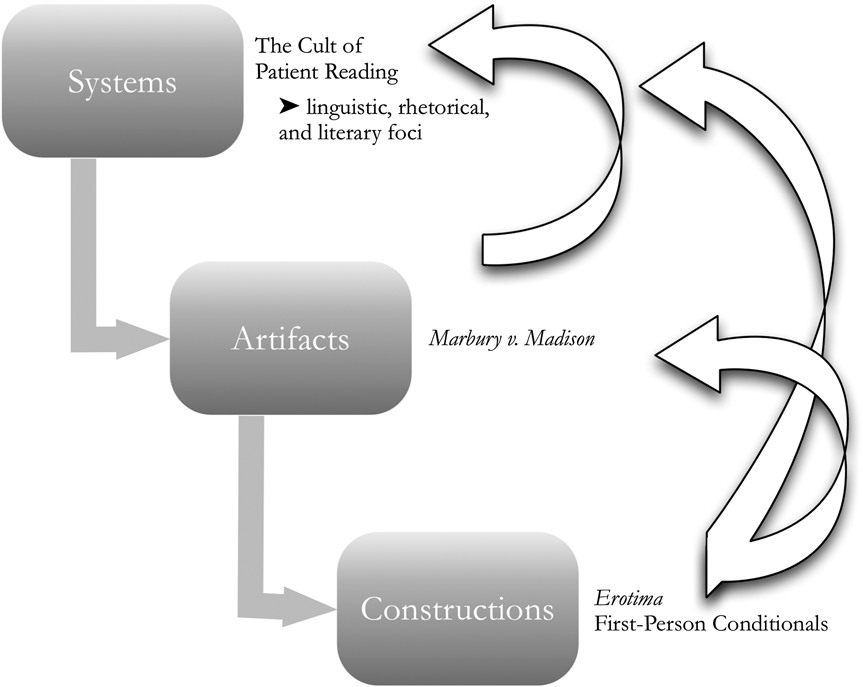
Suppose, for example, we read Marbury according to the perspective and practices of close reading, where every item of the text is to be treated as significant and with effect. Under this dispensation, readers follow an exegetical protocol depicted in Figure 1.
The social ontology of Marbury v. Madison from an exegetical perspective.

With this exegetical framework, there exists no normative barrier to conferring significance onto any piece of language. Such a philological perspective could treat rhetorical questions in Marbury as indexing attitudes toward political opponents, a symptom of the heated partisan Zeitgeist. Alternatively, teachers of argumentation might cite one of the rhetorical questions as an illustration of one type of legal argument.Footnote 12 Still another alternative scenario would be to press these constructions into service for stylometric analysis, perhaps for the purpose of determining the provenance of an historical document attributed to John Marshall, the presence of rhetorical questions being one stylistic mark of Marshall’s stylistic ‘fingerprint’. In these iterations of the tripartite documentary system, human attention can focus on any piece of language as a significant piece of language. This is not, however, the framework in operation when Marbury functions as an act of jurisprudence.
5.1. iao and the jurisprudential domain
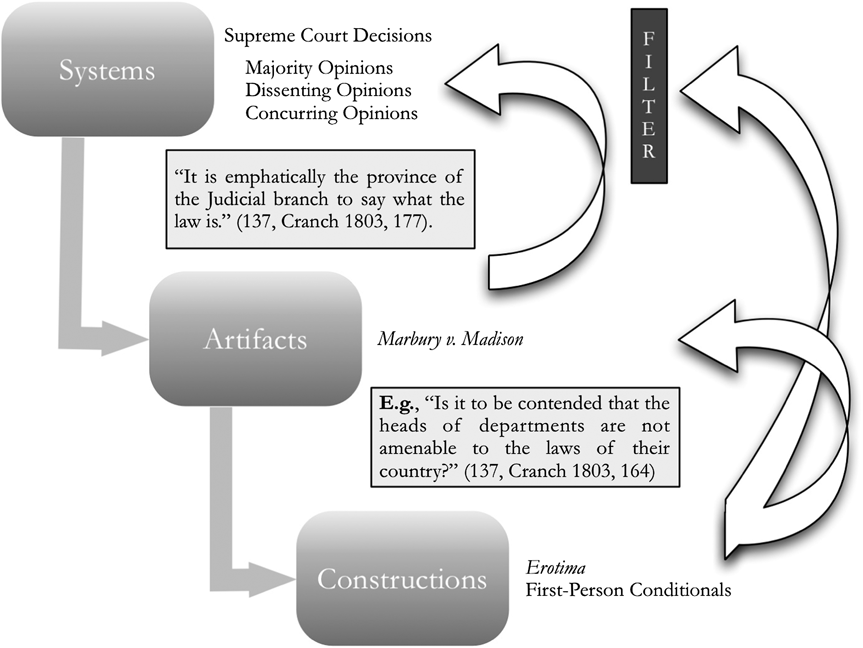
Our claim (not a particularly contentious one, in itself) is that this text and others like it operate in a jurisprudential configuration of systems, artifacts, and constructions. The critical difference for Marbury is the systems stratum, as depicted in Figure 2. In this jurisprudential framework, documents are viewed as constituting and regulating social reality such that certain statements (constructions) that are part of the documents (artifacts) in a genre (Supreme Court opinion) are taken as legally binding and constraining on all subsequent related acts: political, social, or legal.
The jurisprudential ontology of Marbury v. Madison.
There are certain textual elements therein that are ontologically more significant as ‘holdings’ than other statements (which, as explained in Section 5.2.2, are regarded as obiter dicta, or non-binding opinions). These holdings come to stand for the whole rhetorical act itself. They take their place in the system of jurisprudence and are thus constitutive elements rather than mere constituents. At the constructional level, all statements of the opinion are proper parts of the artifact; however, only a few select constituents constitute legally binding representations. Of course, these can and do change over time.
The statements epitomizing Marbury’s holdings are few, with the following list of six being nearly exhaustive, and with the first being, by far, the most frequently cited passage from the decision.
(4) It is emphatically the province and duty of the judicial department to say what the law is (1803, p. 177).
(5) [t]he very essence of civil liberty certainly consists in the right of every individual to claim the protection of the laws (1803, p. 163).
(6) … the theory of any such government must be that an act of the Legislature repugnant to the Constitution is void (1803, p. 177).
(7) So if a law be in opposition to the constitution; if both the law and the constitution apply to a particular case, so that the court must either decide that case conformably to the law, disregarding the constitution; or conformably to the constitution, disregarding the law; the court must determine which of these conflicting rules governs the case. This is of the very essence of judicial duty (1803, p. 178).
(8) It [the Constitution] would be on a level with ordinary legislative acts, and, like other acts, … alterable when the legislature shall please to alter it (1803, p. 177).
(9) It cannot be presumed that any clause in the constitution is intended to be without effect (1803, p. 174).
Statement (4) asserts the Judiciary’s preeminence as expounders of the Constitution, and statements (6), (7), and (9) establish the hierarchy of the Constitution over the laws, statement (8) hypothetically reverses this hierarchy, suggesting its absurdity, while statement (5) reinforces the hierarchy in which the civil liberties granted by the Constitution must be guaranteed (and not subverted) by laws. These statements comprise Marbury’s substantive holdings: a mere 164 words out of the approximately 10,000 that comprise the functional whole.
Even so, the number of rhetorical questions is indeed numerous and noticeable to careful readers at the construction stratum, but these constructions apparently lack the same kind of perlocutionary effect and weight as it pertains to the artifact of the decision itself. These six bear the significance of precedent, while the rhetorical questions, for the most part (along with vast swaths of the rest of the decision), are treated as obiter dicta, mere opinions of the jurist about the case-at-hand.
Figure 2 provides graphic representation of the jurisprudential ontology. Notice that certain elements in the construction stratum are filtered out at the level of the systems stratum.
With the broad outline of our theory of document acts in place, we are now in a position to offer deeper explanations for Marbury’s selective citationality.
5.2. explanatory factors
Our account begins with the basic observation that constituents that produce important perlocutionary effects at the construction level can entirely vanish at the systems level. It is not simply that they become less important − they do not exist as relevant components of a document. The second part of our analysis arises from the observation that, while the relationship between the significance of Marbury at the construction level and its significance at the systems level fully accounts for the case of the vanishing rhetorical questions, it patently fails to account for the full range of real and possible encounters with this (or any) document. This latter fact motivates our discussion of the intriguing and complicated ‘artifact’ stratum of document acts, which mediates between construction and system.
Majority opinions issuing from the Supreme Court operate in a system of jurisprudence based on reasoning by analogy, where the task is to distill from all the facts of the case and its original and appellate history the essential findings that support preceding decisions (stare decisis) and can be applied to essential facets of future cases. At the same time, the opinion itself reflects argument and deliberation over the peculiar facts of the case, a singular occurrent entity. A jurisprudential system admits documents that have to reflect a coherent narrative and descriptive account of the singular case at the same time that these decisions must identify the principles that guide subsequent reasoning by other Supreme Court Justices and justices of inferior courts, as well as legislators and executives at all levels of government.
Figure 2 depicts the jurisprudential ontology, which explicitly assumes that many statements in the decision are without effect. The task of the Court itself, and of legal practitioners and other ratified participants, is to distill the holdings from a welter of dicta. In our account, the illocutionary forces of rhetorical questions and conditionals are pragmatic points most likely to be filtered out. This of course does not make them completely irrelevant. They are still integral features of the artifacts in question.
The above remarks speak to the underlying logic of selective citation, but they do not, in themselves, provide an explanation for why the opinion should deploy such a large number of rhetorical questions in the first place. In other words, if, as obiter dicta, they are destined to be disregarded, then what are they for?
5.2.1. The adjudication factor (construction stratum)
Why so many rhetorical questions in the first place? The concentration of rhetorical questions may be a form–meaning consequence of the real fact that no countervailing arguments were presented by the defendant. They may reflect both the exasperation and umbrage of the Justices. As an integrated whole, Marbury carries with it the markings of its rhetorical situation; namely, that it is the record of a case in which the defendant refused to participate. Madison never appeared in Court to provide ‘cause’ for withholding the commissions. Thus, Madison’s ‘failure to show cause’ allowed Marshall and the Court to regard his position as legally ‘unreasonable’ and to regard it as an abuse of his office, since any justifiable reasons remain inscrutable and opaque to public inspection.
Imagine, by analogy, being addressed by a friend or colleague who is complaining about the words or deeds of some third party. It is not uncommon in such a situation for you to find yourself on the receiving end of the aggrieved speaker’s entreaties, such as Can you believe how rude he was? or Have you ever heard such words spoken in mixed company? These rhetorical questions function as redundant interrogatives that seek to align speaker and addressee commitments and reinforce the attitude toward said person, insofar as they imply agreement on your part to regard the person/object of joint attention with proper disdain, for any reasonable person – and you are reasonable and honorable – will doubtless regard the situation as depicted by the speaker.
It seems quite reasonable to assume that Madison’s (and by extension, Jefferson’s) refusal to even respond to Marbury’s complaint places him in the position of person/object of joint attention who has violated a normative standard of behavior. Marshall’s marshaling of rhetorical questions may be thought of as the written analogue of a speaker soliciting agreement about Madison’s aggravating contempt of court.
5.2.2. A doctrinal factor (systems stratum): obiter dicta and stare decisis
There are two doctrinal factors that account for citational selectivity. The first, as suggested previously, is the obiter dicta / rationes decidendi distinction as it pertains to the doctrine of stare decisis. Although jurists display fundamental disagreements in theory over the supposed influence of stare decisis (i.e., the weight of previous decisions), they all subscribe to the basic principle and see each Supreme Court decision as a proper part of a jurisprudential system that considers previous decisions as final (if not infallible). Prior decisions therefore are subject to great deference unless exigent circumstances or new evidence can be shown to merit disregard, as has happened most famously in Brown v. Board of Education (1954) in overturning the separate but equal doctrine of Plessy v. Ferguson (1896).
Ratione decidendi refer to those facets of the opinion that pertain directly to the case adjudicated, and are therefore constitutional of legal precedent that ‘hold’ for all subsequent decisions that fall into its ambit; obiter dicta (or ‘loose language’) is unnecessary to the decision of the case. As expressed by Justice Curtis in his majority opinion in Carroll v. Lessee of Carroll (1853), every opinion contains general expressions extending beyond the case itself. “If they go beyond the case,” he writes,
they may be respected, but ought not to control the judgement [sic] in a subsequent suit … The reason for this maxim is obvious. The question actually before the court is investigated with care, and considered in its full extent; other principles which may serve to illustrate it are considered in their relation to the case decided, but their possible bearing on all other cases is seldom completely investigated.
It seems clear from these remarks that the task of jurists is to sift through previously relevant opinions, distilling from them the ‘essence’ of the case, and then apply that essence to subsequent cases. While it must be assumed that every word of the Constitution ‘has effect’, not every word of every Supreme Court opinion (or any other court opinion) enjoys the same status. Therefore, statements that prima facie appear to be opinions of the justice, mere illustrations of a larger point, analogous relationships, or hypothetical situations are to be considered passing remarks of little jurisprudential effect. It would seem at first blush that the instances of rhetorical questions peppering the text of Marbury, however plentiful, fall naturally into the category of “other principles”. Constructions with meanings that invite addressee involvement may be filtered as dicta to conform to the general practice of selecting constructions that transcend their local dialogic conditions.
The distinction between constructions that transcend their local interactive context and those that call attention to it mirrors the Use/Mention distinction in philosophy of language (cf. Searle, 1969). Assertions such as “it is the province of the Court to say what the law is” provide readers with clear, memorable material that epitomizes the Court’s majority opinion (this one unanimous) and is a declarative speech act with certain directive effects, whereas the sentiments stemming from a protasis (hypothetical) situation may be more easily associated with the Justice’s individual opinion and/or style of communication in situ and thus attain merely the status of mention. The language here is not used to perlocutionary effect; the language mentions the position of the writer of the Opinion and thus is attributed to Marshall’s own disposition toward the case. The fact that many (about 44%) of the instances of rhetorical questioning are themselves embedded in first-person singular conditional constructions is even more likely to mark them as local expository tactics for increasing a reader’s investment in the particulars of the case and the justices’ reasoned conclusions. Indeed, it may be empirically the case that rhetorical questions and conditionals form a class of grammatical construction that is less likely to be taken up as cited holdings of a case than other classes of grammatical constructions (a plausible but speculative point that only a more expansive study of historical citation practices can determine).
Functionally, elements of the decision that have been deemed obiter dicta simply do not exist as part of Marbury v. Madison, the jurisprudential entity, although they are available for consideration if one takes up the document as an artifact. For any individual reader familiar with the original text, his or her encounters with the record may indeed add up to a rich and complex whole, in which a wide complement of traces of the original context inform their reading of later documents that embed fragments of the original text. But as a matter of doctrine and function, in a very practical way, the institutional realization of the original text’s significance consists only of these holdings. That said, as legal theorists readily admit, today’s dicta can become tomorrow’s law (Scofield, 2002). The barriers between system, artifact, and construction are therefore ‘semipermeable’, as statements once regarded as obiter dicta can point to a doctrinal shift in Marbury’s significance to and within the larger jurisprudential system itself.Footnote 13
6. Discussion
Acts of thinking, deciding, and acting emerge from orchestrated attention and commitments within complex systems of individuals, artifacts, and practices. This is especially true in literate societies with developed legal systems. The study of language use in document-bound societies calls for a theory of document acts that has heretofore not received sufficient treatment among linguists and cognitive linguists. The reason is simple: most efforts are focused on what speakers and hearers do while speaking, reading, or writing in singular events without sufficient attention to the social ontologies in which they operate. This is understandable given that many of the objects of interest to cognitive linguists, such as fictional narratives, poems, and plays, function on the open end of an open−closed systemic continuum, and thus the broad outlines of an information artifact ontology are difficult to limn. The tripartite system outlined above captures the critical ontologies of document acts and at the very least offers theorists a useful heuristic for identifying the most pragmatically relevant stratum of analysis for a given linguistic/pragmatic phenomenon.
The decision in Marbury v. Madison presents a unique case for developing this theory because not only does it operate within a more-or-less closed-deliberation system, its influence over the last three centuries can also be traced and understood better than that of most other legal documents. Although the text of Marbury presents readers with a superabundance of rhetorical questions, these constructions are by and large without effect in the broader legal-political system in which it has jurisdiction.
It may be the case that these types of ‘pragmatic point’ (cf. Fillmore & Kay, 1999; Evans & Green, 2006) constructions, along with analogical counterfactuals and conditionals, comprise a whole class of common linguistic resources that on the one hand function as important constituents of these legal documents but which on the other hand are summarily avoided as precedent-setting statements at the systems stratum. A close look at the Marbury citations suggests as much, yet more empirical work needs to be done. An equally reasonable hypothesis is to suggest that the absence of these types of construction from legal texts will affect how readers understand, remember, reason about, and react to the content therein. Again, more empirical work needs to be done.
Further evidence of the significant presence of rhetorical questions in other opinions might substantiate the claim that the whole is indeed more than the sum of its parts characterizes the experiential relationship between the artifact and its constructional constituents: meaning construction entails elaborate scenes and scenarios full of affect, point of view, attentional shifts, figure−ground orientations, and other common topics of cognitive linguistic investigation. Further evidence of vanishing rhetorical questions among other jurisprudential documents takes research in language and cognition in a different direction by focusing on the social ontological implications of cognitive linguistic research by placing the artifact within a system whereby the whole is decidedly less than the sum of its parts. Here we identify two diverging streams of research within the broader cognitive science and linguistics enterprise, diverging streams that nevertheless find their point of confluence. A theory of document acts represents this confluence of streams.
7. Conclusion
The whole is sometime less than the sum of its parts. Our analysis of Marbury v. Madison bears this out. Its distinctive nature and history allows us to see more clearly than more open-system documents how texts can become focal artifacts for thinking and acting.
Explaining Marbury’s structure and use as a legal document requires a tripartite ontology of the systems, artifact, and construction strata. This allows us to disentangle distinct dimensions along which a text means. When engaging with a document at the construction stratum, we find types of sentences with specific semantic and pragmatic properties and effects. One can focus, for instance, on Marshall’s pregnant phraseology, and consider how ‘repugnant to the Constitution’ functions as an instance of compression-to-human scale through conceptual metonymy (cf. Oakley, 2012, for such an analysis). Alternately, one can consider the whole of Marbury as an historical artifact that illuminates something about the political struggles between Federalists and Democratic Republicans. Or one can focus attention on the whole text of Marbury as a single ‘tool’ for jurists and lawyers to make additional arguments about judicial review, due process, and executive privilege. Here the text is acting as a tool to be used and referred to, rather than either as an ongoing stream of talk (construction level) or as a symptom or consequence of the circumstances of its creation (systems level). In each of these cases, it only makes sense to place the document, however implicitly, in different document ontologies: linguistic evidence from one is not going to be completely relevant to another.
The above comments suggest at the very least that the tripartite model of documents provides heuristic value for cognitive linguists and other scholars who regard close examination of texts as important sources for thinking about human cognition. But we think the model does more than just provide a heuristic device for linguists and text scholars. It captures how literate human beings actually interact with documents. We can refer to a document as this document, or that text; or we can refer to a part of it with this sentence/word/phrase or that sentence/word/phrase; or still we can refer to a document or part thereof as a kind of document, as in the adverbial phrase as a legal document, or Marbury is the most significant Supreme Court Opinion. These commonplace ostensive acts suggest the intuitive correctness of our theory as something more than a heuristic for specialists, but it is its power for partitioning and tracking culture mapping and historical change that makes it relevant for cognitive linguists.
Appendix A complete catalogue of rhetorical questions within Marbury
We catalogue each instance in order of appearance under each of the Adjudicative Questions (AQ) considered by the Court. We insert the preferred Implied Answer (IA) below each instance of erotesis.
Under AQ1: Has the applicant a right to the commission he demands?
(1) Shall I not be permitted, on a motion for mandamus, to call upon the clerks in the office to prove that such an act is among the rolls of the office or that it is duly recorded?
IA: yes, you shall.
(2) Surely it cannot be contended that although the laws are to be recorded, yet no access is to be had to the records, and no benefit to result therefrom?
IA: yes, access must be granted.
(3) Shall it be said that the court of King’s bench has this power of consequence of its being the Supreme Court of judicature, and shall we deny it to this court which the Constitution makes the Supreme Court?
IA: no one shall deny it.
(4) Where are we to look for it but in that court which the constitution and laws have made supreme, and to which they have given appellate jurisdiction?
IA: nowhere else but the court and Constitution.
(5) Suppose I am entitled to a patent for lands purchased in the United States; it is made out and signed by the president, who gives a warrant to the secretary to affix the great seal to the patent; he refuses to do it; shall I not have a mandamus to compel him?
IA: you shall have a writ of mandamus.
(6) Suppose the seal is affixed, but the Secretary refuses to record it; shall he not be compelled?
IA: yes, he shall be compelled.
(7) Suppose it is recorded, and he refuses to deliver it; shall I have no remedy?
IA: yes, you shall have remedy.
(8) Can a keeper of a public record erase therefrom a commission which has been recorded?
IA: no, he cannot.
(9) Or can he refuse a copy thereof to a person demanding it on the terms prescribed by law?
IA: no, he cannot.
Under AQ2: Do the laws of this country afford him remedy?
(10) By the act concerning invalids, passed June, 1704, vol.3, p.112, the Secretary of War is ordered to place on the pension list all persons whose names are contained in the report previously made by him to congress. If he should refuse to do so, would the wounded veteran be without remedy?
IA: no, the veteran would be entitled to remedy.
(11) Is it to be contended that where the law, in precise terms, directs the performance of an act in which an individual is interested, the law is incapable of securing obedience to its mandate?
IA: no, it is not to be contended.
(12) Is it on account of the character of the person against whom the complaint is made?
IA: no, the person’s character/office is irrelevant.
(13) Is it to be contended that the heads of departments are not amenable to the laws of their country?
IA: no, it is not to be contended.
(14) If the Secretary of State should choose to withhold this patent, or, the patent being lost, should refuse a copy of it, can it be imagined that the law furnishes to the injured person no remedy? [epiplexis]
IA: no, it cannot be imagined.
Under AQ3: Is it a mandamus issuing from this court?
AQ3a: the nature of the writ applied for
(15) What is there in the exalted station of the officer which shall bar a citizen from asserting in a court of justice his legal rights, or shall forbid a court to listen to the claim or to issue a mandamus directing the performance of a duty not depending on Executive discretion, but on particular acts of Congress and the general principles of law? [epiplexis]
IA: there is nothing in the exalted station of the officer that shall bar a citizen.
(16) How then can his office exempt him from this particular mode of deciding on the legality of his conduct is the case be such a case as would, were any other individual the party complained of, authorize the process?
IA: he cannot be exempt. A writ of mandamus applies to officers of the Executive when it pertains to his ministerial duties.
AQ3b: the power of this court
(17) To what purpose are powers limited, and to what purpose is that limitation committed to writing, if these limits may at any time be passed by those intended to be restrained? [hypophora]
IA: This distinction between a government with limited and unlimited powers is abolished, if those limits do not confine the persons on which they are imposed, and if acts prohibited and acts allowed are of equal obligation.
(18) If an act of the Legislature repugnant to the Constitution is void, does it, not withstanding its invalidity, bind the Courts and oblige them to give it effect?
IA: no, it does not.
(19) Or, in other words, though it be not law, does it constitute a rule as operative as if it was a law?
IA: no, it does not.
(20) Could it be the intention of those who gave this power to say, in using it, the Constitution should not be looked into? That a case arising under the Constitution should be decided without examining the instruments under which it arises?
IA: no, it could not be their intention.
(21) And if they [judges] can open it at all, what part of it are they forbidden to read or to obey?
IA: no part of it.
(22) Suppose a duty on the export of cotton, of tobacco, or of flour, and a suit instituted to recover it. Ought judgment to be rendered in such a case?
IA: yes, judgment shall be rendered.
(23) Ought the judges to close their eyes on the Constitution, and only see the law?
IA: no, they ought not.
(24) If, however, such a bill should be passed and a person should be prosecuted under it, must the Court condemn to death those victims whom the Constitution endeavours to preserve?
IA: no, the court must not do so.
(25) If the Legislature should change the rule, and declare one witness, or a confession out of court, sufficient for conviction [of treason], must the constitutional principle yield to the legislative act?
IA: no, it must not yield.
(26) Why otherwise does it direct the judges to take an oath to support it? [the Constitution] (How immoral to impose it on them if they were to be used as the instruments, and the knowing instruments, for violating what they swear to support!) [epiplexis]
IA: it does not do so otherwise.
(27) Why does a judge swear to discharge his duties agreeably to the Constitution of the United States if that Constitution forms no rule for his government, if it is closed upon him and cannot be inspected by him?
IA: swearing would be pointless.