


Introduction
Sociolinguistic style
Studies of intra-speaker linguistic variation have shown that individual speakers change their use of linguistic variants in different contexts. Speakers shift the styles they use according to the attention they pay to their speech (Labov Reference Labov1972), their interlocuter and topic under discussion (e.g. Bell Reference Bell1984; Rickford & McNair-Knox Reference Rickford, McNair-Knox, Biber and Finegan1994), and their situational context (e.g. Podesva Reference Podesva2006). Crucially, these shifts are not only in the ‘reactive’ dimension, responding to various environmental factors or convergence to the speech, or imagined speech, of others (i.e. Bell Reference Bell1984; Giles & Coupland Reference Giles and Coupland1991). Researchers examining the ways that individuals use style to project stances and identities have also highlighted the ‘initiative’ dimension of style-shifting—that is, linguistic styles can be agentively deployed by speakers toward interactional ends (e.g. Johnstone Reference Johnstone2000; Schilling-Estes Reference Schilling-Estes2002; Podesva Reference Podesva2006; Coupland Reference Coupland2007; Eckert Reference Eckert2008).
Work examining stylistic practice in interaction has investigated how speakers and listeners use linguistic variation to index social meanings (e.g. Coupland Reference Coupland2007; Eckert Reference Eckert2008; Moore Reference Moore2012). In this framework, individuals are viewed as agents who package together clusters of socially meaningful linguistic and extra-linguistic resources—styles—in order to project personae (e.g. Podesva Reference Podesva2006; Eckert Reference Eckert2008; Zhang Reference Zhang2008), within both linguistic and social constraints. One crucial constraint on the effectiveness of a style is its legibility—speakers fashion linguistic styles in ways that consider how that style will be read and understood by a given audience. The social meanings that come to be attributed to particular linguistic features or styles are negotiated in this space between the speaker, who deploys some style, and the receiver, who interprets it (Agha Reference Agha2003; Eckert Reference Eckert2008; Campbell-Kibler Reference Campbell-Kibler2008; D'Onofrio Reference D'Onofrio2018). The ways in which features are packaged together, and come to be understood as meaningful, are emergent processes tied up in the ideological frames of both speakers and listeners, with styles taking on meaning through sets of beliefs, values, and attitudes held by their users (e.g. Woolard & Schiefflin Reference Woolard and Schieffelin1994; Irvine Reference Irvine, Eckert and Rickford2001; Silverstein Reference Silverstein2003; Eckert Reference Eckert2008). A speaker's ideas of the persona most desirable to project in a given moment, and which stylistic features are best deployed toward these ends, are necessarily mediated by how that speaker believes they will be understood by their audience. This process is ever-evolving, as the styles used to project personae, as well as the nature of the personae themselves, can shift over time (e.g. Zhang Reference Zhang2008).
Previous research on style-shifting has typically focused on the ways that different components of a social interaction—audience members, topics, personae being projected, and so forth—may contribute to the use of particular linguistic features. However, the ways in which an individual speaker's cumulative use of styles across contexts, and the shifts or lack of shifts between them, may itself contribute to the characteristics or identities a speaker projects, is relatively understudied. In a notable exception, Sharma (Reference Sharma2011) contextualized British-Asian speakers’ overarching style-shifting behavior within a repertoire-based analysis, observing that speakers draw variables from a larger set to index their identity across different contexts. She found that speakers’ use of retroflex /ʈ/, a South-Asian linked feature, was variable across their contexts and interlocutors. However, some speakers exhibited greater variability in their production of this feature, contingent on the makeup of speakers’ social networks. Stylistic variability itself, across contexts, is therefore mapped to significant identity-based differences within this larger demographic group.
The meaning of this stylistic variability can also be observed by interlocuters. As audience members, we often encounter the same individuals at multiple points in time, across multiple contexts, doing various types of interactional work. The accumulation of experience with the same speaker across moments, perhaps using a variety of styles, may thus contribute to a holistic image of that speaker. Indeed, it is not only linguists who note speakers’ style-shifting abilities—audiences are able to notice and comment upon various speakers’ flexibility in stylistic practice, which can contribute to the way that speaker is perceived (e.g. Alim & Smitherman Reference Alim and Smitherman2012). Building on the observation that variability in style-shifting can itself have social meaning (Sharma Reference Sharma2011), a question that emerges is how individuals might strategically manage their use of styles across interactional moments in a process of explicit image construction.
In this article, we ask how a speaker's cumulative shifts between styles might contribute to that speaker's construction of a broader public image. Specifically, we ask how variability versus consistency in speakers’ use of linguistic variants across speech events can project social meaning, and how it may contribute to ideologically mediated interpretations of the speaker, thus serving as a dimension of stylistic practice. To examine widely circulating, highly self-conscious uses of styles across moments that accumulate to project an identifiable public image, we focus on US political candidates’ use of sociolinguistic features within a single speech genre: campaign rallies.
Politicians and linguistic variation
Political speech contexts offer sociolinguists an amplified representation of the ways in which speakers use linguistic styles to ‘package identity for social consumption’ (Podesva, Callier, & Jamsu Reference Podesva, Callier and Jamsu2012:65). While all speakers engage in stylistic practice (Eckert Reference Eckert2008), the significance of persona construction, and the specificity of the goals of such construction, are laid bare in the case of politicians in the public eye. As Hernández-Campoy & Cutillas-Espinosa (Reference Hernández-Campoy, Manuel and Cutillas-Espinosa2012:8) point out, ‘[style-shifting] takes on heightened importance in the realm of politics, where actors continually strive to convey their positions on critical issues with the ultimate aim of cultivating support of constituencies and supporters across a range of communicative activities’. Given politicians’ augmented pressure to appeal to large audiences, ‘moments of style-shifting may become especially salient to listeners. Subtle shifts may acquire more accessible social meaning, and, in turn, the social meaning of variables is shaped by these highly constrained public contexts’ (Hall-Lew, Starr, & Coppock Reference Hall-Lew, Starr and Coppock2012:45). Thus the personae that politicians construct in widely broadcast speech contexts, and the semiotic resources they draw upon to do so, may be chosen by virtue of their legibility to a relatively large and diverse community of constituents. These choices may, in turn, serve to further enregister linguistic resources as linkable with particular personae (Agha Reference Agha2003) for larger audiences, via publicly broadcast speech events.
Numerous studies of sociolinguistic variation have examined politicians’ phonological, morphosyntactic, and discourse-level style-shifting with respect to audience differences (e.g. Kendall & Wolfram Reference Kendall and Wolfram2009; Alim & Smitherman Reference Alim and Smitherman2012; Hall-Lew et al. Reference Hall-Lew, Starr and Coppock2012; Hernández-Campoy & Cutillas-Espinosa Reference Hernández-Campoy, Manuel and Cutillas-Espinosa2012; Flores-Bayer Reference Flores-Bayer2017; Holliday Reference Holliday2017). For example, Alim & Smitherman (Reference Alim and Smitherman2012) provided an in-depth analysis of former US president Barack Obama's variation in the use of African American Language (AAL) features, such as monophthongization of /ay/ and copula deletion, across different contexts and for different audiences. Holliday (Reference Holliday2017) analyzed both Barack and Michelle Obama's use of coronal stop deletion across settings, finding that both speakers produced higher rates of deletion during a talk show interview as compared to their speeches at the Democratic National Convention.
In addition to context-based differences in production, studies have shown that listeners attach social meaning to linguistic variants when hearing politicians’ speech, and that the social meaning a variant indexes in a given moment depends on the other linguistic or extra-linguistic factors with which it covaries. Podesva, Reynolds, Callier, & Baptiste (Reference Podesva, Reynolds, Callier and Baptiste2015) examined listeners’ evaluations of six different US politicians’ productions of released versus unreleased /t/. They found that social associations with the same variant (released /t/) varied from one politician to the next, suggesting that individual politicians’ public images, and other features of their linguistic and extra-linguistic styles, contribute to how their use of a linguistic feature is interpreted, as shown in other work on social evaluations (e.g. Campbell-Kibler Reference Campbell-Kibler2007).
While speakers can project any number of stances, qualities, or personae in interaction, the nature of political rhetoric somewhat prescribes the social meanings most necessary for politicians to signal. Kirkham & Moore (Reference Kirkham and Moore2015) described the ways in which political speeches are fashioned to articulate both competence, or qualification for a political position, and responsiveness, or the ability to connect personally with an audience, drawing on a distinction made by Fetzer & Bull (Reference Fetzer and Bull2012). Successful politicians need to simultaneously project their ability to achieve political goals and their personal understanding of their constituents’ desires and needs (Hall-Lew et al. Reference Hall-Lew, Starr and Coppock2012). Kirkham & Moore (Reference Kirkham and Moore2015) analyzed the ways in which Ed Miliband, the former leader of the UK's Labour Party, balances the linguistic signaling of these qualities. Assessing both semantic devices like verb and pronoun choice, as well phonological variants linked with ‘localness’ versus ‘standardness’, Kirkham & Moore (Reference Kirkham and Moore2015) demonstrated that Miliband uses linguistic features to different degrees and effects in two speeches, one highlighting Miliband's responsiveness, in which he primarily aims to align himself with an audience of supporters, and the other foregrounding Miliband's competence, for a broader audience that may have doubted his qualification. They ultimately argue that when Miliband is speaking to different audiences, he constructs different personae, with the aim of projecting one or both of these qualities.
While prior work has illustrated how politicians use linguistic variation for image construction, the vast majority of this work has examined politicians’ style-shifting as largely dependent on differences in audience and/or speech genre (e.g. Podesva et al. Reference Podesva, Callier and Jamsu2012; Kirkham & Moore Reference Kirkham and Moore2015; Holliday Reference Holliday2017; Flores-Bayer Reference Flores-Bayer2017). But given the highly public nature of their linguistic performances, politicians are also required to consider the holistic personae they project not only in single performative instances, but also across many widely broadcast speech events. For career politicians, public image construction and maintenance frequently spans years or decades.
Further, the ways in which politicians style-shift across contexts and over time is commented upon by constituents. Alim & Smitherman (Reference Alim and Smitherman2012) showed that voters attributed Obama's ability to navigate the United States’ racialized social landscapes in part to his ability to style-shift. For example, one participant observed: ‘[Obama's] speech or the extent to which he plays up his Black manner of speaking varies depending on his setting. I feel that he possesses a good balance and mix between the two manners of speaking, and pulls it off successfully, where it doesn't seem unnatural to him’ (Alim & Smitherman Reference Alim and Smitherman2012:6). Another stated, ‘Obama has the ability to use Standard English in a “Black” context by using the “preacher” format to develop his speeches and then delivering them in Standard English. By combining these two experiences, Obama was able to appeal to a larger audience of people. Whites did not feel alienated by his language, and Blacks felt a sense of familiarity with his speech pattern’ (Alim & Smitherman Reference Alim and Smitherman2012:21). Not only is style-shifting noticed, it is frequently evaluated—Obama ‘pulls it off’, and it can ‘appeal to a larger audience’. Further, evaluations of authenticity can be tied to observations of these public figures’ self-presentation across multiple instances—whether or not a politician is described as ‘real’, ‘successful’, or ‘pandering’ can be connected to how much the individual varies across broadcast contexts, and how this variability is interpreted.
In this study, we ask how a politician's general variability or consistency in the use of linguistic features might inform and be informed by their holistic public persona, serving as part of their image construction. We examine three campaigning politicians’ use of two widely legible, socially meaningful linguistic features of American English—(ING) and word-final /t/-release—across multiple widely broadcast events of the same type: scripted speeches at campaign rallies. Ultimately, we demonstrate that linguistic variability across and within rallies, or lack thereof, differs for each speaker, and that the way in which this variability manifests can be linked ideologically to how these candidates frame themselves and are perceived.
Methods
Speaker sample
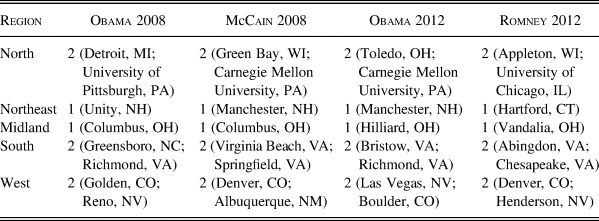
We examine the major party candidates in the United States presidential elections of 2008 and 2012: Barack Obama (in both years), John McCain, and Mitt Romney. Eight speeches for each speaker and campaign year were assessed—thirty-two total. Each file was downloaded from C-SPAN's online video library,Footnote 1 converted to audio WAV files, and transcribed. Speeches were about twenty to forty minutes in duration. All speeches occurred during the relevant election year, prior to the general election. As speech styles often bear associations with geographic regions, we balanced each speaker's sample across the Atlas of North American English's (Labov, Ash, & Boberg Reference Labov, Ash and Boberg2006) broad US dialectological regions (Table 1).
Campaign rallies analyzed, by candidate and year.

Demographic information was obtained via 2010 US census data for each rally location's county. Four by-county demographic factors were assessed as potential predictors of linguistic variation. First, formal education level was included, given that prior work has linked variants of American English (ING) and /t/-release with perceived ‘educatedness’ (e.g. Campbell-Kibler Reference Campbell-Kibler2007; Podesva et al. Reference Podesva, Reynolds, Callier and Baptiste2015). This was operationalized as the proportion of the county's residents that held a high school diploma or less. Second, racialized demographic makeup of each rally location was included, given prior analyses of Obama's style-shifting in relation to racialized aspects of his audience (e.g. Alim & Smitherman Reference Alim and Smitherman2012). This was calculated based on the racialized categories designated by the census. Third, we included population density of the rally location's county in 2010, and fourth, whether the rally took place in the Southern dialect region (Table 1), given prior work linking alveolar (ING) to notions of rurality and Southernness (e.g. Campbell-Kibler Reference Campbell-Kibler2007).
(ING)
(ING) is one of the most studied variables in sociolinguistic work on English in both production and perception, with variants bearing associations with degree of education and intelligence, formality, urbanness versus and rurality, and socioeconomic status (e.g. Fischer Reference Fischer1958; Campbell-Kibler Reference Campbell-Kibler2007, Reference Campbell-Kibler2008; Forrest Reference Forrest2017; Tamminga Reference Tamminga2017). For example, Labov (Reference Labov1966) observed that speakers of higher socioeconomic status or speakers paying more attention to their speech used greater amounts of (ING)'s velar variant -ing. In perception, Campbell-Kibler (Reference Campbell-Kibler2007) found that listeners attribute contrasting social meanings to the velar and alveolar variants of (ING), with the velar variant linked to perceived articulateness, higher education, and higher class, among other social meanings.
All collected speeches were coded for both variants -ing and -in. Only instances of the variable occurring as the progressive verbal suffix, gerunds, participles, adjectives, or the nouns ‘nothing’ and ‘something’ were included. Tokens of (ING) in monosyllabic words (e.g. ‘ring’), or in nouns aside from ‘nothing’ and ‘something’ (e.g. ‘building’) were excluded. Tokens (N = 2,780) were coded by hand and judged auditorily, labeled either ‘alveolar’ for the -in variant or ‘velar’ for the -ing variant. The same coder (the first author) coded all instances across speakers and rallies. Ambiguous tokens, such as those obscured by laughter or applause were excluded.
/t/-release
Inter- and intra-speaker variation in American English /t/ has also been investigated in prior work, with the released variant associated with social meanings such as expressiveness, prissiness, articulateness, educatedness, and formality (e.g. Benor Reference Benor2001; Bucholtz Reference Bucholtz2001; Eckert Reference Eckert2008; Podesva et al. Reference Podesva, Reynolds, Callier and Baptiste2015). For example, Benor (Reference Benor2001) found that Orthodox Jewish boys used significantly more released /t/ than their female counterparts, using the feature to project an intellectual, articulate, Jewish persona. Bucholtz (Reference Bucholtz2001) found that nerd girls at a high school also used this feature as part of a ‘superstandard’ style, aiming to project intellectualism and educatedness in contrast with their coolness-oriented peers.
Further, as mentioned above, Podesva and colleagues (Reference Podesva, Reynolds, Callier and Baptiste2015) tested associations that listeners make with US politicians’ use of released and unreleased tokens of /t/. They found that first, social meanings of released /t/ differed depending on its linguistic context: word-medial released /t/s were evaluated differently than word-final released /t/, perhaps due to differences in how frequently the variant is used in these contexts in production. Furthermore, while some politicians were more positively evaluated for their usage of released /t/ on attributes like articulateness and intelligence, others did not benefit to the same extent. These previous findings suggest that /t/-release is ripe for continued investigation of its construed meanings in a political context.
Due to the differences Podesva and colleagues (Reference Podesva, Reynolds, Callier and Baptiste2015) found between word-medial and word-final /t/, we focus only on word-final tokens of /t/ in our study. Following Podesva et al. (Reference Podesva, Reynolds, Callier and Baptiste2015), tokens of /t/ that preceded interdental fricatives and alveolar stops (/t/, /d/, /ð/, and /θ/) were excluded. Eligible tokens of word-final /t/ (N = 10,450) were coded by hand by the same coder (the second author), assessed by both the presence of a visible release burst in the waveform and spectrogram, as well as audible presence of aspiration. While other work assessing /t/-release draws multiple distinctions between unaspirated variants, here, for minimum ambiguity in coding, each instance was coded as binary ‘released’, indicating aspiration, or ‘not released’, indicating any other variant (glottalized, deleted, flapped). The phonological segment preceding and following each token of /t/ was recorded and included in the statistical analysis, described in further detail below.
Topic
Previous work has illustrated that the topic of discourse influences both how a speaker produces linguistic features (e.g. Rickford & McNair-Knox Reference Rickford, McNair-Knox, Biber and Finegan1994) and how listeners evaluate the use of these features (e.g. Campbell-Kibler Reference Campbell-Kibler2007). In order to assess how the content of a given utterance within a rally influenced speakers’ linguistic variation, we developed an utterance-level topic coding schema, used to classify each full sentence in each speech. Using text transcripts only, we evaluated emergent themes in the types of statements all three candidates made consistently in speeches. We aimed to develop an exhaustive schema that would yield a high degree of inter-coder reliability. A five-topic schema ultimately yielded the greatest amount of agreement, with each sentence coded as belonging to one of the following five categories.
(i) Ordinary Americans: identifying with American people, including anecdotal vignettes in describing ‘ordinary’ American lives
This has happened in recent months at great cost to workers, small businesses, families, and homeowners across our nation. (McCain 2008, Carnegie Mellon University)
The men and women I meet on the campaign trail, like you, every day. The laid off worker who has to go back and retrain at a community college at the age of fifty-five to try to get a new career in a new field, she needs a champion. (Obama 2012, Hollywood, FL)
(ii) Self as candidate or politician: description or promise of candidate's own policy accomplishments or plans, aspects of their own past or future public service
I am gonna be the best president for small businesses and jobs, for women and men of this country.’(Romney 2012, Hartford, CT)
We'll invest in all energy alternatives, wind, solar, tide, and safe nuclear power. (McCain 2008, Columbus, OH)
(iii) Opponent: discussing opponents’ platform and political history
Now for the last three years, the president has expanded government instead of empowering the American people. (Romney 2012, University of Chicago)
Senator Obama is more interested in controlling wealth than creating it! (McCain 2008, Denver, CO)
(iv) Abstract entities or groups: statements not in reference to self/campaign, opponent, or ordinary Americans but referring to institutions, groups of people, and abstract notions
Now friends, Washington's still on the wrong track. (McCain 2008, Albuquerque, NM)
Home values, home construction, is on the rise. (Obama 2012, Boulder, CO)
(v) Asides: telling jokes, comments, or anecdotes unrelated to the thematic course of the speech, often outside of the scripted speech
Wow, that's quite a guy, isn't it, Paul Ryan! That's something! (Romney 2012, Vandalia, OH)
Congratulations on your outstanding season last year and what I'm sure will be an outstanding season the year to come. When does the season start? Coming up right? (Obama 2008, Detroit, MI)
Every sentence was coded using the text transcript only (never audio) separately by both authors, and instances of disagreement (7.15% of sentences) were assessed. Each instance of inter-coder disagreement was discussed and an agreement on coding reached. Each token of the two linguistic variables was thereby coded for the topic in which it appeared, which was assessed qualitatively as a predictor of variant choice.
Statistical analysis
Mixed effects logistic regression models were fit using the lme4 package (Bates, Mächler, Bolker, & Walker Reference Bates, Mächler, Bolker and Walker2015) in R (R Core Team 2016) to assess the influence of the predictors of interest on selection of a linguistic variant. For each binary linguistic variable ((ING): velar vs. alveolar; /t/: released vs. unreleased), four total models were fit. First, a model for the entire dataset collected for that variable tested whether significant inter-speaker differences were visible between each speaker and campaign year. Then, one model per speaker per variable was fit to test intra-speaker variation by aspects of campaign rally locations and topic for a given speaker.
In both full inter-speaker models, one for each linguistic variable ((ING) and /t/-release), speaker-year combination was included as a categorical predictor of binary variant selection. The model predicting (ING) variant included categorical speaker-year as a fixed effect, with four levels (Obama 2008, Obama 2012, McCain 2008, Romney 2012). Lexical frequency of each word was calculated within this corpus. We opted to use frequency within the campaign rally speeches from which we obtained our data, given that the aim of this analysis was to assess variation highly specific to this genre, and we may expect that lexical frequency based on corpora including other genres could behave differently. Logarithmically transformed word frequency was included as a control linear predictor. The maximal random effects structure was used that allowed the models to converge (Barr, Levy, Scheepers, & Tily Reference Barr, Levy, Scheepers; and Tily2013). Likely given the number and complexity of the fixed effects, this resulted in a single random intercept for rally for the full (ING) model, Obama's (ING) model, and all /t/-release models. For McCain and Romney's (ING) models, even this random intercept resulted in a singular fit; fixed effect logistic regressions were therefore fit to the data in these two cases.
Following previous work, we included following segment place of articulation as a control fixed effect in all (ING) models. We roughly followed Forrest (Reference Forrest2017) for relevant groupings, treating following coronals, velars, and pauses as separate categories, and collapsing bilabials and vowels into a single category. Due to small numbers of following velar tokens that made full model convergence impossible, we ultimately collapsed the categories of velars and pauses, which were not significantly different from one another in predicting (ING). This resulted in the three following place categories: coronals, bilabials/vowels, and velars/pauses, predicted in that order to correspond to an increasing number of velar (ING) tokens.
For word-final /t/, preceding and following segment were included as categorical control predictors with three or four levels, respectively, grouped by phonological properties found to be relevant in previous analyses of /t/-release (e.g. Podesva et al. Reference Podesva, Reynolds, Callier and Baptiste2015). Preceding segments were classified as either obstruents, sonorants, or vowels (no preceding pauses occur in this dataset, as only word-final instances of /t/-release are analyzed), and following segments were classified as either sibilant consonants, nonsibilant consonants, vowels, or pauses. As noted above, interdental fricatives and alveolar stops were excluded from the dataset.
In each of the intra-speaker models (one for each speaker for each sociolinguistic variable), demographic factors about rally location were included as fixed effects, as were control variables of lexical frequency and surrounding linguistic context as described in the between-speaker models above.
As mentioned, four rally location demographic factors were included as potential predictors in the by-speaker models. Formal education level (i), or the proportion of the county's residents that held a high school diploma or less, was included as a by-rally linear predictor. Racialized demographic makeup of the county (ii), or proportions of residents who identified with a given racialized census category were tested as by-rally linear predictors. While proportions for all five documented race categories were obtained from the census, we ultimately chose to use proportion of the county's residents who were White due to collinearity among the predicted proportions; tests using other categories (e.g. proportion Black or African American) revealed no significant differences in results to those presented below. Population density (iii) of the county was included as a linear predictor. All three of these linear predictors were scaled. Whether or not the rally took place in the Southern dialect region (iv) served as a categorical predictor. For Obama, campaign year was also included as a predictor.
Given that we were interested in exploring the multiplicity of factors that could predict this variation, we retain all tested factors in our final model summaries reported below. Further, we were more interested in the presence of variance across topics, rather than the directionality of these topics in predicting sociolinguistic variant use, and thus no clear predictions were made for topic at the utterance-level. Given that the predictor of topic was categorical with many (five) levels that would make model convergence and interpretation nearly impossible, topic differences between the five designated categories (Ordinary Americans, Self as politician/campaign/policy promises, Opponent, Abstract entities/concepts, and Asides) were assessed qualitatively by speaker. We leave further statistical analysis of the nature of these topic categories for future work.
Results
(ING): Inter-speaker variation
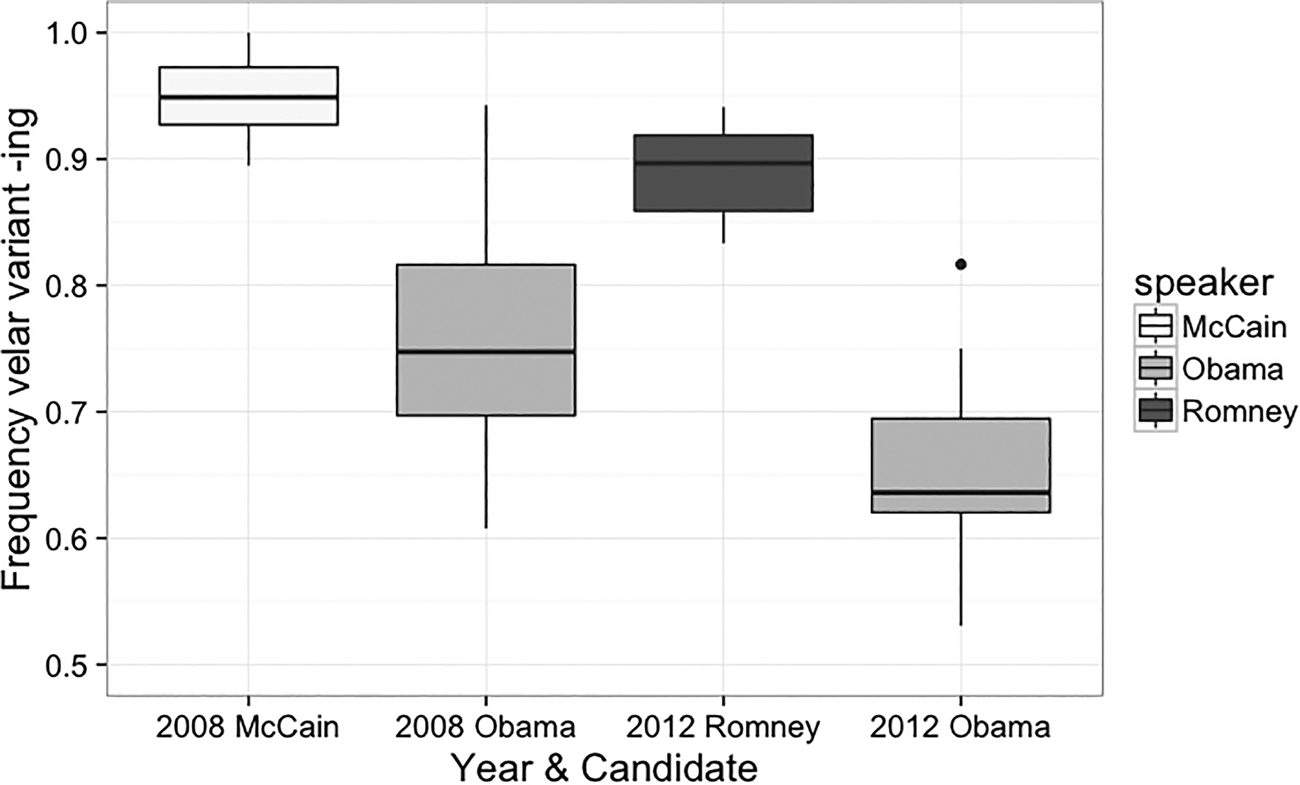
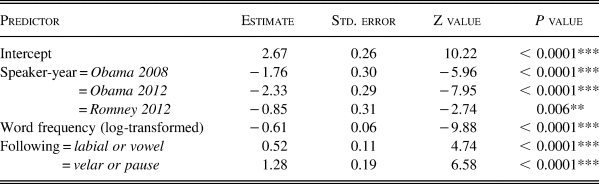
Significant differences emerged in the overall rates of velar versus alveolar (ING) use by candidate and campaign year (boxplots showing spread across rallies for each speaker/year in Figure 1). The overall model for (ING) is shown in Table 2.
Frequency velar (ING) use across rallies, by speaker and year.

Model summary of fixed effects for best-fit by-speaker models predicting (ING) (alveolar vs. velar). N = 2780. Speaker-year default = McCain. Following environment default = coronal.

First, the model found that word frequency significantly predicted (ING) usage in the expected direction: more frequent words were more likely to be produced with an alveolar variant (e.g. Forrest Reference Forrest2017). Furthermore, the control fixed effect of following phonological environment also showed significant effects, such that a following coronal consonant was much less likely to predict velar (ING) than following vowels or labials, which were in turn less likely to predict velar (ING) than following velar consonants or pauses, again in concordance with past work (e.g. Forrest Reference Forrest2017).
Significant differences emerged by speaker and campaign year (Table 2). McCain made relatively little use of the alveolar variant in his 2008 campaign, using it 5.5% of the time. Romney used significantly higher rates of the alveolar variant than McCain (11%). In both campaign years, Obama used much more alveolar (ING) than either McCain or Romney, and Obama differed by campaign year, using 25% alveolars in 2008 and 34% alveolars in 2012.
Further, differences between speakers can be observed in the range of velar (ING) rates across rallies (Figure 1). Both McCain and Romney showed an 11% range of velar (ING) usage. However, Obama showed a 33% range in 2008 and a 29% range in 2012, almost three times the spread of the other candidates. Thus, not only did Obama distinguish himself from the other candidates in his use of alveolar (ING) in terms of overall rates across rallies, but also in how much variability he showed between rallies.
(ING): Intra-speaker variation
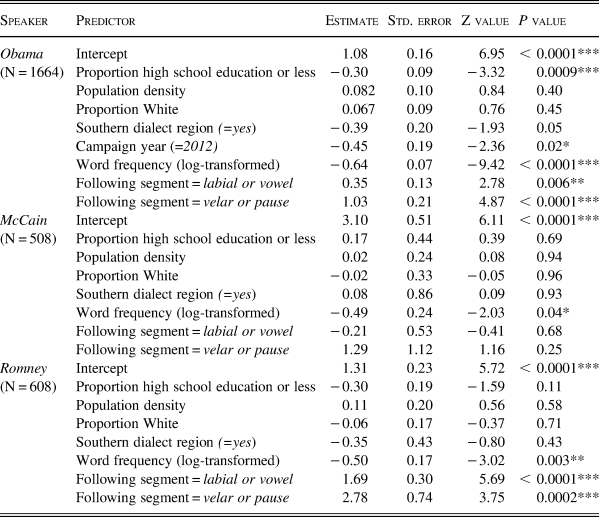
The by-speaker models revealed whether demographic aspects of the rallies corresponded to the selection of (ING) variant for each speaker. Summaries of the fixed effects for each speaker model are shown below in Table 3.
Model summaries of fixed effects for best-fit by-speaker models predicting (ING) (alveolar vs. velar). Southern dialect region default = no, campaign year default (Obama only) = 2008. ***= p < 0.001; **= p < 0.01; *= p < 0.05.

For all three speakers, word frequency served as a significant predictor and operated in the expected direction. Additionally, following segment corresponded to (ING) variant usage for both Obama and Romney in expected directions; this did not significantly predict (ING) variation for McCain. While four demographic factors were tested, only formal education level of a rally's location significantly predicted (ING) usage, and only for Obama. Obama's use of (ING) was significantly predicted by formal education level of the rally county, such that fewer college-educated residents predicted lower rates of velar (ING) across both campaign years (Table 3). Romney and McCain showed no significant effects of the tested rally locale factors. Racialized makeup, population density, and Southernness did not serve as significant predictors of (ING) production for any speaker.
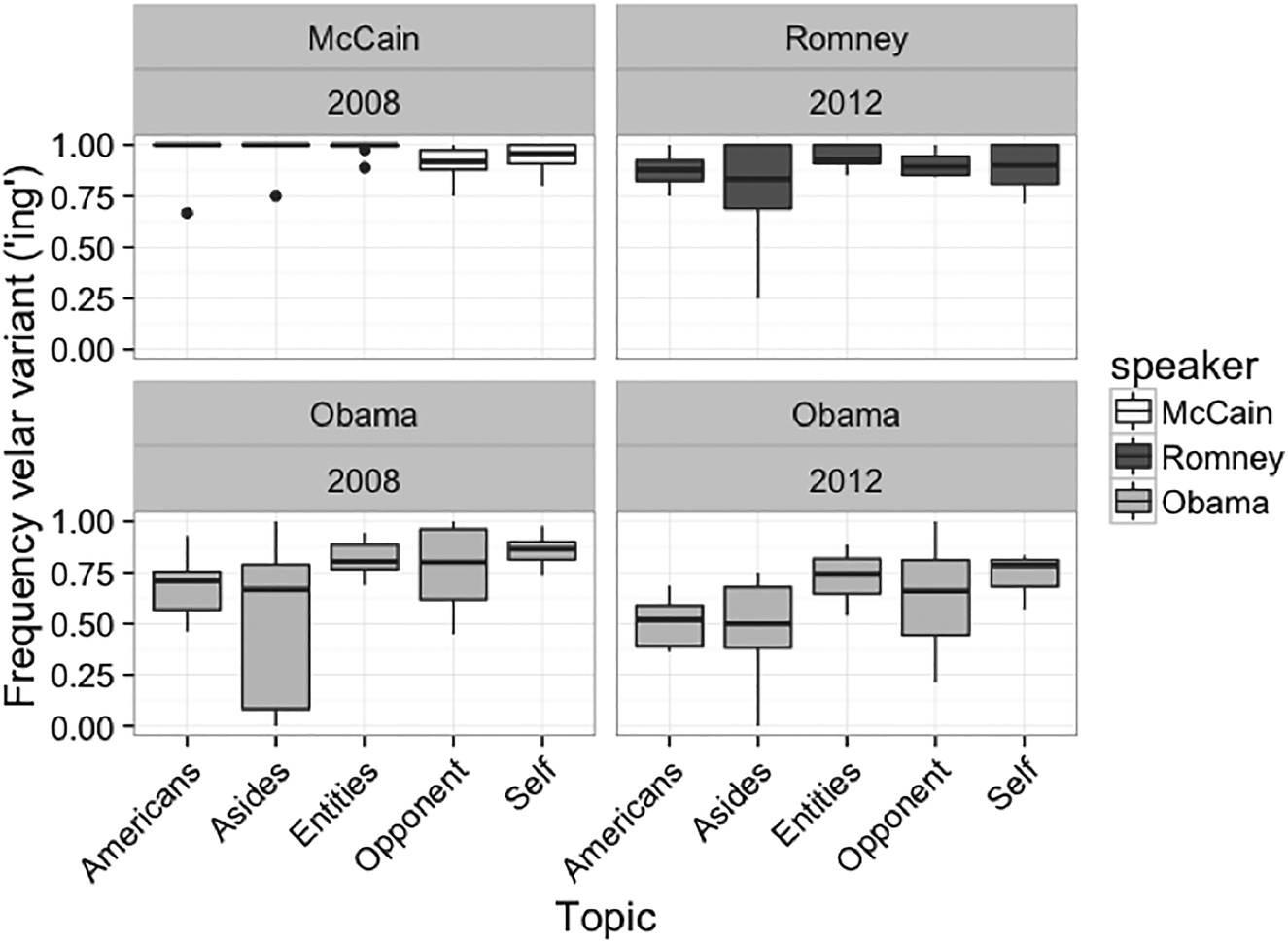
Rates of (ING) by topic for each speaker/year were assessed qualitatively, and boxplots of these rates by topic category are shown in Figure 2.
Frequency velar (ING) use across rallies, by utterance-level topic, speaker, and year.

Large topic-based differences in (ING) usage are visible for Obama, and the ordering with which each topic group corresponded to overall (ING) variant selection frequency was consistent across both campaign years: Obama uses the velar variant less frequently in Asides and when discussing Ordinary Americans, both with a median below 70% in 2008 and around 50% in 2012. He uses the velar variant relatively more frequently (above 75% in both years) when discussing Abstract entities and Himself with respect to his campaign and policies. McCain and Romney showed much less variation by topic than Obama did, perhaps due to overall ceiling effects in both cases. Romney showed the widest range in (ING) selection in Asides, a similar pattern to that observed for Obama in 2008, though Romney's median rate of velar (ING) usage across topics remained at 80% or higher.
Overall, the three speakers differed not only with regard to their overall usage of (ING) variation, but also how much variability they show across rallies and utterances, and in the predictors of this variability. Obama shows a relatively wide envelope of variability, corresponding to education level of his audience and the content of each utterance. However, Romney and McCain show more consistent rates of velar (ING) usage across rallies and utterance topics, neither showing significant effects amongst the tested extra-linguistic predictors, and both exhibiting relatively small ranges of variation across utterance topics.
/t/-release: Inter-speaker variation
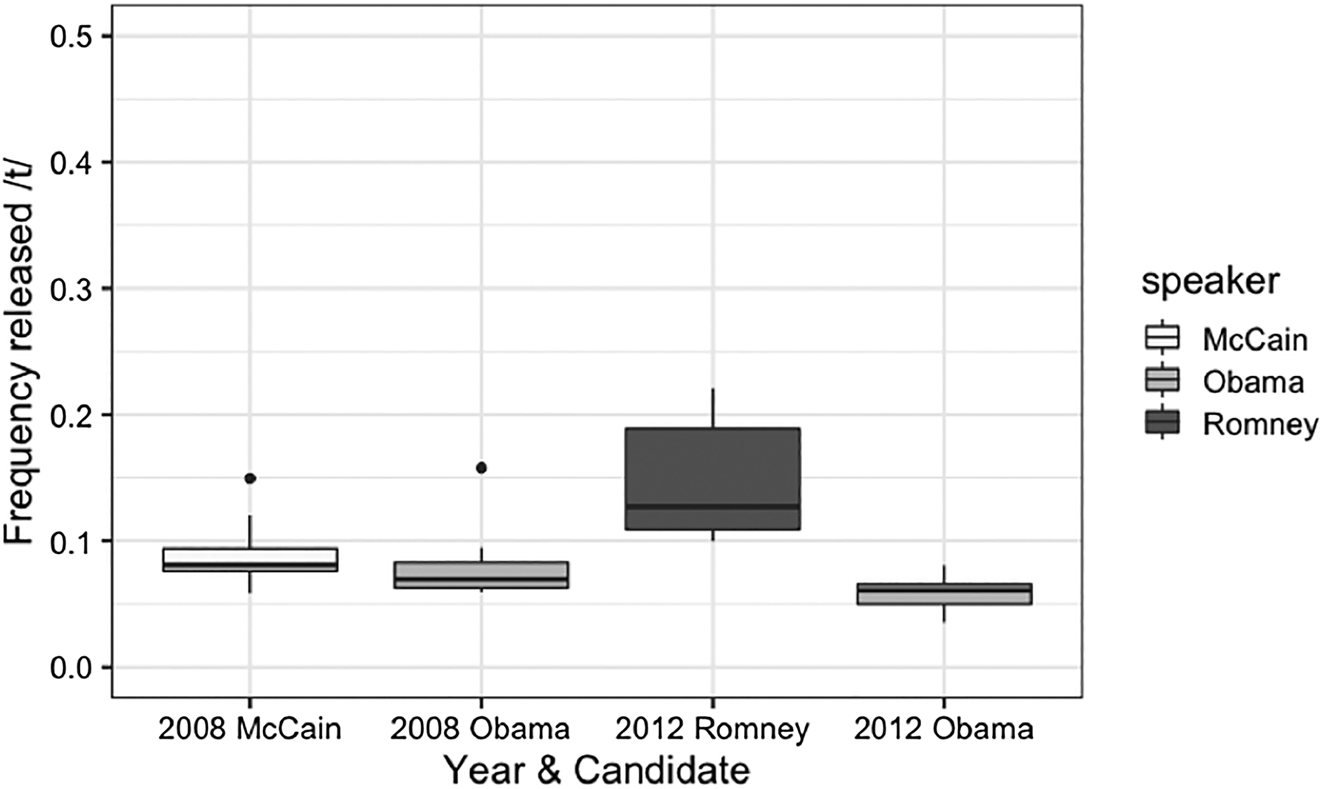
Released /t/ was assessed categorically in a similar fashion to (ING), controlling for additional linguistic predictors of preceding and following segment as described above. Spread in rates across rallies by speaker and campaign year is shown in Figure 3.
Frequency released /t/ across rallies, by speaker and year.

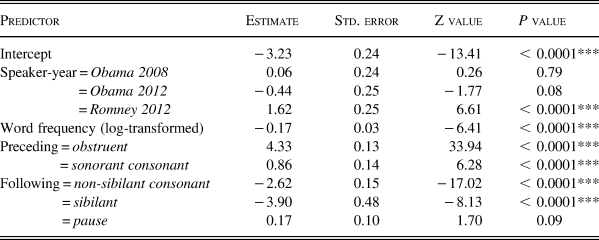
Controlling for these linguistic factors, speaker differences emerged in the inter-speaker model (Table 4). Romney was significantly more likely to use the released variant (overall, 29% of the time) than Obama in 2008, who used it 18% of the time, Obama in 2012 at 14% of the time, or McCain in 2008 at 17% of the time. Romney also exhibited a relatively wider spread across rallies than the other two candidates (Figure 3).
Model summary of fixed effects for overall mixed effects logistic regression model predicting word-final /t/ realization. Preceding environment default level = vowel; following environment default level = vowel, speaker-year default = McCain 2008.

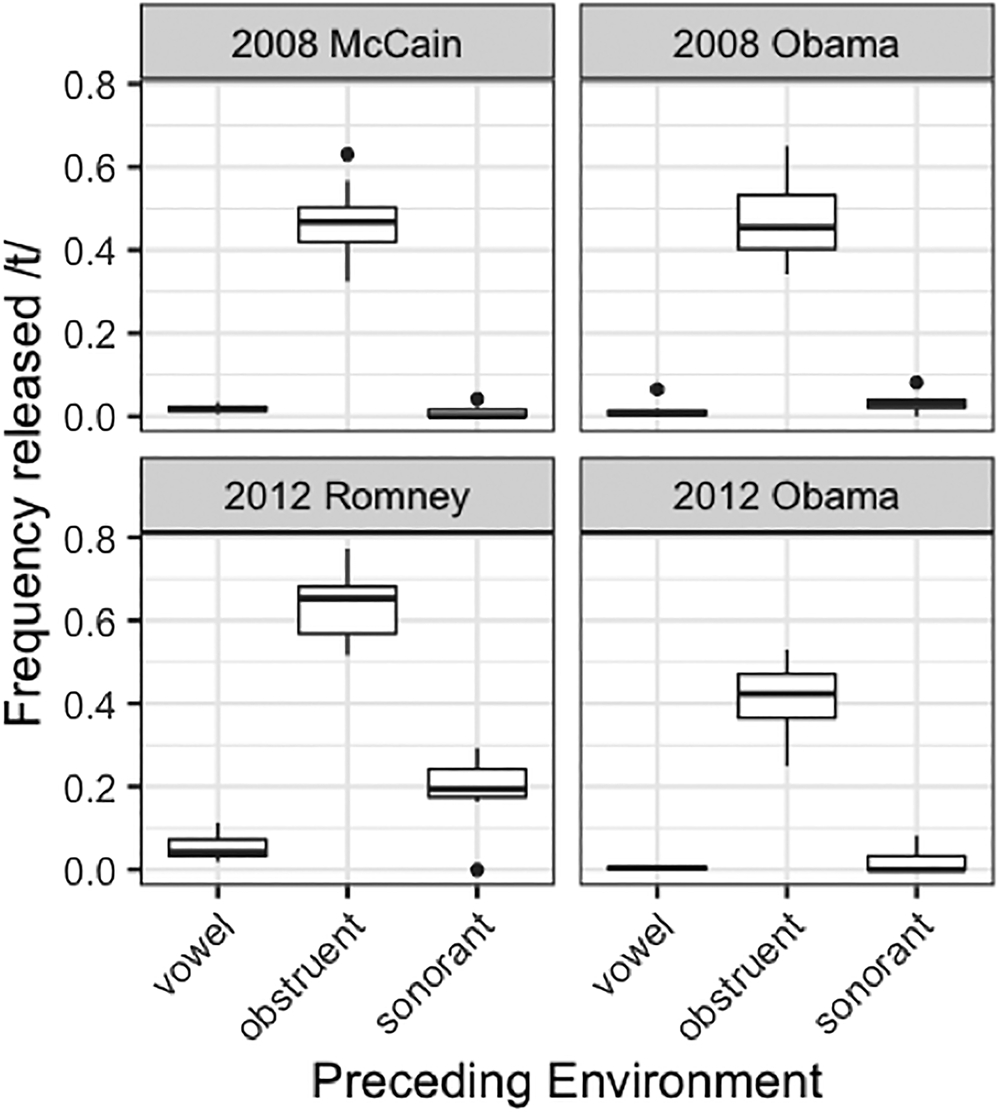
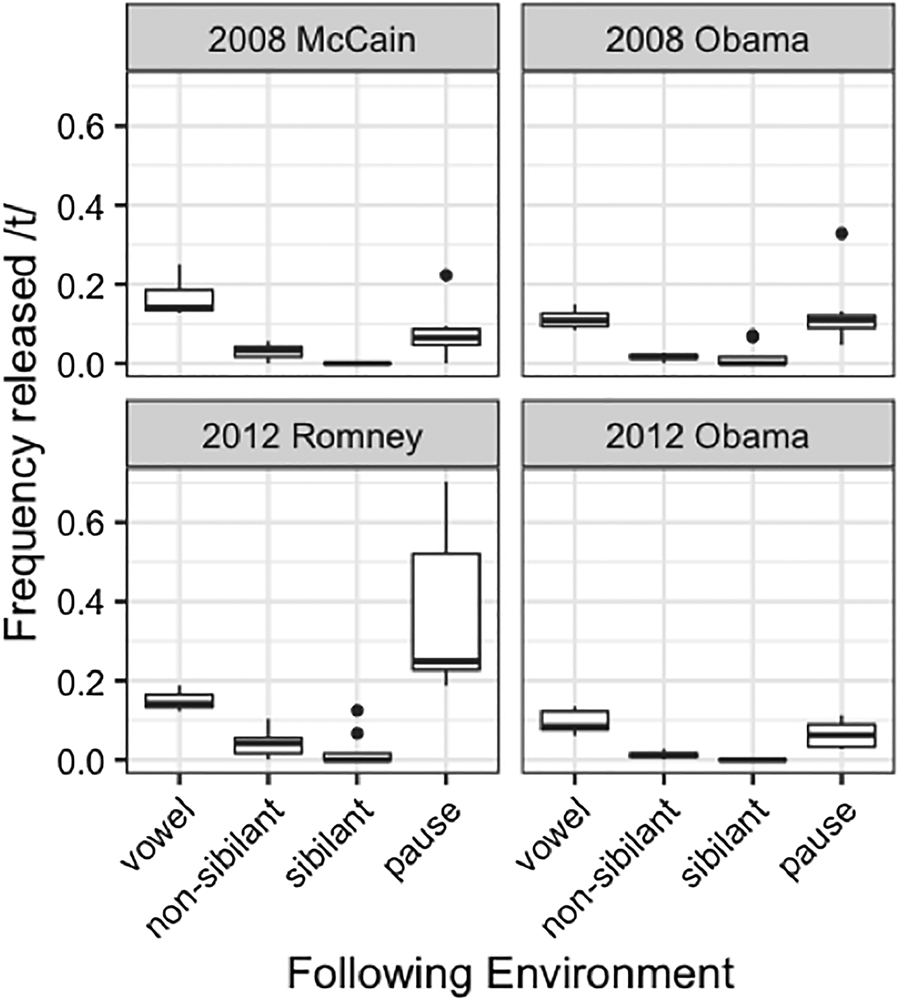
Additionally, the preceding and following phonological environments of a given token strongly conditioned presence of release, as found in previous studies (e.g. Podesva et al. Reference Podesva, Reynolds, Callier and Baptiste2015). A preceding obstruent consonant was much more likely to correspond to a released /t/ than a preceding sonorant consonant, which in turn was more likely to correspond to a release than a preceding vowel. A following pause or vowel was significantly more likely to correspond to a release than a following consonant, though following pauses and vowels behaved similarly, as did sibilant versus nonsibilant consonants. For the individual speaker models, following environments that were not significantly different from one another were collapsed, resulting in two levels: (i) pauses and vowels and (ii) consonants.
/t/-release: Intra-speaker variation
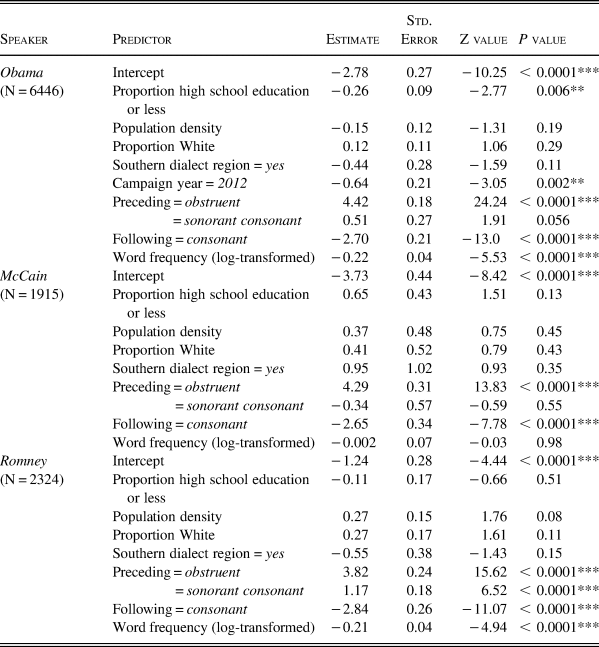
Coefficients and p-values for predictors in the full models for each speaker are shown in Table 5.
Model summaries of fixed effects for best-fit by-speaker models predicting word-final /t/ realization (released vs. unreleased). Southern dialect region default = no, campaign year default (Obama only) = 2008, preceding environment default = vowel, following environment default = vowel or pause.

For all three speakers, phonological environment significantly predicted /t/-release. Lexical frequency was not a significant predictor for McCain, though it operated in the expected direction for both Obama and Romney.
Similarly to the results for (ING), only Obama showed effects of the tested rally-based factors on his use of /t/-release. Specifically, the formal education of the rally location's residents once again served as a significant predictor for Obama, with lower formal education (a greater proportion of high school education or less in the county) predicting the use of less /t/-release. Further, again mirroring results for (ING), Obama displayed significantly less /t/-release in 2012 than in 2008 (Table 5).
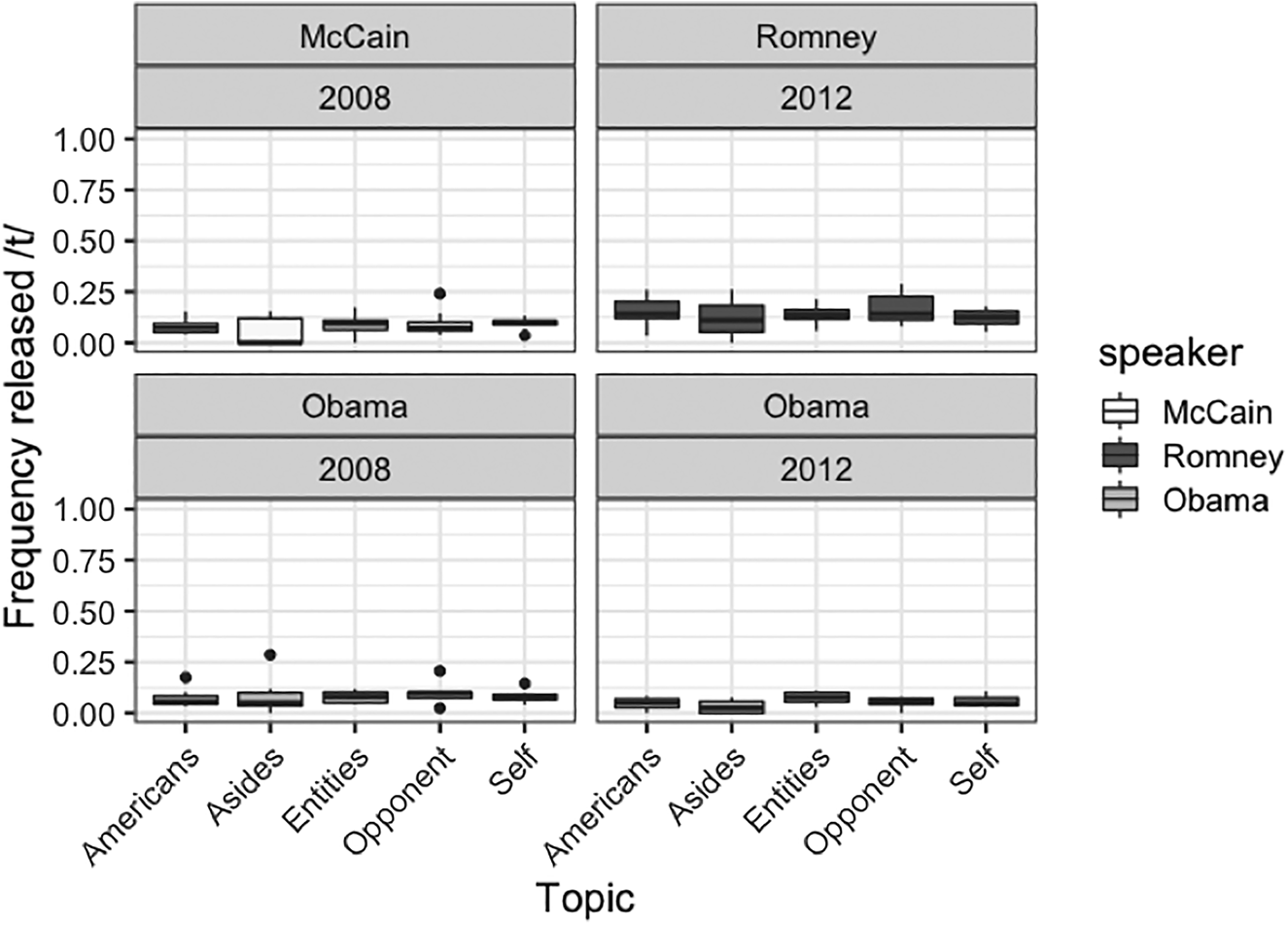
Romney showed the highest rates of /t/-release overall, a result that held across the majority of preceding and following environments, relative to the other two speakers (Figures 4 and 5). In particular, Romney appears to show the highest rate of use and widest spread in prepausal contexts (Figure 5), notably an environment in which the burst following a released /t/ might be most auditorily salient. However, no demographic predictors were found to significantly predict /t/-release for Romney, nor for McCain. Finally, no clear topic-based differences were observed to correspond to /t/-release for any speaker (Figure 6).
Frequency released /t/ across rallies, by speaker and year, and preceding segment type.

Frequency released /t/ across rallies, by speaker and year, and following segment type.

Frequency /t/-release use across rallies, by utterance-level topic, speaker, and year.

(ING) and /t/-release by rally
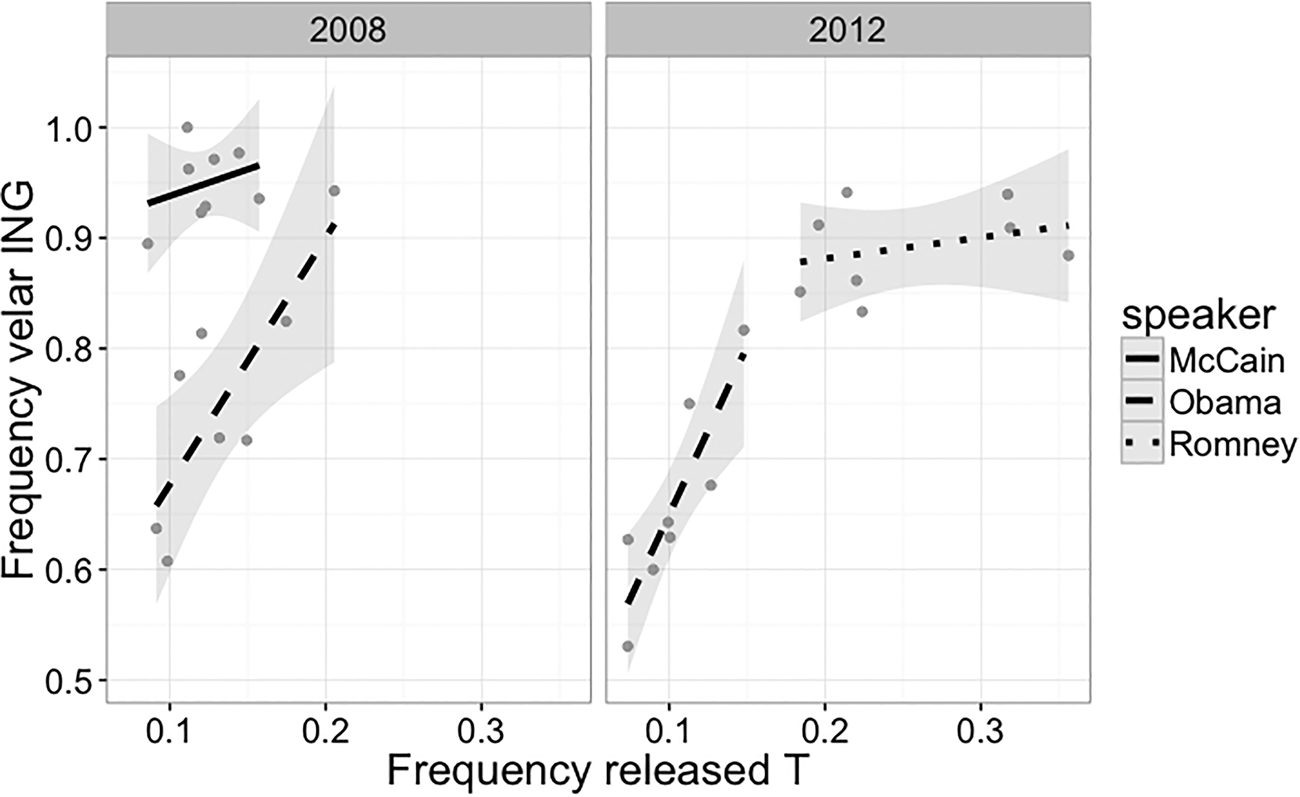
Finally, we analyzed the relation between rate of velar (ING) usage and rate of released /t/ in a given rally. Rates were tabulated for (ING) by calculating the overall frequency of velar (ING) by rally, and for /t/-release by taking the frequency for each preceding–following phonological environment combination, then aggregating the mean frequency across those rates. Plots of linear smooths of these rates by speaker and year are shown in Figure 7 below.
Correlation of released /t/ and frequency velar (ING) rates by rally, speaker, and year (rates of /t/-release aggregated across preceding and following environment combinations).

Spearman's rank-order correlations were run by speaker-year combination to assess the relation between these two rates by rally. Obama shows a significant positive correlation between frequencies of released /t/ and velar (ING), both in 2008 (rs = 0.76, p = 0.037) and in 2012 (rs = 0.93, p = 0.0022). Though McCain and Romney also show a positive relationship between the two rates, these were not statistically significant (McCain rs = .24, p = 0.58; Romney rs = 0.048, p = 0.93). Particularly for McCain, this could be driven by a ceiling effect in his (ING) usage, as he shows very high rates of velar (ING) productions across rallies. Overall, it appears that Obama uses these features in tandem, shifting the frequency of both variants’ usage by rally, while the others show little relation between the two.
Discussion
The three candidates exhibited different rates of velar (ING) and /t/-release, structured by different factors. Furthermore, we found differences in how variable a given candidate was in usage of these features across rallies and utterances. In what follows, we summarize the quantitative findings presented above for each speaker and connect them with the imagery and rhetoric that the candidate deployed in branding himself in a given campaign. By connecting the two, we explore the ways in which sociolinguistic variability or consistency across speech events (in this case, rallies) may reflect and contribute to the candidate's broader image construction.
Obama
In both campaign years, Obama showed both a higher rate of alveolar (ING) and a wider range of rates across locations and topics than the other two candidates. Across rallies, this was predicted by formal education level of the rally location, such that in counties with fewer college-educated speakers, Obama produced a lower proportion of velar (ING). Furthermore, when discussing ordinary Americans or making casual asides, Obama was significantly less likely to use velar (ING) than when the utterance focused on his campaign or policy plans, or more abstract entities like ‘insurance companies’ or ‘the economy’. For example, in a 2012 campaign speech, when discussing the everyday lives of ‘most people’, Obama used numerous alveolar tokens (denoted in the following by word-final n as opposed to velar tokens, denoted by word-final ng): ‘Most people what they're lookin for are jobs that pay the bills. That they've got enough money to buy groceries. And make dinner. And doin the laundry and enforcing bed times.’ This significantly contrasted with his discussions of himself in the context of his campaign promises, in the following quote from the same rally: ‘But I think we should keep moving forward with the new health care law that's already cutting costs and covering more people and saving lives.’
Obama used released /t/ relatively infrequently across phonological contexts, and he did not show a wider range than other candidates across rallies, perhaps due to a floor effect. However, despite its infrequency, Obama's /t/ productions still showed location-based conditioning along the same dimension as observed for (ING)—formal education level of the rally's county. Both the pattern of (ING) and /t/-release with regard to education level operated in the expected directions given prior work on social meanings of these variables (e.g. Benor Reference Benor2001; Bucholtz Reference Bucholtz2001; Podesva Reference Podesva2006; Campbell-Kibler Reference Campbell-Kibler2007).
Across different locales, Obama modified the phonetic features he used in socially meaningful ways. As noted earlier, while we are far from the first to note Obama's strategic style-shifting (Alim & Smitherman Reference Alim and Smitherman2012; Holliday Reference Holliday2017), we suggest the variability Obama exhibits in use of sociolinguistic features across speech contexts is itself socially meaningful, interpretable as a strategic layering of styles toward an overarching public image construction. This is supported by Obama's clustering of the two variants, with velar (ING) and released /t/ rates yoked not only between his campaign years, with both rates decreasing from 2008 to 2012, but also between rallies, as shown in the correlations between use of the two features (Figure 7). These patterns suggest that the features are packaged together as constructions in the enactment of particular styles (Eckert Reference Eckert and Coupland2016).
Given prior social meanings linked with variants of (ING) and word-final /t/, as well as the demographic and utterance-level correlates with variant selection across Obama's speeches, we argue that the variability with which these clusters are produced represents a simultaneous highlighting of both a more formal, qualified style, on the one hand, and a more casual, intimate style on the other, across and within rallies. Fetzer & Bull (Reference Fetzer and Bull2012) and Kirkham & Moore (Reference Kirkham and Moore2015) point out that much political branding aims to achieve such a balance between displays of professional ‘competence’ and displays of ‘responsiveness’ to constituents. The ways in which Obama combines these dimensions via overall structured sociolinguistic variability suggests that he is not just linguistically accommodating to a given audience in a given moment, but that he is in fact layering two linguistic styles agentively, perhaps to simultaneously project competence and responsiveness, in different balances across speech events.
This can first be observed within rallies, in Obama's topic-based variation of (ING). Velar (ING) was most common in the moments in which Obama described his own policy positions and more abstract concepts or entities—that is, when he was asserting his competence in identifying directions at an intellectual, strategic, and professional level, reflected in the use of the more ‘formal’ or ‘standard’ linguistic variant. For example, in a 2008 speech, he states, ‘I've proposed tough penalties on fraudulent lenders and a home score system that will ensure consumers fully understand mortgage offers’. Here, he refers to affected individuals as ‘consumers’, discursively marking himself as seasoned in economic policy and at a remove from those affected by fraudulent lenders.
By contrast, in conveying responsiveness or relatability when speaking directly and casually to the audience in off-script asides (e.g. ‘when is the [hockey] season startin?’ and ‘you guys are gettin it!’), the more ‘casual’ or ‘informal’ alveolar variant emerges most frequently. Obama also shows higher rates of the alveolar variant in anecdotes or references to ordinary Americans’ experiences, in which he rhetorically indicates intimacy or familiarity. In discussing health care reform in 2008, for example, Obama states: ‘as someone who watched his own mother spend the final months of her life arguing with insurance companies… I know what it's like to see a loved one suffer not just ‘cause they're sick, but because of a broken health care system’. Further, he relates his plan for healthcare to the direct experiences of his audience (and thus the American populous): ‘if you don't have health insurance, you're gonna be able to get the same kind of health insurance that members of Congress give themselves’. Not only does Obama invoke a personal anecdote to position himself discursively as a direct experiencer of this ‘broken system’, and thus a member of the audience (‘you’) to whom he is speaking, he also positions the audience and the wider American populous in opposition to establishment politicians. Further, despite his status at the time as a senator, he refers to members of Congress as ‘themselves’, placing himself rhetorically outside of this group. From moment to moment within a given speech, in both content and in linguistic style, Obama appears to layer these ‘competent’ and ‘relatable’ qualities, which correspond indexically to his use of (ING) variants.
Furthermore, Obama's usage of both velar (ING) and released /t/ significantly decreased in tandem between his 2008 and 2012 campaigns. We suggest that this reflects a change between the two campaigns in his highlighting of competence versus relatability. In 2008, arguably the most crucial issue for Obama's campaign was the demonstration of qualification. As a junior US senator who had served only one term, Obama's lack of experience was a major point of criticism in both the 2008 Democratic primary race (e.g. Holian & Prysby Reference Holian and Prsyby2015) and in the 2008 presidential race against John McCain. Obama's newness to federal politics led his opponents and popular media to question the degree to which he was prepared to take on the role of president. For example, an analysis of the first presidential candidate debate was headlined, ‘McCain, Obama fight for title of “most qualified”’ (CNN Politics 2008). In many ways, this overarching need to prove ‘qualification’ for office, which likely corresponded to different meanings for differently racialized, classed, and placed audiences, served as a major aim of Obama's campaign in 2008, as discussed in prior work (e.g. Alim & Smitherman Reference Alim and Smitherman2012). Simultaneously, Obama's relative inexperience also positioned him as external to both the contemporary Bush presidential administration, and national ‘politics as usual’ as a whole. In his branding and marketing efforts, as well as in his speeches, Obama identified himself directly with audiences of Americans, frequently through the use of the first-person plural we, as reflected in campaign slogans, ‘Change we can believe in’, ‘Yes we can’, and a theme of his speech at the Democratic National Convention: ‘We are the ones we've been waiting for.’
While Obama continued to balance these messages of competence and relatability in his 2012 campaign, his need to prove ‘qualification’ differed in 2012, given that he was running as an incumbent president. More crucial in this campaign year was the message that he continued to identify with the American people, and his marketing efforts reflect this explicitly: his 2012 campaign launch video was entitled ‘It begins with us’. Additionally, press coverage and voters in polls observed a more laidback demeanor in Obama's campaign—coverage of his campaign in a 2012 New York Times article was headlined, ‘Relaxed and loose, candidate Obama hits his mark’ (Cooper Reference Cooper2012). ‘Looseness’ can be linked to the increased use of alveolar (ING) and unreleased /t/ in this year as the less ‘formal’ variants of both variables. The display of casualness and relatability via the use of ‘informal’ speech itself is also laid bare in Obama's 2012 voter registration push, branded under the orthographic reductions gottaregister.com and gottavote.com.
In light of Obama's campaign branding, we argue that his structured sociolinguistic variability reflects not just an ability to shift toward different audiences, as shown in past work (e.g. Alim & Smitherman Reference Alim and Smitherman2012; Holliday Reference Holliday2017), but also a strategic layering of linguistic styles accumulated across utterances and speech events. Obama simultaneously presents as a politician intellectually qualified for office and as a relatable agent of change for the American people. Clusters of features allow him to combine these two dimensions in single speeches or campaigns, which audiences within and across rallies can observe as two pieces of a more holistic public image. Further, the degree to which Obama was required or expected to exhibit such variability by constituents is undoubtedly racialized, as discussed in prior work (e.g. Alim & Smitherman Reference Alim and Smitherman2012).
Romney
Romney showed less structured variability in his use of the tested sociolinguistic features than Obama. First, Romney exhibited higher rates of velar (ING), and a narrower range in these rates across rallies, with no observable rally locale or topic-based differences. However, Romney stood apart from both Obama and McCain in his usage of the released variant of word-final /t/: his usage of /t/-release was significantly higher than the others, and he showed a large variance of usage across rallies in prepausal contexts. This linguistic environment may be particularly ripe for stylistic use, given that a released /t/ preceding a pause may be more noticeable than released /t/ preceding another phonological segment. This pattern suggests that released /t/'s social meanings may have been particularly useful for Romney's image construction.
American listeners have been shown to link released /t/ with intelligence, articulateness, and unfriendliness among politicians (Podesva et al. Reference Podesva, Reynolds, Callier and Baptiste2015), and in production, the variant has been associated with displays of ‘nerdiness’ (Bucholtz Reference Bucholtz2001), ‘learnedness’ (Benor Reference Benor2001), and ‘diva’ traits (Podesva Reference Podesva2006) among different communities of practice. Romney may thus have deployed this feature to construct an image consisting of any number of these social meanings. Further, the way in which Romney was interpreted—even in ways unintended—may correspond to the use of this feature as well. For example, a New York Times editorial discussing an earlier Republican primary describes, ‘In the high school version of the 2008 Republican primary contest, Romney was regarded by John McCain and other contenders as the loathed hall monitor, prissy and hypocritical’ (Dowd Reference Dowd2011). Such ‘prissiness’ is, notably, consistent with some portions of the indexical field for /t/-release (Podesva Reference Podesva2006; Eckert Reference Eckert2008).
These public perceptions of Romney's personality endured in his 2012 presidential campaign. In another editorial on the 2012 presidential election by the same columnist, Dowd (Reference Dowd2012) argues: ‘one [difference] that will probably decide this presidential race, is this: Barack Obama is able to convey an impression of likability to voters’. More specifically, commentators noted Romney's style as lacking what could be interpreted as Fetzer & Bull's (Reference Fetzer and Bull2012) ‘responsiveness’—a political commentator describes perceptions of Romney as ‘a tin man… an empty suit, vacuous’ (Egan Reference Egan2010). Of course, numerous aspects of Romney's visual, embodied, and rhetorical style, as well as known aspects of his background as a successful businessman may have contributed to this overall narrative. However, we suggest that his sociolinguistic style can also be related to these characterizations of Romney as stiff or inauthentic: higher use of /t/-release, alongside high rates of velar (ING), could perhaps index a hyper-professional or ‘superstandard’ (Bucholtz Reference Bucholtz2001) style for some audience members, which may run counter to perceptions of responsiveness or likability. While Romney showed cross-rally variability in his use of /t/-release, it may not have been interpreted as linguistically flexible by listeners, particularly given that it was not clearly structured by utterance- or rally-level factors.
McCain
Obama's structured variability contrasted most starkly with McCain's consistency in his use of the two sociolinguistic variables analyzed. McCain showed little variability across speeches in (ING) and /t/-release rates. Overall, McCain's use of velar (ING) was the highest of the candidates, with a relatively narrow range across rallies. His use of (ING) was not predicted by any of the tested demographic factors, nor by topic. Like Obama, McCain also showed a relatively narrow range for his use of /t/-release across rallies, but unlike Obama, no demographic factors or topic categories that we investigated corresponded significantly to his use of the variants.
McCain's narrow ranges of variance and consistency across rallies and topics is itself notable. The lack of structured variability in McCain's speech may be interpreted as an inability or lack of necessity to style-shift, perhaps due to his positionality as an older, white, career politician who likely did not face the same expectation or facility to style-shift as Obama did. However, we suggest that this invariance could itself be interpreted as socially meaningful. Ideologically, a lack of stylistic variability could be evaluated not just as inflexible, but also as consistent, and thereby authentic—a speaker who does not shape-shift to fit the needs of audience members may be interpreted as independent and resistant to pandering. Indeed, McCain's campaign branding in 2008 appears to correspond to such a reading.
As discussed above, McCain's perceived qualification as a candidate was more established than Obama's. McCain's twenty-five years of experience in US Congress, and his prior decades-long military career, featured prominently in his positioning in the 2008 campaign. McCain argued that his track record provided proof enough that he was qualified for the job, without a need to perform this qualification on the campaign trail. In particular, in one campaign commercial released by the McCain campaign, Obama was accused of posing himself as a celebrity—images of Obama were interspersed with those of well-known icons in the entertainment industry at the time, Britney Spears and Paris Hilton, stars framed as shallow and talentless (Mooney Reference Mooney2008). McCain thus positioned himself in opposition to Obama's allegedly inauthentic, pandering performances on the campaign trail, which were implied to belie a lack of talent and a hunger for fame.
Instead, McCain's 2008 campaign crafted his image as a ‘maverick’—an independent thinker not swayed by particular audiences or external influences. He frequently referred to himself as a ‘straight talker’, and the side of his campaign bus was emblazoned with the words ‘Straight talk express’. McCain strongly emphasized his interest in bipartisan cooperation throughout the campaign, and explicitly set himself apart from not only Obama, but also the contemporary Bush administration's policies. The branding of McCain's public image as an independent, ‘straight-talking’ maverick can be linked with the ideological consistency of his speech. Thus, not only can variability within and across speech acts potentially take on social meaning, we argue that a lack of such variability may also be interpreted ideologically as a means of image construction.
Conclusion
This study examined the sociolinguistic variability or consistency that three political candidates showed across multiple widely broadcast campaign rallies. We asked not only whether these candidates exhibited style-shifting across different locations, and across utterances of different topics, but also how the overall variability in sociolinguistic usage that a candidate demonstrated across these domains may itself have social meaning, and how it may have contributed to the broader image a speaker offered for public consumption.
Results suggest that the degree of socially meaningful variability exhibited even within the same genre—campaign rally speeches—may build to contribute more broadly to public image. Studies have long noted the ability and propensity of speakers to style-shift for different audiences or when discussing different topics (e.g. Bell Reference Bell1984; Rickford & McNair-Knox Reference Rickford, McNair-Knox, Biber and Finegan1994). Building on this work, we suggest that during election campaigns, politicians must construct an image for public consumption not only within any given utterance or speech event, but across chains of events (Agha Reference Agha2003), the accumulation of which can be observed by a broader public and thereby contribute to the candidate's holistic image construction. Voters and the media can assess and even comment on the way in which a candidate changes or remains consistent over time (e.g. Alim & Smitherman Reference Alim and Smitherman2012), allowing stylistic practice across multiple moments or contexts to contribute to how politicians are perceived generally, which in turn may impact press coverage and even voting behavior.
In addition to deploying linguistic features to index particular social meanings, as in the case of Romney's use of /t/-release, we suggest that sociolinguistic variability across speech events can be observed and itself imbued with social significance. Obama shows a great deal of structured sociolinguistic variability across and within rallies, which can be mapped to an image of stylistic flexibility and versatility. This variability appears to reflect a layering of different aspects of the political persona he constructed in his campaign branding—qualification and relatability. We further argue that a lack of such cross-context variability does not simply reflect an absence of social meaning, but instead can itself be an indexical resource toward image construction. Specifically, McCain's sociolinguistic consistency can be interpreted as meaningful in the context of his self-presentation as a ‘straight-talking’, independent, authentic candidate.
Overall, speakers and listeners may draw upon accumulations of experience with stylistic practice across multiple encounters in order to project and interpret socially meaningful personae. Thus, not only do speakers draw together socially meaningful linguistic features to construct styles that index particular personae in interactional contexts (Eckert Reference Eckert2008), they also agentively draw together these styles and personae to layer them into a single image. This is particularly salient in the case of campaigning politicians, who must explicitly create a coherent identity for voters and media across many public-facing events. However, we also suggest that such a layering of socially meaningful styles, and interpretation of speakers’ personae across multiple encounters, applies more broadly. Individuals frequently construct their images as speakers, or interpret others’ identities as listeners, across multiple, dynamic encounters with the same interlocuters. Variability itself, both within and across numerous interactions, can serve as a meaningful resource in stylistic practice, as shown in previous work on stylistic variability (e.g. Sharma Reference Sharma2011).
While we argue here that sociolinguistic variability or consistency can be imbued with ideological meaning, evaluations or interpretations of variability can be multiple. For example, while observations of a single speaker using different styles across contexts can be viewed as flexible, dexterous, and sensitive, this may also be perceived as disingenuous, inauthentic, or pandering. Lack of variability could be viewed as consistent, dependable, and authentic, or it could be perceived as stiff, inflexible, or oblivious. The social meanings of this variability, then, are themselves as complex, dynamic, and ideologically loaded as the multiplex social meanings that can be attributed to a single linguistic feature in the context of different styles (Silverstein Reference Silverstein2003; Eckert Reference Eckert2008). The meanings attributed to such variability must thus be assessed in the particular contexts of both speakers’ and listeners’ positionalities. An important step for future work is to examine how listeners evaluate sociolinguistic variability both across and within interactional contexts, and how this might be conditioned by other aspects of the speaker, listener, or relation between the two.