1. Introduction
In 1975, Hou, Yeh & Zhao described a small vertebrate assemblage from the Early Cretaceous Napai Formation (erroneously transliterated as ‘Napan’ by Dong, Reference Dong1992) in Fusui County, Guangxi Zhuang Autonomous Region (southern China). In 1995, during a visit to the Institute of Vertebrate Paleontology and Paleoanthropology (IVPP) in Beijing, one of us (VS) examined the reptile remains from Fusui and noticed that the teeth referred to a pliosaur (as Sinopliosaurus fusuiensis) in fact showed similarities with teeth from the Early Cretaceous of Thailand described as Siamosaurus suteethorni Buffetaut & Ingavat, Reference Buffetaut and Ingavat1986, and tentatively referred to a spinosaurid theropod (Buffetaut & Ingavat, Reference Buffetaut and Ingavat1986). Re-examination of the material from Fusui, together with new discoveries of spinosaurid theropods from Thailand, allows us to reinterpret the supposed pliosaur from the Napai Formation as a spinosaur.
2. Geographical and geological setting
Fusui County is in the southeastern part of Guangxi Zhuang Autonomous Region, about 45 km to the SW of the regional capital, Nanning. A detailed map of the locality was provided by Hou, Yeh & Zhao (Reference Hou, Yeh and Zhao1975), together with a stratigraphic section of the Napai Formation, which they attributed to the Early Cretaceous period on the basis of bivalves (notably Trigonioides). Vertebrate remains, from purple marls intercalated with sandstones, were listed as consisting of a hybodont shark tooth, fragmentary plates of a cryptodiran turtle, five teeth of a pliosaurid (Sinopliosaurus fusuiensis), a spatulate tooth, three incomplete cervical vertebrae and ribs of a brachiosaurid sauropod (Asiatosaurus kwangshiensis) and four teeth of a megalosaurid theropod (Prodeinodon kwangshiensis). The validity of the dinosaur taxa established on the basis of this very fragmentary material is questionable. According to Dong (Reference Dong1992), the sauropod material can be referred to a euhelopodid. Buffetaut, Suteethorn & Tong (Reference Buffetaut, Suteethorn, Tong, Lü, Kobayashi, Huang and Lee2006) compared the vertebrate assemblage from Fusui with more diverse Early Cretaceous assemblages from northeastern Thailand and concluded that the Napai Formation may be correlated with either the Sao Khua Formation (Hauterivian–Barremian?) or the Khok Kruat Formation (Aptian). Dong (Reference Dong, Cheng and Qu1979a) reported the occurrence of ornithopod bones in the Napai Formation, a faunal similarity it shares with the Khok Kruat Formation, which has yielded remains of early hadrosauroids.
3. A redescription of the teeth referred to Sinopliosaurus fusuiensis
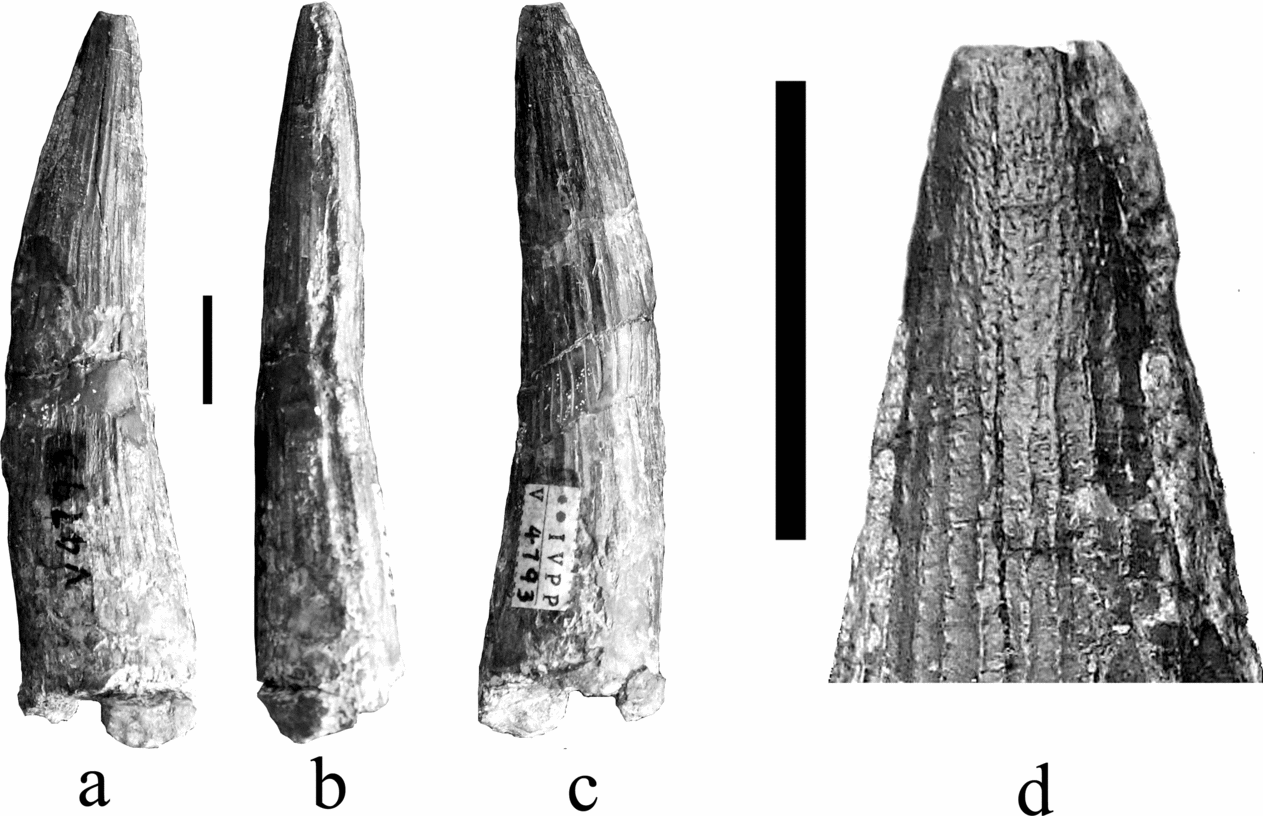
Hou, Yeh & Zhao (Reference Hou, Yeh and Zhao1975) mentioned five teeth referable to Sinopliosaurus fusuiensis, but only four could be found in the IVPP collection. Three of them are poorly preserved and the description below is based on the most complete specimen (IVPP V 4793), which has undergone some deformation and lacks the most apical part of the tip (Fig. 1). The crown is tall, slender, and recurved. As noted by Hou, Yeh & Zhao (Reference Hou, Yeh and Zhao1975), it is compressed laterally (i.e. labiolingually) rather than circular in cross-section (as shown erroneously in their fig. 3). Distinct carinae are present mesially and distally, extending from the base of the crown to its apex; these carinae, not shown clearly on the figure published by Hou, Yeh & Zhao (Reference Hou, Yeh and Zhao1975, fig. 3) but mentioned in their description, are in the plane of curvature of the tooth, so that the mesial carina is convex and the distal carina concave. The enamel bears an ornamentation of well-marked apicobasal ridges, of which there are approximately twelve on each face. These ridges are somewhat irregular, and not all extend for the whole length of the crown. In addition to the ridges, the enamel shows a finer ornamentation of sinuous wrinkles that are developed between the ridges and are particularly marked near the apex (fig. 1d). The wrinkles extend over the carinae, where they form ill-defined serrations, but these are completely obliterated by wear along most of the length of the carinae. The apicobasal height of the crown is 69 mm, and its greatest and smallest diameters at its base are, respectively, 16.5 mm and 13 mm.
Spinosaurid tooth from the Napai Formation (Early Cretaceous) of Fusui county, Guangxi Zhuang Autonomous Region, southern China, IVPP V 4793, in lingual (a), distal (b) and labial (c) views, and close up of apex in lingual view (d), showing ribs and enamel wrinkling. Scale bars: 10 mm.

4. Comparisons and identification
Hou, Yeh & Zhao (Reference Hou, Yeh and Zhao1975) identified the above-mentioned teeth as belonging to the genus Sinopliosaurus Young, which has a complex nomenclatural history. Young first mentioned the genus in 1942, when he referred three teeth from the Jurassic of Kuangyuan, Sichuan Province, to the species Sinopliosaurus weiyuanensis, because ‘they agree perfectly with the tooth previously described from Weiyuan’ (Young, Reference Young1942, p. 306). In fact, as Young himself mentioned in a footnote, his paper on the Jurassic fossils from Weiyuan (Sichuan Province), in which he formally erected the species Sinopliosaurus weiyuanensis, was still in press when the description of the teeth from Kuangyuan appeared, and was not published until 1944 (Young, Reference Young1944). On the basis of publication dates, Sinopliosaurus weiyuanensis Young, Reference Young1942 thus should have priority over Sinopliosaurus weiyuanensis Young, Reference Young1944. The material from Weiyuan referred by Young (Reference Young1944) to a pliosaur includes a tooth, vertebrae, an ischium and a femur. What has been overlooked by many authors, however, is that in 1948 Young changed his mind about the specimens from Kuangyuan and Weiyuan. He considered that the teeth more probably belonged to the crocodilian Peipehsuchus teleorhinus and that the vertebrae also probably belonged to a crocodilian (which does seem likely), so that only the ischium and the femur clearly belonged to a pliosaur; he expressly designated the femur as the type of Sinopliosaurus weiyuanensis (Young, Reference Young1948). Curiously enough, Dong (Reference Dong, Dong, Qi and You1979b) and Sun et al. (Reference Sun, Li, Ye, Dong and Hou1992) figured as belonging to Sinopliosaurus weiyuanensis a tooth from Kunghsien, in southern Sichuan, originally described by Young (Reference Young1935) as pliosaurian, but later referred by him to the crocodilian Peipehsuchus teleorhinus, together with the teeth from Kuangyuan and Weiyuan (Young, Reference Young1948). Hou, Yeh & Zhao (Reference Hou, Yeh and Zhao1975) compared the specimens from Fusui with the teeth from Weiyuan and with poorly preserved teeth from the Early Cretaceous of Wuerho, Xinjiang, described by Young (Reference Young1973) as possibly belonging to Sinopliosaurus weiyuanensis or to another taxon of pliosaur. They considered the teeth from Fusui as belonging to a distinct species on the basis of small differences in ornamentation and compression of the crown.
The specimens described by Young have been considered as non-diagnostic by various authors (Tarlo, Reference Tarlo1960; Sato, Li & Wu, Reference Sato, Li and Wu2003). In view of the extremely fragmentary nature of the material, Sinopliosaurus weiyuanensis should certainly be considered as a nomen dubium. Moreover, the teeth originally referred to that taxon were later attributed by Young (Reference Young1948) to crocodilians; they are at best of dubious affinities and do not show distinctive pliosaur characters, so that purported similarities between them and the teeth from Fusui actually cannot be used to refer the latter to a pliosaur. The Cretaceous teeth from Wuerho described by Young (Reference Young1973) may belong to pliosaurs but show few similarities with the Fusui material.
Plesiosaur (including pliosaur) remains do occur in Jurassic and Cretaceous non-marine sediments in various parts of the world, including China (see Sato, Li & Wu, Reference Sato, Li and Wu2003, for a recent review), and there would be nothing unusual about the presence of a freshwater pliosaur in the Napai Formation. However, while Sinopliosaurus weiyuanensis was partly based on plesiosaur material (the femur and ischium), Sinopliosaurus fusuiensis in our opinion is not. The teeth from Fusui differ from those of pliosaurs in several respects. In particular, carinae in the plane of curvature of the tooth do not occur in plesiosaurs and pliosaurs (see e.g. Owen, Reference Owen1851; Andrews, Reference Andrews1913; Bigot, Reference Bigot1938; Tarlo, Reference Tarlo1960); the teeth of pliosaurs have a concave lingual face and a convex labial face, whereas in the teeth from Fusui the crown is convex mesially and concave distally. In that respect, they also differ from those of all crocodilians, except the ziphodont forms (in which, however, the enamel is usually smooth), but are similar to the teeth of theropod dinosaurs. The ornamentation of the enamel is also different: in pliosaurs the ribs are finer and often do not extend over the whole length of the crown, and frequently the labial face of the crown is smooth or bears only a few ribs.
Although the teeth from Fusui differ from ‘normal’ theropod teeth in their limited labiolingual compression, in the strong ornamentation of their enamel and in the lack of very distinct serrations on the carinae, they closely resemble the teeth of some spinosaurid theropods. The curvature of the crown, the position of the carinae and the wrinkling of the enamel are similar to the condition in Baryonyx walkeri from the Wealden of England (Charig & Milner, Reference Charig and Milner1997) – in which, however, serrations are much better defined. The ribs on the surface of the enamel are more strongly marked on the Fusui teeth than in the holotype of Baryonyx walkeri, but in some Baryonyx-like teeth from the Early Cretaceous of England and Portugal fairly strong ribbing occurs (Buffetaut, Reference Buffetaut2007). The closest resemblance is with teeth from the Early Cretaceous Sao Khua Formation of Thailand described as Siamosaurus suteethorni by Buffetaut & Ingavat (Reference Buffetaut and Ingavat1986), which show the same shape of the crown and the same ribbing and wrinkling of the enamel, together with very poorly defined serrations; a tooth from the Early Cretaceous Sebayashi Formation of Japan shows very similar characters (Hasegawa et al Reference Hasegawa, Buffetaut, Manabe and Takakuwa2003). In view of these similarities, we suggest that the teeth from the Napai Formation at Fusui described as Sinopliosaurus fusuiensis belong to an animal closely related to, if not identical with, Siamosaurus suteethorni.
Buffetaut & Ingavat (Reference Buffetaut and Ingavat1986) tentatively referred Siamosaurus suteethorni to the Spinosauridae. Although this interpretation met with some scepticism, it is becoming clear that some European ‘baryonychines’ had a strongly ornamented dental enamel that does not differ much from that of Siamosaurus. Moreover, an incomplete skeleton recently found in the Early Cretaceous Khok Kruat Formation of Thailand, where Siamosaurus-type teeth occur, clearly belongs to a spinosaurid theropod (Buffetaut et al. Reference Buffetaut, Suteethorn, Le Loeuff, Khansubha, Tong, Wongko, Wannakao, Youngme, Srisuk and Lertsirivorakul2005; Milner, Buffetaut & Suteethorn, Reference Milner, Buffetaut and Suteethorn2007). No teeth have been found in association with that specimen, so that it cannot yet be fully demonstrated that the Siamosaurus teeth and the spinosaur skeleton from the Khok Kruat Formation belong to the same form. Nevertheless, there are now several converging lines of evidence to indicate that Siamosaurus is indeed a spinosaurid theropod, as originally suggested. We therefore refer the teeth from the Napai Formation originally described as Sinopliosaurus fusuiensis to a spinosaurid theropod closely similar to Siamosaurus. Interestingly, this is not the first instance of spinosaurid teeth being misidentified as those of aquatic reptiles. Kobayashi, Takai & Hayami (Reference Kobayashi, Takai and Hayami1964) identified as ichthyosaurian a tooth from the Khorat Group of Thailand (Sao Khua Formation: Ward & Bunnag, Reference Ward and Bunnag1964) that apparently belongs to Siamosaurus, while Schlüter & Schwarzhans (Reference Schlüter and Schwarzhans1978) described Spinosaurus teeth from the Albian of Tunisia as belonging to Plesiosaurus sp.
5. Conclusions
The identification of the ‘pliosaur’ teeth from Fusui as those of a spinosaurid extends to China the known distribution of spinosaurs in Asia. As mentioned above, they had previously been reported from the Early Cretaceous of Thailand (from localities that were probably close to southern China in the Early Cretaceous, before the ‘extrusion’ of SE Asia following the collision of the Indian plate with Asia in the Tertiary) and Japan. Nessov (Reference Nessov1995) described teeth from the Santonian–Campanian of Uzbekistan as Asiamericana asiatica and considered that they belonged either to a spinosaurid theropod or to a saurodontid fish. The latter interpretation is certainly correct, as later noted by Nessov (Reference Nessov1997).
Spinosaurs were first reported from Africa (Stromer, Reference Stromer1915), and then from Europe and South America (see review in Buffetaut & Ouaja, Reference Buffetaut and Ouaja2002). Conflicting hypotheses of vicariant evolution versus dispersal across the Tethys must now be re-evaluated in view of the presence of the group in Asia at a time when it was also present in Africa, Europe and South America.
Acknowledgments
We thank Professor Zhou Zhonghe and Mrs Zheng Fang (Institute of Vertebrate Paleontology and Paleoanthropology, Beijing) for access to the fossil teeth from Fusui, Dr Angela Milner (Natural History Museum, London) and Professor Miguel Ramalho (Museu Geológico, Lisbon) for access to spinosaurid material in their care.