





Impact statement
This research contributes to advancing living materials from experimental laboratory studies toward practical, real-world application. By developing and testing the MUSE – MyceliUm SEat framework, the project demonstrates how mycelium-based materials can be systematically scaled from material samples to functional furniture and publicly used interior environments. The study addresses a critical gap in biodesign: while biomaterials are widely explored in research settings, few are validated under real performance conditions or long-term public use.
Through extreme performance testing, interdisciplinary collaboration and spatial deployment, the project establishes a transferable methodology for integrating biologically grown materials into everyday design practice. The “Living” Room installation presented as part of FUNGA exhibition in the South Tyrol Museum of Nature (Naturmuseum Südtirol), in Bolzano (Feb 2026–2027), extends evaluation beyond technical metrics to include public interaction, perception and long-term durability through real-world exposure over the course of one year (1 year, ca 50–70 000 visitors). This approach supports more informed adoption of sustainable, regenerative material systems in interior design and architecture.
The broader impact of this research lies in its potential to reduce reliance on petrochemical and extractive materials in interiors – an area of the built environment that generates significant waste due to rapid replacement cycles. By proposing a framework that aligns material development, fabrication and real-world testing, the study contributes to the transition toward circular and regenerative design practices at local and international scales.
Introduction
The construction sector is one of the most resource and carbon intensive industries worldwide; however, a significant and often overlooked share of its environmental impact originates from interior environments. Furniture, panels, partitions, ceilings, wall linings, insulation foams, floor finishes, built-in elements, fixtures or textiles are replaced far more frequently than structural components, resulting in a disproportionately high volume of material waste relative to their lifespan. Within the European Union alone, approximately 10.78 million tonnes of furniture waste are generated each year, accounting for around 4% of total municipal solid waste (‘Innovative circular solutions for furniture | Programme | HORIZON | CORDIS | European Commission’ 2022). In addition to technical wear, furniture replacement is increasingly driven by changing lifestyles, interior trends and fast-paced consumption patterns, rather than by functional failure. Studies indicate that many furniture items – particularly upholstered seating and low-cost interior products are discarded within 5–15 years, and often much sooner, as a result of fashion cycles, relocation, or limited repair and refurbishment options. As a consequence, according to European Federation of Furniture Manufacturers statistics – an estimated 80–90% of furniture waste in the EU is currently landfilled or incinerated, while recycling and formal reuse remain marginal (Attilio Ceconello Reference Attilio Ceconello2022; ‘Circular economy opportunities in the furniture sector - EEB - The European Environmental Bureau’ 2017; ‘Innovative circular solutions for furniture | Programme | HORIZON | CORDIS | European Commission’ 2022). Research on circularity in the built environment further highlights that furniture and interior fit-outs are among the least circular material streams, characterised by short effective lifespans, low reuse rates and a strong dependency on virgin resources (Bocken et al. Reference Bocken, de Pauw, Bakker and van der Grinten2016; Pomponi and Moncaster Reference Pomponi and Moncaster2017; ‘Resource efficiency and the circular economy in Europe 2019 : even more from less : An overview of the policies, approaches and targets of 32 European countries’ 2020; ‘Waste recycling in Europe | Indicators | European Environment Agency (EEA)’ 2025). These waste streams reflect a broader material culture shaped by rapid aesthetic turnover and limited repairability, where materials are designed neither for long-term durability nor for intentional ephemerality, but instead persist environmentally long after their functional and cultural relevance has ended. Addressing this challenge, therefore, requires more than incremental waste reduction or improved recycling pathways. It demands a fundamental rethinking of interior materials as renewable, adaptive and regenerative systems. Biomaterials, particularly mycelium-based composites offer such potential, yet their application remains largely experimental, highlighting a persistent gap between material innovation and functional, long-term use in interior contexts. Within this context, mycelium – the root-like networks of fungi – acting as a natural binder, interweaves agricultural residues into lightweight, biodegradable and fire-retardant structures creating composite materials that emerged as a promising alternative for interior applications (Appels et al. Reference Appels, Camere, Montalti, Karana, Jansen, Dijksterhuis, Krijgsheld and Wösten2019; Elsacker et al. Reference Elsacker, Peeters and De Laet2019a; Elsacker et al. Reference Elsacker, Vandelook, Brancart, Peeters and De Laet2019b; Haneef et al. Reference Haneef, Ceseracciu, Canale, Bayer, Heredia-Guerrero and Athanassiou2017). These materials can be grown from organic waste streams and exhibit low embodied energy, natural fire and moisture resistance and favourable thermal and acoustic properties (Jiménez-Obando et al. Reference Jiménez-Obando, Arcila, Tolosa-Correa, Valencia-Cardona and Montoya2025; Jones et al. Reference Jones, Bhat, Huynh, Kandare, Yuen, Wang and John2018). Beyond their environmental performance, mycelium-based materials introduce new design possibilities through growth-based shaping, adaptivity and safe decomposition at the end of their life cycle. Building on this potential, the MUSE – MyceliUm SEat research project (2024–2026) investigates how mycelium-based materials can be meaningfully developed and translated into functional interior applications. Rather than treating mycelium as a finished product, MUSE approaches it as an evolving material system and focuses on developing a methodological framework that connects material experimentation with real-world interior use. The goal is not only to test feasibility but to advance and enhance the material with future commercialisation in mind (Wattanavichean et al. Reference Wattanavichean, Phanthuwongpakdee, Koedrith, Laoratanakul, Thaithatgoon, Somrithipol, Kwantong, Nuankaew, Pinruan, Chuaseeharonnachai and Boonyuen2025), establishing performance reliability, scalability and design adaptability as prerequisites for broader implementation. At the same time, selected design pieces intentionally allow greater biological agency, positioning fungi as active co-designers whose growth patterns, surface differentiation and material behaviours contribute to the creation of unique artefacts. In this way, the project balances performance-driven optimisation with artistic interpretation, acknowledging the living material not only as a technical composite but as a collaborator in the design process. The research context and methods underpinning this framework are presented in the following sections.
State of the art
Over the past decade, mycelium-based materials have gained increasing attention within both academic research and industrial development as promising alternatives to conventional petrochemical and mineral-based composites across multiple fields of application (Abhijith et al. Reference Abhijith, Ashok and Rejeesh2018; Alaneme et al. Reference Alaneme, Anaele, Oke, Kareem, Adediran, Ajibuwa and Anabaranze2023; Bitting et al. Reference Bitting, Derme, Lee, Van Mele, Dillenburger and Block2022; Ghazvinian and Gürsoy Reference Ghazvinian and Gürsoy2022; Manan et al. Reference Manan, Ullah, Ul-Islam, Atta and Yang2021; Sivaprasad et al. Reference Sivaprasad, Byju, Prajith, Shaju and Rejeesh2021; Yang et al. Reference Yang, Park and Qin2021). Advancements in biofabrication techniques, material testing and product prototyping have demonstrated the potential of fungal mycelium as a structural binder capable of transforming agricultural waste streams into lightweight, biodegradable components. Existing studies have established key material properties, including low embodied energy, biodegradability, fire resistance, level of water repellence and favourable thermal and acoustic performance (Elsacker et al. Reference Elsacker, Zhang and Dade-Robertson2023; Jiménez-Obando et al. Reference Jiménez-Obando, Arcila, Tolosa-Correa, Valencia-Cardona and Montoya2025; Madusanka et al. Reference Madusanka, Udayanga, Nilmini, Rajapaksha, Hewawasam, Manamgoda and Vasco-Correa2024; Piórecka et al. Reference Piórecka, Scully, Salmane, Parker and Cruz2024). At the material scale, research has focused on growth conditions, substrate selection, density control and mechanical behaviour, often through laboratory-based testing and small-scale samples. While these investigations have been essential in demonstrating feasibility and defining baseline material characteristics, they are frequently detached from questions of application, fabrication workflows and use conditions. Applications have emerged across product design, interior elements and experimental architectural installations, positioning mycelium as a viable candidate within sustainable material innovation. However, despite growing visibility and technical progress, significant gaps remain in translating these experimental developments into scalable, long-term and systematically validated real-world applications.
Architectural-scale mycelium prototypes
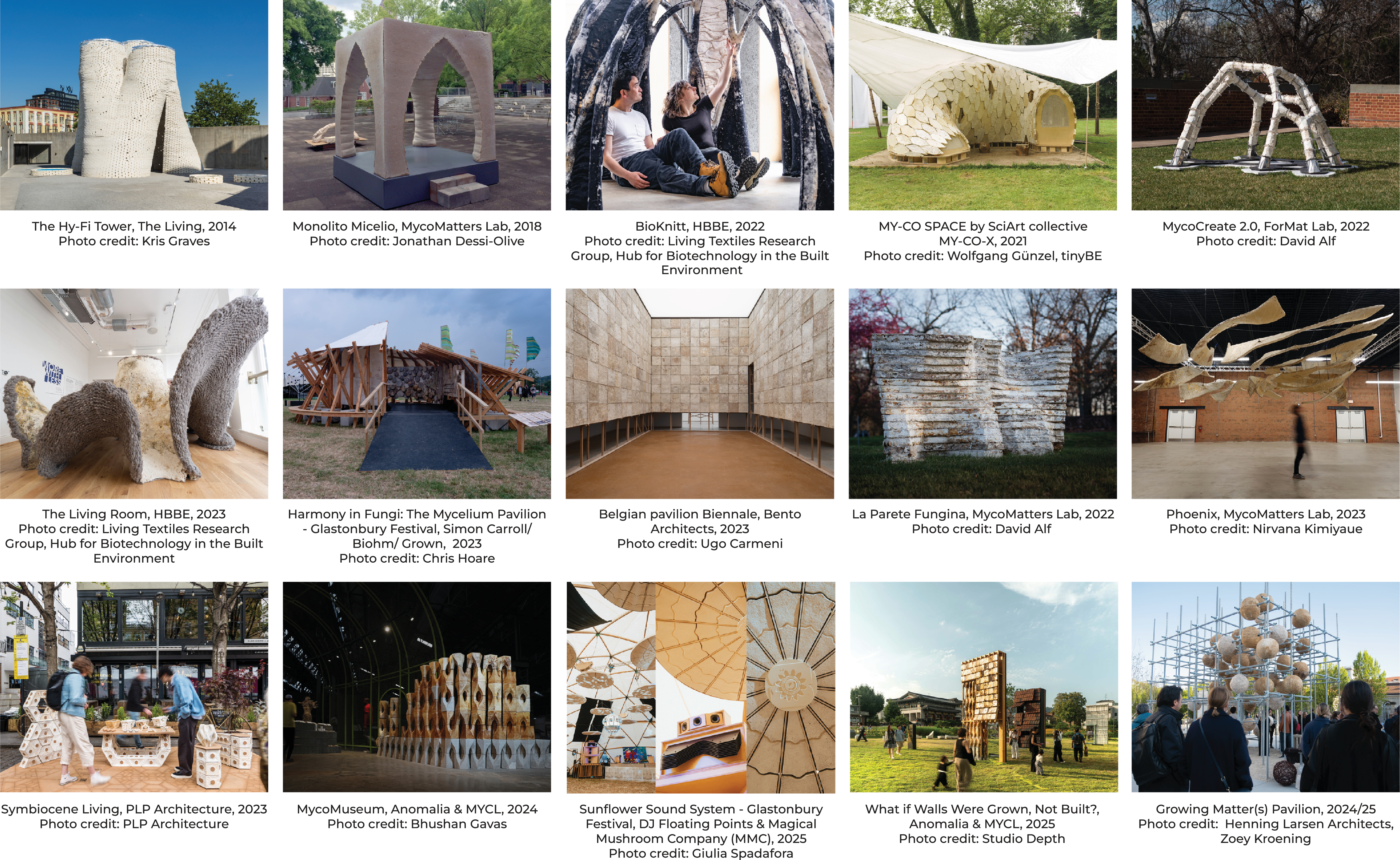
Over the past decade, mycelium-based materials have increasingly appeared also at the architectural scale, primarily through experimental pavilions, installations and demonstrator projects. Early milestones such as Hi-Fi Tower (The Living 2014) and MycoTree (Hebel & Block Reference Hebel2017) established proof of concept for load-bearing mycelium assemblies and compression-based structural logics. Subsequent projects such as Monolito Micelio (MycoMatters Lab 2018), The Growing Pavilion (New Heroes & Krown Design 2019), MY-CO SPACE (V. Meer 2022), BioKnit (HBBE 2022), Symbiocene Living (PLP Architecture 2023) and Growing Matter(s) (Henning Larsen Architects 2025) have expanded the discourse toward spatial enclosures, façade systems, festival structures and bio-integrated architectural components with variety of construction techniques applied (Figure 1). These projects collectively demonstrate the scalability, tectonic potential and expressive qualities of mycelium composites at pavilion and installation scale. However, most remain temporary structures, experimental demonstrators, or short-term cultural installations. Long-term inhabitation, certification pathways, structural standardisation and systematic performance monitoring remain largely underdeveloped. In many cases, mycelium components are integrated with timber or steel substructures, reinforcing the perception of the material as secondary or infill rather than primary structural logic. While architectural prototypes have proven feasibility at large scale, the methodological translation between material research, structural validation and everyday interior use remains fragmented. This gap underscores the need for frameworks that connect material experimentation across scales, from furniture to pavilion within a continuous, performance-driven research strategy.
Examples of mycelium-based materials applied to architectural scale pavilion-like structures.

Figure 1. Long description
The figure presents a collage of fifteen photographs showcasing mycelium-based architecture, design and art projects completed between 2014 and 2025. The examples include pavilions, installations, furniture, exhibition spaces and architectural elements developed by research groups, design studios and architects. Together, they illustrate the diversity, scale and growing adoption of mycelium materials across the built environment and product design.
Academic research and experimental fabrication techniques
Academic research has expanded the material development, compositions and fabrication possibilities of mycelium-based composites by demonstrating how substrate variation, growth conditions and fabrication strategies influence mechanical, thermal and structural performance (Jiménez-Obando et al. Reference Jiménez-Obando, Arcila, Tolosa-Correa, Valencia-Cardona and Montoya2025). Experimental approaches such as fabric forming (Piórecka Reference Piórecka2019; Piórecka et al. Reference Piórecka, Morais and Levy2023b), 3D-printed moulds intersecting with mycelium growth (Parker et al. Reference Parker, Ilgün, Sin Lim, Vašatko, Vu, Piórecka and Keune2023; Piórecka et al. Reference Piórecka, Grigoriadis, Devadass, Meng, Perutxet Olesti, Parker and Cruz2023a) and additive manufacturing of living scaffolds (Diniz Reference Diniz2023; Gantenbein et al. Reference Gantenbein, Colucci, Käch, Trachsel, Coulter, Rühs, Masania and Studart2022) have demonstrated the versatility of mycelium composites as part of broader material system. However, these investigations often remain isolated case studies, focused on specific techniques or formal outcomes rather than on transferable, application-oriented methodologies. At the architectural scale, many realised projects function primarily as demonstrative installations (Figure 1), where stability is frequently ensured through external frames, hybrid assemblies, or temporary conditions rather than through the material itself. Before such systems can be reliably implemented at scale, systematic testing at smaller, tangible scales, particularly furniture, is essential. Furniture scale applications allow material composition and form to be co-developed in relation to function, enabling the study of performance, ergonomics, durability and user interaction under real conditions. This intermediate scale is critical for building trust in the material and for developing a design language grounded in the structural behaviour of mycelium-based composites, without which their translation to architectural applications remains limited.
Being one of the most biodiverse groups on Earth, with an estimated 2.2–3.8 million species, fungi play critical ecological roles in decomposition, nutrient cycling and symbiosis, functions that offer extraordinary potential for material innovation (Hawksworth and Lücking Reference Hawksworth and Lücking2017). Yet, despite this immense biological diversity, research on mycelium-based materials remains concentrated on a narrow subset of commercially available species. The broader spectrum of fungal behaviours and structural capacities is largely unexplored. Moreover, the systematic comparison of tested materials remains difficult: variations in substrate composition, growth parameters, compaction techniques, drying conditions and environmental settings significantly influence performance outcomes, while standardised testing protocols and reporting frameworks are still limited. As a result, direct juxtaposition of findings across studies is challenging and the full material potential of fungi remains underdeveloped. At the same time, the distinctive strength of mycelium-based composites lies precisely within the collaboration with living organisms. Unlike inert industrial materials, MBCs emerge through biological growth processes that retain a degree of variability and responsiveness. Consequently, even under controlled laboratory conditions, performance can exhibit subtle fluctuations. Rather than constituting a flaw, this partially unpredictable behaviour reflects the material’s living nature and represents both a methodological challenge and a source of design potential.
Challenges of industrial applications and commercialisation
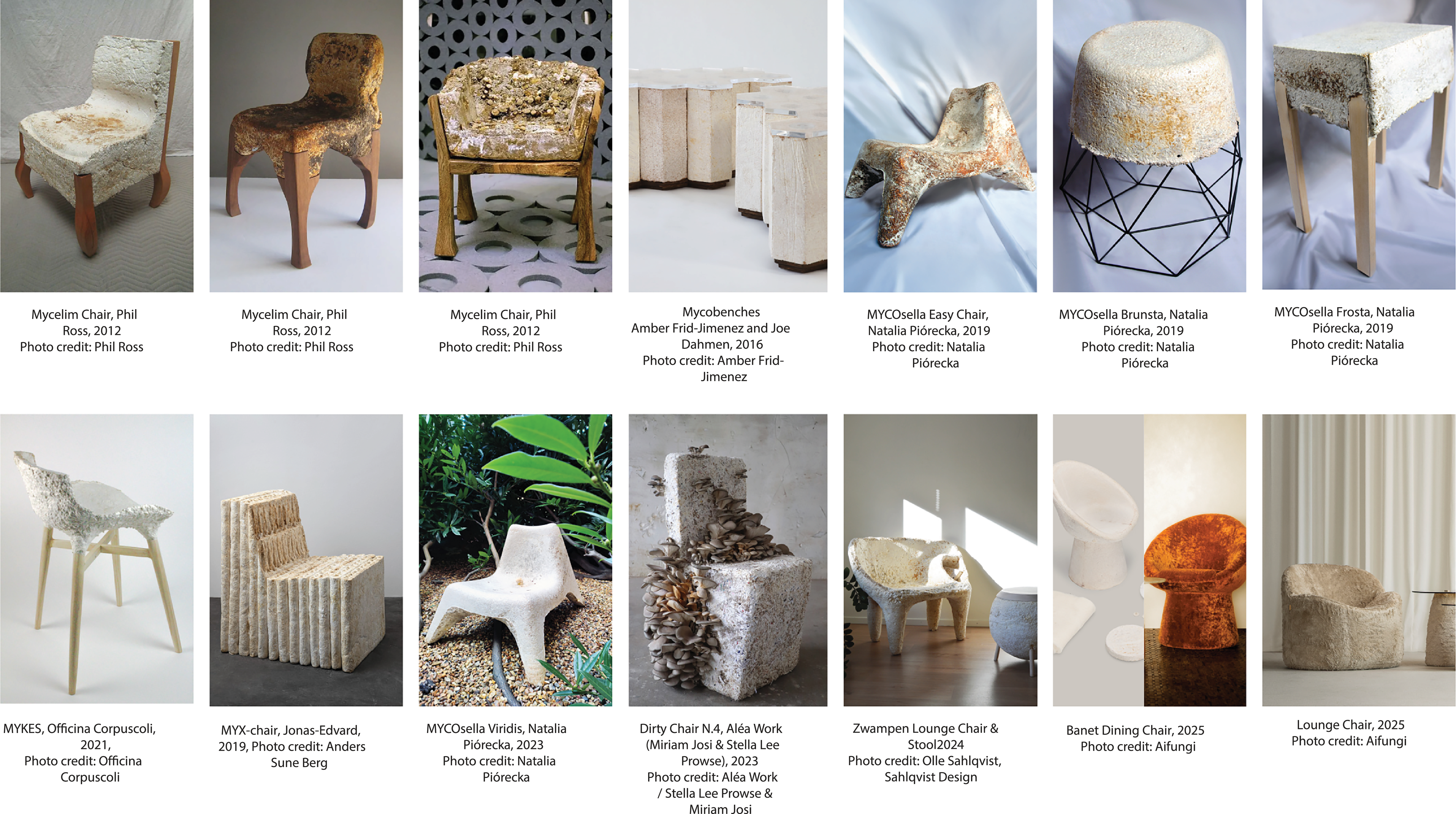
At the product, furniture and interior scale, mycelium-based materials have been explored both commercially and experimentally. Industrial actors such as Ecovative (USA), Biohm (UK), MOGU (Italy) and MycoWorks (USA) have demonstrated that mycelium composites can be scaled and integrated into established production chains, resulting in products such as acoustic and insulation panels, interior tiles, floor panels and mycelium-based leather alternatives (Camilleri et al. Reference Camilleri, Narayan, Lingam and Blundell2025). In parallel, design-led applications have applied mycelium to seating, lighting and sculptural interior elements or furniture highlighting the material’s tactile qualities and potential to replace petrochemical foams and synthetic composites in interior contexts (Figure 2). However, both industrial and experimental approaches reveal persistent limitations. Commercial products typically rely on a narrow range of fungal species, resulting in a uniform white appearance valued for predictability but restrictive in aesthetic diversity (Jones et al. Reference Jones, Bhat, Huynh, Kandare, Yuen, Wang and John2018). Market-ready finishes are therefore often achieved through paints, laminates, or non-biodegradable coatings, frequently involving petrochemical inputs or energy-intensive processes (Appels et al. Reference Appels, Camere, Montalti, Karana, Jansen, Dijksterhuis, Krijgsheld and Wösten2019). Furniture-scale applications of mycelium-based materials have existed for over a decade, with early demonstrators by Phill Ross (Maxmen Reference Maxmen2013), or MYCOsella series (Piórecka Reference Piórecka2019) exploring seating as a tangible interface between living materials and users. Across the development of mycelium-based furniture, different structural strategies have been explored to negotiate material performance at the furniture scale. Early works by Phil Ross (Reference Ross2012) and later projects by Officina Corpuscoli (2021) integrated timber substructures or hybrid assemblies to ensure stability and usability, while other applications incorporated metal frames or other reinforcements to meet structural and safety expectations.
Selected mycelium-based chair prototypes developed between 2012 and 2025, illustrating the evolution of furniture-scale experimentation across artistic, academic and industrial contexts.

Figure 2. Long description
The figure presents a collage of fifteen photographs illustrating the evolution of mycelium-based furniture and seating design. The examples include chairs, stools, benches and lounge furniture created between 2012 and 2025 by designers, artists and research groups. Together, they demonstrate the diversity of forms, fabrication techniques and aesthetic approaches achieved with mycelium composites, ranging from experimental prototypes to refined furniture pieces.
Parallel investigations have explored more monolithic applications. The MYCOsella series (Piórecka Reference Piórecka2019) tested the self-supporting potential of mycelium composite without auxiliary reinforcement, foregrounding questions of geometry-driven stability, challenging material strength. More recent commercially oriented examples, such as Aifunghi (2025a; 2025b), extend this exploration by combining structural mycelium elements with additional bio-based layers to enhance tactile and surface qualities. These varying strategies illustrate an evolving dialogue between structural reliability, sensorial refinement and material expression. At the same time, they point toward further opportunities to cultivate differentiated textures, finishes and structural behaviours directly through biological growth rather than through additional layering, highlighting both the challenge and potential of mycelium-based materials.
Despite this early emergence, progress toward functional, repeatable and well-documented furniture applications has remained limited. Many contemporary examples continue to appear as one-off prototypes or exhibition pieces, often designed for short-term display rather than prolonged use. Documentation of such works typically emphasises final form or material novelty, while fabrication workflows, iterative testing and performance under repeated use are rarely reported. As a result, mycelium-based furniture is frequently presented as an outcome that showcases possibility rather than as an active research instrument capable of generating transferable knowledge or demonstrating functional value.
Limits of current research trajectories
The developments outlined above have advanced the visibility of mycelium-based materials, yet they have also contributed to a stagnation at the level of demonstrators. In practical terms, this stagnation manifests as a continued production of visually compelling prototypes without corresponding advances in long-term structural durability studies, expanded fungal species exploration, comparative material matrix development, or standardised testing frameworks. Feasibility is repeatedly shown, but systematic progression toward validated and transferable systems remains limited.
As a result, material development risks becoming partially decoupled from design practice. Biomaterials demand a reciprocal relationship between material and form, in which composition is tailored to functional requirements and geometry evolves in response to material capabilities and constraints. The capacity to adjust substrate composition, fungal species, growth parameters, density and structural configuration in relation to intended use is central to advancing mycelium-based composites beyond demonstrators, particularly at the furniture scale, where ergonomics, comfort, structural performance and human–material interaction can be critically assessed over time.
Yet public interaction with such materials remains largely confined to curated exhibition contexts, academic showcases, or short-term installations. In these settings, engagement is often limited in duration and controlled in intensity, with objects treated as artefacts rather than as everyday furnishings subjected to sustained use. Consequently, opportunities to observe long-term wear, structural fatigue, ergonomic performance, maintenance needs and user perception over time remain scarce. This restricted exposure limits the ability to evaluate how mycelium-based materials behave under routine domestic conditions, how users relate to their tactile and aesthetic qualities and whether initial curiosity can translate into lasting acceptance and trust.
The field also operates at the interface between academia and industry. Academic projects frequently prioritise experimentation, expressive exploration and speculative application, while industrial actors may conduct extensive internal testing but do not publicly disclose methodologies or long-term performance data due to proprietary constraints. Consequently, transparent, comparative knowledge across the field remains fragmented.
Furthermore, the temporal dimension of mycelium-based material, both during biological growth and throughout extended use, remains insufficiently examined. Long-term ageing behaviour, durability under repeated load and performance degradation are rarely documented in depth. The ecological implications of scaling production and the regional adaptability of fungal species are similarly underexplored. Growth performance, substrate compatibility, climatic tolerance and decomposition behaviour vary significantly across environmental contexts, yet this regional dimension is often overlooked in favour of globally standardised approaches.
Despite substantial progress, the broader biological potential of fungi remains only partially investigated. Most studies rely on a limited range of commercially available species, with little systematic expansion into fungal diversity, multi-organism systems, or substrate variability. Fungi’s intrinsic capacities for pigmentation, surface differentiation, structural differentiation and adaptive behaviour are only beginning to be explored. Aesthetic and tactile qualities are frequently treated as post-processing additions rather than properties emerging directly through biological growth. Biological variability, in turn, is often framed as a constraint to be controlled rather than as a productive parameter within design. Taken together, these limitations indicate that while mycelium-based materials are increasingly accepted within architectural and design discourse, a coherent methodological framework that integrates biological diversity, performance validation, temporal evaluation and design logic remains underdeveloped.
Beyond the state of the art
Taken together, existing industrial and academic work demonstrates that mycelium-based materials are viable and increasingly accepted within interior and architectural contexts, with growing interest from designers seeking alternatives to extractive material systems. What remains underdeveloped is a methodological understanding of how to work with these materials as living systems across scales, particularly in ways that connect material experimentation with functional deployment and long-term use – particularly when transitioning from laboratory samples to large scale prototypes and functional applications.
As scale increases, the complexity of growth control, contamination risk, moisture gradients, density consistency and structural reliability intensifies. Moreover, the often-referred advantage of low-energy production becomes increasingly difficult to maintain at larger scales. Automation and industrial optimisation may improve consistency and quality, yet they frequently introduce higher energy inputs and, consequently, increased carbon footprints. Navigating this tension, between biological integrity, production control and environmental impact, poses a fundamental question for the biodesign laboratory: how can material development remain low impact while achieving reliability and applicability?
Equally, the regional specificity of fungal species is often neglected in discussions of scalability and implementation. Fungal growth performance, substrate compatibility, climatic tolerance and post-use decomposition behaviour are deeply dependent on local environmental conditions and microbial ecologies. Not every species, substrate, or composite strategy will perform uniformly across geographic contexts, particularly when biodegradability and ecological reintegration are core to the material’s value. Ignoring this regional dimension risks oversimplifying biological systems into globally standardised products, undermining both ecological sensitivity and long-term viability.
Furthermore, most studies focus on a limited number of commercially available species and singular material formulations. A systematic exploration of fungal diversity, substrate combinations and compositional variability remains largely absent. Yet such investigation is essential to unlock differentiated mechanical, structural, aesthetic and tactile capacities inherent in fungal systems.
There is a need for integrated frameworks that move beyond isolated material studies or product demonstrators and instead address the expansion of fungal species and substrates, the integration of biological processes into design workflows, the translation of experimental techniques into functional interior applications and the role of interdisciplinary collaboration, teaching and production environments in biodesign research.
Research context and methodology
The present work builds on this foundation by proposing a framework that links material experimentation, performance-driven testing, furniture-scale application, material development and testing and spatial deployment within a single methodological approach. The following section outlines the research context and methodology through which this framework was developed.
Interdisciplinarity and distributed expertise
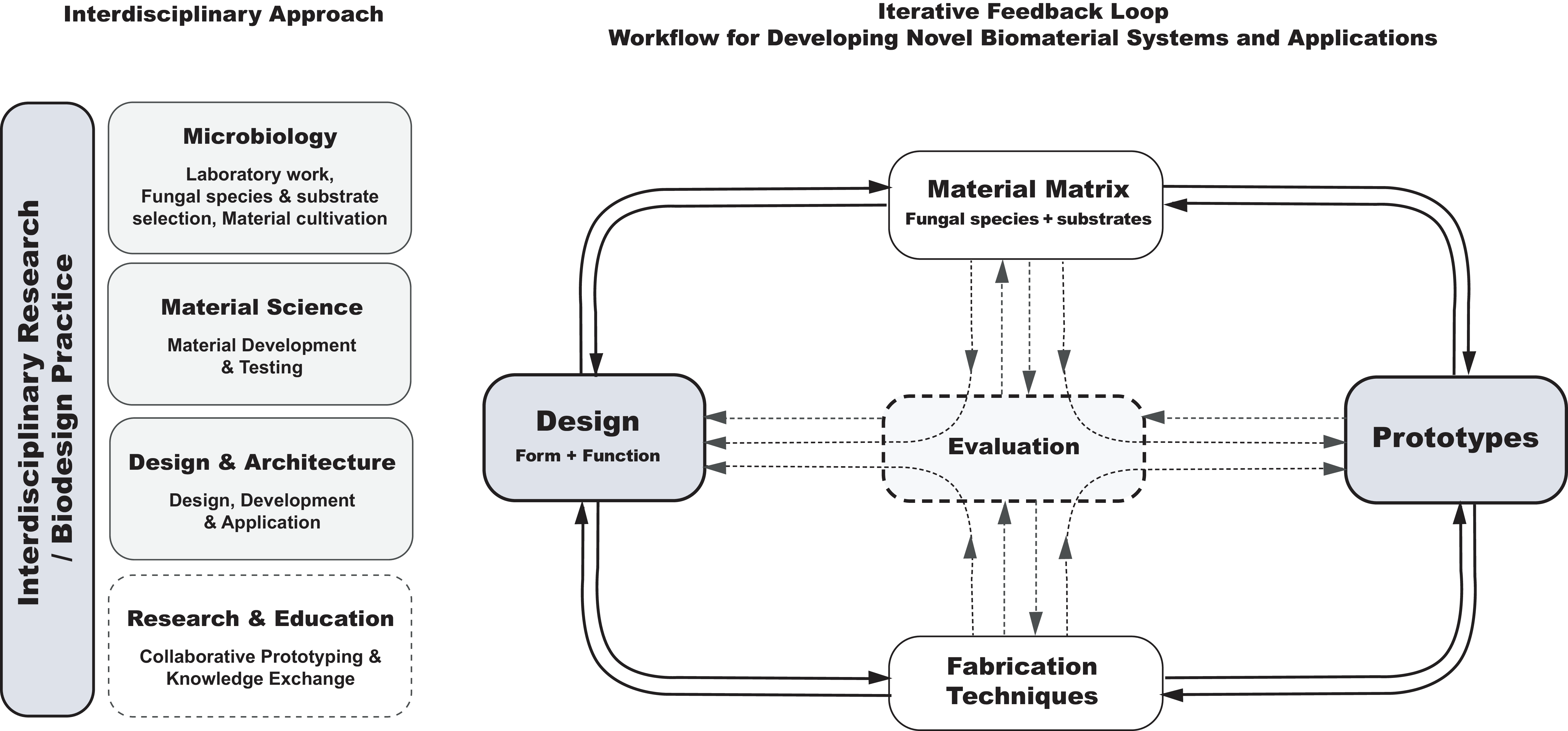
The MUSE project is situated within an interdisciplinary research context where material development, biological processes, design and fabrication are developed in parallel. The research brings together expertise from architecture, product design, material science, engineering, microbiology and mycology, with each discipline contributing specific knowledge at different stages of the process. The project embraces a distributed model of expertise, in which decisions emerge through continuous negotiation between biological behaviour, material constraints and design intent. This interdisciplinary setup reflects the realities of contemporary biodesign practice, where no single discipline can fully address the complexity of working with living materials. Knowledge is therefore generated collectively through making, prototyping, testing and reflecting across scales, with material behaviour informing design decisions and vice versa (Figure 3).
Interdisciplinary Approach and Iterative Feedback Loop workflow implemented in the MUSE project. Photo Credit: Natalia Piórecka and ©MUSE.

Figure 3. Long description
The diagram presents an interdisciplinary workflow for developing biomaterial systems and their applications through an iterative feedback loop. On the left, four disciplines contribute to the process: Microbiology (laboratory work, fungal species and substrate selection, material cultivation), Material Science (material development and testing), and Design & Architecture (design, development and application), supported by Research & Education (collaborative prototyping and knowledge exchange). These inform four interconnected stages: Material Matrix (fungal species and substrates), Design (form and function), Fabrication Techniques, and Prototypes. At the centre, Evaluation connects all stages through bidirectional arrows, indicating continuous assessment and refinement. The circular workflow illustrates how material development, design, fabrication and prototyping repeatedly inform one another throughout the research process.
Designing through the lens of extremes
A central methodological strategy of the research is the use of extreme scenarios as material testing conditions. Instead of beginning with conventional furniture typologies, MUSE deliberately situates early material development within a highly constrained and demanding context: racing car seat. This environment imposes strict requirements related to weight, ergonomics, pressure distribution, friction, safety and durability, significantly exceeding the demands of typical interior applications.
Working through the lens of extremes accelerates material learning by exposing weaknesses, limitations and performance thresholds early in the process. Rather than testing materials incrementally, extreme scenarios function as intensified stress environments, revealing which compositions, densities and fabrication strategies can withstand demanding conditions and which require refinement. In doing so, the methodology establishes a performance-driven foundation for subsequent translation into less constrained contexts, ensuring that material development is guided by structural necessity, while still embracing the adaptive variability of living systems.
Iterative design development, feedback loops & research-through-design
Material and prototype development within MUSE follows an iterative feedback loop workflow, implementing concepts of research-through-design (RtD) methodology – characterised by repeated cycles of prototyping, testing, evaluation and adjustment (Gaver Reference Gaver2012; Zimmerman et al. Reference Zimmerman, Forlizzi and Evenson2007). Material samples, components and furniture elements are continuously modified in response to observed behaviour during fabrication, growth, assembly, drying and use. Rather than pursuing linear optimisation, the process allows material composition and design geometry to co-evolve through successive iterations.
Feedback loops operate across multiple scales: from small material samples to component-level tests and full-scale furniture prototypes. Failures, such as cracking, deformation, contamination, or insufficient structural capacity are treated not as setbacks but as sources of knowledge that inform subsequent design and material decisions. This iterative approach allows both material composition, specific fabrication technique and form to evolve together, ensuring that design responds directly to material capabilities and limitations with every iteration addressing the challenges of the previous.
The research is grounded in a RtD methodology, where knowledge is generated through the act of designing, making and testing rather than through controlled optimisation alone. This approach is particularly suited to biodesign, where biological variability, temporal processes and environmental sensitivity challenge conventional experimental protocols.
Within MUSE, furniture and interior design objects function as research instruments rather than final products. Prototypes are used to probe material behaviour under real conditions, including human interaction, load, wear and environmental exposure. Design outcomes therefore serve as both artefacts and experimental setups, allowing qualitative and quantitative observations to inform subsequent development cycles.
Set-up of a biodesign lab
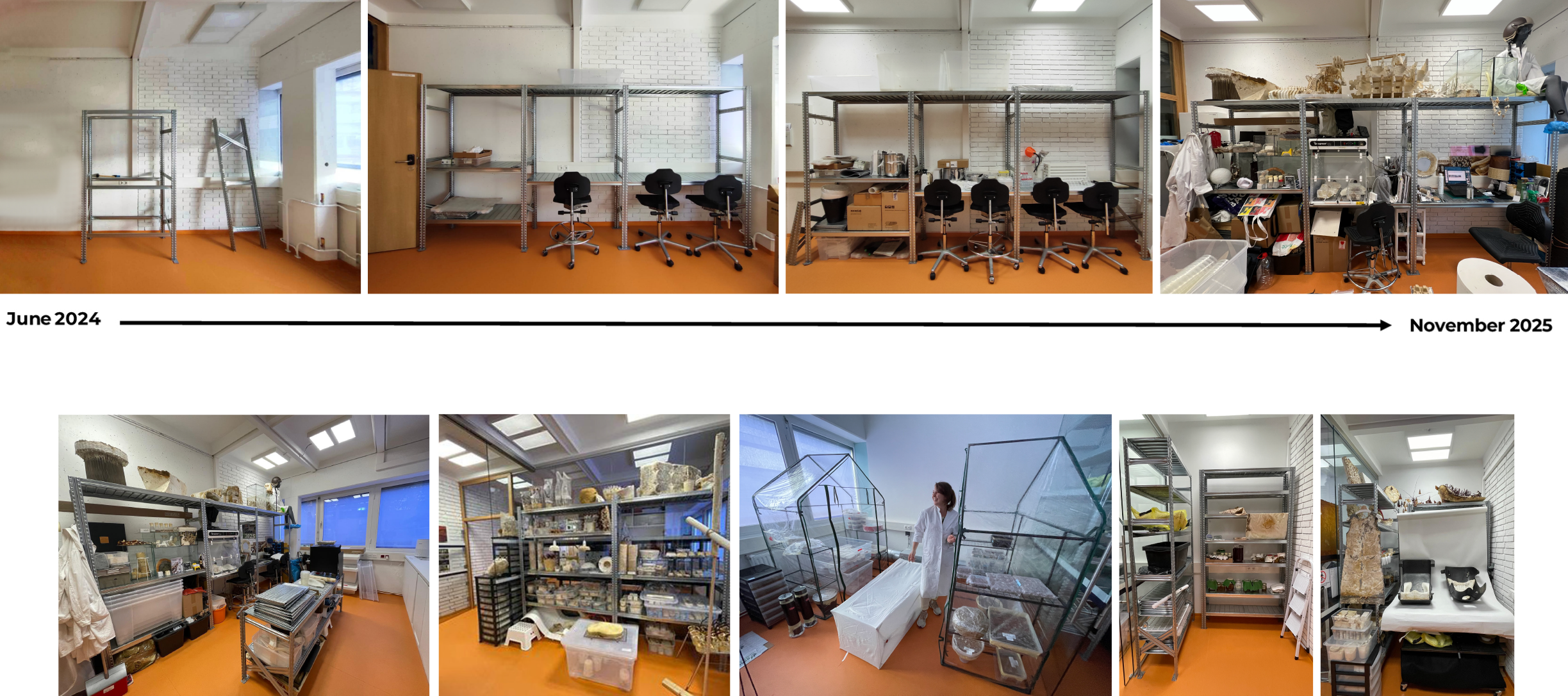
The research was conducted within an academic “Biodesign Laboratory.” During the lab set-up, focus was given on evaluating the “least required” equipment allowing for biomaterial approach also at large scale (Figure 4). This approach directly engaged with the scalability tension identified in the previous section, questioning how biological material development can remain low impact while advancing toward functional application.
Setting up an Integrative Design/EXTREMES – Biodesign Lab. Photo Credit: ©MUSE.

Figure 4. Long description
The figure presents a chronological series of nine photographs documenting the establishment and expansion of the Integrative Design/EXTREMES Biodesign Laboratory between June 2024 and November 2025. The top row shows the gradual transformation of an initially empty workspace into a functioning laboratory with shelving, workstations, equipment and storage. A timeline indicates the progression from June 2024 to November 2025. The bottom row presents the completed laboratory, including material storage, cultivation and preparation areas, shelving with samples and equipment, greenhouse structures for biological experiments, and dedicated workspaces. Together, the photographs illustrate the development of the research environment supporting interdisciplinary biomaterial cultivation, fabrication and testing.
Within this context, variations in temperature, humidity, handling procedures and contamination risk were not treated as shortcomings but as inherent methodological parameters. Growth cycles, drying methods, moulding techniques and material handling procedures were continuously adjusted to accommodate variability in space, equipment and environmental stability. In this sense, the research did not begin from the premise of industrial precision, but from the premise of practical accessibility, asking what it means to develop functional mycelium-based furniture within conditions that mirror real-world design studios rather than specialised biotech facilities – foregrounding questions of robustness, adaptability and repeatability and tests whether mycelium-based materials can be developed and fabricated under conditions closer to real-world practice.
As prototype scale and material demand increased, the laboratory itself became an object of investigation. The team began to systematically rethink the laboratory setup, exploring how a conventional design lab could be gradually transformed into a low-energy, low-maintenance biotechnology environment. This included reorganising spatial zoning, refining contamination protocols, improving passive environmental control strategies and optimising growth and drying processes to reduce energy intensity while maintaining professional standards. Rather than adopting a high-energy, industrial biotechnology model, the project sought to develop a professional yet resource-conscious laboratory infrastructure, balancing biological reliability with ecological responsibility. In doing so, the lab evolved from a contextual condition into an active research component, testing how biotechnology can be embedded within design practice in a way that remains accessible, adaptable and environmentally aware.
Teaching as a methodological instrument
A distinctive aspect of the MUSE methodology is its integration with teaching-based fabrication. Material development and prototyping were carried out in parallel with design seminars and workshops, where students actively participated in growing, moulding and assembling mycelium-based elements. Rather than positioning teaching as a secondary activity, the project treats it as a distributed, Do it yourself (DIY) oriented production model.
This approach reflects the current state of biodesign, where large-scale industrial infrastructures are still emerging, and experimentation often takes place within educational or small-scale contexts. The pedagogical setup allows multiple material variations to be explored simultaneously, accelerates prototyping through collective effort and generates a broad material archive. At the same time, it raises critical questions about standardisation, responsibility and quality control when living materials are produced collaboratively.
By framing teaching as a testing ground for real-world fabrication, the methodology examines what it would mean to design and produce functional objects using mycelium-based materials outside industrial or laboratory settings and how knowledge can be shared, scaled and transferred within such conditions.
Project/case study: the MUSE framework in practice
The MUSE project operationalises the methodological framework outlined above through a sequence of interconnected phases. These phases move from extreme performance testing to translation of the test outcomes into interior applications and finally to spatial deployment in real life context, allowing material knowledge to develop progressively across scales.
Phase I – extreme scenario: racing car seat inserts
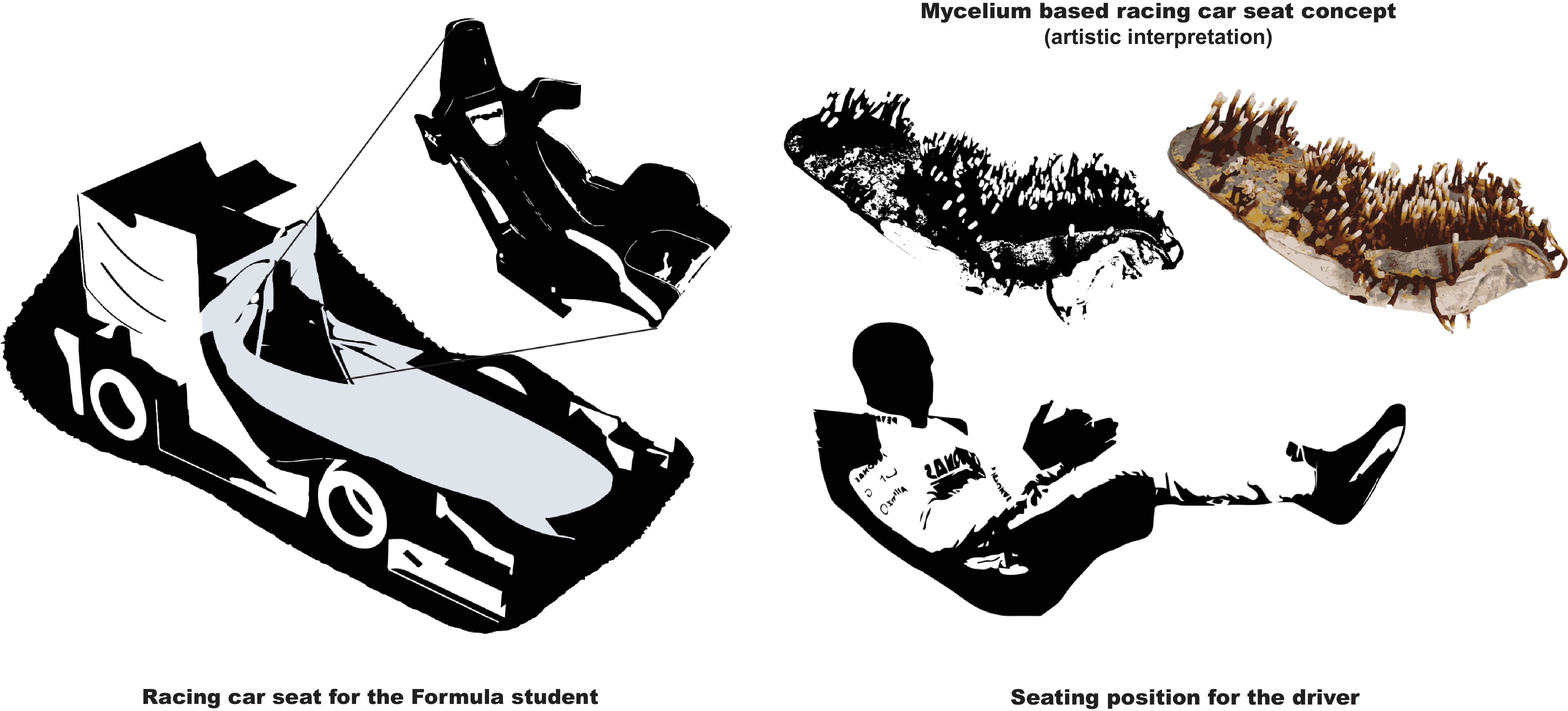
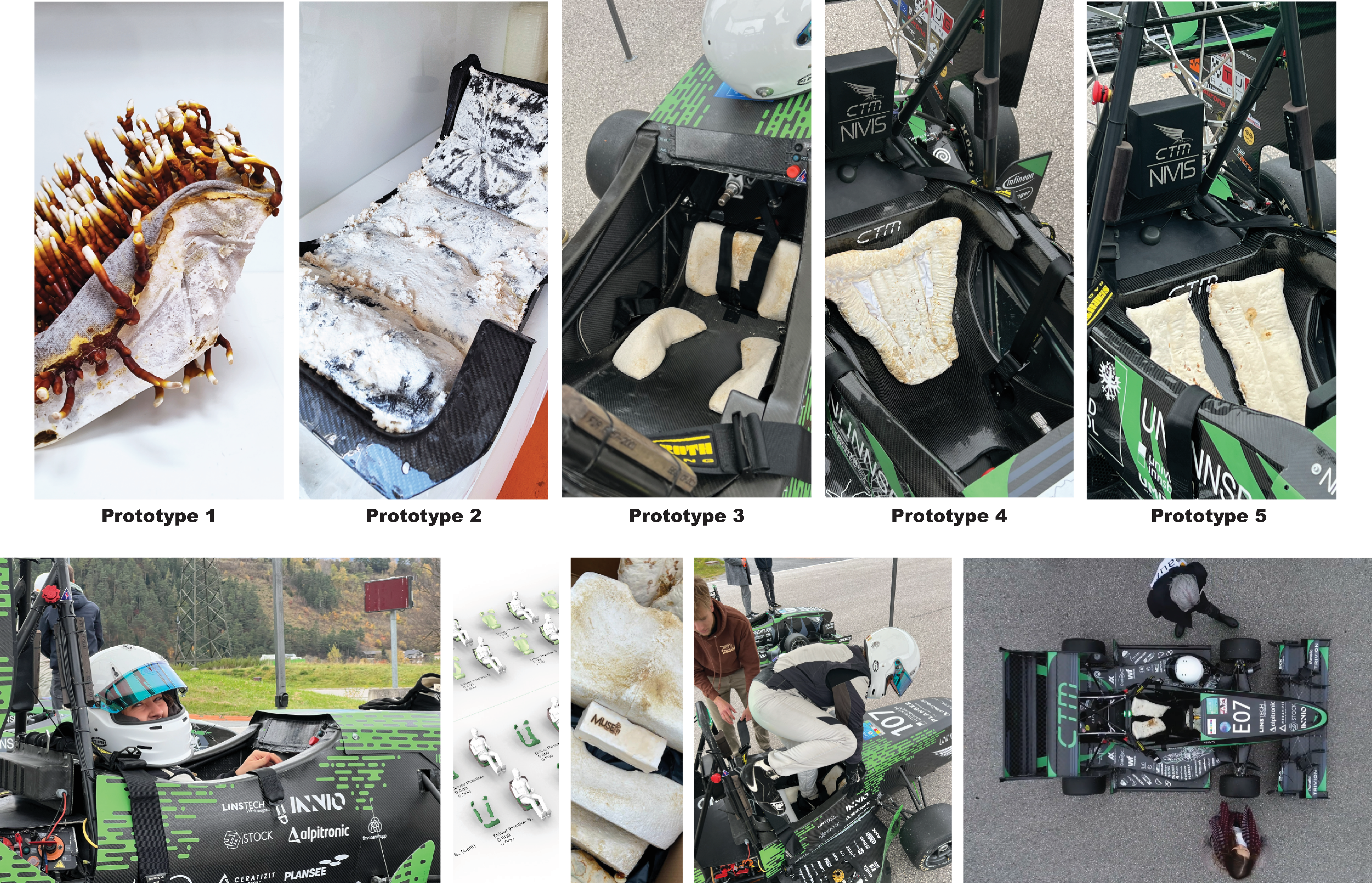
The first phase of the project focused on the development of five distinct mycelium-based seat insert prototypes for racing applications (Figures 5 and 6). In this case the racing car development by the Campus Tirol Motorsport (CTM) team is part of a European wide student initiative for developing e-racing cars with advanced electric motors and other necessary periphery parts such as seats. Each seat prototype explored a different fabrication workflow and structural strategy, allowing comparative evaluation of performance, ergonomics and manufacturability under extreme constraints.
Illustration of the first racing car seat prototype fitting into the car, according to drivers’ ideal position. Photo Credit: Natalia Piórecka and ©MUSE.

Figure 5. Long description
The figure illustrates the conceptual workflow for developing a mycelium-based Formula Student racing seat. On the left, a schematic racing car highlights the location of the driverʼs seat. Below, the driverʼs seating position is shown in a reclined posture. The seat geometry is then translated into a racing seat form, which serves as the basis for the proposed mycelium-based seat. On the right, two artistic visualisations depict the concept as a biomaterial component with mycelium growing around the seat structure. The diagram demonstrates the progression from ergonomic requirements to a biomaterial design concept.
Illustration of the 5 various prototypes created and the testing session in the CTM racing car. Photo Credit: ©MUSE.

Figure 6. Long description
The figure presents a series of photographs documenting five iterations of a mycelium-based Formula Student racing seat. The prototypes show progressive improvements in geometry, material quality and integration within the racing vehicle. Additional photographs illustrate the seat installed in the race car, fabrication and preparation for the on-site instalation, and the completed vehicle with the final seat in use. Together, the images demonstrate the iterative development and validation of the biomaterial seat concept.
The process began with an analysis of multiple drivers and their respective ergonomic requirements. Racing seats demand precise body alignment to ensure safety, stability under acceleration and optimal pressure distribution. Differences in body type, posture and driving position required adaptable solutions rather than a single fixed geometry. The project therefore investigated the possibility of producing interchangeable insert sizes that could be replaced between drivers depending on body dimensions and support needs.
For the primary driver, a detailed body scan was conducted to capture anatomical measurements and positional data. This digital model enabled the development of a highly precise seat imprint, including lower back support, shoulder stabilisation and lower leg positioning. The aim was to create a close-fitting insert that maximised contact while minimising unnecessary material mass.
Across the five prototypes, multiple fabrication strategies were tested. These ranged from precise 3D-printed mould systems, which allowed high geometric control and repeatability, to fabric-based forming techniques and manually crafted moulding approaches that permitted adaptive shaping and material efficiency. By varying the workflow from digitally controlled mould generation to more flexible forming processes, the research evaluated not only material behaviour but also the feasibility and scalability of different production logics.
Material composition and fabrication methods were iteratively refined in parallel with mechanical and performance testing. Importantly, the prototypes were not only evaluated in laboratory conditions but also tested in the field (Figure 6). The Integrative Design | EXTREMES (ID/E) - MUSE team had the opportunity to drive the Formula Students car of the MUSE project partner Campus Tirol Motorsport (CTM) and directly assess performance, comfort, pressure distribution and ergonomic stability under real racing conditions. This experiential testing provided critical feedback on functionality, ergonomic performance and user perception, contributing to a more comprehensive understanding of functional viability.
Through this phase, the racing seat inserts operated as fully functional prototypes, enabling the consolidation of fabrication strategies, ergonomic configurations and material parameters necessary for subsequent translation into interior applications.
Material matrix development and knowledge transfer
Rather than identifying a single “optimal” formula, the research consolidated a range of viable compositions adaptable to different performance requirements. Central to this process was the development of a Material Matrix: a comparative framework in which multiple fungal species and substrates were systematically tested and evaluated. The fungal species were chosen based on their hyphae types and density of growth. Substrate fibres, where selected based on their fibre types and particle sizes.
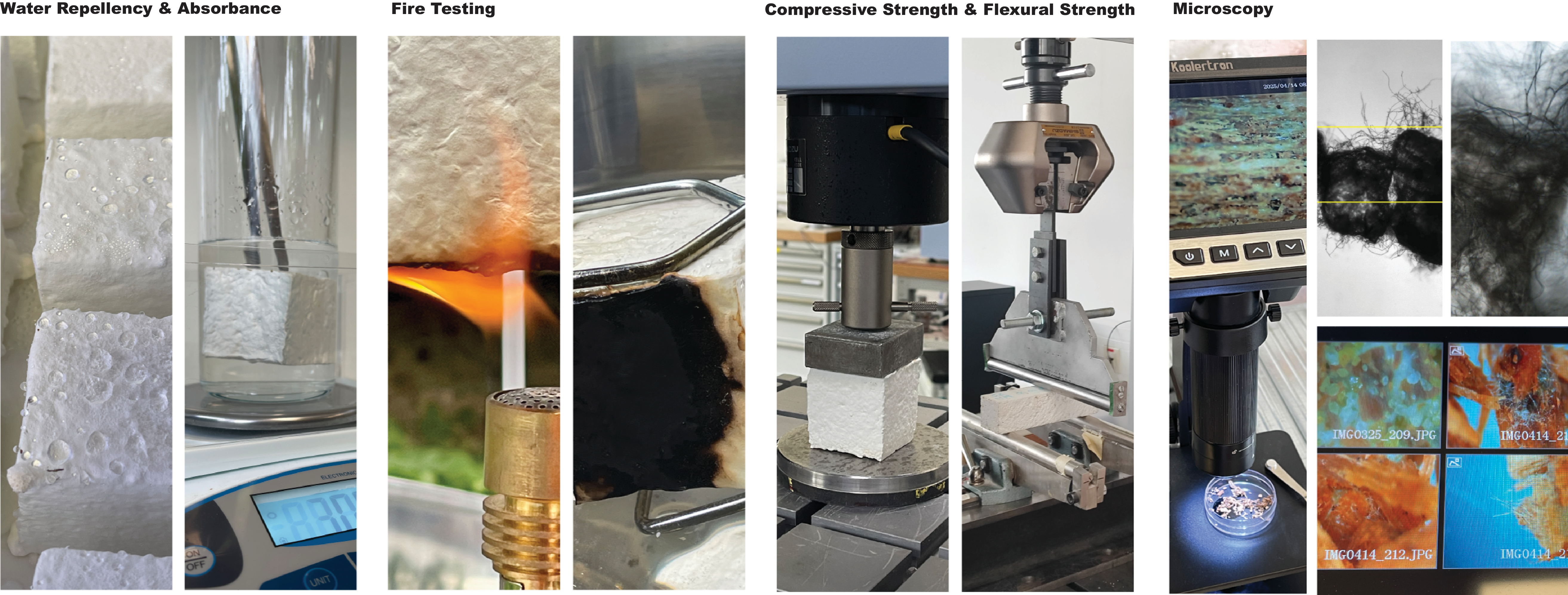
The objective was not uniform optimisation, but the creation of a flexible compositional biomaterial system capable of being tailored to specific structural, ergonomic and sensorial demands of the design. Primary variation in the material matrix was the combination of the fungal species and substrates, which alongside maintained environmental conditions allowed variation of material properties, such as stability, weight, stiffness, structural strength, as well as its tactile and visual appearance. The evaluation criteria for material samples across material matrix, was based on the series of qualitative material testing including compressive strength and flexural behaviour through three-point bending tests, fire resistance and water absorption capacity (Figure 7). In addition, microscopic analysis was conducted to examine the surface condition and mycelium-substrate interaction of the resulting compositions. These examinations in combination with qualitative assessments: tactile (texture, roughness, softness, surface finishes), aesthetic (colouration, patterns, morphology) and multi-sensory (smell, thermal perception, acoustic response, user interaction) provided a comprehensive understanding of material characteristics across compositions.
Material testing conducted for various compositions of material. Photo Credit: ©MUSE.

Figure 7. Long description
The figure presents photographs of laboratory methods used to evaluate mycelium-based materials. The tests include water repellency and absorbance, fire resistance, compressive and flexural strength, and microscopic analysis of the material structure. Together, the images illustrate the experimental procedures used to assess the physical, mechanical and structural properties of the developed biomaterials.
Phase II – Translation to furniture
Building upon the material matrix development, consolidated through systematic testing, the second phase focused on the translation of performance-driven material knowledge into functional interior furniture. Whereas the racing inserts operated under highly constrained extreme conditions, the furniture phase required balancing structural reliability with ergonomics, tactility, aesthetics and fabrication feasibility. Knowledge gained, informed design guidelines in tailoring of the material selection and specific fabrication techniques, to form and possible applications. Rather than separating material development from fabrication processes and assemblies, this matrix-based approach enabled material composition to co-evolve along the production strategies enabling the creation of a catalogue of various prototypes which outcomes fed back to the original designs. This approach established the technical and methodological foundation for translating performance-driven material logic beyond the racing context and into furniture and interior applications.
A range of furniture typologies, including chairs, stools, tables, wall panels, sculptures, lamps and smaller interior objects were developed as experimental prototypes. Rather than applying a fixed material recipe, compositions were selected and adjusted from the previously established matrix according to anticipated load conditions and functional requirements. Higher-density blends were deployed in load-bearing zones, while lighter or more porous compositions were used where structural demand was reduced.
Multiple fabrication strategies were employed to explore how workflow influences structural performance and material expression. This included fabric forming, in which textile membranes shaped growth through tension; precise 3D-printed mould systems enabling high geometric control and repeatability; and assembled hybrid mould constructions combining various components to achieve complex forms. By comparing digitally controlled mould production with more adaptive, manually constructed systems, the research aimed to explore a precision, scalability and material efficiency across different fabrication logics.
The interaction between biological feedstock, growth constraints, fabrication strategies and mould geometry and mould material exposed a range of intrinsic behaviours in scaled up objects, including density gradients, fibre orientation patterns, shrinkage variations, colouration and surface differentiation. Rather than treating these effects as irregularities to be eliminated, they were documented and analysed as material traits emerging from the interplay between biological processes, environmental conditions and design parameters, forming the basis for further investigation. This insight reinforced the need for a reciprocal relationship between material, designed geometry and its production, where form evolves in response to biological behaviour.
Furniture thus functioned as an intermediary scale between material samples and architectural deployment. At this level, structural performance and behaviour was examined under everyday loading, at the same time evaluating human–material interaction, ergonomic comfort and fabrication repeatability, alongside the fulfilment of the desired function of the application, what allowed to critically and in depth assess the prototypes. The furniture phase therefore operated not merely as application, but as a controlled expansion of the material system into functional interior use, preparing the groundwork for its subsequent integration within The “Living” Room installation, firstly exhibited at the FUNGA-exhibition in the South Tyrol Museum of Nature (Naturmuseum Südtirol), Biodiversity Center, in Bolzano (February 2026–2027).
The “living” room as composite prototype setting
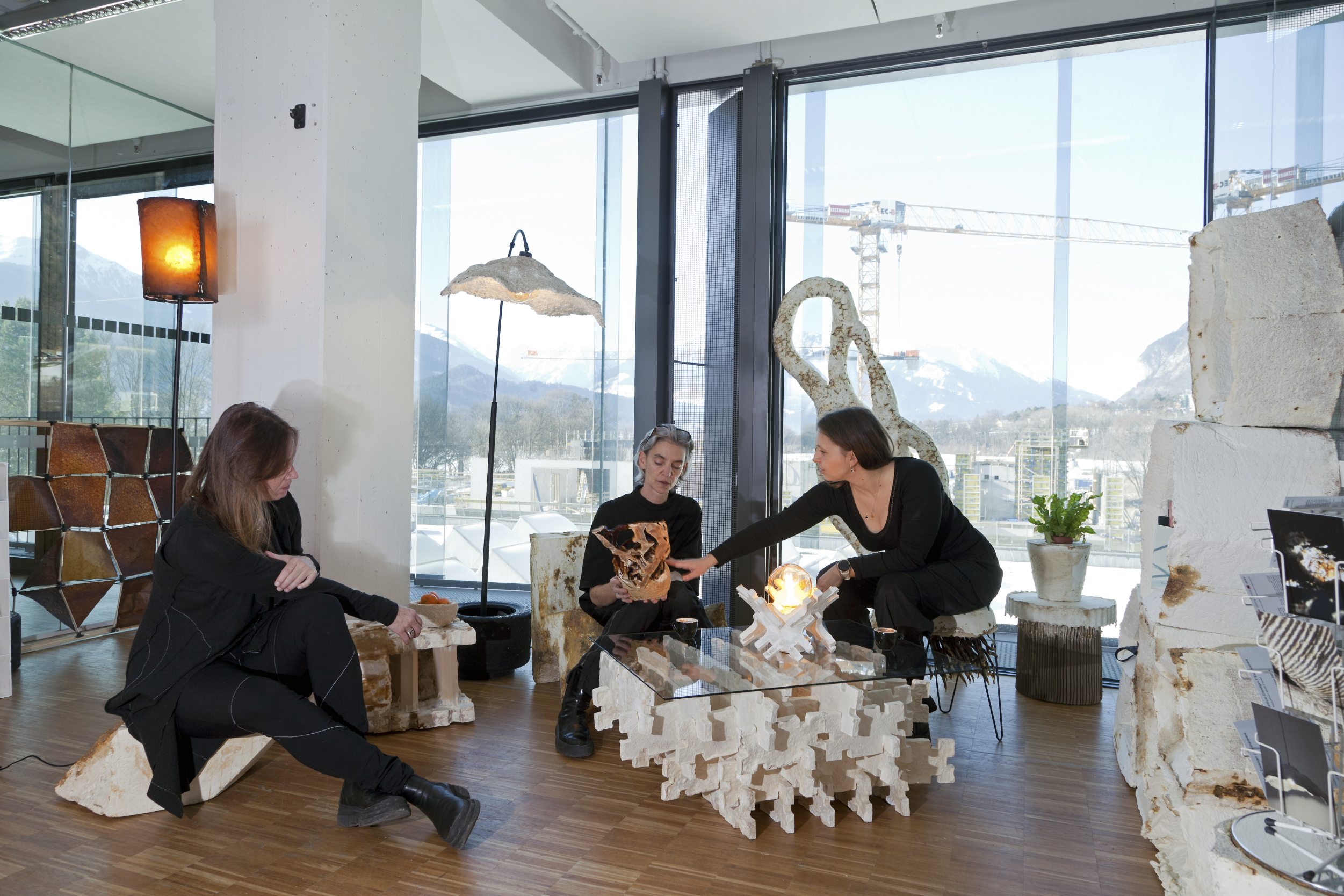
The culmination of Phase II was the development of The “Living” Room, conceived as a composite, inhabitable prototype rather than a conventional exhibition display (Figure 8). The installation was designed as an experimental setup, in which visitors could directly interact with mycelium-based furniture and interior elements. Unlike isolated prototypes presented as static artefacts, the installation invited sitting, touching, observing and prolonged engagement. The deliberate “please touch” exhibition environment thus functioned as a real-world testing ground for evaluating structural performance, tactile qualities, surface ageing and ergonomic comfort under everyday use conditions.
The “Living” Room installation set up in use. Photo Credit: Bruno Stubenrauch and ©MUSE.

Figure 8. Long description
The photograph shows an interior exhibition featuring furniture, lighting and decorative objects made from mycelium-based biomaterials. Three people are seated and interacting around a sculptural coffee table, surrounded by stools, lamps and larger mycelium objects. Large windows in the background reveal a mountain landscape, illustrating the presentation of biomaterial prototypes in a functional interior environment.
In this sense, the installation also operated as a form of embedded, citizen science-oriented research ( Bonney et al. Reference Bonney, Cooper, Dickinson, Kelling, Phillips, Rosenberg and Shirk 2009 ). Public interaction became an active component of the investigative process, as visitors’ behaviours, feedback and patterns of use contributed to the ongoing evaluation of material performance and perception. Rather than positioning the exhibition as a final outcome, it was framed as an extended research phase in which societal reception, trust and material acceptance could be observed in situ.
Furnishing a complete room introduced a new level of complexity. Multiplicity and variation were embraced as deliberate design strategies, collecting the works developed across the duration of the MUSE research project. The furnished room integrated diverse designs within one cohesive spatial system showcasing the multitude of fungal “expressions.” This approach demonstrated the adaptability of the material matrix while allowing comparative observation of different material behaviours within the same environmental context.
The exhibition opening, attended by a curious and numerous audiences, provided the chance for immediate and spontaneous user interaction. Seatable components were naturally tested through intuitive behaviour, revealing how visitors perceived stability, comfort and material integrity. To complement this embodied engagement, a structured survey was implemented to gather qualitative feedback on perception, aesthetics and trust in the material.
Designed for extended public use, The “Living” Room enables long-term observation of wear patterns, structural resilience and changing perception over time. The year-long visitor interaction study is continuously documented, positioning the installation not as a finalised outcome but as an ongoing phase within an evolving material investigation. Rather than serving as a static exhibition, The “Living” Room functions as a long-term evaluation framework, allowing observation of behavioural patterns, wear development and shifts in public perception over time.
By furnishing a complete interior environment, the project extended beyond isolated object-based experimentation toward systemic integration. Material, form, use and public engagement were examined collectively, enabling assessment not only of structural performance but also of experiential and spatial coherence within a real-world context.
Discussion
The project operates within a broader context of contemporary planetary extremes, including accelerating climate change, escalating waste accumulation, resource scarcity and increasing regulatory and environmental pressures on material systems. Interior materials today are embedded within these systemic extremes: they are produced under extractive industrial models, replaced at rapid rates and disposed of within already saturated waste streams. Designing with biomaterials therefore cannot be separated from these environmental urgencies.
Working through the lens of extremes thus serves a dual function. At the material scale, extreme use scenarios act as stress tests, rapidly revealing structural limitations, failure modes and performance thresholds. At the systemic scale, environmental and waste-related pressures define the broader constraints within which material innovation must operate. In both cases, extremes function as accelerators of knowledge: they force clarity about what is structurally viable, environmentally responsible and functionally meaningful.
The use of extreme testing environments functioned as a methodological accelerator within the MUSE framework. The racing car scenario imposed severe constraints related to weight, safety, ergonomics and structural performance, reducing the material to what was strictly necessary. This forced optimisation sharpened understanding of density distribution, geometry-structure relationships and material efficiency. By designing under maximal constraint, the project avoided speculative overdesign and instead focused on structural precision. The resulting compositions proved not only viable in the racing context but more robust when translated into everyday applications.
At the same time, the scaling of prototypes within a restricted laboratory setup demonstrated that meaningful material development does not necessarily require high-energy industrial infrastructure. Expanding prototype size under constrained environmental conditions allowed the team to explore the upper limits of growth, drying and fabrication while actively limiting energy-intensive processes. This approach tested whether material scalability could remain aligned with low-impact production principles, rather than defaulting to automation and increased energy input as scale increased.
Collaboration played a critical role in this acceleration. Partnerships with external experts, including Mushroom Research Center Austria (MRCA) and material scientists, enabled immediate performance validation and iterative refinement. Rather than separating design experimentation from technical assessment, the project relied on distributed expertise, integrating material science, fabrication and applied performance knowledge. This collaborative model also supports scalability, demonstrating how interdisciplinary networks can facilitate rapid development beyond purely academic environments.
The methodological trajectory followed a top–down logic: beginning with a highly constrained and performance-driven object and subsequently translating its refined material logic into less extreme contexts. The development of one highly robust system under racing conditions provided a structural foundation that could be adapted to furniture and interior applications. By confronting both performance-driven and ecological extremes simultaneously, the methodology shifts material development away from speculative exploration toward purpose-driven refinement, where composition, geometry and fabrication are shaped by explicit functional and environmental demands. This approach positions extreme testing not as an isolated technical exercise, but as a strategy for aligning material research with the pressing conditions of contemporary design practice.
Crucially, the public exhibition of the “Living Room” introduced a further dimension of testing. The spatial deployment of furniture elements enabled direct engagement with a broader audience, allowing real-world interaction, perception and behavioural feedback to inform ongoing development. Observing how visitors touch, sit on, evaluate and emotionally respond to the material provides insight into acceptance, trust, tactile perception, highlighting areas requiring further refinement. In this way, exhibition becomes not a final presentation, but an extended research phase bridging laboratory investigation and societal reception.
Working with living materials necessitates an acceptance of variability and instability. Biological growth introduces fluctuation in density, shrinkage and surface differentiation. Rather than eliminating these behaviours, the research incorporated them into the design process, reframing variability as an active and prominent parameter within material development. This shift, from control toward calibrated responsiveness, represents a key methodological contribution to contemporary biodesign practice.
Limitations and ongoing work
Despite promising results, several limitations remain. Biological variability continues to influence reproducibility, particularly as sample size increases. Larger elements introduce higher risks of contamination, especially within semi-controlled or non-sterile laboratory environments. Environmental parameter fluctuations, e.g. in terms of low temperature and humidity further affect growth cycles and drying behaviour. As prototypes increase in scale and volume, environmental control becomes more complex and less predictable.
The long-term evaluation of The “Living” Room installation is ongoing, representing a sort of Citizen Science Project. Continued documentation of wear patterns, structural resilience and public perception will provide further insight into durability and ageing characteristics under extended use. These observations are essential for assessing the material’s viability beyond short-term deployment.
Future research will expand the material matrix of mycelium-based composites through exploration of additional fungal species, substrate variations and hybrid biological systems, with particular attention to regional specificity. Further refinement of low-energy laboratory infrastructure and contamination management strategies will also be pursued, supporting more stable scaling processes while maintaining environmental responsibility. In parallel, the findings will continue to be disseminated through academic publications, exhibitions, interdisciplinary collaborations and various platforms, contributing to broader knowledge exchange within the fields of biodesign, material research and sustainable interior practice.
Conclusion
This paper presents MUSE- MyceliUm SEat research–through-design framework for advancing mycelium-based composites from material experimentation to functional interior deployment. By positioning extreme testing as a methodological accelerator, consolidating adaptable material compositions into a matrix system and translating performance knowledge across scales, the MUSE project demonstrates a structured pathway for integrating living materials into real-world contexts.
The project contributes to biodesign research by articulating how material development, fabrication strategy, laboratory infrastructure, interdisciplinary collaboration and spatial deployment can operate within a unified methodological approach. It highlights furniture as a critical tangible, intermediary scale between laboratory experimentation and architectural implementation and positions public interaction as an essential component of material validation.
Rather than treating mycelium composites as a static sustainable substitute, the research frames it as an evolving material system shaped through reciprocal relationships between biology, form and use. In doing so, it proposes a transferable framework for advancing living materials within design practice while embracing the productive complexity inherent to biological systems and giving space to fungi for “expressing” their potential in acting as co-designers.
Data availability statement
Data availability is not applicable to this article as no new data were created or analysed in this study.
Acknowledgements
We are grateful for the assistance of our ID/E-team members: Henning J. Dörfler, Tabea Weinbörner and Irina Radeva, as well as our MUSE-partners and collaborators MRCA (Mushroom Research Centre Austria), CTM (Campus Tirol Motorsport), Sophie Gruber (Material Science Department, University of Innsbruck), Günter Scheide (Transfer Office, University of Innsbruck).
Author contributions
Conceptualisation: N.P.; J.A.J.; B.I. Methodology: N.P.; B.I. Investigation: N.P.; J.A.J. Data curation: N.P. Data visualisation: N.P. Writing original draft: N.P. Writing review & editing: N.P.; J.A.J; B.I. Supervision: B.I.; Project administration: N.P. Funding acquisition: N.P.; J.A.J; B.I. All authors approved the final submitted draft.
Financial support
This work was supported by Land Tirol through the Tiroler Wissenschaftsförderung (Tyrolean Science Promotion) programme (MUSE – MyceliUm SEat, 2024–2026). The research was conducted at the University of Innsbruck, Faculty of Architecture, Department of Experimental Architecture (Integrative Design | EXTREMES).
Competing interests
None.
Ethical standards
The research was conducted in accordance with institutional ethical guidelines and applicable legal requirements. The “Living” Room installation functioned as a public exhibition and experimental environment. Visitor participation in surveys and feedback collection was voluntary and based on informed consent. No personally identifiable data were collected, and responses were recorded anonymously. The study did not involve vulnerable populations, medical procedures, or animal research. All data were handled in accordance with data protection regulations and used solely for research purposes.
Artificial intelligence statement
The authors confirm that the intellectual content, research design, analysis and arguments presented in this manuscript were created and developed solely by the authors. AI-assisted tools (ChatGPT, OpenAI) were used exclusively for language refinement, including grammar, punctuation and sentence structure. All outputs were critically reviewed, edited and approved by the authors, who take full responsibility for the final manuscript.

 Open access

