Introduction
One of the major threats to oceanic seabird species is the introduction of mammalian predators such as rats (Rattus spp.), cats (Felis catus L.) and house mice (Mus musculus L.) onto their breeding islands (Croxall et al. Reference Croxall, Butchart, Lascelles, Stattersfield, Sullivan, Symes and Taylor2012). Rodents have been introduced to many oceanic islands and the devastating effects of rats on small to medium-sized seabirds are well known (Atkinson Reference Atkinson1985, Jones et al. Reference Jones, Tershy, Zavaleta, Croll, Keitt, Finkelstein and Howald2008). Larger seabirds, such as albatrosses, are less affected by rat predation, although rats have attacked Laysan albatrosses (Phoebastria immutabilis Rothschild) on Kure Atoll (Courchamp et al. Reference Courchamp, Chapuis and Pascal2003) and also may affect Amsterdam Island Albatross (Diomedea amsterdamensis Roux, Jouventin, Mougin, Stahl & Weimerskirch) (Thiebot et al. Reference Thiebot, Barbraud, Delord, Marteau and Weimerskirch2014).
Mice have been introduced to even more oceanic islands than rats, yet until recently they were considered to have little impact on seabird populations with only a few records of mice killing storm-petrels (Campos & Granadeiro Reference Campos and Granadeiro1999, Ainley et al. Reference Ainley, Henderson and Strong1990) and petrels (Fugler et al. Reference Fugler, Hunter, Newton and Steele1987). However, observations on Gough Island, central South Atlantic Ocean, over the last decade show that predation by mice on albatross chicks and on petrel chicks and eggs is widespread, highlighting how mice can be devastating predators of seabirds when they are the only introduced mammal (Cuthbert & Hilton Reference Cuthbert and Hilton2004, Wanless et al. Reference Wanless, Angel, Cuthbert, Hilton and Ryan2007, Reference Wanless, Ratcliffe, Angel, Bowie, Cita, Hilton, Kritzinger, Ryan and Slabber2012, Hilton & Cuthbert Reference Hilton and Cuthbert2010, Cuthbert et al. Reference Cuthbert, Louw, Parker, Rexer-Huber and Visser2013a, Reference Cuthbert, Louw, Lurling, Parker, Rexer-Huber, Sommer, Visser and Ryan2013b, Davies et al. Reference Davies, Dilley, Bond, Cuthbert and Ryan2015, Dilley et al. Reference Dilley, Davies, Bond and Ryan2015). In the absence of competition and predation from larger introduced species, mice attain very high population densities, and resort to attacking and killing seabird chicks mainly in winter when other food resources are scarce (Cuthbert et al. in Reference Cuthbert, Wanless, Angel, Burlé, Hilton, Louw, Visser, Wilson and Ryanpress).
Marion Island is a globally important breeding site for albatrosses, supporting some 22% of the world population of wandering albatrosses (Diomedea exulans L.), 7% of grey-headed albatrosses (Thalassarche chrysostoma Forster), 9% of sooty (Phoebetria fusca Hilsenberg) and 3% of light-mantled albatrosses (Phoebetria palpebrata Forster) (Tickell Reference Tickell2000, Ryan et al. Reference Ryan, Jones, Dyer, Upfold and Crawford2009). Mice were brought to sub-Antarctic Marion Island, southern Indian Ocean, during the sealing era sometime before 1818 and were the sole introduced mammal until 1949 when cats were introduced to control mice at the newly established weather station (Cooper Reference Cooper2008). The cats soon turned feral, greatly reducing burrowing petrel populations over four decades (Schramm Reference Schramm1986), before finally being eradicated by 1991 (Bester et al. Reference Bester, Bloomer, van Aarde, Erasmus, van Rensburg, Skinner, Howell and Naude2002). This left mice as the sole introduced mammal on Marion Island. The first signs of mouse attacks on seabirds were recorded in the winter of 2003, when wandering albatross chicks were observed with rump wounds typical of those inflicted by mice on Tristan albatross (D. dabbenena Mathews) chicks at Gough Island (Jones & Ryan Reference Jones and Ryan2010). In April 2009, one-third of sooty albatross fledglings at an isolated colony in the south-west of Marion Island were found ‘scalped’ with raw, bleeding crowns and necks, and a similar wound was found on a sooty albatross chick on the island’s south-east coast (Jones & Ryan Reference Jones and Ryan2010). Mice were suspected of being responsible for these wounds (Jones & Ryan Reference Jones and Ryan2010), even though summer-breeding albatross chicks are seldom attacked by mice on Gough Island (Cuthbert et al. Reference Cuthbert, Louw, Parker, Rexer-Huber and Visser2013a). Another sooty albatross fledgling was attacked in 2010 at the same colony where multiple scalpings occurred in 2009 (BJD unpublished data), but no further attacks were recorded until 2015.
In this paper, we confirm that mice can cause fatal wounds on albatross chicks at Marion Island, and report the unprecedented increase in the frequency and distribution of mouse attacks on albatross chicks in the autumn of 2015. Scalping allows mice to attack well-feathered albatross chicks, raising concerns about the conservation status of all albatrosses breeding on the island.
Study area and methods
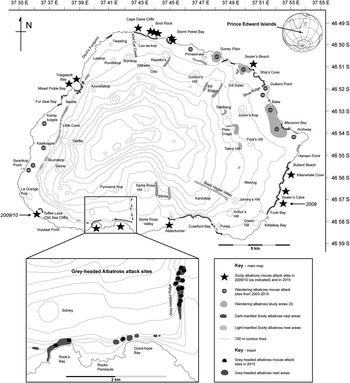
The populations of albatrosses breeding at Marion Island (290 km2; 46°45'S, 37°45'E) have been monitored since the early 1980s (Ryan et al. Reference Ryan, Jones, Dyer, Upfold and Crawford2009). Approximately 1850 pairs of wandering albatrosses breed each year in loose colonies on the coastal plains around the island, 7500 pairs grey-headed albatrosses breed on cliffs along the south coast, and 1800 pairs of sooty and up to 400 pairs of light-mantled albatrosses breed singly or in small colonies on cliffs around the island (Ryan et al. Reference Ryan, Jones, Dyer, Upfold and Crawford2009, unpublished data; Fig. 1). Two to five ornithological field researchers are based on the island year-round and conduct complete island counts of incubating adults and of large chicks to estimate crude breeding success. More accurate estimates of breeding success are obtained from three study colonies of wandering albatrosses (~270 pairs per year, initiated in the 1980s), one study colony of grey-headed albatrosses (~100 pairs per year, initiated in 1997), and five study areas to monitor sooty albatrosses (~50 pairs of sooty and ~10 pairs of light-mantled albatrosses, initiated in 2013). Chicks in these colonies are visited every few weeks until fledging.
Marion Island showing the locations of albatross breeding colonies and mouse attack sites.

The over-wintering field researchers spend a considerable amount of time in the field outside of study colonies, and further observations outside of colonies are provided by field workers from other research programmes who are asked to report wounded albatross chicks. Despite this ongoing surveillance, there have been few observations of mouse-wounded albatross chicks (Jones & Ryan Reference Jones and Ryan2010). However, during the April 2015 pre-fledging count of grey-headed albatrosses, one fledgling was observed on Grey-headed Albatross Ridge with head wounds typical of those seen on sooty albatross chicks in 2009 (Jones & Ryan Reference Jones and Ryan2010). This triggered a series of additional surveys of all grey-headed and coastal sooty albatross colonies. All three small, summer-breeding albatross species breed on cliffs, limiting access to most colonies. Chicks were examined with binoculars for signs of mouse attacks. Most observations were made from cliff tops, but a few colonies were also inspected from below. Where possible, researchers entered colonies where attacked birds or carcasses were observed to check for cryptic wounds and to remove carcasses.
Grey-headed albatrosses
Detailed observations were made on grey-headed albatross chicks on Grey-headed Albatross Ridge (Fig. 1), where most colonies are accessible on foot. Chicks in these colonies were checked for mouse wounds on five occasions from 27 April to 22 May 2015, recording the number of wounded chicks and the nature of their wounds at each attack site. In order to gain a better understanding of the frequency of mice attacks, we monitored the fate of 17 chicks (nests marked with poles) which were newly wounded since the first check on 27 April. The cause of these wounds was confirmed by filming two wounded chicks with motion-activated infra-red cameras (Bushnell Trophy Camera, model 119436). Cameras were mounted 30 cm off the ground on PVC poles, 2–5 m from the nest, and set on high motion sensitivity to take one image per second for 3 seconds upon activation (following methods in Davies et al. Reference Davies, Dilley, Bond, Cuthbert and Ryan2015). In addition, direct observations of wounded chick behaviour at night were made on 27 April and 3 May. Grey-headed albatross colonies on the slopes of Rook’s Peninsula and Rook’s Bay (Fig. 1) were checked on three occasions (3, 13 and 23 May) but the last check was incomplete due to bad weather. The small grey-headed albatross colony in Crawford Bay was not checked because it could not be approached closely enough to assess whether any chicks were wounded.
Sooty and light-mantled albatrosses
Sooty albatrosses breeding along coastal cliffs are hard to count accurately because their dark plumage blends with the cliffs and nest sites are hard to access (Ryan et al. Reference Ryan, Jones, Dyer, Upfold and Crawford2009). Experienced observers worked systematically around the island’s coast, counting and inspecting chicks. Where possible, observers descended into colonies for closer inspections and to remove carcasses. Two complete surveys of coastal colonies were conducted from 1–6 May and 15–26 May 2015. A remote camera was used to confirm that mice caused the head wound on one sooty albatross chick at Storm Petrel Bay on 18 May. Light-mantled albatrosses mainly breed at scattered locations inland on Marion Island; chicks in only a few of these areas were checked for mouse wounds, but the small numbers of chicks on coastal cliffs were checked during surveys of sooty albatrosses.
Wandering albatrosses
In addition to regular checks of the three wandering albatross study colonies (Fig. 1), a complete survey of all chicks from the meteorological base at Transvaal Cove to Cape Davis and from Mixed Pickle Cove to La Grange Kop was conducted from 25–30 June, where each chick was inspected for wounds. Remote cameras were used to monitor chicks in 2012 (n=12 chicks), 2013 (n=10), 2014 (n=6) and 2015 (n=10), and confirmed that mice were responsible for wounds on chicks at Macaroni Bay on 5 July 2013 and 14 June 2014 (rump wounds) and at Sealer’s Beach on 10 June 2015 (crown wound).
Attack sites
On each check of grey-headed and sooty albatross colonies, the locations and numbers of wounded chicks were noted, and fresh carcasses were counted and removed. Carcasses were considered to be at an attack site if the carcass was within 20m of a wounded chick (or beneath wounded chicks on sheer cliffs). Waypoints of attack sites were recorded on the ground using a Garmin GPS to assess the horizontal distance between attack sites, and these estimates are thus conservative especially for adjacent sites along steep slopes. Sites were considered discrete if the nearest adjacent attack site was >50m away (the approximate home range of mice on Gough Island; Cuthbert et al. in Reference Cuthbert, Wanless, Angel, Burlé, Hilton, Louw, Visser, Wilson and Ryanpress). Means are presented±1 standard deviation.
Results
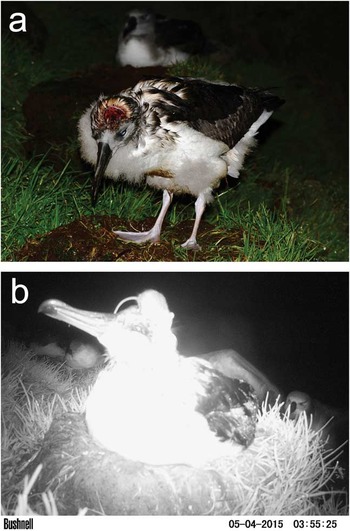
Filming at night confirmed that mice were responsible for the wounds on all three albatross species where cameras were deployed in 2015 (two grey-headed, one sooty and three wandering albatross chicks). At night, wounded grey-headed albatross chicks remained standing while other chicks slept (Fig. 2a), presumably to deter mice from attacking. Cameras recorded at least one mouse feeding on each wounded chick once they finally lay down. At Grey-headed Albatross Ridge, the two wounded grey-headed albatross chicks we filmed sat at 18h10 and 03h00, whereupon mice climbed onto their heads. The chicks initially appeared to try to shake off the mice, but after a while the chicks sat while the mice fed on their heads (Fig. 2b). The filmed sooty albatross chick was attacked from shortly after dusk; mice fed on the chick’s head for four hours as it roosted with its bill tucked under its back feathers before the chick stood up, shook the mice free and remained standing for the rest of the night. This chick was still alive 6 days later. The three wounded wandering albatross chicks were all fed on by mice at night, although the chick filmed in July 2013 was killed the following day by giant petrels Macronectes spp. The chick with a head wound filmed in June 2015 was too young to stand for long periods, and was attacked by mice from shortly after dark.
A wounded grey-headed albatross chick standing at night while an unwounded chick lies down (a. photo by BJ Dilley). Once the wounded chick sat down at 03h00 it was attacked by a mouse (b. infra-red remote-triggered image). Both images are of the same chick and were taken on Grey-headed Albatross Ridge on the night of 3–4 May 2015.

The combination of their wounds and their high activity levels at night caused wounded grey-headed and sooty albatross chicks to appear weak and tired during the day compared to uninjured birds, which were lively and spent much time exercising their wings. When approached, badly wounded chicks failed to stand and bill-clap at the intruder, lying slumped over their nest with drooped wings. Wounded chicks also often had oily and dishevelled feathers, making them conspicuous even from a distance. However, birds with small wounds were easy to overlook, especially if wounded on the back of the head, because once alert they turned to face an intruder. The likelihood of detecting wounded chicks also varied among colonies, depending on how closely the colonies could be approached. Most colonies were scanned with binoculars from <50m, but some were only possible to scan from greater distances (up to 200m). As a result, the numbers of wounded birds reported here are minimum estimates.
Grey-headed albatrosses
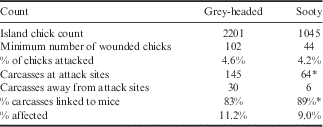
The first wounded grey-headed albatross chick on Marion Island was observed during the annual fledgling census on 16 April 2015. Subsequent island-wide checks from 27 April to 26 May 2015 found 102 wounded chicks (4.6% of the island fledgling count; Table I). Mice mainly targeted the head and neck: 63% of wounds on the crown, 22% on the nape, 9% on the back of the neck and 2% below the eye (n=57 chicks, 11 with multiple wounds). The only attacks away from the head and neck were on the elbow joints (4% of chicks). Of the 17 chicks at marked nests, seven died before they were checked again 5.4±2.0 days later (range 3–8 days); the other ten chicks were still alive up to 11 days later. Most surviving chicks had enlarged wounds, although the rate at which wounds grew varied considerably. Some small crown wounds seemed to remain the same size at subsequent checks, whereas wounds on other chicks grew rapidly.
Estimated numbers of grey-headed and sooty albatross chicks attacked by mice on Marion Island from 27 April to 26 May 2015. The percentage affected is represented as (minimum number of wounded chicks+carcasses at attack sites)/island chick count.
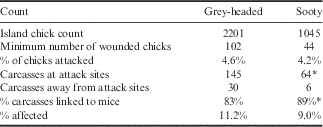
* Percentage of carcasses linked to mice excludes 15 chicks at one site killed by giant petrels during an extreme wind event.
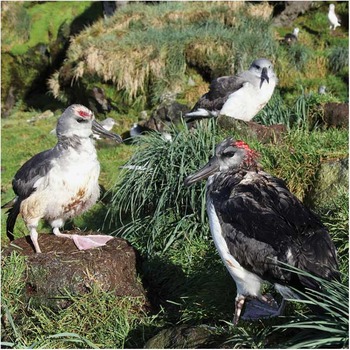
Wounded chicks often occurred in clusters (Fig. 3). Eleven attack sites were located on Grey-headed Albatross Ridge (Fig. 1) containing 57 wounded chicks (5.5% of all chicks on the ridge, 3.2±2.4 chicks per site, range 1–10 chicks per site). Attack sites farther inland had the greatest number of injured chicks. The uppermost attack site had ten wounded chicks within an ~30 m radius. Attack sites were 74±30m from the nearest adjacent attack site (range 51–150m, n=11). Seven attack sites were found in other grey-headed albatross colonies: three at Rook’s Peninsula East, three at Rook’s Peninsula West and one above Rook’s Bay (Fig. 1).
Two grey-headed albatross chicks with typical ‘scalping’ crown wounds on Grey-headed Albatross Ridge, Marion Island, on 3 May 2015 (photo by PG Ryan).

In addition to wounded chicks, 175 grey-headed albatross chick carcasses were found, of which 145 (83%) were at mouse attack sites. Taken together, the wounded chicks and carcasses suggest that mice attacked more than 11% of pre-fledging chicks in 2015, and that most of these chicks died. The number of carcasses within attack sites along Grey-headed Albatross Ridge increased between checks, suggesting that the frequency of attacks increased as winter approached. On the final check on 23 May, mice were frequently observed running within the colony during the day and four freshly dead chicks with mouse injuries were found on their nest mounds. These carcasses were untouched by other predator/scavengers such as sub-Antarctic skuas (Stercorarius lonnbergi Mathews) or giant petrels.
Sooty and light-mantled albatrosses
Following the observations of suspected mouse attacks on eight sooty albatross chicks at two sites in April 2009, another wounded chick was found at the Toffee Lava nest site (Fig. 1) on 29 May 2010 (BJD unpublished data). There were no further sightings of injured chicks until 30 April 2015, when four wounded fledglings and seven freshly dead carcasses were found at a colony north of Triegaardt Bay (Fig. 1). Subsequent checks of coastal colonies located wounded sooty albatross chicks at 14 of 104 colonies (13.5%, Fig. 1). Attack sites were 3.8±3.9 km from the nearest adjacent attack site (range 0.1–10.7 km, n=14).
Of the 1045 sooty albatross chicks checked, at least 44 chicks had mouse wounds (4.2%, 3.5±2.5 chicks per attack site, range 1–8 chicks per colony). One wounded light-mantled albatross chick was found among 25 surveyed at nine coastal and two inland breeding sites (4%); it was found on the east coast near Bullard South (Fig. 1) at a mixed-species colony that also contained a wounded sooty albatross chick. Like grey-headed albatross chicks, most sooty albatross wounds were on the crown, nape or back of the neck (96%, n=45); only the light-mantled albatross chick and two sooty albatross chicks were attacked away from the head, with wounds on the elbow joint (n=2) and on the outer tail base (n=1).
Numbers of attacked chicks increased as winter set in; 32 wounded chicks were found at 12 colonies during the first survey (30 April to 6 May) and at least a further 13 during the second survey (15–26 May 2015), when two new sites were recorded: Triegaardt Bay South and Sealer’s Beach (Fig. 1). Wound progression and chick mortality varied among sites. At one site on the coastal cliffs below Lou-se-Kop all four wounded chicks observed on 1 May were still alive on 5 May (three largely unchanged, one with a considerably enlarged wound). However, at Triegaardt Bay North, three of four wounded birds observed on 30 April had died by 5 May; the remaining chick’s injury was more severe and two additional chicks had been attacked. On 30 April, there were 23 fledglings and seven fresh carcasses at this site; two new carcasses were present on 5 May and a further 12 carcasses on 25 May, when only six fledglings remained (two of which had mouse wounds). This suggests that at least 21 chicks were killed by mice at this colony, which probably fledged fewer than ten chicks from 160 pairs incubating in November 2014.
Overall, 70 fresh chick carcasses were found, 64 (91%) of which were at colonies with mouse-wounded chicks, despite these colonies supporting <20% of chicks surveyed. However, 15 carcasses were found when exceptionally strong winds allowed giant petrels access to part of a large colony south of Triegaardt Bay on 4 May 2015, before the first mouse attacks were recorded at this site. Excluding these carcasses, 89% of carcasses were at colonies where mouse attacks took place (Table I). Combining the injured chicks (45) and mouse-related carcasses (49), it is likely that mice attacked ~9% of pre-fledging chicks in 2015, and that most of these chicks died. This is a conservative estimate because some early chick mortalities may have been missed and many carcasses could have fallen into the sea or been carried away by giant petrels or skuas.
Wandering albatrosses
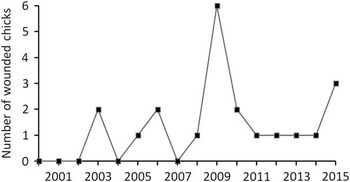
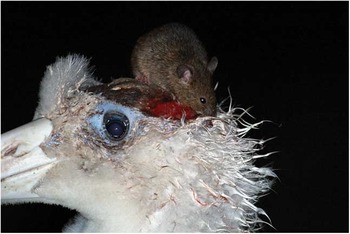
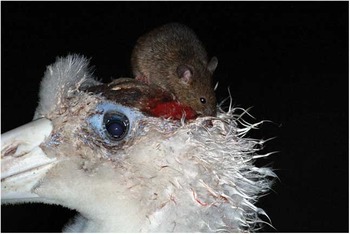
Since 2003, 21 wandering albatross chicks have been found with mouse wounds in the three study colonies (average 1.5±1.6 per year, range 0–6, 268±44 nests monitored per year; Fig. 4), with nine incidental sightings from other parts of the island (Fig. 1). Eighteen of the 30 attacks (60%) were first observed in July–August (range 6 April to 11 November). Of the chicks that were checked repeatedly, 18 of 25 (72%) died from their wounds, or when attacked by giant petrels. By the end of July 2015 there had been three attacks on chicks in study colonies in 2015, which is not unusually high compared to other years (Fig. 4). The survey of chicks outside study colonies in June 2015 inspected 553 chicks (~70% of chicks outside study colonies), of which three (0.5%) had mouse wounds: one near Kampkoppie and two near Swartkop Point, both on the island’s west coast. Prior to 2015, mice targeted the rump (n=21), wing (3) or shoulder (1); however, in 2015 three of the six chicks attacked had head wounds (Fig. 5).
Numbers of mouse-wounded wandering albatross chicks in three study colonies (~270 pairs) monitored annually at Marion Island since the first wounded chicks were observed in 2003.

A mouse feeding on the crown of a wandering albatross chick at Sealer’s Beach study colony, Marion Island, 15 June 2015. This chick died 5 days later (photo by S Schoombie).
Discussion
To date mouse attacks on albatross chicks have only been confirmed to occur on Gough Island (Wanless et al. Reference Wanless, Ryan, Altwegg, Angel, Cooper, Cuthbert and Hilton2009, Davies et al. Reference Davies, Dilley, Bond, Cuthbert and Ryan2015) and suspected on Marion Island (Jones & Ryan Reference Jones and Ryan2010). Our observations confirm that mice are responsible for the wounds observed on all three albatross genera breeding on Marion Island, and that large numbers of grey-headed and sooty albatross chicks died from these wounds in 2015. This is the first direct evidence that mice are responsible for fatal attacks on seabird chicks at Marion Island. Given the presence of field researchers on Marion since the 1980s and the striking nature of the wounds inflicted, it is unlikely that mouse attacks on surface-nesting seabirds were overlooked prior to the first records in 2003. Ours is also the first record of extensive mouse predation on Thalassarche and Phoebetria albatross chicks. Although mice are well known to be serious predators of Tristan albatrosses on Gough Island (Wanless et al. Reference Wanless, Ryan, Altwegg, Angel, Cooper, Cuthbert and Hilton2009, Davies et al. Reference Davies, Dilley, Bond, Cuthbert and Ryan2015), there have been only two records of mice killing chicks of these summer-breeding albatrosses: one sooty albatross and one Atlantic yellow-nosed albatross (Thalassarche chlororhynchos Gmelin) (Cuthbert et al. Reference Cuthbert, Louw, Lurling, Parker, Rexer-Huber, Sommer, Visser and Ryan2013b).
Mice are the only introduced mammals at both Gough and Marion islands. Wanless et al. (Reference Wanless, Angel, Cuthbert, Hilton and Ryan2007, Reference Wanless, Ryan, Altwegg, Angel, Cooper, Cuthbert and Hilton2009) hypothesized that the impacts of mice on seabirds are most severe on such islands because mouse populations are not regulated by the effects of dominance, competition and predation by other, larger introduced mammals (e.g. cats or rats). On Marion Island, mice were not an important food source for cats (van Aarde Reference Van Aarde1980) so it is unlikely that cat predation limited the mouse population (van Aarde et al. Reference Van Aarde, Ferreira, Wassenaar and Erasmus1996). However, cats may have influenced mouse demography, and their removal, combined with a warming climate (Le Roux & McGeoch Reference Le Roux and McGeoch2008), may have allowed mouse densities to increase (Ferreira et al. Reference Ferreira, van Aarde and Wassenaar2006). In 2008–11, densities in mire habitats on Marion Island reached up to 237 mice ha-1 (McClelland Reference McClelland2013), similar to peak densities on Gough Island (266 mice ha-1, Cuthbert et al. in Reference Cuthbert, Wanless, Angel, Burlé, Hilton, Louw, Visser, Wilson and Ryanpress).
A striking feature of the attacks on Marion Island albatrosses in 2015 was that most wounds were on the chicks’ heads and necks. Mice on Gough Island mainly attack albatrosses on the rump or wings (Wanless et al. Reference Wanless, Ryan, Altwegg, Angel, Cooper, Cuthbert and Hilton2009, Davies et al. Reference Davies, Dilley, Bond, Cuthbert and Ryan2015), and prior to 2015, all wounds on wandering albatrosses on Marion Island also were on the rump or wings (Jones & Ryan Reference Jones and Ryan2010, this study). Most mouse attacks on seabird chicks at both islands take place in winter, when mouse populations crash as food resources are depleted (Matthewson et al. Reference Matthewson, van Aarde and Skinner1994, Cuthbert et al. in Reference Cuthbert, Wanless, Angel, Burlé, Hilton, Louw, Visser, Wilson and Ryanpress). Thalassarche and Phoebetria albatross chicks fledge in autumn or early winter, and are thus quite mobile and presumably better able to fight off mice by this time of year, and perhaps even more importantly, they are also well-feathered. We hypothesize that the dense cover of long contour feathers prevent mice from attacking the rump area where they usually target downy Diomedea albatross chicks.
Mice gain two benefits by targeting albatross crowns and napes: i) they are safe from retaliation by the chick’s bill, and ii) the short feathers on the crown make it easier to reach the skin. This novel attack technique allows mice on Marion Island to attack fully-feathered chicks, making the chicks of summer-breeding species available in the critical period as food resources dwindle in April–May. Gough Island mice have not learned this behaviour; the few Thalassarche and Phoebetria albatross chicks attacked on Gough Island were killed as downy chicks in December–January by mice entering the nest cup from below (Cuthbert et al. Reference Cuthbert, Louw, Lurling, Parker, Rexer-Huber, Sommer, Visser and Ryan2013b).
When it was first discovered that house mice were significant predators of seabirds on Gough Island, much was made of the fact that they are larger (average adult body mass 35 g) than any other island mouse population (Cuthbert & Hilton Reference Cuthbert and Hilton2004, Wanless et al. Reference Wanless, Angel, Cuthbert, Hilton and Ryan2007, Cuthbert et al. in Reference Cuthbert, Wanless, Angel, Burlé, Hilton, Louw, Visser, Wilson and Ryanpress). This might confer an advantage in subduing petrel chicks (Dilley et al. Reference Dilley, Davies, Bond and Ryan2015), but our observations on Marion Island show that large body mass is not a prerequisite for attacking large albatross chicks. Adult body mass of mice on Marion Island (21 g; Avenant & Smith Reference Avenant and Smith2003) is similar to mice on other islands (e.g. 19–22 g at Antipodes, Russell Reference Russell2012; 21 g at South Georgia, Cuthbert et al. Reference Cuthbert, Black, Rexer-Huber, Parker and Sommer2012), and has not increased since cats were eradicated (Ferreira et al. Reference Ferreira, van Aarde and Wassenaar2006, McClelland Reference McClelland2013). Indeed, smaller size might make it easier for mice to cling onto the heads of albatross chicks. The fact that ‘normal’ house mice are able to attack and kill large albatross chicks indicates the need for vigilance wherever mice have been introduced to seabird breeding islands.
It is tempting to speculate what might have triggered the sudden increase in mouse attacks on albatrosses at Marion Island in 2015. One hypothesis is prey switching by mice, whereby mice supplement the invertebrate component of their diet with seabird chicks, driven by a steady decrease in invertebrate biomass on Marion Island over the last 40 years (Burger Reference Burger1978, Gleeson & van Rensburg Reference Gleeson and van Rensburg1982, Smith et al. Reference Smith, Avenant and Chown2002, McClelland Reference McClelland2013). Another intriguing question is how attacks on albatross chicks commenced at scattered locations all around Marion Island’s ~70km coastline. Multiple attacks typically occurred at each affected site, suggesting some cultural transmission of this novel foraging technique (cf. Wanless et al. unpublished), but this mechanism cannot explain how attacks were initiated seemingly independently at sites separated by distances hundreds of times greater than mouse home ranges (Cuthbert et al. in Reference Cuthbert, Wanless, Angel, Burlé, Hilton, Louw, Visser, Wilson and Ryanpress).
Marion Island was not listed by Croxall et al. (Reference Croxall, Butchart, Lascelles, Stattersfield, Sullivan, Symes and Taylor2012) as one of 73 priority islands where the eradication of invasive alien vertebrates would benefit globally threatened seabirds. House mice are present on 25 of these islands; five have no other invasive vertebrates, and of these, only Gough Island supports breeding albatrosses. If the levels of mouse predation recorded on sooty (globally Endangered) and grey-headed albatrosses (Vulnerable) at Marion Island in 2015 recur in the coming years, they may have long-term demographic consequences on these populations, strongly suggesting that Marion Island is a priority island for mouse eradication and that mice alone may significantly affect threatened seabird species.
Acknowledgements
We thank all over-wintering field workers for their albatross observations since 2003, and especially Delia Davies, Alexis Osborne, Vonica Perold and Kim Stevens for the deployment of cameras. Azwianewi Makhado, Rob Crawford and Bruce Dyer kindly provided the nest cameras. Logistical and financial support was provided by the South African Department of Environmental Affairs, through the South African National Antarctic Programme (SANAP), the National Research Foundation and the University of Cape Town. We thank John Cooper and John Parkes for their comments. We thank Jean-Baptiste Thiebot and one anonymous reviewer for their useful comments which improved drafts.
Author contribution
PGR, BJD, SS and JS conducted the fieldwork. BJD analysed the data and wrote the draft. PGR supervised the research and advised on manuscript preparation.