Modifications in surgical techniques and innovations in perioperative care have improved the survival rates of patients with CHD. The focus of research is currently shifting from survival to quality of life. Seizures and epilepsy interfere with neurodevelopment and quality of life. Perioperative clinical seizures and comorbidities of epilepsy are often experienced by patients with CHD. Perioperative clinical seizure has been reported in 6–9% of neonates with CHD during the post-operative period. Reference Helmers, Wypij and Constantinou1,Reference Ehyai, Fenichel and Bender2 Its occurrence has been associated with worse neurodevelopmental outcomes, providing an early sign of brain injury with neurological and developmental sequelae. Reference Rappaport, Wypij and Bellinger3 It has been demonstrated that epilepsy occurs in 2.4% of patients with CHD, Reference Billett, Cowie, Gatzoulis, Vonder Muhll and Majeed4 while another study revealed that 5% of post-operative patients with CHD develop epilepsy by the age of 15 years. Reference Leisner, Madsen, Ostergaard, Woo, Marino and Olsen5 A single institutional retrospective study was performed to investigate the incidence and risk factors of perioperative clinical seizure and epilepsy in children with CHD.
Materials and methods
Patients
We enrolled 782 children who underwent surgery for CHD at Kanagawa Children’s Medical Center (Kanagawa, Japan) from January 2013 to December 2016. The patients were followed up at our hospital for ≥4 years. Perinatal, perioperative and follow-up data were retrospectively extracted from the medical records. The onset of epilepsy was used as an endpoint, and medical data recorded after the onset were excluded. Therefore, five patients who had already developed epilepsy prior to surgery for CHD were excluded. Perioperative clinical seizures were defined as seizures that occurred within 21 days after surgery for CHD. Epilepsy was defined as a seizure that occurred >21 days after surgery and was diagnosed by a paediatric neurologist through electroencephalography. In patients with perioperative clinical seizure and/or epilepsy in whom brain imaging was performed, the findings of these analyses were retrospectively extracted from the medical records. Brain imaging involved CT and/or MRI. This study was approved by the Research Ethics Committee of Kanagawa Children’s Medical Center (approval number: 1906-12). Due to the retrospective and observational nature of the investigation, the risk associated with participation in this study was low, and it was not possible to obtain consent from each participant. Therefore, the need for informed consent was waived, and the opt-out approach was used. We published information regarding this study on the website of the Kanagawa Children’s Medical Center (URL: http://kcmc.kanagawa-pho.jp/about/files/rec_circulation03.pdf). We assumed that the patients were willing to participate in this study unless stated otherwise.
Classification
Based on preoperative echocardiography, anatomical CHD classification was performed as follows: class I, biventricular circulation without aortic obstruction; class II, biventricular circulation with aortic obstruction; class III, single ventricle without aortic obstruction; and class IV, single ventricle with aortic obstruction. Reference Clancy, McGaurn and Wernovsky6 Cardiac surgery was evaluated using Risk Adjustment in Congenital Heart Surgery 1. Reference Jenkins, Gauvreau and Newburger7 Hence, the surgical procedure for CHD was classified into the following six stages according to the level of difficulty, regardless of the patient background. Category 1 denoted atrial septal defect surgery; category 2 denoted ventricular septal defect repair; category 3 denoted Fontan procedure; category 4 denoted atrial switch operation with ventricular septal defect closure; category 5 denoted repair of truncus arteriosus and interrupted arch; and category 6 denoted stage I repair of hypoplastic left heart syndrome (Norwood operation).
Statistical analysis
Multivariate logistic regression analysis predicted unstable estimates due to the multicollinearity and low number of events. Therefore, in this study, we constructed a regression model using elastic net Reference Zou and Hastie8 (a method used for the analysis of parameters). Items clinically considered to have an effect on epilepsy were used as explanatory variables. Regression analysis was performed using the elastic net method with epilepsy as the objective variable. We used two parameters (i.e. α and λ) in the elastic net model. α (0 ≤ α ≤ 1) is a hyperparameter, which indicates the degree between the ridge and lasso regression. The elastic net model with α = 1 and α = 0 is identical to lasso regression and ridge regression, respectively. λ is a hyperparameter for the penalty term of the elastic net model. Hyperparameters are generally set by analysts. Cross-validation is frequently used to optimise the λ. In this study, we used a 10-fold cross-validation.
Subsequently, we performed a mediation analysis. Reference Imai, Keele and Tingley9–Reference Imai, Keele, Tingley and Yamamoto11 Our conceptual model is summarised in Fig 1. Perioperative clinical seizure may be the first symptom of epilepsy, and the “c” pathway of Fig 1 was presumed to be clearly correlated. Since it has been clinically predicted that perioperative clinical seizure and epilepsy are strongly associated with brain injury, it was presumed that the risk factors for perioperative clinical seizure and epilepsy overlap. In other words, it was presumed that the “a” and “b” pathways shown in Fig 1 existed. However, their individual involvement in the development of epilepsy remains unclear. Therefore, perioperative clinical seizure was considered an intermediate variable for epilepsy and excluded from the explanatory variables in the regression analysis with epilepsy as the objective variable. Mediation analysis was performed by dividing the effect of the explanatory variable on epilepsy into an indirect effect mediated by an intermediate variable (perioperative clinical seizure) and a direct effect not mediated by this variable. All statistical analyses were conducted using R version 4.0.2 (R Core Team, 2018). We used the glmnet package Reference Friedman, Hastie and Tibshirani12 in the analysis with the elastic net model mediation analysis and the mediation package Reference Tingley, Yamamoto, Hirose, Keele and Imai13 in the mediation analysis. The significance level was set at p-values <0.05.
Proposed mediational pathway in this study Arrows indicate the flow of association. Exposure is the origin of the association of interest. The mediator was perioperative clinical seizures, a variable that may modify the exposure-outcome association. The outcome was epilepsy, an end point of this study. Pathways “a” and “bc” indicate the direct and indirect pathway from exposure to outcome, respectively.

Results
Perinatal and perioperative characteristics of patients with and without epilepsy
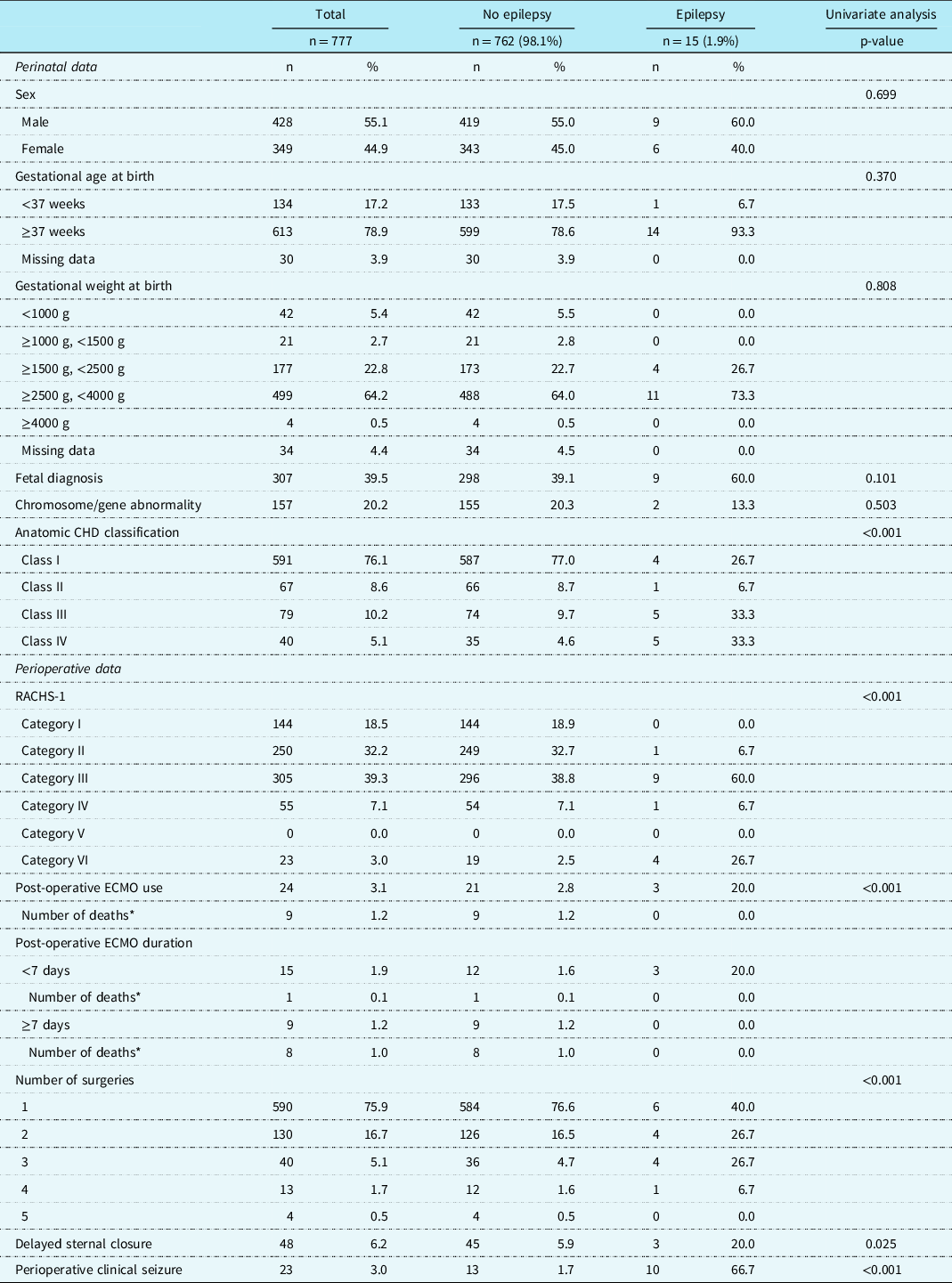
Table 1 shows the characteristics of patients in the epilepsy and control groups. Of the 777 patients, 15 (1.9%) and 23 (3.0%) experienced epilepsy and perioperative clinical seizure, respectively. Ten of the 15 patients (66.7%) who developed epilepsy also experienced perioperative clinical seizure. Among those who used extracorporeal membrane oxygenation less than 7 days after surgery (15 patients), three (20.0%) had epilepsy and one (6.7%) expired without withdrawal from extracorporeal membrane oxygenation. In patients who used extracorporeal membrane oxygenation ≥7 days after surgery, there was no occurrence of epilepsy, and eight of nine (88.9%) patients expired without withdrawal from extracorporeal membrane oxygenation.
Perinatal and perioperative data of patients with and without epilepsy

ECMO = extracorporeal membrane oxygenation; RACHS-1 = Risk Adjustment in Congenital Heart Surgery 1.
* Number of deaths without withdrawal from ECMO after surgery for CHD.
Elastic net
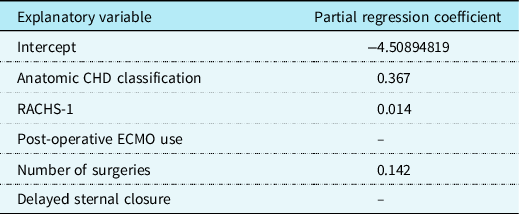
Anatomical CHD classification, Risk Adjustment in Congenital Heart Surgery 1, post-operative extracorporeal membrane oxygenation use, number of surgeries, and delayed sternal closure were used as explanatory variables. The results of the analysis performed with the elastic net method using the explanatory variables and epilepsy as the objective variable are shown in Table 2.
Analysis using the elastic net method with epilepsy as the objective variable

ECMO = extracorporeal membrane oxygenation; RACHS-1 = Risk Adjustment in Congenital Heart Surgery 1.
The partial regression coefficient with epilepsy as the objective variable for anatomical CHD classification, Risk Adjustment in Congenital Heart Surgery 1, and the number of surgeries was 0.367, 0.014, and 0.142, respectively. These findings showed that epilepsy was more common in patients with higher anatomical CHD classification, higher Risk Adjustment in Congenital Heart Surgery 1, and higher number of surgeries.
Mediation analysis
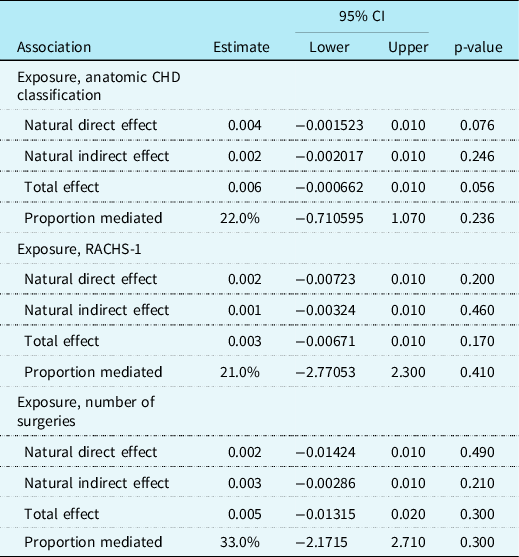
The results of the mediation analysis are shown in Table 3. The direct and indirect effects on epilepsy via perioperative clinical seizure were not statistically significant in any of the anatomical CHD classifications, Risk Adjustment in Congenital Heart Surgery 1, and number of surgeries. The proportion mediated for anatomical CHD classification, Risk Adjustment in Congenital Heart Surgery 1, and the number of surgeries was 22.0, 21.0, and 33.0%, respectively.
Mediation analysis with perioperative clinical seizures as the mediator and epilepsy as the outcome

CI = confidence interval; RACHS-1 = Risk Adjustment in Congenital Heart Surgery 1.
Imaging characteristics of patients with epilepsy
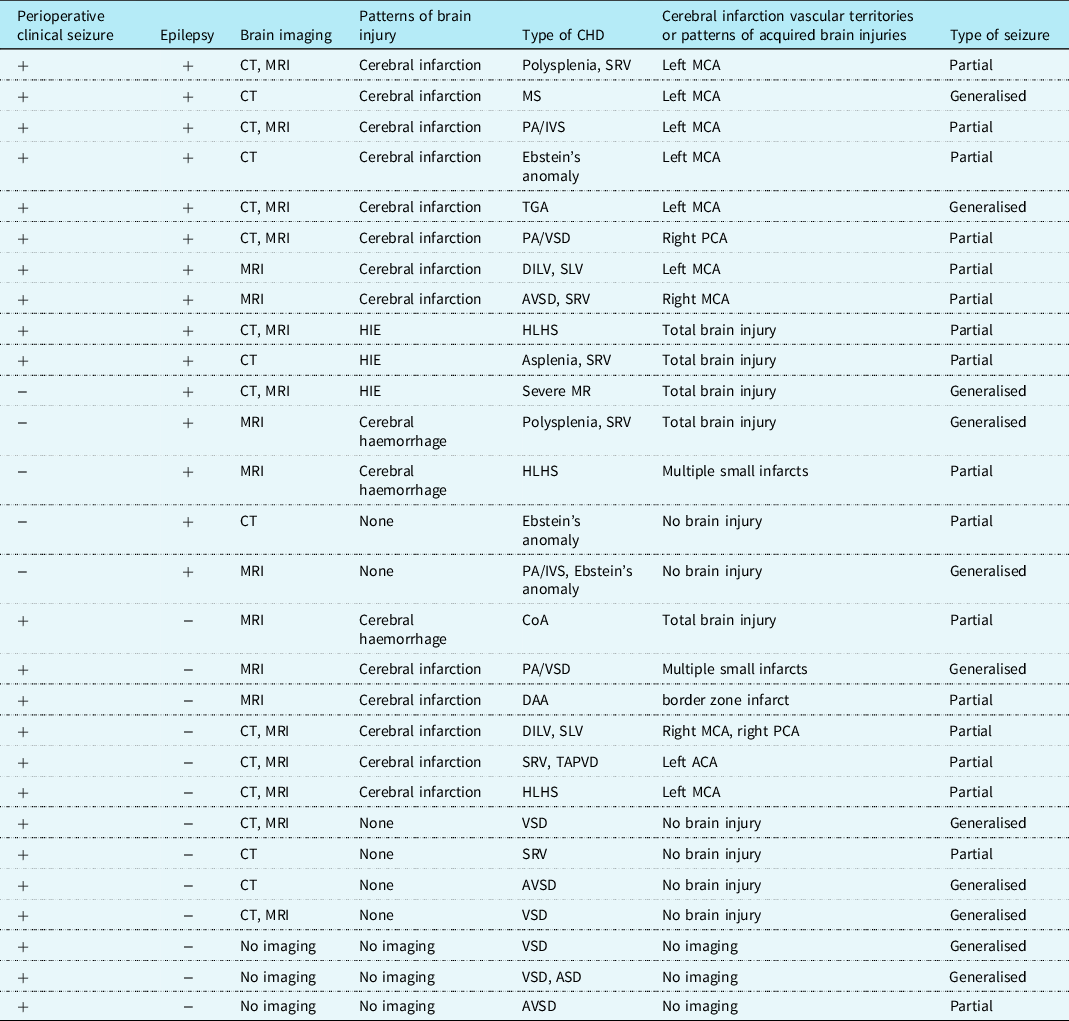
Brain imaging tests were performed in 20 of 23 patients with perioperative clinical seizure and all 15 patients with epilepsy. Table 4 shows the clinical features of the perioperative clinical seizure and/or epilepsy groups. Notable imaging findings were observed in 16 of 20 patients (80.0%) with perioperative clinical seizure; of those, 10 (62.5%) were subsequently diagnosed with epilepsy. Notable imaging findings were observed in 13 of 15 patients (86.7%) with epilepsy: eight patients with cerebral infarction; three patients with hypoxic-ischaemic encephalopathy; and two patients with cerebral haemorrhage. In the 15 patients with epilepsy, the imaging analysis did not reveal white matter integrity. Partial seizures were observed in 10 of 15 patients (66.7%), while generalised seizures were observed in five of 15 patients (33.3%).
Imaging characteristics of patients with perioperative clinical seizure and/or epilepsy

ACA = anterior cerebral artery; AVSD = atrioventricular septal defect; CoA = coarctation of aorta; DAA = double aortic arch; DILV = double inlet left ventricle; HIE = hypoxic-ischaemic encephalopathy; HLHS = hypoplastic left heart syndrome; MCA = middle cerebral artery; MR = mitral valve regurgitation; MS = mitral valve stenosis; PA/IVS = pulmonary atresia with intact ventricular septum; PA/VSD = pulmonary atresia with ventricular septal defect; PCA = posterior cerebral artery; PCS = perioperative clinical seizures; SLV = single left ventricle; SRV = single right ventricle; TAPVD = total anomalous pulmonary venous drainage; TGA = transposition of the great arteries; VSD = ventricular septum defect.
Discussion
In the present study, the incidence of perioperative clinical seizure and epilepsy was 3.0 and 1.9%, respectively. These rates were slightly lower than those previously reported.
Currently, there is no consensus on the risk factors for epilepsy in post-operative patients with CHD. A prospective cohort study using univariate logistic regression analysis in 128 post-operative patients with CHD demonstrated that post-operative use of extracorporeal membrane oxygenation and longer hospital stay were risk factors for epilepsy. Reference Desnous, Lenoir and Doussau14 A population-based cohort study involving 15,222 patients with CHD reported that the risk of epilepsy was most elevated among those who underwent multiple surgeries. Reference Leisner, Madsen, Ostergaard, Woo, Marino and Olsen5
In this study, we found that anatomical CHD classification, Risk Adjustment in Congenital Heart Surgery 1, and the number of surgeries were risk factors for developing epilepsy. Although brain injury is thought to be associated with the development of epilepsy, the mechanism of brain damage during the CHD perioperative period involves multiple factors. The exact mechanism responsible for brain injury in CHD is not yet fully understood, and several theories have been developed. Firstly, brain development could differ in infants with CHD because of intrinsic (epi)genetic factors. A large part of heart and brain development occurs simultaneously in the human fetus and involves shared genetic pathways. A discrepancy in one of these genetic pathways may lead to abnormal development of both organs, thereby causing neurodevelopmental impairments. Reference Mebius, Kooi, Bilardo and Bos15 Secondly, the heart defect may entail changes in oxygen saturation because of intracardiac or extracardiac mixing. This may subsequently lead to circulatory alterations that affect oxygen and nutrient supply to the brain, thereby disrupting normal cerebral development. Reference Mebius, Kooi, Bilardo and Bos15 Thirdly, decreased cerebral blood flow based on the specific sub-type of CHD is more pronounced in the presence of severe brain injury. For example, in conditions with left outflow tract obstruction (e.g. hypoplastic left heart syndrome, aortic valve stenosis), cerebral blood flow is supplied retrograde through the distal and transverse aortic arch by the ductus arteriosus. As pulmonary vascular resistance decreases, there is a potential for systemic steal to the pulmonary circulation. This is because adaptations to maintain systemic perfusion may be inadequate in the setting of single-ventricle physiology. Reference Peyvandi and Donofrio16 Fourthly, cardiopulmonary bypass operations to ensure intraoperative vital organ perfusion and oxygen supply are linked to specific risks (e.g. embolisation, deep hypothermia, flow rate, hemodilution, blood gas management, post-operative hyperthermia, systemic inflammatory response, and capillary leak syndrome). These may be risk factors for brain injury in patients with CHD during the perioperative period. Reference Hövels-Gürich17 The anatomical complexity of CHD, high-risk cardiac surgery, and multiple cardiac surgeries that we have identified cause brain damage through various mechanisms, including the above.
In contrast to previous reports, the use or lack of post-operative extracorporeal membrane oxygenation was not identified as a risk factor. The present study showed that patients who used extracorporeal membrane oxygenation for a long time had more severe conditions and were at a higher risk of death. Therefore, even if the use of post-operative extracorporeal membrane oxygenation causes brain damage and epilepsy, it was not possible to retrospectively determine the development of epilepsy due to the large number of deaths. The analysis performed using the elastic net method may have been unable to recognise the use or lack of post-operative extracorporeal membrane oxygenation as a risk factor.
In this study, mediation analysis was performed to determine the involvement of perioperative clinical seizure in the development of epilepsy. The results showed that the anatomical complexity of CHD, high-risk cardiac surgery, and multiple cardiac surgeries had limited indirect involvement via perioperative clinical seizures. A perioperative clinical seizure may be the first symptom of epilepsy and clinically involved in its development. However, epilepsy may occur even in the absence of perioperative clinical seizure after surgery for CHD. Patients with high-risk factors may develop epilepsy with or without perioperative clinical seizure and require long-term monitoring.
The elastic net method identified anatomical CHD classification, Risk Adjustment in Congenital Heart Surgery 1, and the number of surgeries as potential risk factors for developing epilepsy; however, there was no significant difference found in the mediation analysis. This may be attributed to the small number of events; thus, more cases should be accumulated and analysed.
In this study, 10 of the 15 patients with epilepsy experienced stroke (cerebral infarction and cerebral haemorrhage), and three patients had hypoxic-ischaemic encephalopathy but no white matter integrity. White matter integrity has been observed at a high rate before and after surgery in newborn babies with CHD. Reference Dimitropoulos, McQuillen and Sethi18 Of the four patients who developed epilepsy after surgery for CHD, three had hypoxic-ischaemic encephalopathy and one had no findings. Hence, it was concluded that white matter integrity was not associated with the development of epilepsy. Reference Desnous, Lenoir and Doussau14 Brain imaging tests were not systematically performed, and it was not possible to evaluate the timing of brain damage occurrence. Moreover, the factors responsible for the occurrence of brain damage remain unknown. It has been reported that 16% of patients after CHD surgery with cardiopulmonary bypass had new white matter integrity. Reference Andropoulos, Hunter and Nelson19 Despite the high incidence of white matter integrity in post-operative patients with CHD, its absence in patients with epilepsy indicates that white matter integrity may not be involved in the development of this condition. Nevertheless, a high proportion (86.7%) of patients with epilepsy had stroke and hypoxic-ischaemic encephalopathy, indicating that these conditions may influence the development of epilepsy. In our study, partial and generalised seizures were observed in 10 (66.7%) and five (33.3%) of 15 patients, respectively. Since most incidents of stroke were associated with damage (also to the local grey matter), it is possible that numerous partial epilepsies occur, as observed in this study. The present study revealed that clinical features and imaging findings were in agreement.
There are some limitations in this study. Firstly, due to the retrospective nature of the study, electroencephalographic monitoring was not systematically performed after surgery for CHD. It is possible that some patients who had abnormalities detected through electroencephalography did not have clinical seizures. Therefore, the number of patients with perioperative clinical seizure may have been underestimated. Secondly, this study examined the development of epilepsy during an observation period of 4–7 years following surgery for CHD. Studies are warranted to determine the incidence of epilepsy after the aforementioned observation period. Thirdly, there was no significant difference found in the mediation analysis. Therefore, it is unclear whether the identified items are risk factors for developing epilepsy. This may be due to the low incidence of perioperative clinical seizure and epilepsy. Therefore, analysis of additional cases is warranted to obtain more accurate results. However, consistent with the clinical impression, anatomical CHD classification, Risk Adjustment in Congenital Heart Surgery 1, and the number of surgeries identified using the elastic net method were shown to cause epilepsy. Fourthly, brain imaging was not systematically performed on patients following CHD. Therefore, this study could not compare patients with and without perioperative clinical seizure and/or epilepsy. There may be patients who do not develop perioperative clinical seizure and/or epilepsy despite the presence of brain damage. Moreover, the threshold of brain damage that would cause perioperative clinical seizure and/or epilepsy remains unclear and should be determined in the future. Finally, brain MRI was not systematically performed. Therefore, six patients with epilepsy underwent brain CT only. Although white matter integrity can be detected non-invasively through MRI, Reference Wang, Liu, Hong, Chen, Ji and Cao20 this approach is less sensitive than CT. This may explain the absence of white matter integrity in patients with epilepsy, as shown by brain imaging.
In summary, the incidence of perioperative clinical seizure and epilepsy was 3.0 and 1.9%, respectively. The anatomical complexity of CHD, high-risk cardiac surgery, and multiple cardiac surgeries were identified as potential risk factors for developing epilepsy, with a low rate of indirect involvement via perioperative clinical seizure and a high rate of direct involvement independently of perioperative clinical seizure. Unlike white matter integrity, stroke and hypoxic-ischaemic encephalopathy may also be linked to the development of epilepsy.
Acknowledgements
None.
Financial support
This research received no specific grant from any funding agency, commercial or not-for-profit sectors.
Conflicts of interest
None.
Ethical standards
The authors assert that all procedures contributing to this work comply with the ethical standards of the relevant national guidelines on human experimentation (Ethical Guidelines for Medical and Health Research involving Human Subjects) and with the Helsinki Declaration of 1975, as revised in 2008, and has been approved by the Research Ethics Committee of Kanagawa Children’s Medical Center (approval number: 1906-12).