INTRODUCTION
Globally, limited supply of high-quality forages remains a long standing challenge for the ruminant production industry. Improving utilization of local forages would enhance production efficiency and reduce costs. In recent years, using exogenous enzymes as feed additives for ruminants has received considerable attention for their potential role in increasing forage degradability and improving animal performance (Beauchemin et al. Reference Beauchemin, Colombatto, Morgavi and Yang2003). Many studies have confirmed that the addition of enzymes to feeds can improve degradability of dry matter (DM) and neutral detergent fibre (NDF) in vitro (Colombatto et al. Reference Colombatto, Morgavi, Furtado and Beauchemin2003a ; Eun & Beauchemin Reference Eun and Beauchemin2007a ; Eun et al. Reference Eun, Beauchemin and Schulze2007) and enhance digestion of forage and milk production in dairy cows (Yang et al. Reference Yang, Beauchemin and Rode2000; Arriola et al. Reference Arriola, Kim, Staples and Adesogan2011). For low-quality forage, Tang et al. (Reference Tang, Tayo, Tan, Sun, Shen, Zhou, Xiao, Ren, Han and Shen2008) showed that the application of fibrolytic enzymes improved in vitro gas production (GP) and degradation of cereal straws. However, Colombatto et al. (Reference Colombatto, Morgavi, Furtado and Beauchemin2003a ) reported that the in vitro effectiveness among various enzyme products was highly variable. Furthermore, dietary enzyme addition failed to increase milk production in some in vivo studies, indicating the need for prior in vitro evaluation before conducting a feeding study (Beauchemin et al. Reference Beauchemin, Rode, Maekawa, Morgavi and Kampen2000; Kung et al. Reference Kung, Cohen, Rode and Treacher2002; Sutton et al. Reference Sutton, Phipps, Beever, Humphries, Hartnell, Vicini and Hard2003). Probable reasons for lack of effects may relate in part to the types and activities of the enzymes used. Even within a single microbial species, enzyme activities can vary widely depending on the source of micro-organism, growth substrates and culture conditions employed during manufacture (Considine & Coughlan Reference Considine, Coughlan and Coughlan1989; Gashe Reference Gashe1992).
The focus of enzyme-related research for ruminants has been on degrading the major plant structural polysaccharides, cellulose and hemicellulose. Enzyme products with high xylanase activity (EPX) are expected to hydrolyse xylan, the main constituent of hemicellulose. Recently, several studies have been conducted to investigate the responses of ruminal fermentation to the addition of EPX (Eun et al. Reference Eun, Beauchemin, Hong and Bauer2006; Eun & Beauchemin Reference Eun and Beauchemin2007b ): these studies have shown that the response to individual enzyme product is forage-specific. Additionally, research on effects of EPX sources for ruminal fermentation is scarce. Therefore, the objective of the present study was to evaluate the effects of five EPX from various sources on in vitro ruminal fermentation and degradation of three forages widely used in China [i.e. maize (Zea mays) stover (MS), rice (Oryza sativa) straw (RS) and Guimu No.1 grass (Pennisetum americanum×P. purpureum, GM)]. A batch culture technique was used to examine the responses to increasing EPX dose at two incubation times (i.e. 24 and 48 h). The GP kinetic characters, cumulative GP, methane (CH4) production, in vitro degradability of DM (IVDMD) and NDF (IVNDFD) and end products of in vitro fermentation [volatile fatty acids (VFA) and ammonia-N (NH3-N)] were measured as indices of in vitro fermentation characteristics.
MATERIALS AND METHODS
Experimental layout
An in vitro study using a batch culture technique was conducted to evaluate the effects of five various EPX products on GP characters, degradability and fermentation characteristics of three forages. Each forage was evaluated in a separate assay conducted after 24 and 48 h of incubation. Both incubation times were used because the ruminal retention time values of forage-based diets were reported to be between 24 and 48 h in goats or cattle (Udén et al. Reference Udén, Rounsaville, Wiggans and Van Soest1982; Hristov et al. Reference Hristov, Ahvenjarvi, McAllister and Huhtanen2003), and it has also been reported that the response to enzyme is less marked at longer in vitro incubation times (Colombatto et al. Reference Colombatto, Morgavi, Furtado and Beauchemin2003a ). Within each assay, treatments were applied in a 5 (EPX)×4 (dose) factorial arrangement. The doses were: 0 (control), 20 (low), 50 (medium) and 80 (high) xylanase units/g DM forage. The medium dose was selected based on a previous study (Giraldo et al. Reference Giraldo, Tejido, Ranilla and Carro2007, Reference Giraldo, Tejido, Ranilla and Carro2008) wherein similar xylanase activity was used.
Forages
Three forages grown in the southern region of China were used as substrates: MS (Z. mays, variety Kexiang Sweet Corn No. 1, from Changsha City, Hunan Province, 28°12′N and 113°58′E), RS (O. sativa, variety Xiang 125S/BAR-1, from Liuyang City, Hunan Province, 28°16′N and 113°63′E) and GM [Hybrid Napiergrass Guimu No.1 grass (P. americanum×P. purpureum), from Huanjiang City, Guangxi Province, 24°83′N and 108°26′E]. Mature maize (Z. mays, variety Kexiang Sweet Corn No. 1) stover was harvested on 25 July 2011. For RS, rice grains were harvested on 8 August 2011, after which mature rice straw was collected randomly from three plots measuring 1 m2. The GM was collected at the pre-flowering stage on 18 November 2011. Samples of each forage were harvested in triplicate using a 1-m2 quadrat and chopped to a 20 mm length with a chaffcutter (Xingrong Machinery, Guangzhou, Guangdong, China) after air-drying. Then the three replicate samples (500 g each) of each forage were oven-dried at 65 °C for 48 h, and ground to pass a 1-mm screen (DF-2, Changsha Instrument Factory, Changsha, Hunan, China) with 1 mm sieve. Ground samples were stored for chemical analysis and used in the in vitro incubation. The MS, RS and GM contained (on a DM basis): 52·3, 62·4 and 89·4 g crude protein (CP)/kg; 636, 632 and 612 g NDF/kg; and 386, 434 and 336 g acid detergent fibre (ADF)/kg, respectively.
Enzyme products
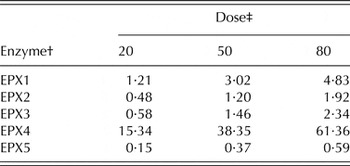
Five enzyme products, derived from the xylanase genes of various fungi and designated as EPX1, EPX2, EPX3, EPX4 and EPX5, were used in the present study. Enzyme products EPX1, EPX2, EPX3 and EPX4 were single xylanase activity experimental enzyme products produced from recombinant micro-organisms and were in powder form: EPX1 (SunHY; Wuhan, Hubei, China) came from the xylanase gene of a strain of Trichoderma harzianum; EPX2 (Youtell; Yueyang, Hunan, China) was derived from a strain of Trichoderma reesei; EPX3 (Youtell, Yueyang, Hunan, China) from a strain of Orpinomyces and EPX4 (VTR, Guangzhou, Guangdong, China) from a strain of Aspergillus oryzae. The final enzyme product, EPX5 (Dyadic International Inc., Jupiter, FL, USA), produced from a strain of Trichoderma longibrachiatum, was in liquid form and characterized with high xylanase and relatively low endoglucanase activities. It was included as a positive control that could improve in vitro fermentation of forages. The enzymatic characteristics of the EPX products are presented in Table 1. Since xylanase activity differed among the EPX products, the amount of each EPX product that was added into the incubation bottle was adjusted, depending on the target xylanase activity (Table 2).
Enzymatic activities (U)* and description of enzyme products

* One enzymatic unit was expressed as μmol xylose or glucose/min/g or ml enzyme from the corresponding substrate, using a standard curve made with xylose or glucose (from 0 to 0·8 mg/ml) obtained under identical conditions.
† EPX, enzyme product with high xylanase activity, derived from xylanase genes of various fungi as follows: EPX1, from a strain of Trichoderma harzianum; EPX2, from a strain of Trichoderma reesei; EPX3, from a strain of Orpinomyces; EPX4, from a strain of Aspergillus oryzae; EPX5 was produced from Trichoderma longibrachiatum.
‡ Protein concentration was expressed as mg/g (EPX1–EPX4) or ml (EPX5).
Amounts of enzyme product (mg or μl)* added to each incubation bottle (containing 500 mg substrate dry matter)

* Unit for amounts of EPX1–EPX4 was mg, while unit for amounts of EPX5 was μl.
† EPX, enzyme product with high xylanase activity, derived from xylanase genes of various fungi as follows: EPX1, from a strain of Trichoderma harzianum; EPX2, from a strain of Trichoderma reesei; EPX3, from a strain of Orpinomyces; EPX4, from a strain of Aspergillus oryzae; EPX5 was produced from Trichoderma longibrachiatum.
‡ Dose as units of xylanase/g of DM forage substrate; one enzymatic unit was expressed as μmol xylose/min/g or ml enzyme from oat spelt xylan, using a standard curve made with xylose (from 0 to 0·8 mg/ml) obtained under identical conditions.
In vitro incubation
Ground forage (0·5 g) was weighed into a 125-ml bottle (Wanhong Glass Instrument Factory, Haimen, Jiangshu, China) and each sample was replicated four times. The EPX products in powder form were first dissolved in 1 mm sodium phosphate buffer (pH 6·0), and then the appropriate amount of diluted enzyme solution was applied to the substrate in the bottle to supply 20, 50 or 80 xylanase units/g substrate DM. Buffered rumen fluid (50 ml) was then added under CO2 flushing to each bottle within minutes of applying the enzyme to the substrate. In addition, bottles containing substrate without enzyme were included as controls (i.e. dose=0 xylanase unit/g DM forage). Bottles containing buffered ruminal fluid alone or buffered ruminal fluid plus enzyme products without substrates were also prepared and used to correct for GP and fermentation residues resulting from the inoculum or the enzyme product itself (Eun & Beauchemin Reference Eun and Beauchemin2007a ).
Ruminal fluid was obtained from three ruminally cannulated Liuyang Black goats (a local breed; 21±0·7 kg body weight) fed ad libitum a mixed diet of MS and concentrate (50 : 50, wt/wt) offered twice daily at 08·00 and 18·00 h. Concentrate contained (per 1000 g DM): 638 g ground maize, 142 g wheat bran, 189 g soybean meal, 11 g salt and 20 g premix. The goats were managed according to the protocols approved by the Animal Care and Use Guidelines of the Animal Care Committee, Institute of Subtropical Agriculture, The Chinese Academy of Sciences, Changsha, China. Ruminal contents of each goat were obtained from various locations within the rumen immediately before the morning feeding, mixed and strained through four layers of cheesecloth. The resulting particle-free fluid was mixed with the buffer medium, prepared as outlined by Goering & Van Soest (Reference Goering and Van Soest1970), in a proportion of 1 : 4 (v/v) at 39 °C under continuous flushing with CO2.
Once the buffered rumen fluid was added to the bottle, the bottle was immediately sealed with a rubber stopper, shaken and placed in an incubator at 39 °C. Headspace GP was measured at 2, 4, 6, 8, 10, 12, 16, 24, 36 and 48 h of incubation by inserting a needle attached to a pressure transducer (CYG130-12, Kunshan Shuangqiao Sensor Measurement Controlling Co., Ltd., Kunshan, Jiangsu, China) through the stopper. The pressure readings (pounds per square inch: psi), corrected for the enzyme and inoculum controls, were transformed to volumes (ml) using an equation with known pressure readings and gas volumes in the bottles (Mota et al. Reference Mota, Rodríguez, Solanas and Fondevila2005).
The fermentation was terminated at 24 and 48 h to determine the 24 and 48-h IVDMD. At each time, a sample of gas (5 ml) collected in a graduated syringe was transferred to a 10 ml pre-evacuated vial (Exetainer; Labco Limited, High Wycombe, Buckinghamshire, UK). The bottles were then placed in a refrigerator at 4 °C for 2 h to stop the fermentation. The contents of the bottles were then transferred to pre-weighed Gooch filter crucibles (Shanghai Huake Instrument Factory, Shanghai, China). A sample (1·5 ml) of filtrate from each bottle was added to 0·15 ml 25% metaphosphoric acid (HPO3) for VFA and NH3-N determination. Samples were frozen and stored at –40 °C until analysis. Crucibles containing the residues were washed with 50 ml of hot distilled water (55 °C), dried at 65 °C for 48 h, weighed, and the residues were analysed for DM and NDF to calculate IVDMD and IVNDFD, respectively.
Chemical analyses
The enzyme products were assayed for xylanase [Enzyme Commission (EC) 3.2.1.8] and endoglucanase (EC 3.2.1.4; Webb Reference Webb1992) activities according to the procedures of Colombatto & Beauchemin (Reference Colombatto and Beauchemin2003). All activities were measured at pH 6·0 and 39 °C to represent ruminal conditions of ruminants fed mixed forage and concentrate diets (ruminal pH normally ranges from 5·5 to 7·0). A solution (0·01, w/v) of oat spelt xylan and medium-viscosity carboxymethyl cellulose (Sigma, St. Louis, MO, USA) were used as substrates for determination of xylanase and endoglucanase activity, respectively. One hundred microliters of suitably diluted enzyme solution was incubated in triplicate with 1 ml substrate solution and 0·9 ml buffer at 39 °C for 5 min. The reaction was terminated by adding 3 ml of 3,5-dinitrosalicylic acid solution (DNS) reagent and placing the tubes into boiling water for exactly 5 min. The absorbance was read at 540 nm using a spectrophotometer (8500II, Thermo Electron Corporation, Rochester, NY, USA). The units of xylanase or endoglucanase activity were expressed as μmol xylose or glucose equivalents/min/g for powder EPX and μmol xylose or glucose equivalents/min/ml for liquid EPX, respectively, using a standard curve made with xylose or glucose (from 0 to 0·8 mg/ml) obtained under identical conditions. The amount of protein concentration in the enzyme products was determined using a commercially available bicinchoninic acid (BCA) kit (BCA Protein Assay Kit, Nanjing Jiancheng Bioengineering Institute, Nanjing, Jiangsu, China) with bovine serum albumin (BSA) as the standard (Walker Reference Walker and Walker2009). Twenty microliters of suitably diluted enzyme was added to microtiter plates, followed by 200 μl of BCA reagent mixture (reagent A:reagent B, 50 : 1 ratio v/v). The reaction was allowed to proceed at 60 °C for 30 min, and absorbance was measured at 562 nm using a MRX-HD plate reader (Labsystems, Helsinki, Finland).
The forages were analysed for DM using the procedures of the Association of Official Analytical Chemists (AOAC 1999, method 930·15), organic matter (OM, method 985·01), and CP (6·25×nitrogen, method 990·03). The NDF and ADF (expressed inclusive of residual ash) were determined using a Fibretherm Fibre Analyzer (Gerhardt, Bonn, Germany) according to Van Soest et al. (Reference Van Soest, Robertson and Lewis1991) with addition of sodium sulphite and heat stable α-amylase in the NDF analysis.
Concentration of CH4 in gas samples was determined using a gas chromatograph (Agilent 7890A; Agilent Technologies, Palo Alto, CA, USA) with a packed column in nickel tubing (2·4 m×0·2 mm internal diameter (i.d.), 80–100 mesh, Agilent Technologies). Gas was flushed through a sampling loop of the gas chromatograph, fitted with a flame ionization detector (column temperature=60 °C, injector and detector temperature=280 °C). The carrier gas (N2) flow rate was 21 ml/min. For VFA analysis, samples were thawed and centrifuged at 15 000 g for 10 min and the supernatant was analysed using a gas chromatograph (Agilent 7890A; Agilent Technologies) with capillary column (30 m in length with a 0·25 mm i.d., Agilent Technologies). The attenuation was set at a nitrogen diffluent ratio of 1 : 50, hydrogen flow 30 ml/min, airflow 365 ml/min, injector temperature 250 °C and detector temperature 280 °C. The oven temperature was 60 °C held for 2 min, which was then increased by 20 °C/min to 220 °C. The N2 was used as carrier gas at a flow rate of 0·8 ml/min. The ammonia-nitrogen (NH3-N) was determined as described by Weatherburn (Reference Weatherburn1967) using a spectrophotometer (8500II, Thermo Electron Corporation, Waltham, MA, USA).
Biometric analyses
To estimate the kinetics of GP, the following equations (Wang et al. Reference Wang, Tang and Tan2011, Reference Wang, Sun, Tang, Tan and Pacheco2013) were used:
 $$GP = VF \times \displaystyle{{1 + d} \over { 1 + exp(b - k \times t )}} - d$$
 $$t 0 {\cdot} 5 = \displaystyle{{{\rm ln}(2 + 1/d)} \over k}$$
 $$FRD 0 = \displaystyle{k \over { 1 + exp(b )}}$$
where GP is cumulative GP (ml/g DM) at different incubation times; VF is the asymptotic GP (ml/g DM); k is the fractional rate of GP (/h); b and d are the shape parameters; t is gas reading time (h); t0·5 is the time when the GP is half of the theoretical maximum GP; and FRD0 (%/h) is the initial fractional rate of degradation. The GP characters (VF, k, b and d) were calculated using NLREG (Version 5.0) software (Sherrod Reference Sherrod2005).
The data were analysed separately by forage using the MIXED procedure of SAS (SAS 2002) in a 5×4 factorial arrangement. The model included EPX, dose and their interaction as fixed effects. If the interaction term was not significant, it was subsequently excluded from the final model. Dose effect was analysed for linear and quadratic trends. Differences among EPX groups were tested using the Kenward–Roger method. The probability difference (PDIFF) option of the least square means statement was applied to evaluate pair-wise comparisons between the EPX group means. Mean values were considered to be significantly different when P<0·05 and considered a tendency when 0·05≤P≤0·1.
RESULTS
Gas production kinetics
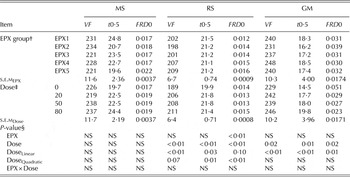
There were no interactions between EPX and dose for GP kinetics and other measurements for any of the forages; therefore, only the main effects of EPX and dose are discussed (Tables 3–9). For MS, there was no effect of EPX or dose on any of the GP kinetic variables (Table 3). For RS, there was a difference in the effect of EPX (P<0·01) on FRD0. The EX5 treatment resulted in a greater FRD0 for RS than any other treatments. Increasing EPX dose increased (P<0·05) VF and t0·5 for RS and GM. For RS, these GP kinetic variables were or tended to be linearly (VF and t0·5, P<0·05; FRD0, P=0·096) and quadratically (VF, P=0·065; t0·5 and FRD0, P<0·05) increased with increasing EPX dose, whereas for GM they were only increased linearly (P<0·05). Additionally, the FRD0 was linearly (P<0·05) decreased for GM with increasing EPX dose.
Gas production kinetic characters for the three forages used in the present study*

* VF is the asymptotic gas production (ml/g DM); t0·5 is the time (h) when the GP is half of the theoretical maximum GP; and FRD0 (%/h) is the initial fractional rate of degradation; MS, maize stover; RS, rice straw; GM, Guimu No.1 grass; EPX, enzyme product with high xylanase activity.
† EPX, enzyme product with high xylanase activity, derived from xylanase genes of various fungi as follows: EPX1, from a strain of Trichoderma harzianum; EPX2, from a strain of Trichoderma reesei; EPX3, from a strain of Orpinomyces; EPX4, from a strain of Aspergillus oryzae; EPX5 was produced from Trichoderma longibrachiatum.
‡ Dose as units of xylanase/g of DM forage substrate; one enzymatic unit was expressed as μmol xylose/min/g or ml enzyme from oat spelt xylan, using a standard curve made with xylose (from 0 to 0·8 mg/ml) obtained under identical conditions.
§ NS, not significant; DoseLinear, linear effect of dose; DoseQuadratic, quadratic effect of dose.
Cumulative gas production, methane production and degradability
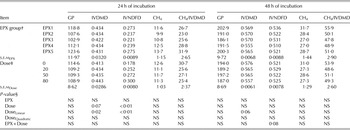
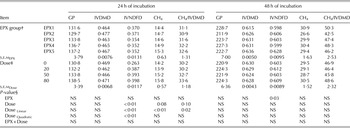
For MS, there were no EPX group effects for GP, IVDMD, IVNDFD, CH4 or CH4/IVDMD at either incubation time (Table 4). There was a linear response to increasing EPX dose for IVDMD after 24 (P<0·05) and 48 h (P=0·063) and IVNDFD (P<0·01) only at 24 h. However, CH4 production was not affected by EPX dose.
Gas production, methane production and degradability coefficient of maize stover*

* GP, gas production (ml/g DM); IVDMD, in vitro degradability of DM; IVNDFD, in vitro degradability of NDF; CH4, methane (ml/g DM incubated); CH4/IVDMD, methane/in vitro degradability of DM (ml/g DM digested); EPX, enzyme product with high xylanase activity.
† EPX, enzyme product with high xylanase activity, derived from xylanase genes of various fungi as follows: EPX1, from a strain of Trichoderma harzianum; EPX2, from a strain of Trichoderma reesei; EPX3, from a strain of Orpinomyces; EPX4, from a strain of Aspergillus oryzae; EPX5 was produced from Trichoderma longibrachiatum.
‡ Dose as units of xylanase/g of DM forage substrate; one enzymatic unit was expressed as μmol xylose/min/g or ml enzyme from oat spelt xylan, using a standard curve made with xylose (from 0 to 0·8 mg/ml) obtained under identical conditions.
§ NS, not significant; DoseLinear, linear effect of dose; DoseQuadratic, quadratic effect of dose.
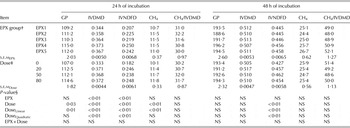
For RS, dose increased (P<0·01) GP and CH4 production at 24 h in a linear manner, with no EPX group effects (Table 5). However, these same variables were not affected by treatments at 48 h. There were effects (P<0·01) of EPX on IVDMD and IVNDFD at 24 h, but not at 48 h. The degradability coefficients of DM and NDF recorded for EPX4 group (0·373 and 0·250, respectively) were the highest, whereas EPX1 group had the lowest (0·344 and 0·207, respectively). Increasing EPX dose increased (linear effect, P<0·01; quadratic effect, P<0·01) IVDMD and IVNDFD at 24 h, but only IVNDFD was affected by dose at 48 h (linear effect, P<0·01; quadratic effect, P<0·01).
Gas production, methane production and degradability coefficient of rice straw*

* GP, gas production (ml/g DM); IVDMD, in vitro degradability of DM; IVNDFD, in vitro degradability of NDF; CH4, methane (ml/g DM incubated); CH4/IVDMD, methane/in vitro degradability of DM (ml/g DM digested); EPX, enzyme product with high xylanase activity.
† EPX, enzyme product with high xylanase activity, derived from xylanase genes of various fungi as follows: EPX1, from a strain of Trichoderma harzianum; EPX2, from a strain of Trichoderma reesei; EPX3, from a strain of Orpinomyces; EPX4, from a strain of Aspergillus oryzae; EPX5 was produced from Trichoderma longibrachiatum.
‡ Dose as units of xylanase/g of DM forage substrate; one enzymatic unit was expressed as μmol xylose/min/g or ml enzyme from oat spelt xylan, using a standard curve made with xylose (from 0 to 0·8 mg/ml) obtained under identical conditions.
§ NS, not significant; DoseLinear, linear effect of dose; DoseQuadratic, quadratic effect of dose.
For GM, there were no effects of EPX on GP, degradability or CH4 variables, except for IVNDFD coefficient after 48 h of incubation which was greater (P<0·05) with EPX5 (0·628) than with other EPX (Table 6). Increasing EPX dose increased IVNDFD (linear effect, P<0·01; quadratic effect, P<0·01), CH4 (linear effect, P<0·01) and CH4/IVDMD (linear effect, P< 0·05) at 24 h, but there was no effect of dose on these variables at 48 h.
Gas production, methane production and degradability coefficient of Guimu No. 1 grass*

* GP, gas production (ml/g DM); IVDMD, in vitro degradability of DM; IVNDFD, in vitro degradability of NDF; CH4, methane (ml/g DM incubated); CH4/IVDMD, methane/in vitro degradability of DM (ml/g DM digested); EPX, enzyme product with high xylanase activity.
† EPX, enzyme product with high xylanase activity, derived from xylanase genes of various fungi as follows: EPX1, from a strain of Trichoderma harzianum; EPX2, from a strain of Trichoderma reesei; EPX3, from a strain of Orpinomyces; EPX4, from a strain of Aspergillus oryzae; EPX5 was produced from Trichoderma longibrachiatum.
‡ Dose as units of xylanase/g of DM forage substrate; one enzymatic unit was expressed as μmol xylose/min/g or ml enzyme from oat spelt xylan, using a standard curve made with xylose (from 0 to 0·8 mg/ml) obtained under identical conditions.
§ NS, not significant; DoseLinear, linear effect of dose; DoseQuadratic, quadratic effect of dose.
Volatile fatty acid and ammonia-nitrogen profiles
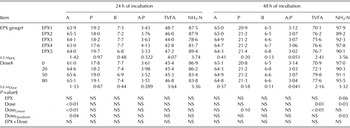
For MS, there was no effect of EPX on individual VFAs or NH3-N concentration, except for a trend effect of EPX on NH3-N concentration (P=0·061) after 48 h (Table 7). Increasing EPX dose increased acetate proportion (linear effect, P<0·01; quadratic effect, P<0·05) at 24 h, but not at 48 h. The total volatile fatty acids (TVFA) was increased (linear effect, P<0·01) with increasing dose at 48 h.
VFA profiles and NH3-N concentrations of in vitro incubation medium for maize stover*

* TVFA expressed as mM and individual VFA expressed as moles/100 moles; ammonia-N expressed as mg/dl; TVFA, total volatile fatty acids; A, acetate; P, propionate; B, butyrate; TVFA, total VFA; NH3-N, ammonia-N; EPX, enzyme product with high xylanase activity. Trichoderma harzianum
† EPX, enzyme product with high xylanase activity, derived from xylanase genes of various fungi as follows: EPX1, from a strain of Trichoderma harzianum; EPX2, from a strain of Trichoderma reesei; EPX3, from a strain of Orpinomyces; EPX4, from a strain of Aspergillus oryzae; EPX5 was produced from Trichoderma longibrachiatum.
‡ Dose as units of xylanase/g of DM forage substrate; one enzymatic unit was expressed as μmol xylose/min/g or ml enzyme from oat spelt xylan, using a standard curve made with xylose (from 0 to 0·8 mg/ml) obtained under identical conditions.
§ NS, not significant; DoseLinear, linear effect of dose; DoseQuadratic, quadratic effect of dose.
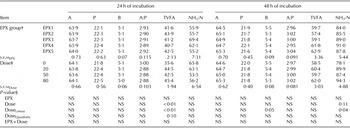
For RS, there was no effect of EPX on individual VFAs or NH3-N concentration (Table 8). Increasing EPX dose increased (linear effect, P<0·01) TVFA at 24 h, but not at 48 h. Butyrate proportion and NH3-N concentration were affected (linear effect, P<0·05) by dose at 48 h.
Total VFA profiles and NH3-N concentrations of in vitro incubation medium for rice stover*

* TVFA expressed as mM and individual VFA expressed as moles/100 moles; ammonia-N expressed as mg/dl; TVFA, total volatile fatty acids; A, acetate; P, propionate; B, butyrate; TVFA, total VFA; NH3-N, ammonia-N; EPX, enzyme product with high xylanase activity.
† EPX, enzyme product with high xylanase activity, derived from xylanase genes of various fungi as follows: EPX1, from a strain of Trichoderma harzianum; EPX2, from a strain of Trichoderma reesei; EPX3, from a strain of Orpinomyces; EPX4, from a strain of Aspergillus oryzae; EPX5 was produced from Trichoderma longibrachiatum.
‡ Dose as units of xylanase/g of DM forage substrate; one enzymatic unit was expressed as μmol xylose/min/g or ml enzyme from oat spelt xylan, using a standard curve made with xylose (from 0 to 0·8 mg/ml) obtained under identical conditions.
§ NS, not significant; DoseLinear, linear effect of dose; DoseQuadratic, quadratic effect of dose.
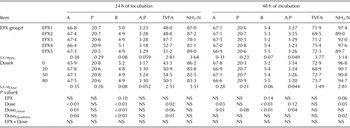
For GM, there was no effect of EPX for individual VFAs or NH3-N concentration (Table 9). Increasing EPX dose affected acetate (linear and quadratic effect, P<0·05, 24 h; linear effect, P<0·05, 48 h) and butyrate (linear and quadratic effect, P<0·01, 24 h; linear effect, P<0·01, 48 h) concentrations at 24 and 48 h, TVFA (linear effect, P=0·062; quadratic effect, P<0·05) only at 24 h and NH3-N concentration (quadratic effect, P<0·05) only at 48 h.
Total VFA profiles and NH3-N concentrations of in vitro incubation medium for Guimu No. 1 grass*

* TVFA expressed as mM and individual VFA expressed as moles/100 moles; ammonia-N expressed as mg/dl; TVFA, total volatile fatty acids; A, acetate; P, propionate; B, butyrate; TVFA, total VFA; NH3-N, ammonia-N; EPX, enzyme product with high xylanase activity.
† EPX, enzyme product with high xylanase activity, derived from xylanase genes of various fungi as follows: EPX1, from a strain of Trichoderma harzianum; EPX2, from a strain of Trichoderma reesei; EPX3, from a strain of Orpinomyces; EPX4, from a strain of Aspergillus oryzae; EPX5 was produced from Trichoderma longibrachiatum.
‡ Dose as units of xylanase/g of DM forage substrate; one enzymatic unit was expressed as μmol xylose/min/g or ml enzyme from oat spelt xylan, using a standard curve made with xylose (from 0 to 0·8 mg/ml) obtained under identical conditions.
§ NS, not significant; DoseLinear, linear effect of dose; DoseQuadratic, quadratic effect of dose.
DISCUSSION
The medium dose of xylanase activity, added to the incubations in the present study (Table 2), was similar to the dose rates used in previous studies (Colombatto et al. Reference Colombatto, Mould, Bhat, Morgavi, Beauchemin and Owen2003b ; Eun & Beauchemin Reference Eun and Beauchemin2008; Elghandour et al. Reference Elghandour, Salem, Gonzalez-Ronquillo, Bórquez, Gado, Odongo and Peñuelas2013). In those studies, the quantity of enzyme products in powdered form needed to provide the desired dose ranged from 0·5 (Eun & Beauchemin Reference Eun and Beauchemin2008) to 20 mg/g (Elghandour et al. Reference Elghandour, Salem, Gonzalez-Ronquillo, Bórquez, Gado, Odongo and Peñuelas2013) of DM, whereas with liquid enzyme products, Colombatto et al. (Reference Colombatto, Mould, Bhat, Morgavi, Beauchemin and Owen2003b ) found that the addition of 2·55 μl/g DM improved the fermentation of cellulose and xylan. However, in the case of EPX4, the actual quantity of product added in order to achieve the desired activity was excessively high, with 38·35 mg/g of DM added. The EPX4 product had the lowest protein concentration, and thus a low xylanase activity.
Dose of exogenous xylanases and fermentation characteristics of low-quality forages
Supplementing EPX products substantially improved the degradation of MS, RS and GM. For instance, at the dose of 20 units/g DM, the EPX products increased 24-h IVNDFD of MS by 41·6%, RS by 35·2% and GM by 47·1% when compared to the control. The improvement of IVNDFD can allow greater voluntary feed intake (Dado & Allen Reference Dado and Allen1995) by ruminants due to decreased rumen fill, and it can increase the energy density of diets and stimulate microbial nitrogen production (Oba & Allen Reference Oba and Allen2000). It has been proposed that a 0·01 increase in forage IVNDFD would elicit a 0·17 kg increase in DM intake and a 0·25 kg increase in 4% fat-corrected milk yield of dairy cows (Oba & Allen Reference Oba and Allen1999). Thus, using EPX as a feed additive may have the potential to improve the productivity of ruminants fed locally grown low-quality forages. Improvement of fibre degradation with EPX has resulted from enhanced attachment and colonization of plant cell wall material by rumen micro-organisms (Nsereko et al. Reference Nsereko, Beauchemin, Morgavi, Rode, Furtado, McAllister, Iwaasa, Yang and Wang2002), increased microbial growth (Eun et al. Reference Eun, Beauchemin and Schulze2007), or synergism with endogenous microbial enzymes (Morgavi et al. Reference Morgavi, Beauchemin, Nsereko, Rode, McAllister, Iwaasa, Wang and Yang2001).
The dose response of EPX in increasing IVDMD and IVNDFD was forage-dependent, indicating that the effectiveness of a particular enzyme dose differed among the three forages. However, the lack of interactions between EPX and dose for the three forages indicated that the dose response was not product-dependent within forage. The linear increases in IVDMD or IVNDFD with increasing EPX dose for MS indicated no inhibitory effects of EPX dose on xylan degradation. However, the quadratic responses to EPX dose for RS and GM indicated diminishing effects with increasing dose rate and suggested that a high rate of EPX may have inhibitory effects on xylan degradation by blocking the enzyme binding sites (Nsereko et al. Reference Nsereko, Morgavi, Rode, Beauchemin and McAllister2000) or decreasing microbial attachment to substrate (Morgavi et al. Reference Morgavi, Beauchemin, Nsereko, Rode, McAllister and Wang2004). Such effects were also observed in vitro by Eun & Beauchemin (Reference Eun and Beauchemin2008) and in vivo with other substrates and enzyme products (Nsereko et al. Reference Nsereko, Beauchemin, Morgavi, Rode, Furtado, McAllister, Iwaasa, Yang and Wang2002). Based on the degradation results, it was concluded that, among the three forages evaluated, MS showed the most potential for improvement of fibre degradation using EPX.
Enzyme treatment also exerted positive effects on GP variables. For example, the increase in FRD0 (in vitro rate of fermentation measured at early stages) with EPX addition indicated that EPX accelerated the rate of fermentation. However, this improvement response only occurred in RS but not in MS and GM, suggesting enzyme-forage specificity. Increased FRD0 would be beneficial in vivo because the rate of fermentation measured at early stages of in vitro incubations was somewhat of an indicator of the in vivo feed efficiency (Wang et al. Reference Wang, Sun, Tang, Tan and Pacheco2013).
The greater CH4 production with EPX with RS and GM, but not MS, also indicated an enzyme-forage specificity. The greater CH4 production with EPX might have resulted from greater acetate production. Acetate production is associated with the release of H2, which is utilized by methanogens to form CH4 (Stewart et al. Reference Stewart, Flint, Bryant, Hobson and Stewart1997). Similarly, several studies have reported that using fibrolytic enzymes increased in vitro CH4 production in grass hay alone or with concentrates (Dong et al. Reference Dong, Bae, McAllister, Mathison and Cheng1999; Giraldo et al. Reference Giraldo, Tejido, Ranilla and Carro2007, Reference Giraldo, Tejido, Ranilla and Carro2008). However, the lack of effect of EPX addition on CH4/IVDMD production for MS and RS indicated using EPX with these two forages did not increase intensity of CH4 production, and thus any increase in CH4 production with added EPX was due to an increase in forage degradation (i.e. IVDMD).
Given the substantial effects of EPX on forage degradation, it was considered important to evaluate changes in the fermentation end products during incubation, with VFA and NH3-N concentrations as indicators. It was expected that increased VFA and NH3-N production would accompany any improvement of forage degradability. However, in the present study, the unchanged individual VFAs and NH3-N concentrations for RS using EPX were not expected, as the degradation was enhanced with increasing EPX. The lack of complete consistency between degradation and fermentation end products production might be due to the type of substrates, EPX sources, and the efficiency of enzymes (i.e. ruminal enzyme and EPX) on microbial growth, which affect forage fibre utilization.
Effectiveness of different sources of exogenous xylanase
Four of the xylanase products (except EPX5) were single activity products derived from different organism sources, but assessed at equal xylanase activity to explore effectiveness of variable sources of EPX on GP and forage degradation. The greater IVDMD and IVNDFD of RS using EPX4 (i.e. derived from A. oryzae) indicated that EPX source is a factor influencing the efficacy of exogenous xylanases on forage degradation. Similar results for maize silage were also reported by Eun & Beauchemin (Reference Eun and Beauchemin2008), in which increases in IVDMD and IVNDFD were observed after applying different sources of enzymes based on equal xylanase activity, with very low endoglucanase activity; however, the specific sources of the enzymes used were not mentioned. The reason for the differences in effects of EPX from different sources is not certain. It was expected that EPX4 (from A. oryzae) would have maximal synergistic effects in rumen fluid because it can increase the number of ruminal bacteria (Newbold et al. Reference Newbold, Brock and Wallace1992a , Reference Newbold, Frumholtz and Wallace b ). Furthermore, the fungi A. oryzae has been shown to produce an esterase capable of breaking ester bridges form between ferulic and p-coumaric acids form and arabinoxylan (Tenkanen et al. Reference Tenkanen, Schuseil, Puls and Poutanen1991), and the extent of cross-linking by p-coumaryl and feruloyl groups to arabinoxylans is one factor that limits the digestion of plant cell walls (McAllister et al. Reference McAllister, Hristov, Beauchemin, Rode, Cheng, Bedford and Partridge2001). Moreover, it must be stated that xylanase activity was determined using oat spelt xylan as substrate and conditions (i.e. pH 6·0 and 39 °C) similar to those observed in the present incubation, but the activity could have been largely different if the testing conditions changed, as activity depends on the conditions used (Colombatto & Beauchemin Reference Colombatto and Beauchemin2003). However, not all the responses to different EPX sources were positive. The minimal difference in MS and GM degradation among EPX suggested the responses to different EPX source were also forage-dependent.
CONCLUSIONS
Although responses to EPX were variable among the forages evaluated, the present results showed that several EPX substantially increased the in vitro ruminal degradation of MS, RS and GM, but responses were forage-specific. The present results indicate that EPX has potential to improve ruminal digestion of local low-quality forages in China. The source organism used to derive the EPX gene might also be a consideration in the effects of EPX on forage degradation, with the evidence of more positive effects on degradability and initial fractional rate of degradation from RS when applied an EPX derived from A. oryzae.
The authors wish to acknowledge the financial support received from the International Atomic Energy Agency (16315), ‘Strategic Priority Research Program – Climate Change: Carbon Budget and Relevant Issues’ (Grant No. XDA05020700) and the National Natural Science Foundation of China (Grant No. 31320103917).