INTRODUCTION
What determines the effect of political connections on firm performance? Forming a political connection is a prevalent corporate political strategy (Pfeffer & Salancik, Reference Pfeffer and Salancik1978). Although the phenomenon is a widely studied stream in resource dependence theory (RDT), it has not experienced a theoretical renaissance (Hillman, Withers, & Collins, Reference Hillman, Withers and Collins2009; Pfeffer & Salancik, Reference Pfeffer and Salancik2003). Consequently, the literature exhibits mixed empirical results that require further theoretical elucidation to understand what is behind them. One stream of literature argues the positive effects of political connections. Faccio (Reference Faccio2006) finds abnormal returns of listed firms upon the political appointment of connected politicians. Moreover, when a firm's representative serves in an elected position, that firm's value and influence increase (Hillman, Zardkoohi, & Bierman, Reference Hillman, Zardkoohi and Bierman1999). A family connection to incumbents in local government boosts firm performance by increasing operational profitability (Amore & Bennedsen, Reference Amore and Bennedsen2013). Similarly, firms increase resource rents from the political environment when their connected politicians are in political power (Khwaja & Mian, Reference Khwaja and Mian2005). Overall, these studies investigated the effect of political connections under the condition of connected politicians in power.
Other studies examine the adverse effects of political connections. For example, a rumor in Indonesia that Suharto might be leaving politics due to health issues had a negative effect on the value of firms connected to him (Fisman, Reference Fisman2001). In China, after the arrest of top Communist Party officials, the market value of Chinese firms that were politically connected to the Shanghai municipal government was adversely affected (Sun, Mellahi, Wright, & Xu, Reference Sun, Mellahi, Wright and Xu2015). Furthermore, the market value of firms connected to Malaysia's Deputy Prime Minister Anwar Ibrahim dropped significantly after he lost his position, whereas firms connected to Prime Minister Mahathir gained USD 5 billion in market value (Johnson & Mitton, Reference Johnson and Mitton2003). In sum, when regimes change, firms connected to former politicians lack relationships with incumbents and thus underperform (Jiang, Jia, Bai, & Bruton, Reference Jiang, Jia, Bai and Bruton2021; Siegel, Reference Siegel2007).
Given these conflicting viewpoints, the extant literature lacks a theoretical explanation on boundary conditions for resource dependence predictions in political environments. Most studies adopting RDT focus on dyadic exchange relations between firms and politicians. However, entire political processes and power relationships are beyond the conventional application of RDT (Vasudeva, Zaheer, & Hernandez, Reference Vasudeva, Zaheer and Hernandez2013; Yan & Chang, Reference Yan and Chang2018). First, the extent to which external dependence conditions impinge on the effectiveness of political strategies is underexplored (Deng & Yang, Reference Deng and Yang2015; Xia & Li, Reference Xia and Li2012). To understand this, it is necessary to broaden the discussion of power concepts at the macro level. The concept of political power constituting macro-environmental complexity has been a neglected dimension in the literature. Analyzing sources and dynamics of political power is a pertinent step toward understanding what confounds the effect of political connections on firm performance (Davis & Cobb, Reference Davis, Cobb, Schoonhoven and Dobbin2010). Prior literature suggests two potential sources of political power that firms can use to build political connections. De jure (formal) political power is based on formal legislation. Thus, different political systems’ varying arrangements of formal political institutions cause different patterns of political power distribution (Moe & Caldwell, Reference Moe and Caldwell1994; Shepsle, Reference Shepsle and Weisberg1986). De facto (informal) political power refers to the ability to engage in collective action, use of violence, and lobbying or bribing (Acemoglu & Robinson, Reference Acemoglu and Robinson2006: 326). Previous studies on political connections focus heavily on China with its one central party, and we still know little about other emerging countries with different political dynamics, such as Mongolia. Unlike one-party dominant political systems, agent's de facto political power in democratic systems can be considerable (Moe, Reference Moe2006).
Second, the literature focuses heavily on asymmetric dependence and power relationships from an exchange perspective, and largely overlooks ties that matter (Xia, Ma, Lu, & Yiu, Reference Xia, Ma, Lu and Yiu2014). This limitation necessitates distinguishing direct and indirect political connections based on the sources of political power through which firms build political connections. Direct political connections use de jure political power and form direct connections through arrangements, such as ownership, personal services, and appointing a politician to the board. Indirect political connections refer to an informal mechanism of connection to de facto political power through collective acts of informal networks for generating political influence. In this study, we investigate how direct and indirect political connections affect firm performance and how their effects vary with changes in formal political power. We find that direct and indirect political connections positively affect firm performance by increasing operational capability. However, the positive effect of direct political connections varies with changes in political power, whereas the effect of indirect political connections is more robust to changes in political power.
Several contributions emerge from this study. First, this research theoretically extends a boundary condition of the political environment in RDT by arguing the effectiveness of political connections is contingent on the dynamics of political power in democratic systems. Given the characteristics of emerging democracies, de jure political power often shifts from one party to another, altering the political power of individual politicians. Consequently, direct political connections are susceptible to changes in de jure political power, whereas indirect political connections consistently contribute to firm performance. Second, this study disentangles the mixed findings reported in the political connection literature by distinguishing connection types based on sources of political power. Most political connection studies focus on direct political connections due to data availability, resulting in mixed findings but understudy indirect political connections based on informal networks. Third, we contribute to the understanding of how formal and informal institutional relationships shape political outcomes. In emerging democracies, causal relationships between formal institutions and political outcomes are strongly influenced by informal institutions and networks. Fourth, this study adds new insights to the informal networks literature by introducing indigenous concepts such as the identity of nutag (homeland).
THEORETICAL BACKGROUND AND HYPOTHESES DEVELOPMENT
Although RDT explains relationships between firms, political environments, and actions to combat dependences and uncertainties, studies tend to focus on either dyadic exchange relationships between firms and politicians or inter-organizational relationships, ignoring how firms interact with their larger political environments. Therefore, RDT still does not fully explain the conditions under which different political strategies are effective (Casciaro & Piskorski, Reference Casciaro and Piskorski2005). This study addresses this gap by exploring power dynamics in emerging democracies and the effect of various political connections on firm performance. To understand this, it is imperative to explore the sources of power that influence political outcomes. Power is simply the ability to get others to do what they would not otherwise do (Clegg, Courpasson, & Philips, Reference Clegg, Courpasson and Philips2006). Power is not a property that someone possesses; it is a strategy that operates through a network of relations. Power theorists generally distinguish formal (de jure) and informal (de facto) sources of power. Formal sources of power are based on authoritative power allocated through formal political institutions and informal power resides in the collective actions of groups with shared interests (Clegg et al., Reference Clegg, Courpasson and Philips2006). Both sources of power can be instrumental for strategically influencing political outcomes.
According to RDT, firms may be motivated by self-interest to manage external dependencies. However, they may not always be capable of doing so due to their interdependent position in social networks, resource base, or their dynamic capabilities (Casciaro & Piskorski, Reference Casciaro and Piskorski2005; Oliver & Holzinger, Reference Oliver and Holzinger2008). Accordingly, firms are likely to use two types of mechanisms to build political connections based on possible power sources. Firms can influence political outcomes either directly through authoritative power or indirectly through informal sources of power. Most RDT studies focus on direct political connections such as serving in a government or appointing politicians to boards but neglect informal mechanisms of political connections (Westphal, Boivie, & Ming Chng, Reference Westphal, Boivie and Ming Chng2006). Political outcomes such as policies are not just a simple exchange matter between firms and politicians; nevertheless, RDT studies tend to focus on economic exchanges that are grounded in theories of industrial economics or transaction cost economics. Power is central to the resource dependence rationale (Casciaro & Piskorski, Reference Casciaro and Piskorski2005). Therefore, analyzing the mechanisms, sources, and dynamics of power is critical to understanding the conditions of effective political links and political processes (Davis & Cobb, Reference Davis, Cobb, Schoonhoven and Dobbin2010). The political process of converting inputs into outputs within a political system is what configures political power (Easton, Reference Easton1965). As such, we assume that a firm's power to influence a political outcome differs according to the sources of power, and the effect is contingent on the dynamics of the formal political power within a system. This study investigates the effectiveness of political connections in democratic systems, which creates room for agents to exercise informal power.
Role of Political Power
Political power refers to mutual relations of control among holders of public authority and between the latter and the people at large (Morgenthau, Reference Morgenthau1973: 32). A political system is defined as the authoritative allocation of values to society (Easton, Reference Easton1965). Different political systems create different dynamics of political power and fundamentally influence political life and institutional design across countries (Moe & Caldwell, Reference Moe and Caldwell1994). Thus, the choice of the political system means the choice of institutional form, suggesting that different political systems produce different institutional environments and power dynamics (Djordjevic, Reference Djordjevic1967; Moe & Caldwell, Reference Moe and Caldwell1994). Political power in authoritarian systems is highly concentrated in one polity (Djordjevic, Reference Djordjevic1967), while democratic systems separate political power and set fixed terms for authorities (Moe & Caldwell, Reference Moe and Caldwell1994). Thus, authoritarian systems tend to provide a stable basis for political power, while democratic systems tend to limit and separate domination of power (Slater, Reference Slater2003). Thus, a problem emerges from the separation of powers involving multiple political parties (Moe & Caldwell, Reference Moe and Caldwell1994), where agents can exercise political power through political parties (Lawson, Reference Lawson1980). An agent's political power is considerable in democratic systems because agents can exercise electoral power using their resources and networks (Moe, Reference Moe2006). Thus, decision making in democratic systems is somewhat problematic due to the separation of political power and an agent's de facto power (Acemoglu & Robinson, Reference Acemoglu and Robinson2006; Moe, Reference Moe2006).
An election is crucial for determining who holds political power, and the outcome is an interaction between de jure political power and de facto political power (Acemoglu, Golosov, & Tsyvinski, Reference Acemoglu, Golosov and Tsyvinski2011). Due to electoral volatility, de jure political power in democratic systems tends to shift between a left-right continuum from election to election (Dahl, Reference Dahl1961). Ideally, political power in democratic systems is equally distributed; however, it often indicates populist tendencies in most new democracies (Acemoglu, Egorov, & Sonin, Reference Acemoglu, Egorov and Sonin2013). Political populism is predominant in most emerging democracies due to weak political institutions and unstable connections between political parties, voters, and partisans (Hagopian, Reference Hagopian, Boix and Stokes2007). Hence, political populism tends to induce high electoral volatility to compete over legitimate (de jure) political power (Acemoglu et al., Reference Acemoglu, Egorov and Sonin2013). Frequent shifts in de jure political power create unstable policy environments in which a new ruling party often attempts to change policies and implement new laws favoring their own supporters (Acemoglu et al., Reference Acemoglu, Golosov and Tsyvinski2011; Bonardi, Reference Bonardi2011).
Behind this electoral volatility, informal institutions often shape political behavior and outcomes in clientelist politics (Lauth, Reference Lauth2000). As Helmke and Levitsky (Reference Helmke and Levitsky2006) state, a ‘growing body of research on Latin America, post-communist Eurasia, Africa, and Asia suggests that many “rules of the game” that structure political life are informal – created, communicated, and enforced outside of officially sanctioned channels’. Therefore, final political outcomes are mainly determined by pervasive informal institutional networks that shape formal (de jure) political power in emerging democracies. Informality prevails in such countries due to weak formal institutions and informal networks seem to be a reliable resource in uncertain environments (Horak, Afiouni, Bian, Ledeneva, Muratbekova-Touron, & Fey, Reference Horak, Afiouni, Bian, Ledeneva, Muratbekova-Touron and Fey2020). The persistence of informal institutions under democratic systems mainly derives from elite investment in de facto political power through collective actions such as lobbying, bribing, controlling the party system, constituency building, campaign contribution, and other types of intimidation and force (Clegg et al., Reference Clegg, Courpasson and Philips2006). Business and political elites exercise de facto power based on informal networks to obtain economic institutions for economic rent from society (Acemoglu & Robinson, Reference Acemoglu and Robinson2006). When important economic institutions are captured by elite networks, changes in political institutions and constitutions merely change the outcome of resource allocation. This makes de facto political power more resilient to changes in formal institutions because such incentives persist as those in power pursue their own benefit (Acemoglu & Robinson, Reference Acemoglu and Robinson2006). In sum, our theoretical analysis suggests the effectiveness of political connection is contingent on the dynamics of political power that configure political outcomes, which extends predictions of resource dependence logic in emerging democratic settings. In emerging democracies, informal networks can be strategically utilized by firms depending on their capability and political connections to incumbent politicians (de jure power) or to prevalent informal networks (de facto power) and may have different outcomes over electoral volatility.
Political Connections
Prior literature mostly focuses on interdependence through exchange and neglects variations in connections that tend to limit the accuracy of resource dependence predictions on firm-political linkage (Xia et al., Reference Xia, Ma, Lu and Yiu2014). The main purpose of political connections is to influence political outcomes so that a firm can reduce its dependence and acquire resources. In democracies, political outcomes can be influenced by de jure and de facto political power, which are established through different mechanisms. Thus, a political connection is a relationship between a firm and a political power through individuals (Bianchi & Viana, Reference Bianchi and Viana2014). Because different sources of political power stem from different network relationships, it is important to consider how and to whom connections are made and thus to distinguish variations in political connections (Tihanyi et al., Reference Tihanyi, Aguilera, Heugens, Essen, Sauerwald, Duran and Turturea2019). Recent studies distinguish direct political connections, which take the form of ownership or representation on boards, and indirect political connections, which are made through informal networks (Bianchi & Viana, Reference Bianchi and Viana2014; Grigoriev & Zhirkov, Reference Grigoriev and Zhirkov2020; Tihanyi et al., Reference Tihanyi, Aguilera, Heugens, Essen, Sauerwald, Duran and Turturea2019; Yan & Chang, Reference Yan and Chang2018). As different connections differ in their political path dependence, power-dependent relationships, and different sources of power, they may have different effects on firm performance (Vasudeva et al., Reference Vasudeva, Zaheer and Hernandez2013; Wahab, Jamaludin, Agustia, & Harymawan, Reference Wahab, Jamaludin, Agustia and Harymawan2020). To clarify conflicting views and advance the literature, we propose an alternative definition based on Bianchi and Viana's (Reference Bianchi and Viana2014: 2) definition of political connection: ‘political connection refers to direct links, that is relationships between present or former top managers, employees or investors, and politicians with present or past political activities, or through indirect links such as campaign contributions, lobbying activities, informal networks that enables building relationships with present, past, or prospective political authorities’.
Political connections such as personal service (Hillman et al., Reference Hillman, Zardkoohi and Bierman1999), a large shareholder or top manager being a member of parliament or a minister (Faccio, Reference Faccio2006), and appointing a politician on board (Hillman, Reference Hillman2005; Khwaja & Mian, Reference Khwaja and Mian2005) are direct mechanisms for connecting firms to formal political power through ownership or representation on boards (Grigoriev & Zhirkov, Reference Grigoriev and Zhirkov2020; Wahab et al., Reference Wahab, Jamaludin, Agustia and Harymawan2020). In contrast, being closely related to politicians through friends or relatives, or membership in informal networks are where firms using indirect mechanism through which firms can form politically active informal networks with multiple politicians (Grigoriev & Zhirkov, Reference Grigoriev and Zhirkov2020; Wahab et al., Reference Wahab, Jamaludin, Agustia and Harymawan2020; Westphal et al., Reference Westphal, Boivie and Ming Chng2006). The nature of democratic systems enables firms to use informal networks to exchange financial support and vote promises with politicians in return for policies, public goods, and government contracts on the political market (Bonardi, Reference Bonardi2011). Thus, it is possible to demarcate political connections identified in the literature into direct and indirect connections. Establishment of political connections is largely determined by the degree of a firm's dependence from the government (Pfeffer & Salancik, Reference Pfeffer and Salancik1978), political path dependence (Jiang et al., Reference Jiang, Jia, Bai and Bruton2021), particular interdependent positions in a social network (Casciaro & Piskorski, Reference Casciaro and Piskorski2005), or resource-base and dynamic capabilities (Oliver & Holzinger). Power-dependent relationships differ significantly between direct and indirect political connections. In direct dyadic relationships, politicians hold legitimate power while firms have less power to influence politicians and thus rely on exchange values. Thus, this power structure is unidirectional, which increases firms’ dependence on politicians. Conversely, indirect political connections enable firms to influence politicians by offering financial support and vote promises. In this relationship, politicians have de jure power and firms have de facto power, and this creates mutual dependence. Thus, different types of political connections bear different advantages and weaknesses.
Direct Political Connections and Firm Performance
Direct political connections are relationships between firms and de jure political power through individuals who hold authoritative political positions; they are thus most often dyadic exchange relationships. In an imbalanced power relationship, a firm's bargaining power with politicians is weak and reliant on economic exchange (Ferriani, Fonti, & Corrado, Reference Ferriani, Fonti and Corrado2012). Studies investigating direct political connections suggest potential dark sides associated with such connections (Sun, Hu, & Hillman, Reference Sun, Hu and Hillman2016; Tihanyi et al., Reference Tihanyi, Aguilera, Heugens, Essen, Sauerwald, Duran and Turturea2019). The value of such political connections changes over time (Sun, Mellahi, & Thun, Reference Sun, Mellahi and Thun2010). Weaknesses of direct political connection emerge when a board's political connections enable a blockholder's rent appropriation, which diminishes firm performance (Sun et al., Reference Sun, Hu and Hillman2016) or if a symbolic board spends more time on its political agenda than on contributing to firm performance (Wahab et al., Reference Wahab, Jamaludin, Agustia and Harymawan2020). An owner serving in a political capacity tends to expropriate a firm's resources for his or her political career, which also harms firm performance. Furthermore, legitimacy concerns due to publicly overt formal relationships with politicians make direct political connections more compliance-oriented than influence-oriented (Oliver & Holzinger, Reference Oliver and Holzinger2008). In such relationships, a firm's ability to influence policy is limited by legitimate actions and decisions of connected politicians. Consequently, firms with direct political connections are more likely to have inconsistent performance.
Despite the potential dark side, direct political connections in the form of economic exchanges with connected politicians who hold power have short-term positive effects on firm performance (Jiang et al., Reference Jiang, Jia, Bai and Bruton2021). Firms with such connections can acquire critical resources, information, and legitimacy, as well as reduced uncertainty from the political environment, which overall buffers from imminent changes in the political environment (Li, Reference Li2007; Oliver & Holzinger, Reference Oliver and Holzinger2008). Direct political connections contribute to firm performance in at least two ways. First, firms effectively anticipate and adapt their internal capabilities and cost to maintain or create value from any imminent policy changes (Oliver & Holzinger, Reference Oliver and Holzinger2008; Wahab et al., Reference Wahab, Jamaludin, Agustia and Harymawan2020). A first-mover advantage arises from timely information about imminent political outcomes. In this sense, dynamic and predictive capabilities largely determine the effectiveness of direct political connections on firm performance (Oliver & Holzinger, Reference Oliver and Holzinger2008). Second, firms with direct political connections are likely to conform to social norms rendering legitimacy benefits to the firm. Legitimacy creates reputation and trust, which prolongs organizational survival (Suchman, Reference Suchman1995). Studies suggest that compared to non-connected firms, firms with direct political connections can gain informational advantages, knowledge acquisitions, access to loans, better protection of property rights, first-mover advantage, optimal investments, and various other buffering benefits from the political environment. (Amore & Bennedsen, Reference Amore and Bennedsen2013; Faccio, Reference Faccio2006; Khwaja & Mian, Reference Khwaja and Mian2005). Therefore, we make the following hypothesis:
Hypothesis 1: Direct political connections positively contribute to firm performance.
Indirect Political Connections and Firm Performance
Unlike direct connections, the power of indirect connections stems from informal power sources circulating within social relations. It is an institutional source of power in which collective acts of mobilization through informal networks are capable of generating political influence (Clegg et al, Reference Clegg, Courpasson and Philips2006; Lauth, Reference Lauth2000). Thus, indirect political connections are a significant source of organizational power to manage external dependence and influence political outcomes. Informal access to resources through informal networks builds strong social and political capital (Lauth, Reference Lauth2000). This type of relationship is not enforced by formal mechanisms. Rather, it rests on personalized trusts and long-term reciprocity that characterize strong social ties (Li, Reference Li2007). Indirect political connections enhance a firm's power in several ways. First, they influence political outcomes through active engagement in informal institutional networks, public media, interest group coalition, and constituency building, in which firms are rational actors who wish to create and change institutions according to their wealth-maximization (Lord, Reference Lord2003). Thus, proactive firms are not just economic actors but also political actors that are extensively involved in political processes (Barley, Reference Barley2010). Second, indirect political connections go beyond dyadic relationships and are capable of developing into multiple connections to the dominant political parties, reducing a firm's dependence on one politician or one political party. In Malaysia, indirect relationships with dominant parties facilitate access to key political leaders and the positioning of party members, sustaining a long-term systemic relationship-based economy (Wahab et al., Reference Wahab, Jamaludin, Agustia and Harymawan2020).
Third, indirect connections are mostly based on prevalent informal networks such as guanxi (Chen, Chen, & Huang, Reference Chen, Chen and Huang2013), blat (Ledeneva, Reference Ledeneva2008), clannism (Minbaeva & Muratbekova-Touron, Reference Minbaeva and Muratbekova-Touron2013), and yongo (Horak, Reference Horak2014) that play a significant role in shaping sociopolitical and economic life (Horak et al., Reference Horak, Afiouni, Bian, Ledeneva, Muratbekova-Touron and Fey2020). In clientelist relationships, informal networks exert influence on formal institutions and political processes by functioning as both a constraining force and as a resource (Lauth, Reference Lauth2000). Such connections are less sensitive to changes in formal political institutions and dynamic shifts in de jure political power in emerging democracies (Acemoglu & Robinson, Reference Acemoglu and Robinson2006). In most emerging democracies, business-political networks orchestrate political outcomes through informal institutions which result in electoral volatility (Shu & Lewin, Reference Shu and Lewin2017). Behind these election façades, informal networks play a major role in selecting future political candidates by limiting or eliminating opportunities of other potential candidates who openly seek political participation (Helmke & Levitsky, Reference Helmke and Levitsky2006; Lauth, Reference Lauth2000). This makes politicians more dependent on informal networks for their selection as candidates and for financial resources. In sum, proactive firms accumulate political capital through mobilizing and utilizing their economic, social, and institutional capitals (Ocasio, Pozner, & Milner, Reference Ocasio, Pozner and Milner2020). Hence, indirect political connections are a source of sustainable competitive advantage with the capability to influence political outcomes. Thus, we posit that:
Hypothesis 2: Indirect political connections contribute positively to firm performance.
Political Connections and Operational Capability
Central to RDT is the notion that firms can reduce dependence on external stakeholders to create a competitive advantage (Pfeffer & Salancik, Reference Pfeffer and Salancik2003). Firms depend on external stakeholders to obtain input resources and output marketing opportunities needed to build operational capability (Hillman et al., Reference Hillman, Withers and Collins2009). In emerging countries with weak market-oriented institutions, political power controls raw resources, materials, and marketing opportunities. Political connections enable firms to improve their operational capability (Amore & Bennedsen, Reference Amore and Bennedsen2013; Tihanyi et al., Reference Tihanyi, Aguilera, Heugens, Essen, Sauerwald, Duran and Turturea2019) in a dynamic environment in two ways. First, political connections increase access to low-cost resources (Khwaja & Mian, Reference Khwaja and Mian2005), especially raw resources and materials. Political connections enable firms to acquire cheap energy, land, natural resources, and labor, which can reduce the cost of goods sold. Second, political connections help firms access more market opportunities (Tuschke, Sanders, & Hernandez, Reference Tuschke, Sanders and Hernandez2014). Tihanyi et al. (Reference Tihanyi, Aguilera, Heugens, Essen, Sauerwald, Duran and Turturea2019) find that political connections improve firm performance by increasing leverage and R&D intensity. Political connections can facilitate access to more market information, market entry, market channels, and marketing resources in emerging countries (Wahab et al., Reference Wahab, Jamaludin, Agustia and Harymawan2020). Therefore, by building political connections, firms can increase sales and acquire resources at a lower cost, leading to an increase in operational capability. Politically connected firms can improve firm performance by utilizing operational capability (Amore & Bennedsen, Reference Amore and Bennedsen2013; Tihanyi et al., Reference Tihanyi, Aguilera, Heugens, Essen, Sauerwald, Duran and Turturea2019). Therefore, we posit that:
Hypothesis 3: Operational capability mediates the positive effects of both direct and indirect political connections on firm performance.
Political Power as a Moderating Mechanism
Studies examining direct connections suggest that political connections that are valuable at one point in time can become a handicap later (Jiang et al., Reference Jiang, Jia, Bai and Bruton2021; Sun et al., Reference Sun, Mellahi and Thun2010). This is the main weakness of direct political connections because their source of power comes directly from de jure political power in a dyadic relationship. In this relationship, a firm's power to influence a political outcome relies on a connected politician's power and economic exchanges. However, when the election results lead to a shift in political power, firms connected to former politicians are no longer able to exert a positive influence. When firms try to build new connections, it is difficult because of their political path dependence (Jiang et al., Reference Jiang, Jia, Bai and Bruton2021). This institutional factor affects the relationship between direct political connections and firm performance, which extends the resource dependence prediction in political environments (Xia et al., Reference Xia, Ma, Lu and Yiu2014). Thus, in democratic systems, the performance effects of direct political connections are short-term due to frequent power fluctuations, as illustrated by the story of the Malaysian Deputy Prime Minister Anwar Ibrahim (Johnson & Mitton, Reference Johnson and Mitton2003). This logic explains the limitation of direct connections in democratic systems, which is bounded by an incumbent's political power over time.
Indirect political connections are more resistant to changes in de jure political power because the source of power is based on de facto political power. Firms gain electoral power and accumulate political capital through informal networks in several ways. First, by changing formal electoral rules, whether majority or proportional, in their favor (Lauth, Reference Lauth2000). Second, procedures for nominating political candidates within political parties are influenced by informal networks through financial contributions to the party, coercive bargaining with party leaders and clientelist relationships (Helmke & Levitsky, Reference Helmke and Levitsky2006). Third, informal institutions influence electoral outcomes through vote buying, electoral gifts, cash distribution, influencing friends and family, and public media support (Hagopian, Reference Hagopian, Boix and Stokes2007). Overall, the election process comes down to the economics of favor relationships between informal networks and voters who feel obligated to return the favor by giving their votes to candidates selected by informal networks (Lauth, Reference Lauth2000). This informal social exchange persists over time, which contributes to the persistence of informal institutions (Horak et al., Reference Horak, Afiouni, Bian, Ledeneva, Muratbekova-Touron and Fey2020).
Ultimately, legislators in majority coalitions trade de jure power for distributing state resources distributed to voters and donors who supported them in elections (Bonardi, Reference Bonardi2011). In this complex relationship, the power of informal networks comes from the needs of politicians and political parties to win elections (Acemoglu & Robinson, Reference Acemoglu and Robinson2006). In essence, politicians and political parties are dependent on the capabilities and resources of informal networks, and those who pursue indirect political connections are capable of influencing political outcomes (Slater, Reference Slater2003). This election process, dependent on informal networks, takes places in every political party including dominant parties. Thus, informal networks are capable of shifting de jure political power from one political party to another. In sum, we presume that indirect political connections are a source of sustainable competitive advantages during periods of electoral volatility in emerging democracies. Therefore, we make the following hypothesis:
Hypothesis 4: Political power change weakens the positive effect of direct political connections on firm performance.
Hypothesis 5: Political power change does not alter the positive effect of indirect political connections on firm performance.
Research Settings
Our study is based in Mongolia. Although Mongolia has a multi-party system, two political parties are dominant. The Mongolian People's Party and the Democratic Party share most of the partisans in patronage relations (Fish, Reference Fish2006). Parliamentary elections take place every four years after which new government ministers are appointed by parliament. Thus, the winning party holds full legislative and executive power after the election. The past seven elections have rotated between these two main parties and electoral volatility has induced multiple shifts in de jure power over the past 30 years (GECM, 2018).
Informal networks in Mongolia
After the collapse of the Soviet Union, Soviet style ethnographic social construction provided potential resources for political mobilization and collective identity in Mongolia (Sneath, Reference Sneath2010). Thus, nutag (homeland) identity is a significant component of social networks in Mongolia. Nutag (homeland) refers to a place that is shared by a group of people who were born and lived in the same area. It encompasses an extensive network of kin, friends, family alliances, schoolmates, and neighbors from the same hometown and is a common form of clan-based social organization that prevails in most nomadic countries (Minbaeva & Muratbekova-Touron, Reference Minbaeva and Muratbekova-Touron2013). In Mongolia, nutag developed into institutions known as homeland associations (HAs), which function not only to build business-political relations but also to mobilize the power of political parties (Shagdar, Reference Shagdar2015: 3–4). Each province's constituency is represented by its own HA, with the purpose of supporting its nutag. Board members mainly consist of business-political elites and after elections, the leadership of the board of each HA is automatically transferred to a politician from the current ruling party (Shagdar, Reference Shagdar2015). Thus, the board composition of each HA includes successful business elites and politicians from different political parties, originally all from the same hometown. HAs play a significant role in political processes, particularly in electoral procedures. Business members provide resources to candidates of different political parties. This patron–client relationship enables firms to form connections with current and future politicians of different political parties.
Several justifications make this research generalizable. First, despite differences in economic performance, political dynamic, and democratic transition, particularly post-Soviet countries with democratic systems, have exhibited similar transitions (Fish, Reference Fish2001: 331). These countries followed similar path-dependent institutional trajectories influenced by Soviet legacy. Moreover, in most post-Soviet countries, a political and administrative culture based on the Soviet system of the nomenklatura, or strong patron–client relationship, persists up to now (Liebert, Condrey, & Goncharov, Reference Liebert, Condrey and Goncharov2013). Second, informal institutions, particularly informal traditions and practices, of some former Soviet countries, share similar arrangements and norms that were cemented under Soviet rule (Aliyev, Reference Aliyev2015). For the most part, informal institutions that articulate relationships are clan-based in Central Asia and other post-Soviet countries, including Mongolia (Collins, Reference Collins2006). Such informality prevails in political and social life in most former Soviet countries (Ibraeva & Nezhina, Reference Ibraeva, Nezhina, Liebert, Condrey and Goncharov2013). Informal business-political networks can be found in different countries regardless of different political systems, such as Russia (Grigoriev & Zhirkov, Reference Grigoriev and Zhirkov2020), Malaysia (Wahab et al., Reference Wahab, Jamaludin, Agustia and Harymawan2020), China (Yan & Chang, Reference Yan and Chang2018), Korea (Horak, Reference Horak2014; Siegel, Reference Siegel2007), and Denmark (Amore & Bennedsen, Reference Amore and Bennedsen2013). Third, populist tendencies in political life emerged in Mongolia due to rich natural resources, and most political parties make populist promises during the elections. These populist democratic characteristics are common in most Latin American and other emerging democracies (Acemoglu et al., Reference Acemoglu, Egorov and Sonin2013). Thus, our result can be considered generalizable to countries that exhibit similar political and institutional dynamics.
METHODS
Sample and Data Collection
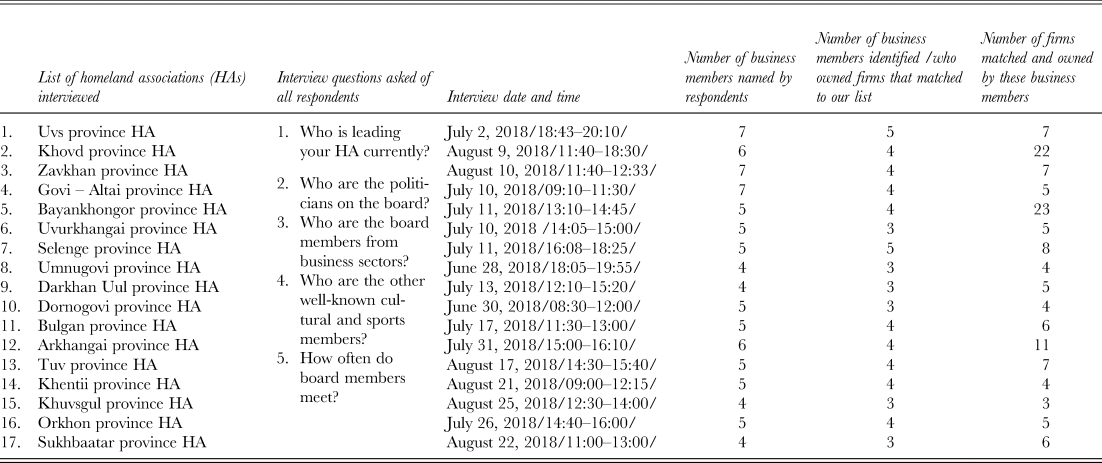
We draw data from different sources. First, we purchased the financial data of the top 500 private firms in the 2013 to 2017 period from the tax administration bureaus of six districts of Ulaanbaatar city. Second, semi-structured informal interviews were conducted with board members or board secretaries of 17 provincial HAs. The interviews included five significant and important questions designed to extract relevant and precise answers within a short period of time. The interviews were conducted in Mongolian by one of the authors and interviewees were contacted through informal networks; specifically, someone in a close relationship with participants. Table 1 shows the detailed information of the interview.
Interview data

Third, we hand-collected secondary data about the income and wealth of parliament members, government ministers, the Prime Minister, and President from 2013 to 2017. The Mongolian parliament enacted anti-corruption laws and established an Independent Authority Against Corruption (IAAC) agency in 2008. Since then, politicians and public officers must report their income and wealth annually to the IAAC agency website (IAAC, 2018). We matched the reported firm names and seven-digit code registration numbers in these reports to our sample firm names and registration numbers. We also collected additional secondary data from a transparent political party website is called shilen nam, which has collected publicly released campaign contribution information for each political party since 2008 (Shilen nam, 2018).
Measures
Dependent variable
We use return on equity (ROE) as a proxy variable for firm performance for several reasons. The first reason we use ROE is that politically connected firms, particularly firms with direct connections, tend to have inconsistent profitability while non-connected firms tend to have steady but lower profitability. The inconsistent profitability of politically connected firms tends to exhibit losses for a certain period and suddenly generate high profit. Losses are a negative value that shrinks shareholders’ equity, and a sudden increase in profitability technically indicates high ROE (Hargrave, Reference Hargrave2019). This may mean that when a connected politician loses political power, firms experience loss, and when the politician is elected, those connected firms start to generate profit after the election. Furthermore, the capital market in Mongolia is underdeveloped. Thus, market-based measurements are not informative and lack quality (Peng, Reference Peng2004). Another reason we use ROE rather than other financial ratios such as return on assets is that sample firms come from multiple industries, including mining, service, manufacturing, and infrastructure. Return on assets is more suitable for comparing firms in the same industry because asset differences vary in different industries (Hargrave, Reference Hargrave2019). Therefore, ROE is a suitable firm performance measure for our study with high variance among industries. Technically, ROE is obtained by dividing net income over equity.
Independent variables
We measure direct political connections as a dummy variable coded as 1 if a firm's owner or largest shareholder is a politician and 0 otherwise. Data are extracted from the official website of IAAC agency (IAAC, 2018). The annual wealth and income reports provide a list of firms owned by each politician. We measure indirect connections as a dummy variable coded as 1 if a firm's owner was a member of an HA according to our interview data and 0 otherwise. From these data, we are able to identify the names of the firm's owner who are connected to which politicians and how many politicians from different political parties. If a firm owner or large shareholder is a member of an HA in a specific province, we consider this firm to have indirect political connections.
Mediating variable
We measure operational capability as the ratio of the cost of goods sold to sale price. Cost of goods sold includes the cost of goods, operational expenses, and interest. Political connections can help firms to reduce the cost of resources, operational expenses, and financing costs. Furthermore, political connections can also generate increased market sales. Operational capability increases with a decrease in the cost of goods sold or an increase in sales.
Power change
We measure power change as position changes of incumbent politicians. During our sample period (2013 to 2017), there are two different ruling parties. The Democratic party held full power from June 2012 to June 2016. The Mongolian People's party held full power from June 2016. Power change is measured as a dummy variable coded as 1 if there is a change in their political position due to election results and 0 otherwise. Some firms’ owners with indirect connections are identified as members of political parties. If such individuals are members of the Democratic Party, this was considered to indicate a change in power with a nuance of limitation.
Control variables
Firm size is measured by the mean value of five years of sales converted to natural log values to correct for skewness. Firm age is measured by the number of years since the founding year and is also converted into natural log values. The sample firms are drawn from more than 20 industries and are therefore categorized into three groups. To examine whether these industries exert an effect and to avoid heteroscedasticity, we code industries as industry 1 (extractive industry), industry 2 (road and construction), and industry 3 (other industries including firms with diversified business portfolios). The donation variable represents the firm's political activity and campaign contributions to political parties before the election, as disclosed publicly (Shilen nam, 2018). This variable is measured by the number of political parties donated during the election campaign. Other membership variables represent the firm's political activity data obtained from the websites of CEO clubs, wrestling clubs, and horse racing clubs. If a firm owner or shareholder is a member of such club the variable is coded as 1 and 0 otherwise. Regulated and foreign ownership variables are dummy variables. If a firm operates in a regulated industry the variable is coded as 1 and 0 otherwise. Foreign-owned firms coded as 1 and 0 otherwise. All coded data and publicly disclosed secondary data used in this study can be accessed at a open science framework database (Ulziisukh, Reference Ulziisukh2021).
Analysis
We use a moderated multiple regression model to test our hypotheses using software SPSS v22. Forty firms with missing data are excluded from the analysis. Thus, data from 460 firms are included in the final analysis. Each variable is mean-centered to mitigate the multi-collinearity issue. In moderated multiple regression, there is a tendency toward collinearity issue for interaction variables because constituent variables are drawn from the same independent variable (Friedrich, Reference Friedrich1982). Our model does not pose a risk of collinearity and the value of variance inflation factors are all below the generally accepted rule of thumb.
RESULTS
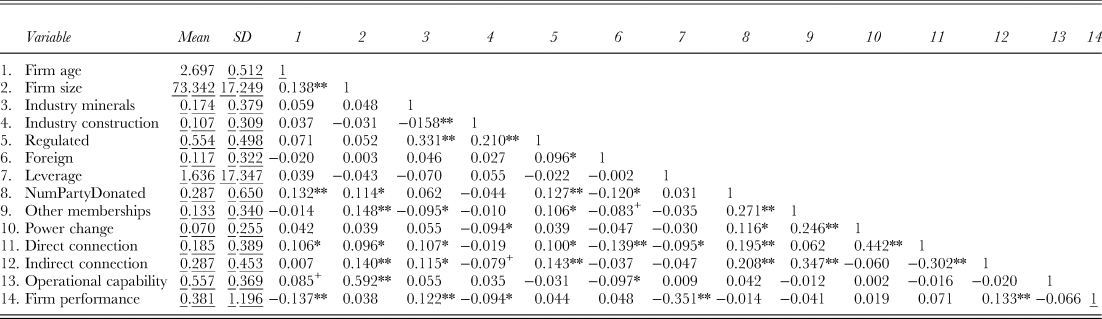
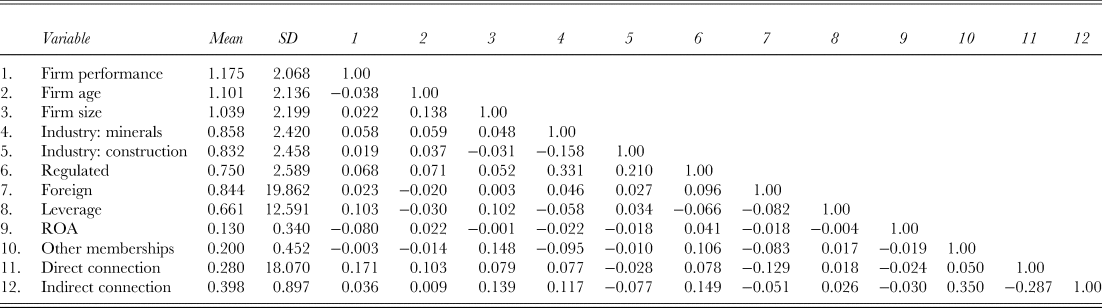
Descriptive data and correlations are reported in Table 2. Among the 460 firms, 85 firms have direct political connections (mean value = 0.19, SD = 0.389) and 132 firms (mean value = 0.29, SD = 0.453) have indirect political connections. Table 2 shows that direct and indirect political connections are negatively related, which indicates that firms often choose one political strategy. The correlation between direct political connections and firm performance is not significant, while indirect political connections are significantly related to firm performance. Table 2 offers initial evidence for the positive effects of indirect connections on firm performance.
Descriptive statistics and correlations

Notes: N = 460; **p < 0.01, *p < 0.05, +p < 0.10 (two-tailed test).
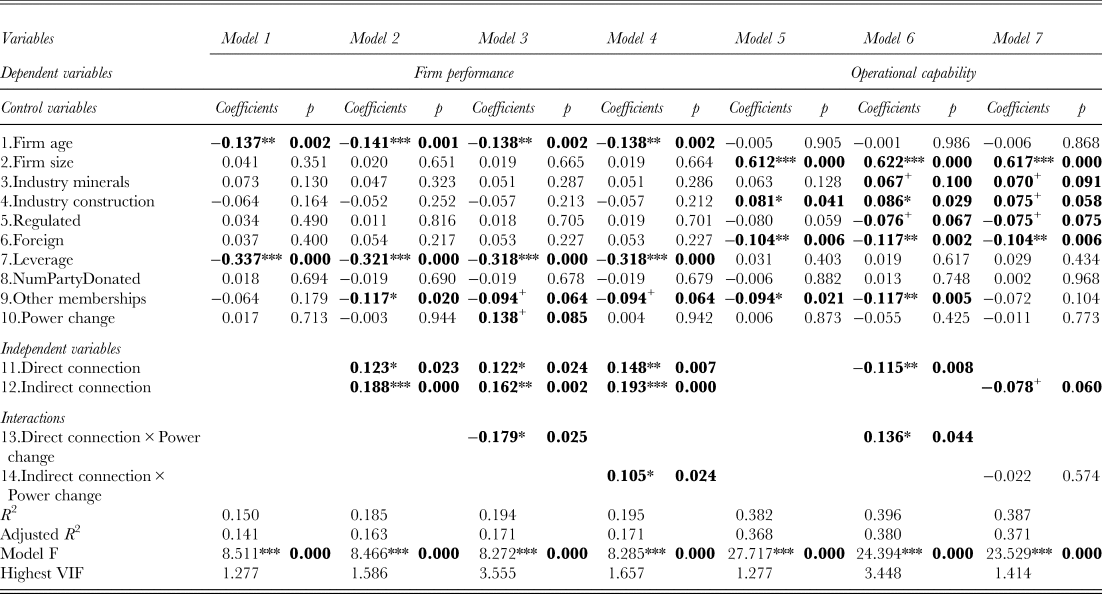
To test Hypothesis 1 and Hypothesis 2, we run models 1 and 2. We first ran Model 1 as a base model with control variables. As shown in Table 3, control variables in Model 1 indicate that older firms have significantly lower performance. Firm's age (β = −0.137, p = 0.002) and leverage (β = −0.337, p = 0.000) have a negative effect on firm performance. This result is consistent with some empirical evidence from emerging economies. Older firms may have a greater agency problem (Peng, Reference Peng2004), excessive costs, and dissolution risks. Financing costs in emerging countries with weak legal systems tend to be higher than those in developed countries, which results in a negative contribution to firm performance (González, Reference González2013). The average annual interest rate of commercial banks in Mongolia is around 22% (TDBM, 2019). Non-banking and private lending interest rates are double the bank rates. Firm size is statistically not significant (β = 0.041, p = 0.351). Maybe the cost of resource acquisition led to the insignificant effect of sales volume on ROE. Firms in extractive industry (β = 0.051, p = 0.286) and construction industry (β = −0.057, p = 0.212) do not have higher ROE than other industries. The effect of regulated industry (β = 0.019, p = 0.701) is not significant. Although Table 2 shows that the regulated industry has significant positive correlations with both types of political connections, firms in regulated industries may spend more on political activities that do not contribute to firm performance. The effect of foreign ownership (β = 0.053, p = 0.227) can also not increase firm performance. Foreign firms are not adaptable to the Mongolian institutional and political environment. Table 2 shows that foreign ownership is negatively related to direct connections. The number of parties donated (β = −0.019, p = 0.679) is also statistically not significant. Because many firms donate for campaign and thus donation to political parties does not necessarily promote firm performance. In Model 1, the effect of other memberships is not significant (β = 0.017, p = 0.713) while it is significantly negative (β = −0.117, p = 0.020) when direct and indirect connections are controlled in Model 2. This suggests that connecting to other networks is inefficient to promote firm performance.
Standardized coefficients of moderated multiple regressions

Notes: N = 460; ***p < 0.001, **p < 0.01, *p < 0.05, +p < 0.10 (two-tailed test); The coefficients reported are standard regression coefficients.
Model 2 is statistically significant at p = 0.001 with R 2 = 0.185. In Model 2, the effects of both direct and indirect political connections are statistically significant (β = 0.123, p = 0.023; β = 0.188, p = 0.0003). Every increase of one standard deviation in direct political connections increases firm performance (ROE) by 0.123. The 95% confidence band for effect of direct connections is [0.052, 0.703]. The upper value of the effect is 0.703, which indicates that when firms build direct connection, the ROE can increase 0.703. This result supports Hypothesis 1. Every increase of one standard deviation in indirect political connections increases firm performance (ROE) by 0.188. The 95% confidence band for effect of indirect connections is [0.228, 0.764]. The upper value of effect is 0.764, which indicates that when firms build indirect connections, the ROE can increase 0.764. This result also supports Hypothesis 2.
Hypothesis 3 theorizes that operational capability mediates the positive effects of both direct and indirect political connections on firm performance. We adopt Preacher and Hayes's approach and test the mediation role of operational capability in relationships between two types of political connections and firm performance using the bootstrapping method, in which the significance of an indirect effect suffices to validate the existence of a mediating effect (Preacher & Hayes, Reference Preacher and Hayes2008; Zhao, Lynch, & Chen, Reference Zhao, Lynch and Chen2010). The result shows the indirect effects of direct political connections on firm performance through operational capability are significantly positive at the 5% level (0.038; bootstrapping confidence interval: 0.0022–0.1141). The indirect effects of indirect political connections on firm performance through operational capability are also significantly positive at the 5% level (0.0220; bootstrapping confidence interval: 0.0010–0.1036). These results indicate both direct and indirect political connections promote firm performance by improving operational capability, which supports Hypothesis 3.
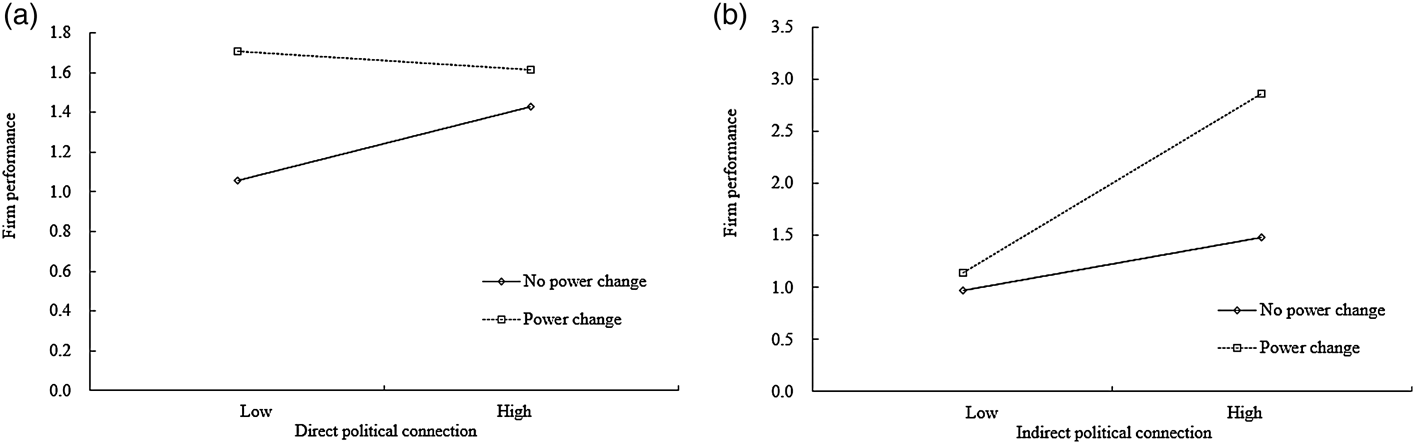
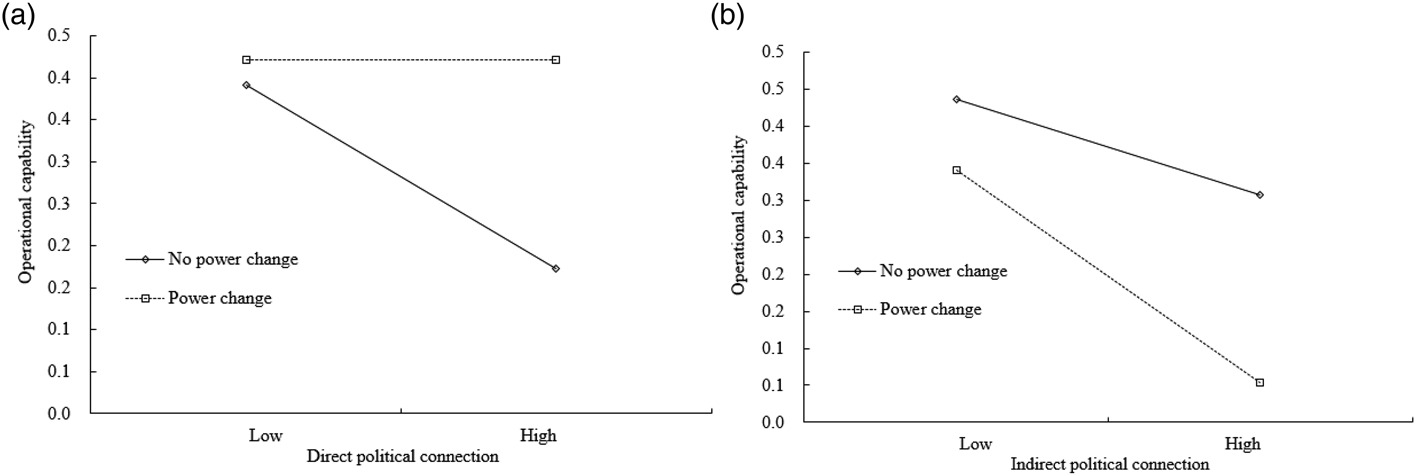
To examine the moderating effect of political power change, we run Models 3 and 4. The interaction of political power change and direct political connections is significantly negative (Model 3: β = −0.179, p = 0.025), while the interaction of political power change and indirect connections is significantly positive (Model 4: β = 0.105, p = 0.024). To gain further insights, we plot the relationships in Figures 1a and 1b (Aiken & West, Reference Aiken and West1991). As shown in Figure 1a, the effect of direct connections decreases when power change increases, suggesting that power change weakens the effect of direct connections on firm performance. The slope analysis indicates that the positive effect of direct political connections is smaller when power change is high (β = −0.091, p = 0.73) than when it is low (β = 0.374, p = 0.023). When power changes, the effect of direct connections can change from −0.091 to 0.374. Figure 1b shows that the effect of indirect connections increases when power change increases, suggesting that power change strengthens the effect of indirect connections on firm performance. The slope analysis indicates that the positive effect of indirect connections is greater when power changes are high (β = 1.727, p = 0.002) than when it is low (β = 0.510, p = 0.001). That is, the positive effect of direct political connections on firm performance decreases with power change while that of indirect political connections does not, which supports Hypotheses 4 and 5.
(a) The moderating effects of power change (b) The moderating effects of power change

To examine the moderating effects of political power change on the relationships between the two types of political connections and operational capability, we run Models 6 and 7. Interaction of political power change and direct connections is significantly positive (Model 5: β = 0.136, p = 0.044), and interaction of political power change and indirect connections is also significantly positive (Model 6: β = 0.022, p = 0.574). The relationships are plotted in Figures 2a and 2b (Aiken & West, Reference Aiken and West1991). Figure 2a shows the effect of direct political connections on operational capability. The slope analysis indicates the positive effect of direct connections is smaller when power change is high (β = 0.001, p = 0.99) versus low (β = −0.109, p = 0.001). This result suggests that when power changes, the role of direct political connections in reducing operational cost decreases. Figure 2b shows the effect of indirect connections does not change significantly when power change increases, suggesting that power change does not change the effect of indirect connections on operational capability. The slope analysis indicates the change is not significant. That is, the role of direct political connections in reducing operational cost or increasing operational capability decreases with power change while the effect of indirect political connections does not. These results offer additional evidence supporting Hypotheses 4 and 5.
(a) The moderating effects of power change (b) The moderating effects of power change

Robustness Test
To check the robustness of our results, we pooled our data into two different periods. The first period is when the Democratic Party held full power in 2013, 2014, and 2015. The second is when the Mongolian People's party held full power in 2016 and 2017. All five years of financial data are split into these two periods. Direct political connections are measured differently because of differences in the parliamentary and government power in the two different periods, coded as 1 if the firm has a seat in parliament or government during a given period and 0 otherwise. The models are tested for both periods without the power variable and interaction effect because there are no changes in political power during either period.
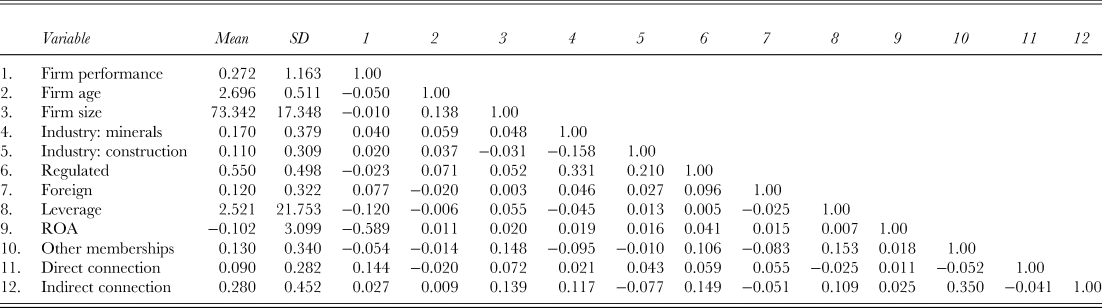
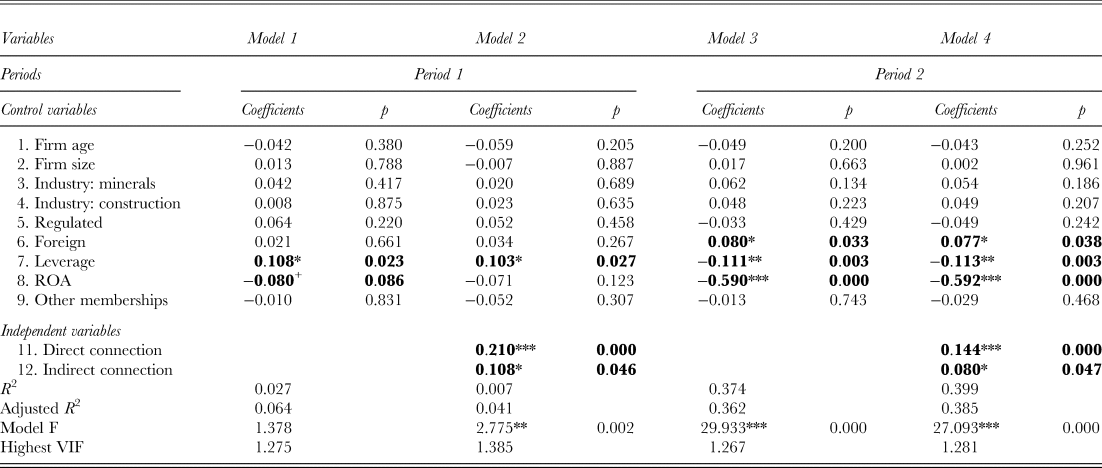
Then we reran the two multiple regression models for the two different periods. The descriptive results and correlations are shown in Tables 4 and 5. The regression results for Period 1 are statistically significant (p = 0.002 with R 2 = 0.064). During Period 1, both direct and indirect political connections have statistically significant effects (β = 0.210, p = 0.000035; β = 0.108, p = 0.046). For Period 2, the regression results are statistically significant at p = 0.0001 with R 2 = 0.399. During Period 2, the effects of both direct and indirect political connections are statistically significant (β = 0.144, p = 0.00011; β = 0.080, p = 0.047). These results are all in line with our main results (Table 6).
Descriptive statistics and correlations for Period 1

Notes: N = 460; **p < 0.01, *p < 0.05, +p < 0.10 (two-tailed test).
Descriptive statistics and correlations for Period 2

Notes: N = 460; **p < 0.01, *p < 0.05, +p < 0.10 (two-tailed test).
Standardized coefficients of multiple regression for Period 1 and Period 2

Notes: N = 460; ***p < 0.001, **p < 0.01, *p < 0.05, +p < 0.10 (two-tailed test); the coefficients reported are standard regression coefficients.
DISCUSSION
This study contributes to the literature on the resource dependence rationale and inconclusive literature on the effects of political connections. This study goes beyond the conventional assumption of a simple exchange relationship between firms and politicians by extending the boundary conditions for resource dependence prediction. In doing so, first, RDT and political connection literature neglect the larger political processes that shape the fundamental conditions necessary for effective political connections (Yan & Chang, Reference Yan and Chang2018). Based on RDT, we propose the dynamics of political power place boundaries on the effectiveness of various political connections. Second, prior RDT studies focus on the exchange perspective rather than on mechanisms through which political connections are established (Xia et al., Reference Xia, Ma, Lu and Yiu2014). We investigate firm-level data on political connections in 460 firms under two different ruling parties in an emerging democracy. The results show that firm's political connections enhance its performance. However, the effectiveness of direct political connections is bounded by changes in de jure political power. In contrast, the positive effects of indirect political connections are persistent despite electoral volatility, as these connections are established through informal networks with de facto power. Moreover, a firm's operational capability mediates the positive effects of both types of political connections on firm performance.
Theoretical Contributions
Several contributions emerge from this study. First, our findings contribute to RDT by showing that formal political power serves as a boundary condition for the effectiveness of different types of political connections. The effects of boundary conditions in RDT mainly investigated in the context of merger and acquisitions (Casciaro & Piskorski, Reference Casciaro and Piskorski2005; Deng & Yang, Reference Deng and Yang2015; Finkelstein, Reference Finkelstein1997). Strong regulatory constraints are an institutional contingency for board political capital (Sun et al., Reference Sun, Hu and Hillman2016), and ownership ties are a boundary condition for diversification (Xia et al., Reference Xia, Ma, Lu and Yiu2014). Nevertheless, studies mainly focus on the minor constituents of the institutional environment, which does not fully explain what constitutes the institutional context in a broader schema (Barley, Reference Barley2010). Therefore, this study departs from the conventional view of RDT by diagnosing power sources, political processes, and strategies that firm deploy to manage the political environment (Oliver & Holzinger, Reference Oliver and Holzinger2008). Moreover, studies mainly focus on market-oriented institutional transition in China rather than regular changes of power from one party to another in democracies. This research extends RDT literature by investigating a new boundary condition for this dynamic power change. We find the effect of political connections varies with political power dynamics. Specifically, the positive effect of direct political connections decreases while that of indirect political connections increases with dynamic power change.
The dynamic process of political connections has been neglected in the literature (Chen et al., Reference Chen, Chen and Huang2013). Most research on ties, connections, and guanxi is static. Our findings suggest political outcomes depend on a dynamic interaction between formal and informal political power (Moe, Reference Moe2006). In particular, emerging democracies exhibit frequent shifts in de jure political power due to extensive actions taken by informal networks, which conditions the effect of political connections. Most research adopting RDT focuses on exchange between a firm and a politician rather than on power relationships in the whole political process. Our study addresses Pfeffer and Salancik's (Reference Pfeffer and Salancik2003) statement that ‘under what conditions political strategies are successful or not still a strange omission in the literature’ (xix). We extend the literature by investigating how the role of political connections varies with dynamic power change in a democratic system. Second, this study stresses the importance of variation in the ties connecting firms to the political environment. Most studies focus heavily on direct mechanisms of political connections which constraints the exploration of the function of political connections. Although prior literature focuses on the positive functions of political connections, such connections can have negative effects when politicians in power change (Johnson & Mitton, Reference Johnson and Mitton2003; Siegel, Reference Siegel2007; Sun et al., Reference Sun, Mellahi, Wright and Xu2015). It is necessary to explore the mechanisms of connections to address the apparent paradox of political connections. However, the literature offers little insights into how robust political connections can be built.
This article addresses this limitation by introducing indirect political connections, which have largely been ignored. We find there are two sources of power that can influence political outcomes, which clarifies the distinction between different types of political connections. Beyond direct political connections, firms can influence policies through the collective actions of informal networks (Barley, Reference Barley2010; Helmke & Levitsky, Reference Helmke and Levitsky2006). Therefore, we distinguish direct and indirect political connections, consistent with recent studies (Grigoriev & Zhirkov, Reference Grigoriev and Zhirkov2020; Wahab et al., Reference Wahab, Jamaludin, Agustia and Harymawan2020). We find both direct and indirect political connections can promote firm performance through the mediating role of operational capability. In particular, two types of connections can reduce resource acquisition cost and bring more market opportunities (Hillman et al., Reference Hillman, Withers and Collins2009). However, the effect of direct connections depends on the power of connected politicians. In contrast, firms can build political connections through indirect mechanisms such as joining politically active informal networks that include multiple politicians, which move beyond dyadic relationships (Grigoriev & Zhirkov, Reference Grigoriev and Zhirkov2020; Wahab et al., Reference Wahab, Jamaludin, Agustia and Harymawan2020). Relying on informal networking with multiple candidates, firms can obtain a robust advantage when political power shifts. Direct political connections are susceptible to changes in de jure political power, which often fluctuates in emerging democracies. In contrast, literature related to informal networks alludes to the strength of indirect political connection mechanisms. We find that in an emerging democracy, indirect political connections are a source of sustainable competitive advantage. Such connections can be found in different countries regardless of different political systems, such as Russia (Grigoriev & Zhirkov, Reference Grigoriev and Zhirkov2020), Malaysia (Wahab et al., Reference Wahab, Jamaludin, Agustia and Harymawan2020), China (Yan & Chang, Reference Yan and Chang2018), Korea (Horak, Reference Horak2014; Siegel, Reference Siegel2007), and Denmark (Amore & Bennedsen, Reference Amore and Bennedsen2013). This study suggests building strong political connections through informal networks is possible in different systems and countries.
Third, this research contributes to the understanding of formal and informal institutional relationships in emerging democracies. Although there are studies of political connections from diverse perspectives, we still know little about how informal personal connections are related to formal institutions (Chen et al., Reference Chen, Chen and Huang2013). Our results demonstrate the mode of interaction between formal and informal institutions in the electoral process. Through informal nutag network, firms can foster person-to-person connections with multiple politicians in a democratic system. In Mongolia, nutag has developed into institutions as HAs, which can mobilize power for political parties (Shagdar, Reference Shagdar2015). By providing resources to candidates from different political parties, firms can build connections to both current and future politicians. These informal networks exert influence and exercise de facto power based on collective actions. The agentic power of informal networks alters the conduct of formal institutions such as electoral systems, legislators, and judiciaries (Helmke & Levitsky, Reference Helmke and Levitsky2006). Therefore, much of the formal institutional outcome is explained by the influence of informal institutions and changing behavior of political outcomes. Persistence of informal networks is based on the intentions of their ultimate purpose to influence political outcomes in power-sharing arrangements (Acemoglu & Robinson, Reference Acemoglu and Robinson2006).
Fourth, we add new insights to informal network literature by introducing nutag as a new concept. Previous studies identify many types of informal networks, such as guanxi in China (Chen et al., Reference Chen, Chen and Huang2013), yongo in Korea (Horak, Reference Horak2014), blat in Russia (Ledeneva, Reference Ledeneva2008), and clannism (Minbaeva & Muratbekova-Touron, Reference Minbaeva and Muratbekova-Touron2013). This study enriches informal network literature by identifying nutag as another form of network. Different from guanxi, nutag is a clan-based informal network unlike guanxi-based dyads, which play a significant role in shaping sociopolitical life in Mongolia. Nutag networks form a strong relationship-based political economy, which include mixed affective and instrumental relationships. Nutag in Mongolia is more open than yongo in Korea (Horak, Reference Horak2014). Through nutag, firms can access diverse political candidates and politicians. Yongo in Korea is closed or exclusive to alternative politicians (Horak, Reference Horak2014). This exclusiveness may reduce the robustness of political connections when power changes from one party to the other. However, the flexibility of nutag in Mongolia enables firms to foster diverse relationships and thus survive in political uncertainty environment. Nutag is similar to the clannism of Kazakhstan (Minbaeva & Muratbekova-Touron, Reference Minbaeva and Muratbekova-Touron2013).
Managerial Implications
This research has meaningful managerial implications. First, beyond direct political connections, firms in emerging countries can build indirect political connections to manage dependence and uncertainty. To acquire resources through political connection, firms often also accept a political risk rooted in political uncertainty and power change. Especially in emerging countries with underdeveloped political institutions, firms should carefully consider how to build political connections to reduce the negative effects of power change. We find both direct and indirect political connections promote firm performance by increasing operational capability or reducing the cost of goods sold and/or increasing sales. Therefore, to promote firm performance, firms can not only build political connections through ownership but also build indirect political connections to access crucial resources by becoming involved in pervasive informal institutions. Second, and more importantly, in countries with a dynamic political environment, firms should invest more in indirect political connections than in direct political connections, because the latter is more robust. Although direct political connection has a strong positive effect on firm performance, indirect political connection is robust to political power changes in emerging democracies. Our findings indicate that although political connections enable firms to deal with the external uncertainties of institutional systems, excessively strong connections also bear political risk. Therefore, to buffer the negative impact of power change, firms should pursue indirect political connections, which have higher levels of strategic flexibility.
Limitations and Future Research Directions
This study is limited to democratic systems. Future research could add more insights to resource dependence predictions by comparing political systems. Firms in well-developed Western democracies may use different forms of indirect political connections to promote their performance. The moderating effects of power change may also vary with the quality of democratic systems. Further, reviews of existing studies that distinguish between direct and indirect political connections might strengthen our understanding of the boundary condition effect argued here.
NOTES
We acknowledge the National Natural Science Foundation of China (No.72172115) for financial support.
DATA AVAILABILITY STATEMENT
The data that supports the findings of this study are openly available in Open Science Framework at https://doi.org/10.17605/OSF.IO/XJWRZ.