Global regulation is becoming ever more pluralist. Transnational corporations, civil society organizations, public-private partnerships and other non-state entities are entering into agreements and building institutions that affect people's lives in many countries. Novel forms of regulation are rapidly developing alongside more traditional forms of international law.Footnote 1
Of these novel regulatory institutions, we focus on what we term GXG.Footnote 2 GXG is an institutionalized process of participatory and multilevel collective problem solving, in which the problems (and the means of addressing them) are framed in an open-ended way, and subjected to periodic revision by various forms of peer review in the light of locally generated knowledge.Footnote 3 The five key elements of GXG are outlined below. GXG takes place in the context of public and state regulation, and often relies on forms of state and public power. Yet it can also, by virtue of its systematic peer review, destabilize the established practices of regulatory institutions. As will be illustrated below, GXG institutions are often initiated transnationally through a range of public and private stakeholders, and the focus of activity regularly moves back and forth between public and private regulation. We argue that GXG is normatively justified by the deliberative and inclusive redefinition, based on exchanges of information and experience over time, of the preferences and goals that it fosters, although neither the success of deliberation nor the inclusion of all relevant stakeholders is assured.
The ideal-type of a GXG regime entails five key deliberation-fostering steps: First, initial reflection and discussion among stakeholders with a broadly shared perception of a common problem, resulting in second, the articulation of a framework understanding with open-ended goals. Third, implementation of these broadly framed goals is left to ‘lower-level’ or contextually situated actors who have knowledge of local conditions and considerable discretion to adapt the framework norms to these different contexts. Fourth, continuous feedback is provided from local contexts, allowing for reporting and monitoring across a range of contexts, with outcomes subject to peer review. Fifth, goals and practices should be periodically and routinely re-evaluated and, where appropriate, revised in light of the results of the peer review and the shared purposes. GXG regimes frequently operate in the shadow of a ‘penalty default’ that induces appreciation of the relative benefits of joint efforts by sanctioning non-co-operation, typically by substantially reducing the parties’ control over their fate through the imposition of an alternative, less attractive regime or outcome that none of them favors. While GXG clearly shares features with various other accounts or theories of novel forms of transnational regulation, all five of the elements outlined above must be present to constitute a GXG system. Our hypothesis is that where these five features operate together, they can constitute a form of governance that fosters a normatively desirable form of deliberative and participatory problem solving.
It may be helpful here to distinguish GXG from some of the other post-hierarchical forms of new governance that it resembles. First, like the literature on collaborative governance and adaptive management of the environment, GXG emphasizes the importance of learning from implementation.Footnote 4 But adaptive management treats learning as a disembodied process, or analogizes it to a highly stylized (perhaps imaginary) idea of the scientific method.Footnote 5 GXG shows how practical learning can be organized and institutionalized, and how this process – particularly the autonomy it affords lower-level or locally situated units to adjust the implementation to local contexts – leads to new forms of accountability and evaluation. Secondly, like the work on governing the commons associated with Elinor Ostrom, GXG holds that local knowledge is indispensable to the solution of a broad range of complex collective action problems, and correspondingly, that centrally imposed solutions are often unworkable.Footnote 6 But whereas for Ostrom local knowledge often remains tacit and actors engage in tit-for-tat bargaining strategies, the organization of GXG obligates local actors to explain the reasons for their choices, and typically to justify outcomes in terms of metrics agreed on (and periodically revised) by all.Footnote 7 Whereas the organizational center virtually disappears in Ostrom's cases of successful commons management, a new kind of center plays a continuing role in GXG, pooling information and organizing peer evaluation of it, and on occasion responding to (or invoking the threat of) a penalty default. Thirdly, GXG shares with theories of multilevel and network governance in the European Union (EU) the view that an exclusive focus on the interactions between nation states and the supranational entities they create is unduly restrictive.Footnote 8 However, although the literature on multilevel governance has focused on important policy networks involving sub-national actors that escaped notice in the ‘two-level’ perspective, it has refrained for the most part from arguing that multilevel policy making creates novel institutions or a new form of learning.Footnote 9 GXG attempts to show how nested institutions at multiple levels can, when linked together in particular ways, cohere into an innovative form of learning organization. Finally, GXG's frequent dependence on penalty defaults implies that traditional states remain important, if only in the background; yet the destabilizing effect GXG on traditional state institutions shows that new decision-making processes do not simply reinforce state governance by extending its reach to new problems and domains.Footnote 10
Experimentalist actors broadly know what outcomes they desire. For example, they agree that they want a cleaner environment, sustainable forestry, protection of dolphins along with vibrant tuna fishery or the empowerment of disabled people in ways that respect their autonomy. However, they are uncertain about how these objectives can be realized. Experimentalist institutions reflect participants’ awareness of limits on their foresight, and of the possible fallibility of initially preferred solutions, more than their concern about distributional issues. Accordingly, such institutions establish methods of periodically revising their procedures ex post on the basis of peer review of the diverse experience of the actors attempting to realize the desired outcomes.
Experimentalist institutions also establish patterns of accountability that are different from both those underpinning the standard principal-agent model and from the mechanisms of traditional hierarchical, supervisory, fiscal, legal and market accountability that characterized world politics during the half-century after World War II.Footnote 11 They emphasize mutual monitoring and peer review that involves elaborate processes of consultation that are horizontal rather than vertical in structure. Peer review is thus a mechanism for both learning systematically from diverse experience and holding actors accountable for their actions. Experimentalism institutionalizes an iterated process of goal formulation, lower-level adaptation and exploration, joint evaluation and revision captured in the five steps set out above – beginning with the initial perception of a common problem and moving through articulating an initial framework of action, and arriving by way of local experience at revision.
Each of the other arrangements we describe in the next section – including traditional international organizations, various networked governance arrangements and contemporary regime complexes – may evolve into or develop practices of GXG. When international organizations routinize the ad hoc adjustments that are characteristic of regime complexes and adopt organizational forms that allow state and non-state actors to learn, continually and accountably, they are engaging in GXG. In other words, any governance arrangements – but only those arrangements – that meet all five of the key elements outlined above constitute GXG in our sense.
Next we situate our analysis of GXG in the context of two broad developments in multilateral governance over approximately the last sixty years: the emergence of integrated international regimes in certain issue areas and the emergence of less coherent regime complexes. We then focus for illustrative purposes on one particular example, the Montreal Protocol process, and conclude with a set of reflections on the conditions for GXG. Other salient examples of GXG not discussed in this article include the UN Convention on the Rights of Persons with Disabilities, regulatory arrangements to catch tuna without killing dolphins and certification arrangements, especially in forestry.Footnote 12
This article does not seek to evaluate the successes or failures of GXG. We take the view, however, that the participatory, deliberative, locally informed and adaptive problem solving that this form of governance is designed to foster is normatively attractive. Yet human institutions – including, inevitably, GXG – are easily distorted or corrupted, and unintended consequences are common. Nevertheless, we believe GXG has the potential to be a constructive development, establishing relationships of legitimate authority by keeping the circle of decision making open to new participants and generating possibilities for responsive and effective problem solving in an iterative and non-hierarchical fashion.
INTERNATIONAL REGIMES AND REGIME COMPLEXES
After World War II a number of international regimes – sets of rules, norms and practices governing particular issue areas – were negotiated and implemented, beginning with the creation of the United Nations and its specialized agencies, the International Monetary Fund and World Bank, and the General Agreement on Tariffs and Trade (later transformed into the World Trade Organization, WTO). A concentration of power in either one state or a few states with similar interests facilitated the establishment of such regimes both before and just after the Cold War.Footnote 13
In the 1990s the European Community, now the EU, became a more important international actor and began to conclude major treaties, notably the Land Mines Treaty and the Rome Statute, which established the International Criminal Court. Other human rights agreements were also instituted and strengthened during this period, and gained almost universal membership.Footnote 14 However, even as the prospect of coherent and comprehensive global governance emerged, it was sharply challenged. The Land Mines Treaty and the Rome Statute did not receive the adherence of the United States. After the establishment of the WTO, efforts to elaborate more comprehensive and binding rules in the Doha Round collapsed. A sustained effort to build a comprehensive climate change regime, presaged by the UN Framework Convention for Climate Change at Rio in 1992, also failed. Generally speaking, attempts after 1995 to develop new comprehensive and integrated international intergovernmental regimes were unsuccessful. Established regimes fragmented, and on occasion their authority was overtly challenged.
At the same time, technological change helped to alter the relationships among international organizations and their role in world politics. Novel forms of networked information exchange emerged that were often transnational or transgovernmental rather than intergovernmental. The relations between entities, rather than the entities or organizations themselves, took on an increasing significance in world politics, and the sources of authority of international organizations became correspondingly blurred.Footnote 15 Entities other than states now often have authority in part because other actors defer to them as legitimate rule makers.Footnote 16 In other cases, emergent authorities are ‘orchestrated’, in the sense that they are supported and coordinated by existing international organizations.Footnote 17 The growth of public-private partnerships since the 1990s has created another, relatively novel, source of authority that reflects the growing importance of access to new sources of knowledge and learning.Footnote 18
Institutional inertia and political deadlock, the rise of non-hierarchical organizations, and the proliferation of linkages between international organizations and civil society actors – all fomented by and contributing to greater uncertainty – have led to the emergence of a variety of higher-order governance arrangements, the most representative of which are regime complexes. A regime complex has been defined as ‘an array of partially overlapping and non-hierarchical institutions governing a particular issue area’,Footnote 19 although others have proposed narrowing and tightening the definition.Footnote 20 Regime complexes, including different mixes of states, sub-state units, international organizations, civil society organizations and private actors, have in various issue areas replaced more tightly integrated international regimes. Regime complexes have been identified in the areas of climate change, food security, refugee policy, energy, intellectual property and anti-corruption.Footnote 21 The proliferation of bilateral and regional deals on trade policy suggests that even international trade – whose lead organization, the WTO, has been so important – may be increasingly characterized by a regime complex rather than an integrated international regime.Footnote 22
EXEMPLIFYING GXG: THE MONTREAL PROTOCOL
The Montreal Protocol to the Vienna Convention, which came into force in 1989 after more than a decade of contentious debate, established a regime to protect the ozone layer against the risks of chlorofluorocarbons and halons. The protocol – widely regarded as one of the most successful international environmental agreements – fixed an initial schedule for the reduction and elimination of ozone-depleting substances (ODS), with exceptions for ‘essential’ uses for which no substitutes could be found, and set out the core elements of a regime for extending and modifying protective measures. The parties were to apply certain control measures and reassess them every four years in light of current scientific, environmental, technical and economic information, as determined by panels of experts. Parties to the agreement were to report annual production, and imports and exports of regulated chemicals, and permit verification of their performance. Trade in controlled substances with non-parties was carefully restricted. Developing countries – those annually consuming less than threshold amounts of controlled substances per capita – could defer control measures.Footnote 23
A multilateral fund, financed by the rich countries, was established to assist developing countries. The periodic meeting of the parties reserved broad authority to review implementation, add or remove controlled substances, adjust controls and oversee the quadrennial assessments. A secretariat helped members prepare meetings and manage data reported under the agreement.
These institutions are indispensable to the systematic operation of the regime. So too, in the early phases of implementation, was the shadow of power (or the prospect of ‘penalty default’) – threats of trade sanctions, denial of support to transition economies and EU sanctions against member states that did not comply with data-reporting requirements. However, the Technology and Economic Assessment Panel (TEAP) and the sector-specific Technical Options Committees (TOCs), which were set up as part of the quadrennial review system, together with the multilateral funds, are of particular interest here. Developed in response to the challenges of implementation, in ways foreseen vaguely – at best – by the protocol's architects, they came to institutionalize the broad stakeholder participation, corrigibility of goals and continuous learning from performance monitoring that defines an experimentalist organization.
In sectors such as solvents, refrigerants and halon fire-extinguishing agents, the TOCs determine the feasibility of substitutes for ODS that are currently in use. When difficulties are encountered, the TOCs (upon a formal request for review from the TEAP) either authorize exemptions for ‘essential’ and ‘critical’ uses or provide extended timetables for meeting the phase-out obligation. To reduce the risk of capture, formal membership on TOCs is limited to representatives of user industries and groups, regulators and standard setters. The core activities of the TOCs involve joint exploration of innovative possibilities by working groups of users and producers – including plant visits to evaluate alternative processes that do not rely on ODS, examination of use and leak reduction through improved logistics, and pilot projects involving new substances – and formulating regular progress reports.Footnote 24
These experimental arrangements plainly overtaxed not only the financial and technical capacities of developing countries (where the attendant risks of corruption were acute), but also the multilateral funds, as they were initially conceived. During the 1990s, therefore, a more comprehensive system emerged. In order to receive support, a developing country – having established a national ozone unit (at times with regional subdivisions) to collaborate with the fund – must prepare a national regulatory framework and detailed sector-by-sector plans for phasing out the production and use of ODS.Footnote 25
This institutional development produced a highly decentralized global regime that is characterized by close links between sub-systems ‘for reviewing implementation, responding to implementation problems, and revising and developing rules and institutions’.Footnote 26 The secretariat of the Montreal Protocol plays a coordinating role, but has little (if any) directive authority. Its main role is as a ‘hub’, performing information-pooling functions that facilitate exchanges between the center and local units.Footnote 27 This regime is dependent on continuing connections with the public and private sectors – often down to ground-level actors. It is therefore able to make the substantive and procedural rules, at once mandatory and subject to frequent revision, necessary to meet demanding phase-out targets while extending the control regime to new domains.
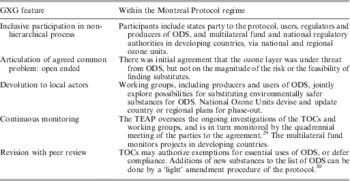
Table 1 summarizes how the Montreal Protocol regime relates to the five key identifying characteristics of GXG. This regime, and other institutionalized arrangements such as those for forestry certification, catching tuna without killing dolphins and the UN Convention on the Rights of Persons with Disabilities, demonstrate that Experimental Governance is not limited to regulatory settings within states, or to the relatively unique transnational setting of the EU, in which member states share long-standing institutional and cultural ties, even while retaining a degree of sovereignty.Footnote 28 Footnote 29 Footnote 30
The Montreal Protocol as an Exemplar of GXG

CONDITIONS FOR EXPERIMENTALIST GOVERNANCE
Under what conditions is GXG likely to thrive as a mode of governance in world politics? Although we have not developed a comprehensive theoretical answer, we present four hypotheses to spark further enquiry.
We suggest as a first necessary condition for GXG that governments are unable to formulate a comprehensive set of rules and effectively monitor compliance with them. In uncertain and diverse environments, in which central actors cannot readily foresee the local effects of rules, and where even effective rules are likely to be undermined by unforeseeable changes, this condition is likely to be met.
The second condition is the obverse of the first: governments must not be stymied by disagreement over basic principles. When there is substantial distributive conflict, penalty defaults are unavailable or unavailing, and the potential costs of unsatisfactory responses are high and irreversible, GXG is unlikely to thrive. It progresses best in the ‘Goldilocks Zone’ – where the balance between too much and too little agreement, like the temperature of Goldilocks’ porridge, is ‘just right’.
A third condition follows from the first two. Because Experimentalism works best when central actors have limited foresight and share a thin consensus that leaves open important questions of implementation and the implications of initial commitments, the co-operation of (newly formed or previously marginal) civil society actors either as agenda setters or problem solvers (and sometimes both) will normally be indispensable to the success of Experimentalist regimes. Such participation blurs the distinction between public and private regulation.
Finally, GXG is likely to be unworkable where key actors are unwilling or reluctant to co-operate – because they have veto rights over relevant decisions or prefer not to jeopardize established interests – and when it is impossible to place the reluctant parties under the threat of a ‘penalty default’.Footnote 31 So long as the parties do not face such a penalty, reluctance to participate in new arrangements easily drifts into obstructionism. Experimentalist institutions, like all others devised so far, are vulnerable to manipulation and unintended consequences. The form of transparency created by regular peer review of results, and by the increased participation of civil society and other stakeholders, should erect obstacles to familiar forms of capture, but they are also likely to create other kinds of vulnerability to outside influence and new opportunities to pursue hidden agendas and strategic advantages – for instance, by tempering criticism in return for access to decision makers. Thus GXG is not a panacea.Footnote 32
Yet one of the greatest normative merits of GXG is that it openly recognizes this vulnerability. We are often ill informed and unwilling to pay for the production of public goods. Our analytical ability to predict human behavior is also limited, especially where strategic interactions are involved. We may recognize problems yet not know how to deal with them. Under such conditions, GXG advises that we should often establish processes that help us generate unimagined alternatives and improve our ability to choose among these alternatives by rigorously exposing each to criticism in light of the others.
A final appealing feature of GXG is its potential to increase participation in, and thus the democratic legitimacy of, institutions. GXG may reduce the trade-off between overall responsiveness and democratic participation, broadly conceived. By opening agenda setting and problem solving to a wide range of actors, particularly from civil society, GXG makes possible a forward-looking or dynamic form of accountability that is unavailable in traditional, principal-agent regimes. In GXG practices at their best, the openness of decision making improves dynamic accountability, which increases participation in decision making. While this amounts neither to traditional, representative democracy nor to counter-majoritarian constitutionalism, we argue that it can constitute a form of deliberative, collective rule making that may contribute in global contexts to self-governance under the rule of law.