1. Introduction
There are several Carboniferous to Permian post-Variscan basins in Sardinia (Cassinis et al. Reference Cassinis, Cortesogno, Gaggero, Pittau, Ronchi and Sarria2000 and references therein; Aldinucci et al. Reference Aldinucci, Dallagiovanna, Durand, Gaggero, Martini, Pandeli, Sandrelli and Tongiorgi2006 and references therein). They are scattered all over the Variscan basement and represent the filling of sedimentary depressions of variable extent that developed during and after the collapse of the Variscan chain. According to Cassinis et al. (Reference Cassinis, Cortesogno, Gaggero, Pittau, Ronchi and Sarria2000 and references therein), the basins were intramontane, strike-slip (Biddle & Blick, Reference Biddle and Blick1985) and similar to the post-Variscan Saar–Nahe Basin that developed in Western Germany (Korsch & Schäfer, Reference Korsch and Schäfer1995); the Sardinian basins were filled by thick terrigenous and carbonate successions, and their development was associated with strong volcanic activity of various types and affinities (Cassinis et al. Reference Cassinis, Cortesogno, Gaggero, Pittau, Ronchi and Sarria2000 and references therein). The composition of the succession changed over time, depending on the change in climate, landscape morphology and tectonic regime. The sediment was deposited in various terrestrial environments of gradually decreasing energy related to the progressive smoothing of the Variscan chain by erosive post-orogenic processes.
The aims of this paper are to provide a general overview of the evolution of the depositional settings of the carbonate-bearing basins and provide evidence of the facies evolution of the lacustrine successions that developed in several of them. Particular attention has been paid to their carbonate deposits and their depositional environments, which up until now were never investigated in such detail. The factors that influenced the changing carbonate–siliciclastic deposition are identified and compared with the tectonic evolution of the continental basins to which they belonged. A comparison with coeval, carbonate-bearing lacustrine basins of Southern France and Germany is also carried out in order to distinguish autocyclic from allocyclic (e.g. climate) factors influencing the deposition.
2. Geological setting
Following the Variscan orogeny (Carmignani et al. Reference Carmignani, Carosi, Di Pisa, Gattiglio, Musumeci, Oggiano and Pertusati1994), Sardinia was subject to extensional–transtensional tectonics during Late Carboniferous–Permian times, leading to the development of several sedimentary basins (Fig. 1) due to the progressive collapse of the Variscan chain (Ziegler & Stampli, Reference Ziegler, Von Raumer and Neubauer2001). The development of the Late Carboniferous–Permian basins was the result of a right-lateral megashear system superimposed on the collapsing Variscan megasuture. Such megashear persisted in Europe during these times (Arthaud & Matte, Reference Arthaud and Matte1977; Massari, Reference Massari1986; Vai, Reference Toutin-Mourin1991, Reference Vai2003; Ziegler & Stampli, Reference Ziegler, Von Raumer and Neubauer2001). An intracontinental transform system crossed Palaeo-Europe and linked the Southern Uralides and the Northern Appalachians (Muttoni et al. Reference Muttoni, Kent, Garzanti, Brack, Abrahamsen and Gaetani2003; Vai, Reference Vai2003). In the latter, a crustal shortening prevailed during Stephanian–Autunian times. In Palaeo-Europe, this mainly transtensive system caused the development of wrench-induced, pull-apart, intramontane basins, which accommodated continental, terrigenous and volcanic successions (Massari, Reference Massari1986; Gaetani et al. Reference Gaetani, Arche, Kiersnowski, Chuvachov, Crasquin, Sandulescu, Seghedi, Zagorchev, Poisson, Hirsch, Vaslet, Le Metour, Ziegler, Abbate, Ait-Brahim, Barrier, Bouaziz, Bergerat, Brunet, Cadet, Stephenson, Guezou, Jabaloy, Lepvrier, Rimmele, Dercourt and Gaetani2000). The hypothesis of a transition from a dextral to a sinistral shear regime during Middle Permian times (leading to a marked shift in the magmatic affinity of the related volcanic rocks) must also be mentioned (Deroin & Bonin, Reference Deroin and Bonin2003).
Localization of the investigated post-Variscan basins in Sardinia.

In Sardinia, these basins originated in two distinct tectono-sedimentary cycles (Cassinis & Ronchi, Reference Cassinis and Ronchi2002; Barca & Costamagna, Reference Barca and Costamagna2006 b), and consequently gave rise to different types of succession that may be superimposed locally. The deposits related to the lower cycle present a dark, mainly limnic facies and cover the Variscan metamorphic rocks unconformably. The deposits belonging to the upper cycle pertain to a red-bed facies and may cover the deposits of the lower cycle or the Variscan basement directly. The basins, particularly the limnic basins, have mainly been studied in relation to the abundant micro- and macroflora that were often used for biostratigraphic purposes (La Marmora, Reference La Marmora1857; Lovisato, Reference Lovisato1884; Comaschi Caria, Reference Comaschi Caria1959; Vardabasso, Reference Vardabasso1966; Del Rio, Reference Del Rio1973; Pittau et al. Reference Pittau, Del Rio and Funedda2008). In the last 30 years, several papers concerning the palaeontology (Fondi, Reference Fondi1980; Ronchi et al. Reference Ronchi, Broutin, Diez, Freytet, Galtier and Lethiers1998, Reference Ronchi, Cassinis, Durand, Fontana, Oggiano and Stefani2011, Reference Ronchi, Sacchi, Romano and Nicosia2014; Freytet et al. Reference Freytet, Galtier, Schneider, Ronchi, Tintori and Wernerburg2002; Pittau et al. Reference Pittau, Barca, Cocherie, Del Rio, Fanning and Rossi2002; Werneburg et al. Reference Werneburg, Ronchi and Schneider2007; Baucon et al. Reference Baucon, Ronchi, Felletti and Neto de Carvalho2014), stratigraphy (Cocozza, Reference Cocozza1966; Cassinis et al. Reference Cassinis, Cortesogno, Gaggero, Pittau, Ronchi and Sarria2000 and references therein; Ronchi, Reference Ronchi2001; Cassinis & Ronchi, Reference Cassinis and Ronchi2002; Ronchi et al. Reference Ronchi, Sarria and Broutin2008) and sedimentology (Barca et al. Reference Barca, Costamagna and Del Rio1994; Fontana et al. Reference Fontana, Neri, Ronchi and Stefani2001; Barca & Costamagna, Reference Barca and Costamagna2002, Reference Barca and Costamagna2003, Reference Barca and Costamagna2005, Reference Barca and Costamagna2006 a,b; Costamagna & Barca, Reference Costamagna and Barca2008; Costamagna, Reference Costamagna2011) of these basins have been published, and their synsedimentary tectonics have been partially analysed (Sarria & Serri, Reference Sarria and Serri1986; Barca et al. Reference Barca, Carmignani, Eltrudis and Franceschelli1995, Reference Barca, Costamagna, Janssen and Von Der Handt2001; Cassinis et al. Reference Cassinis, Cortesogno, Gaggero, Ronchi, Sarria, Serri and Calzia2003 a,b). The calc-alkaline volcanic activity in these basins, related to the transtensive to extensional movements triggering the collapse of the chain, has also been investigated (Gaggero et al. Reference Gaggero, Gretter, Langone and Ronchi2017 and references therein).
3. Materials and methods
Geological investigations have been undertaken in the Pennsylvanian to Permian carbonate-bearing areas (Fig. 1). Firstly, a reconnaissance survey was developed in order to find new well-preserved outcrops and new stratigraphic sections containing carbonates that were worth describing, sampling and comparing with the previously known successions. In addition, for each of the seven areas investigated, the stratigraphic sections described by previous authors have been revised with particular regard to their sedimentological features. In addition, in this study special attention has been paid to the analysis of the macro–microfacies of the carbonate intercalations that have not been investigated in detail before, in order to define their depositional context in the framework of the lacustrine body. The sampling was thus concentrated on the collection of carbonate lithofacies for the analysis of thin-sections under the microscope. The palaeoenvironmental reconstructions and the overall stratigraphic section for each depositional basin described in this paper took significant advantage of the critical analysis and the sedimentological interpretations of the stratigraphic sections surveyed by previous authors.
4. Carbonates of the lower cycle (limnic succession: Pennsylvanian–Cisuralian)
4.a. San Giorgio Basin
4.a.1. Stratigraphy
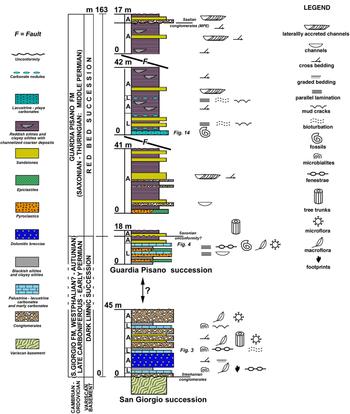
The San Giorgio Basin (SW Sardinia, Iglesiente; Fig. 1) is the oldest post-Variscan molasse basin on the island of Sardinia (Westphalian D?–Stephanian; Fondi, Reference Fondi1980; Pittau et al. Reference Pittau, Del Rio and Funedda2008). Multiple stratigraphic sections (Barca & Costamagna, Reference Barca and Costamagna2003) have allowed a complete succession of the San Giorgio Formation to be constructed that is nearly 45 m thick (Fig. 2). The base of the succession rests unconformably on top of the Variscan basement formed by terrigenous deposits of the Cabitza Formation (Middle Cambrian – Lower Ordovician; Pillola, Reference Pillola1990). It is composed of a 1 m thick quartzose conglomerate or by not more than 2–3 m of coarse, frequently channelized polygenic breccias and minor, locally matrix-rich conglomerates (fanglomerates) consisting of angular siliciclastic pebbles and cobbles from the Cabitza Fm (Middle Cambrian – Lower Ordovician; Pillola, Reference Pillola1990) and carbonate cobbles from the Gonnesa Group (Lower Cambrian; Pillola, Reference Pillola1990). Rare granitoid pebbles have also been found.
Stratigraphic column of the San Giorgio and Guardia Pisano areas. A – alluvial environment; L – lacustrine–palustrine environment.

This unit is overlain by a 2.5 m thick interval of well-bedded, laminated dolostones and calcareous dolostones, locally intercalated with thin beds of blackish pelites, sharply covered by a 10 m thick interval of well-stratified dolomitic breccias. This latter interval is overlain by a 30 m thick succession subdivided into two cycles each composed of parallel- to wavy-laminated dolostones with intercalated fine blackish carbonaceous pelites that show subtle parallel laminations (Fig. 3a) passing upwards to sandy to conglomeratic, locally cross-bedded siliciclastic rocks. Rare bioturbation, mud cracks and vertebrate trails were observed locally on the basal surfaces of the carbonate-pelitic intervals. The pelites contain plant remains (Del Rio, Reference Del Rio1973). The conglomeratic-arenaceous horizons frequently preserve roots and tree trunks in life position. Synsedimentary normal faults are present. The rate of reworking of the basement pebbles increases steadily upwards. The top of the succession is composed of chaotic polygenic conglomerates.
San Giorgio Basin. (a) Finely bedded, laminated dolostones containing coarser tempestitic beds: undulated strata surfaces (ripples) are locally visible. (b, c, d) Alternations of micritic beds and microbial films. Locally, desiccation fenestrae possibly due to the shift of the lakeshore are visible. Scale bar = 1 cm.

4.a.2. Carbonate facies, microfacies and petrography
The carbonate intercalations are formed by two different lithotypes: dolomitic breccias and dolomitic mudstones and bindstones. The dolomitic breccia horizon, made up of tightly packed angular pebbles and grains of Lower Cambrian carbonates of the Gonnesa Group, is located on top of the first muddy carbonate horizon of the succession. It is formed by decimetre-thick chaotic, fining-upwards or, rarely, coarsening-upwards beds composed of poorly to well-sorted angular dolomite pebbles (<10 cm in size), passing gradually to millimetre-thick dolomite grains. Cross-bedding and plane-parallel bedding structures are not uncommon. The beds are usually characterized by faint erosive lower surfaces. The breccia clasts are cemented by carbonates. Rounded quartz grains are also present. A subsequent late dolomitization process (Permian–Triassic? Boni et al. Reference Boni, Parente, Bechstad, De Vivo and Iannace2000) is superimposed locally on the coarse groundmass, thus frequently obliterating the previous structures. Local pockets of silicification may also be present. The thin, muddy carbonate and microbialitic horizons form three intercalations. These are minutely laminated owing to micrite deposition and microbial activity (Fig. 3b, c, d), and are frequently intercalated with thin, dark carbonaceous-terrigenous muds rich in palynomorphs and dark organic particles. The microbial films locally show wrinkled fenestral structures and small domes. Scarce coarse, fining-upward carbonate sand- to silt-sized horizons with an erosive base are intercalated both between the microbial films and in the carbonaceous mud. Localized bioturbation and wavy bedding surfaces are visible. Vertebrate and invertebrate trace fossils have been found locally on the bed surfaces (Fondi, Reference Fondi1980; Marchetti et al. Reference Marchetti, Petti, Zoboli and Pillola2018). The result of a superimposed late dolomitization process shows as a fine recrystallization of the carbonates.
4.a.3. Interpretation
Based also on the several stratigraphic columns surveyed by Barca & Costamagna (Reference Barca and Costamagna2003), it is possible to draw the following palaeoenvironmental reconstruction of the San Giorgio Basin. The coarse clastic beds of the San Giorgio Basin succession on top of the Variscan unconformity possibly represent colluvial blankets; these blankets may fill small-scale topographic depressions, thus providing evidence of channels scoured on a levelled surface of Variscan metamorphic rocks. Roots and tree trunks in their life position embedded in conglomeratic-arenaceous horizons were most likely buried by sudden flood events. Upwards, the basin features a cyclic recurrence of lithofacies, possibly reflecting enhanced tectonic control, as suggested by the synsedimentary normal faults. The thick dolomitic breccia beds do not fit in this scheme. Their origin may be related to a period of enhanced tectonic activity. The poorly sorted debris formed by Cambrian carbonate extraclasts probably originated from fault movements in the exposed Variscan basement nearby. Based on its described structures and textures, the breccia horizon was deposited by different processes ranging from debris- to stream-flows.
The coarse siliciclastic lithofacies were formed by coarse fan lobes fringing and episodically choking an ephemeral lacustrine waterbody of shallow depth. The lake filled with alternations of stromatolitic bindstones and wave-rippled silt-mudstones representing lake shoreface carbonates with sporadic emersion events and deeper, varved carbonate muds and dark carbonaceous pelites, possibly representing an offshore environment. Lacustrine storm layers (the coarser graded layers in between the shallow-water microbial films) and turbidites (the coarser graded layers in the dark carbonaceous pelites of the deeper environment) are also represented. Episodic increases in tectonic activity or a drop in the local base level enhanced erosion and brought debris transported by rivers to the lake. Ultimately, this process caused the complete filling of the lake. According to the macro- and microfloral content (Cleal et al. Reference Cleal, Scanu, Buosi, Pittau and Kustatscher2016 and references therein) and the features of the lithofacies, the succession was deposited under a temperate to warm-humid climate. The dolomitization process may be connected with the late Variscan hydrothermalism (‘geodic dolomite’; Boni & Iannace, Reference Boni and Iannace1988; Boni et al. Reference Boni, Parente, Bechstad, De Vivo and Iannace2000). The rare, weak silicification may also be due to hydrothermal activity.
4.b. Guardia Pisano succession
4.b.1. Stratigraphy
The Guardia Pisano succession (SW Sardinia, Sulcis; Fig. 1) (Pittau et al. Reference Pittau, Barca, Cocherie, Del Rio, Fanning and Rossi2002; Barca & Costamagna, Reference Barca and Costamagna2006 a) crops out in three stratigraphic sections located along road-cuts. Its base is not visible. The succession can be subdivided into two main units (Fig. 2): a lower unit, dark grey to blackish in colour and not more than 15 m thick, that pertains to the lower limnic blackish successions and can still be referred to the San Giorgio Fm; and a red to purplish upper unit known as the Guardia Pisano Formation, which is almost 110 m thick and referable to the upper red-bed facies. The age of the two units can be differentiated by biostratigraphy using macro- and microfloral assemblages, and by U–Pb radiometric dating of rhyolitic volcanic rocks (Pittau et al. Reference Pittau, Barca, Cocherie, Del Rio, Fanning and Rossi2002). The lower unit has been referred to the Carboniferous–Permian boundary and has a radiometric age of 297 ± 5 Ma. The limnic and red-bed successions are separated by a faint erosive unconformity.
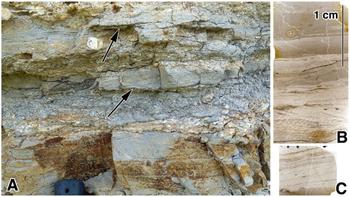
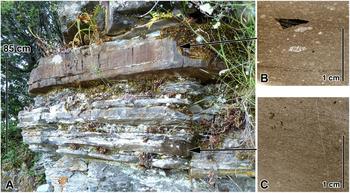
Here, we will only characterize the lower limnic part. This succession features tight alternations of dark grey to blackish, locally finely laminated (varved) carbonaceous siltstones to clayey siltstones, grey sandy epiclastic to volcaniclastic sandstones, and volcanic rocks, both pyroclastic rocks and lavas. Some of the coarser depositional bodies are lens shaped. The volcanic rocks pertain to the lower Carboniferous–Permian tectono-sedimentary cycle (Cassinis et al. Reference Cassinis, Cortesogno, Gaggero, Pittau, Ronchi and Sarria2000 and references therein; Deroin & Bonin, Reference Deroin and Bonin2003; Gaggero et al. Reference Gaggero, Gretter, Langone and Ronchi2017). The upper part of the limnic succession contains some grey marly to carbonate, laminated beds (Fig. 4a) and a single, some decimetre-thick yellowish carbonate bed. The latter contains the remains of fish and amphibians (Freytet et al. Reference Freytet, Galtier, Schneider, Ronchi, Tintori and Wernerburg2002; Werneburg et al. Reference Werneburg, Ronchi and Schneider2007). Some horizons are weakly silicified. In the lower part of the succession, scattered clay-silty horizons contain a rich macro- and microfloral assemblage. The sudden start of the upper red-bed unit is marked by a poorly visible erosive surface evidenced by some brown-reddish layers of weakly cross-bedded coarse sandstones.
Guardia Pisano succession. (a) Alternations of pyroclastic rocks and laminated marly-carbonate beds (arrows). (b) Cyclical carbonate deposition consisting of faintly graded micritic laminae; the base is featured by a sharp contact. The lower event is cross-laminated. (c) Alternations of micritic beds and thin microbial mats.

4.b.2. Carbonate facies, microfacies and petrography
The carbonates of this succession are represented in the lower part by some grey, laminated marly beds (marly mudstones) intercalated with coarse to fine volcaniclastic and epiclastic beds (Fig. 4a), and a decimetre-thick yellowish bed in the upper part of the succession. The lower carbonate beds are composed of thin, wavy microbial films (Fig. 4b, c), locally with fenestral fabric, alternating with micritic to siliciclastic, silt-sized laminae containing small fragments of organic matter (plant debris). Conversely, the upper carbonate bed is a quartz-rich bioclastic wackestone with ostracods, Characeae (?) and other indeterminable fossils; a limited calcretization process is superposed here.
4.b.3. Interpretation
Based also on the stratigraphic column and the 3D reconstruction of the depositional bodies (Barca & Costamagna, Reference Barca and Costamagna2006 a), the limnic lower part of the Guardia Pisano succession, pertaining to the San Giorgio Fm, was deposited in a perennial palustrine to shallow lacustrine environment. It mainly features thin, fine, locally varved siliciclastic deposits rich in organic matter and contains beds with concentrated macro- and microfloral contents (Pittau et al. Reference Pittau, Barca, Cocherie, Del Rio, Fanning and Rossi2002). These were crossed during palustrine phases by shallow channels (lens-shaped deposits) filled with sandy or volcaniclastic debris deriving from the erosion of the Variscan basement or the coeval volcanic activity; these deposits tended in the end to choke the lake. The rare, intercalated carbonate–marly deposits in the upper part may have been triggered episodically by a slight increase in the lake depth, leading to the development of cyanobacteria and the deposition of carbonate mud. The uppermost, coarser carbonate bed with organic remains may instead represent different higher energy lacustrine conditions (shoreface) periodically subjected to emersion. The deposition of the succession took place in a context of volcano-tectonic activity, as suggested by the intercalated volcanic rocks. The presence of amphibians, acanthods and sharks, possibly migrating through river systems (Freytet et al. Reference Freytet, Galtier, Schneider, Ronchi, Tintori and Wernerburg2002; Werneburg et al. Reference Werneburg, Ronchi and Schneider2007), implies an open lake context. Similar depositional conditions have been hypothesized for some sectors of the German Saar–Nahe Basin (Schäfer, Reference Schäfer, Baganz, Bartov, Bohacs and Nummedal2012).
4.c. Perdasdefogu Basin
4.c.1. Stratigraphy
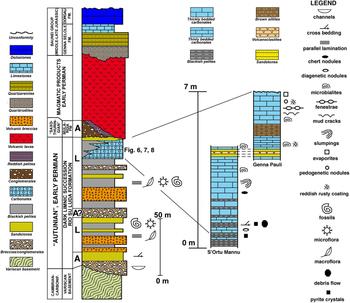
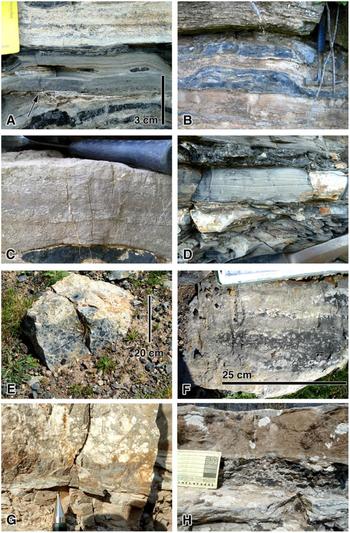
The Permian Perdasdefogu Basin in central Sardinia (Ogliastra; Fig. 1) (Ronchi et al. Reference Ronchi, Broutin, Diez, Freytet, Galtier and Lethiers1998, Reference Ronchi, Sarria and Broutin2008) is the island’s thickest limnic succession, reaching nearly 250 m in thickness. However, this study measured a significantly smaller thickness, amounting to c. 150 m including the upper volcanites(Fig. 5). Based on the rich, fossiliferous content (algae, permineralized plants, amphibians, shark teeth and scales), Freytet et al. (Reference Freytet, Toutin-Morin, Broutin, Debriette, Durand, El Wartiti, Gand, Kerp, Orzag, Paquette, Ronchi and Sarfati1999, Reference Freytet, Galtier, Schneider, Ronchi, Tintori and Wernerburg2002) assigned the succession to the uppermost Gzhelian – lower Asselian, whereas Pittau et al. (Reference Pittau, Del Rio and Funedda2008) assigned it to the Asselian. The base of the succession unconformably covers the Variscan basement with 5–15 m of lens-shaped polygenic breccias and clast- to matrix-supported conglomerates and breccias (locally fanglomerates) made up of Variscan basement pebbles and a lesser amount of quartz pebbles. These coarse deposits are often channelized and cut by synsedimentary faults. They are overlain, after a thin, faintly cross-bedded sandstone interval, by c. 50 m of blackish varved siltstones and clayey siltstones, with few carbonaceous clays, sandstones and rare conglomerates. This succession contains volcanic intercalations that are constituted by fine pyroclastic rocks, lavas, coarse breccias or domes. Upwards, there are c. 20 m of prevailing carbonates formed initially by alternations of micritic, thinly laminated (varved) (Fig. 6d), locally cross-bedded, dark carbonaceous-carbonate pelites, pelites and clayey limestones with scattered pyrite nodules and tiny pyrite crystals. These are overlain by rhythmic alternations of laminated pelites and muddy to sandy limestones, topped by locally silicified, thickly bedded limestones, dolomitic limestones, dolomites and cherts overprinting carbonate deposits with rare blackish pelitic intercalations. Upwards, the carbonate beds are thinner and the silicification is less pervasive. Chert nodules and streaks are scattered in the middle part, and whitish to grey pedogenetic nodules are enclosed in fine muddy beds. Anhydrite nodules now pseudomorphed by calcite and indeterminable bioturbation structures are also visible. Scattered discontinuous coal layers and lignitic clays are embedded in the upper carbonate interval. Episodic, middle- to fine-grained, decimetre-thick yellowish siliciclastic–volcaniclastic horizons are also intercalated in the uppermost carbonate layers. Slumps, synsedimentary faults and thin intraclastic debris flows (Fig. 6h) are frequent, especially in the carbonate part of the succession.
Stratigraphic column of the Perdasdefogu Basin. A – alluvial environment; L – lacustrine–palustrine environment.

Perdasdefogu Basin, carbonate outcrops. (a) Tempestite-graded bed with sharp basal contact (arrow). (b) Domal stromatolite silicified beds. (c) Oncolitic bed showing several graded events. (d) Varved silty-carbonate sediments; local cross-lamination is visible. (e) Palustrine limestone showing black pebbles in grey micrite. (f) Alternations of micritic beds and palustrine nodulized carbonate beds. (g) Calcitic nodules of pseudomorphed anhydrite with chickenwire structure in micritic matrix. (h) Carbonate breccia forming an intraclastic debris flow.

The upper, mainly carbonate, interval of the succession may be replaced laterally by scattered, isolated, decimetre-thick muddy to sandy carbonate beds embedded in carbonaceous blackish pelites. Upwards, locally volcaniclastic and/or terrigenous sandstones rest sharply on the carbonates. The entire described succession is known as the Rio Su Luda Formation (Ronchi & Falorni, Reference Ronchi and Falorni2004). It is overlain by polygenic conglomerates and limited reddish pelites that may be referred to the Mulargia Formation (see Section 5.b). The thickness of this upper interval is thought to be c. 20 to 30 m.
The top of the succession is typically represented by Cisuralian dacitic lavas and breccias of c. 50 to 100 m thick that may rest both on the carbonates or the siliciclastic units. The volcanic rocks are unconformably overlain by the terrigenous Middle Jurassic Genna Selole Formation (Dieni et al. Reference Dieni, Fischer, Massari, Salard-Cheboldaeff and Vozenin-Serra1983; Costamagna, Reference Costamagna2015). Ronchi et al. (Reference Ronchi, Sarria and Broutin2008) reported a maximum thickness of 107 m for the calcareous interval of the Rio Su Luda Fm (based on drillings). This unusual thickness (if compared with the outcrops) may be the consequence of doubling and folding due to Permian synsedimentary transpressional tectonics, which are still poorly understood (Sarria & Serri, Reference Sarria and Serri1986; Barca et al. Reference Barca, Costamagna, Janssen and Von Der Handt2001).
4.c.2. Carbonate facies, microfacies and petrography
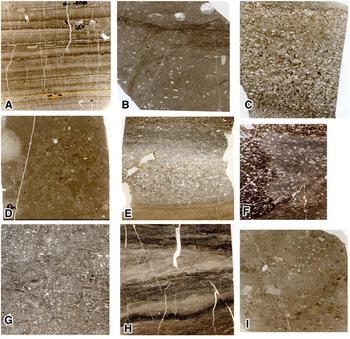
In the Perdasdefogu Basin, the Rio Su Luda upper carbonates show a coarsening-upwards trend along with a growing abundance of microbialitic beds and the gradual disappearance of the blackish pelites, which nonetheless continue being present here and there as thin interbeds in between the carbonate beds. The carbonates are laminitic mudstones locally intercalated with crinkled algal films (Figs 6d, 7a), stromatolitic bindstones (Figs 6b, 7h) and bioclastic (ostracods and rare gastropods) (Fig. 7c, f) to oncolitic (Figs 6c, 7g), rarely peloidal, ooidal or intraclastic packstones/grainstones. The algal microbialites show a wrinkled upper surface. The laminated mudstones (varved) may be parallel to cross-laminated and contain scattered pyrite crystals. Intercalated with mudstones and locally with bioclastic wackestones (Fig. 7b) are decimetre-thick, normally graded beds (Fig. 7e) with an erosive base and a basal coarse lag with intraclasts and bioclasts, overlain by locally cross-bedded grainstones (Fig. 6a). Decimetre-thick, laterally discontinuous intraclastic breccia beds are present, and are locally associated with slumps. In the upper part of the carbonate succession, the bed surfaces show frequently distinct stromatolite domes (Fig. 6b) with oncoids, rare fenestral structures and desiccation cracks. Nodulized and mottled limestones, with intergranular cracks interpreted as palustrine carbonates (Figs 6f, 7d, I, 8a, b), and beds and interbeds of coal are scattered in the upper part of the carbonate succession. These carbonates may contain blackish nodules interpreted as black pebbles (Figs 6e, 8a). Here, former evaporitic nodules (Fig. 6g), now completely silicified, often occur in micritic beds and have a chickenwire structure; they are interspaced with bindstones, frequently forming depositional couplets at the top of the carbonate succession. Post-depositional chert nodules, streaks and beds overprinting or displacing the carbonates are disseminated. Small syn-depositional fractures are scattered. Locally, some decimetre-thick repeated cycles of muddy limestones → microbialitic limestones → nodulized limestones with thin coal laminae (Fig. 8), locally capped by an oxidized, irregular surface (emersion?), can be observed. In the cavities of the packstones, a siliceous, two-generation cement can be seen. A well-representative, although somewhat reduced, section of these limestones showing the depositional evolution crops out at the Ortu Mannu (lower part) and Genna Pauli (upper part) localities (Fig. 5); its overall thickness amounts to 7 m.
Micrographs of the Perdasdefogu carbonates. Square side = 2 cm. (a) Thinly laminated deposits (varves) with scattered microbial films. Small chert nodules and clustered pyrite crystals are also present. (b) Bioclastic wackestone with gastropods and ostracods; possible plant root bioturbation is visible. (c) Bioclastic packstone (ostracod coquina). (d) Nodulized mudstone–wackestone. (e) Turbidite graded bioclastic bed (ostracods) in thinly laminated silty limestone. (f) Bioclastic, partially silicified wackestone–packstone with ostracods. (g) Oncolitic packstone. (h) Algal bindstones alternated with micritic beds containing organic matter laminae. (i) Mottled limestone with circumgranular cracks and intraclasts.

Perdasdefogu Basin. (a) Polished slab of a microbial, locally nodulized carbonate embedding black pebbles. (b) Polished slab of a nodulized carbonate with intercalation of dark pelites; note the black pelites infilling fractures in carbonates due to the pedogenetic cracking.

4.c.3. Interpretation
Based also on the sedimentological analysis of the several stratigraphic columns surveyed by Ronchi et al. (Reference Ronchi, Sarria and Broutin2008 and references therein), the following palaeoenvironmental reconstruction of the Perdasdefogu Basin is possible. The development of the basin started with coarse deposits that can be referred to an alluvial system, probably consisting of small intramontane alluvial fans (fan deltas?) with rare debris flows. The smoothing of the surrounding relief caused a gradual fining upwards of the succession; this, possibly with the initially increasing subsidence, at first created a transgressive sequence (sensu Busson Reference Busson1982; Olsen, Reference Olsen and Katz1991) and triggered a rapid deepening (and widening?) of the basin. In the central part of the basin, this led to the deposition of an alluvial to palustrine–lacustrine terrigenous, fining-upwards sequence. Depending on the grain size and the sedimentary structures of the deposits, the palustrine–lacustrine sequence can be attributed, respectively, to bottom lake or lake offshore (profundal zone), shoreface to foreshore (littoral zone), and backshore sub-environments. While the coarser, graded beds intercalated in the varved pelites of the deeper lake offshore can be ascribed to lacustrine turbidites, those enclosed in the shallow bioclastic wackestones can be interpreted as storm layers. The stopping of terrigenous input, possibly due to the smoothing of the Variscan chain, triggered a sedimentation change in the lake from siliciclastic to carbonatic. Facies belts developed side by side and are interdigitated (Fig. 9) as (1) varved, locally cross-laminated mudstones, locally affected by lake-bottom currents, with intercalated higher energy beds (turbidites; lake offshore) and rare microbial films; (2) laminites with slumps and debris flows (lake slope?); (3) bioclastic wackestones with intercalated graded beds (storm layers), and winnowed(?) ostracod coquinas and oolite/oncolite packstones (shoreface); (4) stromatolitic, locally fenestral and/or domal bindstones with or without evaporites (foreshore); and (5) pedogenetically transformed palustrine carbonates (Arp, Reference Arp1995; Flügel, Reference Flügel2004) with oxidized bed surfaces, alternated with carbonaceous clays and organic peats (lakeshore, backshore and marshes). Periodic variations of the shoreline position due to limited rainfall rate changes were possible. Nonetheless, the entire succession is evidence of a regressive trend (sensu Busson, Reference Busson1982; Olsen, Reference Olsen and Katz1991) leading to the filling of the lake. The presence of pseudomorphed evaporitic nodules marks episodic hypersaline environments. The dark colour of the deposits suggests anoxia that was intermittent on the shore and dominant in the lake bottom. The embedded black pebbles suggest burning episodes. Accumulations of amphibian skeletons suggesting mass mortality events may be related to hydromagmatic episodes.
Palaeoenvironmental framework of the lacustrine carbonate facies in the Perdasdefogu Basin.

The frequency of volcanic and volcaniclastic intercalation, along with slumps and debris flows, is evidence of a strong tectono-magmatic influence. The silicification phenomena are late- to post-depositional, and probably related to hydrothermal activity, although a late diagenetic origin of the displacing chert nodules cannot be excluded (Bustillo, Reference Bustillo, Alonso-Zarza and Tanner2010). At the top of the succession, the upper sandstones and the poorly organized quartzose conglomerates that choke the lake could in the end represent the prograding, alluvial filling-up of the basin in response to a further uplift phase of the chain.
The Perdasdefogu Basin lake was probably an open, permanent stratified lake with an anoxic bottom under a temperate to warm-humid climate, surrounded by small alluvial fan deltas (examples in Fouch & Dean, Reference Fouch, Dean, Sholle and Spearing1982). The lake changed from terrigenous to autochthonous carbonate sedimentation, which was probably related to chemical, physiographic and climatic changes of the waterbody due to the modification of the relief of the surrounding landscape. The Perdasdefogu Basin thus provides evidence of a transgressive to regressive sequence (Olsen, Reference Olsen and Katz1991) that in the end filled the basin.
Similar depositional conditions were suggested for the German late Variscan Molasses (Schneider & Romer, Reference Schneider, Romer, Linnemann and Romer2010; Schäfer, Reference Schäfer, Baganz, Bartov, Bohacs and Nummedal2012).
4.d. Montarbu Basin
4.d.1. Stratigraphy
The Montarbu Basin succession (Ronchi et al. Reference Ronchi, Sarria and Broutin2008) in central Sardinia (Barbagia; Figs 1, 10) rests unconformably on top of the Variscan basement, with a thickness of c. 120 m including the volcanites. Its age is latest Carboniferous – Early Permian (Ronchi et al. Reference Ronchi, Sarria and Broutin2008) and it can be referred to the Rio Su Luda Formation. It starts with alternations of channelized polygenic clast- to matrix-supported breccias and conglomerates, and cross-bedded sandstones with brown to grey-green laminated (varved) pelites. There are often intercalated, erosive, graded sandstone beds in the pelites. On the whole, the succession tends to be finer upwards. Towards the top of the succession, accumulations of green sandstones rest unconformably on top of the pelites or laterally to them. Plant fossils have been found in the pelites (Pittau Del Rio & Funedda, Reference Pittau, Del Rio and Funedda2008; Ronchi et al. Reference Ronchi, Sarria and Broutin2008). The top of the succession features reddish siltstones (Mulargia Formation? See Section 5.b). Eastwards, the succession may be covered by volcanic porphyrites. The Middle Jurassic Genna Selole Formation follows unconformably.
Stratigraphic column of the Montarbu Basin. A – alluvial environment; L – lacustrine–palustrine environment.

One single intercalation of carbonates has been found in this succession. It is located c. 8 m above the base and is c. 80 cm thick. The carbonate horizon is formed by some dark grey, silicified carbonate to marly beds with a maximum thickness of 20 cm. The carbonate beds contain small chert nodules (Fig. 11a), and they are intercalated with marly-sandy beds. These intercalations rest on dark grey sandstones, and are covered by coarse sandstones and polygenic microconglomerates.
Montarbu Basin. (a) Carbonate beds embedded in silty to sandy siliciclastic rocks. (b) Bioclastic packstone with ostracods, chert and a wood fragment. (c) Bioclastic packstone with poorly visible ostracods and fish scales.

4.d.2. Carbonate facies, microfacies and petrography
The carbonate beds are laterally discontinuous and are composed of dark grey calcarenites showing locally weak, indistinct cross- and wavy bedding. They are tight bioclastic packstones, rarely wackestones, and yield ostracods, fish scales and rare wood fragments (Fig. 11b, c).
4.d.3. Interpretation
Owing to the abundant vegetation, the survey of several continuous stratigraphic sections in this basin has been not possible. Nonetheless, based on several scattered short successions described here and elsewhere and lithostratigraphically correlated, the following reconstruction has been attempted. The Montarbu Basin was dominated by siliciclastic deposition in which fluvial deposits (related to small alluvial fans / fan deltas?) surrounded a siliciclastic-dominated, lacustrine waterbody. As suggested by the cyclical reprise of the coarse sedimentation, the fluvial coarse deposits moved back and forth, probably in response either to the variation of the base level or to the tectonic activity leading to uplift, and so choked the lake cyclically. Episodic coarser lacustrine storm layers accumulated at some distance from the lake shore. An isolated episode of carbonate deposition in this lake produced the few carbonate beds, which were deposited in a nearshore, shallow environment with elevated energy. The exclusive carbonate deposition was perhaps triggered by a temporary stop in the terrigenous input in a small area of the lake. In the end, the lake was choked and the basin was filled by volcanic products.
4.e. Genna Arramene
At Genna Arramene in central Sardinia (Ogliastra; Fig. 1), under a thick Cisuralian volcano-sedimentary sequence, a few scattered outcrops of a poorly visible terrigenous to carbonate lacustrine sequence rest unconformably on top of the Variscan basement; its thickness probably does not exceed 10 m. The sedimentological analysis of scattered boulders indicates that the rare outcrops closely resemble some of the Perdasdefogu Basin; in fact, silicified stromatolitic and laminitic carbonates with oncoids and pseudomorphosed evaporites with a chickenwire structure are visible. This is the first time a Carboniferous–Permian sedimentary succession has been observed in this area.
4.f. Lu Caparoni succession
4.f.1. Stratigraphy
In NW Sardinia (Nurra; Fig. 1), a not more than 70 m thick limnic post-Variscan succession (Gasperi & Gelmini, Reference Gasperi and Gelmini1979; Cassinis et al. Reference Cassinis, Cortesogno, Gaggero, Ronchi and Valloni1996, Reference Cassinis, Durand and Ronchi2003 b; Ronchi et al. Reference Ronchi, Sarria and Broutin2008) rests unconformably on top of the Variscan basement. Its age is reported to be Asselian (Pittau et al. Reference Pittau and Del Rio2008), although a recent paper by Gaggero et al. (Reference Gaggero, Gretter, Langone and Ronchi2017) would allow the assignment of its base to the uppermost Gzhelian. Its base is almost always composed of the Punta Lu Caparoni Formation (Gasperi & Gelmini, Reference Gaggero, Gretter, Langone and Ronchi1979; Fontana et al. Reference Fontana, Neri, Ronchi and Stefani2001) (Fig. 12), which is a thin, 10–15 m thick unit. It is formed by conglomerates, black fine sandstones, siltstones and pelites, and thickly bedded yellowish carbonates in varying percentages. The best exposure is at Punta Lu Caparoni, where it is formed by two thin sedimentary cycles composed of conglomerates and microconglomerates passing first to dark grey fine sandstones and laminated sandy pelites and ending with fine yellowish to brown silicified dolostones with a reddish rusty coating at the top. The cycles are separated from each other by a faint discontinuity and pass sharply upwards to the coarse siliciclastic rocks of the Pedru Siligu Formation. Previous interpretations divided the Punta Lu Caparoni Fm from the upper Pedru Siligu Fm with an unconformity and a discontinuous volcanic bed. However, it appears that the Pedru Siligu Fm may conformably overlie the Punta Lu Caparoni Fm. Locally, a limited erosion of the underlying carbonate bed may exist, but there is no evident change in the bedding direction. A paraconformity interpretation thus appears to be more congruent.
Stratigraphic column of the Punta Lu Caparoni Fm. A – alluvial environment; L – lacustrine–palustrine environment.

The Pedru Siligu Fm, whose pertinence to the limnic succession was suggested by Ronchi et al. (Reference Ronchi, Sarria and Broutin2008), is a 40 to 50 m thick unit that rests conformably on top of the Punta Lu Caparoni Fm, an interbedded volcanic interval or, rarely, directly over the Variscan basement. It is formed by immature polygenic conglomerates, pebbly sandstones and sandstones showing cross- to parallel bedding and frequent lens-shaped beds. Volcanic rocks are present in its upper part. The limnic succession is overlain by a red-bed succession starting with the Porto Ferro Fm (Cassinis et al. Reference Cassinis, Durand and Ronchi2003 b).
4.f.2. Carbonate facies, microfacies and petrography
The dolomitic beds found in the Punta Lu Caparoni Fm are pedogenetically transformed mudstones, nodulized bioclastic wackestones with scarce and poorly preserved ostracods, and microbial bindstones (Fig. 13). Small quartz grains are present. The reddish rusty coating over the irregular surface of the carbonate beds is similar to that observed in the Perdasdefogu Basin and may be related to emersion events.
Laminated bindstone (microbial films alternating with micritic beds) at the top of the lower cycle of the Punta Lu Caparoni Fm.

4.f.3. Interpretation
Based also on the stratigraphic sections surveyed by Gasperi & Gelmini (Reference Gasperi and Gelmini1979), the following palaeogeographic reconstruction can be drawn. The Punta Lu Caparoni Fm fills the topographic depressions of a rugged surface over metamorphic schists. These irregularities were initially filled by coarse to fine debris deriving from the alteration of the adjacent basement. Ultimately, when the relief was essentially smoothed, the feed of terrigenous material stopped and was replaced by lacustrine deposition, changing from siliciclastic to carbonate sedimentation. The restarting of the sequence marks a limited rejuvenation of the relief (further uplift?) and the repetition of the cycle. The Punta Lu Caparoni Fm was deposited by fluvial deposits (related to small alluvial lobes?) flanked and finally covered by small, shallow (shoreface?) lacustrine environments. The superimposition of the coarse fluvial Pedru Siligu Fm marks the restarting of extensional tectonics, leading to the collapse of the Variscan chain and the production of major debris that buried the surfaces previously smoothed by the Punta Lu Caparoni Fm.
5. Carbonates of the upper cycle (red-bed succession: Guadalupian–Lopingian?)
As previously noted, the red-bed post-Variscan basins follow the black limnic basins in time and space or can be directly located unconformably on top of the Variscan basement. In the former case, the possible transitions from limnic to red-bed basin are highly variable, from concordance (with a sharp to gradual transition) to an angular unconformity.
5.a. Guardia Pisano succession
5.a.1. Stratigraphy
As stated in Section 4.b, the Guardia Pisano upper red-bed unit pertains to the Guardia Pisano Fm cropping out in SW Sardinia (Sulcis; Figs 1, 2) (Barca & Costamagna, Reference Barca and Costamagna2006 a). It starts suddenly with an unconformity that truncates the Pennsylvanian–Cisuralian lower limnic deposits of the San Giorgio Fm. This c. 110 m thick succession has been assigned to the Middle–Upper(?) Permian, owing to the finding of Lebachia shoot imprints and by correlation with well-dated lithofacies in Provence (France; Cassinis et al. Reference Cassinis, Durand and Ronchi2003 b; Durand, Reference Durand2008).
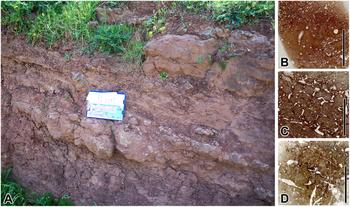
The Guardia Pisano Fm consists initially of brown-reddish layers of sandstones, which are embedded in the middle of red pelites and yield tree trunk chunks. This is followed by channelized reddish fine sandstones with lateral accretion features embedded in red siltstones. Some thin, scattered volcanic beds are here present, too. The succession proceeds upwards with parallel-laminated and locally finely stratified silty to clayey red-bed deposits with bioturbation (Scoyenia ichnofacies), calcrete beds and calcareous layers of lined-up carbonate nodules (Fig. 14). Upwards, it contains pelites and lens- to ribbon-shaped sandy to pebbly channelized bodies, again with lateral accretion structures. In the finer deposits, mud cracks and desiccation structures also occur.
Guardia Pisano succession. (a) Nodular carbonate beds embedded in the red-bed pelitic succession. (b) Bioturbated, nodulized (?) peloidal mudstone with ostracod remains and bioturbation. (c) Desiccation cavities (root canals?) due to pedogenization into a silty mudstone. (d) Bioclastic wackestone with unclassified remains. Scale bar = 1 cm.

5.a.2. Carbonate facies, microfacies and petrography
In the intermediate part of the red-bed succession, calcretes and irregular carbonate nodules of up to 20 cm in diameter and a few decimetre-thick carbonate beds are embedded in thinly laminated red pelites with mud cracks. These are pedogenically transformed marly mudstones and wackestones with ostracods and other indeterminable organic fragments (Fig. 14a–d). Bioturbation may be present.
5.a.3. Interpretation
Based also on the stratigraphic column and the 3D reconstruction of the depositional bodies (Barca & Costamagna, Reference Barca and Costamagna2006 a), this red-bed succession was deposited in a continental environment featuring interfingered fluvial and minor lacustrine siliciclastic and carbonate deposits; the alluvial plain was characterized by reddish massive pelites and sandy meandering channel fills. The lacustrine environment was temporary and very shallow. The thin, fine, plane-parallel laminated deposits, irregular carbonate nodules, bioturbation, mud cracks and desiccation structures point to ephemeral playa lakes with strong evaporation processes.
5.b. Mulargia–Escalaplano Basin
5.b.1. Stratigraphy
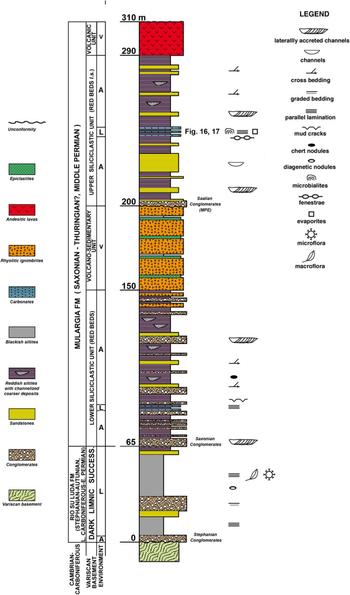
The Mulargia–Escalaplano Basin succession (Cassinis et al. Reference Cassinis, Cortesogno, Gaggero, Pittau, Ronchi and Sarria2000; Barca & Costamagna, Reference Barca and Costamagna2005) is located in central Sardinia (Gerrei; Fig. 1). It formed in a single basin later separated by Tertiary tectonics (Pecorini, Reference Pecorini1974). In western Mulargia, the red-bed succession rests conformably, with a gradual change, on top of a thin limnic succession featuring alternations of coarse-grained, from chaotic to graded, to varved fine-grained siliciclastic deposits. The succession is c. 60 m thick and Gzhelian in age (macrofloras; Pittau et al. Reference Pittau, Del Rio and Funedda2008). It may be referred to the Rio Su Luda Fm. In the eastern Escalaplano area, the red-bed succession lies unconformably on top of the Variscan metamorphic rocks. The red-bed succession should be regarded as a separate lithostratigraphic unit resting on the Rio Su Luda Fm or the basement metamorphic rocks. It is named herein as the Mulargia Fm. It is c. 250 m thick and composed of a succession of four different lithofacies associations (Fig. 15). These are (1) a lower siliciclastic unit composed of alternations of basement-derived, chaotic polygenic channelized conglomerates and matrix-supported breccias (fanglomerates) followed by channelized reddish sandstones with lateral accretion structures embedded in reddish siltstones and clayey siltstones with mud cracks. Nodular calcrete horizons and scattered, laterally discontinuous decimetre-thick carbonate nodular beds are frequent in its lower part. Thick intercalations of volcaniclastites occur in the topmost part of this unit, prevailing gradually over the siliciclastic rocks. These mark the gradual passage to (2) the volcano-sedimentary unit. This is formed by volcaniclastites forming depositional couplets with thin irregular epiclastites. Rare red-pelite beds are also present. This interval is overlain by (3) the upper siliciclastic unit that rests unconformably on top of the volcano-sedimentary unit and is formed by a fining-upwards reddish succession built of conglomerates, coarse-grained, cross-bedded channelized sandstones with structures of lateral accretion and pelites from eroded Permian volcanites and the lower reddish siliciclastic deposits. In the middle of the unit, scattered yellowish to dark grey limestone and rare dolomitic limestone and dolostone beds intercalate. These may be nodular (Fig. 16) and formed by stromatolites with a fenestral structure (Fig. 17a) and a frequent cauliflower structure alternated with calcilutites and calcarenites. In this unit scattered evaporitic nodules and pockets with a chickenwire structure (now pseudomorphed by quartz and calcite) are present, locally. The carbonates are frequently silicified. At the top of the succession, (4) a volcanic unit occurs, formed by dark andesitic lavas.
Stratigraphic column of the Mulargia Fm in the Mulargia succession. A – alluvial environment; L – lacustrine–palustrine environment.

Mulargia–Escalaplano Basin: irregular, nodular carbonate beds in the Mulargia upper siliciclastic lithofacies.

Mulargia–Escalaplano Basin. (a) Domal algal bindstone with fenestrae. (b) Micrograph detail of the microbialites. (c) Evaporites, plane-polarized light. (d) Evaporites, cross-polarized light. Scale bar = 1 cm.

5.b.2. Carbonate facies, microfacies and petrography
The carbonates found in the Mulargia red-bed succession are of different types. They may be pedogenetically transformed dolomitic mudstones with scarce and poorly preserved ostracods and gastropods, nodular peloidal wackestones and grainstones with circumgranular cracks, algae (Freytet et al. Reference Freytet, Toutin-Morin, Broutin, Debriette, Durand, El Wartiti, Gand, Kerp, Orzag, Paquette, Ronchi and Sarfati1999, Reference Freytet, Galtier, Schneider, Ronchi, Tintori and Wernerburg2002) and microbial mats (Fig. 17a, b); these latter locally alternate with blackish organic matter. Evaporitic beds and pockets (anhydrite pseudomorphed by quartz or calcite) are also present (Fig. 17c, d). Silicification is frequent. The carbonate beds are interstratified with a fine terrigenous succession formed by thin, laminated, mainly reddish pelites with local lens-shaped sandstone beds.
5.b.3. Interpretation
Based also on the stratigraphic columns surveyed by Cassinis et al. (Reference Cassinis, Cortesogno, Gaggero, Pittau, Ronchi and Sarria2000; Escalaplano area) and Barca & Costamagna (Reference Barca and Costamagna2005; Mulargia area), the following palaeogeographic picture can be inferred for this basin. The red-bed succession rests conformably on top of a lacustrine–palustrine terrigenous, limnic succession. This features two fining-upwards cycles separated by a thick volcanic intercalation, indicating a period of tectono-magmatic activity (Middle Permian Episode; Deroin & Bonin, Reference Deroin and Bonin2003) marked by a restart of the coarse deposits. Each cycle was deposited by an alluvial system with gradually decreasing energy, from alluvial fans to possibly meandering rivers (Barca & Costamagna, Reference Barca and Costamagna2005). The occurrence of intercalated fine-bedded pelites with mud cracks and palustrine pedogenized carbonate beds suggests the presence of terrigenous, possibly ephemeral, shallow playa lakes with scattered, strong rainfall events that gave rise to significant fluctuations of the shoreline. Fenestral bindstones and evaporites indicate strong evaporation and a hot-dry climate. Silicification of the upper carbonate beds may be related to coeval hydrothermal activity.
6. Discussion
6.a. Limnic basins
The basal conglomerates of the post-Variscan limnic basins may be ascribed to alluvial fans (fan deltas?) characterized by coarse, sometimes chaotic deposition bordering open lacustrine waterbodies; the lacustrine nature of the latter is supported by several factors, i.e. presence of varved deposits, accumulations of typical macro- and microfloral assemblages, presence of thin-shelled organisms (ostracods, gastropods) with low diversity and specific vertebrate remnants (amphibians), occurrence of freshwater fish remains and vertebrate tracks on the shore facies, and a strict association with alluvial deposits (Talbot & Allen, Reference Talbot, Allen and Reading1996). Coarse, locally channelized breccia deposits with frequent debris flow features alternate with fine, varved sediments, both of which are frequently affected by synsedimentary tectonics; this suggest an interfingering of fan and lacustrine environments due to repeated tectonic uplifts and the elongated, narrow shape of the basins themselves (intramontane troughs), with active tectonic borders. Cyclical alternations of sandy and silty-clayey deposits may also be related to the shift of the lake shore connected to regular fluctuations of the lake level due to microclimatic variations.
During the first stages of development, the deposits of the lacustrine waterbodies are thin with locally rippled sandstone deposits (foreshore, only locally present), overlain by alternations of terrigenous and organic varves. This suggests a stratification of the water column, with a well-developed offshore (profundal zone?) whose bottom is locally reached by turbiditic events, as indicated by the presence of graded beds embedded in fine varved deposits. Later, in several instances, more or less well-developed carbonate deposits occur in the lacustrine waterbodies. These testify to a lack of terrigenous input (due to the progressive smoothing of the surrounding landscape, or, less likely, to a minor rainfall rate?) and/or sheltered areas where carbonates thrive. The coeval hydrothermalism could have warmed up the waters, facilitating the carbonate precipitation (Toutin-Mourin, Reference Toutin-Mourin1992). Early diagenetic silicification processes, acidification of the waterbodies and associated mass mortality events (Ronchi et al. Reference Ronchi, Sarria and Broutin2008) could be associated with the warming. The carbonate deposition in the different basins is of different duration and extension, and may show different facies belts according to the size of the basins, namely from palustrine backshore to foreshore down to offshore. However, carbonate deposition is only episodic in most of the basins. The most complete, laterally persistent, lacustrine facies association crops out at the Perdasdefogu Basin (Fig. 7), where carbonate deposition endured. The limnic basins thus feature permanent, stratified (dimictic?) but open lakes probably some tens of metres deep, under a rainy, temperate to warm-humid environment; warm-humid environments were dominant during Late Carboniferous – Early Permian times (Boucot et al. Reference Boucot, Xu and Scotese2013). The presence of evaporites in the carbonate deposits may be related to very shallow confined environments at the end of the lake’s story. The comparable tectono-sedimentary environment evidenced by several limnic basins in Sardinia implies a similar tectonic cycle and an equivalent age. These are related to the first late Variscan extensional strike-slip tectonics, giving rise to half-graben basins (Cassinis et al. Reference Cassinis, Perotti, Ronchi, Lucas, Krainer and Schneider2013).
A similar depositional context has been described for the German late Variscan intramontane molasses (Schneider & Romer, Reference Schneider, Romer, Linnemann and Romer2010; Schäfer, Reference Schäfer, Baganz, Bartov, Bohacs and Nummedal2012).
6.b. Red-bed basins
The red-bed successions were formed in wide and well-developed alluvial environments characterized by the entire spectrum of alluvial facies: alluvial fans, braided to meandering streams, and shallow, ephemeral closed lakes in the depressions of the floodplain (Barca & Costamagna, Reference Barca and Costamagna2005, Reference Barca and Costamagna2006 a). These latter correspond with progressively drying playas under the hot-arid to sub-arid climates with extraordinary rainfall events that were dominant in Middle to Late Permian times (Boucot et al. Reference Boucot, Xu and Scotese2013). The rounding and reworking of the pebbles testifies to an extended depositional system with wider basins in comparison to the limnic ones. Carbonate beds were rare, featuring limited lacustrine fauna and related to periods of desiccation following strong episodic rainfall; evaporites, although very rare, suggest an arid climate with strong evaporation. Dolomitization could be related to the hydrothermalism connected to the coeval magmatic activity (Boni et al. Reference Boni, Parente, Bechstad, De Vivo and Iannace2000) or, alternatively, to an increased brine concentration of the drying lake (Sass & Bein, Reference Sass, Bein, Shukla and Baker1988).
6.c. Comparison between the limnic and red-bed basins
The comparison between the lithofacies associations of the older limnic and the younger red-bed successions provides evidence of the more complete development of the alluvial facies and the greater extension of the red-bed alluvial system itself. This implies that the red-bed basins were larger and environmentally varied. Conversely, permanent lacustrine facies are typical of the limnic successions. The fine, lacustrine deposits are supposed to correspond in both the limnic and red-bed successions to the final filling of the post-Variscan molassic basins after the surrounding high areas were levelled. The carbonate production in the limnic basins seems to be almost totally organic in origin, as suggested by the significant presence of bioclasts (ostracods, gastropods, algae). Conversely, it seems to be mostly inorganic in the red-bed basins due to the far more limited presence of fragmented organisms; therefore, it is probably related to evaporation processes in shallow ephemeral lakes under hot-arid to sub-arid climates. Nonetheless, in both cases, the warming of the water due to coeval hydrothermal magmatic processes could have had some importance in the inorganic precipitation of the carbonates (Toutin-Mourin, Reference Toutin-Mourin1992). The dolomitization processes may also be connected with the hydrothermalism (Boni & Iannace, Reference Boni and Iannace1988; Boni et al. Reference Boni, Parente, Bechstad, De Vivo and Iannace2000), although this could also be related to the brine concentration in the late stages of the lake.
Furthermore, the sedimentation in the limnic environment took place under a rainy, warm-humid climate. This assumption is suggested by several factors: (1) analysis of the palynomorphs (Pittau & Del Rio, Reference Pittau and Del Rio2002; Pittau et al. Reference Pittau, Del Rio and Funedda2008; Cleal et al. Reference Cleal, Scanu, Buosi, Pittau and Kustatscher2016); (2) the faunal content (Freytet et al. Reference Freytet, Galtier, Schneider, Ronchi, Tintori and Wernerburg2002); (3) the local presence of organic-rich lacustrine carbonates with well-developed facies; (4) the dark colour of the pelites, testifying to the abundance of organic matter; and (5) the accumulation of coal seams (Accardo et al. Reference Accardo, Marini and Sarria1984) associated with pedogenically formed nodular structures and desiccation cracks in carbonate wackestones and bindstones (palustrine carbonate environment).
Conversely, a hot-dry seasonal climate can be inferred for the red-bed basins, based on: (1) analysis of the palynomorph association (Pittau et al. Reference Pittau, Del Rio and Funedda2008); (2) the presence of evaporites; and (3) the occurrence of beds of nodulized carbonates deriving from the evaporation of the groundwater.
Similar evolving climatic conditions from the limnic to the red-bed basins are reported from the Pennsylvanian–Permian Saar–Nahe Basin (Schäfer, Reference Schäfer and Wrede2005) and in Provence (Cassinis et al. Reference Cassinis, Durand and Ronchi2003 b; Durand, Reference Durand2008).
6.d. Palaeomorphologic and palaeoclimatic considerations
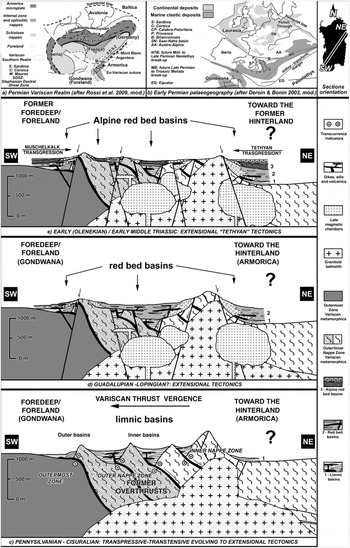
The usually sharp change from dark limnic to red-bed sedimentation is often marked by an unconformity, magmatic activity and a sudden coarsening of the deposits (Fig. 18). This could be related to a final uplift of the Variscan chain that probably developed over the Carboniferous/Permian boundary, and a younging of the landscape. The change in sedimentation was generated by the change from warm-humid, limnic, narrow, intramontane basins to hot-arid, open, wide, red-bed basins, due to the transition from shear-transtensive tectonics to normal extensional tectonics (Muttoni et al. Reference Muttoni, Kent, Garzanti, Brack, Abrahamsen and Gaetani2003; Vai, Reference Vai2003). This climatic and environmental change gave rise to the transition of the enclosed waterbodies from open, humid, permanent lakes to closed(?), ephemeral, arid lakes. The red-bed deposition under a hot-arid climate persisted in Early to early Middle Triassic times (Costamagna, Reference Costamagna2012 and references therein), although it was separated from the Permian succession by a weak unconformity and a hiatus probably including the late Lopingian period and related to the first movements of the Alpine extensional tectonics (Fig. 19).
Schematic comparison of the stratigraphic successions of the investigated areas.

Schematic comparison of the different evolutive stages of the Sardinian Pennsylvanian to early Middle Triassic continental basins and their location in respect to the (a) general geodynamic and (b) palaeogeographic context. Scale and thicknesses only indicative; feeding of the late-extensional volcanic rocks not fully represented in figures. (c) Pennsylvanian (?Westphalian–Stephanian) to Cisuralian (Asselian): limnic basins during transtensive/transpressive regime. Late-tectonic granitoids cut the former tectonic structures. (d) Guadalupian (post-Asselian) to Lopingian(?): red-bed basins. Basins open up, coalesce and their bottoms collapse: orographic barriers no longer exist and local climate changes from humid to dry. The Variscan peneplain develops. Post-tectonic intrusions take place. (e) Early Triassic (Olenekian?) – early Middle Triassic (late Anisian, Pelsonian–Illyrian boundary): Alpine red-bed basins, thin and rapidly submerged by the marine Muschelkalk transgression.

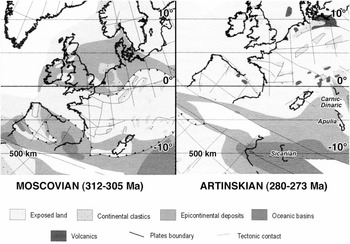
So far as the transition from the limnic basins to the red-bed basins is concerned, the limnic to red-bed sedimentation is interpreted as essentially being due to an aridization trend during the Permo-Carboniferous (Moscovian–Artinskian) related to the 7° northward shift of Sardinia to the tropics (Vai, Reference Vai2003; Vai & Izart, Reference Vai, Izart and Crasquin2000 a,b) (Fig. 20); this led to a general climatic change from a warm-humid climate to a subtropical more seasonally dry climate (Roscher & Schneider, Reference Roscher, Schneider, Lucas, Cassinis and Schneider2006 and references therein). It has been suggested that the uplift of the Variscan mountain range during Asselian time should be the initial cause of this climate shift (Pittau et al. Reference Pittau, Barca, Cocherie, Del Rio, Fanning and Rossi2002, Reference Pittau, Del Rio and Funedda2008). This chain would have formed a barrier to atmospheric circulation, thus inducing climate change and enhancing aridity. However, the Variscan chain perhaps never reached an altitude that could alone have had such an effect on the surrounding areas, with its maximum height being 2000 m (Fluteau et al. Reference Fluteau, Besse, Broutin and Ramstein2001; Roscher & Schneider, Reference Roscher, Schneider, Lucas, Cassinis and Schneider2006; Pangaea B hypothesis) to 3000 m (Roscher & Schneider, Reference Roscher, Schneider, Lucas, Cassinis and Schneider2006; Pangaea A hypothesis). Instead, we suggest that the local basin climate (microclimate) was forced to change during the transition from transtensional to extensional basins. This change was related to the progressive morphotectonic evolution of the Variscan orogen, passing during Stephanian–Asselian times from a rugged landscape with narrow, deep basins due to uplift (abundance of coarse, immature deposits) to a gradually smoothed and lower, gently rolling landscape in post-Asselian time (Pittau et al. Reference Pittau, Del Rio and Funedda2008).
Latitudinal shift of Sardinia during Late Carboniferous (Moscovian, after Vai & Izart, Reference Vai, Izart and Crasquin2000a) and Permian (Artinskian, after Vai & Izart, Reference Vai, Izart and Crasquin2000b) times. From Dercourt et al. (Reference Dercourt, Gaetani, Vrielynck, Barrier, Biju-Duval, Brunet, Cadet, Crasquin and Sandulescu2000).

In addition, Sardinia was placed during Pennsylvanian to Permian times alongside the southern edge of the Variscan chain, close to the border of the approaching Pangaea supercontinent (Fig. 20) (Vai, Reference Vai2003). Owing to its palaeolatitudinal position at about 5° south, Sardinia was still in the reach of the monsoonal winds originating from the Palaeotethys located to the east-southeast. The Sardinian climate could have therefore still been seasonal, with sub-aridity and intense rainfall episodes (mildly monsoonal?). This could explain the scarcity of evaporite deposits and the episodic intense rainfall in the Sardinian Permian red-bed basins.
7. Comparisons with coeval European Carboniferous–Permian carbonates
The remains of several Variscan internal basins linked to the collapse of the Variscan chain, and connected with the main extensional structures that led to the break-up of Pangaea, crop out in Western and Central Europe (Ziegler, Reference Ziegler1990, Reference Ziegler, Von Raumer and Neubauer1993; McCann et al. Reference McCann, Pascal, Timmerman, Krzywiec, Lopez-Gomez, Wetzel, Krawczyk, Rieke, Lamarche, Gee and Stephenson2006; McCann, Reference McCann2008). Their evolution and facies is comparable to the coeval Sardinian basins. The Carboniferous–Permian successions of Provence (SE France), the Northern Massif Central (France) and the Saar–Nahe Basin (Germany) closely resemble those of NW Sardinia (Cassinis et al. Reference Cassinis, Durand and Ronchi2003 b). They are post-Variscan molassic basins and feature a lower limnic succession and an upper red-bed succession with scattered carbonates.
7.a. Provence
Carbonates are missing in the limnic Pennsylvanian–Cisuralian succession and are rare in the upper red-bed Guadalupian to Lopingian(?) successions (Durand, Reference Dieni, Fischer, Massari, Salard-Cheboldaeff and Vozenin-Serra2008 and references therein). During Carboniferous to Permian times, a mainly terrigenous sedimentation associated with coeval tectono-magmatic activity took place in several basins. Some of them (Toulon-Cuers and La Luc basins) can be correlated (Aldinucci et al. Reference Aldinucci, Dallagiovanna, Durand, Gaggero, Martini, Pandeli, Sandrelli and Tongiorgi2006 and references therein; Durand, Reference Durand2008) to the NW Sardinian basins and can be assumed to have been very close palaeogeographically (Cassinis et al. Reference Cassinis, Durand and Ronchi2003 b) (Fig. 20). The local Permian climate was hot and tropical, with alternating wet and dry periods. Laterally to alluvial fans, in shallow to deep lakes related to half-graben structures (Calcaires de Bau Rouge Member of the Les Salettes Formation, Toulon-Cuers Basin), alternations of carbonates with giant stromatolites and sapropelitic shales were deposited. Nonetheless, carbonates are rarer in the Provencal basins than in Sardinia. Locally, lenses and beds may contain microfaunal remains and ostracods. The beds, lenses and nodules of carbonates were deposited in ephemeral lacustrine to palustrine environments flanking each other (Toutin-Mourin, Reference Toutin-Mourin1985, Reference Toutin-Mourin1992). Toutin-Mourin (Reference Toutin-Mourin1992) suggested a correlation between the carbonate precipitation and the CaO content of the basement, whose mobility was triggered by the heating of the coeval volcanic rocks. The scarcity of the carbonates in the lakes could thus be related to a very low CaO content in the basement in Provence. However, the striking stratigraphic differences between the western red-bed Nurra–Provence basin and the Guardia Pisano succession and the eastern Mulargia–Escalaplano Basin must be noted. This could suggest an orographic separation between NW Sardinia and the other sectors of the island, at least during Middle to Late (?) Permian times.
7.b. Massif Central basin of Aumance
The Aumance basin of the Northern Massif Central (France; Courel et al. Reference Courel, Bonnion, Gelard and Paquette1989; Freytet et al. Reference Freytet, Lebreton and Paquette1992) shows a different evolution and different features (such as the distribution of the carbonates) in respect to the Sardinian basins. It is characterized first by Stephanian siliciclastic deposits pertaining to the limnic facies, which rest unconformably on top of the Variscan basement. These deposits are also unconformably covered by an ‘Autunian’ fluvial succession with intercalated palustrine and lacustrine facies (related to ephemeral and permanent lakes) including carbonate deposits possibly related to sheltered areas. The lower part of this succession can be referred to the limnic facies (‘Grey Autunian’), while the upper part can be referred to the red-bed facies (‘Red Autunian’). Both the Grey Autunian and the Red Autunian contain carbonates in the form of sandstone cements, dolomitic rhombs in pelites or isolated carbonate beds. The latter can be bioclastic (ostracods), oolitic, oncolitic or stromatolitic. As partially stated before, while the carbonate beds were deposited in palustrine to lacustrine basins, the carbonate cements and the dolomitic rhombs formed in floodplain pelites.
Pedogenization processes followed by nodulization, related to palustrine conditions, may affect those beds. Dolomitization processes may also follow. According to Freytet et al. (Reference Freytet, Lebreton and Paquette1992), the dominating climate was tropical dry with a marked wet season.
7.c. Saar–Nahe Basin
In Western Germany, the Saar–Nahe Basin is linked to diverse tectonic cycles superposing several basins. These are (1) an intramontane, late Namurian–Westphalian Basin (Ziegler, Reference Ziegler1990, Reference Ziegler, Von Raumer and Neubauer1993; Schäfer, Reference Schäfer2008); (2) a wider Stephanian–Autunian Saar–Nahe Basin (Ziegler, Reference Ziegler1990, Reference Ziegler, Von Raumer and Neubauer1993; Schäfer, Reference Schäfer and Wrede2005, Reference Schäfer2008). Above, on top of a local unconformity (Ziegler, Reference Ziegler1990, Reference Ziegler, Von Raumer and Neubauer1993; Schäfer & Korsch, Reference Schäfer and Korsch1998; Schäfer, Reference Schäfer2008), follows the (3) Saxonian–Thuringian auct. red-bed facies succession. All these basins are separated by unconformities, meaning individual uplifts and rejuvenations of their reliefs.
Although the preserved basin fill of the Saar–Nahe Basin is thicker than that of the Sardinian basins, comparisons between the two areas show remarkable similarities in sedimentary evolution. Both Permian–Carboniferous basins developed mainly along reactivated Variscan thrusts, restarting former transcurrent lines (e.g. Ziegler & Stampli, Reference Ziegler and Stampli2001). The carbonates of the limnic lacustrine deposits of the Saar–Nahe Basin are ‘Autunian’ in age and associated with the terrigenous ‘paper shales’. These form the top of fining-upward depositional cycles formed at their base by conglomeratic sandstones, sandstones and muddy sandstones (Schäfer & Stapf, Reference Schäfer, Stapf, Matter and Tucker1978; Schäfer, Reference Schäfer, Baganz, Bartov, Bohacs and Nummedal2012). The cycles show a gradual transition into mudstones, paper shales, micritic carbonates and coal in the upper portion. Both paper shales and carbonates contain well-preserved flora and fauna (fish, conchostracans, amphibians). Oncolites and stromatolites may form distinct beds within the carbonate rocks. They were deposited in an open, shallow lake under foreshore to shoreface conditions and a humid to subtropical climate. The carbonates of the Saar–Nahe red-bed successions are rare and related to isolated playa basins (Boy et al. Reference Boy, Haneke, Kowalczyk, Lorenz, Schindler, Stollhofen, Thum, Lützner and Kowalczyk2012).
8. Conclusions
The characteristics of the carbonate deposits embedded in the mainly siliciclastic post-Variscan lacustrine basins of Sardinia, together with those of the siliciclastic rocks contained in the basins (Barca & Costamagna, Reference Barca and Costamagna2003, Reference Barca and Costamagna2005, Reference Barca and Costamagna2006 a,b; Costamagna & Barca, Reference Costamagna and Barca2008), suggest an evolution of the lacustrine waterbodies in time and space. In a first step, limnic basins with long and narrow permanent lakes were developed in the middle of a transtensional depositional setting frequently affected by magmatic activity. The environmental conditions of those basins were generally unstable, as suggested by the intercalations of coarse deposits. Nonetheless, later in some of the described basins (e.g. the Perdasdefogu Basin) the significant carbonate deposition, mainly of organic origin, indicates more steady environmental conditions, with the scarcity of terrigenous material possibly due to the peneplaning of the surrounding Variscan reliefs, the distance from siliciclastic sources (tributary fluvial mouths) and a warm-humid climate. Evaporites are common at the end of the lake’s story and possibly related to temporary hypersaline conditions. The microfacies of the carbonates occasionally suggest a well-developed facies belt from coastal palustrine through shoreface to offshore environments. Conversely, the lacustrine waterbodies of the red-bed deposits developed in playa lakes during different times and were small, periodic and short-lived. Carbonates were ephemeral, of a restricted environment and related to extraordinary rainfall events that created shallow and small ponds that eventually dried out. Consequently, these carbonates are mainly of chemical origin along with rare evaporites precipitated under a hot-dry climate. The observed climatic change was probably not only related to the latitudinal plate shift and the uplift of the Variscan chain, but also to changes in the orographic conditions of the chain and, perhaps, to the proximity of the nearby Palaeotethys.
Correlations with the coeval Provencal and Massif Central (France) basins and with the Saar–Nahe (Germany) post-Variscan basins show some differences in size, thickness and origin of the carbonate deposits, probably related to the diverse morphologic and tectonic setting of the lacustrine waterbodies.
Author ORCIDs
Costamagna Luca Giacomo 0000-0002-6246-4877
Acknowledgements
The research was financed by MiUR (L. G. Costamagna, formerly 60% grants). Thanks to A. Schafer (Bonn University), to E. Kustatscher (Museum of Nature Sud Tyrol) and to G. B. Vai (Museo Capellini, Bologna University for the friendly review of an early version of this paper. The suggestions of the Editor Prof. Stephen Hubbard were deeply appreciated. Discussions with F. Jadoul (Milano University) about lacustrine carbonate depositional environment were highly useful.