The standardized infection ratio (SIR),1 or the ratio of observed to expected infections, is a nationally adopted metric used to track and compare catheter-associated urinary tract infection (CAUTI) and central-line–associated bloodstream infection (CLABSI) rates over time and across facilities. Despite its widespread use, the SIR may not be suitable for all settings as it assumes that device utilization is not drastically changing and population is stable over time.Reference Pepe, Maloney and Leung2 Additionally, the SIR may perform differently based on the healthcare-associated infection it is used to track. The standardized utilization ratio (SUR)3 is a process metric used to compare catheter utilization at the national, state, or facility level to support efforts to reduce device utilization. Both CLABSIs and CAUTIs are included in the hospital-acquired condition (HAC) reduction penalty program and account for 34% of the HAC score.4 Our objective was to look at the correlation between SIR and SUR for CAUTIs and CLABSIs across community hospitals in a regional network.
Methods
This observational study included surveillance data prospectively collected by infection preventionists from 43 hospitals in the Duke Infection Control Outreach Network (DICON) from January 1, 2018, to December 31, 2018. Data from 2019 and 2020 were excluded due to partial reporting to National Healthcare Safety Network (NHSN) during this time, and challenges with obtaining accurate SURs for all hospitals for this period. Hospitals were stratified into large (>70,000 patient days), medium (30,000–70,000 patient days), and small hospitals (<30,000 patient days) based on DICON’s benchmarking for community hospitals. SIR and SUR for CAUTIs and CLABSIs were compared using a scatter plot, and the R 2 value was calculated using Microsoft Excel version 16.46 software (Microsoft, Redmond, WA).
Results
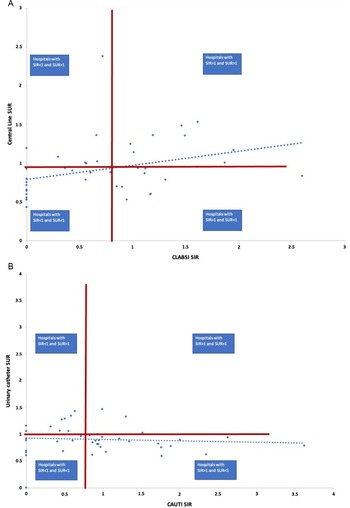
The 43 hospitals reviewed included 24 small, 11 medium, and 8 large hospitals. Among them, 15 hospitals reported an SUR > 1 for central-line use, and half of these had an SIR >1 for CLABSIs. Also, 13 hospitals reported an SUR >1 for urinary catheter use, but 10 of these (77%) had an SIR <1 for CAUTIs. Scatter plots for comparison of SIR and SUR for CLABSIs and CAUTIs across the network are shown in Fig. 1A and B. We detected a weak positive correlation between SIR and SUR for CLABSIs (0.33, R 2 = 0.11) but no correlation between SIR and SUR for CAUTIs (−0.07; R 2 = 0.00). Smaller hospitals showed a better correlation for CLABSI SIR and SUR (0.37) compared to medium and large hospitals (0.19 and 0.22, respectively). Conversely, smaller hospitals showed no correlation between CAUTI SIR and SUR, while medium and larger hospitals showed a negative correlation (−0.31 and −0.39, respectively).
A. Correlation of CLABSI SIR and central-line SUR in 43 DICON hospitals. B. Correlation of CAUTI SIR and urinary catheter SUR in 43 DICON hospitals.

In conclusion, our data reveal a positive correlation between SIR and SUR for CLABSIs, suggesting that decreasing line utilization correlates with decreasing CLABSI SIR. However, there was no correlation between SIR and SUR for CAUTIs in smaller hospitals, and a negative correlation between SIR and SUR for medium and large hospitals. These findings suggest that, at best, efforts to decrease urinary catheter use may not be reflected as improvements in CAUTI SIR. At worst, efforts to decrease urinary catheter use may paradoxically increase CAUTI SIR. Thus, the CAUTI SIR is a poor metric of the overall quality of urinary catheter-related care, since reducing unnecessary catheter days is important for preventing many types of catheter harm (eg, infection, falls, delirium).
Previous studies comparing metrics used to track and measure CAUTI have also highlighted the limitations of SIR for accurately reflecting patient care quality. Pepe et al Reference Pepe, Maloney and Leung2 found that SIR was useful in hospitals with many CAUTI events or larger hospitals but has limited utility in small hospitals for which SIRs cannot be calculated. Others have raised concerns that reducing catheter days can paradoxically increase the SIR, similar to the correlation we observed, since the current SIR model uses catheter days to determine the expected number of infections. Reference Advani and Fakih5–Reference Fakih, Huang and Bufalino7 Specifically, the SIR does not adjust for local interventions focusing on removing low risk catheters, which will eventually select for a population of high-risk catheterized patients in the denominator. 1
The paradoxical relationship between CAUTI SIR and SUR, along with challenges with the CAUTI definition itself, incentivizes hospitals to focus more of their prevention efforts on urine culture stewardship rather than catheter avoidance and care. The NHSN CAUTI definition relies on the presence of fever and positive urine culture, but it does not allow for attribution of fever to a secondary source.8 For example, if an inpatient with an indwelling urinary catheter (>2 days) and fever secondary to Staphylococcus aureus endocarditis has a positive urine culture for Staphylococcus aureus, this will be reported as an NHSN CAUTI event, even though the fever and bacteriuria are secondary to bacteremia. This assignment is different from the NHSN CLABSI definition, which does allow attribution to secondary source.8 If the same patient with a positive blood culture for Staphylococcus aureus had a central line but had convincing radiographic evidence of endocarditis within the infection window, the case would not be reported as an NHSN CLABSI event. Because fever is such a nonspecific and common symptom, NHSN CAUTI events are very susceptible to changes in testing or ordering practices. Hence, focus on testing practices may eclipse process improvement initiatives, centered on proper device need and care.Reference Mullin, Kovacs and Fatica9,Reference Fakih and Advani10 Culturing stewardship has direct benefit in reducing associated antimicrobial use and patient harms; however, we need to balance this intervention with focus on device use and care.
Our study has several limitations. These data are primarily from community hospitals in southeastern United States; hence, these findings may not be applicable in all settings. However, challenges with CAUTI SIR have been reported by other health systems.Reference Pepe, Maloney and Leung2 Additionally, we did not compare CLABSI or CAUTI SIRs over time because historical comparisons of CAUTI rates can be misleading because of the definition changes over time. We were unable to include data from 2019 and 2020, but we found a similar paradoxical relationship between CAUTI SIR and SUR for DICON hospitals in 2017 (data not shown). Definitional changes for NHSN CAUTI in 2015 led to nationwide reductions in CAUTI SIR and artificial inflation of hospital performance scores unrelated to changes in patient safety.Reference Advani, Lee, Schmitz and Camins11 The reason behind this artificial reduction was that NHSN began reporting “2015 re-baseline” SIRs in 2017; however, CMS programs adopted the 2015 re-baseline in their hospital performance score calculations in 2019.Reference Hsu, Wang and Jentzsch12
Going forward, we need to shift the focus from measuring “CAUTI events” to all types of catheter-related harm and refine our performance metrics so that our measurements reflect our efforts to improve patient outcomes.Reference Pepe, Maloney and Leung2,Reference Fakih and Advani10 We suggest further review of the CAUTI metric and removing or changing the weight of this metric in the HAC score. Focusing on metrics like device utilization, which reflect both process and outcome measurements, may incentivize more inclusive quality improvement efforts.Reference Advani and Fakih5,Reference Abrantes-Figueiredo, Ross and Banach13
Acknowledgments
We thank our DICON infection preventionists for collecting the data.
Financial support
No financial support was provided relevant to this article.
Conflicts of interest
S.A. reports grants from the Centers for Disease Control and Prevention, National Institutes of Health (NIDDK grant no, K12DK100024), Society for Healthcare Epidemiologists of America, and consulting fees from IPEC Experts (owner), unrelated to this manuscript