INTRODUCTION
Recently, the genetic evidence for an independent Baltic population of harbour porpoise (Phocoena phocoena (Linnaeus, 1758)) has been reviewed by Palmé et al. (Reference Palmé, Laikre, Utter and Ryman2008) who state that the differences found so far may be too small to support the hypothesis of a separate population within the Baltic Sea. However, Wiemann et al. (Reference Wiemann, Andersen, Berggren, Siebert, Benke, Teilmann, Lockyer, Pawliczka, Skora, Roos, Lyrholm, Paulus, Ketmaier and Tiedemann2010) found some molecular (both mitochondrial and microsatellite DNA) differentiation between the Belt Sea and the inner Baltic. Both molecular and morphological studies have detected differences between the Belt Sea/western Baltic Sea on one side and the North Sea on the other (Kinze, Reference Kinze1985; Andersen, Reference Andersen1993; Andersen et al., Reference Andersen, Holm, Siegismund, Clausen, Kinze and Loeschcke1997, Reference Andersen, Ruzzante, Walton, Berggren, Bjørge and Lockyer2001). Huggenberger et al. (Reference Huggenberger, Benke and Kinze2002) found significant differences between samples from the inner Baltic (east of the Darss and Limhamn underwater ridges) and the Belt Sea as well as the German Bight in the North Sea using traditional morphometrics (i.e. cranial length measurements), while Börjesson & Berggren (Reference Börjesson and Berggren1997) found morphological differences between a Swedish Baltic sample and a sample from Swedish Kattegat/Skagerrak. Despite the criticisms of Palmé et al. (Reference Palmé, Laikre, Utter and Ryman2008), it is usually assumed that a single independent population is present in the inner Baltic and hence that animals there originate from the same founding stock.
In recent years, geometric morphometrics have largely replaced traditional morphometrics based on length measurements (Adams et al., 2004). Geometric morphometrics is characterized by the capture of 2- or 3-dimensional coordinates from previously defined morphological landmarks from biological specimens to get an approximation of shape (Marcus et al., 2000). Landmark-based geometric morphometrics are superior to traditional morphometrics through more powerful statistical analyses and the facility of graphical representation of morphological change, in that original shapes are preserved throughout the analysis (Adams et al., 2004).
In this paper, we evaluate hypotheses regarding the population structure of the harbour porpoise in the Baltic region (Danish North Sea, Kattegat, Belt Sea and the inner Baltic Sea) using geometric morphometrics. We aim at providing the best possible evaluation of the population structure in the area based on morphology, with the use of large sample sizes.
MATERIALS AND METHODS
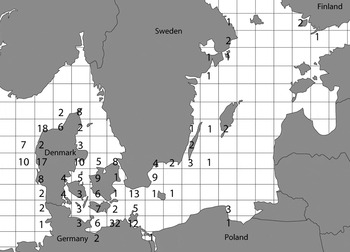
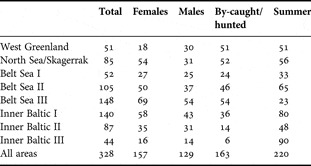
Observations were made on skulls from the collections of the Natural History Museum in Copenhagen (N = 152), the Natural History Museum in Stockholm (N = 38), the Museum of Evolution in Uppsala (N = 3), the Natural History Museum in Helsinki (N = 3), Hel Marine Station in Poland (N = 7) and the German Oceanographic Museum in Stralsund, Germany (N = 74). Sexual maturity was known for 158 of the specimens from the Baltic at large (Danish North Sea, Skagerrak, Belt Sea and the Baltic Sea). In addition, specimens without known maturity status were included if they were within the size ranges of the mature specimens, leading to a total of 277 specimens from the Baltic region. Figure 1 shows geographical distribution of the samples and Table 1 shows sample sizes divided among the geographical delimitations (see below). The samples from the North Sea, Skagerrak and Belt Sea were collected from 1980 to the present. In order to get as large a sample as possible, the inner Baltic samples included specimens from as long ago as the 1870s. A total of 14 animals from before 1980 are included in the inner Baltic sample. In the analyses, it is assumed that these older specimens represent the same population unit as the current Baltic porpoises and that temporal shape development in this population is negligible relative to inter-population differences.
Map of the Baltic region. Grids defined by the International Council for Exploration of the Sea. The numbers of specimens from each grid square are given. Two specimens without exact location, but known to be in the inner Baltic by any of the three tested definitions were also included in the analyses.

Sample sizes listed by area (see definition in text and Figure 2), sex, by-caught (Europe)/hunted (Greenland) status and summer collection (April–October). As there were specimens of unknown sex, male and female numbers do not always add up to the total number.

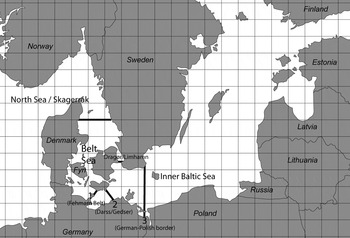
Based on Andersen et al. (Reference Andersen, Ruzzante, Walton, Berggren, Bjørge and Lockyer2001), Wiemann et al. (Reference Wiemann, Andersen, Berggren, Siebert, Benke, Teilmann, Lockyer, Pawliczka, Skora, Roos, Lyrholm, Paulus, Ketmaier and Tiedemann2010) and satellite trackings of porpoise movements in Danish waters (Sveegaard et al., Reference Sveegaard, Teilmann, Tougaard, Dietz, Mouritsen, Desportes and Siebert2011), North Sea, Skagerrak and northern Kattegat porpoises were pooled in one sample, henceforth termed North Sea/Skagerrak. There is more uncertainty regarding partitioning between the Belt Sea and the inner Baltic. Beside the traditionally used population delimitation (reviewed by Koschinski, Reference Koschinski2002) at the Darss/Gedser and Limhamn/Dragør ridges, Wiemann et al. (Reference Wiemann, Andersen, Berggren, Siebert, Benke, Teilmann, Lockyer, Pawliczka, Skora, Roos, Lyrholm, Paulus, Ketmaier and Tiedemann2010) found some indications of a split of haplotypes south of Fyn. To test whether our data fitted a more easterly or westerly delimitation than the Darss/Gedser ridge better, we tested three alternative delimitations: (1) at the Fehmarn Belt and the Limhamn underwater ridge; (2) at the Darss and Limhamn underwater ridges; and (3) at the German–Polish border and straight north to the south-eastern corner of Sweden. See Figure 2 for geographical partitioning of the samples and Table 1 for sample sizes from all areas and delimitations. To assess the differences obtained within the Baltic region relative to differences caused by long-term reproductive isolation, a sample of 51 specimens from West Greenland (from the collections of the Natural History Museum, Copenhagen) were included.
Map of the Baltic region. Grids defined by the International Council for Exploration of the Sea. Partitioning of samples is marked with bold black lines, the three alternative tested delimitations between the Belt Sea and the inner Baltic are numbered from east to west.

Shape analysis
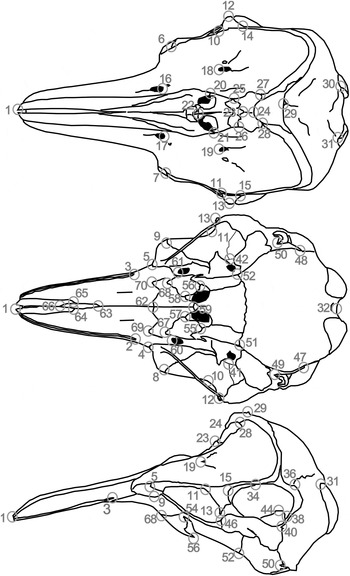
Seventy cranial landmarks that could be unequivocally located and were presumed to be homologous among all skulls were defined. The landmark positions are depicted in Figure 3, and described in Appendix. Three-dimensional (3-D) coordinates of the landmarks were registered with a Microscribe® 3D digitizer.
The 3-D cranial landmarks used for shape analysis defined for dorsal ventral and lateral views of the skull. See Appendix for description of landmarks.

The raw landmark coordinates were run through the generalized least-squares Procrustes superimposition (Rohlf & Slice, Reference Rohlf and Slice1990) using the MorphoJ-program (Klingenberg, Reference Klingenberg2011). The Procrustes procedure used here was amended by the suggestions of Klingenberg et al. (Reference Klingenberg, Barluenga and Meyer2002) in order to deal with the redundancy of data points caused by the object symmetry of the vertebrate skull.
To exclude size-related variation, all further analysis was performed on the residuals of a multivariate regression of shape (Procrustes coordinates) on the centroid size (CS, the square root of the summed squared distances of each landmark to the averaged coordinates of the configuration). Since the amounts of explained variance of regressions using CS and log (CS) as dependent variables were almost identical, it was assumed that allometric shape development was linear. Thus, CS without log-transformation was used for the regression.
In order to reduce the number of variables relative to the number of observations, multivariate comparisons were performed on the first 15 components of a principal components analysis (PCA). These 15 PCs accounted for 60% of the total variance in the dataset, all subsequent PCs accounted for less than 2% each.
Sexual dimorphism was investigated for each geographical sample by testing the significance of the Mahalanobis distance between the sexes with a permutation test with 10,000 iterations. This revealed no significant differences for any of the areas (α = 0.05), and the sexes were therefore pooled within each area for further analysis. To test if porpoises migrated between areas from spring/summer (the breeding season) to autumn/winter specimens collected from April–September were tested against specimens from October–March in each sample in the same manner as the test for sexual dimorphism. Furthermore, the geographical comparisons were also performed using only females or spring/summer samples (April–October) or by-caught animals. Female-only samples exclude males, which may disperse more; spring/summer samples cover the breeding season and exclude the winter season, when migrations have been proposed to occur (Møhl-Hansen, Reference Møhl-Hansen1954; Gaskin, Reference Gaskin1984), while by-caught samples exclude strandings which may have drifted from another area. Table 1 lists the number of specimens in the sample by the employed area definitions, sex, by-catch status and season.
Differences among the North Sea/Skagerrak, inner Danish waters, inner Baltic and West Greenland were analysed with a permutation test of the significance of Mahalanobis distances (10,000 iterations) and discriminant function analysis using jackknife cross-validation (Lachenbruch, Reference Lachenbruch1967) for reclassification of specimens.
The hypothesis that shape differences across the three entities represent a continuum from the North Sea to the inner Baltic was tested by comparing the directionality of the vector describing shape differences between the North Sea/Skagerrak and Belt Sea to the vector between the Belt Sea and the inner Baltic using the program Veccompare of the IMP Package (Sheets, Reference Sheets2001). If the shape differences represent a continuum, the angle between these two vectors should not be significantly different from 0°. Veccompare compares between-group vector directionality with the 95% confidence interval (CI) of within-group ranges assessed by a bootstrap procedure with 4900 resamples. If the observed between-group angle is larger than the CI-ranges of the two within-group angles, the directions of the two compared vectors are significantly different at α = 0.05.
RESULTS
Morphometric distances
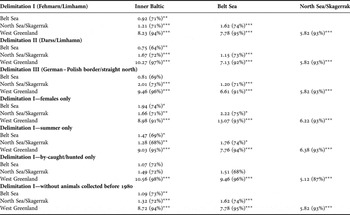
We obtained similar results from each of the three delimitations (Fehmarn Belt/Limhamn ridge, Darss/Limhamn ridges, and the line from the German/Polish border and north to Sweden) between the Belt Sea and the inner Baltic. Greater morphological distance and more successful reclassification of individuals were obtained with the most westerly border at Fehmarn Belt and these results are presented below.
Distances and significance of distances are listed in Table 2. Highly significant differences (P < 0.01) were detected among all the geographical entities, whichever of the geographical delimitations was used, except for between Belt Sea and Baltic porpoises using the easterly delimitation, where there was no significant difference, probably because of the low number of Baltic porpoises with this delimitation. The greatest distances were detected between the West Greenland population and the samples from the Baltic region. Within the Baltic region, the Mahalanobis distance between the Belt Sea and the inner Baltic was somewhat smaller than the distance between the Belt Sea and the North Sea/Skagerrak.
Mahalanobis distances among the samples and percentages of specimens successfully allocated to their original sample in the respective comparisons. Significance of Mahalanobis distance between samples: *, P < 0.05; **, P < 0.01;***, P < 0.001.

We found no significant (α = 0.05) differences between males and females or sampling seasons within any of the samples. Carrying out discriminant analyses with only females enhanced discrimination slightly, while using only summer samples or by-caught animals did not enhance discrimination of geographical areas over analyses using pooled samples.
Description of differences
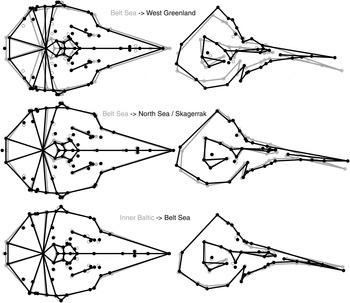
Shape differences between the geographical samples are shown in Figure 4. The differences between the Greenlandic porpoises and the three respective samples from the North Sea/Skagerrak, Belt Sea and inner Baltic were very similar, due to the relative similarity of the latter three samples. Greenlandic porpoises have shorter rostrocaudal lengths, but taller and wider braincases. The post- and antorbital processes are displaced caudally, indicating a more posterior position of the eyes. The nasals and nasal apertures are displaced towards the rostrum, indicating a more anterior position of the blowhole. The rostrum has less ventral inclination.
Shape changes associated with discriminant vectors between the samples (dorsal aspect to the left and lateral aspect to the right). Grey outline and markers represent the shape of the sample mentioned first, black outline and markers, the shape of the sample mentioned last. Shape differences between the samples are exaggerated by a factor 6.

In the Baltic region, the shape differences are subtle. Relative to the North Sea/Skagerrak porpoises, the Belt Sea skulls have a shorter and wider braincase, a more ventrally inclined rostrum and foramen magnum, a longer zygomatic process, larger nasal bones and shorter tooth rows. The inner Baltic porpoises are similar to the Belt Sea porpoises in terms of orientation of the foramen magnum and rostrum, while they have a narrower braincase, with a broader rostrum, shorter and less robust zygomatic processes and smaller nasal bones.
COMPARISON OF SHAPE VECTORS IN THE BALTIC REGION
The vectors describing the shape difference going from the North Sea/Skagerrak to the Belt Sea and the difference going from the Belt Sea to the inner Baltic had an angle of 116.0°, while the 95% CIs of the two vectors were ±59.6° and ±69.3°, respectively. Thus, the vectors are significantly different at α = 0.05.
DISCUSSION
The current study revealed highly significant morphological differences in harbour porpoises from the North Sea, Skagerrak, Kattegat, Belt Sea, western Baltic and inner Baltic (Table 2). The detected differences were much smaller than when comparing any of the areas to porpoises from West Greenland, from where gene flow should be negligible (Rosel et al., Reference Rosel, Tiedemann and Walton1999). The Baltic Sea has a short history as a habitat suitable for porpoises. A recent investigation indicates immigration and establishment of harbour porpoises in the Baltic Sea around 9000 years ago, after the last Ice Age (Sommer et al., Reference Sommer, Pasold and Schmolcke2008). This is a short time for evolution of differences, and the relatively short distances and lack of obvious barriers to gene flow in the Baltic probably ensure that genetic and morphological differences will always be moderate. During these 9000 years there have been several winters with almost complete ice coverage in the Baltic, which would have forced porpoises from this area into the Belt Sea (Teilmann & Lowry, Reference Teilmann and Lowry1996; Koslowski & Schmelzer, Reference Koslowski and Schmelzer2007). It had been assumed that the Baltic porpoises made annual migrations out of the Baltic Sea through the Belt Sea during the winter (Møhl-Hansen, Reference Møhl-Hansen1954; Gaskin, Reference Gaskin1984). Andersen & Clausen (Reference Andersen and Clausen1983) noted that these migrations did not occur on a large scale anymore and recently, the assumption of massive seasonal migration has been challenged by new data extracted from historical sources (Kinze, Reference Kinze2008). Investigations of population structure in the area have not indicated migrations based on seasonal separation of samples (Huggenberger et al., Reference Huggenberger, Benke and Kinze2002; Wiemann et al., Reference Wiemann, Andersen, Berggren, Siebert, Benke, Teilmann, Lockyer, Pawliczka, Skora, Roos, Lyrholm, Paulus, Ketmaier and Tiedemann2010). The bulk of the material for the current study was collected over the past 30 years, and we did not detect a signal of seasonal variation. Some of the Finnish and most easterly Swedish specimens in our sample were collected in the winter before 1950, so even if these migrations have taken place, they were probably not a ubiquitous phenomenon.
Kinze (Reference Kinze1985) initially found no differences between harbour porpoises from the Kattegat and Skagerrak, but later (Kinze, 1990) he established significant differences between his Kattegat/Belt Sea sample and a Swedish Skagerrak sample. Börjesson & Berggren (Reference Börjesson and Berggren1997) found that inner Baltic porpoises had wider anterior skulls and longer tooth rows than Kattegat/Skagerrak porpoises. This does not correspond with the differences we obtained between the Belt Sea and inner Baltic but fits better with the difference we recorded between the Baltic inner and North Sea/Skagerrak, so it is probable that the Kattegat/Skagerrak sample from Börjesson & Berggren (Reference Börjesson and Berggren1997) predominantly represented animals drawn from the same population as our North Sea/Skagerrak sample. Most of the significantly different length measurements of Huggenberger et al. (Reference Huggenberger, Benke and Kinze2002) are difficult to relate directly to our shape data, but the longer tooth row found in their North Sea and narrower rostrum base of their ‘transition’ sample (roughly the same area as that of our ‘Belt Sea’ sample) is also found in our North Sea and Belt Sea samples, respectively.
Given the limited shape differences among the samples in the Baltic region, and some degree of overlap in porpoise movements (Sveegaard et al., Reference Sveegaard, Teilmann, Tougaard, Dietz, Mouritsen, Desportes and Siebert2011), the morphometric approach is not very useful for establishing clear boundaries among different population units. The best resolution out of three investigated hypotheses for delimitation between the Belt Sea and the inner Baltic was obtained at the narrow point in Fehmarn Belt. Even if we cannot clearly define where the population split is, our results do indicate that there is a morphological segregation within the Belt Sea/inner Baltic area which is independent from the split between the North Sea/Skagerrak and the Belt Sea and thus not based on isolation by distance from the North Sea population. If morphological differences within the Baltic were the result of isolation by distance, a reasonable assumption would be that the morphological variation that was related to geography would show a continuous change in the same direction from one end of the area to the other. The vectors describing the shape difference going from the North Sea/Skagerrak to the Belt Sea and the difference going from the Belt Sea to the inner Baltic had an angle of 116°, which means that going from the Belt Sea into the Baltic, the shape vector describes a change going somewhat back towards the North Sea shape. This could indicate morphological adaptation that is peculiar to the Belt Sea porpoises relative to the other samples. The Belt Sea and southern Kattegat do possess some unique oceanographic and topographic conditions relative to the neighbouring areas. The area serves as the only drain from the Baltic Sea, which is the largest estuary in the world. It consists of mainly shallow water with deeper channels carrying saline water from the North Sea into the Baltic Sea, while the low saline water flows out of the Baltic at the surface. This creates strong halo- and thermoclines as well as strong wind and density driven currents. We propose that the unique and ever changing environment is the basis for the special adaptations forming the population separations. One striking feature of the Belt Sea porpoises relative to the neighbouring samples is a more ventrally inclined rostrum. The more coastal porpoise species (harbour porpoise, finless porpoise (Neophocaena phocaenoides Cuvier 1829), vaquita (Phocoena sinus Norris & McFarland, 1958) and Burmeister's porpoise (Phocoena spinipinnis Burmeister, 1865)) also have more ventrally inclined rostra relative to the pelagic porpoise species (Dall's porpoise (Phocoenoides dalli True, 1885) and spectacled porpoise (Phocoena dioptrica Lahille, 1912)) where the ventrally inclined rostra were interpreted as an adaptation to more feeding on demersal and benthic prey items (Galatius et al., Reference Galatius, Berta, Frandsen and Goodall2011). The Belt Sea porpoises may have adapted similarly, although on a much smaller scale. Porpoises along the Norwegian coast eat more pelagic prey than porpoises from the Danish North Sea and Belt Sea (Aarefjord et al., Reference Aarefjord, Kinze and Lindstedt1995), porpoises from Skagerrak and Kattegat have been observed to eat mainly herring (Börjesson et al., Reference Börjesson, Berggren and Ganning2003), while porpoises from the Belt Sea consume mainly cod (Sveegaard, Reference Sveegaard2011). Comparable data from the inner Baltic are not available. The Belt Sea including southern Kattegat and maybe part of the German Baltic seems a small area for a population of highly mobile animals without obvious restrictions to movement, but adaptation to a unique local environment may explain this.
Satellite telemetry studies show that porpoises regularly cross the borders we evaluated in this study (Teilmann et al., Reference Teilmann, Sveegaard, Dietz, Petersen, Berggren and Desportes2008). Almost 100 harbour porpoises have been satellite tracked in the Baltic region (Teilmann et al., Reference Teilmann, Sveegaard, Dietz, Petersen, Berggren and Desportes2008; Sveegaard et al., Reference Sveegaard, Teilmann, Tougaard, Dietz, Mouritsen, Desportes and Siebert2011; NERI, unpublished data). These data show that individual harbour porpoises may swim several hundred kilometres within a few weeks or stay within smaller areas for the operational period of the tag (up to 1.5 years). Although some animals from the Kattegat/Belt Sea move into the North Sea/Skagerrak and inner Baltic, they tend to stay within the region in which they were tagged or return to this area after a period. Thus, movements and home ranges of satellite tagged porpoises suggest population segregations in the northern Kattegat and around the Darss/Gedser underwater ridge (Teilmann et al., Reference Teilmann, Sveegaard, Dietz, Petersen, Berggren and Desportes2008; Sveegaard et al., Reference Sveegaard, Teilmann, Tougaard, Dietz, Mouritsen, Desportes and Siebert2011). These extensive movements, combined with the inclusion of specimens collected outside the breeding season and stranded specimens which may have drifted after dying, mean that our samples may contain specimens that would not reproduce in the area where they were collected. This implies that the morphometric distances between neighbouring populations are probably underestimated and that the actual divergence of Belt Sea porpoises may thus be greater than our estimates.
The current study gives further indication of reproductive isolation of harbour porpoises in the inner Baltic. This putative population is in acute danger of extinction (Skòra et al., Reference Skòra, Pawliczka and Klinowska1988; Berggren & Arrhenius, Reference Berggren and Arrhenius1995; ASCOBANS, 2003; Gillespie et al., Reference Gillespie, Berggren, Brown, Kuklik, Lacey, Lewis, Matthews, McLanaghan, Moscrop and Tregenza2005).
ACKNOWLEDGEMENTS
Mogens Andersen of the Danish Museum of Natural History, Klaus Harder of the German Oceanographic Museum, Ulf Johansson and Peter Mortensen of the Stockholm Natural History Museum, Mats Eriksson of the Museum of Evolution in Uppsala, Iwona Pawliczka of Hel Marine Station and Martti Hildén of the Natural History Museum in Helsinki provided valuable assistance and made specimens available at their respective institutions. This work was supported by ASCOBANS (Agreement on Small Cetaceans of the Baltic and North Seas) (grant number: SSFA/ASCOBANS/2009/02).
Supplementary materials and methods
The supplementary material refered to in this paper can be found online at journals.cambridge.org/mbi.