





Introduction
Architectural education prepares students to become designers of the built environment, including buildings, public spaces, neighbourhoods and the broader urban fabric in which everyday life unfolds. The built environment is one of the most significant interfaces between human communities and the wider ecological world. For this reason, the pedagogical question of how future architects learn to perceive, interpret and respond to place is inseparable from broader concerns in environmental education.
This study contributes to environmental education scholarship through a place-based inquiry into how architecture students developed environmental awareness through sustained engagement with the historic urban fabric of Mardin in southeastern Türkiye. Mardin is a historic city in southeastern Türkiye, situated on a limestone ridge overlooking the Mesopotamian Plain near the Syrian border. Place-based education is a pedagogical approach that grounds learning in the social, cultural and ecological specificities of a particular locality, treating the place itself as a primary educational resource.
The city is bordered by Diyarbakır and Batman to the north, Şanlıurfa to the west, Siirt and Şırnak to the east and Syria to the south and occupies a critical position in terms of regional transport networks as well as cultural and economic relations. Owing to its geographical location, the city has historically served as a strategic junction. Situated at the intersection of international trade routes such as the Silk Road and the Spice Route, it became a significant centre of regional and cultural interaction. Mardin is located at a vantage point overlooking the Mesopotamian Plain and is characterised by a topography shaped by surrounding elevations and valleys. This natural setting gives the city a distinctive character. Mardin stone, quarried locally and valued for its durability and workability, has long been used as a primary building material and constitutes one of the key elements shaping the city’s urban fabric. In addition, the region’s sloping terrain has influenced the street pattern and settlement layout of Mardin.
Beyond its cultural and historical significance, Mardin is situated within an ecologically vulnerable landscape. The region is semi-arid, characterised by hot summers, cold winters and limited and seasonally concentrated rainfall. Within this setting, Mardin’s vernacular architecture is itself an ecological response: thick limestone walls act as thermal mass that moderates extreme summer heat and winter cold; inward-facing courtyards, narrow streets and stepped and fragmented masses reduce solar exposure. The terraced settlement follows the slope rather than levelling it, reducing excavation and preserving the topography. These features were not styled but evolved as long-term negotiations between dense human habitation and a delicate ecosystem operating at the edge of habitability.
Drawing on this framing, the research seeks to explore the essence of the experiences of former students (who participated in the studies between 2005 and 2010) in a faculty of architecture, focusing on being in and understanding a complex physical environment, specifically how the multi-layered fabric of Mardin functioned as a primary pedagogical agent. The research aims to re-evaluate the pedagogical processes and outcomes of the Istanbul Technical University (ITU) Mardint design studies by shifting the focus towards the sustainability of cultural heritage and environmental education. The ITU Mardint design studies have been examined from various perspectives in prior work (Toy & Demir, Reference Toy and Demir2026; Toy, Reference Toy2026).
In addition to examining experience through the lens of social interaction, this inquiry explores learning as an epistemological and ontological bond formed between the individual and the environment. In this context, learning is framed through the theory of transformative learning, moving beyond the mere acquisition of knowledge, what was learnt, to a deeper investigation of how students were transformed. In this study, such transformation was not merely an academic outcome but a shift in students’ perspectives.
Since the time of their mediaeval predecessors, universities have existed as institutions with social missions (Biggar, Reference Biggar2010; Farnell, Reference Farnell2020). Early universities, such as Bologna and Paris, which emerged in Western Europe during the eleventh and twelfth centuries, were institutions established to respond to the social needs of their time. The University of Bologna, which employed the concept of universitas, aimed to train specialists in disciplines such as medicine and law, while the University of Paris focused on theology and philosophy. Moreover, these institutions functioned as bodies that reinforced the ideological foundations of the social order through the production of knowledge.
In the subsequent period, in the fifteenth century, the Catholic University of Leuven turned towards educating administrators to manage cities and support trade that developed alongside urbanisation; in the seventeenth century, Lund University aimed to consolidate the idea of the nation–state through knowledge. In the nineteenth century, the Humboldt University focused on educating technical and administrative elites. During the same period, Land-Grant Universities established in the United States aimed to contribute directly to economic development by supporting the production of knowledge that could be transformed into economic benefits through practical applications. In the twentieth century, the training of leaders and distinguished individuals from various disadvantaged communities was pursued to support the process of democratisation (Benneworth, Reference Benneworth and Temple2014; Farnell, Reference Farnell2020; Pinheiro et al., Reference Pinheiro, Benneworth, Jones, Farinha, Ferreira, Smith and Bagchi-Sen2015).
As evidenced by the historical trajectory, the social role of universities – shaped primarily by their contribution to society through the production of knowledge – has historically evolved to encompass a wide range of functions, from economic development to democratisation and from urbanisation to social inclusion.
Experiential learning refers to a pedagogical model in which knowledge is constructed through the transformation of direct experience, rather than transmitted as predefined information. This approach is also grounded in a dual theory of knowledge. Kolb (Reference Kolb2015) explains this approach through dual dialectic in which learning occurs via both concrete experience (an empiricist perspective) and abstract conceptualisation (a rationalist perspective), defining learning as a continuous and cyclical process. Thus, knowledge gains meaning by being integrated through both direct experience and cognitive processes.
Building on this dialectic, the concept of reflection serves as a vital bridge that transforms raw experience into meaningful learning. Within the framework of environmental education, reflection is not merely retrospective thought but a critical pedagogical tool that fosters environmental awareness. Tooth and Renshaw (Reference Tooth and Renshaw2009) note that when learning is applied beyond the classroom, in outdoor settings, and involves first-hand experiences and authentic investigations, it enhances the socio-ecological dimension through full mind/body engagement and reflective response within natural environments. Through reflective practice, learners navigate environmental complexities, facilitating a shift from mere observation to engaged action. Building on reflective practices, strategies involve rethinking knowledge, facing change and using familiar experiences to engage with the unknown, thereby offering educators new pedagogical insights (St. Pierre & Blenkinsop, Reference St. Pierre and Blenkinsop2025).
Thus, it is crucial that students are encouraged to experience “dialogue,” as it involves a range of challenges of varying natures (Guilherme & de Freitas, Reference Guilherme and de Freitas2017). Therefore, dialogue, together with social ecology and environmental meaning-making, is an important part of this learning process.
One of the most emphasised aspects of experience today is that it occurs within concrete, non-hypothetical conditions. In this context, the relationship that experience-centred pedagogical approaches establish with reality occupies an important place. Experience is frequently associated with “real-life problems/situations” or “real-world problems/situations” (Dewey, Reference Dewey1938, Reference Dewey2001; Kolb, Reference Kolb2015; Schön, Reference Schön2016). In the specific context of architectural education, it is frequently asserted that the learning process should be realised through experience and social environments (Rege, Reference Rege2021; Rodriguez, Reference Rodriguez2018; Tam, Reference Tam2022; Thompson, Reference Thompson2016). The material, climatic and social conditions of place enter into dialogue with the student and contribute to producing the very perceptions, sensibilities and design judgements that students later describe as their own.
Despite the growing body of literature on experiential learning, environmental education and architectural pedagogy, a notable gap remains in studies examining how complex, multi-layered historic environments function as active pedagogical agents within design education. Existing research most often focuses on studio-based learning processes as cognitive outcomes, rather than on environmental awareness and the transformative relationship formed between students and place through lived, reflective experience. This study addresses this gap by investigating architectural learning as a transformative process embedded in social interactions and environmental engagement.
In the context of the ITU Mardint studies, reflection functions as the mechanism through which the physical and cultural environment is internalised, turning design exercises into transformative epistemological journeys.
Architectural pedagogy embedded in such a place inevitably brings students into contact with questions of heat, soil, vegetation, energy and how buildings interact with the ecosystem. The city’s historic architectural fabric, together with its multicultural and multilingual structure, provides a dialogical setting conducive to the reflective and experiential learning processes outlined in this study. By examining the role of space as a pedagogical agent, this study focuses on students’ reflections on the environmental dimension of learning.
A part of the studies was conducted in Mardin, where processes such as the conservation of the historic fabric, adaptive reuse strategies (i.e., transforming the use of existing historic buildings into new functions while preserving their physical integrity) and the development of new design proposals compatible with the historical context were adopted. This experience, which contributes to environmental awareness and community engagement, was reflected in the students’ comments. The study focuses on understanding how learners interpret meaning and reflect on their learning experiences within the framework of the Istanbul Technical University Mardin design studies (or ITU Mardint). It is an application and research centre that began its activities in 2005, and the participants of this research consisted of students who took part in these studies.
Literature review
The design studio is the core pedagogical setting of architectural education, in which students work iteratively on open-ended design projects under the guidance of supervisors, integrating theoretical knowledge, technical skills and critical reflection through ongoing dialogue, critique and review. The role of the environment in educational paradigms has evolved significantly, transitioning from a passive backdrop to an active, relational learning agent. As the structural backbone of architectural education, the design studio operates as a learning environment in which theoretical and practical knowledge are reciprocally constructed.
Historically, within the dominant frameworks of Western modernity, this knowledge construction has been heavily mediated by technocratic, anthropocentric and rationalist assumptions. In conventional eco-design and sustainability discourses, the environment is frequently treated as an external, objectified entity.
Contemporary literature expands upon experiential roots, proposing that the socio-spatial configuration of the design studio environment possesses inherent pedagogical agency, actively shaping how learners perceive, interact with and comprehend their architectural production (Djabarouti & O’Flaherty, Reference Djabarouti and O’Flaherty2019; Özeren & Dinç Kalayci, Reference Özeren and Dinç Kalayci2026). Furthermore, it is noted that in architectural pedagogy, the built environment actively functions as an “open textbook” (Salama & Holgate, Reference Salama and Holgate2025).
Rather than relying solely on abstract classroom representations, experiential learning models immerse students directly within physical contexts, allowing them to actively engage with complex sociocultural, tectonic and spatial realities. For instance, the direct experience of the environment transforms the urban landscape into an active agent of learning, triggering both self-conscious, focused engagements and spontaneous, unfocused interactions that are essential for deep spatial comprehension (Kesim & Baturayoğlu Yöney, Reference Kesim and Baturayoğlu Yöney2021). By interacting directly with environment and topography, students allow the physical context to guide their design logic and problem-solving processes, demonstrating that spaces actively dictate learning trajectories and foster meaningful insights (Blenkinsop & Wilhelmsson, Reference Blenkinsop and Wilhelmsson2025; Djabarouti & O’Flaherty, Reference Djabarouti and O’Flaherty2019; Riley et al., Reference Riley, Jukes and Rautio2024; St. Pierre & Blenkinsop, Reference St. Pierre and Blenkinsop2025).
In recent literature, Metin et al. (Reference Metin, Kevseroğlu Kurban and Elagöz Timur2025) emphasise that architecture is inherently shaped by social, cultural and environmental factors. Focusing on culturally significant urban and architectural contexts in Divriği/Sivas and Büyükada/Istanbul (Türkiye), their findings show that this approach effectively guided students in developing inclusive spatial strategies responsive to cultural and environmental contexts, thereby demonstrating the transformative capacity of context-aware design pedagogies. Raskovic and Tilinger (Reference Raskovic and Tilinger2024) indicate that incorporating place-based approaches into design studios encourages students to engage more actively with their environment. To operationalise this framework for environmental learning, their study utilised the local territory of Subotica (Serbia) as an active educational resource, undertaking field visits to define design programmes based on direct contextual engagement. In a parallel vein, Öztürk Demirkıran (Reference Öztürk Demirkıran2025) reports on a design studio in which students engaged with Kınalıada, Istanbul (Türkiye) and indicates that direct contact with the environment reframed students’ relation to their surroundings. While the studies discussed above focus on the built environment, a more radical pedagogical shift occurs in environmental and place-based education, which advocates for reframing the natural world explicitly as a pedagogical collaborator.
Whilst this literature recognises the environment as a relational pedagogical agent, studies that engage students as the principal voice and examine how a multi-layered historic setting, where cultural, climatic and topographic conditions are inseparable, shapes their environmental perception remain scarce. The present study positions itself within that gap.
In conclusion, the literature firmly underscores that the environment is not a mere frame for human action but a vital, relational agent. By recognising the agency of environment, positioning the environment as a co-educator catalyses a more holistic, empathetic and responsive educational practice. This understanding aligns with recent work in urban environmental education, where the city is conceptualised as an active pedagogical agent and a setting for socio-ecological learning (Leou & Kalaitsidaki, Reference Leou, Kalaitsidaki, Russ and Krasny2017; Tidball & Krasny, Reference Tidball and Krasny2010). Within this framework, the design studio is no longer viewed as a static container for instruction, but as an active socio-spatial participant where architectural learning is continuously co-constructed with the living world.
Problem statement
In traditional architectural design studios, students’ engagement with their surrounding environment is often limited. Conversely, working within regions characterised by rich and diverse traditions enhances environmental awareness, fostering a stronger sense of social responsibility and heightened sensitivity towards the conservation of historical and cultural values. While understanding students’ perceptions is vital for advancing environmentally responsive education, existing research often overlooks the learning process, focusing instead on final design outcomes. This study addresses this gap by providing an in-depth analysis of students’ reflective views throughout their learning journey.
Specifically, this study investigates the manner in which the intricate urban fabric of Mardin operates as a dynamic pedagogical agent, scrutinising its transformative implications for students’ architectural understanding and socio-ecological consciousness. Despite the limitations of ITU Mardint, the way students perceive the environment and the significance they attribute to context-based processes, highlights a clear necessity for further development of educational models in this field.
Research design
This study investigates the research question in depth, focusing on how students develop understanding through their interactions with the physical and social environment. A total of 21 students participated in the study, which utilised open-ended questions. The inquiry focused on experiential aspects, exploring how the environment is perceived and reflected in practice (Table 1). The interview questions yielded both qualitative and quantitative data. The qualitative data obtained from interviews were analysed using a descriptive approach, prioritising the direct representation of the participants’ views without further thematic abstraction.
Key open-ended questions on environmental awareness

Table 1. Long description
A table titled ‘Questions’ with six rows and one column. The table lists the following questions: 1. What did you gain from the experience? 2. How did out-of-school learning environments and learning methods influence your perspective? 3. Could you explain how you integrate the feedback during and after the studies into your studies? 4. What kind of practical knowledge did you gain about design or the process during the ITU Mardint studies? 5. Could you explain the education process outside the school environment -both during and after- in terms of how it is reflected in your studies? 6. What were the most instructive and significant parts of the process for you?
The study received ethical approval from the Ethics Committee of ITU. Data were analysed using MAXQDA 24, a qualitative data analysis software. Participants were recruited using snowball sampling. A total of 36 students were contacted, of whom 21 voluntarily participated in the research (response rate: 58.3%). An in-depth analysis was conducted on these 21 responses. To enable more thorough examination, the dataset pertaining to environmental learning was categorised separately. Participants S1 to S13 were undergraduate students, while participants S14–S21 were enrolled in the urban design master’s programme.
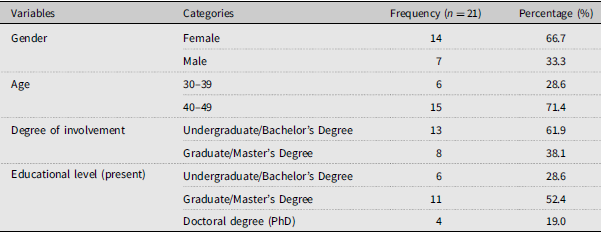
Table 2 presents the demographic characteristics of the 21 participants across multiple categories. The sample comprised 14 females (66.7%) and 7 males (33.3%), indicating a female majority. The age distribution revealed that most participants were aged 40 and above. This demographic profile aligns with the study’s objective to explore learning as a continuous, lifelong process that transcends formal educational boundaries, emphasising the importance of sustained reflection, questioning and deliberation.
Demographic characteristics of students

Table 2. Long description
A table with four columns and five rows, including headers. The columns are labeled Variables, Categories, Frequency (n = 21), and Percentage (%). The table presents demographic data of 21 participants. Row 1: Gender, Female, 14, 66.7 percent. Row 2: Gender, Male, 7, 33.3 percent. Row 3: Age, 30-39, 6, 28.6 percent. Row 4: Age, 40-49, 15, 71.4 percent. Row 5: Degree of involvement, Undergraduate/Bachelor’s Degree, 13, 61.9 percent. Row 6: Degree of involvement, Graduate/Master’s Degree, 8, 38.1 percent. Row 7: Educational level (present), Undergraduate/Bachelor’s Degree, 6, 28.6 percent. Row 8: Educational level (present), Graduate/Master’s Degree, 11, 52.4 percent. Row 9: Educational level (present), Doctoral degree (PhD), 4, 19.0 percent.
Regarding educational level at the time of studio participation, the majority were undergraduate students (61.9%). However, longitudinal tracking revealed educational progression, with the majority subsequently obtaining graduate (master’s) degrees (52.4%), indicating continued academic engagement beyond the initial study period.
Participant reflections highlighted how experiential learning fostered the development of site-specific perspectives. For instance, S1 noted “I experienced designing by taking different inputs into account and seeing how these designs contribute to a specific place,” while S3 emphasised that “the opportunity to experience diverse urban structures and textures enhanced my outlook within an architectural framework.” Similarly, S4 valued “experiencing the diversity in different geographies of Türkiye.” S7 particularly highlighted the social dimension, observing that the studio provided “a very effective encounter that connected [students] familiar with urban and architectural jargon with people who really needed to benefit from them.” These comments underscore that experience fosters the development of a site-specific perspective. This aligns with experiential learning theory (Dewey, Reference Dewey1938; Kolb, Reference Kolb2015), demonstrating that authentic, place-based settings enable students to ground theoretical knowledge within living, practical realities.
In response to the inquiry regarding the influence of out-of-school learning, statements emerged emphasising the continued use of similar methods and the essential nature of seeing the place where the work takes place in situ (S3); highlighting the contribution to the local community and the site itself, as well as the importance of conducting the process in its real context (S4, S9). Participants also underscored the significance of working in an out-of-school setting within a real place-based context, noting that such experiences enable learning about the people, culture and ways of life of the environment through direct engagement on site (S5, S6, S13, S16). Furthermore, learning not only through theoretical knowledge but also through problems encountered in practice and real needs was emphasised (S13, S15).
Conversely, some participants stated that these studios were not different from other studios within their educational experience (S18, S19). It was also noted that S18 and S19 were students enrolled in an urban design master’s programme and indicated that such practices are more common within the field of urban design. It was observed that undergraduate students placed greater emphasis on out-of-school learning environments and perceived them as different from their conventional educational experiences.
Gaining an understanding of a place’s culture, natural environment and local people requires spending some time within that context. As Gruenewald (Reference Gruenewald2003) argues, place-based pedagogy aims to ground learning in local contexts, ensuring that education is not isolated from the social and ecological realities of the environment. In addition, as Lave and Wenger (Reference Lave and Wenger1991) contend, learning is not an independently reifiable process located somewhere; rather, “learning is an integral part of generative social practice in the lived-in world.” This perspective directly resonates with the participants’ emphasis on learning through engagement with real places, communities and lived experiences beyond the traditional in-school studio environment.
Developing environmental understanding requires a learning process embedded within that specific context and responsive to its feedback. Some students stated that they incorporated their observations, experiences and research on the lifestyle of the people of Mardin, the region’s characteristic structural features and local materials into the design process (S1, S2, S8, S12). Another response emphasised developing an approach by considering which functions might be required in the region (S7), while several highlighted their efforts to shape their design approach through direct communication with the local community and by incorporating their perspectives (S4, S8, S13, S15, S16, S21). Overall, the responses indicated that experiencing the site, observing it and engaging with local people were transformed into tangible knowledge that informed the design process.
These design responses became more concrete when students engaged with the material and climatic conditions of the site. S17 reported designing for Mardin’s hot dry summers and cold winters through energy-efficient material choices and natural ventilation, framing these not as stylistic preferences but as the basic conditions under which a building can belong to its place. S1 reflected on the failure of mass housing typologies imported into the region, noting that families relocated into high-rise units faced winters too cold and summers too hot, having lost the climatic logic embedded in the traditional dwelling; this observation shaped direct questions about how contemporary needs could be met without abandoning what the local context already knew. S21 described the experience as confirming the effectiveness of an urban approach attuned to climate and culture, while S16 emphasised the importance of learning from local precedent without formally imitating it and of accounting simultaneously for practical concerns such as access, infrastructure and topography. S11 added that working in Mardin obliged him to think jointly about urban fabric, sociocultural and historical context and relationship with topography in a way that no other site had previously demanded. Taken together, these reflections show that the city was not encountered merely as a cultural backdrop but as a working set of conditions, including materials, slope, sun, natural ventilation and inhabited memory, that participated directly in shaping what students proposed.
The importance of interacting with the environment and stepping outside the architect’s comfort zone (S7), “experiencing the atmosphere, people, and culture of the place, walking through its streets, and working directly on site” (S10) and being aware of external factors (S9) were emphasised in the participants’ statements. In addition, while one participant highlighted the significance of context-based, on-site work by stating that “like all work conducted away from the school and on site, it was effective and inspiring” (S12), other statements reflected more specific and concrete learning outcomes related to the process, such as “I had the opportunity to observe more closely the technical challenges encountered in the restoration of historic buildings” (S13). Furthermore, the statement “I think students are more participatory and more motivated in out-of-school work” (S16) reflects a general perception formed after the process.
However, due to variations in the duration of time spent in Mardin, students’ levels of experience also differed. For instance, one student who experienced a short visit to Mardin perceived that the process did not take place through a field-based approach (S18). The process of visiting Mardin and other surrounding cities was left to the students’ own initiative; for example, S3 stated that they separated from the group to explore the nearby city of Diyarbakır out of personal interest.
In response to the question “What were the most instructive and significant parts of the process for you?,” students highlighted a range of experiences related to engaging with the local context and working beyond the conventional studio environment. These included the ability to evaluate the local context through a contemporary perspective and develop site-specific design approaches (S1), participation in the Mardin field trip (S2) and an increased awareness of environmental factors framed by the principle of “think local, respect local” (S3).
Students also emphasised the challenge of developing new design proposals capable of adapting to an existing and strongly defined urban and historical fabric (S4), as well as the significance of stepping outside the comfort zone of the school setting (S7). The process of designing in close proximity to a historic structure and understanding the sensitivity of the spatial relationship established with it was noted as particularly instructive (S8). Furthermore, engaging with local residents and evaluating the project within its broader social context (S13), participation in technical site visits (S16, S2) and the experience of working on a design project in the south-eastern region of Türkiye and within a historic environment for the first time (S18) were identified as meaningful and impactful components of the learning process.
In addition, the following statement is particularly noteworthy: “The existing condition of the city was already educational and instructive; in my view, this was the most significant contribution to my learning. Urban residents and those living in the city resemble the intertwined nature of its complex urban fabric. People from different backgrounds and cultures live closely together. One person’s terrace becomes another person’s roof. Just as buildings are interwoven, individuals from diverse backgrounds coexist in close proximity. The city possesses an urban fabric that can be encountered in very few places in the world” (S19).
Overall, the responses to this question reveal that the learning process was strongly shaped by direct engagement with the existing urban and environmental context rather than by abstract or studio-based instruction alone. Students perceived Mardin itself as an active pedagogical agent, emphasising that the layered physical environment, together with its social and cultural complexity, constituted a primary source of learning. In this sense, the city was not merely a backdrop for design activity but functioned as a living environment through which students developed a heightened awareness of context, environmental continuity and spatial interdependence. The emphasis placed on interwoven building forms and the coexistence of diverse social groups suggests that students gained a deeper understanding of environment as a holistic construct, encompassing physical form, cultural practices and lived experience. Such reflections indicate that learning was grounded in the ability to read and interpret the environment as a complex, integrated system, reinforcing the role of place-based and environmentally situated learning in architectural education.
The word “Mardin” appeared with the highest frequency (f = 137). This strong emphasis suggests that students consider the environment. Furthermore, this word is identified in the context (Stemler, Reference Stemler2001) and it aligns with students’ consistent awareness of environmental features, reinforcing the importance of this issue in the learning process.
From an environmental and dialogical perspective, students’ reflections suggest a growing awareness of the city as a socio-ecological system in which the built environment, cultural practices and everyday social relations are deeply interconnected. The emergence of learning through continuous dialogue with the environment indicates that Mardin was perceived as an active pedagogical agent. The focus on Mardin’s unique urban structure and shared spatial characteristics reflects an understanding of environment as a relational and experiential construct – one that emerges through lived interactions and embodied encounters rather than existing as a static physical setting.
Word trends analysis showing absolute frequencies of key themes in student responses is presented in Figure 1.
Word trends illustrating the absolute frequencies of key themes across student reflections.

The emphasis on the terms “Mardin” and “local” is also evident across individual student responses. The words consistently used by students align with their views on environment-based learning.
Discussion
The findings indicate that the learning process constituted a transformative encounter in which the city of Mardin functioned as an active pedagogical agent. The recurring emphasis on Mardin’s multi-layered urban fabric, local people, culture and architecture coupled with the high frequency of the term “Mardin” in student reflections, indicates that participants moved beyond a superficial understanding of the site. This focus underscores the significance of the city’s unique environmental and cultural characteristics as primary drivers of the learning experience.
Specifically, student S19’s observation regarding the intertwined nature of the city – where “one person’s terrace becomes another’s roof” – reflects a direct engagement with Mardin’s authentic spatial reality. Through their architectural lens, the student recognises this physical interconnectedness as a lived form of spatial interdependence, suggesting that such environments have the potential to demonstrate social cohesion more effectively than traditional classroom instruction. As Lave and Wenger (Reference Lave and Wenger1991) argue, learning in such a context becomes an integral part of generative social practice, where the built form and lived experience are inextricable.
Furthermore, the data indicates that students demonstrated a growing interest in responsive, context-based approaches. By stepping outside the conventional architectural comfort zone, participants transitioned from abstract design to engagement with real-world actors. This reciprocal relationship, where the environment provides constant feedback, can enable students to transform their observations of local materials and cultural practices into tangible knowledge. These reflections suggest that experiencing a site-specific reality fosters a deeper socio-ecological awareness, indicating the significant potential for integrating such place-based pedagogical models more broadly within architectural education.
This is also where the role of the site as an active pedagogical agent becomes most legible. When students reported responses to stone, the local material of the region, slope, natural ventilation and the misalignment of imported building types with local climate, they were not describing the city as something they thought about but something that talked back to them during designing. Place-based architectural pedagogy, in this sense, is less the application of contextual themes to a site than a sustained negotiation in which the environment selects, refuses and reshapes the proposals that students bring to it.
The emphasis on learning environments beyond the formal school setting aligns closely with students’ repeated references to place, locality and direct engagement with the environment. The data suggest that such external settings enable a more situated and experiential understanding of the built environment, thereby enhancing the contextual sensitivity. Students’ reflections suggest that a local setting facilitated a more nuanced interaction with the physical, social and cultural dimensions of place, thereby strengthening place-based learning and dialogic engagement. These findings underscore the pedagogical value of external school learning environments in supporting socially and environmentally responsive architectural education curricula.
Drawing upon data gathered specifically from ITU Mardint, student reflections indicate a need for the further development of pedagogical approaches. There is a notable divergence between a conventional learning setting and a context-based approach, as detailed in Figure 2. While the conventional framework remains primarily classroom-bound and focused on predetermined knowledge, context-based pedagogy emphasises a transformative journey where the intricate environmental fabric functions as a primary catalyst for learning.
Conventional and context-based approaches.

According to the comparison, the conventional setting relies on a linear transfer of information, positioning the student as a passive recipient. In contrast, the context-based model encourages students to act as active investigators and social agents within the community. Furthermore, the approach highlights a transition in knowledge acquisition; rather than focusing solely on studio-based outcomes, it prioritises ontological awareness and the internal transformation of the student. By integrating a complex learning environment, cultural heritage and local perspectives, this approach fosters a synthetic form of socio-ecological consciousness that is often overlooked in standardised curricula. Ultimately, Figure 2 illustrates that this pedagogical shift is not merely a change in location, but a fundamental re-evaluation of the roles and epistemological foundations of architectural education.
Conclusion and recommendations
This study investigated students’ reflective practice and environmental awareness, offering a distinct analytical perspective on place-based architectural education. The findings demonstrate that students place significant value on direct engagement with the physical and social context, and that this engagement contributes to a deeper environmental awareness. Learning within a complex, multi-layered urban setting cultivated an ontological bond between students and the site, indicating that the environment functioned not as a backdrop for instruction but as an active pedagogical agent. In this respect, the study substantiates the conceptual figure of the city as teacher and positions the urban palimpsest, with its sedimented material, ecological and social strata, as a legitimate site of architectural learning.
What emerged in this case was a learning process grounded in concrete physical conditions rather than in hypothetical ones. Student reflections drew attention to the thermal and tectonic behaviour of local stone, the constraints imposed by slope and orientation, the role of natural ventilation under semi-arid climatic conditions. The intertwined urban fabric, with its narrow streets, fragmented masses settling in accordance with the slope, and dwellings in which one roof functions as another’s terrace, made visible a form of social and spatial interdependence that would be difficult to convey through studio simulation alone. Such observations suggest that place-based engagement can support an ontological awareness of locality that constitutes a meaningful basis for sustainability learning, and that the environment may be understood as a relational participant in educational processes rather than as a passive setting. These dynamics indicate that architectural learning, when embedded in a layered urban setting, is most productively conceived not as the transmission of design knowledge to a passive learner but as a reciprocal exchange in which the environment itself participates in shaping pedagogical outcomes. Framed in these terms, the study offers a contribution to the wider effort within environmental education to develop pedagogical approaches that are responsive to the ecological, social and cultural dimensions of contemporary spatial practice.
The ITU Mardint initiative serves as an important case study, however it is noted that as the entirety of the process did not take place on-site, the experience functioned more as an extended technical field trip rather than a fully immersive residency. To enhance the depth of learning, it is recommended that future models consider conducting the entirety of the studio process within the region. Specifically, new pedagogical formulations should be developed that allow for the entire design process to unfold on-site. This would ensure a more sustained engagement with the environment and its social fabric, allowing for a more continuous and profound dialogue with the location.
The study was preferred due to the controllability of the methodological experiment and the detailed monitoring of process-oriented data. Although the findings demonstrate the potential of place-based design, further studies conducted with larger groups would consolidate the evidence base. Furthermore, the study highlights the need for the continued development of environmentally responsive pedagogical models. Conceptually, the study positions architectural pedagogy within the broader field of urban environmental education and argues for the city, read as palimpsest and engaged as active pedagogical agent, as one of the discipline’s most under-recognised educators. Integrating place-based approaches into architectural curricula is consequently essential not only for fostering socio-ecological awareness among future practitioners, but also for advancing the wider project of urban environmental learning to which this study seeks to contribute.
Acknowledgements
I am deeply grateful to all the participants for their time and contributions.
Funding statement
This research did not receive any specific grant from funding agencies in the public, commercial or not-for-profit sectors.
Ethical standard
The study received ethical approval from the Ethics Committee of Istanbul Technical University. The ethics application was approved on September 5, 2024.
Author Biography
Betül Toy is an architect, researcher and academic. She graduated from the Department of Architecture in 2013 and earned a Master’s degree in Architectural Design in 2016 and another Master’s degree in History of Architecture in 2020. She holds a PhD in Architectural Design from Istanbul Technical University (ITU). She worked as an architect in various offices and is also the former Editor-in-Chief of YAPI Journal. She is currently a Research Assistant at Istanbul Topkapı University. Her academic fields include social responsibility in architectural education, the role of architects in society, architectural design pedagogy, contemporary learning paradigms and experiential learning.



 Open access

