Introduction
In the course of their disease, dementia patients can show a wide range of dementia-associated neuropsychiatric symptoms such as changes of personality, depression, psychosis, anxiety and specific problem behaviors such as agitation and aggression (Lyketsos et al., Reference Lyketsos, Steinberg, Tschanz, Norton, Steffens and Breitner2000). Neuropsychiatric symptoms are particularly distressing to patients and their caregivers (Ypma-Bakker et al., Reference Ypma-Bakker2002) and are the most important reason for admission to a nursing home (Lyketsos et al., Reference Lyketsos, Steinberg, Tschanz, Norton, Steffens and Breitner2000). Prevalence of neuropsychiatric symptoms ranged from 61% to over 80% (Lyketsos et al., Reference Lyketsos, Steinberg, Tschanz, Norton, Steffens and Breitner2000; Brodaty et al., Reference Brodaty, Draper, Saab, Low, Richards, Paton and Lie2001). A recent study of a large sample of Dutch nursing home patients with dementia showed that 81% of the patients had at least one neuropsychiatric symptom as measured by the Neuropsychiatric Inventory Nursing Home version (NPI-NH), with a prevalence of agitation/aggression of 31%, and apathy and irritability both 34% (Zuidema et al., Reference Zuidema, Derksen, Verhey and Koopmans2007a). Using the Cohen Mansfield Agitation Inventory (CMAI), more than 80% of the patients showed at least one symptom of agitation, with general restlessness (44%) and verbal aggression (33%) being most frequently observed symptoms (Zuidema et al., Reference Zuidema, Derksen, Verhey and Koopmans2007a).
The Dutch guideline on diagnosis and management of dementia recommends psychosocial interventions as first-line treatment of neuropsychiatric symptoms (van Gool et al., Reference van Gool, Stam, Steenhoek and Hagemeijer2006). However, in nursing home practice these symptoms are often managed with psychotropic drugs. Prescription of psychotropic drugs to treat neuropsychiatric symptoms is becoming increasingly controversial. Effects are modest and there are recent warnings of an increased risk of stroke or mortality in dementia patients who receive these agents (Sink et al., Reference Sink, Holden and Yaffe2005; Schneider et al., Reference Schneider, Dagerman and Insel2005; Rochon et al., Reference Rochon2008).
Knowledge of the amount of psychotropic drugs prescribed and the factors associated with the drug use is important in gaining better insight into the practice of psychotropic drug prescription in order to provide more detailed advice for the careful application of these drugs. International studies regarding psychotropic drug use found that 67–78% of nursing home patients with dementia had at least one prescription of a psychotropic drug; 21–42% used antipsychotics, 15–31% sedatives and more than 40% used antidepressant drugs (Pitkälä et al., Reference Pitkälä, Laurila, Strandberg and Tilvis2004; Kim and Whall, Reference Kim and Whall2006; Lövheim et al., Reference Lövheim, Sandman, Kallin, Karlsson and Gustafson2006; Selbaek et al., 2006).
Some studies have investigated the use of psychotropic drugs in relationship with factors such age, gender, severity of dementia and type of neuropsychiatric symptoms (Kim and Whall, Reference Kim and Whall2006; Lövheim et al., Reference Lövheim, Sandman, Kallin, Karlsson and Gustafson2006). The literature shows neither a clear association between gender and the use of psychotropic drugs (Draper et al., Reference Draper2001; Lövheim et al., Reference Lövheim, Sandman, Kallin, Karlsson and Gustafson2006) nor an association between severity of dementia and psychotropic drug use (Kim and Whall, Reference Kim and Whall2006; Lindesay et al., Reference Lindesay, Matthews and Jagger2003). However, it does show an association between specific neuropsychiatric symptoms and psychotropics. In general, antipsychotic medication was more frequently prescribed in patients with at least one neuropsychiatric symptom (Lindesay et al., Reference Lindesay, Matthews and Jagger2003; Selbaek et al., 2006). One study showed no association between different types of agitation and specific type of medication (Ramadan et al., Reference Ramadan, Naughton and Prior2003), but in a Norwegian study there was an association between the type of psychotropic drug and the psychiatric symptoms for which it had been prescribed (Selbaek et al., 2006).
The aim of this study was to investigate psychotropic drug use in Dutch nursing home patients with dementia and the association between age, gender, severity of dementia, and type of neuropsychiatric symptoms.
Methods
Participants
All residents of 59 dementia special care units (SCU) in 25 Dutch nursing homes participated in this study. The investigation was performed within a four-week period in 2003. Methods have been reported in detail elsewhere (Zuidema et al., Reference Zuidema, Derksen, Verhey and Koopmans2007a). Patients were considered for inclusion provided they: (1) met the DSM-IV criteria (American Psychiatric Association, 1994) for dementia and (2) resided in the nursing home for more than 4 weeks. Terminally ill patients were excluded. Approval of the Ethics Committee at the University of Nijmegen was obtained. Informed consent was acquired from a primary family member or legal guardian of the patients.
Assessments
Baseline characteristics, such as age, gender, marital status and time of institutionalization, were retrieved from the patients' charts. Neuropsychiatric symptoms were assessed by interviewing vocational nurses by trained nurse-assistants using the Neuropsychiatric Inventory – Nursing Home version (NPI–NH) Dutch version (Kat et al., Reference Kat, de Jonghe, Aalten, Kalisvaart, Droes and Verhey2002). The NPI–NH includes 12 neuropsychiatric symptoms: delusions, hallucinations, agitation, depression, anxiety, euphoria/elation, apathy/indifference, disinhibition, irritability, aberrant motor behavior, night-time disturbances and appetite/eating change. Both the frequency and severity of each symptom are rated on a four-point (1–4) and three-point (1–3) Likert scale, respectively. Agitation and aggression were assessed using the Cohen Mansfield Agitation Inventory (CMAI), Dutch version (Cohen-Mansfield and Billig, Reference Cohen-Mansfield and Billig1986; de Jonghe and Kat, Reference de Jonghe and Kat1996). The CMAI assesses 29 behaviors. The frequency of each symptom is rated on a seven-point scale (1–7) ranging from “never” to “several times an hour”. Severity of the dementia was assessed using the Global Deterioration Scale (Reisberg et al., Reference Reisberg, Ferris, de Leon and Crook1982). Data on the actual prescription of psychotropic drugs on the day of assessment were retrieved from the medical chart, using the Anatomical Therapeutical Chemical classification (Nordic Council on Medicines, 1990) and grouped into antipsychotics, anxiolytics, hypnotics/sedatives and antidepressants.
Analysis
Clinically relevant neuropsychiatric symptoms measured with the NPI–NH were defined by a frequency × severity score ≥ 4 for each individual symptom. Clinically relevant agitation measured with the CMAI was defined as behavior occurring at least once a week or more (frequency score ≥ 3). Six NPI-NH items were grouped (post-hoc) into two clusters: psychosis (hallucinations, delusions), agitation (agitation, disinhibition, irritability, aberrant motor behavior). Depression, anxiety, apathy and night-time behavior were analyzed separately. Euphoria and eating change were excluded from analysis.
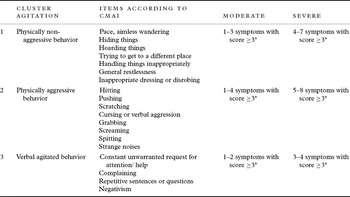
CMAI-items were grouped into physically non-aggressive behavior, physically aggressive behavior, and verbal agitated behavior (Table 1) (Zuidema et al., Reference Zuidema, de Jonghe, Verhey and Koopmans2007c). The sumscore of CMAI–clusters were divided into no agitation, moderate and severe agitation (Table 1). Associations between gender, stage of dementia, neuropsychiatric symptoms as independent variables and psychotropic drug use as dependent variables were analyzed in two separate models using binomial logistic regression: one model with NPI-NH symptoms and the other model with CMAI symptoms, because of the expected high correlation between CMAI clusters and NPI-NH agitation scores.
Categorization of agitation and operational definition of no, moderate, or severe agitation, based on the CMAI items

*Clinically significant behavior = each individual symptom occurring at least once a week (with a score of ≥ 3).
CMAI = Cohen-Mansfield Agitation Inventory.
Results
Patients' characteristics
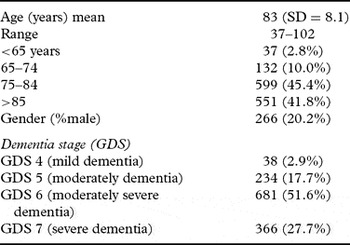
A total of 1322 nursing home patients met the inclusion criteria for this study. Patients had a mean age of 83 years (± 8.1); most of the patients had a GDS stage 6 and 20.2% were male (Table 2.).
Patients' characteristics (n = 1322)

GDS = Global Deterioration Scale.
Prevalence of psychotropic drug use
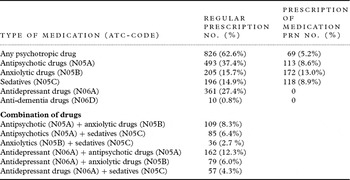
Sixty-three percent of the patients used any regular prescribed psychotropic drug; 36% of patients used one drug, 20.3% two different drugs, 5.8% three different and 0.5% used four different types of psychotropic drugs, while 5.2% had a prescription for incidental use (“pro re nata” (PRN)), mostly anxiolytics.
Antipsychotics (37.4%) and antidepressant drugs (27.4%) were the most frequently prescribed drugs for regular use (Table 3). The most prevalent combination of regularly prescribed drugs was antidepressant with antipsychotic drugs and the combination of an anxiolytic and an antipsychotic drug.
Prevalence of psychotropic drug use among patients (n = 1322)

Note: All percentage values are presented as a percentage of the total group.
ATC = Anatomical Therapeutical Chemical classification; PRN = pro re nata.
Associations between patients' characteristics and psychotropic drug use
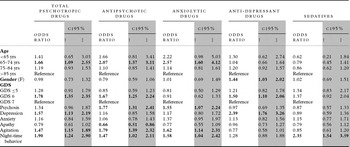
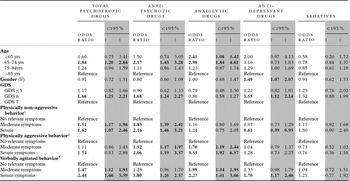
Tables 4 and 5 list associations between age, gender, dementia stage, neuropsychiatric symptoms and regular use of psychotropic drugs.
Association between patient characteristics, NPI-NH and regular psychotropic drug use in Dutch nursing home patients with dementia

†95%-Confidence Interval Lower Boundary.
‡95%-Confidence Interval Upper Boundary.
If value 1 is not included in the 95% Confidence Interval, the p-value is significant (<0.05).
Association between patient characteristics, CMAI and psychotropic drug use in Dutch nursing home patients with dementia

§Physically non-aggressive behavior (pacing, aimless wandering, hiding things, hoarding things, trying to get to a different place, handling things inappropriately, general restlessness, inappropriate dressing or undressing). Moderate symptoms: 1–3 items (of 7) ≥3; severe symptoms: 4–7 items ≥3.
∥Physically aggressive behavior (hitting, pushing, scratching, cursing or verbal aggression, grabbing, screaming, spitting, strange noises). Moderate symptoms: 1–4 items (of 8)with a score of ≥3, severe symptoms: 5–8 items with a score of ≥3.
¶Verbal agitated behavior (constant unwarranted request for attention/help. complaining, repetitive sentences or questions, negativity) (Zuidema et al., Reference Zuidema, de Jonghe, Verhey and Koopmans2007c). Moderate symptoms: 1–2 items (of 4)with a score of ≥3, severe symptoms: 3–4 items with a score of ≥3.
†95%-Confidence Interval Lower Boundary.
‡95%- Confidence Interval Upper Boundary.
If value 1 is not included in the 95% Confidence Interval, the p-value is significant (<0.05).
Age
Age had a significant association with psychotropic drug use in general, and with antipsychotic and anxiolytic drug use in particular. Patients between 65 and 74 years old were more likely to have a prescription of any psychotropic drug. The group between 65 and 74 years old had more than a twofold risk to use antipsychotic or anxiolytic drugs compared with those of who were over the age of 85 years.
Gender
Women had an increased risk for the use of antidepressant medication (OR 1.44 and 1.49 for the two models).
Dementia stage
Psychotropic drugs in general, and antipsychotic and antidepressant drugs in particular, were most frequently prescribed in patients with GDS stage 6. Anxiolytics and sedatives had no association with dementia stage.
NPI-NH symptoms
Psychotic symptoms were positively associated with the use of antipsychotic drugs (OR 1.77) and anxiolytic drugs (OR 1.55), and depressive symptoms were associated with psychotropic drugs in general and antidepressant drugs in particular (OR 1.57 and 2.39). Night-time behavior was associated with psychotropic drugs in general, and with antipsychotics, anxiolytics and sedatives in particular. There was no association between anxiety and any psychotropic drug. Apathy was negatively associated with antipsychotic medication (OR 0.66) (see Table 4). Agitation as measured by the NPI-NH was significant positively associated with the use of psychotropics, antipsychotics and anxiolytic drugs.
CMAI symptoms
Physically non-aggressive agitation was positively associated with the use of psychotropics in general and antipsychotics in particular. Severe physically non-aggressive behavior had a negative relation with anti-depressant drugs. Physically aggressive behavior was positively associated with the use of antipsychotic and anxiolytic drugs, and verbal agitation increased the use of psychotropic or anxiolytic drugs. The risk for antipsychotic and antidepressant drug use was also increased for patients with severe verbal agitation.
Discussion
Two-thirds of this group of Dutch nursing home patients with dementia were prescribed at least one psychotropic drug, mostly antipsychotics and antidepressants. Thirty percent of the users took a combination of drugs. Age and dementia severity were positively associated with the use of psychotropic drugs in general. Although gender was not associated with psychotropic drug use in general, women were more frequently prescribed antidepressants. Patients with clinically relevant neuropsychiatric symptoms received psychotropic drugs more frequently, except those patients with anxiety or apathy. Patients with psychosis or agitation had a greater risk of using antipsychotic or anxiolytic drugs, and patients with verbal agitation were more frequently prescribed psychotropic and anxiolytic drugs.
The prevalence rates of psychotropic drug use presented in this study are comparable with both Dutch and international studies (Lyketsos et al., Reference Lyketsos, Steinberg, Tschanz, Norton, Steffens and Breitner2000; Zuidema et al., Reference Zuidema, Koopmans and Verhey2007b). The association of age with psychotropic drug use is comparable with international figures that show that psychotropic drugs were prescribed more frequently to younger patients (Draper et al., Reference Draper2001; Lindesay et al., Reference Lindesay, Matthews and Jagger2003; Lövheim et al., Reference Lövheim, Sandman, Kallin, Karlsson and Gustafson2006). In contrast to other studies, we found that psychotropics were not associated with male gender; only antidepressant drugs were independently associated with female gender.
The association of dementia severity and psychotropics is in line with some other studies (Lindesay et al., Reference Lindesay, Matthews and Jagger2003; Macdonald et al., Reference Macdonald, Carpenter, Box, Roberts and Sahu2002; Selbaek et al., 2006). In the present study there was an increase of psychotropics with increasing cognitive deterioration.
Other studies have shown associations between functional impairment and psychotropic drug use. In a British and Swedish study, antipsychotic drug use was independently positively associated with cognitive impairment and lower dependency in activities of daily living (ADL) (Lindesay et al., Reference Lindesay, Matthews and Jagger2003; Lövheim et al., Reference Lövheim, Sandman, Kallin, Karlsson and Gustafson2006). However, one American study found no association between cognitive deterioration, ADL-dependency and psychotropic use (Kim and Whall, Reference Kim and Whall2006).
In another American study patients with clinically relevant symptoms used antipsychotic drugs or benzodiazepines more frequently (Ramadan et al., Reference Ramadan, Naughton and Prior2003). A Norwegian study found a significant association between the type of drug and the psychiatric symptoms for which it had been dispensed; psychotic symptoms were strongly associated with the use of antipsychotic medication, whereas depression and anxiety were strongly associated with antidepressant, anxiolytic and sedative drug use (Selbaek et al., 2006). The positive association between depression and psychotropic drug use in general and antidepressant drugs was also found in an American study (Kim and Whall, Reference Kim and Whall2006). There was no association between depression and antipsychotics, which is in line with a Norwegian study, although in a Swedish study there was a small but statistically significant association between depression and antipsychotic drugs (Lövheim et al., Reference Lövheim, Sandman, Kallin, Karlsson and Gustafson2006; Selbaek et al., 2006).
This study had some limitations: First, we did not record the reasons for drug prescription, the severity of the symptoms when the drugs were first administered, nor the duration of usage. Secondly, although assessments of neuropsychiatric symptoms were performed with trained interviewers and with valid measurement instruments, the NPI-NH and CMAI scores may have been subject to inter-nurse variability in terms of their actual perception of the symptoms. Finally, although NPI-NH items were clustered into clinically meaningful categories, other categorizations – for example, into previously published clusters (Zuidema et al., Reference Zuidema, de Jonghe, Verhey and Koopmans2007d) – could have given somewhat different results.
The high prevalence of neuropsychiatric symptoms despite the use of psychotropic drugs raises the question of the efficacy of the drugs. There is controversy about the benefit of psychotropic drugs (more specifically antipsychotic drugs) in the management of neuropsychiatric symptoms in dementia. Several studies show moderate efficacy with high placebo responses (Schneider et al., Reference Schneider2006) and large side effects (van Iersel et al., Reference van Iersel, Zuidema, Koopmans, Verhey and Olde Rikkert2005). Furthermore, there is a growing body of evidence for the risk of stroke and mortality with antipsychotic drug use (Sink et al., Reference Sink, Holden and Yaffe2005; Rochon et al., Reference Rochon2008).
Nursing home physicians should systematically monitor the effects of the prescribed drugs and should attempt to lower the dose or even discontinue the drug at least every three to six months. There is growing evidence that discontinuation of antipsychotics is possible (Ballard et al. Reference Ballard2008). We also know from recent research that psychosocial interventions and training of staff clearly reduces antipsychotic drug use in nursing home patients (Fossey et al., Reference Fossey2006). More research is needed on drug discontinuation and on the effects of non-pharmacological interventions.
Conflict of interest
None.
Description of authors' roles
R. Nijk, S. Zuidema and R. Koopmans initiated the study concept and design; S. Zuidema collected the data; R. Nijk and S. Zuidema undertook the data analysis and interpretation; R. Nijk wrote the paper, and it was critically reviewed by S. Zuidema and R. Koopmans.