INTRODUCTION
Portunid crabs with two genera and about four species including mud crab (Scylla spp. De Haan, 1833), blue swimming crab [Portunus pelagicus (Linnaeus, 1758)], and gazami crab [P. trituberculatus (Miers, 1876)]) are important shellfish commodities of commercial fisheries in the Indo-Pacific region (Lai et al., Reference Lai, Ng and Davie2010). Of about 11 genera and 48 species (Apel & Spiridonov, Reference Apel and Spiridonov1998) of Portunid crabs in the Persian Gulf and Sea of Oman, only three genera and four species including mud crab [Scylla serrata (Forskål, 1775)], blue swimming crab [P. segnis (Forskal, 1775)], blood-spotted swimming crab [Portunus sanguinolentus (Herbst, 1783)] and crucifix crab [Charybdis feriata (Linnaeus, 1758)] are important shellfish commodities of commercial fisheries. In the Persian Gulf the blue swimming crab was misidentified as P. pelagicus until 2010 when additional samplings by Lai et al. (Reference Lai, Ng and Davie2010) indicated that the blue crab in the region is P. segnis. This species occurs in the west Indian Ocean, western Indian Sub-continent, Pakistan, Persian Gulf, Red Sea, Mediterranean Sea and east coast of Africa (Lai et al., Reference Lai, Ng and Davie2010). This crab occurs in a wide range of habitats from intertidal zone to depths of at least 50 m on sandy, muddy and seagrass beds in inshore and continental shelf areas (Lai et al., Reference Lai, Ng and Davie2010).
In the northern Persian Gulf, crabs are non-targeted species and are incidentally caught in shrimp bottom trawl nets. The crabs in this area mainly belong to Portunidae, Matutidae, Calappidae, Majidae and Leucosiidae families. In the northern Persian Gulf, there are four species belonging to family Portunidae including Portunus segnis, P. sanguinolentus, Charybdis feriata and Scylla serrata that are potential fishery species due to their large sizes. Catch statistics by the Iranian Fisheries Organization shows an estimate about 2834 tonnes (average for 2003–2011) for P. segnis being landed by a variety of fishing gears (trawl net, gill net) in the northern Persian Gulf and Sea of Oman (personal communication, IFRO).
In Iranian waters of the Persian Gulf and Sea of Oman, there is no organized fishery for the blue swimming crab. This crab is a major by-catch in bottom trawl nets, traps and bottom gill nets targeting the demersal fish, shrimp and painted spiny lobster Panulirus versicolor and flathead locust lobster Thenus orientalis. A limited fishery exists among local anglers and part of their catch is transported to a few domestic markets in the country. Given the ever-increasing demand for seafood in domestic and export markets, there is an increasing demand prospect for an organized fishery for the blue swimming crab in the Persian Gulf and Sea of Oman, requiring an urgent need for action to better manage fisheries stocks of this crab.
Previous studies on crab stocks in the northern Persian Gulf have mainly focused on population parameters and reproductive biology of P. pelagicus (Kamrani et al., Reference Kamrani, Sabili and Yahyavi2010) and on some biological aspects of this species in the north-western Persian Gulf (Jazayeri et al., Reference Jazayeri, Papan, Savari and Saki Nejad2011; Hosseini et al., Reference Hosseini, Vazirizade, Parsa and Mansori2012b). In the most recent studies, growth and mortality parameters along with reproductive biology for P. segnis have been explored in coastal waters of the Persian Gulf and Gulf of Oman (Safaie et al., Reference Safaie, Kiabi, Pazooki and Shokri2013a, Reference Safaie, Pazooki, Kiabi and Shokrib). There are few regional studies on heavy metal concentrations in P. pelagicus (Hosseini et al., Reference Hosseini, Abdi Bastami, Karami and Parsa2012a).
Despite a high potential fishery value and wide distribution of blue swimming crab in the northern Persian Gulf and Sea of Oman, no studies have been published investigating the population dynamic of this crab in this area. Likewise, no attempts have been made to study the species biodiversity in genus Portunus in the northern Persian Gulf. In response to this lack of knowledge, and acknowledging the urgent need for action to better manage fisheries stocks of the blue swimming crab, this study aims to explore size frequency distribution, catch per unit effort (CPUE) and biomass of blue swimming crab P. segnis in coastal waters of Hormozgan province located in the northern Persian Gulf, Iran.
MATERIALS AND METHODS
Study area and sampling
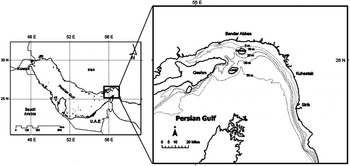
Data on blue swimming crab P. segnis were collected for a period of 29 months from May 2010 to September 2012 in coastal waters of Hormozgan Province located in the northern Persian Gulf, Iran (Figure 1). Using shrimp bottom trawling nets with a 40 mm mesh size from wings to sac and 20 mm at the cod end, the crab specimens were collected during daytime (from 6.00 a.m. to 18.00 p.m.) in an area extending from 26°25′E 57°29′N to 27°07′E 56°06′N. A stratified sampling was undertaken by dividing the area into three strata including shallow depth range (2–5 m), intermediate depth range (5–10 m) and deep depth range (10–50 m) (Figure 1). The total catch rate for blue swimming crab, sex composition and effort rate for each haul were recorded. A total of 1689 male and 1824 female crabs were caught and kept in a deep freezer for further analysis. Using a digital caliper, the carapace width (CW) across tips of the largest lateral spines was measured to the nearest millimetre. The different coverage days in a month was separated using a lunar Islamic calendar.
Study area for Portunus segnis in the northern Persian Gulf.

Data analyses
Using the data on carapace width, size frequency distribution for male and female crabs was depicted in each month. The CPUE was determined using the weight of crabs captured per 1 h. The normality of CPUE data was tested using the Kolmogorov–Smirnov test in SPSS19. The CPUE data were not normally distributed and transformation methods failed to remove heterogeneity of variances, thus the data were kept untransformed. The differences in CPUE between lunar cycles, depth layers, hauling with different engine powers (range: 240–450 hp) and vessel speeds (range: 1.1–3.6 knots) were determined using non-parametric Kruskal–Wallis test.
In areas where the sea bottoms were smooth enough for trawling, standing stock size (B) was determined by the following equation (Pauly, Reference Pauly1983):
 $$B=\displaystyle{{\overline {CPUE} \times A} \over {a \times x_1 }}$$
where,
 $\overline {CPUE}$
is average of catch per unit of effort, a is the area swept by bottom trawl, x
1 is catch ability coefficient and A is the area of the region. The total area and area of each substratum was calculated with a planimeter (total area was 336.25 n m2).
The area swept by the trawl net in an effort unit was computed using the following formula (Pauly, Reference Pauly1983):
 $$a=V \times t \times h \times x_2$$
where ‘V’ is the speed of the trawler, over ground, while trawling, ‘t’ is the time spent trawling, ‘h’ is the length of the trawl's head rope (range: 23–47 m) and ‘x 2’ is a fraction equal to the effective width of the net divided by the length of the head rope (Pauly, Reference Pauly1983).
RESULTS
Size structure
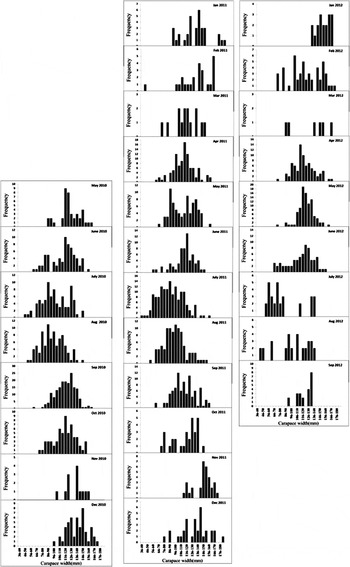
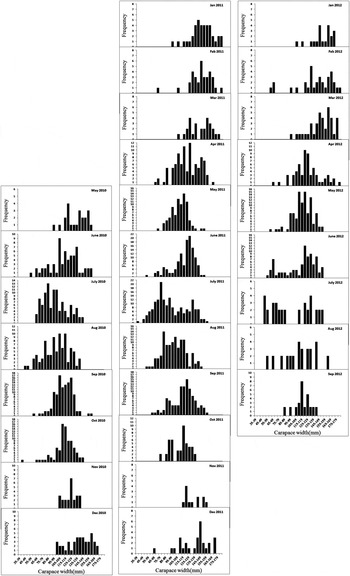
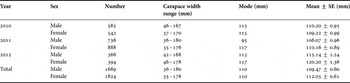
Using the swept area method, 1689 male and 1824 female crabs were collected from May 2010 to September 2012. The carapace width (CW) for males and females ranged from 36 to 180 mm and 35 to 178 mm, respectively (Table 1). The mean (±SE) CW for males and females varied between 109.47 ± 0.60 and 112.05 ± 0.61, respectively (Table 1). The results showed that the marketable size of males and females (CW > 100 mm) were dominant from December to May, whereas, the juvenile crabs were dominant from June to October. The average CPUE had an upward trend from June to October (Figures 2 and 3). About 30% of captured crabs had a CW below 100 mm (including about 30–55% of immature crabs).
Monthly size frequency distribution for male P. segnis in the study area.

Monthly size frequency distribution for female P. segnis in the study area.

Size composition for P. segnis within study period (2010–2012).

CPUE analysis
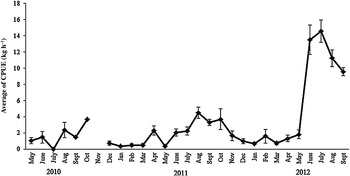
The CPUE increased from June to October in each year and declined afterwards (Figure 4). The highest CPUE was recorded in July 2012 followed by June, August and September 2012. The lowest CPUE was recorded in January, February and March (Figure 4). The maximum CPUE was recorded at 415 and 450 engine powers and vessel speeds of about 2.5 and 2.8 knots.
The changes in CPUE (Mean ± SD) for P. segnis in the study area.

The CPUE increased at full moon. This value was fairly constant before the full moon and was followed by an increase. The results of nonparametric Kruskal–Wallis test showed significant differences in the amount of crabs caught per unit effort within different days of the lunar month (χ 2 = 60.61, d.f. = 28, P ≤ 0.05).
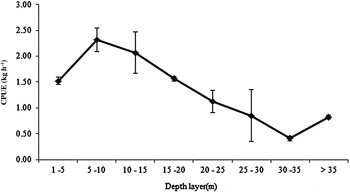
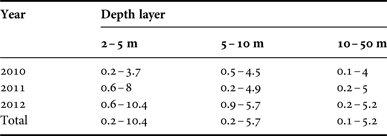
When data for the whole study period were pooled, the highest value of CPUE was observed in shallow coastal areas less than 10 m and significantly declined as depth increased (Table 2, Figure 5). Kruskal–Wallis test results also showed significant differences in CPUE between different depth layers (χ 2 = 39.27, d.f. = 7, P ≤ 0.05).
The CPUE (Mean ± SD) for P. segnis in different depth layers during the study period in the study area.

CPUE (kg h−1) in different depth layers during the study period (2010–2012) in the study area.

The maximum CPUE in overall depth layer for blue swimming crab was recorded at 415 and 450 engine powers and vessel speeds of about 2.5 and 2.8 knots.
Biomass
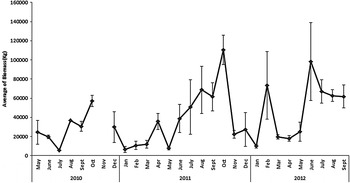
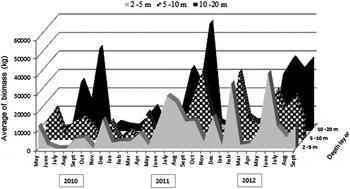
The monthly biomass estimations by swept area method showed an upward trend from June to October within the study period, so that the maximum biomass was 110 tonnes in October 2011 (Figure 6). The density of crabs within depth layers significantly changed in different months (Figure 7).
Variation in biomass (Mean ± SD) for P. segnis during the study period in the study area.

Biomass variation within depth layers for P. segnis during the study period.

DISCUSSION
Based on the results of Lai et al. (Reference Lai, Ng and Davie2010), the blue swimming crab in the northern Persian Gulf is P. segnis. The results of this study confirm the presence of P. segnis in the region. The carapace width for P. segnis ranged from 35 to 180 mm with the dominant size groups being 95–115 and 110–117 mm for males and females, respectively. Josileen & Menon (Reference Josileen and Menon2007) reported a range of 70–195 mm for the carapace width for P. pelagicus at the Mandapam coast of India. They further reported that the dominant size groups were 106–110 and 126–130 mm for males and females, respectively. Dineshbabu et al. (Reference Dineshbabu, Shridhara and Muniyappa2008) measured a size range of 56–165 mm in males and 61–170 mm in females for P. pelagicus landed at south Karnataka coast, India in 2001–2002. Abdel Razek et al. (Reference Abdel Razek, Taha and Ameran2006) reported a size range of 40–150 mm (in carapace width) for both sexes of P. pelagicus in Bardawil Lagoon, Egypt. In previous studies, the annual growth rate for P. pelagicus was approximately 1–1.7 y−1, whereas in this study the annual growth rate for P. segnis ranged from 1.6–1.7 y−1 (Safaie et al., Reference Safaie, Kiabi, Pazooki and Shokri2013a).
Dineshbabu et al. (Reference Dineshbabu, Sreedhara and Muniyappa2007) reported carapace width ranges of 61–170 and 56–160 mm for male and female blood-spotted swimming crabs Portunus sanguinolentus, respectively, and mean size ranging from 93.3 to 108.1 mm in male and 88.5 to 106.5 mm in female crabs in Karnataka coast, India. The wider size range along with the maximum and mean size observed in the present study were larger than those recorded for P. pelagicus at Mandapam coast, south Karnataka coast in India and Bardawil Lagoon in Egypt and for P. sanguinolentus in South Karnataka coast, India. Differences in the results for carapace size range in the present study and those of Josileen & Menon (Reference Josileen and Menon2007), Dineshbabu et al. (Reference Dineshbabu, Sreedhara and Muniyappa2007, Reference Dineshbabu, Shridhara and Muniyappa2008) and Abdel Razek et al. (Reference Abdel Razek, Taha and Ameran2006) might be driven by differences in species, sampling technique, the ecosystems investigated and the responses of species to environmental gradients.
The results showed that the marketable size of male and female crabs was dominated by adult crabs (CW > 100 mm) from December to May, whereas, the juvenile crabs were dominant from June to October. The abundant adult crabs from December to May might be due to the presence of mature crabs being gathered for spawning (Safaie et al., Reference Safaie, Pazooki, Kiabi and Shokri2013b). A current study on the reproduction of blue swimming crab in the present study area indicates that the spawning peak occurs within a few months, starting from late January to late May (Safaie et al., Reference Safaie, Pazooki, Kiabi and Shokri2013b).
The increased CPUE from June to October might be driven by migration of juvenile crabs from nursery grounds in adjacent mangroves to subtidal sea areas. Romano & Zeng (Reference Romano and Zeng2006) have argued that early juveniles of Portunus pelagicus cannot tolerate low salinities for extended periods, due to their weak hyper-osmoregulatory abilities. The juvenile P. pelagicus crabs move to deeper water in response to changes in water temperature and inshore salinity (Romano & Zeng, Reference Romano and Zeng2007). In the present study, the lack of juvenile crabs at nursery grounds could, however, indicate that juvenile crabs are absent due to poor water quality or lack of food in mangroves area forcing them to move to subtidal sea areas with favourable water quality and food.
The increased CPUE from June to October agrees with the observed identical trends for other Portunid crabs reported elsewhere. For example, Sumpton et al. (Reference Sumpton, Potter and Smith1994) recorded the recruitment of P. pelagicus in Morton Bay, Queensland, Australia occurring throughout the year with a peak during spring. Abdel Razek et al. (Reference Abdel Razek, Taha and Ameran2006) reported that recruitment of P. pelagicus in Bardawil Lagoon in Egypt occurs during January and August. They further reported the abundance of larger size of both sexes during October, November and December; meanwhile the smaller size was observed from January to May.
The seasonality of CPUE for P. segnis could be attributed to post-spawning migration of adult crabs to deeper waters as seasonal fluctuations in abundance of P. pelagicus have been attributed to the migration of adult crabs to offshore areas in Western Australia (Edgar, Reference Edgar1990). A driving factor for declined CPUE from November to January might be the depletion of juvenile crabs as a result of shrimp trawling in the study area (from August to October). Chande & Mgaya (Reference Chande and Mgaya2003) attributed the decrease in catch of P. pelagicus to increased overfishing resulting from the capture of juvenile crabs that were finally discarded at the Dar es Salaam coast of Tanzania.
The results of the present study show that changes in CPUE are linked to variation in the lunar cycle, depth of water, engine power and the vessel speed. The effect of lunar cycle on shrimp catch Penaeus semisulcatus has been reported by Garcia & Le Reste (Reference Garcia and Le Reste1981) in which the maximum shrimp catch occurred at night time with new moon. The results obtained varied from one year to the next (Garcia & Le Reste, Reference Garcia and Le Reste1981). Likewise in the present study, crab catch during night time was significantly lower than that for daytime.
During the study period, the sublittoral shallow water less than 10 m depth harboured the highest CPUE, as indicated by the large number of crabs with different sizes (36–180 mm for males and 35–178 mm for females). Svane & Hooper (Reference Svane and Hooper2004) found the smaller crabs of P. pelagicus in shallow waters at South Australia, while adult crabs occurred in deeper waters. They further reported the juvenile crabs with a size ranging 80–100 mm in carapace width occurring in mangrove creeks and mud flats for a period of 8–12 months. Batoy et al. (Reference Batoy, Sarmago and Pilapil1980) found that the size variation of P. pelagicus in different habitats might be attributed to their swimming ability, as large individuals can tolerate strong waves in deeper waters. Batoy et al. (Reference Batoy, Sarmago and Pilapil1980) further showed that the size variation of P. pelagicus in different depth layers might be due to breeding migration of ovigerous females to deep areas of the oceanic environment. Safaie et al. (Reference Safaie, Pazooki, Kiabi and Shokri2013b) reported the highest ovigerous females of P. segnis during the spawning season in shallow coastal waters and further reported that female crabs were of large size and caught in deep areas. Differences in the results for the occurrence of ovigerous P. segnis in the present study and those of Batoy et al. (Reference Batoy, Sarmago and Pilapil1980) for P. pelagicus might be driven by differences in the physiological adaptations and the habitat preference of these species during spawning season.
In this study, the average biomass of P. segnis was an estimated 29.2, 37.7 and 48.4 tonnes at the first, second and third year, respectively, with an average 39 tons y−1. Chande & Mgaya (Reference Chande and Mgaya2003) at the Dar es Salaam coast of Tanzania have reported similar results in which average harvestable biomass of P. pelagicus accounted for 34.5 tonnes y−1, while the contribution of recruitment to the biomass was about 20.2 tonnes y−1. They further reported a seasonal variation in catch rate with a peak between December and May. Valinassab et al. (Reference Valinassab, Daryanabard, Dehghani and Pierce2006) in a study on abundance of demersal fish resources in the Persian Gulf recorded a biomass of 0.01% of total biomass of about 73,000 tonnes for P. pelagicus. Differences in estimated biomass for P. segnis with that of Valinassab et al. (Reference Valinassab, Daryanabard, Dehghani and Pierce2006) for P. pelagicus might be due to sampling in different depth layers and difference in sampling period. In the present study, sampling was undertaken within a relatively long period of about 12 months in a depth layer ranging 2–20 m while that by Valinassab et al. (Reference Valinassab, Daryanabard, Dehghani and Pierce2006) was within a relatively short period of about 3 months and depth layer ranging 10–50 m.
During the study period, temporal changes were recorded in biomass and density with an upward trend from June to October. Dineshbabu et al. (Reference Dineshbabu, Shridhara and Muniyappa2008) reported the peak fishing season to be during December and June for P. pelagicus in South Karnataka Coast of India. Dineshbabu (Reference Dineshbabu2011) reported the presence of Charybdis feriata throughout the trawling season (August to June) with a peak fishery commencing December and terminating June. Gondal et al. (Reference Gondal, Saher and Qureshi2012) reported a seasonal variation in biomass of fauna in a sandy intertidal zone in Sonmiani Bay (Miani Hor), Balochistan of Pakistan. They further reported that among crustaceans, Portunid crabs formed a total biomass of about 9.27% of which P. pelagicus accounted for 68.59% of total crab biomass. Garcia & Le Reste (Reference Garcia and Le Reste1981) suggested that some factors responsible for seasonal variation in catchability include hydrological conditions, species-specific behaviour, recruitment and selectivity patterns and variation in numerical abundance. The findings from the present study and others suggest that the changes in abundance of crab stocks might be driven by two main factors, these being the recruitment of young crabs and fishing mortality. In the present study, migration of juvenile crabs from nursery grounds to subtidal sea areas that began from June to October explained the upward trend of biomass from June to October.
Given CPUE trend and biomass estimation, the results of the present study suggest that October is the optimum time for an open fishery season for blue swimming crab P. segnis in the northern Persian Gulf. Furthermore, the highest CPUE is achievable in shallow coastal areas less than 10 m depth.
ACKNOWLEDGEMENTS
We would like to thank Mr Mohammad Momeni and Dr Mohammad Sedigh Mortazavi (Iranian Fisheries Research Organization) for providing sampling opportunities. We are also grateful to several members of the fishing cooperative at Hormozgan province for their cooperation and assistance during sampling.