

Published online by Cambridge University Press: 10 May 2005
The use of active learning strategies can involve students with course material in ways that the traditional lecture can not. As described by Bonwell and Eison (1991), active learning requires that students engage in activity (other than listening) that emphasizes the development of cognitive skills through higher order thinking tasks such as analysis, synthesis, and evaluation. There are numerous ways to integrate active learning strategies in the classroom, including: collaborative or group exercises, experiential learning, guided discussion, computer-based instruction, peer-to-peer teaching, and participant demonstrations. Incorporating active learning exercises into course curriculum can have a powerful effect on the development of learning skills. The benefits of active learning for students include an increased motivation to learn, increased responsibility for learning, improved attitudes toward learning, better interpersonal skills, and an increased ability to appreciate and consider a variety of perspectives (Jacobs, Power, and Inn 2002).
This piece is devoted to one example of active learning: a cooperative learning exercise that allows students to experience the dynamics of a political campaign without leaving the classroom. This campaign exercise is similar in format to the Pappas and Peaden (2004) and Kathlene and Choate (1999) simulations presented in earlier issues of PS; however, it differs in several key areas. The campaign exercise presented here incorporates a role for interest groups (increasingly important players in U.S. elections), a role for the Internet and web-based campaigning, opportunities for competition within and outside of the class, and numerous ways to customize the exercise to suit individual instructor's goals.
Campaigns are by nature group exercises and therefore adapt well as a collaborative learning instrument. The exercise is structured so that each student assumes a role as either a member of a campaign team, a member of the press, or a member of a special interest group. Students are responsible for both individual and group projects. While group activity is essential, student grades are based primarily on a series of assignments completed by the individual student. This particular campaign exercise has proven an effective teaching tool in a variety of courses, including introductory American politics, the presidency, Congress, state and local politics, voting behavior and elections, ethics, political parties, and women and politics. Incorporating a simulation or role playing exercise of this type into course material requires a bit of risk taking on the part of the instructor. However, the benefits outweigh the risks as students engage with the material in a way that would be difficult to achieve in an alternate format, and the quality of their work consistently exceeds expectations.
Numerous empirical studies support the conclusion that student learning is more successful when students engage with the course material in ways that transcend the traditional lecture (Astin 1985; Bean 1996; Bonwell and Eison 1991; Bosworth and Hamilton 1994; Cross 1987; Johnson and Johnson 1983; 1989). When students work together— sharing ideas and beliefs—they often expand their capacity for understanding.
As a learning tool, collaborative exercises help students develop a number of important skills: interpersonal communication, group management, inquiry, conflict resolution, and presentation (Bosworth and Hamilton 1994, 27). For the group to function successfully, students must be willing to listen to peers, elicit viewpoints from group members, provide constructive feedback, refrain from derogatory remarks, and commit to resolving inter-group conflicts. To complete the task or exercise, students working together must discern how to organize the group, run group meetings, analyze assumptions and evidence, critique each other's work, summarize and synthesize information, speak in front of groups, and generate presentation materials or a final report. At the outset, it may be necessary for the instructor to demonstrate or model some of the skills necessary for optimal collaborative learning, but over the course of the exercise students will develop and refine their group-work tool kits.
As a teaching strategy, collaborative learning is most effective when the exercise incorporates four basic principles: simultaneous interaction, equal participation, positive interdependence, and individual accountability (Kagan and Kagan 1999, 125). Simultaneous interaction where several students are actively involved in a task at any given time enhances participation and engagement. The equal participation principle ensures that all students in the classroom have an opportunity to speak or engage in the specific project. Positive interdependence means that what benefits one student benefits the rest of the students in the group. Situations of positive interdependence motivate students to encourage each other to do the best work possible. Individual accountability should minimize the occurrence of free riders by making each student responsible for his or her own contribution to the exercise.
One type of cooperative learning exercise—the simulation—is simply an “operating model of some aspect of political reality” (Walcott 1980, 5). Simulations have been used to model the events that define legislative bargaining, legal decision making, international diplomacy, budgeting, urban politics, public policy making, and political campaigning (Belch 1973; Dukes and Seidner 1978; Grummel 2003, House 1971; Walcott 1976; 1980). Although in-class simulations may require more of the instructor in terms of preparation, organization, and time allotted than other smaller scale collaborative projects, the benefits of a simulation are significant.
The basic features of a simulation include: a role for each student, a goal or set of goals to be achieved, obstacles to goal-attainment (such as the conflicting goals of other players), constraints on behavior or game rules, and resources available to participants, such as information or tools to be employed in the exercise (Wolcott 1980, 6). Although there is a final destination in every simulation, the outcome may not be as important as the process. In the campaign exercise detailed below, the simulation ultimately produces a winner: the candidate who receives the most votes at election time. The election is an important motivator for the students, but it is the whole process, not just the final event, that produces the most learning. Students come to appreciate the difficulty and complexity of managing a political campaign over the course of the simulation as they grapple with the kinds of events that characterize real campaigns. Most students come away from the exercise with a new appreciation for the complexity of the campaign process and the amount of work, group cohesion, and organization required to manage a successful campaign.
The purpose of the simulation is to educate students about the dynamics of the campaign process. The instructor is at liberty to choose the context of the campaign. The election could involve a presidential race, a contest for a U.S. House or Senate seat, or a competition for a seat in a state legislature or city council.1
Instructors and students may find Congressional Quarterly's CQ's Congressional Election Simulation (2002) helpful. The guide is specific to a U.S. House election, but its organization and format is similar to the simulation discussed in this article.
The simulation is designed to help students improve the following skills:
Upon completion of the exercise students should have a better understanding of how a political campaign is run, what skills it takes to manage a successful campaign, the importance of organization and group unity, the complexity of the campaign process, the pressure associated with a fast-paced campaign environment, and most important, the excitement that characterizes involvement in a political campaign. Students are often surprised at how involved and excited they become in the simulation—despite the fact that the entire exercise unfolds in the classroom.
The simulation is designed for a class of 25–55 students. Depending on the number of students, two or three candidate roles may be used. In a small class the instructor may choose to exclude roles as needed.
I devote eight class meetings to the simulation exercise. I begin the simulation during the second half of the semester, then alternate a simulation day with a traditional lecture/discussion day. On days that we do not conduct simulation business, I devote the class period to discussion of the readings associated with a particular element of the campaign process. Alternating between simulation and non-simulation days ensures that course material is covered and that students have a chance to retreat from the simulation periodically and reflect upon events that have transpired. It is also possible to structure the simulation so that the exercise runs six weeks (Pappas and Peaden 2004), ten weeks (Kathlene and Choate 1999), or throughout the course of the entire semester. I use the first half of the semester for topics other than the campaign process, but I have found that scheduling the simulation during the latter part of the course has several advantages: (1) students can engage in group work during the first half of the course to hone their group interaction skills, (2) the simulation requires that all players remain active participants; students rarely leave the class after the midterm break, (3) student focus always seems to wane as the semester progresses (especially during spring semester); the simulation engages the students and motivates participation—even on balmy spring days.
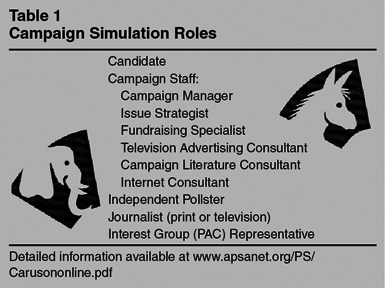
Each student assumes a role as either a candidate, member of a campaign staff, independent pollster, print or television journalist, or as the representative of an interest group. Each campaign staff includes a Candidate, Campaign Manager, Press Secretary, Fundraising Specialist, Television Advertising Consultant(s), Campaign Literature Consultant(s), Issue Strategist(s), and an Internet Consultant. The pollster works independently from the campaigns and is expected to conduct a variety of polls and provide analysis for the class. The press pool is composed of journalists from national and local media outlets. Between three and five journalists tends to work well. The special interest community is comprised of business, union, trade, or specific issue groups that are important players in the context of the race. I structure the simulation as a race for an open U.S. Senate seat in Florida. The special interest groups used in the simulation represent key interests in the state of Florida or at the national level. For example, the National Rifle Association, the Teachers Union, the Chamber of Commerce, the Citrus Growers Association, the Cattlemen's Association, the Sierra Club, Emily's List, and so forth. Although the American Association of Retired People (AARP) is a non-partisan group, I have allowed students to represent this organization given the important political power of senior citizen groups in a state like Florida. Complete role descriptions are available at www.apsanet.org/PS/Carusononline.pdf.
The method for allocating student roles is determined by the instructor. My strategy is to allow students to rank order their top three role preferences. One week before role assignment, I provide the students with the role descriptions and responsibilities and ask them to complete a form with their top three role choices. I take this information and run it through a computer program that randomly assigns roles depending on the preference orderings of the class. Since the candidate roles are extremely important, I hand select students for these roles, but I do not share this information with the class. Serendipitously, students tend to distribute themselves fairly evenly over the role choices. In the worst case scenario, a student will receive his or her third choice. Self selection of roles means that students are more likely to receive a role they will enjoy (and work hard at).

The opening event of the simulation is a press conference. At this event, the candidates officially announce their candidacies and discuss their campaign platforms. Following the candidates' statements, there is a brief question and answer period with members of the press. At the time of the press conference, the students have met in their respective groups only once so the candidates are only expected to outline three issues on which they will base their campaigns. The press is not allowed to ask specific policy/programmatic questions until later in the simulation. Over the course of the next four or five simulation meetings, campaign members work to put together a cohesive campaign while managing media relations with the press (granting interviews, responding to media inquiries, and engaging in damage control when necessary) and pursuing the financial resources of the interest group community.
Media representatives are busy covering the race and reporting (via press releases or videotaped segments) the activities of the different campaign organizations and the special interest community. The special interest representatives are busy deciding which candidate(s) to support and how. The identity of the special interest groups depends on the context of the race (Republican primary, Democratic primary, general election, nonpartisan election). Since I run the exercise as a general, but nonpartisan, election, I try to ensure that both liberal and conservative views are represented in the pool of special interests. The special interest groups have important financial resources that the candidates seek and as a result there is quite a bit of interaction between the campaign staffs and the special interest groups. Candidates are free to refuse special interest money—but few do.
Toward the conclusion of the simulation, each interest group representative is asked to make a brief presentation to the entire class regarding which candidate will be receiving a donation and/or other form of support—some groups make television advertisements for a candidate, propose a fundraising event, or offer the use of a corporate jet. At this time, the candidates announce whether they will accept the donation. In addition, when appropriate, members of the media announce endorsements of specific candidates. This particular class meeting is highly anticipated (and often raucous) as we keep track of the special interest resources flowing to each candidate on a leader board. The candidate who receives the most support from the special interest community receives five extra election votes.
The penultimate event in the simulation exercise is a debate between the candidates. Following the debate, the audience is asked to vote for a preferred candidate. Since the loyalties of the class members are already well known by this point, I include students from outside the class to give the outcome of the election an element of uncertainty. At the time of the debate, each campaign staff distributes campaign literature to the “voting public.” I begin the event with a brief introduction. In random order the audience is allowed to view television commercials taped by each campaign. We then begin the debate with opening statements from the candidates. The debate itself is moderated by one of the media representatives; the other journalists are responsible for presenting questions to the candidates. The candidates are not aware of the content of the questions before the debate. Following media questions, the candidates are each allowed a brief closing statement. At the conclusion of the class period, voting ballots are distributed to all present. I tabulate the votes at a later date and announce the results at the following class meeting, at which time we engage in a simulation debriefing. A sample schedule of simulation events is available at www.apsanet.org/PS/Carusononline.pdf.
Ideally, on days devoted to the simulation, each campaign team should have a private area in which to meet. These areas should not be too far from one another as members of the media and special interest groups will want to meet with the campaign staffs. To produce the television advertisements, the students will need access to video equipment. The necessary equipment is often available through the university, but if access to equipment is a problem, it is not necessary to produce ads. If ads are produced, the class will need to be able to view them prior to the debate and at the debate site. I arrange for the debate to take place in a venue outside of a traditional classroom. I hold the debate in a university recording studio equipped with podiums and stadium seating for the audience. The entire production is professionally videotaped (lights, camera, action!). This scenario gives students a realistic experience with a live, televised debate; however, I have also held the debate in a traditional classroom with excellent results. Access to these kinds of facilities will vary, but whatever your resources, I recommend scheduling the debate in a room other than the one used for regular class meetings.
One week prior to the start of the simulation, I provide students with a packet of information that includes a description of each role and a schedule of events and assignments. By this time, the students have already received information regarding the basics of the campaign process. As we move through the simulation we tackle specifics such as media management, fundraising, literature, voter contact, use of the Internet as a campaign tool, campaign ethics, and so forth.
Each student receives a packet of information including background material concerning the context of the simulation, role assignments, role descriptions, grading criteria, a list of written and reading assignments, a list of helpful library resources and useful web sites, and a schedule of events. Candidates are provided with basic biographical information on which to base their candidacies.2
I choose real legislators from the state and use The Almanac of American Politics published by the National Journal for basic background information.
Overwhelmingly, students enjoy the experience of the simulation exercise. The content of the exercise engages their attention and they seem to thrive on the responsibility of the roles. The role responsibilities are varied enough that every student will find something that appeals to him or her, and self selection into preferred roles helps ensure the student's interest and full participation. Students especially like that their final simulation grade is based on an individual effort as opposed to the effort of the entire staff/group, or on which candidate wins the election. The individualized grade accountability motivates them to work hard which in turn benefits the entire class.
Students who participated in the simulation exercise as part of an upper level course during the spring semesters of 2002 and 2003 were asked to provide feedback regarding the simulation experience. A total of 85 students completed the surveyed. Of these students, 80% (68) were political science majors and 20% (17) represented other majors within the College of Arts and Sciences. Roughly half of the respondents were female, the majority were upper level students (junior or senior status), and all had completed at least an introductory political science course. When asked to evaluate the campaign exercise as a learning tool on the anonymous questionnaire, 81% of students surveyed indicated that they valued the simulation experience “very highly” as a learning exercise; 19% of students indicated that they valued the simulation experience “highly.” In written comments, many students expressed an interest in becoming involved with a campaign organization. 97.6% of students surveyed indicated that the campaign exercise caused them to become more interested in the election process. 73.8% of students surveyed indicated that the experience of the simulation made them reconsider preconceived notions about the campaign process, such as how campaigns are organized and the level of complexity associated with running a successful campaign. In written comments, many students indicated that running a successful campaign was a lot more difficult that they originally believed. Many learned the value of team work and organization. The simulation also stimulated an interest in civic participation. 71.4% of students indicated that they would seriously consider working for a political campaign in the future.
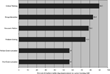
In terms of learning skills, 90.5% of students responded that the campaign exercise improved their critical thinking skills (as defined by the ability to interpret, analyze, and evaluate information). 78.6% of students indicated that their research abilities improved as a result of participation in the simulation. 75.1% reported that the simulation helped them refine their problem solving skills. Approximately 57% reported that the exercise assisted in the improvement of written and oral communication skills. 83.4% of students found that their group interaction skills improved and 88.1% reported that they were impressed by the quality of work accomplished by their colleagues. In addition, in written comments, many students indicated that the simulation helped them to identify learning skills at which they excelled and those that needed improvement. Such awareness is an important step in taking individual responsibility for the learning process (see Figure 1).

Student Assessment of Improvement in Learning Skills as a Result of Participation in the Campaign Simulation
Several commonly mentioned barriers prevent faculty from employing active learning strategies in the classroom. These obstacles include several misperceptions: (1) it will be impossible to cover the necessary course content in the time available, (2) devising and implementing an active learning strategy is too time consuming, (3) large class size prevents implementation, (4) the lecture format is the way students learn best, (5) a large amount of materials or equipment is needed to support the exercise, and (6) students will resist non-lecture approaches (Bonwell and Eison 1991, 53).
One of the benefits of the campaign simulation is the opportunity to blend active learning with traditional lecture. I alternate simulation class periods with a traditional lecture/discussion period. While I may not cover the amount of material I would if I did not make use of the simulation, all (100%) of the students surveyed in my courses indicated that they learned more from the campaign exercise than they believed they would have from a traditional lecture/discussion approach.
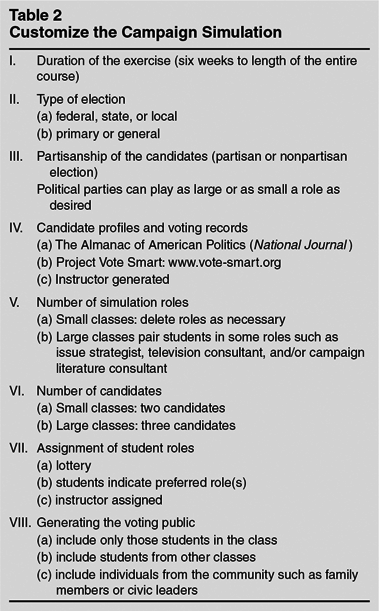
The simulation does require quite a bit of organization and supervision by the instructor, but the payoff is an energized and entertaining classroom. While unsuitable for very large survey courses, the simulation is an excellent choice for most upper level courses. As outlined in Table 2, it can be modified in various ways to suit the course and student body.

The first time I employed the simulation, I held my breath before each class, waiting for disaster to strike. Instead of disaster, the simulation ran smoothly and the students raved. The class may experience an occasional rough spot, but nothing different from what an instructor might encounter in a traditional classroom.
Initially, in any classroom environment, students may be hesitant to work with one another. I employ short cooperative learning exercises throughout the class (prior to the simulation) to familiarize students with the process of group work and to encourage trust among peers. Even if the students do not have the opportunity to work with one another prior to the simulation exercise, the fast pace and intensity of the simulation generates group cohesion. Large scale student-based learning exercises do involve an element of risk. In some cases, it may be prudent to start small and work up to something more detailed and time consuming (such as the simulation presented here).
Active learning strategies offer a powerful teaching method for engaging students in course material. Learning is not a spectator sport. Incorporating active learning exercises into the lecture/discussion framework increases motivation and enthusiasm in the classroom (Cloke 1987) and is especially important for those students with alternative learning styles (Fraas 1982). Since politics is essentially about group work and communication, active learning strategies are especially well suited to the political science discipline. The campaign simulation exercise detailed in this paper is an unusually helpful tool in explaining the campaign process. It allows students to experience first-hand the pressure, frustration, joy, and sense of accomplishment associated with the modern political campaign.
The author would like to thank Barbara Palmer for introducing her to the exercise presented in this article. The manuscript has benefited from helpful commentary from Laura van Assendelft and Jeff Harmon. All errors and omissions remain the responsibility of the author.

Campaign Simulation Roles

Student Assessment of Improvement in Learning Skills as a Result of Participation in the Campaign Simulation

Customize the Campaign Simulation