Introduction
Didymocarpus Wall. (Gesneriaceae) is a medium-sized genus with more than 70 species distributed from India to Southeast Asia (Nangngam & Maxwell, Reference Nangngam and Maxwell2013; Nangngam & Middleton, Reference Nangngam and Middleton2014; Möller et al., Reference Möller, Wei, Wen, Clark and Weber2016; Hong et al., Reference Hong, Li, Maciejewski, Wen and Do2018). The genus is characterised by the combination of lithophyte perennial habit, the ovate to ovate-cordate lamina which is mostly glandular hairy, the tubular corolla with an oblique limb (rarely trumpet-shaped or bell-shaped), two fertile stamens, three staminodes, a capitate stigma, an orthocarpic ovary and a bivalve capsule which dehisces loculicidally (Weber et al., Reference Weber, Burtt and Vitek2000). Didymocarpus is similar to Henckelia Spreng. in having dehiscent fruits on the dorsal side and chiritoid stigma (Weber et al., Reference Weber, Middleton, Forrest, Kiew, Lim, Rafidah, Sontag, Triboun, Wei, Yao and Möller2011a, Möller et al., Reference Möller, Nampy, Janeesha and Weber2017). The greatest diversity of species of Didymocarpus in this region is in China and Thailand, in which 30 known and 23 known taxa have been reported, respectively (Nangngam & Maxwell, Reference Nangngam and Maxwell2013; Nangngam & Middleton, Reference Nangngam and Middleton2014; Möller et al., Reference Möller, Wei, Wen, Clark and Weber2016). In Indochina, only five species have been recorded from Vietnam (Hong et al., Reference Hong, Li, Maciejewski, Wen and Do2018) and none in Laos and Cambodia (Cho et al., Reference Cho, Chhang and Kim2016; Zhu, Reference Zhu2017). Didymocarpus bonii Pellegr. is the only species listed in the Checklist of the Vascular Plants of Laos (Newman et al., Reference Newman, Ketphanh, Svengsuksa, Thomas, Sengdala, Lamxay and Armstrong2007), but this species has since been removed to Petrocodon Hance based on the results of a phylogenetic analysis of the trnL-F and internal transcribed spacer (ITS) regions (Weber et al., Reference Weber, Wei, Puglisi, Wen, Mayer and Möller2011b) and is now recognised as Petrocodon bonii (Pellegr.) Mich.Möller & A.Weber. The lower diversity in the region is probably a consequence of insufficient botanical exploration. Therefore, diversity and distribution patterns of Gesneriaceae in Indochina should be treated as underestimated.
Nam Kading National Protected Area in central Laos is one of the biodiversity hotspots in the country (Hallam & Hedemark, Reference Hallam, Hedemark, Sunderland, Sayer and Hoang2013). Recently, a series of botanical studies has elucidated its plant diversity and discovered numerous new species and records from this area, including Strobilanthes namkadingensis Soulad. & Tagane (Acanthaceae; Souladeth et al., Reference Souladeth, Tagane, Zhang, Okabe and Yahara2017), Begonia namkadingensis C.-J.Yang, Soulad. & Tagane (Begoniaceae; Yang et al., Reference Yang, Tagane, Souladeth, Okabe, Hu and Yahara2018), Monoon namkadingense Soulad. & Tagane and Neo-uvaria laosensis Tagane & Soulad. (Annonaceae; Tagane et al., Reference Tagane, Souladeth, Zhang and Yahara2018b), as well as 30 new records for the flora of Laos (Tagane et al., Reference Tagane, Souladeth, Rueangruea, Okabe, Zhang, Chayer, Yang and Yahara2018a)
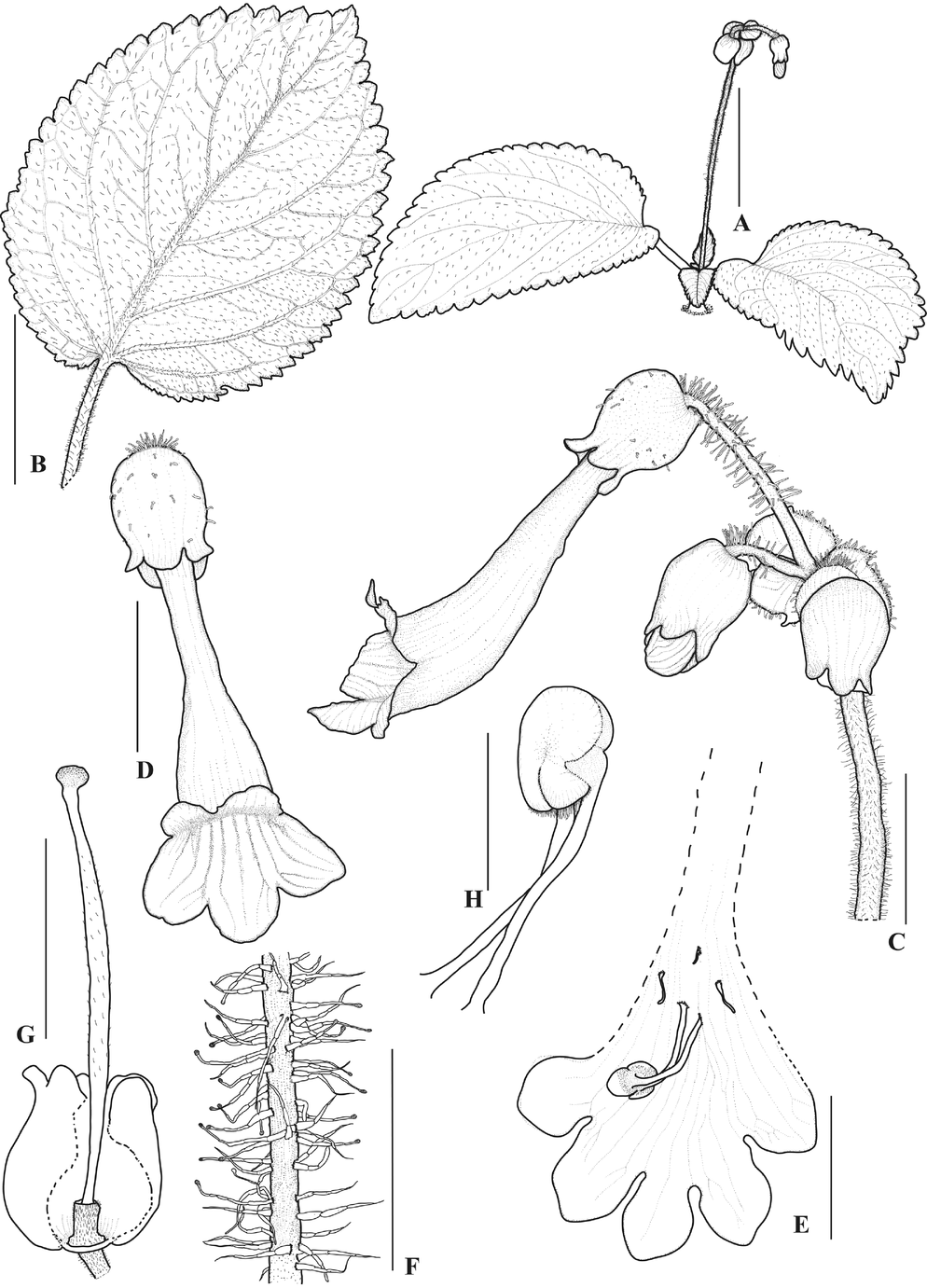
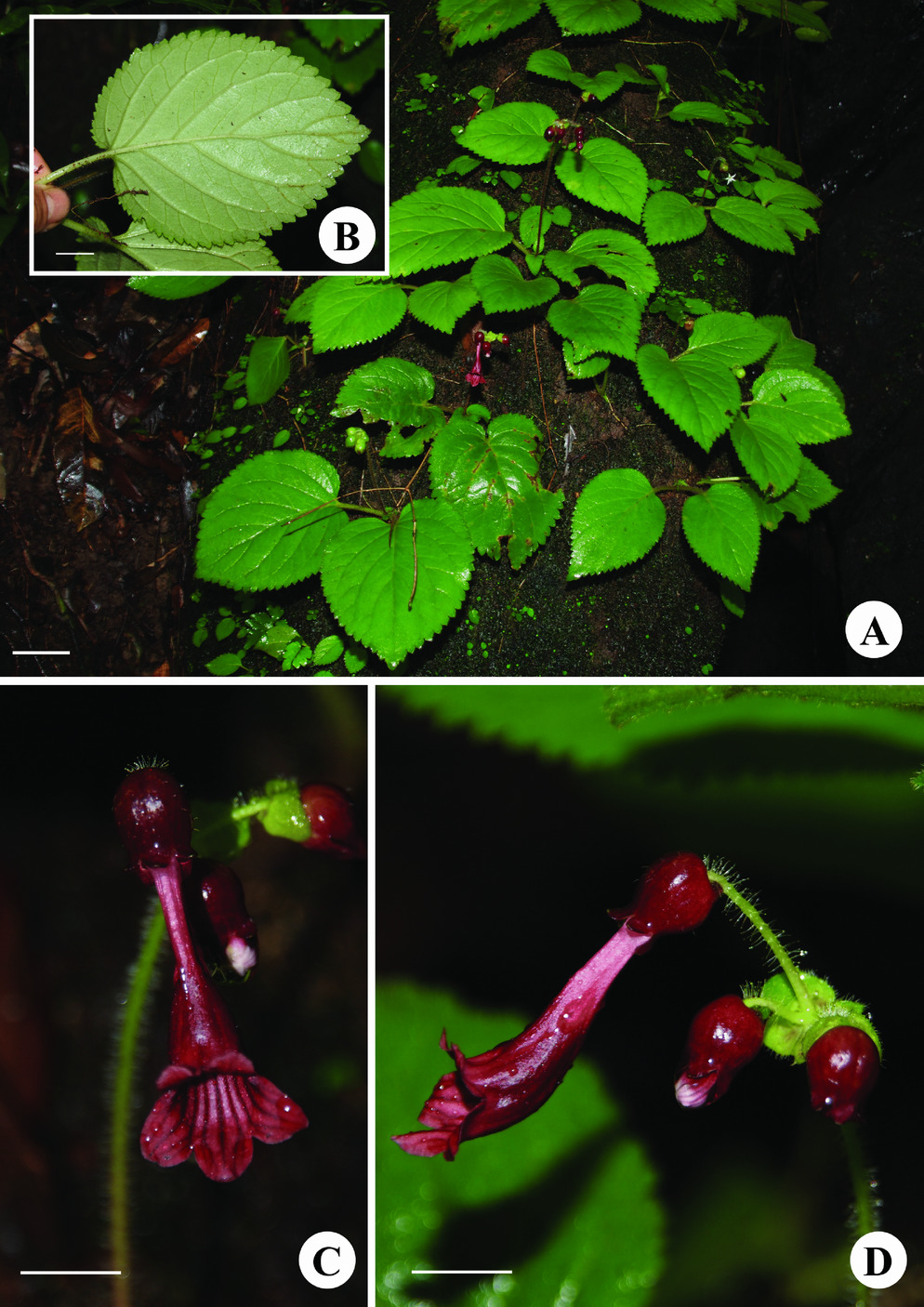
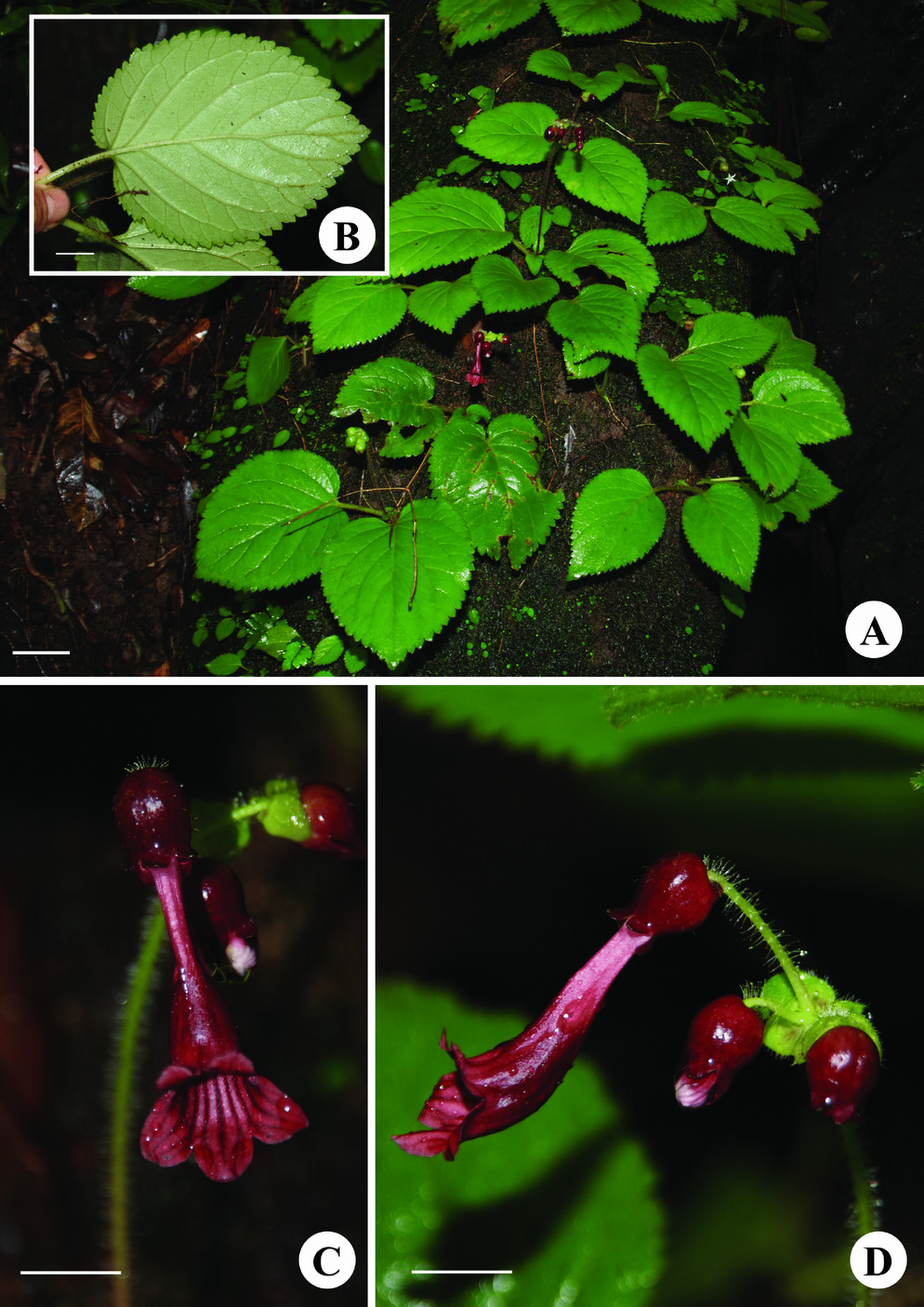
In this paper, we describe a new species of Gesneriaceae, Didymocarpus middletonii Souvann., Soulad. & Tagane, found on limestone rocks along a stream in Nam Kading National Protected Area. Photographs, a hand-drawn illustration, and DNA barcodes of rbcL, matK and ITS (Kress & Erickson, Reference Kress, Erickson, Kress and Erickson2012) are also provided for the new species.
Materials and Methods
Morphological observations
The new species was recognised by detailed comparisons with morphologically similar species: descriptions found in a review of the literature (Nangngam & Maxwell, Reference Nangngam and Maxwell2013; Nangngam & Middleton, Reference Nangngam and Middleton2014; Möller et al., Reference Möller, Wei, Wen, Clark and Weber2016; Hong et al., Reference Hong, Li, Maciejewski, Wen and Do2018); dry specimens from the herbaria BKF, FOF, FU, HNL and KAG; and digitised plant specimens available online (e.g. JSTOR Global Plants, no date). The measurements of the description below are based on the herbarium materials we collected.
DNA barcoding
Total DNA was extracted from silica gel–dried leaves collected in the field. DNA extraction was carried out by using a modified CTAB protocol (Doyle & Doyle, Reference Doyle and Doyle1987), as described in detail by Toyama et al. (Reference Toyama, Kajisa, Tagane, Mase, Chhang, Samreth, Ma, Sokh, Ichihashi, Onoda, Mizoue and Yahara2015). Amplification and sequencing of the three DNA barcode regions, rbcL, matK and ITS, were performed according to published protocols (Kress et al., Reference Kress, Erickson, Jones, Swenson, Perez, Sanjur and Bermingham2009; Dunning & Savolainen, Reference Dunning and Savolainen2010, for rbcL and matK; Rohwer et al., Reference Rohwer, Li, Rudolph, Schmidt, van der Werff and Li2009, for ITS).
Taxonomic Treatment
Didymocarpus middletonii Souvann., Soulad. & Tagane, sp. nov.
Didymocarpus middletonii is similar to Didymocarpus brevicalyx Nangngam & D.J.Middleton, Didymocarpus formosus Nangngam & D.J.Middleton from Thailand and Didymocarpus puhoatensis X.Hong & F.Wen from Vietnam but differs from these three in having an urceolate calyx (versus campanulate) and a smaller corolla (c.3.4 cm long versus longer than 4.5 cm). – Type: Laos, Nam Kading National Protected Area, Bolikhamxai Province, Pak Kading District, 18°20′38.2″, 104°09′29.5″, 665 m elevation, 29 vi 2017, Tagane, S., Souladeth, P., Okabe, N., Yang, C.-J. L1198 [fl.] (holo FOF; iso E, HNL, P). Figs 1, 2.
Didymocarpus middletonii Souvann., Soulad. & Tagane. A, Habit; B, abaxial surface of lamina; C, inflorescence with flower (lateral view); D, flower (top view); E, dissected corolla, showing stamens and staminodes; F, multicellular glandular and eglandular hairs on pedicel; G, calyx and pistil; H, fertile stamens. Scale bars: A, 4 cm; B, 3 cm; C–E and G, 1 cm; F and H, 4 mm. Drawn by K. Souvannakhoummane from Tagane et al. L1198 (FOF).

Didymocarpus middletonii Souvann., Soulad. & Tagane in the type locality. A, Habit; B, abaxial surface of lamina; C, flower (front view); D, flower (lateral view). Scale bars: A, 4 cm; B–D, 1 cm. Photographed by S. Tagane on 29 June 2017.
Deciduous, perennial, lithophytic herb, 8–16 cm tall. Stem erect, 0.3–0.7 cm long, single, densely covered with multicellular glandular hairs. Leaves opposite, anisophyllous; petioles terete, 1.5–3.8 cm long, covered with multicellular eglandular hairs, light green; blade asymmetrical or subsymmetrical, broadly ovate, 8–11.5 × 6.5–8.5 cm, membranous, base slightly oblique, slightly cordate to broadly obtuse-cuneate or sometimes truncate, apex acute, margins serrate, dark green adaxially, light green abaxially, densely covered with white multicellular eglandular hairs on both surfaces, venation pinnate, midrib prominent beneath, secondary veins 5–6 on each side of midrib, subopposite, sometime alternate, obscure above, prominent beneath. Inflorescences terminal, cymose, up to 14.2 cm long, 1- to 3-flowered; peduncles slender, 8–11.4 cm long, dark brown to reddish towards green, covered with multicellular glandular and eglandular hairs; pedicels 7–12 mm long, reddish towards green, with indumentum as on the peduncle. Bracts paired, orbicular, c.3 × 2.7 mm, apex rounded, margin entire to crenate, green, covered with multicellular eglandular hairs. Calyx shallowly 5-lobed, radially symmetrical, c.7.8–9.2 mm long, c.7 mm in diameter, dark red, sparsely covered in multicellular eglandular hairs, tube urceolate, c.7 mm long, lobes triangular, c.2 × 2 mm, apex acute. Corolla funnelform, c.3.4 cm long, light red at base, reddish to blackish purple elsewhere, 9 dark stripes inside, glabrous; tube c.3 cm long, base narrow, c.2.4 mm in diameter, dilated and slightly ventricose towards the throat, widest at throat, c.9 mm in diameter; corolla lobes suborbicular or triangular, lower lip 3-lobed, lobes triangular, more or less equal, c.6 × 5.5 mm, upper lip 2-lobed, lobes suborbicular, c.4.5 × 4.5 mm long, apex rounded. Fertile stamens 2, inserted c.1.4 cm from the base of the corolla; filaments c.5.8 mm long, glabrous; anthers connected, ellipsoidal, c.2 mm long, 1 mm in diameter, tips and bases rounded, silky hairy on the back. Staminodes 3, adnate to corolla c.1.2 cm from base, reduced to thin filaments, lateral ones 2 mm long, the central one 1 mm long, glabrous. Disc cylindrical, c.1.8 mm long, margin irregular. Pistil c.2.2 cm long, sparsely glandular puberulent; ovary narrowly linear, c.1.8 cm long, sparsely glandular puberulent; stigma capitate, concave, papillose.
Distribution. Laos, Bolikhamxai Province (so far known only from the type locality).
Habitat and ecology. Didymocarpus middletonii grows on shaded rocks, along a stream in semi-evergreen forest. Given that most of the individuals seen during our field survey had flower buds, the species should be in full bloom in July.
Etymology. The specific epithet honours Dr David Middleton (Singapore Botanic Gardens), from whom we received the most generous advice regarding this new species.
Vernacular name.  [Dok Lam Phong Hin Si Mouang (meaning: limestone purple funnel flower)].
GenBank accession nos. LC373520 (rbcL), LC373521 (matK) and LC373522 (ITS); we sequenced Tagane et al. L1198.
Preliminary conservation assessment. Critically Endangered (CR). Didymocarpus middletonii is known only from a single population, with c.30 individuals, in a very restricted area of limestone karst in Nam Kading National Protected Area. Therefore, we propose the status CR for this species according to the IUCN criterion CR B2a D (IUCN, 2012). The habitat is very close to the construction of Nam Kading Dam, which is likely to impinge on the survival of this species.
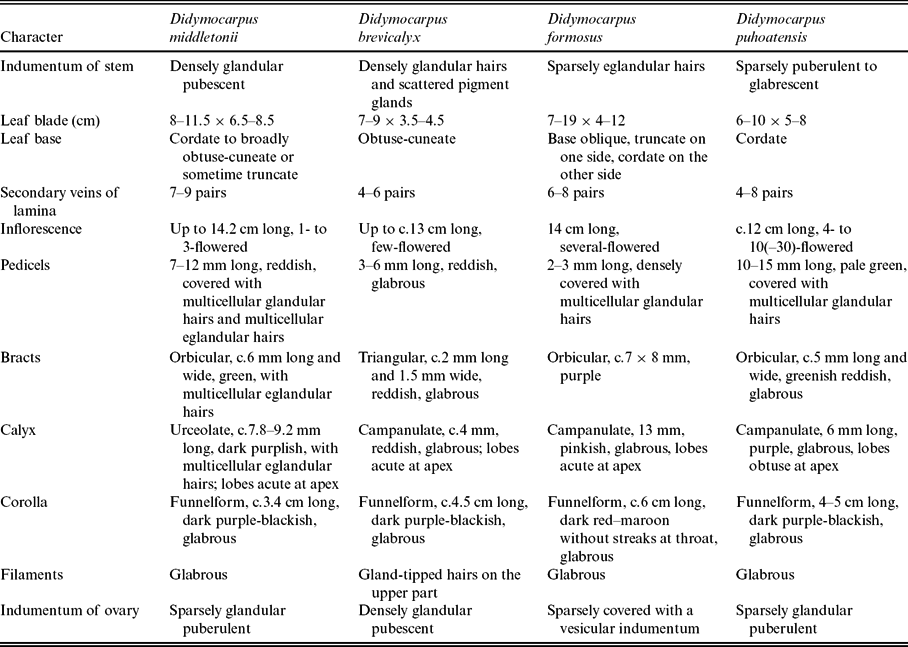
Didymocarpus middletonii is similar to D. brevicalyx but easily distinguished by its wider lamina (6.5–8.5 cm wide versus 3.5–4.5 cm wide), pedicel and bracts covered with glandular hairs (versus glabrous), smaller corollas with longer staminodes (corolla 3.4 cm long, staminodes 1–2 mm long versus corolla 4.5 cm long, staminodes 3–5 mm long). Didymocarpus middletonii is similar to D. formosus but easily distinguished by its small habit (versus 40 cm tall), bracts green (versus purple) and smaller corolla (versus 6 cm long). Didymocarpus middletonii is similar to D. puhoatensis but easily distinguished by its bracts covered with eglandular hairs (versus glabrous) and shorter pedicels (versus 1–1.5 cm long). A detailed morphological comparison of these allied species is given in Table 1.
Diagnostic characters for Didymocarpus middletonii Souvann., Soulad. & Tagane and its relativesFootnote a

a The measurements of Didymocarpus brevicalyx and D. puhoatensis are taken from Nangngam & Middleton (Reference Nangngam and Middleton2014) and Hong et al. (Reference Hong, Li, Maciejewski, Wen and Do2018), respectively.
Acknowledgements
The authors are grateful to the managers and staff of Nam Kading National Protected Area for permitting and supporting our botanical inventory in the protected area. Thanks to Dr David Middleton (Singapore Botanic Gardens) for his valuable comments on species identification. We also thank the curators of the herbaria BKF, FOF, FU, HNL and KAG for granting access to their specimens, and Keiko Mase (Kyushu University) for her help with DNA sequencing. This study was supported by the Environment Research and Technology Development Fund (4-1601) of the Ministry of the Environment, Japan, and MEXT/JSPS KAKENHI (grant no. JP15H02640).