Introduction
Complex interventions, or those comprising multiple components (Campbell et al., Reference Campbell2000) are an increasingly popular way to improve health for older adults at risk of social isolation. The need for intervention for these adults arises from evidence for an association between social isolation and mortality (Holt-Lunstad et al., Reference Holt-Lunstad, Smith, Baker, Harris and Stephenson2015), cognitive function (Fratiglioni et al., Reference Fratiglioni, Paillard-Borg and Winblad2004; Engelhardt et al., Reference Engelhardt, Buber, Skirbekk and Prskawetz2010), and mental and physical health outcomes (Golden et al., Reference Golden, Conroy and Lawlor2009). Older adults living alone are at increased risk of social isolation and also of adverse health outcomes such as malnutrition (Walker and Beauchene, Reference Walker and Beauchene1991; de Castro, Reference de Castro2002; Hseih et al., Reference Hseih, Sung and Wan2009). Since malnutrition is associated with undesirable outcomes such as impaired immunity and quality of life (Chandra and Kumary, Reference Chandra and Kumary1994; Vetta et al., Reference Vetta, Ronzoni, Taglieri and Bollea1999), intervention is warranted.
Increasingly, social cognitive interventions are used to improve health outcomes for older adults (Bandura, Reference Bandura2004). The social cognitive framework focuses on learning through interactions with others, and harnesses these interactions to improve self-efficacy and self-regulation in a number of domains, including nutrition (Hendy et al., Reference Hendy, Nelson and Greco1998; Anderson et al., Reference Anderson, Winett and Wojcik2007). As such peers are key in delivering social cognitive interventions, since observing a peer engage in a behavior increases the likelihood of a participant engaging in that behavior, and peers have been shown to increase the success of nutrition interventions (Hyland et al., Reference Hyland2007; Perez-Escamilla et al., Reference Perez-Escamilla, Hrorni-Fiedler, Vega-Lopez, Bermudez-Millan and Segura-Perez2008). Utilizing peer volunteers to deliver a nutritional education has the additional benefit of facilitating social interaction and increasing social support in an ostensibly nutritional intervention (Masi et al., Reference Masi, Chen, Hawkley and Cacioppo2011; Toepoel, Reference Toepoel2012; Hemingway and Jack, Reference Hemingway and Jack2013). Since social cognitive interventions use peers to deliver interventions they can be said to be complex, since they focus on delivery of support within a given domain (in this case, nutrition) while also delivering intervention in social support.
Learning from peer volunteers by using a qualitative interview approach can provide the research team with valuable insights into the effectiveness of the intervention, and the faithfulness with which the intervention was delivered (Campbell et al., Reference Campbell2007). Hyland and colleagues interviewed peer volunteers engaging in a nutritional intervention, and found that while the volunteers worried about the limited facilities available to them, as well as about the health status of their participants, they also felt that training was of central importance to their involvement in the intervention (Hyland et al., Reference Hyland2007); a finding corroborated by a similar study of volunteers in a social support intervention (Mui et al., Reference Mui, Glajchen, Chen and Sun2013). Mui and colleagues also found that feeling appreciated was of key importance for volunteers (Mui et al., Reference Mui, Glajchen, Chen and Sun2013). These findings are important to designing future interventions, and for refining novel interventions (Fonteyn and Bauer-Wu, Reference Fonteyn and Bauer-Wu2005). Since our intervention was a novel social and nutritional intervention, we wanted to explore its feasibility, effectiveness, and enjoyability by interviewing the peer volunteers involved.
Since volunteers are also instrumental in process evaluation (Oakley et al., Reference Oakley, Strange, Bonell, Allen and Stephenson2006), we also wanted to investigate whether volunteers had insights to share with the researchers on the success of the intervention and on how to improve potential future refinements of this intervention. As has previously been pointed out, process evaluations are required in order to fully explain trial results, whether positive or negative (Campbell et al., Reference Campbell2007).
Method
Participants
Participants in this study had previously acted as peer volunteers in a social cognitive nutritional intervention, whereby volunteers visited older adults living alone once weekly for 8 weeks, to prepare and share a meal together (see McHugh et al., Reference McHugh, Lee, Aspell, Lawlor and Brennan2015), in accordance with social cognitive principles of vicarious modeling and learning through interactions (Bandura, Reference Bandura2004). Volunteers were trained prior to involvement to focus on creating an equal partnership with their partners throughout the intervention. Training consisted of a single 8-hour day, wherein volunteers attended sessions delivered by research psychologists and a clinical nutritionist. Sessions included: an overall introduction to the intervention, a brief description of Social Cognitive theory, basic nutritional education and culinary skills, a session on intervention protocol including training on what to do in case of an emergency, the importance of consistency in the intervention delivery, protocols for contacting the research team, and how to use the RelAte guidebook, which included recipe ideas for use in the intervention. Volunteers were also encouraged to think of themselves as researchers, evaluating the efficacy of the intervention and considering room for improvement throughout their involvement. Volunteers were brought to the home of their participant by a member of the research team and a full risk assessment of the participants’ home was performed, which had been a recommendation made by the approving ethics committee. Risk assessments allow volunteers to become aware of the risks in the participant home, while understanding that every home has risks. For instance, volunteers visiting participants who lived in apartments were made aware of the location of the fire escape, and those visiting participants who used gas hobs were directed to the national gas service website if they were not familiar with natural gas safety procedures. Emergency contacts for the participant were given to the volunteer in case anything happened during their visits. Once the research team had introduced the volunteer and participant, they had the opportunity to request a different pairing. If happy to continue with the pairing, volunteers received weekly verbal support and financial compensation for the purchase of ingredients for the weekly meals. Verbal support was provided when volunteers rang the research team before visiting the participant, and after 90 minutes (the recommended duration of the intervention sessions), the research team would then call the volunteer to inform them that the session should end and to ensure that there had been no problems.
All volunteers from the intervention were invited to take part in the current study via convenience sampling. Fifty volunteers (seven male) had initially been recruited through active retirement groups, parishes, senior citizen groups, and the national media. All volunteers were of white Irish origin. Of these 50 volunteers, all but two were retired; the two who were not retired were working part-time. Volunteers were from the greater Dublin area. Following completion of the trial, all 50 volunteers were contacted and invited to participate in a second qualitative study, the results of which are presented below. Twenty one volunteers consented to take part (17 female). Reasons for non-participation were mostly due to time constraints and no volunteers reported reasons for non-participation that would have impacted study results. The two volunteers who were still working did not participate in the focus groups due to time constraints. Four of the seven male volunteers participated in the focus groups meaning that male volunteers from the original sample were over-represented relative to female volunteers, but apart from this no systematic differences between the participating group and the original group were detectable. Informed written consent was acquired from each volunteer at the study outset. We considered the ethical implications of asking volunteers to discuss their partnerships within a focus group setting and decided to offer an alternative of engaging in one-to-one interviews, if they felt they would rather disclose directly to a researcher (although no volunteers chose this option for this reason). Volunteers were also assured that their data would be kept confidential and would not be relayed to the study participants. Volunteers who participated in the focus groups had a mean age of 66.81 (range 57–79) and had made a mean number of 5.93 visits during their tenure with the study (range 3–8).
Design
A qualitative focus group methodology was employed. Focus groups can elicit discussion and elaboration among participants and are useful when the researcher is interested in interaction between individuals as a tool for expanding upon themes, rather than merely as a means of conducting several interviews at once (Kitzinger, Reference Kitzinger1995). This is because interaction, agreement, and disagreement among group members can help participants to revise and clarify their meanings, confirm their opinions, and theoretically, can lead to a deeper consideration of the research question on the part of the participants. According to Kitzinger, the ideal focus group contains 4–8 individuals and lasts for 1–2 hours. We followed these guidelines in designing our focus groups. A semi-structured guide was used to facilitate discussion while allowing participants to guide the content of the interviews (see Appendix A1 published as supplementary material online attached to the electronic copy of this paper at http://journals.cambridge.org/ipg). The study was approved by the local Research Ethics Committee.
Procedure
Focus groups were held in a boardroom. Tea, coffee, and pastries were provided and volunteers were thanked for their time as well as for their involvement in the intervention. In accordance with suggested reporting guidelines in qualitative research we here report the characteristics of the interviewers (Tong et al., Reference Tong, Sainsbury and Craig2007). The interview and focus groups were conducted by two female researchers who held MSc. Degrees in Psychology, one of whom had been involved in the study since its onset, and who had previously met all volunteers during their training and throughout the intervention. The researchers were supervised by a female post-doctoral researcher with prior experience of conducting several qualitative studies with older adults. All volunteers had prior knowledge of the supervising researcher and one of the interviewers, and were familiar with their occupations, and their goals in conducting the research. Since the interviewers were invested in the success of the intervention, we must consider that bias was possible during the execution of the focus groups, but an interview guide was agreed upon beforehand and hopefully minimized the impact of bias on the questions asked during the focus groups. Since the interviewees knew the researchers before the focus groups, it is also possible that some due to social desirability responded to questions favorably and failed to report all grievances or issues with the intervention: this is another consideration. The first focus group (FG1) consisted of four participants. The second group (FG2) consisted of six participants, the third (FG3) consisted of seven participants, and the fourth (FG4) consisted of four participants with an added interview conducted at the end. One additional one-to-one interview was facilitated for a volunteer who had arrived late to a focus group. The average length of a focus group was 59.4 minutes (range 45–68 minutes).
Data analysis
All focus groups were recorded using Dictaphones and transcribed verbatim by the two researchers. Following this, one of the researchers and the post-doctoral researcher independently coded the transcripts, using a thematic analysis approach as described by Braun and Clarke (Braun and Clarke, Reference Braun and Clarke2008). Since we had a specific research question, deductive thematic analysis was used. This approach brings researchers from description to interpretation. First researchers read and reread the transcripts to gain a sense of immersion and familiarization with the data. This process was informed by the researcher's prior knowledge of and interactions with the volunteers, which was not avoidable in the circumstances. A process of initial open coding was followed, whereby each researcher recoded codes in relation to the transcripts, before iteratively comparing and evaluating each code in relation to the rest of the data. Following this process, the researchers compared their final analyses, and discussed any disagreements until a consensus was reached. Codes were then grouped for similarity, in a cooperative process between the two researchers, and developed into themes, which were reviewed iteratively, defined, and are described below. Upon completion of each focus group, researchers repeated the above process, and discussed at length the contribution made by each successive focus group to the richness of the dataset. When the fourth focus group was conducted, the researchers agreed that little had been added to the theoretical richness of the data by this point and this was taken to mean that data saturation had been reached.
Results
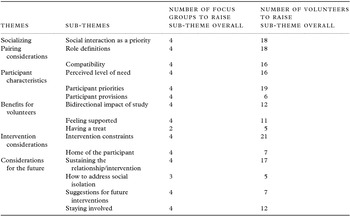
Six themes were found with a total of 16 subthemes contained therein. We will take each of these themes in turn, and give examples from the transcripts. Participants are coded with the name of the focus group (FG) that they participated in (numbers 1–4) and their participant within that focus group (e.g. V3). Themes and subthemes are summarized in Table 1.
Themes and subthemes described in the focus groups, including a count of the number of focus groups (4 total) in which each theme was raised, and a count of the number of volunteers (18 total) to raise each theme

The first theme that we took note of in the data was socializing in the context of the multicomponent intervention. Volunteers spoke at length about how they prioritized the social aspect of the intervention; “FG3V3: I felt conscious that it was more about the social visit”. For many, the mealtime seemed to be a portal to facilitating social interaction. This was illustrated as follows: “FG3V3: We were talking while cooking so you'd hardly notice that we were cooking. . .then we'd sit down and prepare the thing and have a talk again”. Volunteers spoke about the importance of establishing a rapport with their partners and this was generally reported as having gone successfully; FG3V2: “We got to know each other, we were very comfortable with one another”; FG1V3: “We got on like a house on fire and we worked out well”. Some volunteers expressed difficulty in getting through the duration of the intervention because they did not get on well with their partner. For these volunteers, the intervention was described more so as a chore than an enjoyable experience; FG1V2: “There was a difficulty in my mind, going through the motions”. This finding is interesting considering that these individuals were volunteering their spare time to engage with the research.
A second theme raised in the data was that of pairing considerations. A few volunteers were concerned about the Role Definitions that developed during the course of the intervention between partners. The intervention had been designed in accordance with the tenets of Social Cognitive Theory, focusing on an equal partnership. Instead of feeling that they were participating in a truly equal partnership, some volunteers reported that they were made to feel like a member of staff working for the participant (FG3V3: “I felt because I was a visitor, they kind of felt that I was the home help”). The research team had tried to anticipate difficulties with the relationship by naming those involved as participants and volunteers, rather than recipients and providers, but this nomenclature did not appear to alleviate the issue of the power balance for most pairs.
Compatibility was raised as a key issue in successful partnerships by many volunteers. The volunteers in this group agreed that older adult volunteers were preferable to students or younger adults in this regard. However, one volunteer disagreed and said that some people just wanted to talk to anybody and that age would not affect this. (FG3V5: “I don't think so, I think my person would have just enjoyed telling her story. If the student was prepared to listen. . .definitely she'd just be delighted to tell this young person all she's been through”). One volunteer spoke about her bond with her partner being based on having similar backgrounds (FG3V7: “We found that bond and that trust and things about the country and our own background and things like that”). Another volunteer attributed her compatibility to her partner to their similar taste in food (FG4V4: “We both liked the same food, like we discussed always what we were going to have and eh, like we never had a ripple about that”). the growing movement of personalized care.
Another theme apparent in the data was the characteristics of the participant. Some volunteers described the perceived level of need of their partner as being overwhelming, or to an extent that they could not fulfill. However, many more volunteers expressed considerable disappointment that their partners did not have what they saw to be a high level of need. These volunteers had apparently expected to be giving a great deal of help to an individual in need, and were somewhat disappointed that they did not feel needed (FG4V1: “I thought she was really interesting and very down to earth and actually very busy and not somebody in huge need of a visit”).
Certainly some volunteers did feel that they could spot the needs of their partner; it is possible that it takes some skill to be able to help people with social isolation, since it may present itself merely as a wish to talk (FG3V6: “I think it's certainly filled a need because I know with my lady who was lovely and we got on so well, she wanted to talk, talk, talk and I found it so hard leaving. . .she would just love if I had just sat there and talked to her”).
Volunteers also discussed the priorities for their participants. Participants were seen as having unique needs which were sometimes difficult for their volunteer partners to cope with; FG1V2: “You know we weren't there for counselling or anything like that”). Physical issues too concerned the volunteers, such as sensory and dietary issues. One participant was very worried that her partner with angina would experience a cardiac event while she was present, and this anxiety interfered with her ability to relax and enjoy the intervention (FG3V2: “I used to be afraid when [they] told me [they] had angina if something. . .have one while I was there”). As well as confronting personal issues of the participant, volunteers also described the personal preferences of their partners. Since the aim of the intervention was to socialize, this may have attracted participants who otherwise would have dined out of the home. In both cases where this was reported, the participant had recently transitioned to living alone, so eating out may have been an attempt to combat isolation, or a reaction to losing the household member who routinely cooked. Similarly, other partners were apparently simply not in the habit of cooking. (FG2V6: “I think he just got out of that habit, just got out of the habit of cooking for himself”). Some volunteers remarked that while their partners may have had the ability to incorporate cooking more into their daily lives, that habit meant that they did not wish to do so in later life, which may have been an age-related generalization (FG1V1: “People when they get older too don't want to change, they don't, I mean my ones would never eat curry ever ‘cos there was no curry eighty years ago you know?”).
Volunteers also discussed their participants in terms of the provisions that they made for them during the intervention. Many volunteers described leaving leftovers for their participants, or showing them how to safely freeze and otherwise store leftover food. Volunteers described how they taught their partners new recipes and felt that they were received well in many cases (FG2V5: “She was just the person who always cooked the same bacon and cabbage, blah blah blah, she never did different recipes, so she loved the fact that I was doing fishcakes or whatever”). This obvious satisfaction that the volunteers drew from providing their partners with tangible support was in contrast to the suspicion by another volunteer that participants had in fact only gotten involved in the research to get free food (FG2V1: “If there's something going for free or for nothing, Jesus, why wouldn't you?”).
Promisingly, volunteers spoke at length about the bidirectional benefits of the intervention from their perspective. Learning new skills was also reported to be a benefit, which was not explicitly linked to cookery but likely more to do with the situation of meeting someone new and preparing meals with them as a whole (FG2V6:”I was sort of exploring this thing myself, you know like, I mean say something happened to me and I'm out on my own, like you're learning, you're learning skills and stuff that you probably don't think you have”). One volunteer commented that she benefitted from the social aspect of it as much as her partner had, indicating that even those who do not identify as socially isolated may benefit from or enjoy increased social participation opportunities (FG3V2: “I'm on my own a good bit now, so I had her company, it wasn't, I gained from it too”). The benefits received by volunteers were also largely to do with the reciprocity of the relationship that they had built with their partner, which in many cases became friendships (FG2V2: “I think I made a difference, she certainly made a difference in my life”).
Volunteers reported enjoying the feeling of being a part of the research team, which is key in maintaining involvement. Volunteers reported mostly feeling supported by the research team (FG4V2: “I thought it was very well run, you know. You had your booklet and you had your vouchers, and I thought that was all very clear and precise and you know, done well”), although some had had bad experiences in contacting the team during the day (typically during lunchtime).
As well as this, the meal itself was perceived by many to be a treat. Some partners took time to set the table and make an occasion of the meal, which heightened the sense of the meal as an occasion (FG3V5: “The table would be set outside for us, like she really looked forward to me calling. . .it wasn't the food, it was the whole visit”). The fact that so many volunteers viewed their weekly appointment with their partner as a treat is a desirable outcome and predicts that the volunteers would remain committed to the intervention if it were longer-term.
Volunteers discussed more practical points relating to the intervention also. These were raised mostly as considerations for the researchers when reflecting on the success of the intervention. There were intervention constraints acknowledged by volunteers. Volunteers were paired with participants who lived in the greater Dublin area and while every effort was made to ensure that they lived within a 10-minute drive of their partner, for some volunteers the journey was slightly longer (FG4V3: “I didn't mind travelling, please don't misunderstand that, but people might have a problem with travel, so I'd look at the geography”). Time constraints were faced by many volunteers, and trying to find a time that suited both partners was reported to be tricky at times. Some partners missed sessions but the median number of sessions completed out of 8 was 7, indicating a high level of compliance and also that the time commitment was likely suitable to volunteers. Volunteers were concerned about having enough time in the 90-minute slot each week to complete the mealtime intervention (FG4V5: “I found the hour and a half very tight from the cooking point of view”) and some volunteers reported that they did not stick to this time limit (FG4V5: “I didn't have the heart to sort of say, ‘I need to go’. . .I just wanted to make it as relaxing as possible”). Financial constraints relating to the intervention were also raised during the focus groups. A budget of €8 was allotted per week, and given in the form of vouchers for a supermarket chosen by the volunteer. While most volunteers felt this to be a generous budget, some felt it was insufficient (FG1V3: “The pricing of it made it very difficult to get food”). Shopping constraints were mentioned also. Some volunteers experienced supermarket staff who had not used vouchers before and faced some difficulties with these (FG1V3: “I drove the [supermarket] nuts, they never saw them before, they couldn't scan them. . .you [the researcher] got it sorted for me and I didn't have difficulty after that”).
Volunteers had some issues to report regarding the home of the participant also. These issues included hygiene, visitors in the home during the intervention timeslot, facilities for cooking and eating, and a sense of a lack of consideration for the volunteer. In some cases the issues were beyond the remit of the research, as in those cases where the kitchen facilities were insufficient to prepare a meal (FG2V6: “The kitchen could have done with an upgrade”). However, most volunteers had positive things to say about their partner's homes (FG3V4: “The lady I was with was spotless as well, she was immaculate”; FG1V2: “The best thing about it was there was nothing that I wanted in terms of equipment, whether it was a specific frying pan, a grip pan, a small saucepan. She had all kinds of gadgets”).
The final theme that we observed in the data was the theme of Future Considerations. This describes advice that was given by volunteers for how the researchers could best proceed in this research area. Volunteers were concerned about how to sustain the relationship with their partner after the end of the research project, likely reflecting the bonds they had forged with their partners, and continued concern for their well-being after completing the study. Volunteers reported feeling that they wished they could have kept the contact going but had been asked by the research team to cease contact after the 8 weeks’ intervention until all testing was completed with participants, so as not to affect study results (FG4V5: “I was afraid to keep in touch, I don't think we were allowed to do that”), but some had contravened the guidelines and maintained contact anyway (FG4V1: “Myself and [names partner] are in touch though, and I hope that's ok!”), which, thought it affects the validity of study results, speaks to the strength of the bonds built by many partners in the intervention. This issue of how to detach after 8 weeks or considering sustaining the relationship again relates to the difference between research and a service, which one volunteer noted (FG3V6: “It goes back again to the whole eight weeks being a project rather than a service”).
Volunteers had also thought carefully about how to address social isolation among older adults, in keeping with the theme of the research. Volunteers advocated the use of creative solutions to tackle social isolation and reported seeing the need for it in the community (FG2V6: “I think the ideals of the study are very good in that the meal becomes the focal point of the day you know?”) but had realized during their involvement with the study that it is very difficult to recruit individuals who are truly socially isolated (FG4V2: “You see people who are needy, they're not going to be the first people to put themselves forward for something like this because they're shy, and maybe they don't want to let others see that they actually do need it”).
Volunteers had some suggestions for future interventions , which included making the research aims of an intervention as clear as possible in complex intervention situations (FG1V3: “Maybe a bit more clarity around what's happening so that we're not bringing separate agendas”). One volunteer suggested that group interventions may work better than a dyadic design, since “one on one is fairly intense”, and group interventions would facilitate more connections among more individuals (FG4V4: “Although she made enormous strides in it, to have something where you meet as a group you know? Maybe that would be totally unrealistic, but I just thought that could have been a little bit of an extension and people maybe would have felt a wee bit more secure”). Volunteers also suggested changing the meal to something of a lower burden such as afternoon tea, so that the focus could be more clearly on social interaction (FG1V1: “I'd skip the dinners and have the afternoon tea”).
Volunteers reported an interest in staying involved in both volunteering and in the research process (FG4V5: “I must say, I'm quite willing to do just one more, and maybe something more challenging after that. . .whatever you have worked out for me”) and more broadly with the voluntary sector; several volunteers mentioned that since taking part in the research program they had gone on to volunteer with other services.
Discussion
The current study consulted peer volunteers following engagement in a complex intervention, to gain their perspectives on the success of the intervention. The current study results are informative as a process evaluation and refinement of this novel social and nutritional intervention. We conducted focus groups with 21 participants, and arrived at a final six themes describing volunteer experiences in the intervention. Results indicate that the intervention was well received by volunteers but that they were concerned that the research aims were not sufficiently clear from the start of the project, and they had many interesting ideas on how to optimize its delivery.
Volunteers generally prioritized the goal of providing social interaction over nutrition but this emphasis likely requires further training to fully educate volunteers on the importance of this aspect of intervention. Considerations of compatibility and role formation were highlighted by volunteers as key in determining the success of the intervention. Reciprocity in dyadic interactions has previously been reported to be important in peer led interventions (Lester et al., Reference Lester, Mead, Graham, Gask and Reilly2012). It has also previously been reported that ensuring similarities exist between the volunteer and the participant can predict intervention success (Andrews et al., Reference Andrews, Gavin, Begley and Brodie2003). Differentiating between service and intervention was highlighted also as a key issue faced in the study. A refined version of this intervention would do well to ensure compatibility between partners and to engage more deeply in the formation of the participant and volunteer roles from the outset to ensure no power imbalance is experienced by either party.
One issue for volunteers was the extent to which they felt they could or should maintain boundaries during the intervention. The research team requested that volunteers did not share their phone numbers with participants, but many did anyway. This violation was also reported by Lester and colleagues (Lester et al., Reference Lester, Mead, Graham, Gask and Reilly2012) and so may represent a general tendency to make involvement in the intervention easier and more convenient for both volunteers and participants. Potentially a future refinement of this intervention could provide temporary phones to avoid volunteers having to provide their own personal numbers, which would make scheduling more convenient for both parties without threatening the privacy or boundaries of the volunteer.
Volunteers discussed the difficulty in tackling social isolation at a societal level. Whittemore and colleagues found a similar result in their support intervention, where volunteers reported difficulty in severing contact and concern over entanglement with their participants (Whittemore et al., Reference Whittemore, Rankin, Callahan, Leder and Carroll2000). A related issue was that some volunteers reported difficulty in following the intervention guidelines and ceasing contact after completion of the intervention. This is an issue meriting further consideration since the participants in the current study defined themselves to be in need of social connection and to prevent them from continuing to receive social interaction may be ethically problematic. A future refinement of the current intervention would do well to consider this ethical issue alongside recommendations from the volunteers presented here and ensure the sustainability of the intervention after its trial period. This sustained social support is akin to friendship (Andrews et al., Reference Andrews, Gavin, Begley and Brodie2003) and constitutes a long-lasting social intervention through which supplementary interventions such as nutritional education could also be delivered in future interventions.
A common theme in the data was the difficulty encountered accessing truly socially isolated populations. Often peer volunteers felt that their efforts would have been better invested in individuals that they perceived to be more isolated than those participating in the current study. This feeling meant that some peer volunteers were disappointed with what was required of them in the intervention, and with the extent to which they felt that they had made a difference by the end of the project. This sense of feeling underappreciated following involvement in an intervention was previously reported by another social support intervention study (Mui et al., Reference Mui, Glajchen, Chen and Sun2013) and may represent a significant barrier to keeping peer volunteers involved in delivery of services and interventions. We acknowledge that not all individuals who took part in the current intervention were objectively categorized as being socially isolated but rather were recruited if they self-reported a risk of social isolation. This is a weakness of the intervention and limits the generalizability of the current findings. The difficulty in accessing the very individuals who are reluctant to be accessed, or who are the least likely to be linked in to the type of social and community networks that would facilitate their recruitment, has previously been discussed by Cattan and colleagues (Cattan et al., Reference Cattan, Kime and Bagnall2011). Thompson has described low socioeconomic status, poor health, and low social integration as particular barriers to involvement in research, and these of course are the very risk factors associated with isolation and isolated populations (Thompson et al., Reference Thompson, Heller and Rody1994). Broader national advertisement and more narrow inclusion criteria may help to circumvent this issue in a future refinement of this intervention.
There are methodological limitations inherent in the current research study. Volunteers were not all able to attend for focus groups and as such the data collected may be missing valuable insights. Selectivity bias may have meant that those volunteers who were on the whole satisfied with their experiences in the study were more likely to attend for the focus groups and give feedback than those who may have had less rewarding experiences. The current results relate specifically to a social and nutritional complex intervention designed using the tenets of Social Cognitive Theory, and as such results presented here may not be generalizable to other types of complex intervention. The intervention lasted only 8 weeks and volunteer perspectives as such may not be as considered as they would be if the intervention went on for a longer duration and gave the volunteers more experience from which to draw.
Future studies should carefully outline the research priorities to peer volunteers involved in interventions. The confusion illustrated by our volunteers about what to priorities in a complex intervention is something which is likely to be reflected in other multicomponent interventions, and may need to be carefully considered in intervention design when researchers are aiming to combine different domains in a single intervention. It is vital for the consistency of the intervention delivery that volunteers understand and agree with the intervention priorities set out by the research team.
Our results indicate that peer volunteers have many insights into the intervention deployment process and can offer valuable and extensive insights that have the capacity to inform the design of future interventions. The nutritional and social intervention delivered appears to be, in the opinions of the volunteers interviewed, effective in delivering social interaction and in meeting the needs and priorities of the participants involved. We conclude also that volunteers report many benefits to getting involved as a peer volunteer in an intervention. Future research will refine the current intervention taking into account these volunteer insights. Future studies should also take into account the insights from peer volunteers’ experiences in designing interventions, and examine the barriers and facilitators to delivering effective interventions more closely using qualitative methods.
Conflict of interest
Funding was received to conduct the intervention study from Home Instead Senior Care. Home Instead Senior Care were involved in the initial development of the study, but played no role in the data collection or analysis of the intervention trial, nor of this current qualitative study. They were not involved in the decision to publish this manuscript, although they did see it prior to its submission to this journal.
Description of authors’ roles
Dr JE McHugh devised the research question, performed data analysis, and wrote the manuscript. Professors Brennan & Lawlor devised the original intervention concept, secured funding for the study, and revised the final manuscript. Ms Lee, Ms Aspell, and Ms Connolly performed data collection and assisted with data analysis.
Acknowledgments
The authors wish to thank the funders of the intervention, Home Instead, as well as all volunteers who took part in the current study, and healthcare professionals and organizations who assisted with recruitment to the study.