Implications
Certain levels of backfat depth in carcass and intramuscular fat (IMF) in meat guarantee the correct processing and high quality of pork products, but they are not easy to attain due to genetic selection for lean of the current pig crossbreds. In addition, the price of the feeds and the environmental contamination due to animal husbandry are increasing dramatically in the last years. An early shifting to the finisher feed, whose protein content is lower and also is usually cheaper than the grower feed, could be a strategy to solve these problems.
Introduction
Decades of genetic selection for lean have resulted in a drastic reduction of fatness in pigs. However, in the Mediterranean countries, fatter pigs are required for elaborating cured products, such as ham, due to the beneficial effects on processing and eating quality (Ruíz et al., Reference Ruíz, García, Muriel, Andrés and Ventanas2002). Several nutritional strategies are being evaluated to achieve a certain level of backfat depth and also of IMF; for instance, the restriction of dietary CP (D’Souza et al., Reference D’Souza, Pethick, Dunshea, Pluske and Mullan2003) and/or Lys (Suárez-Belloch et al., Reference Suárez-Belloch, Guada and Latorre2015a and Reference Suárez-Belloch, Guada and Latorre2015b) as the first-limiting amino acid for growth. The reduction of these nutrients in diet would decrease the rate of protein synthesis increasing the proportion of energy retained as fat (Adeola and Young, Reference Adeola and Young1989).
In this context, an early supply of the finisher diet could be an alternative of easy implementation in practice. According to National Research Council (NRC) (Reference Ntawubizi, Raes, Buys and De Smet2012), diets for pigs from 60 to 100 kg BW have to include 19.4 g N and 8.4 g total Lys/kg, whereas those for pigs from 100 to 135 kg BW ought to provide 16.7 g N and 7.1 g total Lys/kg. Similarly, Fundación Española para el Desarrollo de la Nutrición Animal (FEDNA) (2013) recommends 170 g CP and 9.6 g total Lys/kg for grower diets (60 to 100 kg BW) and 134 to 152 g CP and 8.0 g total Lys/kg for finisher diets (100 kg BW slaughter). Thus, finisher diets are nutritionally less concentrated and therefore cheaper than grower diets.
Our hypothesis is that the change of feed from the grower to the finisher period earlier than recommended (before reaching 100 kg BW) could increase body fatness, having in mind the CP content of both diets. Besides, it would also reduce feeding costs and environmental contamination (Gallo et al., Reference Gallo, Dalla Montà, Carraro, Cecchinato, Carnier and Schiavon2014 and Reference Gallo, Dalla Montà, Carraro, Cecchinato, Carnier and Schiavon2015). The aim of this study was to investigate the effect of providing the finisher diet at 100, 90 or 80 kg BW on performances and carcass, meat and fat quality of barrows and gilts intended for dry-cured products.
Material and methods
Animal husbandry and feeding management
All the experimental procedures used in this study were in compliance with the Spanish guidelines for the care and use of animals in research (Boletín Oficial Estado, 2007). A total of 120 crossbred pigs, 50% barrows and 50% gilts, with 54.1±3.45 kg BW and 103±3 days of age were used. All animals were the progeny of Duroc sires (Asociación Turolense de Industrias Agroalimentarias, Teruel, Spain) and Landrace×Large White dams (Hypor España G.P., Barcelona, Spain). Males were castrated with 5±3 days of age. At the arrival to the experimental farm (El Chantre, Teruel, Spain), pigs were housed in 30% slotted floor pens (2.30×2.60 m) in a natural environment barn and allotted to 24 pens (five pigs each) according to initial BW (same average BW per pen).
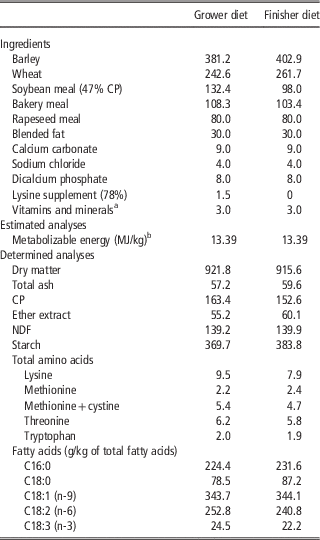
There were six treatments consisting of two sexes (barrows and gilts) and three BWs at the time of feed change (100, 90 and 80 kg), and each treatment was replicated four times. The first group (100 kg BW) was considered as control according to the optimum time of feed change from the grower to the finisher period as recommended by NRC (Reference Ntawubizi, Raes, Buys and De Smet2012) and FEDNA (2013). Diets for both phases were formulated to meet the nutrient levels recommended according to FEDNA (2013) for pigs of that BW with a high potential of lean growth. The composition and the estimated (FEDNA, 2010) nutrient value of diets are shown in Table 1. Pigs had free access to pelleted feed and water during the trial. Samples of each diet were taken, pooled at the end of the experimental period and preserved at room temperature for analysis. Animals were slaughtered when the average age was 170 days (169 and 171±3 days for barrows and gilts, respectively).
Ingredient composition and estimated and determined analyses of the experimental diets (g/kg as-fed basis, unless otherwise indicated)

a Provided per kilogram of complete diet: 7000 IU vitamin A; 1300 IU vitamin D3; 10 IU vitamin E; 0.4 mg vitamin K3; 0.8 mg vitamin B1; 3 mg vitamin B2; 1 mg vitamin B6; 15 μg vitamin B12; 12 mg nicotinic acid; 8 mg calcium pantothenate; 10 mg choline chloride; 1 µg biotine; 15 mg Cu (copper sulfate); 80 mg Fe (ferrous carbonate); 35 mg Mn (manganese sulfate); 80 mg Zn (zinc oxide); 0.1 mg Co (cobalt carbonate); 0.3 mg Se (sodium selenite) and 0.3 mg I (potassium iodate).
b According to FEDNA (2010).
Growth performance traits
Mortality and the possible presence of pathologies were checked daily. Individual BW and feed consumption per pen were recorded every week and were used to calculate average daily gain (ADG), average daily feed intake (ADFI) and feed conversion ratio (FCR) per replicate. Also, the average daily CP intake and the feeding costs per pig were calculated, for the overall trial, considering that 238 and 230€/ton were average prices of feed for growing and finishing, during the month of June in the Lonja Barcelona (2015).
Pre-slaughter procedure
On the day before slaughtering, feed was withheld for 7 h and pigs were weighed and transported 30 km to a commercial abattoir (Jamones y Embutidos Alto Mijares, S.L., Teruel, Spain), where they were kept in lairage for 10 h with full access to water but not to feed. Animals were electrically stunned (225 to 380 V/0.5 A for 5 to 6 s), exsanguinated, scalded, skinned, eviscerated and split down the midline according to standard commercial procedures.
Carcass measures and sampling
At the end of the slaughter line, hot carcass weight was individually recorded and used to calculate dressing percentage. At 45 min postmortem, carcass length (from the posterior edge of the symphysis pubis to the anterior edge of the first rib), ham length (from the anterior edge of the symphysis pubis to the hock joint) and ham perimeter (at its widest) were measured on the left side of each carcass using a flexible ruler with a precision of 0.5 cm. In addition, backfat thickness (between the last 3rd and 4th ribs) and fat depth over the gluteus medius (GM) muscle (at its thinnest point) were measured, by a rule with millimeter precision, on the same carcass side.
The head was removed at the atlanto-occipital junction and carcasses were suspended in the air and refrigerated at 2°C (1 m/s air speed; 90% relative humidity) for 6 h. Later, carcasses were processed and main lean cuts (left ham, shoulder and loin) were trimmed to fit commercial requirements, and individually weighed to calculate their yield in carcass. Finally, the carcasses of three pigs per pen (12 per treatment to give a total of 72 animals) were randomly chosen to get two samples for subsequent analyses: 400±20 g of loin (longissimus thoracis (LT) muscle) at the last rib level, and 50±5 g of subcutaneous fat including fat layers, skin and lean at the tail insertion in the coxal region. All the samples were individually vacuum-packaged and stored at −20°C.
Laboratorial analyses
In feeds, dry matter was determined by oven drying (934.01), total ash by muffle furnace (942.05), CP by the Kjeldahl method (976.05) and ether extract by Soxhlet analysis (2003.05), following the procedures of the Association of Official Analytical Chemists (2005). The NDF was analyzed with an ANKOM 220 Fibre Analyser (ANKOM Technology, Fairport, NY, USA) as described by Mertens (Reference Mertens2002). Total starch content was enzymatically determined using a commercial kit (Total Starch Assay Kit K-TSTA07/11; Megazyme, Bray, Ireland). The amino acid composition was analyzed in an external laboratory (Ofice, Barcelona, Spain) by HPLC-Fluorescence (PNT-M-109), with the exception of tryptophan and cystine that were determined by HPLC-UV and gas chromatography, respectively. The fatty acids of feeds were extracted and quantified according to the method of Jenkins (Reference Jenkins2010) and laboratorial equipment used is described below.
When required, pork samples were thawed in vacuum-packaged bags for 24 h at 4°C, removed from packages and weighed. Thawing loss was calculated taking into account the fresh and thawed weight. Color, chemical composition, cooking loss and hardness were determined in thawed samples. After blooming for about 20 min, pork color was evaluated with a chromameter (CM 2002; Minolta Camera, Osaka, Japan) using objective measurements as described by Latorre et al. (Reference Latorre, Ripoll, García-Belenguer and Ariño2009). The illuminant used was D65 and the standard observer position was 2°. The average of three random readings was used to measure lightness (L*, a greater value is indicative of a lighter color), redness (a*, a greater value is indicative of redder color) and yellowness (b*, a greater value is indicative of a more yellow color). In addition, chroma (C*) and hue angle (H°) were calculated as
 $$C^{{\rm {\asterisk}}} {\rm {\equals}}\surd(a^{{\rm {\asterisk}}} ^{{\rm ^2}} {\rm {\plus}}b^{{\rm {\asterisk}}} ^{{\rm ^2}} )$$
and as
 $$H^{\circ}\,{\equals}\,{\rm tan}^{{{\minus}1}} \,({{b^{{\rm {\asterisk}}} } \mathord{\left/ {\vphantom {{b^{{\rm {\asterisk}}} } {a^{{\rm {\asterisk}}} }}} \right. \kern-\nulldelimiterspace} {a^{{\rm {\asterisk}}} }})\,57.29$$
, respectively. Chroma is related to the quantity of pigments and high values represent a more vivid color denoting lack of grayness, and H° is the attribute of a color perception denoted by blue, green, yellow, red, purple and so on related to the state of pigments.
Cooking loss was estimated from the pre- and post-cooked weights. In brief, an LT slice (200±20 g) was taken from each chop, weighed, placed in a plastic bag and cooked to an internal temperature of 70°C in a 75°C water bath (Precisterm; J.P. Selecta S.A., Barcelona, Spain). Internal temperature was monitored during cooking with a handheld temperature probe (model HI 9063; Hanna Instruments, Woonsocket, RI, USA). Cooked samples were allowed to cool at 15°C for 30 min, blotted dry and weighed. Samples were then cut parallel to the long axis of the muscle fibers into rectangular cross-section slices of 10×10 mm and 30 mm length. Slices (six per chop) were sheared perpendicular to the fiber orientation, with a Warner-Bratzler device (Instron, Norwood, MA, USA) attached to an Instron Universal testing machine model 4301 (Instron), equipped with a 5-kg load cell and a crosshead speed of 150 mm/min.
Chemical composition of LT samples was analyzed for moisture by the oven drying method, CP using a Kjeldahl MT 2300 analyzer (Höganäs, Switzerland) and IMF by an ANKOM XT15 equipment (ANKOM Technology) according to Boletín Oficial Estado (1979).
Lipids from subcutaneous fat samples were extracted in chloroform methanol, according to Bligh and Dyer (Reference Bligh and Dyer1959) and butylated hydroxytoluene was used as antioxidant. Fatty acid methyl esters were generated by trans-esterification of lipids extracts, dissolved in n-hexane with KOH (2 N) in methanol and collected in hexane. Later, their composition and also that of feeds was determined using a Hewlett-Packard 6890 II gas chromatograph (Agilent, Wilmington, DE, USA) with a capillary column SP2380 (PA, USA) (100 m×0.25 mm×0.20 μm). Nitrogen was used as gas carrier and the methyl esters were identified using retention times of Sigma Chemical Co. standards. The proportions of total saturated (SFA), monounsaturated (MUFA) and polyunsaturated fatty acids (PUFA) were calculated from individual fatty acid proportions.
Statistical analyses
Data were analyzed as a randomized factorial design (2×3), using the GLM procedure of the SAS package (version 9.2). The model included sex (barrows and gilts) and the pig BW at the time of feed change (100, 90 and 80 kg) as main effects, as well as the interaction sex×time of feed change. In addition, for CP intake and feeding costs, correlation analysis was carried out using CORR procedure. The experimental unit was the pen (n=4) with five animals for growth performances and carcass traits and with three animals for meat and fat traits. A P-value<0.05 was considered as a significant difference and a P-value between 0.05 and 0.10 as a trend.
Results
No significant interactions were detected for the variables studied and therefore only main effects are reported.
Growth performances
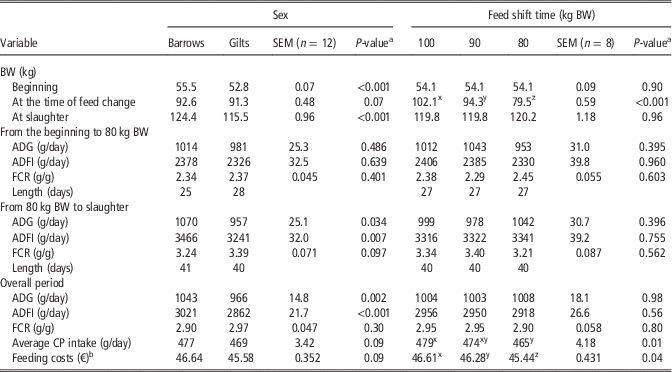
At the beginning of the trial, barrows were heavier than gilts (P<0.001) (Table 2) because they were of a similar age. From 54 to 80 kg BW, both sexes showed similar growth performances. However, from 80 kg to the slaughter BW, barrows ate more feed (P=0.007) and grew faster (P=0.03) than gilts, effects which were also observed when the overall period was studied (P<0.001 for ADFI and P=0.002 for ADG). Consequently, barrows were heavier at slaughter (P<0.001). At the end of the trial, average daily CP intake and feeding costs per pig tended to be higher for barrows than for gilts (P=0.09).
Effect of an earlier supply of the finisher diet on productive performances of barrows and gilts

ADG=average daily gain; ADFI=average daily feed intake; FCR=feed conversion ratio.
x,y,zMeans with different superscript letters within a row differ (P<0.05).
a No significant interaction (sex×feed shift time) was detected (P>0.10).
b During experimental period (66 days for barrows and 68 days for gilts). Calculated using the average prices of June (Lonja Barcelona, 2015).
As it was expected, no difference in ADG, ADFI or FCR was detected among treatments from 54 to 80 kg BW. Also, an early change to the finisher diet did not affect growth performances of pigs neither from 80 kg BW to the slaughter nor in the global period. The final BW was similar for the three groups taking into account that the slaughter had been previously fixed at 170 days as average. The average daily intake of CP (P=0.01) and the feeding costs per pig (P=0.04) were reduced when the shift to the finisher diet was made earlier.
Carcass characteristics
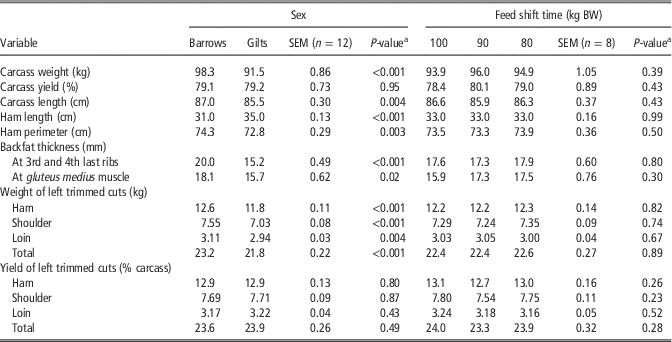
Carcasses from barrows were heavier (P<0.001) and longer (P=0.004) and had shorter (P<0.001) but wider (P=0.003) hams than those from gilts (Table 3). Also, barrows had fatter carcasses, measured between the 3rd and the 4th last ribs (P<0.001) and at GM muscle (P=0.02), as well as heavier hams (P<0.001), shoulders (P<0.001) and loins (P=0.004) than gilts. No differences between sexes were detected for the yield of these primal pieces expressed as percentage of carcass. The BW of feed change did not affect any carcass trait.
Effect of an earlier supply of the finisher diet on carcass quality traits of barrows and gilts

a No significant interaction (sex×feed shift time) was detected (P>0.10).
Pork quality and fatty acid profile of subcutaneous fat
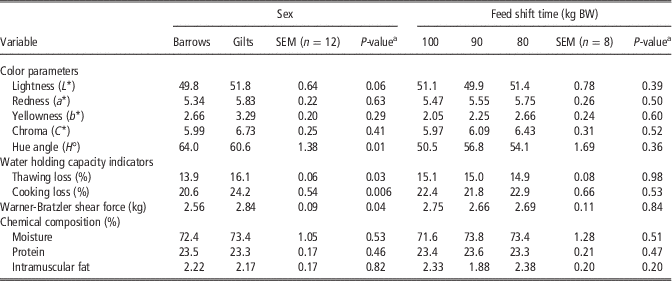
Table 4 shows the effect of sex and feed shift time on thawed pork loin from barrows tended to have lower L* values (P=0.06) and had higher H° values (P=0.01) than that from gilts (Table 4). Also, meat from barrows had lower thawing loss (P=0.03) and cooking loss (P=0.006) and was less hard (P=0.04) than that from gilts. There was no difference between sexes in chemical composition of pork. In addition, no effect of switching diet at earlier age was observed on quality traits of the LT muscle.
Effect of an earlier supply of the finisher diet on thawed pork (longissimus thoracis muscle) quality from barrows and gilts

a No significant interaction (sex×feed shift time) was detected (P>0.10).
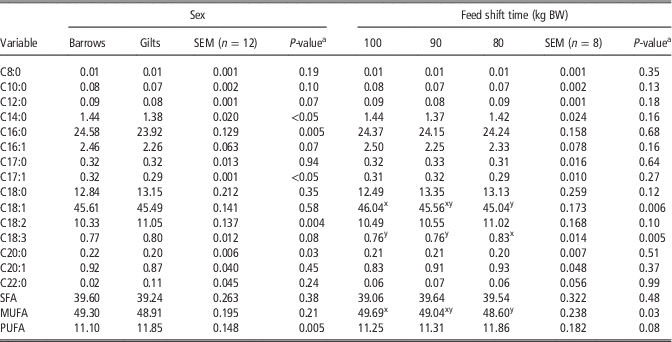
The effect of treatments on the fatty acid profile of subcutaneous fat is shown in Table 5. Barrows had lower PUFA proportion (P=0.005) than gilts because of lower contents of C18:2 (P=0.004) and C18:3 (P=0.08). Although fat from barrows had higher concentrations of C14:0 (P<0.05), C16:0 (P=0.005), C17:1 (P<0.05) and C20:0 (P=0.03) than that from gilts, the total SFA and MUFA contents were not affected by sex (P>0.10). The shift to the finisher diet at lighter BW decreased the MUFA proportion (P=0.03) because of the lower C18:1 content (P=0.006) and tended to increase the total PUFA percentage (P=0.08) due to the higher proportion of C18:3 (P=0.005) and the trend in C18:2 (P=0.10).
Effect of an earlier supply of the finisher diet on fatty acid profile (% of total fatty acids) of subcutaneous fat from barrows and gilts

SFA=∑saturated fatty acids; MUFA=∑monounsaturated fatty acids; PUFA=∑polyunsaturated fatty acids.
x,yMeans with different superscript letters within a row differ (P<0.05).
a No significant interaction (sex×feed shift time) was detected (P>0.10).
Discussion
Growth performances
Under ad libitum conditions, barrows are commonly found to consume more feed than gilts (Latorre et al., Reference Latorre, García-Belenguer and Ariño2008; Suárez-Belloch et al., Reference Suárez-Belloch, Guada and Latorre2015a and Reference Suárez-Belloch, Guada and Latorre2015b) which is confirmed by the results of this experiment, being the difference 160 g/day on average. This value is not far from the 220 g/day reported by Rodríguez-Sánchez et al. (Reference Rodríguez-Sánchez, Sanz, Blanco, Serrano, Joy and Latorre2011) and explains the faster daily gains recorded in barrows compared with gilts. As a result, barrows were heavier at slaughtering because this was fixed at a similar age for both sexes (149 days as average). Also, the higher ADFI in barrows increased the feeding costs per pig by 1.06€ and the average CP intake by 8 g/day during the whole experiment (66 days). Cromwell et al. (Reference Cromwell, Cline, Crenshaw, Crenshaw, Ewan, Hamilton, Lewis, Mahan, Miller and Pettigrew1993) showed that gilts need higher levels of dietary protein than barrows to maximize efficiency of gain and lean growth.
An early shift to the finisher diet did not affect growth performances through the experiment. However, it is worth to note that the amino acid levels of the feeds were able to support high growing rates, as pigs grew around 1 kg/day in both growing and finishing periods. Taking into account that the aim of the trial was increasing fatness, a slight impairment of FCR could have been carried out. In fact, in the literature, worse feed efficiency has been reported as a result of dietary protein or Lys restriction in both the grower (D’Souza et al., Reference D’Souza, Pethick, Dunshea, Pluske and Mullan2003) and the finisher phase (Campbell et al., Reference Campbell, Taverner and Curie1984; Suárez-Belloch et al., Reference Suárez-Belloch, Guada and Latorre2015b). The result of the current work is positive, under a productive point of view, but it would indicate that the nutrient restriction generated advancing the finisher diet by 21 days was very limited.
At the end of the trial, growth performances were not affected but CP intake and feeding cost decreased when the shift to the finisher diet was made to a lighter BW. Regression of these variables with BW showed that CP intake declined at a rate of 7 g/day (r=0.77) per each 10 kg BW, with a saving of feeding cost of 0.58€ (r=0.75), from an initial value of 479 g/day in the control treatment. This suggests that incurring in a slight protein or amino acid restriction by feeding the finisher diet to 80 instead of 100 kg BW does not penalize growth performances while contributes to reducing N losses to environment as well as feeding costs in agreement with previous reports in heavy pigs (Daza et al., Reference Daza, Latorre and López-Bote2010; Gallo et al., Reference Gallo, Dalla Montà, Carraro, Cecchinato, Carnier and Schiavon2014).
Carcass characteristics
The higher weight of carcasses from barrows compared with gilts was a consequence of the heavier BW at slaughtering. Therefore, the higher revenue from a barrow carcass will compensate the higher feeding costs compared with a gilt carcass. Also, carcasses from barrows were longer and had heavier lean cuts (hams, shoulders and loins) than those from gilts confirming previous results with similar pigs (Rodríguez-Sánchez et al., Reference Rodríguez-Sánchez, Sanz, Blanco, Serrano, Joy and Latorre2011) and autochthonous breeds reared outdoor (Franco and Lorenzo, Reference Franco and Lorenzo2013). However, when both sexes are slaughtered at similar BW, gilts have longer carcasses and heavier trimmed lean pieces (Latorre et al., Reference Latorre, Ripoll, García-Belenguer and Ariño2009; Suárez-Belloch et al., Reference Suárez-Belloch, Latorre and Guada2016), probably because females are leaner. In fact, carcasses from barrows were fatter than those from gilts (by 30% at the level of 3rd and 4th last ribs and 15% over the GM muscle). These findings agree with other studies on heavy pigs (Latorre et al., Reference Latorre, García-Belenguer and Ariño2008; Peinado et al., Reference Peinado, Medel, Fuentetaja and Mateos2008; Suárez-Belloch et al., Reference Suárez-Belloch, Guada and Latorre2015a) confirming the high potential for fat deposition of barrows.
The similar responses of both sexes to the different BW of diet shifting, regarding all carcass and primal cut traits is relevant from a practical point of view as far as mixed feeding is concerned. In addition, none of the carcass characteristics were affected by the BW of diet shifting. The lack of a negative impact on ham or shoulder weight or yield is positive but the effort made to get higher body fatness was unsuccessful. The higher backfat depth in pigs fed the finisher diet to 80 rather than 100 kg BW was an expected result because inadequate supply of CP or Lys will limit protein synthesis increasing the energy available for fat deposition (Adeola and Young, Reference Adeola and Young1989). However, the effects on fatness of CP restriction during the finisher period are controversial. Some authors have reported limited (Rodríguez-Sánchez et al., Reference Rodríguez-Sánchez, Sanz, Blanco, Serrano, Joy and Latorre2011) or no influence (Gallo et al., Reference Gallo, Dalla Montà, Carraro, Cecchinato, Carnier and Schiavon2015), although a majority (Cromwell et al., Reference Cromwell, Cline, Crenshaw, Crenshaw, Ewan, Hamilton, Lewis, Mahan, Miller and Pettigrew1993; Cisneros et al., Reference Cisneros, Ellis, Baker, Easter and McKeith1996; Witte et al., Reference Witte, Ellis, McKeith and Wilson2000) have detected a clear increase of backfat thickness and a decrease in LT area or depth. It seems to depend on several factors such as sex, period length or level of restriction. In the current experiment, and with the CP levels used, the strategy of switching to the finisher diet 3 weeks earlier than recommended was not enough to achieve the target.
Meat quality and fatty acid profile
It has been worth that meat characteristics were evaluated in thawed samples and some of them could be affected (paler color, lower moisture and water holding capacity and less tenderness). Meat from gilts had higher thawing and cooking losses than that from barrows, which agrees with previous results (Latorre et al., Reference Latorre, García-Belenguer and Ariño2008; Franco and Lorenzo, Reference Franco and Lorenzo2013). The lower water holding capacity of gilt loin would justify, at least in part, its greater hardness, as a negative relationship between both traits has been reported (Tomovic et al., Reference Teye, Sheard, Whittington, Nute, Stewart and Wood2014). The moisture loss in meat is also related to higher lightness (Moon et al., Reference Moon, Jeong, Kim, Cho and Jeon2009) because the exudates make up a thin film on the chop providing a more brilliant aspect. In fact, in the current trial, higher L* values were recorded in pork from gilts. Regarding the chemical composition, no effect of sex was recorded, although a higher IMF content was expected in LT muscle from barrows than from gilts. In line with the results on carcass fatness and accordance with other authors (Latorre et al., Reference Latorre, García-Belenguer and Ariño2008; Peinado et al., Reference Peinado, Medel, Fuentetaja and Mateos2008), the laboratorial analysis showed higher IMF proportion in pork from barrows but the difference was not significant probably due to the high variability among samples. The sensory benefits of a high IMF content are well known in terms of juiciness and acceptability of meat (Wood et al., Reference Wood, Enser, Fisher, Nute, Sheard, Richardson, Hughes and Whittington2008).
The earlier shift to the finisher diet had no influence on meat quality. However, several reports have shown a significant relationship between dietary CP or Lys restriction with an increase of IMF and tenderness of pork (Cisneros et al., Reference Cisneros, Ellis, Baker, Easter and McKeith1996; Witte et al., Reference Witte, Ellis, McKeith and Wilson2000). It has been even detected when the restriction is applied during the growing phase, although the response is attributed to compensatory growth during the subsequent realimentation period (Stolzenbach et al., Reference Stolzenbach, Therkildsen, Oksbjerg, Lazarotti, Ertbjerg, Lametsch and Byrne2009; Suárez-Belloch et al., Reference Suárez-Belloch, Latorre and Guada2016). As in the case of carcass backfat depth, the effect on marbling can depend on sex, period length, or level of CP or Lys restriction.
The fat from barrows was less polyunsaturated than that from gilts, which agrees with the work of Mas et al. (Reference Mas, Llavall, Coll, Roca, Díaz, Gispert, Oliver and Realini2010). Higher values of SFA and MUFA were recorded in barrows but the differences were not significant. The effects are related to differences in fatness as SFA and MUFA proportions increase with fatness at higher rate than PUFA due to the increasing contribution of de novo synthesis of fatty acids (Wood et al., Reference Wood, Enser, Fisher, Nute, Sheard, Richardson, Hughes and Whittington2008). The most representative SFA is C16:0 whose concentration was significantly higher in barrows than in gilts, confirming the above explanation. The greater PUFA proportion in gilts was mainly due to the C18:2. The linoleic plays an important role in animal nutrition because it can reduce firmness and cohesiveness of adipose tissue and increases the fat oxidation rate (Wood et al., Reference Wood, Enser, Fisher, Nute, Sheard, Richardson, Hughes and Whittington2008).
The shift to the finisher feed at different BW had limited effects on fatty acids but resulted in a decrease of MUFA and in a trend to increase PUFA. Teye et al. (Reference Tomovic, Zlender, Jokanovic, Tomovic, Sojic, Skaljac, Tasic, Ikonic, Dodo and Hromis2006) evaluated the dietary CP restriction in pigs during growing–finishing finding higher level of PUFA, effect likely a consequence of the distinct distribution of fatty acids between triacylglycerol (richer in SFA) and phospholipids (richer in PUFA) and the increasing proportion of triacylglycerol with increasing IMF content (Ntawubizi et al., 2009). Our hypothesis was that if an increase in lipogenesis was produced by the diet management, it would carry out an increase in the concentrations of de novo fatty acids (SFA and MUFA, especially C18:1) and a decrease of essential fatty acids (PUFA). However, no influence on fatness was observed and the explanation could be the modest level of replacement of dietary CP with dietary starch for a limited period of time.
Conclusions
The shift to the finisher feed when pigs achieved 80 instead of 100 kg BW was not successful in getting an increase in the backfat thickness of carcass and the intramuscular content of pork, which is desirable in barrows and gilts intended for dry-cured products. However, it can be an interesting strategy because of its potential to reduce protein intake without impairing growth performances, which would contribute to lowering feeding costs and N losses to the environment.
Acknowledgments
Financial support was provided by the INIA (Project RTA 2008-00093-00-00; Madrid, Spain). Appreciation is due to Chantre (Teruel, Spain) for the care of experimental pigs and to Integraciones Porcinas S.L. (Teruel, Spain) and Jamones y Embutidos Alto Mijares S.L. (Teruel, Spain) for the help during animal slaughtering and carcass sampling.