In the face of pervasive environmental hazards, emerging pandemic threats, and growing population densities, personal disaster preparedness is a critical need.Reference Basolo, Steinberg and Burby1 The importance of personal preparedness has long been recognized, with basic strategies such as stockpiling, sheltering-in-place, and citizen education dating back to the Cold War.Reference Davis2 Experts agree that individuals will require partial or complete self-sufficiency for at least the first 72 hours after a disaster.Reference Basolo, Steinberg and Burby1Reference Russell, Goltz and Bourque3
The significance of postdisaster self-reliance and preparedness has been observed in many incidents. For example, in the aftermath of the 2005 London bombings, an inability to contact loved ones was associated with significant mental distress.Reference Page, Rubin, Amlôt, Simpson and Wessely4 A 2006 study of Londoners suggests that following the 2005 attacks, more than 70% of people sampled made plans for contacting family members in future emergencies.Reference Page, Rubin, Amlôt, Simpson and Wessely4 After Hurricane Katrina hit the US Gulf Coast in 2005, authorities came under criticism for mismanagement and lack of leadership in relief efforts.56 The devastating impact of the storm, combined with a flawed response strategy, left more than 60 000 people stranded in New Orleans to fend for themselves for several days.5 Amid ongoing recognized health care system surge capacity limitations, examples such as these underscore the crucial consequences of personal disaster preparedness.7
In recognizing the importance of personal preparedness, the Federal Emergency Management Agency (FEMA) launched its Ready campaign in February 2003. It should be noted that this campaign preceded Hurricane Katrina. Ready is a national campaign designed to increase public awareness and involvement in disaster preparedness and response across the United States. Specifically, the campaign promotes the message to “get a kit, make a plan and be informed” about different types of emergencies and their appropriate responses.8 The “make a plan” step refers to creating a personal preparedness plan that is applicable to individual, family, or household disaster planning. In the professional literature, these plans are sometimes called communication, disaster, or family plans and are referred to by FEMA as “family emergency plans.” A personal preparedness plan may include such information as a nominated out-of-town contact, neighborhood meeting place, or important medical information.
Using the Ready model, the American Red Cross (ARC) launched a campaign encouraging the public to “do more than cross your fingers,” using instructional pamphlets and videos as well as celebrity endorsements.9 In 2006, following Hurricane Katrina, the federal “lessons learned” report highlighted the essential role of citizens in creating a foundation of partnerships for “transforming national preparedness.”6 Federal government efforts urging the American public to “resolve to be ready” have continued.8
In spite of governmental efforts to increase personal preparedness, numerous studies and polls suggest that preparedness levels in communities are lacking.Reference Basolo, Steinberg and Burby1Reference Kapucu1011 As part of the 2009 National Hurricane Survival Initiative, an independent polling firm found that 66% of people living in Atlantic and Gulf coastal states had no hurricane survival kit and 55% had no family disaster plan.Reference Curtis12 A 2009 ARC influenza A(H1N1-09) poll suggested that only 46% of Americans had enough food, water, and medicine, in accordance with government recommendations, to allow them to remain home if they became sick.13
In light of these salient deficits, a review of the research literature can offer meaningful insight into gaps, strengths, and opportunities for enhancing rates of personal disaster preparedness as a critical element of citizen engagement in community disaster readiness. The purpose of this integrative review is to describe and analyze the state of evidence concerning personal preparedness in disasters. The research question for this review is, what do we know about personal disaster preparedness and the factors that shape its practice? In addressing this question, the objective is to present the best available evidence on personal disaster preparedness as an intended basis for advancing disaster management research, policy, and practice.
METHODS
The purpose of this review was to describe and analyze the current scientific literature on personal disaster preparedness. A literature search via the Cochrane Library found no prior systematic literature reviews on this topic.
Search Strategy
Using key words and MeSH terms, a broad group of medical, public health, and social science electronic databases were searched, including PubMed, ISI Web of Science, BIOSIS, LILACS, CRISP, PsycINFO, EBSCO Psychological and Behavioral Sciences Collection and SSCI, CINAHL, Public Affairs Information Service, Education Full Text, and SCOPUS. The following MeSH terms were employed wherever possible: “Disaster Planning,” “Health Knowledge, Attitudes, and Practices,” “Civil Defense,” and “Terrorism.” In addition, the following key words were used: “preparedness,” “personal preparedness,” “family,” “household,” “individual,” “adult,” “children,” “disaster,” “planning,” “health knowledge,” “health attitudes,” “health practices,” “emergencies,” ”pandemic,” and “workplace.”
Next, all issues of the following disaster medicine- and public health-focused journals were individually examined: Australasian Journal of Disaster and Trauma Studies; Disasters; Disaster Medicine and Public Health Preparedness; The Internet Journal of Rescue and Disaster Medicine; Disaster Management and Response; Biosecurity and Bioterrorism; Public Health Management and Practice; and Annals of Emergency Medicine. Following this examination, references from each publication selected for inclusion were examined for additional relevant literature. Finally, a search of publicly available Internet content was conducted using Google and Google Scholar. The same search terms were used as those with the electronic database searches.
Inclusion Criteria
Only original quantitative or qualitative research designs were included in this review. The types of research reports included were peer-reviewed research articles, abstracts, and summaries of research findings. Primary study subjects selected were individuals, families, and households, as well as health care providers and first responders. Outcome measures incorporated into the review were knowledge, attitudes, and practices related to personal disaster preparedness planning. In addition, an operational definition of personal disaster preparedness was developed. Personal disaster preparedness was defined as behaviors meeting two major goals: preparation of supplies or an “emergency kit” and creation of a family or household plan. Only studies published in English were included in this review. The review took place from August 5, 2009, to January 5, 2010, and assessed articles published between 1950 and 2010.
Article Review Protocol
A three-stage screening process identified candidate articles for review and assessed the extent to which articles met predetermined inclusion criteria derived from prior systematic reviews.Reference Chaffee14Reference Harris, Helfand and Woolf15Reference Akers, Aguilar-Ibanez and Sari16 First, search results were sorted by title relevance, yielding 157 candidate articles. Second, inclusion criteria were applied to abstracts. In the third stage, criteria were applied to 50 full-article texts to generate a final list of 36 publications for inclusion in the review. The primary reason for manuscript exclusion from the review was that many studies focused on responder readiness (work-related preparedness), willingness, or ability to respond rather than personal preparedness. In such articles the working definition of personal preparedness (ie, making a kit or writing a plan) was not discussed or was not an important focal point of the research and thus did not meet the inclusion criteria. In addition, multiple excluded articles did not present original research; for example, editorials, opinion pieces, or policy analyses.
Each of the 36 articles included in this review was evaluated for methodological quality using a checklist of nine a priori criteria (see eAppendix) established by the researchers in adapting criteria previously employed by Chaffee,Reference Chaffee14 Harris et al,Reference Harris, Helfand and Woolf15 and Akers et al.Reference Akers, Aguilar-Ibanez and Sari16 The assessment of study quality focused on relevance to the key review question, reliability, validity, instrument development, sampling strategy, and identification of potential bias. All 36 articles selected articulated a clear purpose statement and identified where their results fit within the larger body of research on personal disaster preparedness.
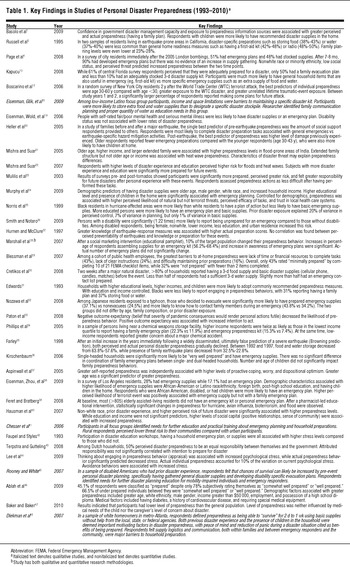
All original research designs, both qualitative and quantitative, were included in this review to capture the full breadth of current evidence. Many systematic reviews, particularly in the medical literature, do not include qualitative work.Reference Chaffee14 In the public health arena, the utility of scientific evidence informs decisions for public health interventions, programs, and policy. Integration of qualitative and quantitative data provides a richer, more nuanced perspective on motivations and structural forces that shape observed actions. Content analysis and narrative summary were used to abstract and organize qualitative themes. Qualitative findings were used to add context and depth to quantitative data trends (Table 1).
Key Findings in Studies of Personal Disaster Preparedness (1993–2010)a

RESULTS
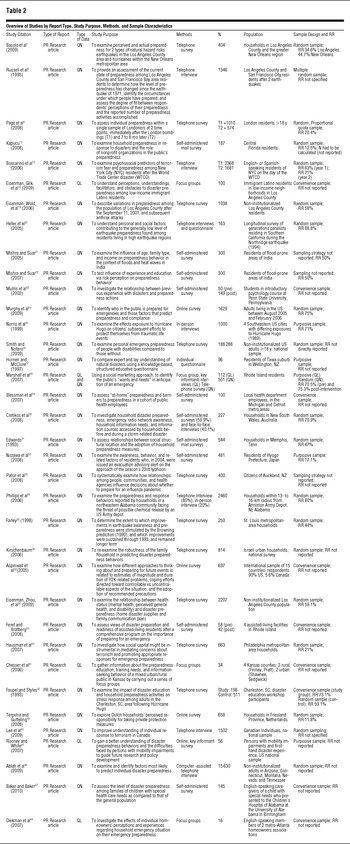
A total of 36 peer-reviewed articles met inclusion criteria for this review. Among these, 31 were quantitative studies (N = 225 667; range 42-188 288), 4 were purely qualitative research (N = 190; range 34-100),Reference Eisenman, Glik, Maranon, Gonzales and Asch18Reference Chesser, Ablah and Hawley41Reference Rooney and White45Reference Diekman, Kearney, O’Neil and Mack48 and 1 article presented both qualitative and quantitative results (N = 131 and N = 501, respectively)Reference Marshall, Petrone and Takach28 (Table 1). The earliest identified article meeting inclusion criteria was from 1993. Twenty-seven of the studies were completed in the United States, with multiple studies in California and the Southeastern United States. International research was identified from Australia, Canada, Israel, India, Japan, England, and the Netherlands. The most common subject group comprised members of the general public surveyed at the household level (Table 2). While exact definitions varied, fundamentally the professional literature points to two operational constituents of personal preparedness: assembly of supplies for an “emergency kit” and development of a household or family plan. The majority of quantitative research in this area employs semistructured interview methodology. Qualitative research on this topic has been informed by both interviews and focus groups (Table 2).
Overview of Studies by Report Type, Study Purpose, Methods, and Sample Characteristics

Reliability
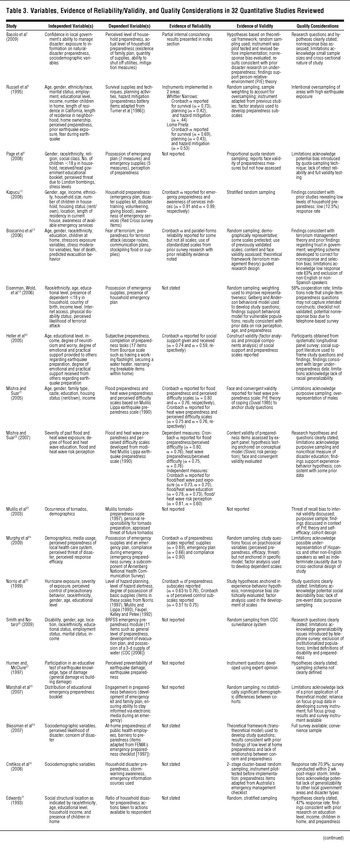
A checklist of a priori criteria was used to evaluate the quality of articles included in this review. Source articles were assessed for reports of statistical reliability, including test-retest, internal consistency, parallel form, split-half, and inter-rater reliability.Reference Chaffee14 Authors reported reliability data in 13 of 32 of the quantitative publications. Cronbach's alpha was the most common measure of reliability. Two reports provided minimal evidence of instrument pretesting, and one discussed parallel forms but provided no statistical results for these reliability measures (Table 3A, Table 3B).Reference Basolo, Steinberg and Burby1Reference Boscarino, Adams, Figley, Galea and Foa17 An additional 11 publications used survey instruments from previous publications or large data sets. Although these publications did not report directly on instrument reliability, they provided reference sources.Reference Eisenman, Glik, Maranon, Gonzales and Asch18Reference Eisenman, Wold and Fielding19Reference Heller, Alexander and Gatz20Reference Mishra and Suar21Reference Mishra and Suar22Reference Mulilis, Duval and Rogers23Reference Murphy, Cody and Frank24Reference Norris, Smith and Kaniasty25Reference Smith and Notaro26
Variables, Evidence of Reliability/Validity, and Quality Considerations in 32 Quantitative Studies Reviewed


Validity
Assessment of validity is a critical component in establishing quality of research methodologies and subsequent results. This review examined source articles for five types of validity: face, content, construct, convergent, and criterion validity (Table 3A, Table 3B). Twenty-eight articles provided evidence of validity, with construct validity being the most common type evaluated (12 of 16 studies). Authors rarely discussed face validity,Reference Page, Rubin, Amlôt, Simpson and Wessely4Reference Mishra and Suar21Reference Mishra and Suar22Reference Hurnen and McClure27 and only one publication evaluated study measures for all five types of validityReference Boscarino, Adams, Figley, Galea and Foa17 (Table 3A, Table 3B). As disaster preparedness is an emerging science, this review considered construct validity in particular detail. Each article was evaluated for discussion and application of public health or social science conceptual models. Seventeen articles directly used conceptual models in framing their research and/or discussing their results. Among these, the stages of change, person-relative-to-event, and Slovic's theory of risk perception were most commonly referenced (Table 3A, Table 3B).
Instrument Development
No one standardized definition of personal emergency preparedness is used in current research or practice, although common elements are consistently studied in most recent publications. As previously noted, multiple authors used survey instruments or subscales from earlier studies and thus did not directly report on instrument development. Eight publications developed new instruments and provided evidence of psychometric evaluation. These measures included focus groups, key informant interviews, expert review and evaluation of reading level, reliability, and factor analysis (Table 3A, Table 3B). In general, the process of instrument development or selection was not described in functional detail.
Generalizability
In this review, three aspects that directly impact generalizability of results were evaluated: sampling strategy, power analysis, and consideration of potential bias. With one exception (a qualitative study),Reference Marshall, Petrone and Takach28 every study included in this review described sampling strategy in sufficient detail. Random sampling was the most common approach (19 of 36 reports). Multiple types of convenience and purposive samples were employed, more commonly in smaller studies. Only two studies provided details of power analysis, with multiple authors referencing previous publications or use of preexisting data (Table 3A, Table 3B). Few publications (14 of 36) addressed issues of potential bias such as nonresponse, social desirability, or missing data. Only five studies reported statistical evaluation of bias. Ten reports tackled issues of potential bias in the discussion section (Table 3A, Table 3B).
DATA SYNTHESIS
Levels of Personal Disaster Preparedness
Multiple studies have demonstrated that, overall, families and households are underprepared for disaster both in the United States and abroad.Reference Basolo, Steinberg and Burby1Reference Kapucu10Reference Eisenman, Wold and Fielding19Reference Blessman, Skupski and Jamil29Reference Cretikos, Eastwood and Dalton30Reference Edwards31Reference Nozawa, Watanabe, Katada, Minami and Yamamoto32Reference Paton, Parkes, Daly and Smith33Reference Ablah, Konda and Kelley46Reference Baker and Baker47 Publications reported a wide range of personal preparedness in their samples. For supply-stocking, results ranged from 7.4% in low-income northeastern Alabama residents living near a military chemical plant to 80% in Australian households affected by a storm-related disaster. For plan creation, results ranged from 11.9% in low-income Alabama residents to 90% in London residents following the July 2005 London terrorist bombings.Reference Page, Rubin, Amlôt, Simpson and Wessely4Reference Cretikos, Eastwood and Dalton30Reference Phillips, Metz and Nieves34 Blessman et al's study of US public health employees' at-home behaviors revealed 75% to be either “minimally prepared” or “not prepared.”Reference Blessman, Skupski and Jamil29 A study of residents near a chemical weapons storage depot revealed that, in spite of high levels of concern about potential accidents, most respondents had neither a family disaster plan nor supplies.Reference Phillips, Metz and Nieves34
Differences in Personal Preparedness Tasks
Personal preparedness incorporates both plan-making and stockpiling. These tasks present different challenges in education, comprehension, and implementation. Given these differences, it is not surprising that success in each task set is highly variable. In a post-Hurricane Katrina New Orleans study, 58.6% of participants reported having a high level of preparedness for disasters. Among this group, 85% had a family plan in place, while only 22% had a full set of supplies prepared.Reference Basolo, Steinberg and Burby1
Conversely, other studies have found that people are less likely to create a family plan than assemble a supply kit.Reference Eisenman, Glik, Maranon, Gonzales and Asch18Reference Murphy, Cody and Frank24Reference Farley35Reference Baker and Baker47 Similarly, educational interventions have met variable success in encouraging supply-gathering versus planning. A large-scale Rhode Island social marketing campaign motivated a greater proportion of recipients to create an emergency kit (an 11.8% increase from baseline) than to generate a family plan (no significant change).Reference Marshall, Petrone and Takach28
Perceived vs Actual Personal Preparedness
A number of publications note a gap between perceived and actual preparedness.Reference Basolo, Steinberg and Burby1Reference Russell, Goltz and Bourque35Reference Kapucu10Reference Ablah, Konda and Kelley46Reference Diekman, Kearney, O’Neil and Mack48 Russell et al suggested that perceived earthquake preparedness was significantly correlated with having both preparedness supplies and plans, and most strongly correlated with stockpiling behaviors.Reference Russell, Goltz and Bourque3 In Basolo et al's study,Reference Basolo, Steinberg and Burby1 61% of Los Angeles County residents reported high levels of disaster preparedness, but less than 25% had a full set of recommended disaster supplies. Results suggested that creating a family plan was more tightly correlated with self-reported preparedness (63% of respondents).Reference Basolo, Steinberg and Burby1
Influence of Demographic Characteristics
Demographic characteristics have suggested mixed impact on personal disaster preparedness. Multiple regression analysis has been used to estimate the degree to which race, education level, socioeconomic status (SES), and age influence disaster preparedness planning. In a 1999 study of Southern US residents after Hurricane Hugo, gender, education, age, and race explained 20% of variance in stockpiling basic supplies but only 1% of planning differences.Reference Norris, Smith and Kaniasty25 In two additional studies, gender appeared to exert an effect on risk perception, as women perceived greater threat risk from potential disasters as compared to men.Reference Mulilis, Duval and Rogers23Reference Kirschenbaum36
Older age, more education, and higher incomes are associated with increased emergency preparedness in US and international samples.Reference Mishra and Suar21Reference Murphy, Cody and Frank24Reference Norris, Smith and Kaniasty25Reference Edwards31Reference Aspinwall, Sechrist and Jones37Reference Eisenman, Zhou, Ong, Asch, Glik and Long38Reference Ablah, Konda and Kelley46 These findings hold true for respondents both with and without disabilities.Reference Smith and Notaro26 When compared to younger individuals, older age is a strong predictor of greater personal disaster preparedness.Reference Boscarino, Adams, Figley, Galea and Foa17Reference Mishra and Suar21Reference Aspinwall, Sechrist and Jones37Reference Eisenman, Zhou, Ong, Asch, Glik and Long38Reference Ablah, Konda and Kelley46 While preparedness appears to peak somewhere after age 30 years, it may drop off again among the elderly, especially disabled elders and residents in assisted-living facilities.Reference Boscarino, Adams, Figley, Galea and Foa17Reference Feret and Bratberg39
Higher SES variables (higher income, home ownership) have been consistently associated with completion of disaster preparedness tasks such as storing food, water, or first-aid supplies.Reference Russell, Goltz and Bourque3Reference Mishra and Suar21Reference Mishra and Suar22Reference Norris, Smith and Kaniasty25Reference Edwards31Reference Phillips, Metz and Nieves34 Russell et al suggested earthquake preparedness was correlated with higher education and income, home ownership, children living in the home, being married, and female gender.Reference Russell, Goltz and Bourque3
Minority race and ethnicity have been inconsistent predictors, with results varying widely depending on the definition and measures of personal disaster preparedness. In multiple large studies, racial/ethnic minority status was associated with lower scores on multi-item scales assessing specific disaster items.Reference Murphy, Cody and Frank24Reference Smith and Notaro26Reference Edwards31Reference Eisenman, Zhou, Ong, Asch, Glik and Long38 While minorities tend to be less prepared before a disaster, these groups may demonstrate greater increases in preparedness postevent.Reference Page, Rubin, Amlôt, Simpson and Wessely4Reference Eisenman, Wold and Fielding19Reference Norris, Smith and Kaniasty25 Among Londoners after the 2005 subway bombings, ethnic minority status and low SES were associated with increased personal preparedness, specifically gathering of basic supplies.Reference Page, Rubin, Amlôt, Simpson and Wessely4 This trend has also been seen in multiple surveys.Reference Eisenman, Wold and Fielding19Reference Norris, Smith and Kaniasty25 It has been hypothesized that minority and lower SES individuals may feel greater personal threat, less confidence in government, and less trust in mainstream disaster information sources.Reference Page, Rubin, Amlôt, Simpson and Wessely4Reference Eisenman, Wold and Fielding19Reference Phillips, Metz and Nieves34Reference Fothergill, Maestas and Darlington49Reference Fothergill and Peek50Reference Carter-Pokras, Zambrana, Mora and Aaby51
Marital status has appeared salient to the task of developing a family preparedness plan. Compared with unmarried couples, the rate of creating such plans is greater among married respondents.Reference Basolo, Steinberg and Burby1Reference Kirschenbaum36 Having dependent minors in the home has also been correlated with greater rates of emergency supply possessionReference Basolo, Steinberg and Burby1Reference Eisenman, Wold and Fielding19Reference Heller, Alexander and Gatz20Reference Edwards31 and family plan creation.Reference Eisenman, Wold and Fielding19Reference Murphy, Cody and Frank24 Regardless of family structure, an essential element may be extent of social support network. In two non-US studies, family and household disaster preparedness appeared to increase with size and function of social support networks.Reference Mishra and Suar21Reference Kirschenbaum36
The highly heterogeneous context and nature of studies to date examining demographic influences on personal disaster preparedness poses challenges to any clear demarcation of “exceptions” per se among this set of modifier domains, beyond the mixed findings (eg, with respect to minority race and ethnicity) described here.
The Role of Psychosocial Predictors
Researchers have examined the impact of psychological variables on personal preparedness. Higher perceived risk has been associated with greater rates of personal preparedness activities.Reference Basolo, Steinberg and Burby1Reference Eisenman, Wold and Fielding19Reference Mishra and Suar22Reference Murphy, Cody and Frank24Reference Aspinwall, Sechrist and Jones37Reference Hausman, Hanlon and Seals40 In a 1999 survey of Washington, DC, residents' preparedness for the anticipated threat of the 2000 Y2K computer bug, optimism, and distressed mood were associated with more preparations for Y2K.Reference Aspinwall, Sechrist and Jones37 A study of New Orleans residents that same year revealed that higher levels of perceived risk, specifically dread risk, increased likelihood of having a family plan more than 6-fold.Reference Basolo, Steinberg and Burby1 Faupel and Styles found that psychological stress correlated with increased household disaster planning.Reference Faupel and Styles42 After the 2005 London subway bombings, perceived personal threat among city residents was a predictor of gathering new disaster supplies (OR 1.50).Reference Page, Rubin, Amlôt, Simpson and Wessely4 Of interest, degree of psychological distress due to previous disaster experience did not suggest a clear relationship to increased preparedness behaviors in this study.Reference Page, Rubin, Amlôt, Simpson and Wessely4
Disaster Preparedness Knowledge
Studies have suggested variation in the nature and extent of personal disaster preparedness knowledge among the general public. In a qualitative study of Los Angeles low-income Latino residents, participants identified gang violence, school shootings, home robberies, and other violent crimes as examples of relevant disasters. Less than half of this group recognized the terms “disaster kit” or “emergency kit” but most were comfortable with the concept of emergency supplies.Reference Eisenman, Glik, Maranon, Gonzales and Asch18 Among rural Kansas residents, focus group participants correctly identified basic contents of a preparedness kit; however, many were unsure regarding what additional supplies were required.Reference Chesser, Ablah and Hawley41
Research on the impact of personal preparedness education on knowledge and behavioral outcomes has revealed mixed findings. In two studies conducted on preparedness to various natural disasters (flood, heat wave, and earthquakes), those with higher threat-specific knowledge were more likely to have prepared for these events.Reference Mishra and Suar22Reference Hurnen and McClure27 Basolo et al's study suggests that exposure to preparedness information sources was associated with greater perceived and actual preparedness (having a personal preparedness plan).Reference Basolo, Steinberg and Burby1 Among a cohort of public health employees, one of the greatest barriers to at-home preparedness was lack of clear instructions and information on how to prepare (24%).Reference Blessman, Skupski and Jamil29 In Murphy et al's study, watching national news or listening to radio talk shows was related to having more supplies.Reference Murphy, Cody and Frank24
Multiple studies have examined the impact of educational interventions in this arena. In 2004, the UK government sent an educational booklet, Preparing for Emergencies: What You Need to Know, to every household in the country. This distribution preceded the 2005 London subway bombings by approximately one year. In a subsequent analysis, people who could recall receiving the booklet were more likely to have gathered preparedness items but not to have made an emergency plan.Reference Page, Rubin, Amlôt, Simpson and Wessely4
Influence of Prior Disaster Experience
Prior disaster experience has been correlated with increased general preparedness.Reference Boscarino, Adams, Figley, Galea and Foa17Reference Heller, Alexander and Gatz20Reference Mishra and Suar22Reference Mulilis, Duval and Rogers23Reference Hausman, Hanlon and Seals40Reference Diekman, Kearney, O’Neil and Mack48 Intensity of exposure to the September 2001 World Trade Center terrorism attack and greater lifetime exposure to traumatic events were both predictive of greater personal preparedness in a multivariate model.Reference Boscarino, Adams, Figley, Galea and Foa17 In a postearthquake California study, extent of damage experienced (direct) and providing instrumental social support to others (indirect) were the best predictors of future preparation.Reference Heller, Alexander and Gatz20
However, when each preparedness task (planning vs stockpiling) received separate consideration, experience was not clearly related to both types of preparedness actions. After the London subway bombings, Page et al's 2005 study found that emergency planning increased from 51% to 90%. However, the number of respondents who gathered emergency supplies before and after the events did not increase.Reference Page, Rubin, Amlôt, Simpson and Wessely4 Among Northern Californian residents who experienced an earthquake, storing food and water were the least prevalent disaster preparedness behaviors before the event but became the most prevalent afterward (12% to 23%).Reference Farley35
DISCUSSION
Emergency preparedness is an inherently multidisciplinary field, drawing on data and expertise from a broad variety of sources, including economics, informatics, medicine, psychology, and public health. Given this diversity, definitions and measures of personal preparedness have varied considerably among researchers.
Academic researchers and emergency planners, both in the United States and internationally, have generally coalesced around a framing of personal disaster preparedness that contains two fundamental tasks: collecting a standard set of emergency supplies and creating a personal preparedness plan. One of the ways this evolution can be observed is in the increasing use of standardized disaster preparedness scales (in academic research) and lists (in government planning documents and public education materials). In spite of the increased infusion of governmental terminology into the research literature since 1990, the current FEMA Ready tripartite model used in the United States (get a kit/make a plan/be informed) has yet to receive explicit research examination. This gap in the research literature could benefit from additional investigation.
The literature on personal preparedness is considerably diverse, addressing a broad spectrum of topics including gaps in preparedness knowledge; perceived versus actual preparedness; preferred sources of preparedness information; governmental role in personal preparedness; preparedness in minority groups; and influences of previous disaster exposure.
A number of studies have sought to identify barriers and facilitators to personal preparedness behaviors and attitudes. Operationally, lack of time and resources to establish and maintain emergency supplies has been identified as an inhibiting factor.Reference Basolo, Steinberg and Burby1Reference Russell, Goltz and Bourque3Reference Eisenman, Glik, Maranon, Gonzales and Asch18Reference Blessman, Skupski and Jamil29 Gaps in comprehension of guidance from preparedness authorities have also appeared as personal preparedness barriers among the general public.Reference Basolo, Steinberg and Burby1Reference Eisenman, Glik, Maranon, Gonzales and Asch18Reference Marshall, Petrone and Takach28Reference Blessman, Skupski and Jamil29Reference Chesser, Ablah and Hawley41 In a focus group study of Rhode Island residents, respondents identified a need for basic information about “where to go and what to do, without too many details.”Reference Marshall, Petrone and Takach28 This observation underscores similar findings that the public often does not understand preparedness instructions and can perceive them as confusing or unrealistic.Reference Basolo, Steinberg and Burby1Reference Eisenman, Glik, Maranon, Gonzales and Asch18Reference Blessman, Skupski and Jamil29Reference Chesser, Ablah and Hawley41 In Blessman et al's study of public health employees, 24% reported unclear instructions as a barrier to completing recommended preparedness tasks.Reference Blessman, Skupski and Jamil29 Rural Kansas focus group respondents highlighted specific informational needs including details of threat severity, recommended duration of supplies, safe shelters, and sources for emergency updates.Reference Chesser, Ablah and Hawley41
Accountability for preparedness behaviors has been another object of research attention. In a national survey of Dutch households, 50% of respondents viewed disaster preparedness as a coequal responsibility between individuals and national government. Interestingly, this research found no direct correlation between perceived responsibility and preparedness intentions.Reference Terpstra and Gutteling43 In the wake of Hurricane Katrina, mistrust of government has been an oft-cited hypothesis for low observed rates of preparedness,56 specifically among racial and ethnic minorities. It appears reasonable that mistrust of government would provide an incentive to prepare and be self-sufficient in a disaster; however, the proposed mediating variable here is information source. Given that the government is a nontrusted information source, certain groups are less likely to follow preparedness directives. Greater perceived preparedness of the local health care system has been correlated with higher levels of personal preparedness.Reference Murphy, Cody and Frank24 Further, a high degree of confidence in local government has been associated with greater perceived preparedness and having a family plan.Reference Basolo, Steinberg and Burby1 These results may be indicative of an understanding of shared responsibility. However, further examination is needed to explore the association between feelings toward government, such as confidence in its abilities, and the division of responsibilities for disaster planning and preparedness.
We note that reference to a personal preparedness plan as a “family” emergency plan by government bodies such as FEMA may disaffect or engender disinterest in single people, young college students, and others who may believe that a family plan is not relevant to them. This belief may explain, in part, why married couples and homes with dependent minors are more likely to have a personal preparedness plan. Of note, though, the presence of dependent minors in a household may in itself contribute to an elevated sense of threat from potential emergencies or higher feelings of responsibility in parents and guardians. For purposes of accuracy, original-source terms (eg, family plan) have been used in this review; however, we suggest “personal preparedness plan” be used as a more impartial and all-encompassing term in light of these considerations.
The current body of research on personal disaster preparedness points to a synergistic interaction among established vulnerabilities. Multiple studies reveal that persons with disabilities are not more likely to be prepared for emergencies and in some examples are less prepared.Reference Eisenman, Wold and Fielding19Reference Smith and Notaro26Reference Eisenman, Zhou, Ong, Asch, Glik and Long38 One study reported that, compared to the general population, respondents with disabilities were significantly more likely to report that they were “not prepared at all” for an emergency (20.7% vs 16.1%). These findings applied to those with physical limitations, chronic medical needs, and mental illness alike.Reference Smith and Notaro26 Another study found that chronic medical and psychiatric illnesses were associated with lower rates of personal preparedness, both for supplies and plans.Reference Eisenman, Zhou, Ong, Asch, Glik and Long38
All-hazards planning has become fundamental to emergency planning frameworks.52 Within the context of personal preparedness, all-hazards planning is rooted in the principle that a generic family kit and plan are useful in response to most disasters, regardless of their cause or severity. Thus, it is important to understand whether members of the public perceive all-hazards personal preparedness as relevant to their own lives. Multiple studies have suggested that individuals and families are more likely to have basic household supplies that are one-time purchases (mobile phone, flashlight) than emergency-oriented items that require replenishing (food, water).Reference Basolo, Steinberg and Burby1Reference Russell, Goltz and Bourque38Reference Heller, Alexander and Gatz20Reference Murphy, Cody and Frank24Reference Cretikos, Eastwood and Dalton30Reference Edwards31 These findings may be particularly important in assessing personal preparedness resources in limited-income and marginalized communities.Reference Eisenman, Glik, Maranon, Gonzales and Asch18
It should be noted that, to our knowledge, no literature exists to date that clearly links having a kit or plan to better response outcomes. Meanwhile, there has been an intensifying focus on methods to characterize social vulnerability factors that influence community resiliency in the face of disasters.Reference Schmidtlein, Deutsch, Piegorsch and Cutter53Reference Cutter and Finch54 In terms of their locus of control, such factors have generally been macro rather than micro in scale. The current lack of explicitly-studied correlation between potential resiliency elements under individual control (eg, personal disaster preparedness) and postevent outcomes can and should become an increasing focus of rigorous research in the realm of community resiliency study. In addition to personal disaster preparedness, examples of such individually-driven behaviors that may fall under this resiliency umbrella include personal compliance with guidance on vaccination measures in the face of emergent infectious disease threats and willingness to follow community directives to evacuate in disasters.
Other priority areas for future research in this field include the relationship between personal preparedness and reduced overall burden on emergency and community services during incident response and recovery. In addition, the association between personal preparedness and reduction in total incident recovery time would provide useful information to disaster management professionals.
Limitations
In spite of the systematic protocol applied for this literature review, it is possible that some relevant publications were not identified. Furthermore, this review included only English-language publications that were subject to full peer review. With this search strategy and inclusion criteria, it is possible that potentially relevant studies were omitted. In spite of these limitations, this review identified a robust number of articles on the topic.
Twenty-seven of the studies included in this review were conducted in the United States, and 9 studies were internationally based. The researchers note that the inclusion of international studies may confound the ability to compare demographic findings on socioeconomic, racial, and ethnic minority status. However, inclusion of these studies is important for a strong, integrative review of the literature, and gives a more accurate overall picture of global preparedness.
Another important consideration is our decision to conceptualize personal disaster preparedness as two essential tasks (supply gathering and plan creation), as characterized in the vast majority of recent publications. Although these two are the most frequently observed constituents of personal preparedness activities, they are not exhaustive. As previously mentioned, for example, current US federal guidance on personal preparedness from FEMA and the ARC includes a third task—to stay informed.8
CONCLUSIONS
This integrative review of the literature points to the need for clear, actionable, realistic, and trusted personal preparedness guidance, including explicit attention to vulnerable populations. Disaster preparedness behaviors rely on complex, multifactorial processes with many variables, such as knowledge about risks, attribution of preparedness responsibility, and cognitive construction of threats. However, there is no standardized understanding of how these factors optimally interact to promote preparedness behaviors. In the aftermath of events such as Hurricane Katrina, the importance of individual and community self-reliance within the first days of disaster response has again come into focus. Given the critical relevance of these findings to public health and safety, it is important to understand how personal preparedness behaviors and perceptions are formed, while being aware of differing needs and vulnerabilities of certain population groups.
Another significant gap found through this review is the lack of a universal set of personal preparedness definitions and measurement criteria. Specifically noted were the inconsistencies between governmental and academic definitions. A standardized set of criteria would facilitate improved exploration of personal preparedness parameters and allow for a better understanding of behaviors and practice. It also would improve program evaluation and enable greater alignment of research and practice initiatives with public policy and planning goals.