INTRODUCTION
For the last three decades, the legal profession has experienced important changes related to the rise of globalization (Dezalay and Garth Reference Dezalay and Garth2011) and mega-law firms (Nelson Reference Nelson1988; Galanter and Palay Reference Galanter and Palay1991), the intensification of competition (Wilkins and Gulati Reference Wilkins and Gulati1998), and increasing levels of job mobility (Kay et al. Reference Kay, Alarie and Adjei2013). Some authors have taken these transformations as a sign of a “crisis of professionalism” (Abel Reference Abel1999), or of the “deprofessionalization” (Rosen 1999) or “proletarianization” (Derber Reference Derber1983; Derber, Schwartz, and Magrass Reference Derber, Schwartz and Magrass1990), of whole swathes of the occupation. For much of the legal profession, this crisis is associated with declining career perspectives, a routinization and hyper-specialization of legal work, and increased levels of stress and depression (Collier Reference Collier2016; Plickert, Kay, and Hagan Reference Plickert, Kay and Hagan2017). In Europe, scholars have also noted a tendency toward the fragmentation of legal labor markets, characterized by increasing internal stratification.
These changes are the product of broader social and economic trends that have impacted highly qualified occupations and professions in post-industrial societies (Faulconbridge and Muzio Reference Faulconbridge and Muzio2012). New forms of labor organization in a neoliberal globalized context have transformed the nature of professional work. Among other changes, increasing workloads and time pressure in many economic sectors have pervasive effects on working conditions, including in highly skilled occupations. These trends have led to an increase in inequalities between different categories of workers (Fligstein and Shin Reference Fligstein, Shin and Neckerman2004), to heightened forms of precariousness (Kalleberg Reference Kalleberg2013; Snorradóttir et al. Reference Snorradóttir, Tomasson, Vilhjálmsson and Rafnsdóttir2015), to a rise in the reporting of depression, ill health, and stress (Karasek and Theorell Reference Karasek and Theorell1990), and to the deterioration of employment relations (Roscigno et al. Reference Roscigno, Lopez and Hodson2009; Crowley and Hodson Reference Crowley and Hodson2014; Thornton Reference Thornton2016a). This situation has paradoxical consequences on the relationship that skilled workers have with their work; they continue to demonstrate high levels of commitment to work and sometimes, as in the case of lawyers, high levels of satisfaction, while the deterioration of working conditions has a particularly marked impact on their stress levels (Schieman, Whitestone, and Van Gundy Reference Schieman, Whiteston and Gundy2006), their ability to achieve work-life balance (Thornton Reference Thornton2016b), and their health (Carter et al. Reference Carter, Danford, Howcroft, Richardson, Smith and Taylor2013; Collier Reference Collier2016). Daniel Wheatley, for example, shows the direct impact of low job autonomy and schedule control on occupational well-being even for professional workers (Wheatley Reference Wheatley2017). In a similar vein, Bailey and Madden (Reference Bailey and Madden2017) describe the erosion of “meaningful work” in many occupations at all levels of the social hierarchy.
This picture of highly skilled professions, and in particular of the work of lawyers, is not entirely new. Indeed, as early as the 1950s, Charles Wright Mills emphasized the transformation of the legal profession in the United States into a routinized and overspecialized occupation, peopled by “mechanics,” or specialized workers (Reference Mills2002 [1951]). A couple of decades later, Charles Derber also pictured lawyers, among other highly skilled professionals, as suffering from forms of alienation and proletarianization induced by a capitalist economy of the professions and by their subordination to management control through salaried employment (Reference Derber1983). He identified a form of “ideological proletarianization” experienced by professionals because of “their orientation towards ends defined by the interest of their employers” (ibid., 319).
In the contemporary context of neoliberal globalization, these processes described decades ago as producing feelings of alienation have taken a new dimension. Firms have become larger in the hopes of increasing profitability, which has translated into increased pressure on lawyers, heightened specialization, and focus on reporting of billable hours. In addition, the number of lawyers is exploding in many countries, increasing competition for jobs, fueling the “up or out” system that prevails in big firms, and increasing precariousness in the lower echelons of the profession (small firms, solo practitioners). Simultaneously, the legal profession has witnessed a rapid rate of feminization, especially at the lower echelons of the occupational hierarchy (Epstein et al. Reference Epstein, Sauté, Oglensky and Gever1995; Schultz and Shaw Reference Schultz and Shaw2003), but this increasing numerical presence of women has not brought gender equality in law firms. Women are in fact the primary victims of the internal “fragmentation” of the profession (Sommerlad Reference Sommerlad2002).
How have these changes impacted the subjective relationship that young lawyers, men and women, have to their work as a career, a status, but also as a daily experience shaped by these changing working conditions? What are their effects on lawyers’ relation to work and potential experience of alienation today, especially young lawyers who are the most exposed to precariousness? Do women, newcomers in the profession who are often overrepresented in the lower echelons, have similar or different experiences compared to their male counterparts? How does firm size and type affect lawyers’ work experience?
Drawing on interviews with early career stage lawyers in France and Switzerland, we argue that the concept of alienation still provides an illuminating perspective on young lawyers’ relationship to their work by exploring both lawyers’ concrete experience and its subjective dimension and therefore enriches our understanding of contemporary legal practice. Of course lawyers, and even young lawyers, do not always experience alienation. Legal work also brings a host of gratifications and many lawyers declare to be satisfied with their profession (Dinovitzer and Garth Reference Dinovitzer and Garth2007). However, as our data show—in line with other studies on the profession in other national contexts (Kay, Alarie, and Adjei Reference Kay, Alarie and Adjei2013; Thornton Reference Thornton2016a; Collier Reference Collier2016)—there is ample evidence of dissatisfaction, ill health, and feelings of estrangement among young lawyers as well.
This article is organized in four parts. First, we present the methodology and data collected in the framework of our research carried out in France and Switzerland. In the next part, we discuss theories of alienation and distinguish four types of work experiences leading to alienation for young lawyers. These experiences are powerlessness, purposelessness, time deprivation, and unfairness. We argue that their prevalence depends on four variables: the size of firms where lawyers work, their job status in the firm, their gender, and their family situation. In the third part we illustrate our conceptual framework with our interview and survey data. In the conclusion, we emphasize the relevance of our approach to understanding work experiences in an occupational context marked by increasing uncertainty, competition and fragmentation, and we identify research questions that merit further exploration.
DATA AND METHODS
Our research project is based on a mixed-methods approach combining survey data and interview data to analyze the professional lives of young lawyers in France and in the French-speaking region of Switzerland who entered the legal profession after 1998. The survey, which included questions about current job practices, professional paths and aspirations, and personal and family life, was prepared in collaboration with the research team involved in the U.S. After the JD survey, and in particular, with colleagues involved in the extension of this survey outside the United States (Plickert and Hagan Reference Plickert and Hagan2011). In France, the web survey was administered between March and July 2016 in collaboration with the French National Bar Council (Conseil National des Barreaux) and the Paris Bar (Ordre des Avocats de Paris). In Switzerland, it was administered between May and June 2016 in collaboration with the Bar organizations in Geneva (Ordre des Avocats de Genève) and Lausanne (Ordre des Avocats Vaudois). We collected a sample of 1,129 respondents, 878 from the Paris Bar and 251 from the Geneva Bar and Lausanne Bar. We also conducted forty-one semi-structured interviews between September 2015 and May 2017, with twenty-six female and fifteen male lawyers or ex-lawyers (sixteen in Switzerland, twenty-five in France). While this article is mainly based on our interview data, the survey provides important additional information, in particular the prevalence of feelings of discrimination and dissatisfaction and a desire to leave the profession.
While studies on lawyers’ working conditions and the impact of globalization on the legal profession in countries such as the UK, the United States, and Australia are well developed (Sommerlad Reference Sommerlad2002; Kay et al. Reference Kay, Alarie and Adjei2013; Thornton Reference Thornton2016b), there are only very limited studies on the French or Swiss legal professions (Karpik Reference Karpik1999; Bessy Reference Bessy2015) and especially on the effects of the recent transformation of the legal market and the sharp increase in the number of young lawyers. Unlike North American lawyers, for whom student debt is a major issue, French and Swiss lawyers do not face significant financial burdens at the beginning of their professional lives (Dinovitzer, Garth, and Sterling Reference Dinovitzer, Garth and Sterling2013). Compared to the United States, the varied prestige of law schools is less blatant in France and Switzerland, suggesting that the place of study may be a weaker determinant of legal careers. These differences make these countries interesting sites to explore the effects of globalization and neoliberalism in the legal professions. Switzerland, and to some extent France, may appear as relatively more protected from the effects of globalization, with fewer mega-law firms structuring the legal markets. However, this relative protection may not compensate for the demographic expansion of the profession and its consequences for young lawyers (Boni-Le Goff et al. Reference Boni-Le Goff, Lépinard, Mallard, Feuvre, Abel and Hammerslev2020).
Because the French and Swiss legal professions present structural similarities (e.g. similar rates of feminization in law schools) and similar formal processes of access to the labor market (bar exams and training processes), we analyze them together, rather than in a comparative perspective.
Interviews were secured first through contacts with the bar associations in the cities in our sample, and then through a snowball process. We also relied on the completed questionnaires of our web survey, since respondents had the opportunity to leave their phone number or email address at the end of the survey if they were willing to contribute to the qualitative interviews. A rather high proportion of respondents for this kind of survey (18.8 percent) left their contact information. With the data available on each voluntary respondent we were then able to select and contact potential interviewees with specific professional and organizational characteristics; twelve persons out of forty-one were contacted through this selection process. Through this combined selection process, we reduced the selection bias that may potentially occur through a single snowball process, especially when interviewees tend to recommend people with similar social characteristics or working experience.
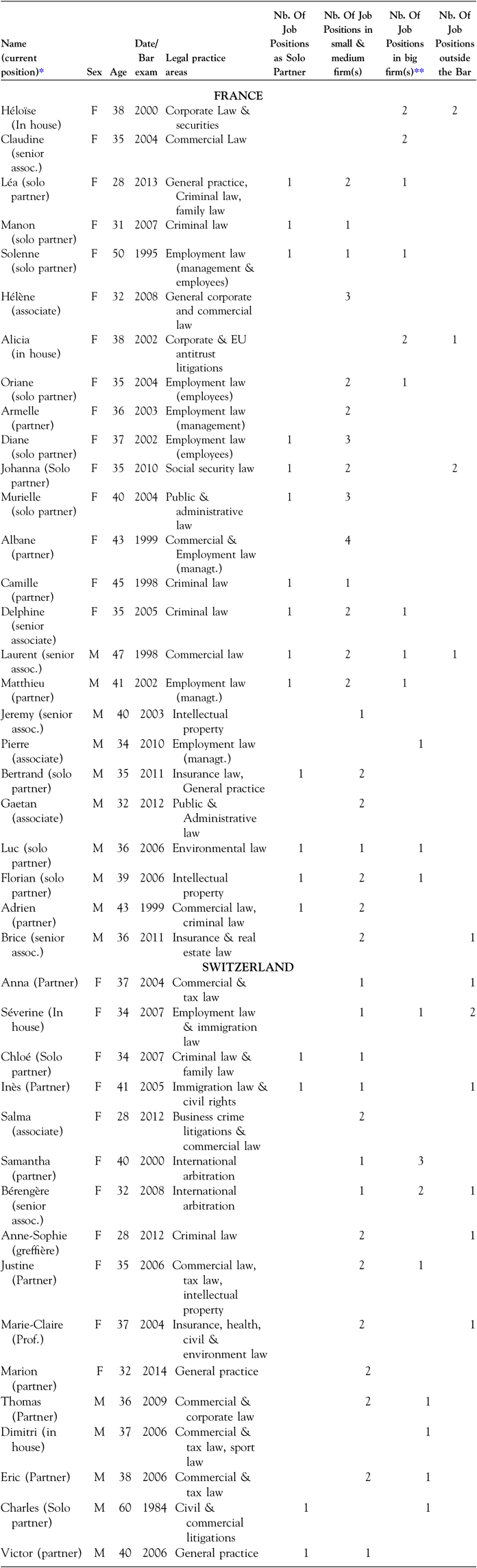
We made sure that our sample reflected the sex ratio of young lawyers’ general population in France and Switzerland; the average sex ratio for lawyers practicing law since 1998 is 62 percentFootnote 1 and the sex ratio of our sample is 63.4 percent. We only interviewed lawyers who passed the bar exam after 1998 (clocking up an average of ten and a half years of bar practice).Footnote 2 We made sure to select lawyers practicing in the different types of law,Footnote 3 in different practice settings (solo partnership, small, medium, or large firms), and in different job positions (associate or “collaborateur,” solo partner, partner) (see Appendix: Table of Interviewees). Our biographic approach enabled us to collect longitudinal data on the forty-one interviewees’ whole professional trajectories and to analyze 121 different job positions and work experiences (see Appendix: Table of Interviewees).
While the web survey revealed how many lawyers perceive discrimination and how many intend to leave the profession, the interviews helped us identify processes and mechanisms through which lawyers manage their relationship to work, and in particular alienation at work (see for example Lamont and Swidler Reference Lamont and Swidler2014). The interviews lasted 90 minutes on average and gave the interviewees the opportunity to address objective and subjective aspects of their life course, career, everyday work practices, and the work-life interface. With the permission of the interviewees, all the interviews were recorded and fully transcribed. We then conducted an inductive thematic analysis of the interview data using Atlas-Ti, a qualitative data analysis software package. We started listing references to subjective feelings of estrangement from work and used this list as the basis to identify the four-fold typology of experiences of alienation detailed in the following section. Segments of each interview referring to one of these dimensions were then systematically coded using Atlas-Ti in order to increase intercoder reliability. These statements were typically elicited when respondents were asked to describe their everyday experiences as a lawyer, what they most appreciated or disliked about their job, their past and current workplaces, or their career development. This approach enabled us to elicit direct and indirect accounts of alienation: direct, through accounts of professional practices and attitudes, sense of achievement, and feelings regarding the workplace; and indirect, through accounts of the different actions, efforts, or strategies developed by professionals to reinforce the positive content and the social utility of their work.
REFINING THE THEORY OF ALIENATION IN THE LEGAL PROFESSION
The legal profession offers a Janus-like picture. On the one hand, scholars have shown how neoliberalism, with the combined effects of globalization, pressure for profitability, and the numerical expansion of large law firms has profoundly transformed the profession (Flood Reference Flood2013; Sommerlad Reference Sommerlad2002). Early career lawyers feel this transformation of legal work all the more powerfully. Their work has intensified and become ever more specialized. There seems to be no limit to the pressure from clients and partners on their productivity. Attrition rates are high during the early stages of the legal career, with women lawyers being particularly likely to express the desire to leave the occupation after a relatively short period of time (Kay et al. Reference Kay, Alarie and Adjei2013, Reference Kay, Alarie and Adjei2016).
On the other hand, many studies find feelings of satisfaction among lawyers with respect to their career choices and achievements. Thus, much research on lawyers in the United States has documented the persistently high levels of satisfaction among North American lawyers, despite blatant gender inequalities, increasing student debt, and falling income levels (Sterling and Reichman Reference Sterling and Reichman2010; Dinovitzer et al. Reference Dinovitzer, Garth and Sterling2013).
This Janus-like picture requires a new theoretical vocabulary to capture how the neoliberalization of the legal profession impacts the subjective relationship of young practitioners to their work in an elite profession such as law. The concept of alienation appears to be a good candidate for this task insofar as it focuses on the concrete experience of work and refers to feelings of disempowerment that, we argue, occur even in the most prestigious occupational contexts.
Marx initially formulated the concept of alienation to describe the experiences of manual workers in the first stages of capitalist industrialization (Yuill Reference Yuill2011). However, the concept has also been used to analyze the experiences of white-collar workers (Mills Reference Mills2002 [1951]; Seeman Reference Seeman1975), including scientists and engineers (Miller Reference Miller1967). Also discussing Marxist theory, other scholars (Derber Reference Derber1983; Derber, Schwartz, and Magrass Reference Derber, Schwartz and Magrass1990) have focused more on the notion of proletarianization but similarly insisted on the loss of autonomy and sense of purpose experienced by professionals in late capitalism. More recently, several authors have used the concept of alienation to account for the manifold psychosociological effects of post-industrial neoliberalism on the experience of workers. For example, Marilyn Strathern has used the concept of alienation to describe the effects of the expansion of an “audit culture” in academic organizations (Reference Strathern2000). Likewise, Christophe Dejours has used it to describe the new health risks associated with individualized, performance-based evaluation procedures in contemporary firms (Reference Dejours2004, Reference Dejours2006).
The heuristic value of this concept lies in its ability to focus on work as an experience and to take into account both objective working conditions and the ways in which these are subjectively interpreted by the people concerned. For Marx (Reference Marx1972 [1844]) and his followers, the concept of alienation (Entfremdung) designates a social process of estrangement from oneself and from society. Marx referred to a three-fold subjective and objective experience of estrangement: from control over work content (powerlessness); from the intrinsic meaning of work and sense of self (meaninglessness); and from others and social utility, or “estrangement of man from man” (Marx Reference Marx1972 [1844]). Contemporary studies adapt this theoretical framework to understand how contingent work, especially temporary work, affects workers’ experience with a threefold deterioration of their relations to work, to others, and to themselves (Rogers Reference Rogers1995; Halbesleben and Clark Reference Halbesleben and Clark2010).
The concept of alienation, however, demands further clarification and elaboration in the case of an elite profession that supposedly provides its members with intrinsic sources of satisfaction (e.g. meaningful work) and extrinsic gratifications (e.g. monetary and symbolic status rewards) and for which levels of satisfaction are often high. The literature nevertheless shows that lawyers, like other elite professionals, experience various processes that can be captured under the theoretical concept of alienation, even when scholars do not systematically use the concept (Kay et al. Reference Kay, Alarie and Adjei2013; Collier Reference Collier2016; Plickert et al. Reference Plickert, Kay and Hagan2017). Indeed, they describe social mechanisms that are typical of alienation in that they affect and “distort” the relationship to the self, to others, and to the world. The work environment for lawyers generates a loss of “agency” and a feeling of dispossession—understood in the sense of the ability to create, explore, and enlarge one’s inner and outer worlds. It also generates a gap between desires or aspirations and concrete experiences which fuels a feeling of contradiction, because efforts remain unrewarded and promises unkept (Haber Reference Haber2007, Reference Haber2008).
Drawing both on this literature, and, inductively, on our empirical data, we propose a typology of four alienation processes: powerlessness, purposelessness, time deprivation, and unfairness (Table 1). The first two processes, powerlessness and purposelessness, are the most evidently linked to alienation, while unfairness and time deprivation have mostly been studied outside of this theoretical framework.
The Four Experiences of Alienation

We first use the term of powerlessness to designate the various forms of dependency experienced by young lawyers and their effects. Young lawyers are dependent on the partners in their firm for all aspects of their job, especially in big law firms; partners assign clients and cases and decide to impose (or not) large amounts of paperwork and repetitive tasks on their subordinates. The vivid descriptions of the first years as junior associatesFootnote 4 in our interviews often resemble accounts of secretarial work in industrial bureaucracies in the mid-twentieth century (Kanter Reference Kanter1977). For Rosabeth Moss Kanter, work in secretarial pools involved three characteristics: “status contingency,” “principled arbitrariness,” and “fealty” related to the “patrimonial power” of managers. Partners in law firms have a similar kind of “patrimonial power”: Junior lawyers also rank the interest of their tasks according to the prestige of their boss (status contingency). Partners frequently impose sacrifices on associates, seemingly without motive (principled arbitrariness). Finally, after completing an unequal share of “dirty work” (Hughes Reference Hughes1971), associates may be rewarded with the opportunity to work on an interesting case (Kanter’s “fealty”). Feelings of powerlessness are also fueled by the fact that the quantity and quality of a lawyer’s workload depends, to a large extent, on their clients (Beckman and Philipps Reference Beckman and Phillips2005). This dependency is further enhanced by the uncertainty of legal markets. Hence young lawyers’ three-fold dependency—on partners, on clients, and on the market—can fuel intense feelings of powerlessness, or dispossession of one’s own work.
Workers in diverse occupations or professions share a quest for “meaningful work,” (Bailey and Madden Reference Bailey and Madden2017) or for “task identity”—“being able to see the end-to-end connection of their work” (Shantz et al. Reference Shantz, Alfes, Bailey and Soane2015, 385). Purposelessness, or a perceived lack of meaning and utility in one’s work, is experienced by many young lawyers.Footnote 5 They express a growing gap between their initial expectations of being a lawyer and their work experience. They came to the job with expectations about the profession valuing creativity and social justice, a symbolically valued dimension especially in the French context (Karpik Reference Karpik1999). Rather than pursuing legitimate and socially valued goals, such as defending the interests of low-income private clients, they find themselves working on, for example, the technical routines of fiscal optimization.
The third type of experience of alienation that we identify is time deprivation, a direct consequence of the well documented “long hours culture” (Sommerlad Reference Sommerlad2002; Flood Reference Flood2013) within the legal profession, characterized by the norm of unlimited dedication to the firm and to clients (Hagan and Kay Reference Hagan and Kay2010; Kay et al. Reference Kay, Alarie and Adjei2013, Reference Kay, Alarie and Adjei2016). While time deprivation is documented in literature focused on work-life balance (Sommerlad Reference Sommerlad2016; Thornton Reference Thornton2016b), it can easily and productively be included in the broader conceptual framework of alienation. Indeed, it captures lawyers’ experience of being dispossessed of their personal time. While elite professions are supposed to reward their members with extrinsic rewards, such as time sovereignty or leisure time, young lawyers experience a “time bind” (Hochschild Reference Hochschild1997), which is simultaneously orchestrated by their firm and their clients. The time pressure put on lawyers generates a general sense of “missing out on life” and a feeling of confinement, including feelings of being “caught up in work” while friends and relatives are living more fulfilling lives. It affects lawyers’ sense of social integration and brings a general feeling of having no time for oneself, even when lawyers do have a family and close relationships. The notion of time deprivation brings attention to the intertwining of professional and private lives (Walsh Reference Walsh2013). The long hours culture weighs heavily on personal decisions (e.g. the timing and number of children), while marital or family arrangements in turn open certain career options and potentially close others (Plickert and Hagan Reference Plickert and Hagan2011).
A last component of alienation that we identify is unfairness, which refers to situations experienced by lawyers—particularly those with low professional status and/or at the beginning of their careers—who feel that the rules that preside over career advancement, workload definitions, or working time requirements are in contradiction with the meritocratic ideal defended in corporate official rhetoric. While inequalities in legal careers have been the object of much research (Hagan and Kay Reference Hagan and Kay1995; Epstein et al. Reference Epstein, Sauté, Oglensky and Gever1995; Sommerlad Reference Sommerlad2002; Garth and Sterling Reference Garth and Sterling2009; Kay, Alarie, and Adjei Reference Kay, Alarie and Adjei2016), we argue that perception and feelings of unfairness are also part of alienation processes, a theoretical relation rarely identified in the literature. Perception of unfairness in the workplace can arise from direct experiences of being treated badly but also from witnessing colleagues being unfairly treated or discriminated against on the basis of their gender, family status, or ethnicity. It can also arise from the feeling that expectations (such as the number of billable hours to be clocked up) are unrealistic. These subjective perceptions of unfairness damage young lawyers’ relationship to their work and to the profession as a whole. Unfairness means that expected rewards are not received, and this threatens the willingness of lawyers to accept unfavorable working conditions over extended periods of time and fuels desires for career changes.
As Table 1 shows, powerlessness and time deprivation relate analytically to alienation as “dispossession,” while purposelessness and unfairness describe experiences of “contradiction.” These four dimensions of alienation also distinguish experiences that are directly linked to work as an activity—powerlessness and purposelessness—and experiences relating to the rewards and gratifications derived from work—time deprivation and unfairness. While these processes of alienation often interact and can be experienced simultaneously, we have chosen to treat them separately for analytical purposes.
What are the variables that may influence young lawyers’ feelings of alienation? We draw four variables from the literature. While they do not exhaust all the variables that may influence feelings of alienation, they are central to explaining who among young lawyers is susceptible to experience more or less alienation at work. These variables are: firm size, professional status, gender, and family situation (being a parent or not).
Research has shown that different size law firms provide very different professional environments (Flood Reference Flood2013; Heinz et al. Reference Heinz, Nelson, Sandefur and Laumann2005). Studies on big law firms show, for instance, the importance of work intensification (Sommerlad Reference Sommerlad2016), which has potential effects on autonomy. Additionally, subordinate positions differ significantly from management and self-employed positions as they expose even highly qualified professionals to specific situations of “principled arbitrariness” and “fealty” (Kanter Reference Kanter1977), as noted before. Hence, we can hypothesize that firm size and the position in the firm, in particular associate or partner, will impact reported powerlessness and purposelessness.
Two dimensions of alienation—unfairness and time deprivation—can easily be related to the negative effects of a gendered professional ethos. The ethos of extensive dedication to work and the long hours culture (Seron and Ferris Reference Seron and Ferris1995; Sommerlad Reference Sommerlad2002), as well as the definition of merit shared by many professional services (Kumra Reference Kumra, Kumra, Simpson and Burke2014), is inherently shaped by a “masculine mystique” (Acker Reference Acker, Mills and Tancred1992; Hagan and Kay Reference Hagan and Kay2010). This ethos impacts men and women differently since it favors lawyers who can easily delegate domestic labor and care in the private sphere. However, despite lower salaries and more limited career prospects (Epstein et al. Reference Epstein, Sauté, Oglensky and Gever1995; Schultz and Shaw Reference Schultz and Shaw2003; Sommerlad Reference Sommerlad2016; Kay et al. Reference Kay, Alarie and Adjei2013, Reference Kay, Alarie and Adjei2016), empirical studies in the United States show that female lawyers declare higher rates of satisfaction than their male counterparts (Hagan and Kay Reference Hagan and Kay1995; Heinz et al. Reference Heinz, Nelson, Sandefur and Laumann2005). Women in a variety of other professions echo these relatively high satisfaction rates (Zou Reference Zou2015). Our empirical data helps explain the “paradox” of satisfaction (Hull 1999, cited in Dinovitzer and Garth Reference Dinovitzer and Garth2007)Footnote 6—high levels of declared satisfaction accompanied by high attrition rates and declared desire to leave the profession—and the extent to which gendered inequalities shape experiences of alienation for women and men.
Last, being a parent is also expected to deeply affect lawyers’ relationship to work. Although having children probably has no direct effect on a lawyer’s sense of powerlessness or purposelessness, in a profession still dominated by a long-hours culture, parenthood may be associated with the experience of alienation as time deprivation. This effect may of course be gendered. Although a long-term historical shift toward a more involved and caring fatherhood model has been identified (Brannen and Nilsen Reference Brannen and Nilsen2006), on average, women still have a greater share of parental labor and domestic chores, especially following the birth of their first child (Bühlmann, Elcheroth, and Tettamanti Reference Bühlmann, Elcheroth and Tettamanti2009). Parenthood is also likely to trigger discrimination and experiences of unfairness. In the legal profession, because of the masculine ethos, mothers appear very often exposed to a specific set of discriminations, while fathers are rewarded with career opportunities, provided that they stick to a male breadwinner model (Hagan and Kay Reference Hagan and Kay2010).
HOW YOUNG FRENCH AND SWISS LAWYERS EXPERIENCE ALIENATION
We find that all young lawyers interviewed reported at least one form of alienation when narrating their work experience.
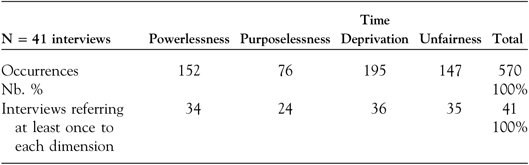
Table 2 displays the distribution of the four types of alienating experiences in the interviews. It shows that each type of alienation was elicited in more than half of the interviews. Time deprivation (195 codes) was the most frequently expressed dimension, followed by powerlessness (152) and unfairness (147 codes). Purposelessness was mentioned less frequently, but was nevertheless identified in twenty-four interviews (76 codes). Thus, our qualitative data suggests that the lawyers we interviewed express more easily alienation as deprivation (powerlessness and time deprivation) than alienation as contradiction (purposelessness and unfairness).
The Four Faces of Alienation in Interviews

References to the different types of alienation were not evenly distributed across the full range of occupational contexts and types of practice. In Supplementary Table 1, we consider each experience of alienation as an analytical unit and analyze how it relates to specific work environments and job position. For example, when an interviewee recounted three different job positions in which s/he experienced alienation, three separate occurrences appear in the table. This analytical technique provides a visual illustration of how episodes of alienation are distributed across different career stages and occupational contexts. Supplementary Table 1 shows that as lawyers move up in the status hierarchy of the law firm, they may experience alienation as deprivation related to work (powerlessness) less strongly than before, but they experience alienation as time deprivation as strongly as—if not more strongly than—before. This finding is interesting, suggesting that alienation never disappears but that its forms change over a career. Supplementary Table 1 also suggests that for each form of alienation, episodes seem more frequent in big law firms than in smaller size law firms, although the data is suggestive rather than conclusive.
Powerlessness
Within our interview sample, thirty-four interviewees out of a total of forty-one mentioned experiences of powerlessness. These feelings arose in situations where lawyers felt strongly dependent: on their firms, on the partners they work for, on their clients, or sometimes on the structure of legal markets. Associates in large law firms and solo practitioners were particularly prone to feelings of powerlessness. The powerlessness of the associates was mainly the result of their dependency on the partner they work for, while the powerlessness of solo practitioners was the result of their unremitting search for (solvent) clients in an increasingly competitive economic context.
Many interviewees emphasized the nature of their relations with partners in their law firm and gave examples of “fealty” (Kanter Reference Kanter1977), describing different forms of personalized pressure and authoritarian practices of the partners. The decisive impact of “the boss” on the general workplace atmosphere was frequently mentioned. Alicia, a thirty-eight-year-old Parisian in-house lawyer specializing in anti-trust regulation described her previous place of work as “a good firm, but the partner was very … bad-tempered so she tended to give everyone a hard time.” Dimitri, a thirty-seven-year-old Swiss business development manager who had previously worked for a big law firm also described the whims of his former senior partner, who made him come into work even when he had pneumonia, resulting in him ending up in the hospital. For young associates, these experiences of dependency have practical consequences. Their future career prospects depend directly on the cases they are given and thus on the good will of the partners on whom they depend.
The bureaucratized structure of large law firms also resulted in young lawyers feeling that they lacked autonomy. Experiences of dependency leading to feelings of powerlessness appear to be particularly frequent in junior positions in large law firms (seventeen interviews), especially in the most prestigious ones, where junior associates are expected to play by the rules of the “up-or-out” Cravath system and to perform a large number of high-quality assignments to be promoted to partnership (Galanter and Paley Reference Galanter and Palay1991).Footnote 7 Lawyers who had worked in such settings emphasized feelings of organizational entrapment, and of being “a pawn in the game.” Interviewees often referred to these bureaucratic working environments as a “huge machine” or even a “war machine.” In these organizations, the requirement of billing hours produces a culture of surveillance and control that made many interviewees uncomfortable. For Matthieu, a forty-one-year-old French partner in a small law firm that specializes in employment law, large firms “with their demands, their financial constraints, require tools (in fact, loads of tools) to control time, to control the time of partners, of associates, of paralegals as well.” In justifying his decision to work in a small law firm, he stated, “I don’t fit into this mold, I can’t work like that.”
Some interviewees working in solo practice or in small- and medium-sized law firms also experienced a sense of powerlessness. In these cases, this feeling came from their sense of being trapped in relations of service. These interviewees said that their dependence on clients—a matter of survival—made control over their workload impossible. As Armelle, a thirty-six-year-old French partner in a medium-sized firm, stated:
Here, it’s a very competitive environment, you can’t afford to say “no” to a big client who asks you on a Friday to check over and validate a corporate agreement … before Monday. … No, if you do that, you lose your client, so ….
For Diane, a thirty-six-year-old employment law specialist, being a solo partner meant feeling isolated while facing multiple types of “stress” coming from different quarters (judges, clients, etc.):
And then it’s … well, you have to face the stress of colleagues, the stress of judges, the stress of clients. And on top of that, you know, the stress related to our independent status, which means: “How am I going to pay my social security contributions this month?” I’m fine now, but the stress is always there….
Depending on whether lawyers are in solo practice or working in a big law firm, alienation presents different features. On the one hand, solo practitioners’ experience of powerlessness appears more related to their economic precariousness and to their dependency on ever-elusive clients. In big law firms, the inherent dependency of junior lawyers on partners, the techniques used to control their working time and work content and their ultimate dependency on clients converge to produce intense feelings of dependency and dispossession.
Purposelessness
Experiences of purposelessness appeared in two contexts. In the first case, lawyers mentioned purposelessness as the result of overspecialization in their work, which they found far removed from the professional ideal of intellectual stimulation and creativity. Purposelessness was also in evidence when interviewees felt that their work was lacking social utility. In this case, purposelessness often acted as the justification for a spectacular career change. When asked why they decided to turn to a different type of legal practice, interviewees often described their decision to change jobs as a matter of solving a moral inner conflict and sometimes even of psychological survival.
Feelings of purposelessness were particularly prevalent among interviewees from large-scale, corporate law firms, where the extensive division of labor offers few opportunities for autonomous and creative work. Speaking about her former corporate law firm, Samantha, a forty-year-old Swiss lawyer currently working for a medium-sized company in international arbitration, expressed the sheer boredom of routinized paperwork. While a position in a big prestigious corporate law firm might be socially valued, she emphasized the lack of creativity that such law practice entails, especially in big practice settings.
Because of this huge machine, you usually only have control over a little piece of the puzzle …. I did corporate law for almost four years, then I got bored of that … [laughs] because corporate law, even if it sounds extremely glamorous, in the end it’s all about writing a contract.
Along with overspecialization, a sense of purposelessness also arises when lawyers feel that their work does not meet the aspirations for social justice they pursued as students. For example, in her former job as associate for a small firm specializing in labor law for corporate clients, Johanna, a thirty-five-year-old French lawyer, managed only occasional pro bono work for non-profit organizations. In contrast, her present job in a solo practice—specializing in defending unemployed clients against social security institutions—appeared much more fulfilling and consistent with her vision of legal work. Another example is that of Léa, a twenty-eight-year-old French lawyer who was also in solo practice. She insisted on her need to “make a difference” by helping individuals rather than corporations. After graduating from a prestigious French business school and then completing law school, she “logically” started her career as a well-paid associate in a corporate law firm. However, she soon quit and was much more enthusiastic about her current general practice, despite her smaller salary:
I didn’t like my previous position at [big law firm], because I only worked for big companies. And at the end of the day, winning a litigation of 3 million Euros for [name of a major company] didn’t change anything. Whereas now, I mean, fighting for a child’s custody, that’s far more rewarding.
Charles, a lawyer in his sixties with a successful career as a partner in a big and prestigious Swiss law firm from which he had recently resigned, recounted how his recurrent feelings of purposelessness grew over time. He described how he became aware of divergences with the rest of the partners about the fundamentals of legal practice, an issue they had previously agreed on. Like Léa, Charles differentiated between corporate law and what he saw as the “true aim of the legal profession”—defending people. For him, a majority of today’s lawyers do not really practice law. In his words:
Lawyering is about defending someone against the state, defending someone who’s in trouble. Well … that’s what attracted me to this line of work, … that’s my conception of this job. Doing corporate law, I have nothing against it, but you could be a lawyer or a fiscal consultant. From a job content perspective, there’s no difference, because it’s really about collaborating and helping the clients’ business. … It’s just that, simply stated, they have nothing to do with the bar.
Interviewees who had already passed through a career “turning point” (Hughes Reference Hughes1971) were most likely to recount explicit tales of purposelessness, notably related to their experience in large, corporate law firms. These lawyers insisted on their current feelings of “rebirth” thanks to the new direction in their careers, and provided vivid descriptions of the moral contradictions and dilemmas experienced in their former jobs. Lawyers who expressed purposelessness in their current position did so when mentioning their “dream” of setting up their own practice. Claudine, a thirty-five-year-old senior associate in a French corporate law firm, believed that she was fortunate, because her firm encouraged her to undertake pro bono activities. However she indirectly expressed the purposelessness of her present job position when she described her “dream” for the future:
I would like something … well, something old-fashioned in the sense of, well, a firm that would be both excellent in the legal sense and that would be involved in the community, as lawyers used to be in the past.
Experience of purposelessness generally appears less easy to capture, because expressing such a feeling can involve the idea of having made the “wrong” life choices. However, a significant number of lawyers working in very specialized domains and in business law appear to be particularly prone to this kind of alienation.
Time deprivation
Both interviews and survey data confirmed that a vast majority of lawyers work long hours, although these have to be considered in relation to the average (statutory) length of the working week in each national context. Based on the web survey, the average declared working time for lawyers at the Geneva Bar amounted to 47.1 hours (median: 48 hours) while it was 49.7 hours (median: 50 hours) at the Paris Bar and 46.4 hours (median: 47 hours) in Lausanne.Footnote 8 The figures were higher when part-time workers were omitted. In French and Swiss corporate law firms, the working hours appeared particularly high, with an average of 52.5 hours a week. These figures appeared particularly high in the French context where the maximum working hours are supposed to be 35 hours a week while they are supposed to be 45 hours a week in Switzerland.
Long work hours have pervasive effects on lawyers’ lives. They reduce the time available for personal and social life and can lead to an overwhelming feeling of being “eaten up by the job,” both physically and psychologically. Interviewees often told stories of cancelled weekends or holidays, emergency calls, and last-minute cases. They expressed a general feeling of being dispossessed of any time sovereignty with a permanent and unpredictable demand on their time from work. Regardless of practice setting, they unanimously defined time patterns at work as “unpredictable.” However, once again, large, corporate law firms stand out as places where extensive working hours are seen as part and parcel of the job (Collier Reference Collier2013). In these environments, 24/7 availability is usually presented as the “price to pay” for comfortable incomes and promising career prospects. As Eric recalled, the prestigious Swiss law firm he used to work for had such a tradition of long hours that any newcomer was immediately aware of the standards of unlimited availability to which they were expected to comply.
We were not forced in any way, we were not told, “This is the best option. It’s better to do this rather than that.” But you clearly had to make a choice: “If you’re expecting to eventually earn your two million Francs a year, then, this is the price you have to pay.” … You have the feeling you can’t stop this mad horse.
The accumulation of long working hours came with many additional sacrifices regarding life outside work. Whether single or with a partner or a family, interviewees emphasized the negative effects of their job on their social life. After four years with a big U.S. law firm (first in New York, then in Paris), Bérengère realized she was suffering from her total lack of personal life. She joked that her cat was her only company when she came home late at night. She recalled that she finally started looking for a less demanding job after one cancelled weekend too many:
In fact, the last straw was, I had plans for a weekend break …. I knew this holiday would be just after an important deadline, so I told myself that this was perfect. … And then, the same old story happened, the deadline was extended. … In my friends’ eyes, I had already this reputation of being the girl who has no life, who never goes out.
In such narratives, the workplace experience was often linked with the physical and psychological costs of not having clear time boundaries around work. Manon, a twenty-eight-year-old French lawyer in a solo criminal law practice, related her feeling of being “eaten up from the inside” by her job and the psychological balance required to “survive.”
For people with a family, sacrificing one’s private life was often associated with a feeling of guilt and with the idea of missing out on important moments. However, the way the fourteen women and the eight men with children discussed their experience of parenthood appears very gendered and in vivid contrast. Women, much more than men, insisted on the guilty feelings they experienced on a daily basis because of the “time bind” (Hochshild Reference Hochschild1997). Of the total of fourteen mothers, all expressed feeling a permanent “mental burden” (Waltzer 1996), while only two men out of eight explicitly talked about moral dilemmas and guilt related to their conflicting parental and professional roles. For example, Marie-Claire, a thirty-seven-year-old former partner in a Swiss medium-sized firm, now a law professor, recalled how, as a divorced mother of two, she often had her head full of professional “worries” and “deadlines” even when on vacation with her children and how she was “vaguely aware of their presence near her while thinking about something else.”
Above all, many interviewees described time deprivation as a direct consequence of the professional ethos. Occurring in various organizational settings, it was depicted as a routine experience of being dispossessed of one’s time sovereignty and of one’s personal life.
Unfairness
Whereas large- and medium-sized law firms often display apparently formal meritocratic rules inspired by the “up or out” Cravath system, internal promotions, and especially the recruitment of new partners, are often the product of biased decision making, with frequent direct or indirect discrimination on the basis of gender, race/ethnicity, or other social characteristics (Schultz and Shaw Reference Schultz and Shaw2003; Garth and Sterling Reference Garth and Sterling2009; Sommerlad Reference Sommerlad2016).
Women were particularly likely to relate experiences of being discriminated against in their workplace. Some women lawyers become skeptical of their own career prospects after experiencing or witnessing gender discrimination, which, in interviews, appeared to be routine in the corporate law firm environment. Anne-Sophie, a twenty-eight-year-old Swiss former associate in a medium-sized firm who is now a court clerk, insisted on the frequent discrimination that female interns experienced in her previous firm, where only men were recruited as associates after their internship. This blatant inequality left her feeling like a “second-rate” lawyer. The sense of unfairness was enhanced by the disparity she perceived between the claim to value equality espoused by the firm and its actual practices.
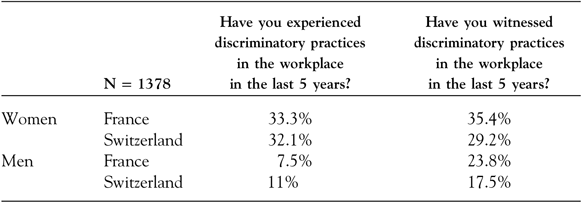
Results from the quantitative survey shed light on the gendered nature of the unfairness dimension of alienation. The proportion of women who reported having been discriminated against in the last five years in both countries was very high; almost one out of three young female lawyers (of the 1,378 surveyed in Paris, Geneva, and Lausanne) claimed to have experienced discriminatory practices in the workplace, and almost as many women claimed to have witnessed discriminatory practices against others (see Table 3). This proportion was three times higher than the proportion of French or Swiss male lawyers who claimed to have been the object of discriminatory practices, although a quarter of male lawyers in France (and one out of six in Switzerland) reported having witnessed discriminatory practices against others.
Discriminatory Practices Experienced or Witnessed by Male and Female Lawyers in France and Switzerland over the Past Five Years

Along with witnessing or experiencing discrimination, unfairness was also associated with prevalent gender stereotyping in legal workplaces. Pregnancy often triggered negative reactions from colleagues and bosses. Women who had announced their pregnancy at work described being excluded from the most interesting cases. Interviewees also said that partners often denied any organizational support to mothers-to-be and young mothers, a finding consistent with other studies (Wallace and Kay Reference Wallace and Kay2012), and that law firms management often suggested that pregnant professionals should simply opt out of lawyering, because their future status as mothers would prevent them from managing the workload expected of them. Some even reported that the contracts of pregnant women were terminated under some false pretext. Interviewees reported that the ideal image of a lawyer as someone extensively and exclusively dedicated to his/her job permeated workplace small talk and meant that pregnant lawyers were automatically assigned an inferior rank in the occupational hierarchy of prestige. Evidence of sexual harassment practices was also found both in interviews and in the survey, and disrespectful comments toward women were very frequently reported. The witnessing of disrespectful comments toward women colleagues was reported by 67 percent of women respondents and 70 percent of men respondents.
The ethos of exclusive commitment to work also affects those men who express the desire to reduce their working hours when becoming a parent; they can also be the target of negative stereotyping, although less systematically than their female counterparts (Burnett et al. Reference Burnett, Gatrell, Cooper and Sparrow2013). Survey respondents with children were asked whether becoming a parent had negative consequences on their professional lives. A significant share of lawyers (60.3 percent in Paris, 48.7 percent in Lausanne, 33.6 percent in Geneva) felt they had experienced at least one negative consequence of becoming a parent, such as losing access to the most interesting caseloads (9.1 percent of total respondents). For instance, Eric’s initial “fast-track” career slowed down significantly when he decided to ask for a 90 percent “part-time” position. As he recounted:
It was also made perfectly clear that I had no chance of ever becoming a partner, absolutely no chance. My [decision to work part-time] was like a stigma. It was as if it was written all over my face “his job is not his priority.”
The stigma faced by Eric and by the other rare, part-time, men lawyers illustrates the resistant gender stereotypes that are part of a particularly virile professional ethos. However, within this context, male and female junior lawyers face unequal risks of discrimination and lack of recognition of their professional worth. They are not affected in exactly the same way by the observed hiatus between the professional ideal of total dedication and their actual work practices.
Conclusion
This article goes beyond other scholarship documenting lawyers’ lives by offering a conceptual framework of alienation that analytically captures how various processes influence lawyers’ relationship to work that is becoming increasingly intense and specialized. This framework helps explain how lawyers’ relation to work can deteriorate or be tainted over the course of a career. The concept of alienation reveals how various aspects of the professional life of young lawyers, marked by increasing uncertainty and competition, combine to produce long-terms effects on lawyers’ relation to their jobs. It helps us understand why some lawyers, especially women, may leave law firms, significantly change their type of legal practice, or leave legal practice altogether. Indeed, this framework provides a more nuanced picture of the experiences of alienation, as it shows how alienation morphs depending on various factors, like career advancement, gender, parental status, or the size of the law firm.
Mapping the causal relations between each type of alienation and the work experience of lawyers would require more systematic exploration. Nevertheless, our interview data indicates the effects of gender, family situation, firm size, and job status on the various forms of alienation lawyers experience. Our data suggests that large law firms tend to be more alienating than small-sized law firms (except possibly with respect to fairness), that alienation is more often experienced as unfairness by junior associates than by senior partners, and that senior partners experience alienation more often as time deprivation than do junior partners.
Further research could provide additional detail on each of our findings. It could investigate how gender, family situation, status, and firm size combine to produce each type of alienation. For instance, it would be interesting to explore how the organizational resistance to working-time flexibility in large-scale law firms pressures men to adhere to a model of hegemonic masculinity (Connell Reference Connell2005). Indeed, a fruitful area of further research lies in a more refined analysis of strategies that lawyers develop in the face of the different experiences of alienation. For instance, interviewees described important career turning points as a direct or indirect consequence of experiences of alienation, however, it is not clear whether women and men lawyers’ coping strategies differ or how different national gender regimes impact these strategies. At the same time, an increasing number of women are gaining political influence within the profession by succeeding in getting elected and becoming members of governing bodies in bar associations. Thus, a useful line of inquiry might explore whether alienation coping strategies contribute to reproducing or to modifying gender relations of power and the gendered professional ethos.
Supplementary material
To view supplementary material for this article, please visit https://doi.org/10.1017/lsi.2019.50.
APPENDIX: LIST OF INTERVIEWEES