Introduction
In the last years, the number of taxonomic studies of fleas based on molecular and phylogenetical data is increasing; however, most genera, species, and subspecies have been described just using morphological criteria. Ctenophthalmidae family has been considered as a ‘catchall’ for a wide range of divergent taxa showing a paraphyletic origin (Whiting et al., Reference Whiting, Whiting, Hastriter and Dittmar2008). The family Ctenophthalmidae (sensu Lewis, Reference Lewis1993) consists of nine subfamilies and 17 described tribes, with 42 genera and 664 species (Whiting et al., Reference Whiting, Whiting, Hastriter and Dittmar2008). This high number of species corresponds approximately with one-quarter of flea species described up until now.
Morphological identification of fleas is essentially based on the shape and structure of their complex genitalia and the distribution of setae, spines, and ctenidia (Beaucournu and Launay, Reference Beaucournu and Launay1990). The modifications of the terminal abdominal segments of the male are much more complicated than in females. From a taxonomic point of view, the most important organ of male genitalia is the aedeagus. It is an extremely complex structure of obscure derivation and is seldom used in identification. Furthermore, associated structures derived from the terminal tergites and sternites are used too for taxonomic discrimination (Lewis, Reference Lewis1993). Sternum VIII of males, although it can be reduced in some species, have great importance in terms of specific identification because it encloses the remaining genital structures and it may bear modifications that are useful in identification, such as spicules and a characteristic chaetotaxy (Lewis, Reference Lewis1993). On the other hand, in females, sternum VII and VIII are usually well developed covering most if not all the terminal portion of the abdomen (Linardi, Reference Linardi2000). In most cases, the configuration, shape, and chaetotaxy of the sternum VII caudal margin can be useful in taxonomic discrimination. Together with sternum VII, the spermatheca of females is considered the most important taxonomic character in order to identify and classify female fleas at different taxonomical levels (Beaucournu and Launay, Reference Beaucournu and Launay1990; Lewis, Reference Lewis1993). The spermatheca is usually placed within sternum VII and is divided into a heavily sclerotized bulga and a less sclerotized finger-like projection, the hilla (Linardi, Reference Linardi2000). From a taxonomical point of view, in recent years, some species of the Ctenophthalmidae family have been studied mainly based on the morphological features mentioned above (Sanchez and Lareschi, Reference Sanchez and Lareschi2014; Acosta and Hastriter, Reference Acosta and Hastriter2017; Keskin, Reference Keskin2019; Keskin and Beaucournu, Reference Keskin and Beaucournu2019a) including the descriptions of two new species and a new subspecies of the genus Ctenophthalmus (Keskin and Beaucournu, Reference Keskin and Beaucournu2019b)
Despite using these morphological structures as useful taxonomical tools, there are many cases where the specific identification of females can be more complicated, especially when they are isolated without males to compare them to. This is the case of the genus Ctenophthalmus whose males are easily distinguishable based on the size, shape, and chaetotaxy of their genitalia; however, females show slight morphological differences on each other (Beaucournu & Launay, Reference Beaucournu and Launay1990). Therefore, the specific and subspecific determination within the genus Ctenophthalmus has been exclusively based on the male morphological characters due to the lack of morphological differences among females. These morphological differences of most species were so small and intraspecific variation was so great that it seemed useless to attempt to make a taxonomical key for this sex (Beaucournu and Launay, Reference Beaucournu and Launay1990; Lewis, Reference Lewis1993).
Due to the inability of systematics to homologize characters adequately across fleas and outgroup taxa, different taxonomic studies have revealed the necessity to carry out an exhaustive revision in flea taxonomy combining morphological, molecular, and phylogenetic data specially focused to species and subspecies level (Whiting et al., Reference Whiting, Whiting, Hastriter and Dittmar2008; Zurita et al., Reference Zurita, Callejón, de Rojas and Cutillas2018a, Reference Zurita, Callejón, de Rojas and Cutillas2018b). This necessity is due to the fact that fleas show a high degree of morphological specializations associated with ectoparasitism. Therefore, fleas appear to have many instances of the parallel evolution of morphology, probably associated with multiple invasions of similar hosts, which further obscures homology (Holland, Reference Holland1964). This fact has been observed in different flea taxa in the last years, Marrugal et al. (Reference Marrugal, Callejón, de Rojas, Halajian and Cutillas2013) noticed that Ctenocephalides felis showed a certain degree of phenotypic plasticity which did not correspond with molecular differences. Recently, Zurita et al. (Reference Zurita, Callejón, de Rojas and Cutillas2018a) found that some morphological diagnostic characters historically used to discriminate between two congeneric species (Nosopsyllus fasciatus and Nosopsyllus barbarus) should be revised.
Based on these precedents, the main objective of this work was to carry out a comparative morphometric, phylogenetic, and molecular study of two different subspecies belonging to genus Ctenophthalmus: Ctenophthalmus baeticus boisseauorum (Beaucournu, Reference Beaucournu1968) and Ctenophthalmus apertus allani (Smit, Reference Smit1955) in order to clarify the taxonomic status of these two subspecies. These species were chosen due to their morphological similarities as well as the fact that they shared the same host and were collected from the same geographical area. In order to carry out this work, Internal Transcribed Spacer (ITS) 1 and ITS2 of ribosomal DNA (rDNA) and the partial cytochrome c oxidase subunit 1 (cox1) and cytochrome b (cytb) of mitochondrial DNA (mtDNA) genes were sequenced and assessed.
Material and methods
Collection of samples
A total of eighty fleas were collected from rodents Arvicola scherman (Arvicolinae) from Asturias (North of Spain) (43°20′00″N 6°00′00″O) (table 1). These fleas were obtained and previously classified with the assistance of colleagues (see Acknowledgements). Fleas obtained were kept in Eppendorf tubes with 70% ethanol for subsequent identification and DNA extraction.
GenBank accession numbers of ITS1, ITS2 and partial cytb, cox1 gene sequences of individuals of Ctenophthalmus sp. (CT), C. baeticus boisseauorum (CBB), and C. apertus allani (CAA) obtained in this study

Morphological identification and biometrical study
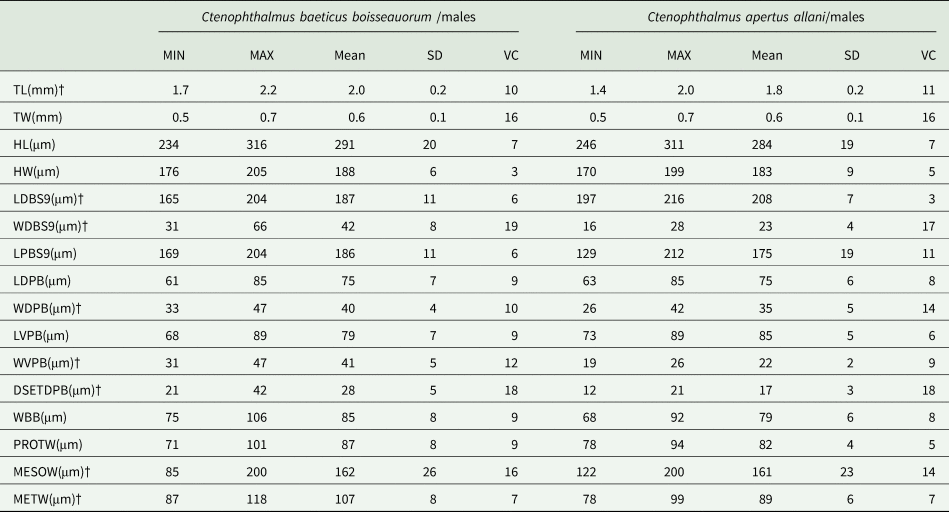
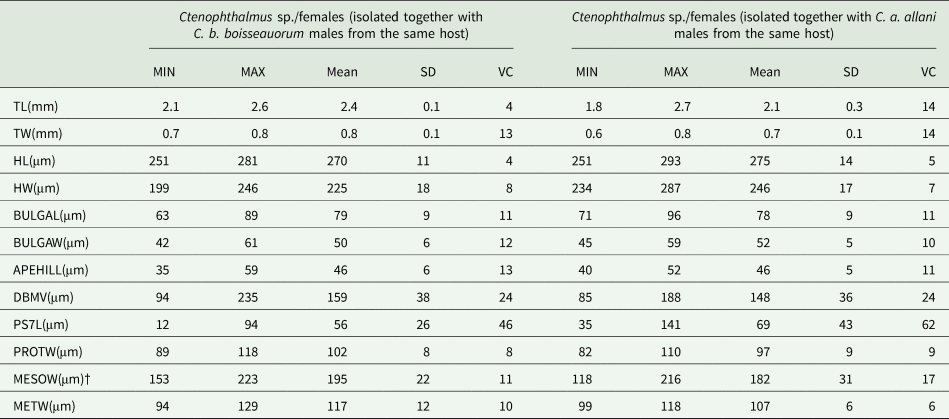
For morphological analysis, whole specimens were examined and photographed under an optical microscope. Subsequently, 30 fleas were put away for molecular purposes, whereas the rest of the samples (50 fleas) were cleared with 10% KOH, prepared and mounted on glass slides using conventional procedures with EUKITT mounting medium (O. Kindler GmbH & Co., Freiburg, Germany) (Lewis, Reference Lewis1993). Once mounted, they were examined and photographed again for a deeper morphological analysis using a CX21 microscope (Olympus, Tokyo, Japan). Diagnostic morphological characters of all the samples were studied by comparison with figures, keys, and descriptions reported by Hopkins and Rothschild (Reference Hopkins and Rothschild1953) and Beaucournu and Launay (Reference Beaucournu and Launay1990). After morphological identification, 30 males and 20 females were measured according to 16 different parameters for males and 12 different parameters for females (tables 2 and 3). Descriptive univariate statistics (arithmetic means, standard deviation, and coefficient of variation) for all parameters were determined using SPSS program version 24 (IBM Corp., Armonk, NY, USA) (Pardo and Ruiz, Reference Pardo and Ruiz2002). Furthermore, to assess phenotypic variations among the samples, morphometric data were explored using multivariate analysis in nine measurements (LDBS9, WDBS9, WDPB, WVPB, DSETDPB, TL (excluding PROTW, MESOW, METW), PROTW, MESOW, METW) in males (see table 2) and 11 measurements (BULGAL, BULGAW, APEHILL, DBMV, PS7L, TW, HL, HW, PROTW, MESOW, METW) in females (see table 3) by principal component analysis, consisting in a method for summarizing most of the variations in a multivariate dataset in few dimensions (Dujardin and Le Pont, Reference Dujardin and Le Pont2004). Phenotypic analyses were conducted using BAC v.2 software (Dujardin, Reference Dujardin2002; Valero et al., Reference Valero, Perez-Crespo, Periago, Khoubbane and Mas-Coma2009; García-Sánchez et al., Reference García-Sánchez, Rivero, Callejón, Zurita, Reguera-Gomez, Valero and Cutillas2019).
Biometrical data of males of Ctenophthalmus baeticus boisseauorum and Ctenophthalmus apertus allani analyzed in this study

TL = total length, TW = total width, HL = total length of the head, HW = total width of the head, LDBS9 = total length of the distal branch of the IX sternum, WDBS9 = total width of the distal branch of the IX sternum, LPBS9 = total length of the proximal branch of the IX sternum, LDPB = total length of the dorsal processus basimere, WDPB = total width of the dorsal processus basimere, LVPB = total length of the ventral processus basimere, WVPB = total width of the ventral processus basimere DSETDPB = Distance between the two setae of the dorsal processus basimere, WBB = total width of the basimere basis, PROTW= total width of the prothorax, MESOW = total width of the mesothorax, METW = total width of the metathorax, MAX = maximum, MIN = minimum, SD = standard deviation, Mean = arithmetic mean, VC = coefficient of variation (percentage converted), † = Significant differences between C. b. boisseauorum and C. a. allani males (P < 0.005).
† = Significant differences between C. b. boisseauorum and C. a. allani males (P < 0.005).
Biometrical data of females of Ctenophthalmus sp. analyzed in this study

TL = total length, TW = total width, HL = total length of the head, HW = total width of the head, BULGAL = total length of the bulga, BULGAW = total width of the bulga, APEHILL = total length of the apex of the hilla, DBMV = distance from bulga to ventral margin of the body, PS7L = total length of the VII sternum prominence, PROTW= total width of the prothorax, MESOW = total width of the mesothorax, METW = total width of the metathorax, MAX = maximum, MIN = minimum, SD = standard deviation, Mean = arithmetic mean, VC = coefficient of variation (percentage converted), † = Significant differences between the two groups of females (P < 0.005).
† = Significant differences between C. b. boisseauorum and C. a. allani males (P < 0.005).
Molecular study
A total of 30 fleas were molecularly analyzed. We previously selected ten males of each subspecies (C. b. boisseauorum and C. a. allani) and ten females previously classified as Ctenophthalmus sp.
For DNA amplification, each specimen (only those isolated for molecular purposes) was transferred to a 1.5 ml tube containing 180 μl of G2 lysis buffer (Qiagen, Hilden, Germany) and 20 μl of proteinase K (Qiagen), and incubated at 56°C overnight. DNA extraction was performed with an EZ1 DNA Tissue Kit (Qiagen) according to the manufacturer recommendations. Flea DNAs were then eluted in 100 μl of Tris EDTA buffer using the DNA extracting EZ1 Advanced XL Robot (Qiagen). The DNA was either immediately used or stored at −20°C until molecular analysis. The DNA extracting EZI Advanced XL Robot was disinfected after each batch of extraction as per the manufacturer's recommendations, to avoid cross-contamination. All molecular markers sequenced in the present study (ITS1 and ITS2 rDNA, cox1 and cytb mtDNA) were amplified by a polymerase chain reaction (PCR) using a thermal cycler (Eppendorf AG; Eppendorf, Hamburg, Germany). PCR mix, PCR conditions, and PCR primers are summarized in the Supporting information (table S1). In the case of cox1, we initially tried to obtain a 658 bp fragment of this marker, the so-called barcoding fragment which can serve as the core of a global bioidentification system for animals (Hebert et al., Reference Hebert, Cywinska, Ball and De Waard2003). For this purpose, we initially used the generic invertebrate amplification primers LCO1490 and HC02198 (Folmer et al., Reference Folmer, Black, Hoeh, Lutz and Vrijenhoek1994); however, we did not obtain reliable results owing to co-amplification of non-specific products. For that reason, we finally used Kmt6 primer (Zhu et al., Reference Zhu, Hastriter, Whiting and Dittmar2015) as a forward to amplify the cox1 partial gene (453 pb), whereas HC02198 remained as a reverse primer for this partial gene. The ITS1, ITS2, cox1, and cytb partial gene sequences obtained from all specimens analyzed were deposited in the GenBank database (table 1).
The PCR products were checked on SYBR Safe stained 2% Tris–borate–ethylenediaminetetraacetic acid agarose gels. Bands were eluted and purified from the agarose gel using the QWizard SV Gel and PCR Clean-Up System Kit (Promega, Madison, WI, USA). Once purified, the products were sequenced by Stab Vida (Lisbon, Portugal). To obtain a nucleotide sequence alignment file, the MUSCLE alignment method (Edgar, Reference Edgar2004) was used in MEGA, version 5.2 (Tamura et al., Reference Tamura, Peterson, Peterson, Stecher, Nei and Kumar2011). To assess the similarity among all marker sequences of all specimens analyzed in the present study and other flea species, the number of base differences per sequence with respect to the sequences under investigation was assessed using the number of differences method of MEGA, version 5.2 (Tamura et al., Reference Tamura, Peterson, Peterson, Stecher, Nei and Kumar2011).
Phylogenetic trees were inferred using nucleotide data and performed using two methods: Maximum Likelihood (ML) and Bayesian Inferences (BI). ML trees were generated using the PHYML package from Guindon and Gascuel (Reference Guindon and Gascuel2003), whereas BI were generated using MRBAYES, version 3.2.6 (Ronquist and Huelsenbeck, Reference Ronquist and Huelsenbeck2003). JMODELTEST (Posada, Reference Posada2008) was used to determinate the best-fit substitution model for the parasite data (ITS2, cox1, and cytb). Models of evolution were chosen for subsequent analyses according to the Akaike information criterion (Huelsenbeck and Rannala, Reference Huelsenbeck and Rannala1997; Posada and Buckley, Reference Posada and Buckley2004). To investigate the dataset containing the concatenation of three markers (ITS2, cox1, and cytb), analyses based on BI were partitioned by gene and models for individual genes within partitions were those selected by JMODELTEST. For ML inference, best-fit nucleotide substitution models included a general time-reversible model with γ-distributed rate variation GTR + G (ITS2) and a Tamura–Nei model with γ-distributed rate variation and a proportion of invariable sites, TrN + I + G (cox1 and cytb). Support for the topology was examined using bootstrapping (heuristic option) (Felsenstein, Reference Felsenstein1985) over 1000 replications to assess the relative reliability of clades. The commands used in MRBAYES, version 3.2.6 for BI were nst = 6 with γ rates (ITS2) and nst = 6 with invgamma rates (cox1 and cytb). For BI, the standard deviation of split frequencies was used to determine whether the number of generations completed was sufficient; the chain was sampled every 500 generations and each dataset was run for 10 million generations. Adequacy of sampling and run convergence was assessed using the effective sample size diagnostic in the tracer, version 1.6 (Rambaut and Drummond, Reference Rambaut and Drummond2007). Trees from the first million generations were discarded based on an assessment of convergence. Burn-in was determined empirically by the examination of the log-likelihood values of the chains. The Bayesian posterior probabilities (BPP) comprise the percentage converted.
The phylogenetic analyses, based on ITS2, cox1, and cytb sequences, were carried out using our sequences and those obtained from the GenBank database (see table S2). Phylogenetic trees based on concatenated sequences of ITS2, cox1, and cytb were rooted including Panorpa meridionalis (Mecoptera: Panorpidae) as outgroup. This choice was based on the combination of morphological and molecular data obtained in previous studies, which provided compelling evidence for a sister group relationship between Mecoptera and Siphonaptera (Whiting, Reference Whiting2002; Whiting et al., Reference Whiting, Whiting, Hastriter and Dittmar2008). The ITS1 sequence of P. meridionalis or other species of Mecoptera was not available either by amplification of different individuals or in any public database. Thus, no phylogenetic tree with other Siphonaptera species based on ITS1 sequences was constructed, and this molecular marker was also discarded for the concatenated dataset. The selection of flea taxa for the concatenated phylogenetic tree was limited to flea species whose ITS2, cox1, and cytb sequences were available in the GenBank database.
Results
Morphological and biometrical results
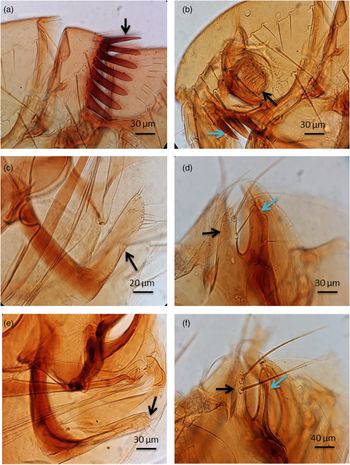
All the specimens studied in this work showed morphological characteristics expected for the genera Ctenophthalmus sp:
• Labial palp with no more than four segments.
• Presence of pronotal ctenidia (fig. 1a).
• Antennae with nine well visible segments. Basal segments of the antennae not fused (fig. 1b).
• Genal ctenidia with three cone-shaped setae horizontally inserted with a sharped apex (fig. 1b).
Morphological characteristics of Ctenophthalmus sp, Ctenophthalmus baeticus boisseauorum, and Ctenophthalmus apertus allani. (a) Pronotal ctenidia (black arrow) of Ctenophthalmus sp.; (b) Head with antennae (black arrow) and genal ctenidia of Ctenophthalmus sp (blue arrow); (c) Male distal branch of IX sternum (black arrow) of C. b. boisseauorum; (d) Dorsal processus basimere (black arrow) and ventral processus basimere (blue arrow) of males of C. b. boisseauorum; (e) Male distal branch of IX sternum (black arrow) of C. a. allani; (f) Dorsal processus basimere (black arrow) and ventral processus basimere (blue arrow) of males of C. a. allani.

Males could be easily discriminated between the two subspecies (C. b. boisseauorum and C. a. allani).
Males of C. b. boisseauorum showed different specific morphological characters:
• Apex of the distal branch of IX sternum without an apical slot (fig. 1c).
• Distal branch of IX sternum with parallel margins (fig. 1c).
• Dorsal processus basimere significantly longer than it is wide with two long setae showing different lengths on each other (fig. 1d).
• Ventral processus basimere significantly longer than it is wide showing an apical slot (fig. 1d).
Males of C. a. allani showed different specific morphological characters:
• Apex of the distal branch of IX sternum with a small apical slot (fig. 1e).
• Apical part of the distal branch of IX sternum with parallel margins (fig. 1e).
• Dorsal processus basimere significantly longer than it is wide with two long setae with the same length on each other (fig. 1f).
• Ventral processus basimere cone-shaped or digitiform without any slot on the apex (fig. 1f).
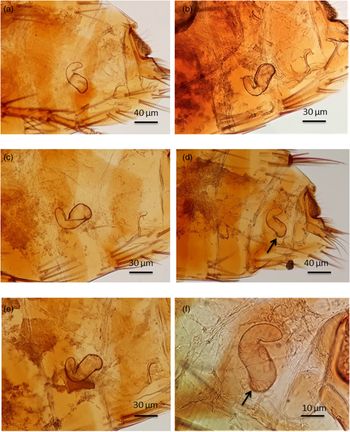
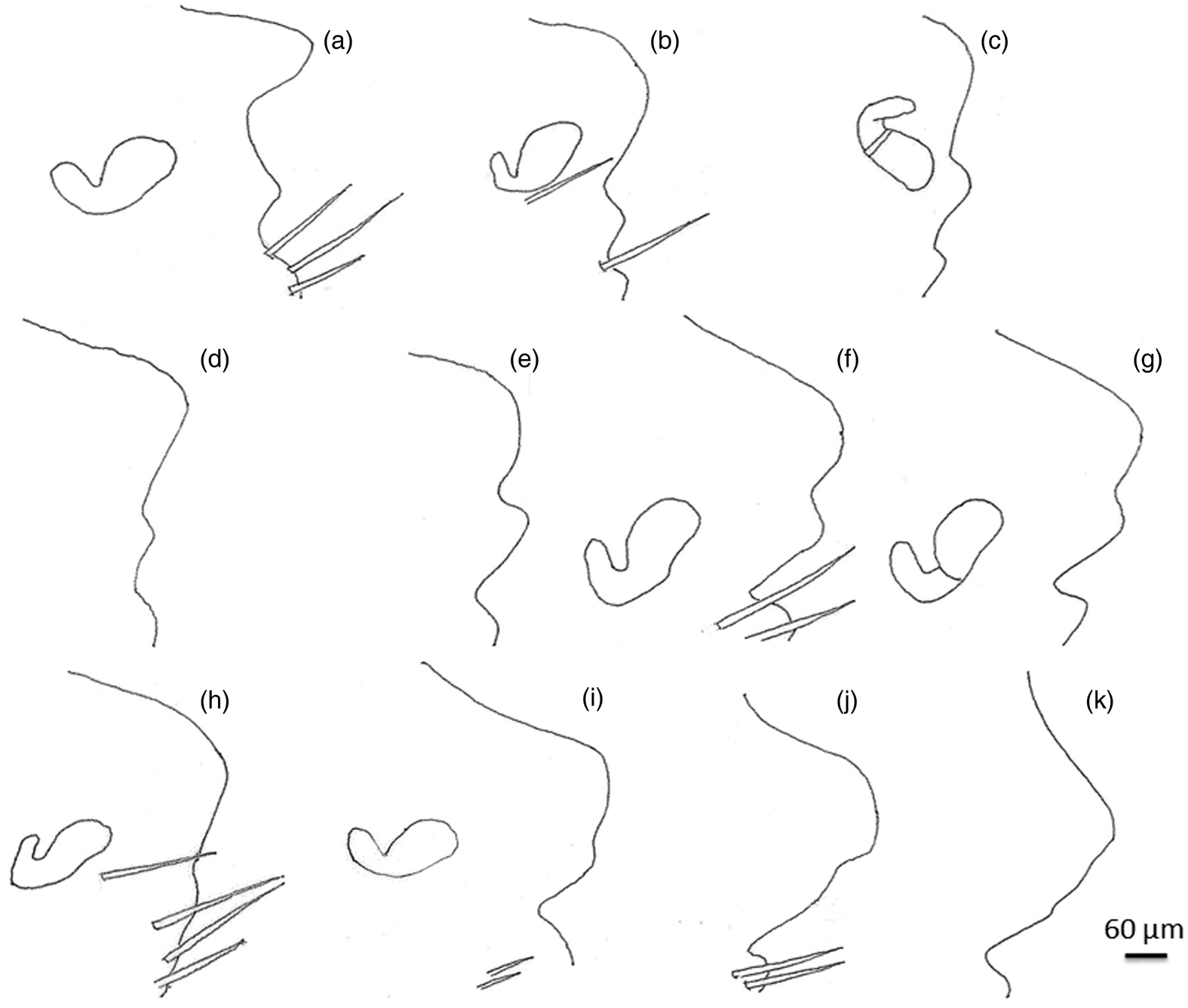
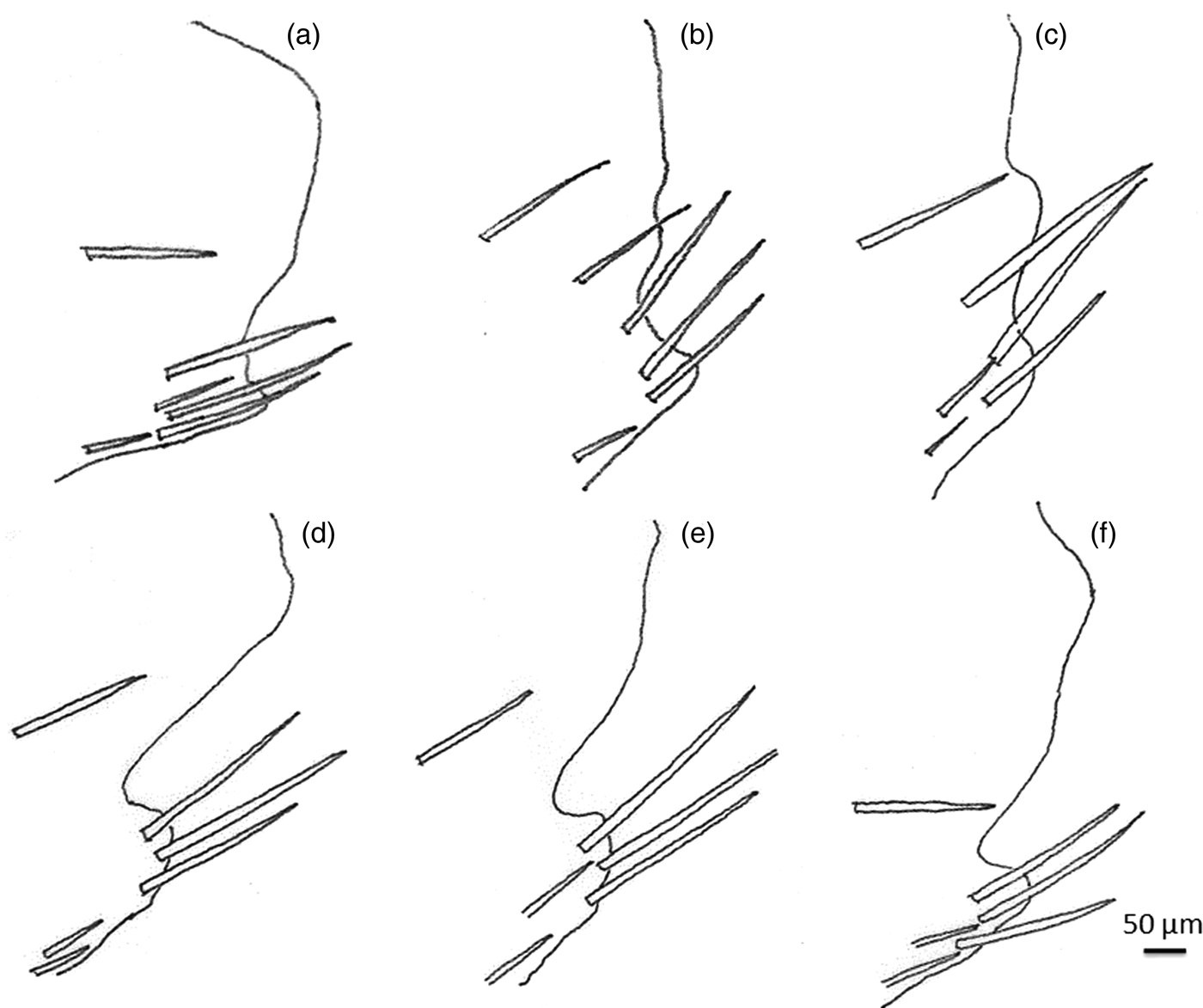
Since there are no criteria to discriminate females belonging to Ctenophtahlmus sp., we considered all the females as two main groups: The first group included females isolated together with C. b. boisseauorum males from the same host, whereas the second group included females isolated together with C. a. allani males from the same host. In spite of the non-existence of discriminative taxonomical characters, the spermatheca and the chaetotaxy and shape of the margin of the sternum VII in females have remained as the most reliable and variable characters in order to carry out a specific classification within Order Siphonaptera. For this reason, we focused on these regions in a deeper way. The spermatheca appeared very similar in all females' specimens assessed without any morphological discriminative pattern between both groups (fig. 2). Thus, the spermatheca always showed a hilla shorter and narrower than bulga. Furthermore, we could notice a small prominence at the end of the bulga in some specimens from both female groups (fig. 2d, f) which sometimes could appear less prominent (fig. 2b, c). Likewise, morphological analysis based on the spermatheca, our results did not show any morphological-specific pattern in order to discriminate among all the female specimens analyzed based on the chaetotaxy and shape of the sternum VII. Thus, we noticed aleatory appearances and shapes for the margin of sternum VII in females (fig. 3). Some females of both groups showed two well-developed apical lobes of variable size which subtended two little sinus of variable size on the posterior margin of VII sternum (fig. 3a–g), whereas other females from both groups showed only one well-developed apical lobe (fig. 3h–k) together with a deep sinus (fig. 3i–k). According to chaetotaxy, no significant differences were observed between both females' groups. Therefore, all specimens assessed showed the presence of six setae with different degrees of development (fig. 4). The distribution of these setae changed among all the specimens analyzed; however, it was common in the presence of three strong setae, longest than the other ones, which appeared very close to each other (fig. 4a–f). With all these variable morphological results, we were not able to set up any taxonomical key or similar for female discrimination.

Variability observed in the shape of the margin of sternum VII of Ctenophthalmus sp. females.

Variability observed in chaetotaxy of sternum VII of females belonging to Ctenophthalmus sp. assessed in this study.

Biometrical results showed significant differences between males of both subspecies (C. b. boisseauorum and C. a. allani) based on different parameters such as TL, LDBS9, WDBS9, WDPB, WVPB, DSETDPB, MESOW, METW (see table 2). Males of C. b. boisseauorum showed a wider distal branch of the IX sternum, a wider ventral processus basimere and more distance between the two setae present on the dorsal processus basimere than C. a. allani males. According to sex differentiation, females generally appeared longer and with a wider head than males (table 3). Only MESOW (width of mesothorax) appeared as a differential significant statistic value between both female groups; although in some individuals, this parameter overlapped between these groups (table 3). Additionally, these data were compared with the results obtained by PCA consisting of the regression of each character separately on the within-group first principal component (PC1). Therefore, male variables significantly correlated with PC1, contributing 73% to the overall variation. Both male populations appeared separated from each other, with no overlapping areas between C. b. boisseauorum and C. a. allani (fig. 5a). The factor map (fig. 5a) clearly showed a bigger global size in the male population of C. a. allani.
(a) Factor map corresponding to adult C. b. boisseauorum (CBBM) and C. a. allani (CAAM) males from Asturias (Spain). Samples are projected onto the first (PC1, 73%) and second (PC2, 9%) principal components. Each group is represented by its perimeter. (b) Factor map corresponding to adult Ctenophthalmus sp. females from Asturias (Spain). Samples are projected onto the first (PC1, 67%) and second (PC2, 18%) principal components. Each group is represented by its perimeter. CTH1: Females of Ctenophthalmus sp. isolated together with C. b. boisseauorum males from the same host; CTH2: Females of Ctenophthalmus sp. isolated together with C. a. allani males from the same host.

Furthermore, female variables significantly correlated with PC1, contributing 67% to the overall variation. In this case, the factor map (fig. 5b) showed an overlapping area without remarkable global size differences between both female groups.
Molecular results
ITS1 and ITS2 analysis
The length of the ITS1 sequences of all the Ctenophthalmus specimens ranged from 888 base pairs (bp) (C. a. allani males) to 889 bp (C. b. boisseauorum males and Ctenophthalmus sp. females) (table 1), whereas the length of the ITS2 fragment was 492 bp for all the specimens. The ITS1 intrageneric similarity ranged from 99.9 to 100%, whereas the ITS2 sequences showed an intrageneric similarity that ranged from 99.6 to 100% with a maximum of two different base pairs among all the sequences analyzed.
The phylogenetic tree inferred from ITS2 sequences of C. b. boisseauorum and C. a. allani and other ITS2 sequences retrieved from GenBank (see table S2) showed all the Ctenophthalmus species and subspecies clustered together in a polytomy with high bootstrap and BPP values (100/100) without any specific phylogenetic pattern of distribution. Furthermore, this genus appeared close related to Tunga penetrans (Tungidae) sharing clade with other species of Ctenophthalmidae (fig. S1).
Partial cox1 mtDNA gene analysis
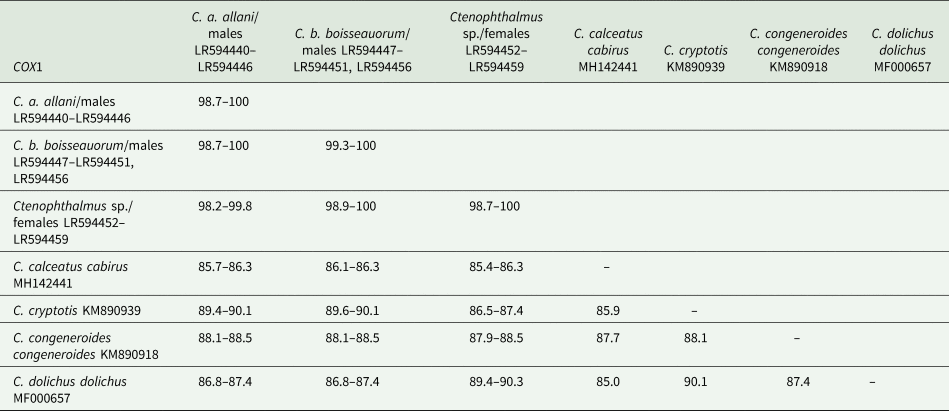
The partial gene cox1 mtDNA sequences of C. b. boisseauorum and C. a. allani males and Ctenophthalmus sp. females were 453 bp in length (table 1). The similarity observed among cox1 sequences of C. a. allani ranged from 98.7 to 100%, whereas this value ranged from 99.3 to 100% for C. b. boisseauorum (table 4). Similar values were observed when we calculated the similarity between males from both subspecies and Ctenophthalmus sp. females, thus we noticed overlapped percentages between them with a minimum value of 98.2% (Ctenophthalmus sp. females – C. a. allani males) and with a maximum value of 100% (Ctenophthalmus sp. females – C. b. boisseauorum males; C. b. boisseauorum males – C. a. allani males) (table 4). In contrast to that, these similarity percentage values were considerably lower when we compared these sequences with partial gene cox1 sequences from other congeneric species. Therefore, these percentage values ranged from 86.5% (Ctenophthalmus sp. females – Ctenophthalmus cryptotis) to 90.3% (Ctenophthalmus sp. females – Ctenophthalmus dolichus dolichus). On the other hand, the lowest value of similarity was observed between C. dolichus dolichus and Ctenophthalmus calceatus cabirus (85.0%) (table 4).
Similarity observed among all the partial cox1 mtDNA gene sequences of different species belonging to Ctenophthalmus sp. obtained in this work and retrieved from Genbank database. Values are given in percentages

Phylogenetic tree topology revealed a clade (BPP and bootstrap values: 67/87) clustering all Ctenophthalmus species, excluding one Ctenophthalmus sp. sequence (AN: KM891003). Within this clade, we observed a highly supported subclade (92/89 – BPP and bootstrap values) corresponding to our sequences appearing in polytomy. Furthermore, Ctenophthalmidae family appeared in polytomy with other flea families (fig. S2).
Partial cytb mtDNA gene analysis
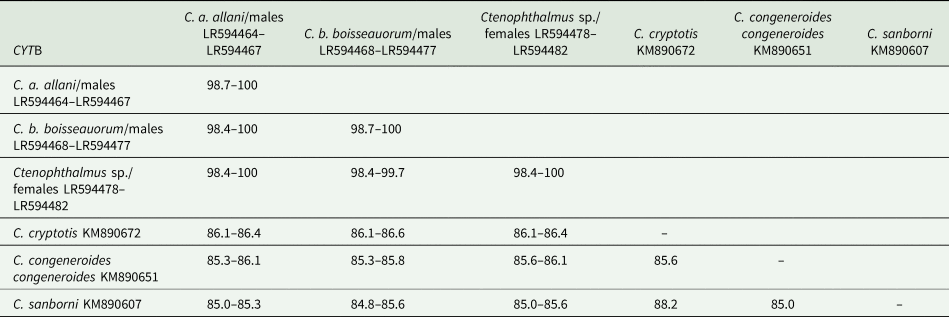
The length of the cytb mtDNA sequences of all the Ctenophthalmus sp. specimens obtained in this study was 374 (table 1). The similarity observed among the partial cytb sequences of males of both subspecies (C. b. boisseauorum and C. a. allani) ranged from 98.7 to 100%, whereas the percentage of similarity obtained when we compared all the Ctenophthalmus sp. females cytb sequences of each other ranged from 98.4 to 100% (table 5). Similar results were observed when we obtained the similarity between males of both subspecies together with Ctenophthalmus sp. females, thus these values ranged from 98.4% (Ctenophthalmus sp. females – C. a. allani males – C. b. boisseauorum males) to 100% (Ctenophthalmus sp. females – C. a. allani males; C. b. boisseauorum males – C. a. allani males) (table 5). Additionally, we also calculated the interspecific similarity between the cytb sequences obtained in this study and those from other species belonging to the same genus (C. cryptotis, Ctenophthalmus congeneroides congeneroides and Ctenophthalmus sanborni). Our analysis revealed lower values out of which none exceeded 86.6%, with a minimum percentage value of 84.8% (C. b. boisseauorum males – C. sanborni).
Similarity observed among all the partial cytb mtDNA gene sequences of different species belonging to Ctenophthalmus sp. obtained in this work and retrieved from Genbank database. Values are given in percentages

The phylogenetic tree inferred from partial cytb gene sequences revealed a well-supported clade (100/88 – BPP and bootstrap values) comprising all the species belonging to Ctenophthalmus genus (fig. S3). Within this clade, we noticed a highly supported subclade (100/95 – BPP and bootstrap values) clustering all the partial cytb mtDNA sequences of C. b. boisseauorum and C. a. allani males and Ctenophthalmus sp. females without any specific phylogenetic pattern of distribution (fig. S3). On the other hand, all the different flea families appeared in a polytomy in the same clade (Pulicidae, Ctenophthalmidae, Ceratophyllidae, Stephanocircidae, Pygiopsyllidae, Stivaliidae and Stenoponiidae) (fig. S3).
The concatenated dataset of ITS2, partial cytb and cox1 gene sequences included 1405 aligned sites and 55 taxa, including outgroups. Phylogenetic analyses of the concatenated dataset yielded a tree with branches that were strongly supported (fig. 6). The analysis based on the concatenated dataset showed all species belonging to Ctenophthalmus genera obtained in this work presenting a monophyletic origin and clustering together in a highly supported clade not showing any specific phylogenetic pattern of distribution (fig. 6). In addition, different families such as Ceratophyllidae, Pulicidae and Stenoponiidae appeared separated from Ctenophthalmidae (fig. 6).
Phylogenetic tree of Ctenophthalmus sp., Ctenophthalmus baeticus boisseauorum, and Ctenophthalmus apertus allani assessed in this study (see table 1) based on concatenated Internal Transcribed Spacer 2 (ITS2), partial cytochrome c-oxidase subunit 1 (cox1) and cytochrome b (cytb) gene of mitochondrial DNA inferred using the Bayesian Inference (BI) and Maximum Likelihood (ML) methods and Bayesian topology. The percentage of replicate trees in which the associated taxa clustered together in the bootstrap test (1000 replicates) is shown on the branches. The Bayesian posterior probabilities (BPP) are percentage converted.

Discussion
Morphological data combined with the modern molecular approaches have become a major source for phylogenetic inference in taxonomical studies (Bybee et al., Reference Bybee, Zaspel, Beucke, Scott, Smith and Branham2010). Nevertheless, probably due to the high level of morphological diversity observed in the Order Siphonaptera, the number of combined analyses of molecular and morphological data is still unusual in this Order. This work constitutes the first study that provides a combination of morphological, biometrical, molecular, and phylogenetic comparative data of two subspecies (C. b. boisseauorum and C. a. allani) belonging to Ctenophthalmus genus in order to assess their taxonomic and phylogenetic relationships. It should be highlighted that genus Ctenophthalmus includes approximately 300 valid taxa (Beaucournu and Lorvelec, Reference Beaucournu and Lorvelec2014) representing the most abundant flea genus in Europe (Beaucournu and Launay, Reference Beaucournu and Launay1990).
Gómez et al. (Reference Gómez, Fernández-Salvador and Garcia2003) reported some notes about the morphological variability of Ctenophthalmus sp. in Spain. These authors argued that even seven different subspecies of Ctenophthalmus (C.) apertus had been described in Spain: C. (C.) apertus apertus, C. (C.) apertus allani, C. (C.) apertus azevedoi, C. (C.) apertus gilcolladoi, C. (C.) apertus gosalhezi, C. (C.) apertus meylani, and C. (C.) apertus personatus, having each of these species their own geographic distribution. Therefore, they placed C. a. allani in the north of Spain at the cities of León, Oviedo, Santander, and Zamora (Beaucournu and Launay, Reference Beaucournu and Launay1990; Gómez et al., Reference Gómez, Fernández-Salvador and Garcia2003). These locations agree with our results since our specimens classified as C. a. allani were isolated from Asturias (north of Spain). In addition, previous authors (Beaucournu and Launay, Reference Beaucournu and Launay1990; Beaucournu and Loverlec, Reference Beaucournu and Lorvelec2014) have just placed C. b. boisseauorum in different geographical areas of the north of Spain. The morphological analysis carried out by Hopkins and Rothschild (Reference Hopkins and Rothschild1966) and Beaucournu and Launay (Reference Beaucournu and Launay1978, Reference Beaucournu and Launay1990) reported that several specimens of each ‘apertus’ subspecies evidenced great variability in male modified abdominal segments as well as in female sternum VII; however, these authors only provided taxonomical keys for males. Beaucournu and Launay (Reference Beaucournu and Launay1978, Reference Beaucournu and Launay1990) speculated about the possibility that this morphological variability was possibly due to interbreeding of two subspecies which have sympatric distribution, but finally, they supported that this fact was just different morphotypes as a consequence of the wide morphological intraspecific ‘apertus’ variations. The higher degree of morphological variation observed in males could be explained because in temporary parasites, males mostly have a shorter life period and are more active in terms of looking for new hosts. Thus, males leave earlier from their hosts (Marshall, Reference Marshall1981), whereas females need blood to produce their eggs, leaving their hosts later (Dryden, Reference Dryden1993). Attending to our morphological results, we could discriminate between the males of C. b. boisseauorum and C. a. allani generally based on the width of the ventral processus basimere and in the total distance between the two setae present on the dorsal processus basimere which showed different lengths in C. b. boisseauorum. Unlike males, females showed an aleatory high degree of polymorphism based on the shape of the margin of the sternum VII. These characters did not correspond with any subspecific morphological pattern between the two groups of Ctenophthalmus females analyzed in this study. Márquez and Soringuer (Reference Márquez and Soringuer1987) observed great variability in the margin of sternum VII in the females of C. a. meylani noticing that some specimens showed morphological characteristics similar to the subspecies C. a. queirozi. These authors argued that in each population a great morphological variability could exit in females associated with different ecological traits which would be responsible for the selection of one specific morphotype. Nevertheless, in our study, the variability observed in the shape of the margin of the sternum VII was similar in both female groups isolated from the same host and from the same geographical origin.
In spite of that, Marquez and Soringuer (Reference Márquez and Soringuer1987) found some differences in this region in terms of the number of setae from one population of C. a. meylani isolated from Granada, Córdoba, and Jaén (Spain). Nevertheless, most specimens analyzed by these authors showed six main setae in sternum VII agreeing on our results. In this sense, the chaetotaxy of sternum VII of females was assessed in our study in order to find new possible morphological variations which allow us to discriminate between females of Ctenophthalmus genus. Nevertheless, both characters appeared hardly identical (with slight differences in the spermatheca of some specimens) even between the two female groups of this study. These results would be in agreement with Beaucournu and Launay (Reference Beaucournu and Launay1990) who did not find clear differences in this region in Ctenophthalmus genus. These taxonomical results were corroborated by PCA and biometrical analysis but were not in concordance with molecular and phylogenetic results, especially based on male specimens which showed a high degree of nucleotide similarity.
ITS1 and ITS2 have been reported as two useful markers in order to infer phylogenetic studies in flea taxonomy, being used with several purposes: molecular characterization of several flea species (Vobis et al., Reference Vobis, D'Haese, Mehlhorn, Mencke, Blagburn, Bond, Denholm, Dryden, Payne, Rust, Schroeder, Vaughn and Bledsoe2004), molecular discrimination among congeneric species (Marrugal et al., Reference Marrugal, Callejón, de Rojas, Halajian and Cutillas2013; Zurita et al., Reference Zurita, Callejón, de Rojas, Halajian and Cutillas2016), molecular characterization of different geographical lineages from the same species (Luchetti et al., Reference Luchetti, Trentini, Pampiglone, Fiorawanti and Mantovani2007; Ghavami et al., Reference Ghavami, Mirzadeh, Mohammadi and Fazaeli2018), or even molecular discrimination among possible cryptic species (Zurita et al., Reference Zurita, Callejón, García-Sánchez, Urdapilleta, Lareschi and Cutillas2019).
In our study, we observed a high similarity (99.6–100%) between C. b. boisseauorum and C. a. allani based on ITS sequence analysis. These results did not correspond with the morphological differences observed between both subspecies agreeing with Zurita et al. (Reference Zurita, Callejón, de Rojas and Cutillas2018a) who did not observe substantial nucleotide differences when they compared ITS1 and ITS2 sequences of N. barbarus and N. fasciatus supporting the idea that N. barbarus should be considered a junior synonym of N. fasciatus.
Even in a long way to ITS sequences, mitochondrial markers have been widely used for estimating molecular phylogenies in fleas in the last years (Lawrence et al., Reference Lawrence, Brown, Peters, Spielman, Morin-Adeline and Slapeta2014; Hornok et al., Reference Hornok, Beck, Farkas, Grima, Otranto, Kontschán, Takács, Horváth, Szőke, Szekeres, Majoros, Juhász, Salant, Hofmann-Lehmann, Stanko and Baneth2018; Zurita et al., Reference Zurita, Callejón, de Rojas and Cutillas2018a, Reference Zurita, Callejón, de Rojas and Cutillas2018b). The cox1 gene has widely showed enough interspecific nucleotide variability among different groups of arthropods in order to discriminate between species and subspecies, even which they appeared morphologically similar (Paz et al., Reference Paz, González and Crawford2011). Thus, sequencing this gen represents one of the best options for phylogenetic studies at these taxonomical level of any group of insects including fleas since it is generally considered the potential ‘barcode’ for insect identification (Hebert et al., Reference Hebert, Cywinska, Ball and De Waard2003). Cytb partial gene has also been widely used in order to infer phylogenetic relationships among different closed flea taxa (Dittmar and Whiting, Reference Dittmar and Whiting2003; Zurita et al., Reference Zurita, Callejón, García-Sánchez, Urdapilleta, Lareschi and Cutillas2019). In the most recent published articles, flea DNA barcoding data have shown a maximum of intraspecific and interspecific similarity ranging from 91.5 to 97% (Zurita et al., Reference Zurita, Callejón, García-Sánchez, Urdapilleta, Lareschi and Cutillas2019). Analyzing all these studies, it seems obvious that cytb and cox1 (likewise ITS1 and ITS2) are easily able to discriminate themselves between two closely related flea species, among different cryptic species or even to reveal the existence of different geographical lineages within the same species. Nevertheless, we noticed a high degree of similarity between C. b. boisseauorum and C. a. allani based on mitochondrial DNA markers (98.2–100%), whereas cytb and cox1 were able to discriminate between these two subspecies and other congeneric ones such as C. cryptotis, C. c. congeneroides, C. sanborni, or C. d. dolichus (84.8–90.3%). Likewise ITS analysis, morphological differences observed between males from both subspecies did not correspond with substantial nucleotide differences in cox1 and cytb sequences. These results could suggest the idea that C. b. boisseauorum and C. a. allani were the same taxon or even consider C. b. boisseauorum as a junior synonym of C. a. allani.
This idea reinforces the results reported by the concatenated phylogenetic tree and all trees constructed on the basis of the single markers. Thus, in all of them, we observed both subspecies clustering together in the same well-supported clades without any specific distribution pattern and separated from other Ctenophthalmus species suggesting that there are no phylogenetic reasons to consider these two morphosubspecies (C. b. boisseauorum and C. a. allani) as two different taxa. In spite of these results, complementary phylogenetic and molecular studies are necessary to confirm a case of synonymy between C. apertus and C. baeticus. Therefore, we should take into account that several subspecies have been described for C. apertus and C. baeticus species which should be molecularly studied before to confirm the existence of phenotypic differences which did not correspond with a real genotypic variability between both species.
In conclusion, for the first time, the present study provides comparative morphometric, phylogenetic, and molecular data for two Ctenophthalmus subspecies (C. b. boisseauorum and C. a. allani). From a morphological point of view, we can conclude that the spermatheca, the outline of VII sternum, and the chaetotaxy of this region in females are not useful tools in order to discriminate between both subspecies. This idea is in agreement with Beaucournu and Launay (Reference Beaucournu and Launay1990) who considered the outline of VII sternum as aleatory and not reliable for taxonomic studies within this genus, whereas both spermatheca and chaetotaxy of sternum VII appeared hardly identical among all the females belonging to these two subspecies. On the other hand, although males of both subspecies could be differentiated based on morphological traits, these morphological differences did not correspond with molecular and phylogenetic data. For that reason, this work brings to light by the first time, the necessity to carry out a progressive taxonomical revision within not only Ctenophthalmus genus if not in the whole Ctenophthalmidae family, which has remained as the ‘catchall’ for a large number of divergent taxa (Whiting et al., Reference Whiting, Whiting, Hastriter and Dittmar2008; Zurita et al., Reference Zurita, Callejón, De Rojas, Gómez-López and Cutillas2015; Keskin, Reference Keskin2019; Keskin and Beaucournu, Reference Keskin and Beaucournu2019b). Within this family, a wide range of different taxa have been only described from a morphological point of view, for that reason, it would be necessary to complement these classic taxonomical data with phylogenetic studies based on molecular data in order to clarify the complex taxonomy of the Ctenophthalmidae family.
In addition, it is known that phenotypic polymorphism is generally due to genetic and environmental sources of variation (Fusco and Minelli, Reference Fusco and Minelli2010). In this sense, complementary data and rigorous and statistical analysis related to ecological conditions and intrinsic characteristics of the host would be needed. These extra data would help us to confirm possible cases of phenotypic plasticity within Ctenophthalmus genus especially referring to modified abdominal segments of males and the outline of VII sternum in females.
Supplementary material
The supplementary material for this article can be found at https://doi.org/10.1017/S0007485320000127.
Acknowledgement
The present work was supported by a grant of the V Plan Propio de Investigación of the University of Seville, Spain. The authors thank Dr Carlos Feliu (University of Barcelona) for providing samples from Asturias (Spain) and Dr Philippe Parola (Institut Hospitalo-Universitaire Méditerranée Infection, Marseille) for lending support for the DNA extraction.