INTRODUCTION
Words are complex entities composed of various pieces of information, of which meaning is one and lexical label (i.e., word form) another. Various features of words have been proposed to affect processing at either the word-form level or conceptual level. The most discussed feature is lexical frequency, how often a word occurs in a given language corpus. A long-lasting and unsettled debate revolves around if and how lexical frequency relates to the age at which a word is learned, or “age of acquisition” (AoA). These features are highly correlated with each other; a high-frequency word is often acquired at an early age, while a low-frequency word is usually acquired at a later age (e.g., Morrison, Ellis, & Quinlan, Reference Morrison, Ellis and Quinlan1992). Another psycholinguistic feature—but bound to a word’s lexical label—that influences lexical-semantic processing is orthographic neighborhood density (ND). This feature quantifies how many close neighbors a word has by counting the number of words that differ orthographically by one letter from the target word. Determining the scope and independence of these psycholinguistic features in word processing can provide valuable information about the organization of words in our mind and brain, and in particular about how separate language aspects may be affected differently due to regional atrophy in individuals with brain damage.
Lexical frequency and AoA are often investigated with various linguistic tasks such as naming and lexical decision with the intention of measuring which of the two features has a larger effect on accuracy and response time (RT). Notably, across studies AoA has been reported to have a larger effect than frequency, an equal effect, or a smaller effect (e.g., Brysbaert & Ghyselinck, Reference Brysbaert and Ghyselinck2006; Cortese & Khanna, Reference Cortese and Khanna2007; Gilhooly & Logie, Reference Gilhooly and Logie1982; Treiman, Mullennix, Bijeljac-Babic, & Richmond-Welty, Reference Treiman, Mullennix, Bijeljac-Babic and Richmond-Welty1995). These contradictory results may be related to the methodological approach used. Many studies use multiple regression analyses to define each feature’s influence (e.g., Brown & Watson, Reference Brown and Watson1987; Cortese & Schock, Reference Cortese and Schock2013), but this statistical approach can be problematic because of high collinearity between frequency and AoA. To circumvent this statistical hurdle, some researchers manipulate one feature while controlling for another, for example, comparing performance on early- versus late-acquired words with on average equal frequencies (e.g., Barry, Hirsh, Johnston, & Williams, Reference Barry, Hirsh, Johnston and Williams2001; Turner, Valentine, & Ellis, Reference Turner, Valentine and Ellis1998). In this study, we have adapted this approach with an additional step, namely to not only control for the other variable but to contrast extreme values of one variable within a constant, extreme value of the other, for example, to analyze the effects of early versus late AoA within only low-frequency words, or high versus low frequency within only late AoA words (Gerhand & Barry, Reference Gerhand and Barry1999).
The effects reported for orthographic ND are contradictory as well. High ND facilitates lexical decision in some studies (e.g., Pollatsek, Perea, & Binder, Reference Pollatsek, Perea and Binder1999; Sears, Hino, & Lupker, Reference Sears, Hino and Lupker1995), inhibits it in others (e.g., Carreiras, Perea, & Grainger, Reference Carreiras, Perea and Grainger1997), and an effect is absent in yet others (e.g., Coltheart, Davelaar, Jonasson, & Besner, Reference Coltheart, Davelaar, Jonasson, Besner and Dornic1977). This inconsistency may be explained by an interaction between ND and frequency, in which ND works in a facilitative manner for low-frequency words and in an inhibitive manner for high-frequency words (Balota, Cortese, Sergent-Marshall, Spieler, & Yap, Reference Balota, Cortese, Sergent-Marshall, Spieler and Yap2004; Sears et al., Reference Sears, Hino and Lupker1995).
The mental lexicon is thought to be separated into a conceptual level, lemma level, and lexeme level. The conceptual level relates to semantics, the lemma level to syntax, and the lexeme level to aspects of word form in single-word processing (Bock & Levelt, Reference Bock, Levelt and Gernsbacher1994). AoA is considered to have a semantic locus, while ND applies to the word-form level (e.g., Brysbaert, Van Wijnendaele, & De Deyne, Reference Brysbaert, Van Wijnendaele and De Deyne2000; Cortese & Khanna, Reference Cortese and Khanna2007; Levelt, Roelofs, & Meyer, Reference Levelt, Roelofs and Meyer1999; Roelofs, Meyer, & Levelt, Reference Roelofs, Meyer and Levelt1996; Steyvers & Tenenbaum, Reference Steyvers and Tenenbaum2005). These loci are exemplified by highly overlapping measures of AoA across languages for words and their translation equivalents, while values of ND for such word pairs differ dramatically across languages (see Lexicon Projects, e.g., Balota et al., Reference Balota, Yap, Hutchison, Cortese, Kessler, Loftis, Neely, Nelson, Simpson and Treiman2007; Ferrand et al., Reference Ferrand, New, Brysbaert, Keuleers, Bonin, Méot, Augustinova and Pallier2010; Keuleers, Diependaele, & Brysbaert, Reference Keuleers, Diependaele and Brysbaert2010; Keuleers, Lacey, Rastle, & Brysbaert, Reference Keuleers, Lacey, Rastle and Brysbaert2012). The locus of frequency is debated but is proposed to relate to both levels (Vonk, Reference Vonk2017).
Individuals with primary progressive aphasia (PPA) experience breakdown of language due to progressive cortical atrophy. While semantic impairment at a word level is only a diagnostic criterion for individuals with the semantic variant of PPA (svPPA), in individuals with all three variants of PPA—non-fluent, logopenic, and semantic—words are affected in some way, namely the production, retrieval, or understanding of words, respectively. Individuals with the non-fluent variant of PPA (nfvPPA) are the least affected in semantic processing, with normal single-word comprehension and spared object knowledge, yet with variability among individuals with the non-fluent variant regarding the degree of word-finding difficulties. The hallmark of individuals with the logopenic variant of PPA (lvPPA) is anomia; although their single-word comprehension is preserved, they often experience effort finding the intended word for production. This deficit is not driven by impairment at a conceptual level, as shown by their ability to use instead simpler substitutions or circumlocutionary descriptions. By contrast, in individuals with svPPA, the conceptual level is inherently affected as these individuals lose the core knowledge of concepts; they may claim they have never known the name or use of a common object.
Psycholinguistic variables, including lexical frequency, AoA, and ND, have also been shown to affect word processing in individuals with PPA, often disproportionately compared to controls. Individuals with semantic PPA typically evidence increased difficulty with low-frequency words (e.g., Lambon Ralph et al., Reference Lambon Ralph, Sage, Green, Berthier, Maritnez Cuitin, Torralva, Manes and Patterson2011; Patterson et al., Reference Patterson, Lambon Ralph, Jefferies, Woollams, Jones, Hodges and Rogers2006), but individuals with the non-fluent and logopenic variants also demonstrate more difficulty with low-frequency words compared to controls (e.g., Diesfeldt, Reference Diesfeldt2011; Wilson et al., Reference Wilson, Brandt, Henry, Babiak, Ogar, Salli, Wilson, Peralta, Miller and Gorno-Tempini2014). Less is known about how ND and AoA influence word processing in each variant. Later AoA has been associated with decreased performance in individuals with PPA, without specification of the variant (e.g., Hirsh & Funnell, Reference Hirsh and Funnell1995; Kremin et al., Reference Kremin, Perrier, De Wilde, Dordain, Le Bayon, Gatignol, Rabine, Corbineau, Lehoux and Arabia2001). Marcotte et al. (Reference Marcotte, Graham, Black, Tang-Wai, Chow, Freedman, Rochon and Leonard2014) showed that in verb production, individuals with semantic PPA produced more errors on late-acquired words than those with non-fluent PPA—no individuals with logopenic PPA were included. With regard to ND, Laganaro, Croisier, Bagou, and Assal (Reference Laganaro, Croisier, Bagou and Assal2012) described a patient with progressive apraxia of speech due to atrophy and hypometabolism in the left insula, inferior, medial and superior frontal gyrus, and precentral gyrus, whose speech production was worse for items with lower phonological ND.
To determine how the conceptual and lexeme levels of the mental lexicon relate to lexical-semantic processing, this study investigated if and how the psycholinguistic features of frequency, AoA, and ND differently affect lexical decision accuracy and RT in individuals with the three variants of PPA. The correspondence between the focal atrophy pattern of individuals with each variant of PPA on the one hand and the brain regions involved in word-form (at the lexeme level of the mental lexicon) or semantic (at the conceptual level of the mental lexicon) processing on the other hand leads to explicit hypotheses about the influence of psycholinguistic variables on lexical decision performance. The inferior frontal, temporoparietal, and occipitotemporal networks are involved in lexical analysis and word-form processing in reading (e.g., Shaywitz et al., Reference Shaywitz, Shaywitz, Pugh, Fulbright, Constable, Mencl, Shankweiler, Liberman, Skudlarski, Fletcher, Katz, Marchione, Lacadie, Gatenby and Gore1998). These areas are typically affected in individuals with either nfvPPA or lvPPA, but not in those with svPPA (e.g., Gorno-Tempini et al., Reference Gorno-Tempini, Hillis, Weintraub, Kertesz, Mendez, Cappa, Ogar, Rohrer, Black, Boeve, Manes, Dronkers, Vandenberghe, Rascovsky, Patterson, Miller, Knopman, Hodges, Mesulam and Grossman2011). Thus, we predicted an effect of ND in individuals with nfvPPA and lvPPA, but not in those with svPPA. By contrast, individuals with svPPA experience semantic problems, caused by atrophy in the anterior temporal lobe. As the effect of AoA has a semantic locus, we predicted that AoA would specifically influence lexical decision performance in individuals with svPPA, but not in those with nfvPPA or lvPPA.
METHOD
Participants
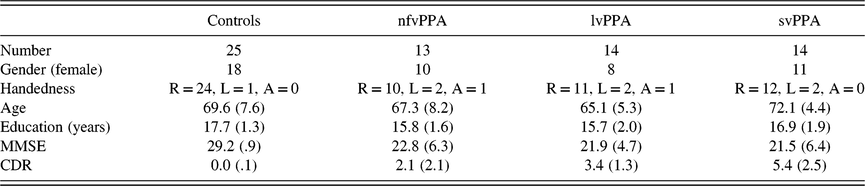
The study sample included a group of 41 individuals with PPA (29 women; mean age = 68.2, SD = 6.7; mean years of education = 16.2, SD = 1.9; Table 1), classified as 13 individuals with nfvPPA, 14 with lvPPA, and 14 with svPPA at the University of California at San Francisco (UCSF) Memory and Aging Center. The clinical diagnosis of dementia and the specific syndrome of PPA for each individual were based on multidisciplinary criteria including clinical history, neurological examination, structural neuroimaging, and neuropsychological and language evaluation by a group of neurologists, neuroscientists, neuropsychologists, and speech-language pathologists. Structural MR neuroimaging confirmed atrophy of the left inferior frontal gyrus and insula in the nfvPPA group, of the left posterior temporal cortex and inferior parietal lobule in the lvPPA group, and of the bilateral anterior temporal lobes in the svPPA group. Neuroimaging was also used to exclude other causes of focal brain damage (e.g., tumor and white matter disease). Of the individuals with svPPA, eight were affected by more atrophy in their right hemisphere than their left hemisphere, yet all displayed substantial atrophy in their left hemisphere on structural MRI scans and exhibited language deficits consistent with svPPA.
Participant characteristics

Note. mean (SD); nfvPPA = non-fluent primary progressive aphasia (PPA), lvPPA = logopenic PPA, svPPA = semantic PPA, L = left-handed, R = right-handed, A = ambidextrous, MMSE = Mini-Mental State Examination, CDR = Clinical Dementia Rating.
Additionally, 25 age-matched controls (18 women; mean age = 69.6, SD = 7.6; mean years of education = 17.7, SD = 1.3) were tested. None of the control participants had a history of head injury or neurological or psychiatric disorders. Recent structural MRI scans (within 1 year of cognitive testing), as well as scores on the Clinical Dementia Rating (CDR; Morris, Reference Morris1993) and Mini-Mental State Examination (MMSE; Folstein, Folstein, & McHugh, Reference Folstein, Folstein and McHugh1975), were available for 18 of the 25 control participants (Table 1). For these individuals, MRI scans did not show abnormalities, CDR was 0 for 17 individuals and .5 for one 88-year-old woman, and MMSE scores ranged from 28 to 30. The seven individuals who did not have MRI, CDR, and MMSE available were not suspected of having any cognitive impairment.
All controls were monolingual speakers of American English. Among the 41 participants with PPA, all were native speakers of American English; of them, 4 were proficient in at least 1 other language. All reported having normal or corrected-to-normal vision. To determine if each participant’s hearing ability was adequate to accurately complete the experimental lexical decision task, auditory thresholds were obtained for each participant. All participants demonstrated adequate hearing with no greater than mild loss in at least one ear for octave frequencies between 250 and 8000 Hz at a level of 25 dB Hearing Level (HL). In addition, stimuli were simultaneously presented auditorily and visually to support anyone with mild hearing loss (Obler, Obermann, Samuels, & Albert, Reference Obler, Obermann, Samuels and Albert1999). Participants gave written consent in accordance with the Institutional Review Boards of UCSF and the City University of New York.
Stimuli
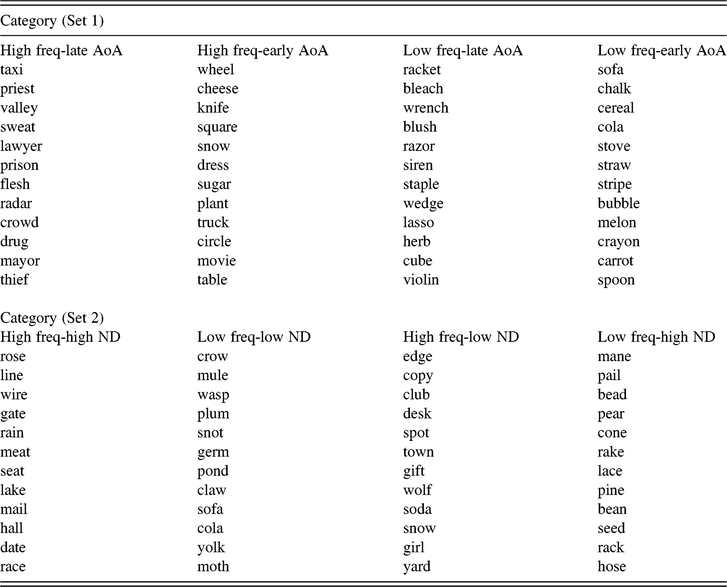
The materials consisted of two sets of 48 nouns each to contrast frequency with either AoA or ND, with three words overlapping between the sets. Each set was divided into 4 categories of 12 words following a 2 × 2 design (high/low frequency vs. early/late AoA and high/low frequency vs. high/low ND; see Table 2 for all words). Familiarity ratings were available for 83 of the 93 unique words (Nusbaum, Pisoni, & Davis, Reference Nusbaum, Pisoni and Davis1984), with the words having high familiarity on a scale from 1 to 7 (mean = 6.95, SD = 0.11, range 6.5–7). Familiarity ratings were missing for four words in Set 1 (frequency vs. AoA; 0× in high frequency-late AoA, 2× in high frequency-early AoA, 1× in low frequency-late AoA, 1× in low frequency-early AoA) and for seven words in Set 2 (frequency vs. ND; 1× in high frequency-high ND, 2× in low frequency-low ND, 1× in high frequency-low ND, 3× in low frequency-high ND).
Stimulus materials

Note. Freq = frequency, AoA = age of acquisition, ND = neighborhood density.
The 4 categories in Set 1 (frequency vs. AoA) each included 12 words that were either high frequency/early acquired, high frequency/late acquired, low frequency/early acquired, or low frequency/late acquired. Low-frequency words occurred 0.4–8.0 times per million words and high-frequency words occurred 20–560 times per million words (Brysbaert & New, Reference Brysbaert and New2009). AoA was determined according to the ratings of Kuperman, Stadthagen-Gonzalez, and Brysbaert (Reference Kuperman, Stadthagen-Gonzalez and Brysbaert2012). Words were considered early acquired 2.5–4.5 years of age and late acquired between 7 and 10 years of age. The categories were matched on letter length, phoneme length, syllable length, imageability, orthographic ND, phonological ND, and familiarity (Balota et al., Reference Balota, Yap, Hutchison, Cortese, Kessler, Loftis, Neely, Nelson, Simpson and Treiman2007; Brysbaert, Stevens, De Deyne, Voorspoels, & Storms, Reference Brysbaert, Stevens, De Deyne, Voorspoels and Storms2014). When each of 2 categories was collapsed to be divided only by our target variables (either frequency or AoA), the 2 24-word categories still matched on these additional variables.
The 4 categories in Set 2 (frequency vs. ND) included 12 words each that were either high frequency/high ND, high frequency/low ND, low frequency/high ND, or low frequency/low ND. As ND is highly influenced by a word’s number of letters (the more letters, the fewer neighbors), only four-letter words—having 2–4 phonemes—were included in this set. ND is measured by the Levenshtein distance to its 20 closest neighbors when performing the minimum number of changes (insertions, deletions, or substitutions of single characters) to morph one word into another (Yarkoni, Balota, & Yap, Reference Yarkoni, Balota and Yap2008). For example, a Levenshtein distance of 1 (the smallest possible) means that the 20 closest words to the target word can all be formed by changing only 1 character. In this set, four-letter words are considered to have high ND with an orthographic Levenshtein distance of 1–1.1 and to have low ND with a distance of 1.45–1.9. The categories were matched on phoneme length, syllable length, AoA, and familiarity. All words in this set were relatively early acquired (AoA = 3.42–6.44 years). When each of 2 categories was collapsed to be divided only by our target variables (either frequency or ND), the 2 24-word categories still matched on these additional variables.
Pseudowords were orthographically and phonologically plausible in English. Candidates for pseudowords were automatically created using Wuggy, a pseudoword generator (Keuleers & Brysbaert, Reference Keuleers and Brysbaert2010), followed by a manual selection and verification by a second reader who was a native speaker of American English. Pseudowords were based on real words used in the experiment; all pseudowords were the same letter- and syllable-length as their base word, differed less than ±0.15 orthographic Levenshtein distance from their base word, and had up to two neighbors at one edit-distance (change to morph one word into another) more or less than their base word. Each pseudoword was generated for a different real word of the stimuli; that is, no pseudowords shared the same base word. No homophones of existing English words were included.
Procedure
A lexical decision task was administered in which participants had to identify whether the string of letters on the screen formed a real word or not. Participants were tested individually in a quiet room at a table with the investigator seated next to them. They indicated their answer by pressing a green button on a keyboard for a real word (green sticker–covered key /) and a red button for a pseudoword (red sticker–covered key z). The instructions specified to answer as accurately and as quickly as possible but stressed that accuracy was more important than speed. This clause served the purpose to avoid shallow lexical processing and to lessen the chance of a speed-accuracy trade-off that would negatively affect accuracy (Pollatsek et al., Reference Pollatsek, Perea and Binder1999). Stimuli were simultaneously presented visually and auditorily to avoid the measurement of task-input-related effects due to diagnosis (e.g., surface dyslexia in individuals with svPPA and phonological loop deficits in individuals with lvPPA).
The task was divided into short blocks, with the first block being preceded by detailed instructions and practice items to accustom the participants to the task. For similar reasons, unknown to the participant, each block started with three filler items. Blocks, as well as words and pseudowords within a block, were randomly presented. A fixation cross of 750 ms preceded the onset of a word. Participants had to answer within 6 s after onset of the word; if no answer was given after 6 s, the word would disappear and a new trial would appear—the item’s accuracy would be scored as incorrect. E-Prime 2.0 (2.0.10.356) was used to design and run the experiment, recording response accuracy and RT in ms (Schneider, Eschman, & Zuccolotto, Reference Schneider, Eschman and Zuccolotto2002).
Statistical Analysis
Descriptive statistics were calculated for all variables. Items that received no response were scored as incorrect (0.1% of the responses; 8 out of 6337, all in individuals with PPA). Responses faster than 200 ms would have been excluded from analyses but did not occur in the data. Analyses with RT as the dependent variable included only items with correct responses. Due to the typical positively skewed distribution of RT, a natural logarithmic transformation was applied to render the data normally distributed.
Means were calculated for both accuracy and RT for each of four categories: high/low frequency versus early/late AoA in Set 1 and high/low frequency versus high/low ND in Set 2. The main analysis included models per group (3× PPA and controls) (1) to compare high versus low frequency while AoA (Set 1)/ND (Set 2) was controlled), (2) to compare early versus late AoA/high versus low ND while frequency was controlled, and (3) the interaction between frequency and AoA (Set 1)/ND (Set 2). Additional models per group (3× PPA and controls) separated the effects of frequency and AoA (Set 1)/ND (Set 2) by analyzing differences in accuracy and RT among the four different categories of words: high frequency-early AoA (Set 1)/high ND (Set 2), high frequency-late AoA (Set 1)/low ND (Set 2), low frequency-early AoA (Set 1)/high ND (Set 2), and low frequency-late AoA (Set 1)/low ND (Set 2). Another series of models compared the effects of frequency and AoA (Set 1)/ND (Set 2) in each PPA group separately to the effects of these variables in the control group.
The data were analyzed with linear mixed models with maximum likelihood estimation adjusted for age, years of education, disease severity, and d’ (positive response-bias). Models analyzing RT included a random intercept (categories nested within subjects) and fixed slope, while models analyzing accuracy included a fixed intercept and fixed slope, as covariance estimates indicated that there was no unique variance to estimate among individuals above and beyond the residual variance per category. Disease severity was calculated as a composite score of CDR box score (Lynch et al., Reference Lynch, Walsh, Blanco, Moran, Coen, Walsh and Lawlor2006) and MMSE in order to account for individual variances in severity of PPA. For each individual with PPA, the sum of the CDR box scores was converted to a scale from 0 to 1 by dividing the summed scores by the maximum possible score of 18. The MMSE scores were flipped (e.g., a score of 26 became a score of 4) and subsequently converted to a scale from 0 to 1 by dividing the flipped score by the maximum possible score, 30. The composite score was the sum of the rescaled CDR box and MMSE scores, ranging from 0 to 2 in which a higher score signifies higher severity. To include disease severity as a covariate in all analyses, this measure was set to zero for control participants, as they did not suffer from PPA. Response bias on the lexical decision task was measured using the sensitivity index d’, following Signal Detection Theory (Macmillan, Reference Macmillan, Wixted and Pashler2002), in which the lower the value, the higher the response bias (e.g., Kielar, Deschamps, Jokel, & Meltzer, Reference Kielar, Deschamps, Jokel and Meltzer2018; Nilakantan, Voss, Weintraub, Mesulam, & Rogalski, Reference Nilakantan, Voss, Weintraub, Mesulam and Rogalski2017).
Fixed variables for models within each diagnosis included age, years of education, disease severity, d’, frequency, AoA (Set 1 only)/ND (Set 2 only), and the interaction term between frequency and either AoA or ND in the main analysis. Standardized effect sizes (Cohen’s d) were calculated by dividing the mean difference between the factor’s levels by the standard deviation (√(N)*standard error of the estimate, in which N is the number of levels per factor (2) times the group’s participants) (Cohen, Reference Cohen1992; Taylor, Reference Taylor2015). Additional models within each diagnostic group to compare the four categories among each other included age, years of education, disease severity, d’, and category as fixed variables. Pairwise comparisons were performed using the Šidák correction. Models that compared across PPA groups included age, education, diagnosis, disease severity, d’, category, diagnosis*frequency, and diagnosis*AoA (Set 1)/ND (Set 2). Main effects were evaluated at α = .05 and interaction effects at α = .10, as the statistical power to detect interactions is typically much lower than the power for main effects (Aguinis, Reference Aguinis1995; McClelland & Judd, Reference McClelland and Judd1993). All data were analyzed in IBM SPSS Statistics Version 24 (IBM Corp., 2016).
RESULTS
Frequency Versus Age of Acquisition
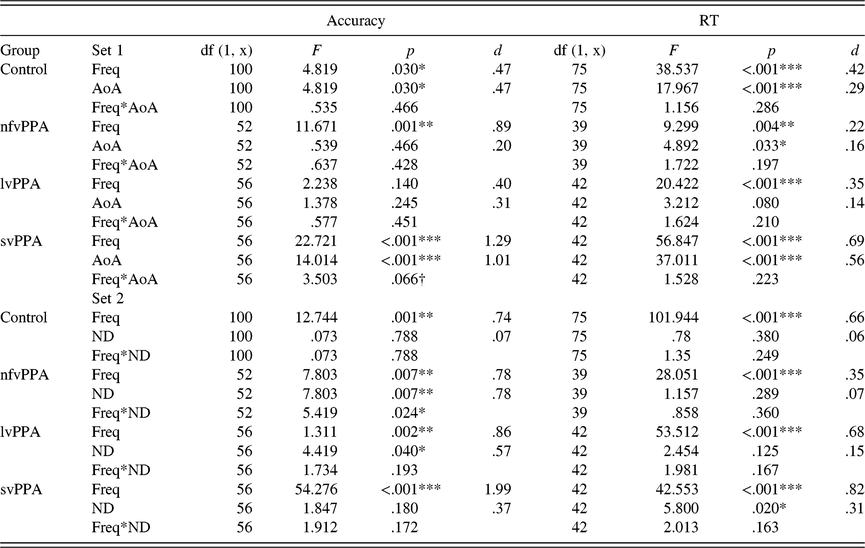
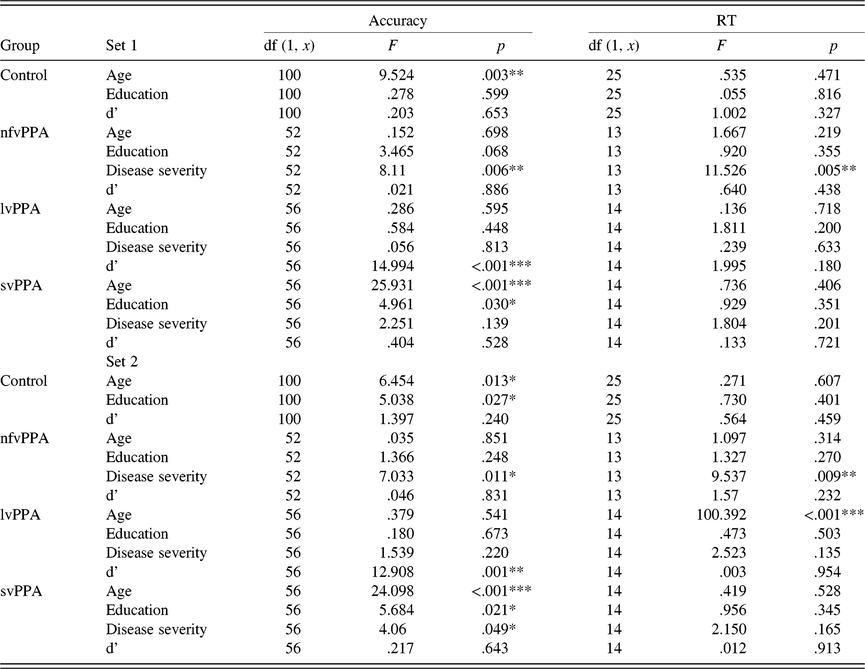
Main effects including effect sizes are reported in Table 3, overall lexical decision performance measured by accuracy and RT is presented in Table 4, and covariate effects are presented in Table 5. In the control group, high frequency and early AoA resulted in more accurate and quicker responses than low frequency and late AoA for both measures. For individuals with nfvPPA, higher word frequency resulted in better accuracy and quicker RTs, while early AoA did not affect accuracy but did lead to quicker responses. In the lvPPA group, frequency did not predict accuracy, but higher-frequency items elicited quicker responses, while AoA predicted neither accuracy nor RT. In the svPPA group, high frequency and early AoA facilitated both accuracy and RT compared to low frequency and late AoA. Only the svPPA group showed an interaction effect between frequency and AoA on accuracy, with a larger AoA effect for low-frequency words than for high-frequency words (Figure 1).
Main effects and interactions of frequency with age of acquisition and neighborhood density within each group

Note. Freq = frequency, AoA = age of acquisition, ND = neighborhood density, df = degrees of freedom, x = denominator df, d = effect size reported in Cohen’s d; *p < .05, **p < .01, ***p < .001; †p < .01 for interactions.
Mean performance in accuracy (%) and response time (log)

Note: mean (SD); Acc = accuracy, RT = response time (log), nfvPPA = non-fluent primary progressive aphasia (PPA), lvPPA = logopenic PPA, svPPA = semantic PPA, freq = frequency, AoA = age of acquisition, ND = neighborhood density.
Covariate effects of within group analyses in stimulus Set 1 and Set 2

Note. df = degrees of freedom, x = denominator df; *p < .05, **p < .01, ***p < .001.
Frequency versus age of acquisition in individuals with semantic primary progressive aphasia (error bars represent 95% confidence intervals).

When contrasting extreme values of one variable within a constant value of the other variable in pairwise comparisons, the svPPA group showed separate effects of frequency and AoA, with better performance on both accuracy (p < .001) and RT (p = .033) on high- versus low-frequency words within late AoA words, and more accurate (p = .001) performance on early- than late-acquired words within low-frequency words. The nfvPPA group showed a frequency effect within early AoA words on accuracy (p = .026). The control and lvPPA groups did not show differences among any categories for either accuracy or RT measures.
Performance of the different PPA groups against each other was directly compared by testing interactions of diagnosis*frequency and diagnosis*AoA. For accuracy, the frequency effect was larger for the svPPA group than the nfvPPA (t(123) = 3.102, p = .002) and lvPPA (t(123) = 3.757, p < .001) groups, and there was no difference between the nfvPPA and lvPPA groups (t(123) = .584, p = .560). Similarly, the AoA effect in accuracy performance was larger for the svPPA group than the nfvPPA (t(123) = 3.201, p = .002) and lvPPA (t(123) = 2.951, p = .004) groups, and there was no difference between the nfvPPA and lvPPA groups (t(123) = −.305, p = .761). For RT, the frequency effect was larger for the svPPA group than the nfvPPA group (t(123) = −2.083, p = .039), but there were no differences between svPPA and lvPPA groups (t(123) = −1.318, p = .190), or between nvfPPA and lvPPA groups (t(123) = .790, p = .431). The AoA effect in RT performance was larger for the svPPA group than the nfvPPA (t(123) = −1.874, p = .063) and lvPPA (t(123) = −2.383, p = .019) groups, and there was no difference between nfvPPA and lvPPA groups (t(123) = −.465, p = .643).
Frequency Versus Neighborhood Density
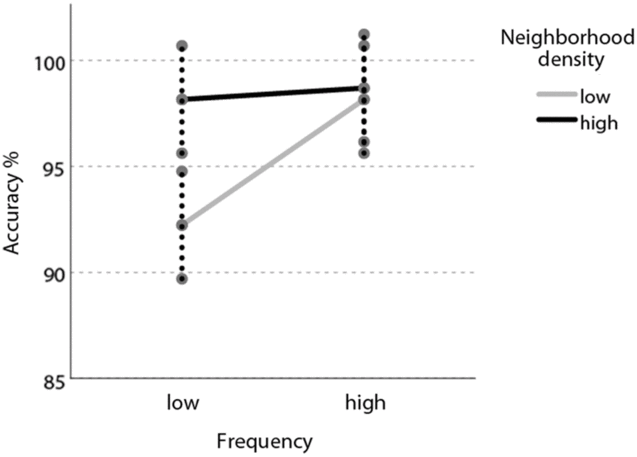
Main effects including effect sizes are reported in Table 3, and covariate effects are presented in Table 5. Controls responded more accurately and quickly to high-frequency than low-frequency words, but there was no effect of ND. Individuals with nfvPPA and lvPPA showed the same pattern: they answered high-frequency words more accurately and more quickly than low-frequency ones and high ND words more accurately, but not more quickly, than low ND ones. The svPPA group answered more accurately and quickly to high-frequency than low-frequency words; there was no effect of ND on accuracy, but there was on RT. Only the nfvPPA group showed an interaction between frequency and ND on their accuracy performance, with a larger ND effect within low-frequency words than within high-frequency words (Figure 2).
Frequency versus neighborhood density in individuals with non-fluent primary progressive aphasia (error bars represent 95% confidence intervals).

When contrasting extreme values of one variable within a constant value of the other variable in pairwise comparisons, the groups collectively showed a pattern of an independent frequency effect across accuracy and RT, present within both low ND and high ND words. Additionally, the nfvPPA group showed an ND effect within low-frequency words (p = .004).
Performance of the different PPA groups against each other was directly compared by testing interactions of diagnosis*frequency and diagnosis*ND. For accuracy, the frequency effect was larger for the svPPA group than the nfvPPA (t(123) = 5.798, p < .001) and lvPPA (t(123) = 5.365, p < .001) groups, and there was no difference between the nfvPPA and lvPPA groups (t(123) = −.533, p = .595). The ND effect did not differ between the svPPA group and the nfvPPA (t(123) = .259, p = .796) or lvPPA (t(123) = .258, p = .797) groups, or between the nfvPPA and lvPPA groups (t(123) = −.006, p = .995). For RT, the frequency effect was larger for the svPPA group than the nfvPPA group (t(123) = −1.669, p = .098), but there were no differences between svPPA and lvPPA groups (t(123) = −1.013, p = .313), or nvfPPA and lvPPA groups (t(123) = .675, p = .501). The ND effect in RT performance did not differ between the svPPA group and the nfvPPA (t(123) = −1.204, p = .231) or lvPPA (t(123) = −1.040, p = .300) groups, or between the nfvPPA and lvPPA groups (t(123) = .184, p = .855).
DISCUSSION
We investigated the effect of three psycholinguistic variables—lexical frequency, AoA, and ND—on lexical-semantic processing in individuals with the three variants of PPA: nfvPPA, lvPPA, and svPPA. The theoretically based expectation was that the effects of AoA and ND in individuals with PPA would be different across variants because these variables are associated with the conceptual versus lexeme levels of the mental lexicon, respectively (e.g., Cortese & Khanna, Reference Cortese and Khanna2007; Roelofs et al., Reference Roelofs, Meyer and Levelt1996). Indeed, our results showed that some effects seem substantially stronger in individuals with one variant than another. In particular, individuals with svPPA experience a strong AoA effect (i.e., better performance on early-acquired than late-acquired words) on both accuracy and RT measures. Accuracy performances of those with the nfvPPA and lvPPA are subject to an effect of ND (i.e., better performance on words with a high than low ND)—however, the svPPA group also showed an ND effect in RT. These findings support the idea that psycholinguistic variables influence lexical-semantic processing at different levels of the mental lexicon.
Lexical frequency is one of the most investigated psycholinguistic variables and has been widely shown to affect RT and accuracy in lexical decision (e.g., Balota et al., Reference Balota, Yap, Hutchison, Cortese, Kessler, Loftis, Neely, Nelson, Simpson and Treiman2007; Brown & Watson, Reference Brown and Watson1987). In this study, as well, frequency had an effect on both accuracy and RT in individuals of all three PPA groups as well as in controls. Effect sizes of the impact of frequency on accuracy were medium in the control group, medium to large in the nfvPPA and lvPPA groups, and large to very large in the svPPA group. The size of each group’s frequency effect corresponded to their overall accuracy score on the lexical decision task. In other words, errors and slower responses in lexical decision were specifically made on low-frequency words; the more errors one makes, the larger the performance gap between words with high versus low frequency becomes.
Our data demonstrate that frequency is not the only psycholinguistic variable to influence lexical-semantic processing. A topic of much debate is the relation between frequency and AoA: are these variables measuring the same or distinct effects, are the effects of equal size or is one stronger than the other, and are they related or independent of each other (e.g., Brysbaert & Ghyselinck, Reference Brysbaert and Ghyselinck2006; Gerhand & Barry, Reference Gerhand and Barry1998; Zevin & Seidenberg, Reference Zevin and Seidenberg2002)? Our findings strongly suggest that frequency and AoA measure two different features because with negligible variance in word frequency in the category of low-frequency words, individuals with svPPA still show a solid AoA effect. In addition, the data showed that the AoA effect is stronger for low-frequency words than high-frequency words in individuals with svPPA, which is also reported in some studies of adults without dementia (Cortese & Schock, Reference Cortese and Schock2013; Gerhand & Barry, Reference Gerhand and Barry1999). This interaction further emphasizes that lexical frequency and AoA are most probably two different features, both having independent influences on lexical-semantic processing.
The words in this dataset and the combination into categories were carefully controlled for a broad range of psycholinguistic and semantic variables. Having done so counters claims in the literature that finding an effect of frequency or AoA is actually a disguised effect of another variable; for example, Gilhooly and Logie (Reference Gilhooly and Logie1982) argued that reports of an AoA effect are in fact failures to control for word familiarity. However, in the current study when familiarity was controlled for in the stimulus set that investigated frequency versus AoA (in addition to letter length, phoneme length, syllable length, imageability, orthographic ND, and phonological ND), the results still showed independent effects of the two variables. In controlling for familiarity, four words were missing familiarity values within the frequency versus AoA set; however, missingness was distributed across three of the four subsets. The missing familiarity values would have to have been extremely low to change the subset’s mean familiarity to make it significantly different from the other subsets. Thus, our finding of an effect of frequency or AoA is unlikely to be a disguised effect of familiarity.
While accuracy scores were relatively high in all PPA groups, only one of the individuals with PPA (with nfvPPA) performed at ceiling (i.e., 100%). Therefore, we do not consider the interpretation of the results to be limited by ceiling effects in the PPA groups. However, the control group’s accuracy means were unambiguously limited by ceiling effects. The interpretation of differences in performance patterns between the control and PPA groups may therefore be biased by test-related limitations and should not be given much weight.
The observed effects of psycholinguistic variables on performance in the PPA groups often corresponded between the two measures of accuracy and RT. In a few instances, however, effects were not replicated across both measures. For example, ND affected accuracy but not RT in the nfvPPA and lvPPA groups. Additionally, the svPPA group demonstrated an ND effect in RT but not in accuracy. Future research may want to explore whether the measures of accuracy and RT tap into similar or slightly different processes during lexical decision in each PPA variant, and whether behavioral or functional characteristics of each PPA syndrome may bias either measure.
In this study, the performance of the control group demonstrated that frequency and AoA have a more or less comparable effect on lexical decision accuracy, consistent with results by Brysbaert and Ghyselinck (Reference Brysbaert and Ghyselinck2006). In individuals with PPA, however, the effect of AoA was always smaller than the frequency effect. Individuals with nfvPPA and lvPPA showed virtually no effect of AoA, while individuals with svPPA showed a solid medium to large effect of AoA on accuracy and RT. The svPPA group also uniquely showed a larger AoA effect compared to the nfvPPA and lvPPA groups on both accuracy and RT. These results confirm the prediction that the effect of AoA, given its strong relation to semantics (e.g., Brysbaert et al., Reference Brysbaert, Van Wijnendaele and De Deyne2000; Cortese & Khanna, Reference Cortese and Khanna2007; Steyvers & Tenenbaum, Reference Steyvers and Tenenbaum2005), would be particularly affected in individuals with svPPA having atrophy in the anterior temporal lobe, which is known to be a semantic hub (e.g., Binney, Embleton, Jefferies, Parker, & Lambon Ralph, Reference Binney, Embleton, Jefferies, Parker and Lambon Ralph2010; Mummery et al., Reference Mummery, Patterson, Price, Ashburner, Frackowiak and Hodges2000; Pobric, Jefferies, & Ralph, Reference Pobric, Jefferies and Ralph2010).
The second set of stimuli was designed to investigate effects of lexical frequency versus orthographic ND. Investigating isolated effects of ND on lexical-semantic processing can be challenging, as ND size is extraordinarily strongly linked to word length—the more letters a word has, the harder it becomes to form another word by changing only one character. In turn, word length is correlated with lexical frequency as formulated by Zipf’s law (Zipf, Reference Zipf1935), which demonstrated that the length of a word is inversely related to the frequency of its use. To avoid potential contamination of word length-effects on ND values, all items in this set were restricted to having four letters in order to assess separate effects of ND and frequency, including possible interactions. However, the much larger frequency effect across all groups in this Set 2 compared to those in Set 1 (frequency and AoA) supports that word length has a substantial influence on frequency effects, despite our efforts to control for this variable within each set.
The data in Set 2 revealed disproportionate effects of ND across the groups. The analyses for the control group yielded medium- to large-sized effects of frequency across accuracy and RT, but there was decidedly no effect of ND (non-significant with effect sizes close to zero)—however, this result may be influenced by ceiling effects. On the contrary, effects of ND were observed in individuals with nfvPPA and lvPPA in accuracy performance, with a positive effect of high ND compared to low ND. This result was in line with the prediction that aspects of word form, such as ND, are affected in individuals with nfvPPA and lvPPA because their atrophy overlaps with brain regions linked to word form. The nfvPPA group was the only one to encounter an interaction effect in which ND specifically affected accuracy in low-frequency words compared to high-frequency words. Such an interaction effect between frequency and ND is consistent with results by Balota et al. (Reference Balota, Cortese, Sergent-Marshall, Spieler and Yap2004) and Sears et al. (Reference Sears, Hino and Lupker1995). While individuals with svPPA did not show an effect of ND on accuracy, they did show an ND effect in RT while the nfvPPA and lvPPA groups did not. Direct comparisons across PPA groups of the ND effect by testing interactions showed no meaningful distinctions in the ND effect across PPA groups for either accuracy or RT. Thus, there is no conclusive evidence in favor of the hypothesis that the ND effect would particularly affect the nfvPPA and lvPPA groups, but not the svPPA group.
The selective vulnerability in lexical decision due to psycholinguistic variables across variants of PPA as a result of affected brain regions may extend to other patient groups and other language processes as well. For example, a study by Middleton and Schwartz (Reference Middleton and Schwartz2010) investigated the effect of phonological ND on naming in three individuals with post-stroke aphasia. Patient 1 had a discrete lesion in the temporoparietal region (i.e., overlapping with regions affected in logopenic PPA), Patient 2 in the temporoparietal region as well as more anterior in the insula (i.e., overlapping with regions affected in logopenic and non-fluent PPA), and Patient 3 in the temporoparietal junction as well as a large part of the middle temporal gyrus, extending as far anterior as the temporal pole (i.e., overlapping with regions affected in semantic PPA). While the focus of the experiments was on ND, AoA was included as a variable in backward stepwise logistic regression models to investigate if it contributed to naming errors. Results revealed that ND but not AoA predicted naming performance in Patients 1 and 2 (with similar lesions to lvPPA and nfvPPA), while AoA contributed independently and more strongly than ND to naming performance in Patient 3 (with a similar lesion to svPPA). Future research should gather additional evidence to determine if the observed brain-language relationship between affected brain regions and psycholinguistic features generalizes to other patient groups as well as language tasks.
In sum, the results reflect a brain-language relationship of brain regions with specific psycholinguistic variables, resulting in different proportional effects of frequency and AoA during lexical-semantic processing in variants of PPA, in a pattern that is consistent with the organization of the mental lexicon. Individuals with nfvPPA and lvPPA, who are characterized as having no semantic impairment, did not experience an effect of AoA—a psycholinguistic variable with semantic locus—in lexical decision accuracy. Individuals with svPPA, who have semantic impairment as its hallmark, showed the opposite pattern with a solid effect of AoA on accuracy performance. These results argue in favor of words being organized in the brain according to a mental lexicon structure including a conceptual (semantic) and a lexeme (word-form) level as proposed by Bock and Levelt (Reference Bock, Levelt and Gernsbacher1994). Thus, the deterioration of language at word level in individuals with PPA seems to be driven by impairment at a particular level of the mental lexicon as a result of atrophy to relevant brain regions for that level (e.g., for word form or semantics). Future studies should investigate whether these psycholinguistic variables interact with any conceptual information in lexical-semantic processing and, if so, how this relates to the organization of the mental lexicon.
ACKNOWLEDGEMENTS
We are immensely grateful to Bruce Miller and the members of the ALBA Language Neurobiology Lab at the University of California at San Francisco (UCSF) Memory and Aging Center for their and the participants’ availability, and for their material and intellectual support of this study. This work was funded by the National Institutes of Health (Maria Luisa Gorno-Tempini, NINDS R01 NS050915; Maria Luisa Gorno-Tempini, NIDCD K24 DC015544; Bruce Miller, NIA P50 AG023501) and Alzheimer Nederland (with a grant for international exchange to Jet M. J. Vonk). We would like to thank Kate Dawson, Zahra Hejazi, Eve Higby, Ted Huey, Aviva Lerman, Iris Strangmann, and Amy Vogel-Eyny for their thoughts and comments on previous versions of the manuscript, and Elaine Allen and Cas Kruitwagen for consulting on the statistical analysis.