Significance outcomes
∙ All of the N-methyl-d-aspartate receptor (NMDAR) antagonists tested (ketamine, memantine, MK-801, AZD6765, Ro 25-6981 and ACPC) partially reversed tetrabenazine-induced ptosis and reduced immobility in the tail-suspension test.
∙ The ability to reverse tetrabenazine-induced ptosis is attributable to a sympathomimetic action that appears an effect common to NMDAR antagonists.
∙ Since we found no differences between ketamine and other NMDAR antagonists tested, we hypothesise that the failure of memantine and possibly other NMDAR antagonists (the channel blocker lanicemine and an NR2B antagonist, MK-0657) to manifest robust, ketamine-like antidepressant efficacy in the clinic results from inadequate target engagement (insufficient dosing) rather than a fundamental difference in mechanism of action.
Limitations
∙ The pharmacokinetic profile (including T max and potential metabolites) of the compounds in this mouse strain are not known. Since behavioural testing was performed at fixed time points, the relative potencies of the compounds in these measures are not optimised.
∙ The use of a subjective rating scale to determine the potency of compounds to reverse tetrabenazine-induced ptosis may reduce the reliability of the estimated minimum effective dose (MED) values of NMDAR antagonists.
∙ There are alternative, and perhaps equally plausible hypotheses to account for the unique antidepressant profile of ketamine compared with other NMDAR antagonists. These hypotheses range from a transient blockade of NMDAR defined by the unique pharmacokinetic profile of ketamine to its ability to produce a burst of glutamate release, which has been hypothesised to be necessary for the rapid and robust effects observed in treatment-resistant depression. Several of these hypotheses are amenable to further testing in preclinical studies.
∙ Clinical studies will be required to critically test the hypothesis that inadequate dosing is responsible for the inability of NMDAR antagonists like memantine, lanicemine and MK-0657 to mimic the robust antidepressant effects of ketamine.
Introduction
Numerous clinical trials have demonstrated that a single intravenous infusion of the NMDAR antagonist ketamine produces a rapid, robust and relatively long-lived antidepressant effect in patients with treatment-resistant depression (Reference Murrough1). There are multiple mechanisms that can produce NMDAR blockade, and ketamine acts at the NMDAR-associated ion channel (Reference Martin and Lodge2,Reference Mealing, Lanthorn and Murray3). However, these dramatic clinical effects have not been replicated using other clinically available NMDA channel blockers, including memantine (Reference Zarate, Singh and Quiroz4) and AZD6765 (lanicemine) (Reference Zarate, Mathews and Ibrahim5,Reference Sanacora, Smith and Pathak6), despite the remarkably similar electrophysiological properties of these compounds at NMDAR (Reference Mealing, Lanthorn and Murray3). Multiple explanations can be invoked to explain the inability of these compounds to replicate the antidepressant effects of ketamine, ranging from inadequate dosing (Reference Zarate, Singh and Quiroz4) to pharmacokinetic differences among these agents (Reference Lord, Wintmolders and Langlois7) that could result in dramatically different intracellular effects following NMDAR blockade.
All pharmacological classes of NMDAR antagonists produce antidepressant-like effects in ‘behavioural despair’ models, including the forced swim (Reference Porsolt, Pichon and Jalfre8) and tail suspension (Reference Steru, Chermat, Thierry and Simon9) tests (for a recent review see (Reference Pilc, Wieronska and Skolnick10)). These tests, while lacking substantial construct and face validity, have high predictive validities (Reference Borsini and Meli11,Reference Cryan, Valentino and Lucki12). In addition, ketamine, like classical tricyclic antidepressants, was reported to mimic the effect of imipramine in reversing tetrabenazine-induced ptosis (Reference Sofia and Harakal13). This test relies on the ability of tetrabenazine to deplete monoamines from nerve endings causing the eyelids to droop. Monoamine reuptake inhibitors (such as desmethylimipramine, amitriptyline and imipramine) are particularly effective in reversing this ptosis (Reference Sofia and Harakal13). This study by Sofia and Harakal (Reference Sofia and Harakal13) was prompted by the sympathomimetic actions of ketamine manifested in both animals and humans (Reference Miletich, Ivankovic and Albrecht14), and published a decade before ketamine was identified as an NMDAR antagonist (Reference Martin and Lodge2). Given the apparent lack of concordance between clinical and preclinical findings with NMDAR antagonists (Reference Pilc, Wieronska and Skolnick10), the purpose of the present study was to compare the effects of ketamine to other NMDAR antagonists in the tetrabenazine-induced ptosis test. Parallel studies were conducted in the tail suspension test (TST) to minimise potential confounds (such as strain differences) when comparing data among laboratories (Reference Pilc, Wieronska and Skolnick10).
Materials and methods
Animals
Male C57Bl/6J mice (obtained from Institute of Pharmacology breeding facility, originating from the Jackson Laboratories and purchased from Charles-River, Germany) weighing ∼24 g, were ∼7 to 8 weeks old at the start of the experiment. The mice were housed in standard laboratory cages under standard colony A/C-controlled conditions: room temperature of 21±2°C, humidity of 40% to 50% and a 12-h light/dark cycle (lights on at 06:00). The mice had ad libitum access to the standard lab chow and tap water. Behavioural testing was performed during the light phase of the light/dark cycle. All mice were used only once, and each separate vehicle-controlled experiment was carried out on a separate cohort of animals.
Drugs
HCl salts of imipramine, memantine and AZD6765 (lanicemine); (Sigma-Aldrich, Poznan, Poland) dizocilpine maleate (MK-801; Abcam Biochemicals, Cambridge, UK), ketamine [10% aqueous solution (115.34 mg/ml) Biowet, Pulawy, Poland], Ro 25-6981 [(aR,bS)-a-(4-hydroxyphenyl)-b-methyl-4-(phenylmethyl)-1-piperidinepropanol hydrochloride] (Abcam Biochemicals, Cambridge, UK) and ACPC (1-aminocyclopropanecarboxylic acid, kindly donated by Dr. M-L Maccecchini) were dissolved in sterile water. Tetrabenazine (Sequoia Research Products, Pangbourne, UK) was dissolved in 1N acetic acid followed by adjustment to pH 6 with NaOH 10% and supplemented with distilled water to the appropriate volume. Physiological saline was used as a vehicle; all solutions were prepared in the volume of 10 ml/kg, right before the administration.
The doses selection for the TST was based on previous reports showing a significant reduction of immobility for imipramine (≥2 mg/kg) (Reference Steru, Chermat and Thierry15), ketamine (≥50 mg/kg) (Reference Bechtholt, Smith and John16,Reference Kos, Popik and Pietraszek17), memantine (≥2.5 mg/kg) (Reference Kos and Popik18), MK-801 (0.01 mg/kg) (Reference Eckeli, Dach and Rodrigues19), Ro 25-6981 (10 mg/kg) (Reference Kiselycznyk, Svenningsson, Delpire and Holmes20) and ACPC (in the mouse forced swim test; ≥100 mg/kg) (Reference Trullas, Folio and Young21). The dose selection for tetrabenazine-induced ptosis and its reversal by ketamine (20 mg/kg) and imipramine (1.25 mg/kg) was based on the initial report of Sofia and Harakal (Reference Sofia and Harakal13). To our knowledge, the effects of MK-801, memantine, Ro 25-6981, AZD6765 and ACPC on tetrabenazine-induced ptosis have not been reported.
Behavioural procedures
In both behavioural tests, we investigated the effects of seven different NMDAR antagonists, each used at two to five doses. This was done on separate cohorts of mice within separate small experiments. Thus, every experiment (a set of treatments) contained its own vehicle control. Care was taken to have no more treatment groups than six per a separate vehicle control.
Tetrabenazine-induced ptosis and its reversal
Groups of mice were administered various doses of test compounds or saline (vehicle) intraperitoneally (IP). Thirty minutes later, the animals were injected with tetrabenazine (IP, 32 mg/kg), and then placed individually into 1 l glass beakers (Reference Sofia and Harakal13). Thirty minutes following tetrabenazine injection (i.e. 60 min following test compound), each mouse was evaluated for the presence of palpebral ptosis by an observer ‘blinded’ to the treatment conditions. The degree of ptosis was rated according to the following rating scale: eyes open (0 points), eyes half closed (1 point), eyes completely closed (2 points) (Reference Sanchez-Mateo, Bonkanka, Prado and Rabanal22).
Statistical analyses were performed using GraphPad Prism 5.0 for Windows. The α value was set at p<0.05. Due to the lack of normal distribution, the given set of treatments (each having its own vehicle control) was subjected to one-way Kruskal–Wallis ANOVA followed by nonparametric Dunn’s multiple comparisons post-hoc test. This was done to identify the MED, the lowest dose of test compound producing a statistically significant effect. Data are presented as median±interquartile range.
TST
Vehicle and various doses of tested compounds were administered IP, 45 min before the test. Immobility in the TST was measured as previously described (Reference Steru, Chermat, Thierry and Simon9,Reference Popik, Kos, Sowa-Kucma and Nowak23). Mice were suspended 65 cm above the table top using a paper adhesive tape; the tape was placed ∼1 cm from the tip of the tail. Mice were suspended for 6 min and an observer blind to the treatment conditions recorded the duration of immobility, defined as a complete lack of movement.
Statistical analyses were performed using GraphPad Prism 5.0 for Windows. The α value was set at p<0.05. The given set of treatments (each having its own vehicle control) was subjected to one-way ANOVA followed by Dunnett’s multiple comparisons post-hoc test. This was done to identify the MED in the TST. Data are presented as mean±SEM.
In this set of experiments we did not measure drug-induced locomotor activity. The measurement of animal motility is often used as a control for the specificity of the antidepressant-like effects of compounds, which was not a goal of the present study.
Results
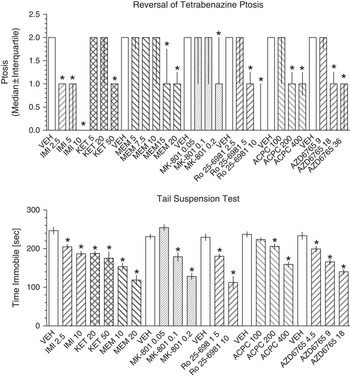
Tetrabenazine produced complete ptosis in all mice by 30 min post injection. Imipramine, employed as a positive control, produced a dose-dependent reduction in tetrabenazine-induced ptosis, with a MED of 2.5 mg/kg (which was also the lowest dose tested) and a complete reversal at 10 mg/kg (Fig. 1, upper panel). Imipramine also produced a dose-dependent reduction in immobility in the TST, with a MED of 2.5 mg/kg (Fig. 1, lower panel). While all NMDAR antagonists produced statistically significant reductions in tetrabenazine-induced ptosis at one or more doses, none of these compounds fully reversed the ptosis in all animals. The NMDA channel blockers (ketamine, memantine, MK-801, AZD6765) were all less potent (based on MED) in reversing tetrabenazine-induced ptosis than reducing immobility in the TST. For ketamine, the MEDs for attenuating tetrabenazine-induced ptosis and reducing immobility were 50 and 20 mg/kg respectively; for memantine these doses were 15 and 10 mg/kg, respectively, for MK-801 these doses were 0.2 and 0.1 mg/kg, respectively and for AZD6765 these doses were 18 and 4.5 mg/kg, respectively. In contrast, the MEDs of Ro 25-6981 (5 mg/kg) and ACPC (200 mg/kg) in the reversal of tetrabenazine induced ptosis and the TST were identical.
Tetrabenazine-induced ptosis and its reversal (upper panel) and anti-immobility effects in the tail-suspension tests (lower panel) of imipramine (IMI) and N-methyl-d-aspartate receptor (NMDAR) antagonists ketamine (KET), memantine (MEM), dizocilpine (MK-801), Ro 25-6981, ACPC and AZD6765. Testing for each compound was done on a separate group of mice and was controlled with a separate vehicle group. Upper panel: For tetrabenazine-induced ptosis, experiment 1 involving imipramine and ketamine, experiment 2 involving memantine, experiment 3 involving MK-801, experiment 4 involving Ro 25-6981, experiment 5 involving ACPC and experiment 6 involving AZD6765, yielded the following Kruskal–Wallis ANOVA values: 57.55 (df=6); p<0.0001; 26.68 (df=5); p<0.0001; 10.09, (df=3), p<0.05; 33.20 (df=3), p<0.0001; 26.22 (df=3), p<0.0001, 26.70 (df=3), p<0.0001, respectively. Symbols: *p<0.05–p<0.0001 versus respective vehicle (the precise p-value is not given for the clarity of figure). In experiment 1, the number of mice for vehicle, imipramine at 2.5 mg/kg, imipramine at 5 mg/kg, imipramine 10 mg/kg, ketamine at 5 mg/kg, ketamine at 20 mg/kg and ketamine at 50 mg/kg were 14, 10, 10, 10, 11, 10 and 10, respectively. In experiment 2, the number of mice for vehicle, memantine at 5, 7.5, 10, 15 and 20 mg/kg, were 16, 10, 8, 10, 8 and 10, respectively. In experiment 3, the number of mice for vehicle, MK-801 at 0.05, 0.1 and 0.2 mg/kg were 9, 10, 10 and 10, respectively. In experiment 4, the number of mice for vehicle, Ro 25-6981 at 2.5, 5 and 10 mg/kg was 17, 10, 10 and 10, respectively. In experiment 5, the number of mice for vehicle, ACPC at 100, 200 and 400 mg/kg was 20, 12, 10 and 10, respectively. In experiment 6, the number of mice for vehicle, AZD6765 at 9, 18 and 36 mg/kg was 10 in each group. Lower panel: For the tail suspension tests, experiment 1 involving imipramine, ketamine and memantine, experiment 2 involving MK-801, experiment 3 involving Ro 25-6981, experiment 4 involving ACPC and experiment 5 involving AZD6765, yielded the following one-way ANOVA values: F(6,55)=16.35, p<0.0001; F(3,33)=44.77, p<0.0001; F(2,21)=28.37, p<0.0001, F(3,36)=31.02, p<0.0001 and F(3,36)=28.45, p<0.0001, respectively. Symbols: *p<0.05–p<0.0001 versus respective vehicle (the precise p-value is not given for the clarity of figure). In experiment 1, the number of mice for vehicle, imipramine at 2.5 mg/kg, imipramine at 10 mg/kg, ketamine at 20 mg/kg, ketamine at 50 mg/kg, memantine at 10 mg/kg and memantine at 20 mg/kg, was 8, 10, 8, 10, 8, 10 and 8, respectively. In experiment 2, the number of mice for vehicle, MK-801 at 0.05, 0.1 and 0.2 mg/kg was 13, 8, 8 and 8, respectively. In experiment 3, the number of mice for vehicle, Ro 25-6981 at 5 and 10 mg/kg was 8 in each group. In experiment 4, the number of mice for vehicle, ACPC at 100, 200 and 400 mg/kg was 10 in each group. In experiment 5, the number of mice for vehicle, AZD6765 at 4.5, 9 and 18 mg/kg was 10 in each group.

Discussion
Multiple intracellular events have been linked to the rapid and sustained effects of ketamine following NMDAR blockade. These include α-amino-3-hydroxy-5-methyl-4-isoxazolepropionic acid (AMPA) receptor activation, increased brain-derived neurotrophic factor (BDNF) formation and activation of tropomyosin-related kinase B (TrKB), activation of mammalian target of rapamycin (mTOR), vascular endothelial growth factor (VEGF) and their associated cascades (Reference Jernigan, Goswami and Austin24–Reference Lindholm, Autio and Vesa27). However, there appear to be significant differences among NMDAR antagonists with respect to reported duration of action and sensitivity to AMPA receptor blockade in both behavioural despair tests (Reference Bechtholt, Smith and John16,Reference Popik, Kos, Sowa-Kucma and Nowak23,Reference Autry, Adachi and Nosyreva28–Reference Wolak, Siwek and Szewczyk31) and models like chronic mild stress (Reference Papp and Moryl32,Reference Li, Liu and Dwyer33), which appear to possess better face and construct validity.
An emerging body of clinical work indicates the rapid and robust antidepressant effects of ketamine are not shared by either other NMDA channel blockers [e.g. memantine (Reference Zarate, Singh and Quiroz4) and AZD6765 (lanicemine) (Reference Zarate, Mathews and Ibrahim5,Reference Sanacora, Smith and Pathak6)] or the NR2B antagonist MK-0657 (Reference Ibrahim, Diaz and Jolkovsky34). Ketamine was reported to reverse tetrabenazine-induced ptosis (Reference Sofia and Harakal13), an action shared by tricyclic antidepressants, and indicative of a sympathomimetic action. To our knowledge, the ability of other NMDAR antagonists to reverse tetrabenazine-induced ptosis had not been examined. Thus, a series of NMDAR antagonists were tested in order to determine if this action was shared with ketamine. Since NMDAR antagonists are active in behavioural despair tests (reviewed in (Reference Pilc, Wieronska and Skolnick10)), these compounds were evaluated in parallel using the TST to eliminate experimental variables that can make direct comparisons across laboratories problematic. In this regard, the MED of ketamine in the TST (20 mg/kg) merits additional comment. While there is general agreement that ketamine is active in behavioural despair measures, some investigators report activity in the 3–10 mg/kg range, whereas other studies require substantially higher doses (>20 mg/kg) (reviewed in Pilc et al. (Reference Pilc, Wieronska and Skolnick10)). It has been speculated that differences in both the potency and duration of action may be attributable to strain differences in the metabolism of ketamine (Reference Pilc, Wieronska and Skolnick10).
The sympathomimetic properties of ketamine (Reference Virtue, Alanis and Mori35) led Sofia and Harakal (Reference Sofia and Harakal13) to examine its ability to reverse tetrabenazine-induced ptosis, an early preclinical screen for biogenic amine-based antidepressants (Reference Willner36). Similarly, the sympathomimetic properties of MK-801 were recognised early in its development (Reference Clineschmidt, Martin, Bunting and Papp37), before its identification as a highly selective NMDAR antagonist (Reference Wong, Kemp and Priestley38). Like ketamine, these effects of MK-801 also appear to arise from a centrally mediated sympathomimetic action (Reference Lewis, Barres and Jacob39). Consistent with the effects of other NMDA channel blockers, dose-related increases in blood pressure have also been noted following AZD6765 administration (Reference Sanacora, Smith and Pathak6). Hypertension is one of the side effects associated with mild to moderate memantine overdose (40).
The present findings, demonstrating that all NMDAR antagonists tested partially reverse tetrabenazine-induced ptosis, indicate this is a class effect, which may be mediated via a centrally mediated sympathomimetic action by dint of NMDAR receptor blockade (Reference Lewis, Barres and Jacob39). At face value, the present findings do not provide insights that may help explain potential differences between ketamine and other NMDAR antagonists reported in both preclinical and clinical studies. Nonetheless, the ability of memantine to produce both an antidepressant-like effect in behavioural despair procedures (Fig. 1a and (Reference Kos and Popik18,Reference Reus, Abelaira and Stringari41–Reference Moryl, Danysz and Quack43)) and partially reverse tetrabenazine-induced ptosis, suggest these doses are sufficient to block NMDAR.
If a central sympathomimetic action is a class effect produced by NMDAR antagonists, then the failure to observe an antidepressant effect with memantine – either in a randomised clinical trial (Reference Zarate, Singh and Quiroz4) or an antidepressant-like signal after many years of clinical use – indicates that the doses used in this randomised clinical trial and routinely in the treatment of Alzheimer’s disease (starting at 5 mg and titrating to 20 mg/day) may, despite claims to the contrary (Reference Parsons, Danysz and Quack44), be insufficient to block NMDAR. Similarly, the failure to observe an antidepressant signal with the NR2B antagonist MK-0657 could be due to the lack of target engagement. Thus, no symptoms of either hypertension or dissociative-like effects were reported in the study using divided doses of 4 to 8 mg/day (Reference Ibrahim, Diaz and Jolkovsky34). In contrast, hypertension was reported in an earlier study (Reference Addy, Assaid and Hreniuk45), administering a single oral dose of 7 mg/kg of MK-0657 to patients with Parkinson’s disease. Since ketamine (Reference Murrough1) produces feelings of depersonalisation and even psychosis (Reference Schatzberg46), it cannot be excluded that these unwanted side-effects, manifestations of target activation (NMDAR blockade), are inextricably linked to its efficacy for treating affective disorder (Reference Mcgirr, Berlim and Bond47). Psychotomimetic-like symptoms have also been reported following administration of both dizocilpine (MK-801 (Reference Leppik, Marienau, Graves and Rask48)); and memantine (Reference Riederer, Lange, Kornhuber and Danielczyk49), consistent with the hypothesis that this is a class effect of NMDAR antagonists. Also consistent with this hypothesis, Luckenbaugh et al. (Reference Luckenbaugh, Niciu and Ionescu50) recently reported that ketamine-induced increases in dissociation and psychotomimesis at 40 min post infusion were highly correlated (r=−0.41, p=0.01) with reductions in the Hamilton Depression rating scale at 7 days post infusion. Thus, if NMDAR antagonists are dosed to produce target engagement (e.g. manifested as dissociative-like reactions and/or hypertension), then this class of compounds, including memantine, lanicemine (Reference Zarate, Mathews and Ibrahim5,Reference Sanacora, Smith and Pathak6) and MK-0657 should produce efficacies comparable to ketamine (Reference Mcgirr, Berlim and Bond47) in treatment-resistant depression. Additional preclinical studies (for example, determining if a glutamate burst and subsequent AMPA receptor activation are observed following administration of all NMDAR antagonists) could further refine this hypothesis by comparing ketamine to other NMDAR antagonists that do not appear to produce the same robust antidepressant effects in the clinic (Reference Pilc, Wieronska and Skolnick10).
Acknowledgements
This work was funded by the Statutory Activity of Institute of Pharmacology, Polish Academy of Sciences. The authors thank Dr. A. Bespalov for the generous gift of tetrabenazine. P.S. and P.P. designed the study and wrote the manuscript. T.K. carried out the experiments, analysed the data and wrote parts of the manuscript. J.C. provided important intellectual content, assisted with the interpretation of results and approved the final version.
Conflicts of Interest
None.
Ethical Standards
The experiments were conducted in accordance with the NIH Guide for the Care and Use of Laboratory Animals and were authorised, monitored and regulated by the Ethics Committee for Animal Experiments, Institute of Pharmacology.