Images have the extraordinary potential to evoke different spaces and times, whether real or imaginary, in relation to a given scene. While the moments and places alluded to do not always refer to a specific historical event or place, images nonetheless contain a message that must be deciphered to complete the circle initiated by the person initially conceiving and realizing a pictorial work and that of the spectator contemplating it at a different time (Figure 1).

The Avenue of the Dead as seen from the Pyramid of the Moon. This perspective highlights the link between the city's two most important points. In the foreground, one sees the Courtyard of the Moon, the Pyramid of the Sun to the left, and the Citadel in the background, on the horizon. If the Causeway was used to play the ballgame, the city's articulating and astronomical axis would clearly take on a very different meaning. Photograph by Gerardo Vázquez, Photographic Archive, Instituto de Investigaciones Estéticas, Universidad Nacional Autónoma de México (IIE-UNAM), 2003.
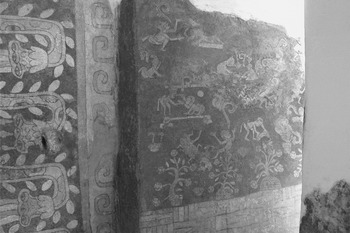
In 1933, near the eastern side of the Pyramid of the Sun, Alfonso Caso discovered a complex known as Tepantitla (Figure 2). He termed the murals found there a “Tlalocan,” based on his interpretation of the mythical paradise of Tlaloc (Caso 1942). This denomination is now 70 years old, and the small figures covering the lower walls have always been regarded as a representation of joyous individuals who have reached this paradise. However, a painstaking analysis of each of these figures highlights a possibility that differs from the most common interpretation of the southwestern wall: a mountain down which a river runs and where bathers happily splash.

Map showing the different buildings and constructions at Teotihuacan. Photograph courtesy Arqueología Mexicana 64:82.
The identification of this mountain with the Mexica altepetl is a topic that different authors, including Doris Heyden (2000:176), have addressed. In the same publication, Elizabeth Boone (2000) and Eduardo Matos Moctezuma (2000) each suggest that Teotihuacan must be an altepetl—a term that refers to the Water Mountain, a mythical Mexica mountain that by association also refers to the Tonacatepetl, or Hill of Sustenance. In this myth, Quetzalcoatl dashes onto the mountain and steals the essential grains for humanity. In recent work, James Lockhart (1992:14) has noted that the word altepetl “is a slightly altered form of the metaphorical doublet in alt, in tepetl, ‘the water(s), the mountain(s),’ and thus it refers in the first instance to territory, but what is meant is primarily an organization of people holding sway over a given territory” (see also Vit 2005:79). Similarly, Alfonso Lacadena uses the term altepetl as a synonym for people or human settlement (Lacadena 2003).
Esther Pasztory (1976), however, interpreted the scene depicted on the southwestern panel as a ceremony at which the “Great Goddess” is represented (Figure 3), an event related to the rains, abundance, and the cave. This scene has also been associated with that depicted in the lower right-hand section of the wall, which shows a person crying while standing on what has been described as a spring flowing around the figure of a frog or toad. It has also been proposed that this person is standing on top of a cave that may allude to the beginnings of Teotihuacan (Matos 2000).

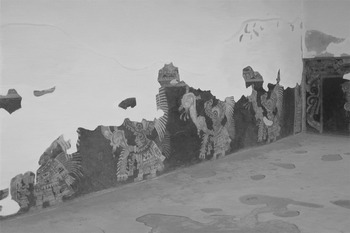
Southwestern wall, with a view of the mountain from which water flows, that has been associated with the Altepetl and the panel termed by Pasztory the “Great Goddess.” Here one sees different variations of the ballgame. On the left-hand side of the wall, the game is played with the feet; on the upper section at the center of the talus, it is played by striking the ball with the hips (ulama) without ballcourt markers. Another variation, also played using the hips, is depicted on the upper right section and shows a ballcourt with markers, above one of which is an object that appears to represent the bundle of years. Photograph by Gerardo Vázquez, Photographic Archive, IIE-UNAM, 2003.
THE BALLGAME AT TEPANTITLA, TEOTIHUACAN
I will now offer a brief analysis of the different types of ballgame identified at Tepantitla, as my proposal is essentially based on this diversity.
The Southeastern Wall
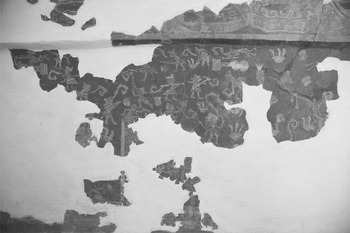
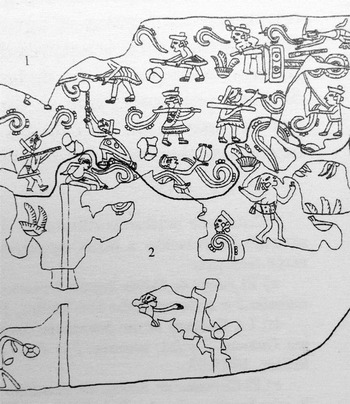
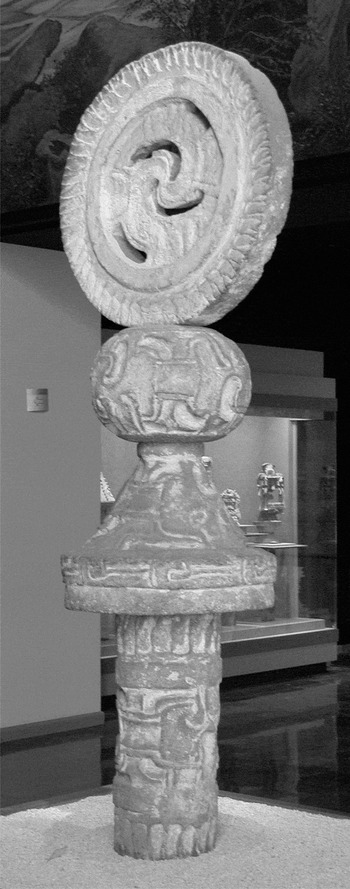
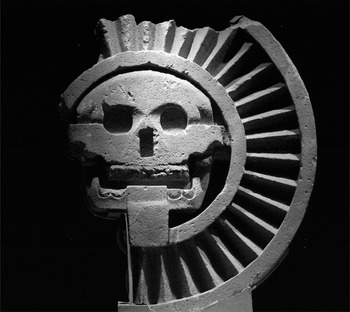
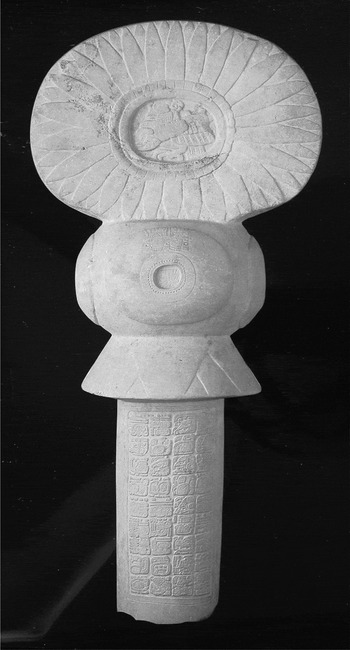
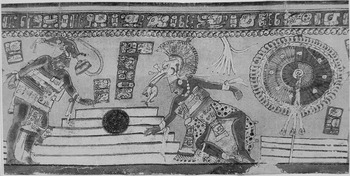
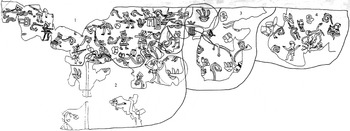
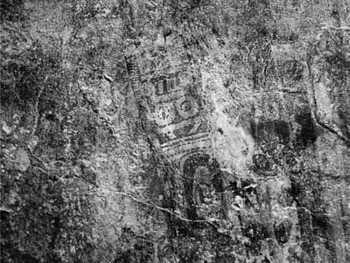
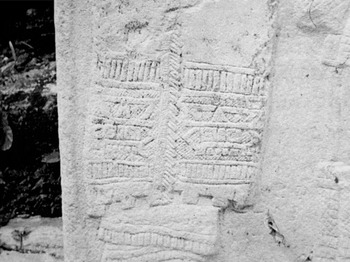
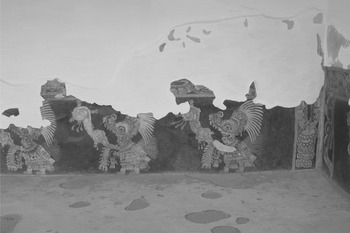
On this wall, the game is played with rods (Figure 4) and takes place between two mobile markers that indicate the limits of the playing field. Above, we see the figures of two people who have apparently been sacrificed (Figure 5). The markers painted at Tepantitla are similar to those uncovered archaeologically at La Ventilla (Figure 6). Another marker, now at the National Museum of Anthropology in Mexico City, depicts a dual figure representing life and death (Figure 7). These are also similar to the one found by Juan Pedro Laporte (1989) at Zone 6-C-XVI in Tikal (Figure 8). It is interesting to note that stone markers, which are similar to those painted on this wall, have been found on both the Altiplano Central in Mexico and in the Maya region. In fact, numerous vases from the Maya region bear painted representations of the ballgame that feature similar markers, which seem to have been fashioned from feathers. In these scenes, the players wear the garments normally used when striking the ball with the hip, while stepped structures appear in the background (Figure 9).

Southeastern wall of the ballgame chamber at Tepantitla. Here the game is played with sticks and mobile markers while an individual is shown sitting on a stepped court. Photograph by Gerardo Vázquez, Photographic Archive, IIE-UNAM, 2003.

Drawing of the southeastern wall. Dulce María Aragón, La Pintura Mural Prehispánica en México, 1991 (Fuente 1996).

Marker at La Ventilla. Photograph by Gerardo Vázquez, Photographic Archive, IIE-UNAM.

Upper section of the mobile marker at Teotihuacan. Photograph by Gerardo Vázquez, Photographic Archive, IIE-UNAM, 2004.

Photo of the Tikal marker now on display at La Aurora Museum in Guatemala. Photograph by the author.

Ceramic vase decorated with ballgame images and showing a mobile marker created from feathers (Whittington 2001).
The most extensive register of Maya ceramics, particularly painted vases, has been assembled by Justin Kerr between 1989 and 2000, in several volumes that can be consulted on the FAMSI website. Many vases bear painted ballgame scenes with stepped structural backgrounds. The Foundation for the Advancement of Mesoamerican Studies (FAMSI) website shows the entire group and uses the letter K accompanied by a number for reference purposes—for example, K1209, K2803, K5435, K3814, and K3842, among others, have this kind of representation.
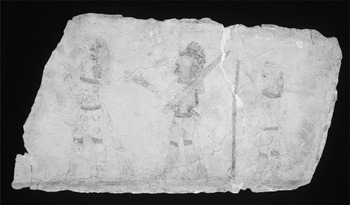
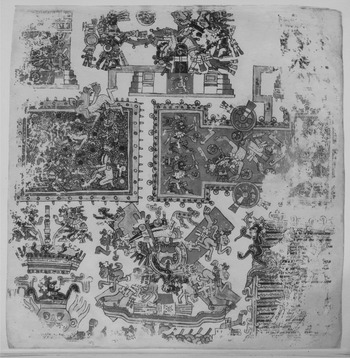
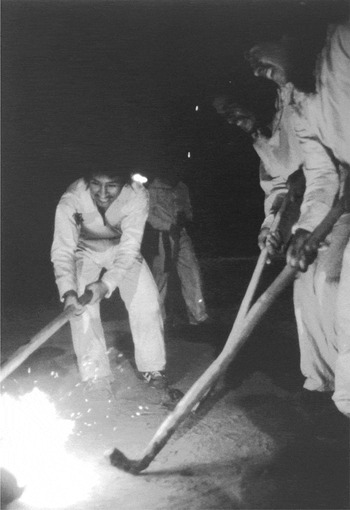
I will focus on two fundamental topics. The first involves the objects painted on vases, which I suggest represent mobile markers made from feathers, and those objects discovered in an archaeological context that are carved in stone. My hypothesis suggests that these are actually equivalent objects because, aside from an iconographic or formal relationship, these objects, whether depicted in murals or on vases, are associated with the ballgame and stepped platforms. Indeed, there is no doubt that ballgame players, stepped platforms, and feather markers are represented. The second issue involves the game played with rods, as depicted on certain fragments of a mural located at Las Higueras, Veracruz (Figure 10) and within the ballcourt shown on plate 42 of the Codex Borgia (Figure 11). This variation of the game is practiced in the state of Michoacan with a ball that is actually set on fire (Figure 12; Uriarte 1992).

Fragment of the painting at Las Higueras, Veracruz, Anthropology Museum of Jalapa. Photograph by La Pintura Mural Prehispánica en México (Fuente 1996).

Plate 42 of the Codex Borgia, Fondo de Cultura Económica. This image indicates that the ballgame played with sticks was of pre-Hispanic origin. The tradition of setting the ball alight, which is still conserved in Michoacan, reflects this variation. Photograph by Gerardo Vázquez, Photographic Archive IIE-UNAM.

A scene of Bola de lumbre, players from Michoacan made a display of this modality in Culiacán, Sinaloa, México, in 1992. Photograph by Germán Herrera, Photographic Archive, IIE-UNAM, 1992.
In the center of the southeastern wall at Tepantitla (see Figure 4), we see a person sitting on a stairway with a ball shown below. Unfortunately, because part of this painting has since been lost, we have no way to know whether other people were depicted at the foot of the stairs on what would be the equivalent of a court, as shown on the reliefs at Yaxchilan and on the Maya vases discussed earlier.
The Southwestern Wall
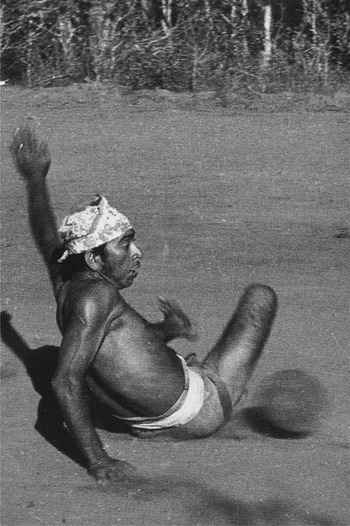
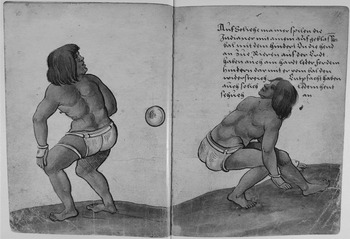
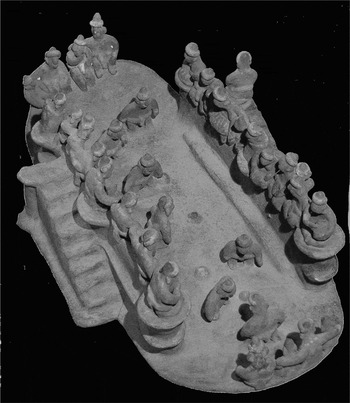
Here, the main theme is the mountain. There are two images of players striking the ball with their feet (see Figure 3), as though playing soccer. I have not yet found any other ancient representation of this ballgame variation. This wall, which shows the most extensive variation of games, depicts figures striking the ball from below, as though playing golf. The center of the wall highlights a ballcourt without markers, where the players are seemingly practicing the popular game known as ulamaliztli, which is still played in the state of Sinaloa (Figure 13) and consists of striking the ball with the hip. Thanks to a drawing made by Cristóbal de Weiditz in 1528 (Figure 14), we know that this game was played at least until the arrival of the Spanish. The “models” from ancient western Mexico also show energetic battles between players struggling to strike the ball with their hips (Figure 15). The mountain is located beneath the central ballcourt. However, another painted court on the southwestern wall features markers and players who also appear to strike the ball with their hips. It is worth noting that this ballcourt features a bundle of rods similar to the xiuhmopilli, or bundle of years. Many of these scenes are accompanied by numerals consisting of dots and bars, although some of them use only dots instead of bars representing the number five. We do not know whether these numbers refer to dates or, perhaps, game scores. Dances and ceremonies, which may have taken place before and after the game, are also highlighted.

Ulama player at El Chilillo, Sinaloa, Mexico. Photograph by Germán Herrera, 1991.

Images created by Cristóbal de Weiditz in 1528 depicting ulama players (Whittington 2001).

Ancient western Mexico model showing a ballgame celebration. Photograph by Gerardo Vázquez, Photographic Archive IIE-UNAM.
The Northwestern Wall
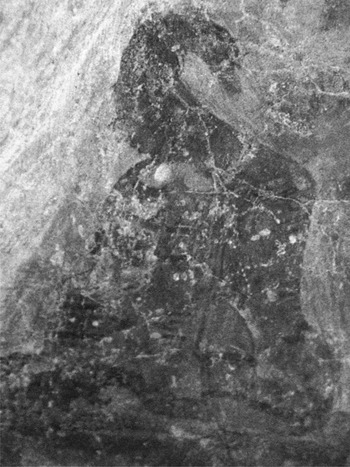
The northwestern wall depicts two ballcourts without markers. The more complete of the two shows two figures, one standing and the other seated in what appears to be a sacrificial scene. The other court, which is badly damaged, shows a figure with its arms open (Figure 16).

Northwestern wall. The mid-left-hand section of the wall depicts a sacrifice performed on a ballcourt without markers. It is interesting to note that the ball lies on top of a reclining figure. Above one sees another ballcourt, where a figures lies on its back with its arms open. Photograph by Gerardo Vázquez, Photographic Archive, IIE-UNAM, 2003.
THE IDENTIFICATION OF THE MAYA GLYPH PU OR PU[H] IN THE PAINTINGS AT TEPANTITLA
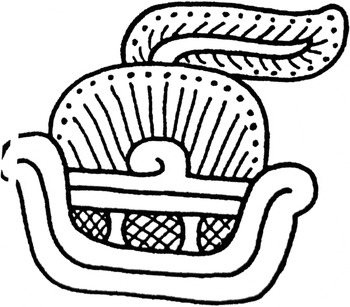
The pu or pu[h] glyph is shown repeatedly on all the walls. According to David Stuart (2000:503), it means the “place of the reeds.” In Nahuatl, this refers to Tollan or Tula, which some authors believe to be the equivalent of the city concept (Figure 17). Naturally, a city is a reflection of a civilization. Boone (2000: 381) identifies different Nahuatl toponyms that refer to Teotihuacan as the place of the reeds, or Tollan.

Representations of the pu, pu or pu[h] glyph that David Stuart identified in 2002 as the equivalent of Tollan, Tula, the place of reeds a synonym of the city as a civilization.
The importance of this identification leads to the following considerations. Civitas, the city, is the germ of civilization. In Mesoamerica, Teotihuacan was precisely that, although it was not the only city. In my opinion, the “city” glyphs shown on the Tepantitla painting and on others at Teotihuacan imply the identification and reaffirmation of a human community that sees itself as belonging to a different category—that is, that of citizen, the act of belonging to a social unit with specific qualities. The Tepantitla paintings contain different glyphs that could be toponyms. This is a combination that we clearly must not overlook. On the one hand, there is the glyph alluding to the city as a concept, Tollan, the Celestial Jerusalem (Davies 1987:48), while on the other, the walls refer to different cities with their possible names as their identifying toponyms.
The different types of ballgame discussed earlier were played—and in some cases, are still played—in certain regions of Mesoamerica. I therefore suggest that the representatives of the elite sectors of these regions or cities may have gathered in Teotihuacan to play the ballgames. Although a ballcourt has not yet been found at Teotihuacan, it is nevertheless feasible that the game was played on the largest ballcourt in Mesoamerica: the Avenue of the Dead. This important way has five sections that might have been the ballcourts. As a gathering of this kind must have been extremely important, I will analyze several of the more significant aspects of this sacred game by highlighting some of its main identifying features throughout Mesoamerica over time.
MESOAMERICAN ELITES AND THE BALLGAME
I intend to start with the Olmec culture, the most ancient and complex Mesoamerican civilization of which we have knowledge, which clearly had a social structure with identifiable strata that indicate the existence of a governing class.
Since 1988, at El Manati, Veracruz, Ponciano Ortiz has found different objects associated with the ballgame, all of which clearly belonged to the governing elite. For example, he has discovered serpent-shaped rods representing the granting of authority, a stone yoke, and wooden effigies of individuals, some of which were decorated with red pigment and covered with cloth, possibly tule. These objects also include a skull, perhaps beheaded; five rubber balls; and four ballcourts. The most ancient phase of occupation at El Manati dates from the Early Formative period (Ortiz et al. 1992).
During the Olmec Roundtable held in March 2005, Carmen Rodríguez presented archaeological evidence of different-size rubber balls dating from 1700 b.c. According to Thomas Lee (1999:223–229), the oldest Mesoamerican ballcourt is located at Paso de la Amada, in the municipality of Mazatan, on the Pacific Coast, and dates from 1800 b.c.
We now have additional cultural information that situates the ballgame prior to the dates used just a few years ago. The antiquity of the findings made by Rodríguez and Ortiz at the El Manati and Macayal zones is particularly interesting.
In Dainzu, Oaxaca, there are representations of ballgame players dating from the late Formative period, which feature the distinctive elements of players' attire; these include an exceptional feline mask that evokes the earliest relations between the ballgame, felines, and the governing class. Eric Taladoire (2003:319–340) suggests that the Mixtec ballgame may be represented on the Dainzu reliefs
In the Maya region during the Classic period, one of the titles reserved for the position of ruler was “ballgame player”—ajpitz, ajpitziil, or ajpitzal (Gillespie 1991). As this relationship is perfectly clear, I will not analyze the many images decorating ceramic vases in which rulers are associated with the ballgame. I will mention only that, on certain occasions, the lord of a particular kingdom is shown playing the ballgame and defeating his opponent, as is the case of the steps in front of Temple 33 at Yaxchilan: “At Naranjo we know that this ballgame was associated with a series of confrontations in which Naranjo lost a war with Caracol. The stairway recording the ballgame in question celebrated that victory and was very probably the site of exactly the kind of sacrifice shown in the Yaxchilan scene” (Schele and Freidel 1991:308). Another, similar example is Temple 11 at Copan, which also serves to highlight the fact that the ballgame was an important activity performed by elite social groups.
Furthermore, if I consider the significance of ballcourts at the main sites of different Mesoamerican cultures—such as Tajin and Chichen Itza, to name just two cities that, due to their size or number of ballcourts, are particularly important within the Mesoamerican context—it is clear that this activity required an enormous communal effort that could be initiated only by the dominant hierarchical sector.
CALENDARS, THE INITIAL ORDERING OF TIME, AND THE BALLGAME
Astronomical and calendrical associations with the ballgame are frequently found in different cultures over time. Authors such as Eduard Seler (1963:II:30) and Walter Krickeberg (1966:211) suggested that competition symbolized the struggle between darkness and light while it also represented a re-creation of the myth of death and the resurrection of the sun and other celestial bodies. Accordingly, the link between day and night becomes associated with the passage of time and the conclusion of calendrical cycles that were exceptionally important for Mesoamerican peoples (Aveni 1980:20; Cohodas 1991; Fox 1991:213–238).
We should recall that in the epic work known as the Popol Vuh, the creator brothers defeated the gods of the underworld by playing the ballgame and subsequently became celestial bodies, the sun and Venus. Originally proposed by Eric Thompson (1975:441), this would seem to be an interpretation that, based on a strict reading of the text, refers us to the creation of the sun and the moon.
It has also been suggested that the ballgame is associated with different moments of the sun's apparent journey through the heavens: equinoxes and solstices. Perhaps the most noteworthy example of this relationship can be found at the Xochicalco ballcourt, where, during the sunset of the spring equinox, the solar disk is seen through the marker. The excavations performed by Guadalupe Martínez Donjuán at Teopantecuanitlan, Guerrero, have demonstrated that the astronomical associations of the symbolic court located in the center of the sunken courtyard date from between 1000 b.c. and 800 b.c. (Martínez Donjuán 1994:143–163). I believe there is no doubt regarding these astronomical associations and, by extension, concerning the calendar and ballgame. Similarly, the connection with Venus or the deity known as Tlaloc among the Mexica also imbues it with a character associated with the periods of the year: the rainy and dry seasons, together with the appearance of Venus in the morning or afternoon, which also divides the year into two distinct periods.
OTHER BALLGAME SYMBOLISM
For Mesoamerican peoples, certain symbolism attached to the ballgame was established long ago (Uriarte 1992). These include the butterfly, as shown on the breastplate found in Tomb 7 at Monte Alban; the marker uncovered on Escalerillas Street in Mexico City in the area surrounding the Main Temple; and on the Tepantitla murals. We know that the butterfly has an igneous nature, an association with fire that highlights this element as the central feature of pre-Hispanic Mexico's most important ceremony—that of the New Fire—which marked the change of each 52-year calendar cycle (von Winning 1987:111–113). In Teotihuacan, the Pyramid of the Sun is aligned with the point where the sun rises on April 29 and August 13 (Galindo 2002:22). These dates form the basis of the calendrical calculations producing the 52-year cycle, after which the New Fire ceremony was performed. The butterfly frequently appears as a decorative element on objects termed theater-type incensarios at Teotihuacan.
We should recall that different myths of creation mention that the gods gathered at Teotihuacan to begin time and that the sacrifice of Nanahuatzin and Teczistecatl, who threw themselves onto a great bonfire, enabled the sun and moon to move through the heavens. It is therefore apparent that, through its different symbols, the ballgame is intimately associated with the concept of the birth of time. Similarly, the presence of Tlaloc in Tepantitla is a very clear example of the close relationship between these transcendental themes.
TLALOC AND THE BALLGAME
Tepantitla offers three different kinds of representations of Tlaloc. The first is located on the border of the ballcourt scene and consists of a frontal depiction of the deity wearing a headdress with three k'an crosses that have been interpreted as a “quincunx,” He also has a water lily in his mouth (Figure 18). In his hands he holds vases bearing his image. According to Thompson, in the Maya area the water lily is frequently associated with the k'an symbol because both allude to abundance (Thompson 1960:75). We should remember that k'an is also the name of the fourth day of the Maya calendar and is related to the corn god. In Yucatec Maya, the word k'an means cord, net, yellow, and, by extension, ripe.

Drawing highlighting some Puh glyphs in the murals. Drawing by Dulce Maria Aragón, Proyecto La Pintura Mural Prehispánica en México, IIE-UNAM.
Thompson suggests that the association of imix and k'an alludes to the abundance of food and drink, perhaps with a certain similarity to “give us this day our daily bread” (Thompson 1960:70). Although this reading could be modified based on recent epigraphic interpretations, Thompson's ideas are essentially correct, because Linda Schele and Nikolai Grube (1997; Grube 2002: 73–107) and Michel Davoust (1997) have interpreted the imix sign as representing the Ha' (water) logogram, while k'an represents WAJ (food, tamal, or tortillas). Similarly, it is also significant that the text reads TI'- HA'-WAJ, ti'ha'waaj ‘mouth of water and tamales,’ or, in other words, the abundance of water and food.
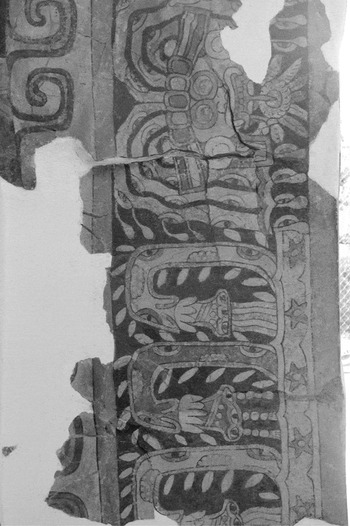
Returning to Tepantitla, the border discussed earlier also contains a second, profile representation of Tlaloc, which depicts only his head with drops running down his neck and a water lily in his mouth. Only one figure is shown wearing a headdress, decorated with a roof ornament or almena. This image is situated on the upper border of the southwestern wall. The profile figures are surrounded by intertwined aquatic bands; those shown in the center and at the corners offer frontal views of the deity. According to Thompson, the k'an cross is associated with the yax sign, meaning the center of all that is precious. It is also the sign representing completeness, serpents, and water. Caso (1946; 1967) suggests that k'an crosses at Monte Alban refer to the solar year and are associated with “turquoise” and “all this is precious.” Thompson reached a similar conclusion with regard to the Maya area, where the k'an cross has the connotation of “green” and “precious.” Together with the different types of ballgame and the central presence of Tlaloc, these themes of abundance and fertility highlight the overall importance of the sacred ballgame. The third representation of Tlaloc is located on the border of the door lintel leading to the Chamber of the Sowing Priests. Tlaloc is shown frontally, with a water lily in his mouth, while streams of liquid with eyes, leaves, and flowers flow from his headdress (Figure 19).

Drawing depicting the border at Tepantitla that bears frontal and profiled images of Tlaloc, in which drops of liquid can be seen flowing from his neck as though he has been beheaded. The upper border of the southwestern wall is enhanced by a profiled figure wearing a complete headdress featuring an almena. Drawing by Dulce Maria Aragón, Proyecto La Pintura Mural Prehispánica en México, IIE-UNAM.
I should also mention another attribute of Tlaloc: the headdress bearing the Trapeze and Ray symbol that is associated with the calendar, known as the year symbol at Teotihuacan. By wearing this symbol in his headdress, Tlaloc acquires an igneous nature that once again refers to the New Fire ceremony. The duality of water and fire embodied in the figure of Tlaloc is not an isolated feature. In fact, the effigy of the rain god was used to decorate incense burners; the face of Tlaloc even appears on the fiery almenas sometimes used as markers at Teotihuacan to indicate the sun's movements (Morante 1996). I believe that the year symbol and water lily are interchangeable, as both allude to the sun's journey and, consequently, to the passage of time. Similarly, as both are attributes of Tlaloc, his face sometimes appears as a solar marker on certain buildings. As discussed earlier, in the upper-right section of the southwestern wall at Tepantitla, Tlaloc's headdress is decorated with a roof ornament, or almena.
At Teotihuacan, Tlaloc is a deity associated not only with rain but also with fire and the sun, especially within the context of the beginning of calendrical time. He is also linked with the social elite and the practice of the ballgame.
The ballgame forms part of certain myths of creation, such as the Legend of the Suns, the Crónica Mexicáyotl, and the Popol Vuh. As the ballgame is associated with the beginning of time and the establishment of cities, aquatic symbols and those representing the passage of time frequently appear as part of its decorative elements. We should not overlook the fact that, according to different authors, the ballcourt is a vehicle for gaining access to the underworld. I believe that these messages actually reinforce each other: Tlaloc, the ballgame, the ruler's blood sacrifice at the end of different periods, the underworld as a place of creation, aquatic plants, the crocodile, k'an crosses and the extremely clear association with the passage of ordered calendrical time, the abundance of water and rain and the ruler as the mediator of this exuberance.
I would also suggest that dual symbolism is a quality of the imagery and deities with which the ballgame is associated (Uriarte 1992). Similarly, it is one of the features of Tlaloc, not only in terms of his favorable or adverse aspects, but also due to his association with fire and the sun, a notion that was repeated and maintained until the Postclassic period. In the Maya area, Tlaloc appears with the symbol of the trapeze and ray on his headdress: as of the Early Classic period in Tikal, on Stele 31; at Copan, on the headdress of the individual depicted on Stele 6 and on other monuments, such as those of Stele 2 at Aguateca and Stele 16 at Dos Pilas, and on lintels 8, 17, 24, 25 and 26 at Yaxchilan. The last of these shows only the face of the central Mexican plateau deity accompanied by the trapeze and ray symbol and occasionally the water lily, although it is not shown in his mouth or on his headdress. Instead, it forms part of the ruler's attire, thus indicating that the sovereign himself assumed the role of a god associated with the sun and time. These scenes often represent sacrificial ceremonies performed at the change end or beginning of each katun.
On Piedras Negras Panel 2, the face of Tlaloc appears together with the trapeze and ray symbol on the shields of the two most important individuals. At Bonampak, we see his face depicted on the ruler's clothing (Figure 20). It also appears on the central figure of the northern wall and on the clothing of the young girl (Figure 21) seated on the throne of the western wall, whose red dress bears images of the deity's face. Both of these examples are located in Room 1. Similarly, Tlaloc's face is represented on the clothes of the women shown on Stelea 2 (Figure 22).

Frontal image of Tlaloc with a water lily in his mouth, which is located on the jamb of the door to the Chambers of the Sowing Priests and ballcourt. Photograph by Gerardo Vázquez, Photographic Archive, IIE-UNAM, 2003.

Image of Tlaloc as decoration of the garments of the individual shown at the center of the eastern wall of Room 1 at Bonampak, who could well be the Ruler of Bonampak performing a divination ceremony. Proyecto La Pintura Mural Prehispánica en México, IIE-UNAM.

Figure number 18 of Room 1 at Bonampak, which features the blinkered decorations characteristic of Tlaloc and the trapeze and ray symbol. Proyecto La Pintura Mural Prehispánica en México, IIE-UNAM.
At Palenque, the southern side of Building 1 of the North Group houses a medallion bearing the face of an individual with Tlaloc goggles. Unfortunately, the medallion is severely deteriorated, and the headdress has not been preserved; in fact, all that remains of the face are the round eyepieces. On the other side of the stairway defining this wall we see a ballgame player with the trapeze and ray symbol; this building is aligned with the ballcourt. Other images of Tlaloc have been reported by different authors, including those located at Temple II of the North Group and Pillar C of the Temple of the Sun. Alejandro Tovalín (1994:113) suggests that some of these stuccoes may date from the fifth century or sixth century.
Consequently, there are innumerable examples of the association between Tlaloc, the trapeze and ray symbol, and the ruler's blood sacrifice. Finally, I would like to stress the fact that all of these activities take place in the underworld, the place where creation begins and where the ballgame is played to activate time, as discussed in the Popol Vuh.
HALLUCINOGENS AND THEIR RELATIONSHIP WITH THE UNDERWORLD
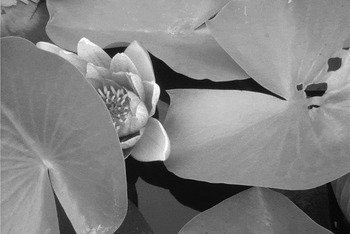
As shown by the Tepantitla murals, the water lily is also associated with the ballgame. As the flower of Tlaloc, the water lily has many meanings. The first and most evident of these is the fact that it closes its petals in the late afternoon and opens them the following morning, when the lily emerges from the water like the sun (Figure 23).

Stelae 2 at Bonampak. The border of the woman's skirt or dress bears images of Tlaloc and the trapeze and ray symbol. Proyecto La Pintura Mural Prehispánica en México, IIE-UNAM.
Furthermore, aside from being powerful emetics, the plant's rhizomes are a mind-altering agent. The water lily is clearly the flower of the underworld inasmuch as its multifaceted significance is based on its descent into the aquatic world at sunset and its psychotropic qualities (Rands 1953). In Yucatec Maya, naab' refers to the water lily; it is also a synonym for a large body of water like the entrance to the underworld (Cohodas 1991:261; Schele and Freidel 1991:305).
In the Maya area, the water lily has certain symbolism equivalent to that of the altiplano. Thompson's (1960) now classic work on Maya hieroglyphic writing offers a complete analysis of these associations. Another word for water lily is imix. In non-calendrical contexts, representations of the imix glyph—which is also the first day of the Maya calendar—“all depict the head of a saurian or ophidian monster with a long nose that is generally missing the lower jaw” (Thompson 1960:72). For Thompson, “Imix is the monster of the Earth, the crocodile on whose back the surface of the Earth was formed, with the water lily as its symbolic form” (Thompson 1960:72). He subsequently adds, “I only know of one reference to the water lily in Maya mythology, in the story of creation of Tizimín, page 21, which contains a passage tentatively translated by Roys and myself, as follows: ‘Then, the deep red calyx emerged, the deep white calyx, the deep black calyx and the deep yellow calyx, the face of the water lily emerged, the water lily that is submerged, the buds of the water lily’” (Thompson 1960:73). According to this story, the water lily is associated with the moment of creation. Thompson (1960:72) also noted that the “Imix monster is the exact counterpart of Cipactli.” The water lily, Imix, can be drawn as the head of the crocodile monster Itzam Kab'Áayin, the symbol of the Earth floating in the primeval waters. The reading of this sign could have the logographic value of Ha' ‘water.’ Consequently, naab' ‘the water lily’ and ha' ‘water’ are equivalents representing the primeval waters of creation. Furthermore, naab' and ha' can be drawn as the head of the crocodile monster Itzam Kab'Áayin, the symbol of the Earth at the time of creation.
It is interesting to note that Karl Taube (1989) has suggested that, during the Late Postclassic period in both the central Mexico and the Maya area, Itzam Kab' Áayin was related to myths of creation, the beginning of time, and Itzamna, the supreme Maya deity identified with the Aztec deity Tonacatecuhtli. We should also recall that, aside from being considered the Lord of the Earth, Tonacatecuhtli is also the Lord of Sustenance, meaning that fertility and abundance were linked during this late period through the primeval concepts discussed earlier.
With regard to the water lily's psychotropic qualities, the belief that those entering a mystic trance may visit the land of their ancestors is common to all cultures. If this plant is a vehicle for attaining an altered state, the fact that it dwells in nocturnal waters stimulates the belief that it accompanies the sun, notions that are also transferred to Tlaloc, who is frequently shown with the flower in his mouth.
THE CHAMBER OF THE SOWING PRIESTS AT TEPANTITLA
I will now analyze the Chamber of the Sowing Priests in Tepantitla, which is adjacent to the “Tlalocan.” This procession of priests can be read in several ways (Figure 24).

A water lily emerging from the water and opening its petals at dawn. Photograph by the author.
The remains of the painting in this room enable us to determine that the procession departed from and returned to the “Tlalocan” chamber, thus conveying a message involving the return to the point of origin or center. Each of the priests bears a unique form of identification (Figure 25), as indicated by the bag decorated with a different animal. Consequently, even though the priests form part of a religious group, their individuality is nonetheless highlighted. As each participant wears a caiman or crocodile headdress identified with the first day of the calendar, this is clearly a gathering or celebration involving individuals with calendrical headdresses who depart from and return to the chamber where the different types of ballgame once, and still, played in Mesoamerica are represented. Accordingly, within this context, the ballgame represents the center.

A procession of priests making an offering of blood or something precious. Each carries a small bag bearing images of different, distinctive animals, and all wear Cipactli (crocodile or caiman) helmets, also known as Imix among the Maya, which refers to the primeval moment of creation. Photograph by Gerardo Vázquez, Photographic Archive, IIE-UNAM, 2003.
I should also note that access is gained to the area where the Tlalocan and Chamber of the Sowing Priests are located through a passage that is approximately 1.2 m long. Here we see a painting of a person leaving the room—that is, after having participated in the ritual, the individual leaves the chambers. Opposite, there are different groups of representations with a calendrical context: k'an crosses and an incipient Trapeze and Ray symbol. As indicated by his attire, this priest forms part of the group of individuals analyzed earlier who met to perform a ceremony from which transcendental concepts and practices of Mesoamerican ideology can be deduced.
THE CALENDAR AND BLOOD SACRIFICE
I will analyze the procession of sowing priests as the representation of a special ceremony associated with the calendar, which included blood sacrifice or the divination of the beginning or end of a calendar cycle. I will also focus my analysis on the priests' attire: the crocodile, or cipactli, helmet or headdress. Cipactli-Imix is the first day of the calendar because, at the moment of creation, it represents the back of the primeval entity upon which the Earth rests and which represents the commencement of an era. The Earth is born, and with its emergence, time also begins. The participants in the procession are bearing insignia that associates them with a ceremony marking the beginning of time. Two small rods, one pointing up and the other down, emerge from their right hands, while a variety of symbols appear around them. It is generally accepted that the one pointing up represents talking or chanting, while the opposite is a symbol of throwing seeds.
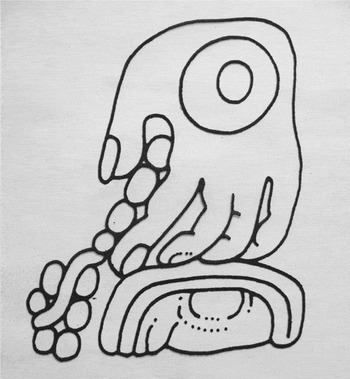
There are two possibilities regarding the act of sowing seeds. First, there are other examples of this symbol at Teotihuacan, where some liquid or seeds flow from the hands of an individual. Such is the case of the border in Room 11 at Tetitla (Uriarte 1996:393–399), which is exactly the same as the Maya logogram for “scattering seeds,” chok: “to throw, cast, scatter” (Figure 26). Furthermore, in the Maya area, the verb “to scatter” has the clear connotation of the blood offering performed by the ruler to mark the change of cycle, as demonstrated by Stuart (1988:181; 2003).

The animal figures shown on the priests' bags serve to emphasize their individuality. Proyecto La Pintura Mural Prehispánica en México, IIE-UNAM.
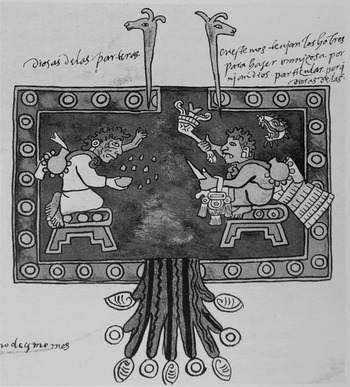
In this case, we can depart from the premise that this symbol has a double meaning. Through the act of scattering seeds, the members of this confraternity are identified as a group by their use of crocodile helmets and as individuals by the different symbols shown on their bags. In the Nahuatl myth of origin, the creator couple, Oxomoco and Cipactonatl, performed a divination ceremony by scattering seeds at the moment of creation (Figure 27). I am therefore inclined to believe that the act of scattering seeds performed by the sowing priests could be a divination ritual. The other possible meaning of this message could be that the seeds are actually drops of blood, thus representing a ceremony performed by members of an elite social group to mark the start of a new cycle. However, both possibilities bring us to a crucial moment of beginning and end in which the rites performed embody both these concepts. If this ceremony is performed by individuals with crocodile headdresses who are shown scattering seeds, it is possible that the ritual is associated with the beginning of time.

The “scattering hand” glyph from the Maya zone is also found at Tetitla, another complex in Teotihuacan. Proyecto La Pintura Mural Prehispánica en México, IIE-UNAM.
Water-lily buds surround the rods. However, as I discussed this topic in greater detail earlier, I will provide only a brief description of its symbolic connotations at this point. The water lily is the flower of the underworld—the place of creation. However, given its biological behavior, it can also be identified as a solar symbol and therefore associated with time and space. Imix is the first day of the Maya calendar and the symbolic form of the water lily, which has the calendrical representation of a crocodile without a lower jawbone. If the plant's rhizomes are hallucinogenic, the water lily represents a vehicle for visiting the land of the ancestors, thus reinforcing the symbolism of the beginning of time (Dobkin de Ríos 1984).
CONCLUSIONS
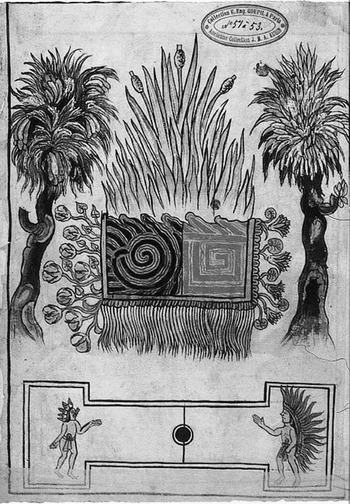
At Tepantitla, the depiction of different types of ballgame that were once played—and, in certain cases, are still played—in different regions of Mesoamerica is accompanied by the Puh-Tollan glyph (Figure 28). The concept of a civilized city, Tollan-Puh, is associated with the playing of the ballgame, as exemplified by plate 16v of the Historia Tolteca-Chichimeca. The ballgame is also related to the moment of creation and the underworld (Figure 29).

Oxomoco and Cipactonatl performing a divination ritual at the moment of creation (Caso 1974:Plate 21).

Tollan, the foundation of a city in association with ballgame (Kirchoff, Odena Güemes, and Reyes García 1989:Plate 16v).
The southwestern wall at Tepantitla shows a mountain down which water runs. It could be associated with the Altepetl or Tonacatepetl, the mystic Hill of Sustenance, and therefore with Teotihuacan as the Altepetl, inspired by this ideal figure. This image leads us to a moment of creation, together with the foundation of time and the city-tollan. It is also the moment of the creation of corn, when, according to myth, Quetzalcoatl stole maize seeds for humanity. Within this context, the ballcourt becomes a way to access the underworld (Schele and Freidel 1991) and is like a cave or mountain, a place from which the underworld can be reached (Broda 2000:414; Heyden 2000:171).
The ballgame is situated at the center of the two walls on the southern side of the Tlalocan chamber. Furthermore, the southeastern wall features descending steps, while its southwestern counterpart depicts the mountain from which water springs, thus indicating the entrance to the underworld, the place of creation and the commencement of past and future time. Finally, Tlaloc is shown at the center of the borders on these two walls; he is de-picted holding jugs of water, while his headdress bears k'an crosses to reinforce the message—Tlaloc, the ballgame, creation, the beginning of time, the birth of corn, and the fertility of the Earth. These are complementary themes that are all present in the myths of creation contained in Postclassic sources from both central Mexico and the Maya region.
Regarding the Chamber of Sowing Priests, scattering seeds or blood is a ceremony that was performed to mark the start of a new cycle. The cipactli helmet or headdress worn by priests, the representation of water lilies, Imix, and the reptile's eye or Trapeze and Ray symbols may confirm that this is actually a ceremony related to the beginning of the calendar cycle.
We may therefore ask certain questions. Does this represent the establishment of time in different Mesoamerican Tollans? Or does it reinforce the message that the Teotihuacan Tollan served as a meeting point where the Mesoamerican elites marked the commencement of a common, agreed on time that would take the crocodile-imix as its first day and the beginning of time at the Teotihuacan Tollan? Through all of the themes discussed here, the conception of a mythical time related to historical time is also feasible.
Similarly, the links between these themes and the ballgame and the relations between the Teotihuacan metropolis and the Maya region are also clear. It cannot be a coincidence that the “scattering hand” and puh glyphs appear in the paintings at Teotihuacan, while the same could be said of the similarities between the painted markers at Tepantitla, those of Tikal, or a stepped ballcourt in the Maya region.
Finally, the possibility once again arises that the central scene of the panel in the ballcourt chamber, referred to as the “Great Goddess,” alludes to a sacrifice by decapitation related to the ballgame. This proposal would be absolutely feasible based on the congruence highlighted by my analysis of the practical ballgame ritual and the concept of creation associated with fertility, abundance, and the blood sacrifice. In my opinion, and based on this information, the murals at the Tepantitla complex acquire a certain coherence from symbolic connotations of the sacred ballgame that they would not otherwise have.
RESUMEN
Este ensayo pretende presentar una reinterpretación de las pinturas de Tepantitla en Teotihuacán, que durante décadas han sido llamadas “Tlalocan.” Esta propuesta se basa en la identificación de diferentes juegos de pelota que aparecen en los murales y su posible vinculación con lo que he reconocido como el glifo maya Pu, pu or pu[h] o “Tollan” Lugar de Juncos. Teotihuacán se nos presenta como la ciudad por excelencia y sobre todo como el lugar donde empezó el tiempo. Me parece que con la evidencia que presento, con base en las imágenes de la cámara de los llamados “Sacerdotes Sembradores” y en la identificación de su yelmo como un tocado de cocodrilo que se puede asociar con Cipactli, el primer día del claendario azteca (mexica). Por otra parte, en ambos cuartos, el del Tlalocan y el de los Sacerdotes Sembradores, hay imágenes de Tláloc con flores y botones de lirio acuático, que por sus propiedades alucinogénicas y su comportamiento biológico, se asocia con el inframundo, con el sol y por ende con el calendario. Así, los murales de Tepantitla como conjunto pueden ser entendidos desde una perspectiva integral y coherente que no se había realizado hasta ahora.