Introduction
Gene therapy involves the introduction of genetic material (including DNA, RNA, small interfering RNA or antisense oligonucleotides) into cells to correct cellular dysfunction or to provide new functions in order to cure or slow the progression of diseases. To date, over 1800 gene therapy clinical trials have been approved worldwide (Ref. Reference Ginn1). T cell gene therapy represents an emerging therapeutic option for use against malignancies, infections and certain monogenic diseases. The ability to harvest, manipulate and reinfuse engineered T cells has made them attractive targets for gene therapy. Pioneering trials have already been undertaken to treat inherited T cell deficiency, redirect T cell antigen specificity, confer resistance to human immunodeficiency virus (HIV) and incorporate suicide genes to safeguard against graft-versus-host disease (GvHD) in the allogeneic transplant setting. As T cells are long lived cells, with periods of quiescence and active proliferation, integrating vector systems have generally been used to modify T cells, and here we review clinical experiences with γ-retroviral and lentiviral vectors (γRVs and LVs, respectively) and consider the potential of integrating transposon-based vectors, as well as transient expression of gene-modifying nuclease enzymes.
Long-term gene expression in T cells mediated by γRV
Murine γRV with intact long-term repeats (LTRs) flanking a transgene expression cassette, and packaged using stable cell lines, which provide accessory packaging and envelope components, have been widely exploited for T cell modification. Efficient γRV-mediated gene integration requires actively proliferating target cells, and T cell activation procedures have evolved from PHA stimulation, to activation with anti-CD3 antibody and currently beads conjugated with anti-CD3 and anti-CD28 antibodies.
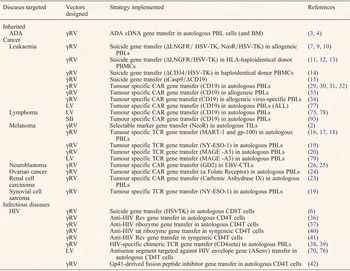
γ-retroviral T cell gene therapies are summarised in Table 1. Initial gene marking studies (Ref. Reference Rosenberg2) tracked tumour-infiltrating lymphocytes mediating regression of metastatic melanoma using a retroviral vector encoding a gene for resistance to neomycin. Soon afterward, autologous T cells from infants with adenosine deaminase (ADA) enzyme deficiency, a form of severe combined immunodeficiency (SCID), were reconstituted using γRV (Refs Reference Blaese3, Reference Bordignon4). Both patients remained free from serious infections, on reduced doses of enzyme replacement (Ref. Reference Muul5). Although the clinical benefit was limited because of low gene transfer rates, retroviral gene transfer proved feasible, and gene-modified autologous cells persisted long-term without causing adverse effects.
T cell gene therapy clinical trials.

BM, bone marrow; CAR, chimeric antigen receptors; CD, cluster of differentiation; EBV-CTLs, Epstein-Barr virus cytotoxic T lymphocytes; GD2, ganglioside 2; HIV, human immunodeficiency virus; HLA, human leukocyte antigen; HSVTK, human herpes simplex virus thymidine kinase; LV, lentiviral-vector; MAGE-A3, melanoma-associated antigen 3; MART, melanoma antigen recognized by T Cells; NY-ESO-1, autoimmunogenic cancer/testis antigen 1; PBMCs, peripheral blood mononuclear cells; TCR, T cell receptor; TIL, tumour-infiltrating lymphocyte; γRV, γ-retroviral vector; SB, sleeping beauty.
Suicide gene therapies
Another early T cell immunotherapy trial recruited patients with HIV infection and modified CD8+ cytotoxic T cells by retroviral transduction with a herpes simplex virus thymidine kinase (HSV-TK) fusion gene. Although technically feasible, the main limitation was host-mediated immune responses against the transgene (Ref. Reference Riddell6). In 1997, Bonini et al. reported the use of allogeneic T cells engineered to express HSV-TK to render cells sensitive to the prodrug ganciclovir (GCV) and safeguard against GvHD (Ref. Reference Bonini7), and similar studies were subsequently reported by a number of other groups (Refs Reference Burt8, Reference Tiberghien9). Donor T cells modified with the HSV-TK suicide gene were administered to patients with leukemic relapse and GvHD was effectively controlled by GCV-induced elimination of the transduced cells (Ref. Reference Bonini7). Tiberghien et al. also demonstrated that the use of HSV-TK expressing donor T cells in 12 patients at the time of allogeneic bone marrow transplantation was feasible and associated with persistent circulation of modified cells, GCV-sensitive GvHD, and the absence of acute toxicity (Ref. Reference Tiberghien9). A similar clinical strategy using an almost identical vector with HSV-TK/NeoR led to secondary graft rejection in two of three treated patients due to immunogenicity of infused T cells (Ref. Reference Fehse10).
In subsequent multicentre trials, leukemic patients were infused with donor lymphocytes expressing the HSV-TK suicide gene, following haploidentical stem-cell transplantation. It was reported that 22 of 28 patients who received genetically modified T cells achieved rapid T cell immune recovery, with the development of a polyclonal repertoire protective against pathogens, leading to a significant long-term reduction of infection-related mortality. Of note, ten patients developed acute GvHD and one developed chronic GvHD, which were controlled by induction of the suicide gene (Ref. Reference Ciceri11). In a follow-up study of these 22 patients, new insights into the biologic events leading to the immune reconstitution after HSV-TK cell infusions were provided. It was suggested that the infused T cells that carried the suicide gene supported de novo generation of T cells from thymus-dependent pathways, leading to long-term immune reconstitution (Ref. Reference Vago12). In other studies, transduced T cells were detectable in nine leukemic patients for up to 5 years with seven of nine patients alive and in complete remission (Ref. Reference Borchers13). A recent publication reports the production and first-in-man use of mismatched donor T cells modified with a γRV expressing a HSV-TK fused to a truncated CD34 marker protein for magnetic selection. Circulating gene-modified T cells were detectable by flow cytometry and by molecular tracking in all three subjects. There was resolution of viral infections, concordant with detected antigen-specific T cell responses, and gene-modified cells persisted for over a year (Ref. Reference Zhan14).
As HSV-TK is virus-derived and immunogenic, alternative suicide genes have also been investigated. Di Stasi et al. devised an inducible T cell safety switch that is based on the human caspase 9. When exposed to a synthetic dimerising drug, the inducible caspase 9 becomes activated and leads to the rapid death of cells expressing the iCasp9/ΔCD19 construct. Five paediatric patients who had undergone stem cell transplantation for relapsed acute leukaemia were treated with high numbers of genetically modified T cells. Four patients developed GvHD, which was treated with a single dose of dimerising drug, eliminating over 90% of the modified T cells within 30 min of the administration and ended GvHD without recurrence (Ref. Reference Di Stasi15).
αβ T cell receptor (TCR) gene therapies
Similar retroviral vectors have been used to redirect TCR specificity using αβ TCRs. Morgan RA et.al. transduced autologous T cells from human leukocyte antigen (HLA-A201) melanoma patients with a retroviral vector constructed and optimised to express a MART-1 αβ TCR. In 17 patients with progressive metastatic melanoma, gene transfer efficiencies ranged from 17 to 67% in peripheral blood lymphocytes. Overall, two patients (12%) demonstrated a sustained regression of their metastatic melanoma, with high levels of circulating engineered cells at 1 year after infusion (Ref. Reference Morgan16). A follow-up study provided a detailed longitudinal analysis of cell persistence and transgene expression in vivo. Interestingly, transgene expression was repressed over time, and silencing was not associated with methylation but rather with transcriptional down-regulation, which was reversible upon lymphocyte reactivation (Ref. Reference Burns17). In subsequent trials carried out with higher avidity TCRs, objective clinical responses were seen in 30% of patients (6/20) treated with autologous MART-1 TCR modified T cells and in 19% of patients (3/16) treated with a gp100-reactive TCR (Ref. Reference Johnson18). Gene transfer efficiencies represented ≥10% of peripheral blood lymphocytes in all patients 1 month following treatment. Some subjects encountered adverse effects related to on-target reactivity in normal tissues expressing melanin antigens, including the eye, ear and skin.
Similar approaches have been used in patients with refractory metastatic melanoma or metastatic synovial cell sarcoma with NY-ESO-1-positive tumours (Ref. Reference Robbins19). After approximately 1 month, gene marking ranged between 2 and 60% of CD8+ T cells present in peripheral blood (in 14 of the 17 treated patients). Four of six patients with synovial cell sarcoma achieved objective clinical responses, with one lasting 18 months, and five of 11 patients with melanoma also achieved objective clinical responses, including two complete responses on-going at 22 and 20 months and one partial response on-going at 9 months. Morgan RA et al. (Ref. Reference Morgan20) also reported the clinical application of MAGE-A3 TCR gene-modified T cells in an adoptive cell therapy trial in nine cancer patients (seven metastatic melanoma, one synovial sarcoma and one oesophageal cancer). At 1 month post-treatment, TCR positive cells in the circulation were in the range of 11–84% with a mean of 41%, and five patients experienced clinical regression of their cancers. However, on-target neurologic toxicities were reported in three cases, and two proved fatal (Ref. Reference Morgan20). Autologous lymphocytes engineered to express HLA-A201/HBs183-91 αβ TCR specific for the hepatitis B virus (HBV) surface antigen (HBsAg) have been used to target HBV-associated hepatocellular carcinoma in a subject with chemoresistant extrahepatic metastatic disease (Ref. Reference Qasim21). Forthcoming trials in London aim to use the same vector platform to target Wilms' tumor antigen 1 (WT1), a tumour associated antigen that may be a useful target in relapsed acute myeloid leukaemia (AML) and other haematological malignancies (ClinicalTrials.gov: NCT01621724, UK-0150), as well as cytomegalovirus, a common pathogen in immunosuppressed transplant patients (EudraCT No: 2008-006649-18, UK-0190).
Chimeric antigen receptor (CAR) gene therapies
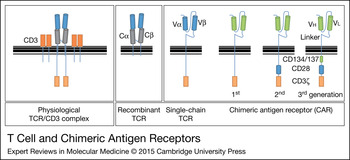
CARs are recombinant receptors that combine the specificity of an antigen-specific antibody with T-cell signalling domains (Fig. 1) and have been recently modified to include co-stimulation domains (Ref. Reference Sadelain, Brentjens and Riviere22). First-generation CARs used in these studies were composed of signalling domains derived from single molecules, either the CD3-ζ chain or Fc receptor γ (FcRγ) chain. Many trials that used gene-modified lymphocytes with first-generation CARs encountered low levels of cell persistence. For example, poor clinical responses were seen in three patients with renal cancer who received autologous T cells transduced with a CAR directed against carbonic anhydrase-IX (Ref. Reference Lamers23) or in eight patients with ovarian cancer who received autologous PBMCs transduced to express a CAR targeting the α-folate receptor (Ref. Reference Kershaw24). In addition, immunogenicity of CARs was observed, as well as on-target adverse effects in non-tumour tissues (Ref. Reference Lamers23). Pule et al. engineered Epstein-Barr virus-specific cytotoxic T lymphocytes (CTLs) to express a CAR directed against diasialoganglioside GD2, a non-viral tumour-associated antigen expressed by human neuroblastoma cells. They reasoned that these genetically engineered lymphocytes would receive optimal costimulation after engagement of their native receptors, enhancing survival and antitumour activity mediated through their chimeric receptors (Ref. Reference Pule25). Four of the eight patients with evaluable tumours had evidence of tumour necrosis or regression including a complete and sustained remission. In a follow up study, the analysis of the long-term fate of these low-level persisting CAR cells was performed on a total of 19 subjects with high-risk neuroblastoma, including the original 11 patients. CAR cells persisted at low levels for as long as 4 years, with a highly statistically significant association between prolonged detection and the number of helper CD4 and central memory T cells. Of the 11 patients with active disease at the time of infusion, three patients achieved complete response (Ref. Reference Louis26).
T Cell and Chimeric Antigen Receptors. The αβ T cell receptor (TCR) comprises α- and β-chains associated with the γ, δ, ε and ζ chains of the CD3 complex. TCRs recognize specific antigenic peptides that have been processed and presented in association with human leukocyte antigen (HLA) molecules expressed on the surface of target cells. Chimeric antigen receptors (CARs) are recombinant molecules composed of an antigen-specific antibody linked through a hinge region to CD3ζ alone (first-generation), or in combination with the intracellular signalling domain of a T cell co-stimulatory molecule, usually CD28 (second-generation), or more recently with an additional signalling domain from a second co-stimulatory molecule such as CD137 (4-1BB) or CD134 (third-generation). These receptors mediate high affinity binding of target cell surface proteins and are independent of HLA presentation.

Second-generation CARs incorporating additional signalling domains derived from costimulatory molecules such as CD28 were assessed against B cell lymphomas expressing the CD19 antigen (Ref. Reference Savoldo27). Patients were simultaneously infused with two autologous T cell products expressing CD19 CARs; one CAR encoded both the costimulatory CD28 and the CD3-ζ domains, while the other encoded only the CD3-ζ chain. Second-generation CARs drove enhanced expansion and persistence of the modified cells as compared with first-generation CARs. Kochenderfer et al. showed their encouraging results with a patient treated with second-generation chimeric antigen receptor T cells directed at CD19 with a dramatic tumour regression (Ref. Reference Kochenderfer28). Nonetheless, this patient was treated a second time after relapse alongside seven others, either chronic lymphocytic leukaemia (CLL) or B-cell lymphoma patients. Six of the eight treated patients obtained objective remissions (Ref. Reference Kochenderfer29). Brentjens et.al. enrolled another 10 patients with either chemotherapy refractory CLL or relapsed acute B lymphoblastic leukaemia (B-ALL) on two phase 1 dose escalation clinical trials with second-generation CARs directed at CD19 (Ref. Reference Brentjens30). Three of four evaluable patients with bulky CLL exhibited either a significant reduction or a mixed response in peripheral lymphadenopathy. Two recent publications with patients with relapsed or refractory B-ALL who received autologous CD19 CAR modified T cells also demonstrated the marked antitumour efficacy (from 88 up to 100%) and reliability of this therapy (Refs Reference Brentjens31, Reference Davila32). In an allogeneic setting, a clinical trial involving T cells obtained from each hematopoietic stem cell transplantation (HSCT) donors and genetically modified to express CD19 CARs showed that a relatively small number of these cells can cause regressions of malignancies (CLL and Mantle Cell Lymphoma), which were refractory to other therapies, without causing GvHD (Ref. Reference Kochenderfer33). In another trial (Ref. Reference Cruz34), eight patients with B-cell malignancies who had relapsed after HSCT were infused with donor-derived virus-specific T cells expanded with LCLs and transduced with a γRV bearing a CD19 CAR transgene. These infusions were safe in all patients, did not induce GvHD, expanded in the presence of Epstein-Barr virus (EBV) reactivation, and in two of six patients could produce objective clinical responses (Ref. Reference Cruz34).
Some subjects have encountered complications following infusion of CAR modified T cells, with cytokine-mediated toxicities (Ref. Reference Morgan35). A systemic inflammatory syndrome related to cytokine storms mediated by tumor necrosis factor alpha (TNFα) and interleukin-6 (IL-6) has been reported in early phase trials, and measures taken to address such complications include the use of anti-IL-6 antibody therapy (Refs Reference Brentjens31, Reference Davila32).
Overall, γRV genetic modification of T cells with CARs established the first proof of concept data for this type of cancer immunotherapy.
HIV therapies
γRV vectors have also been used to deliver transgenes in the context of clinical gene therapy for the treatment of HIV. In 1998, a pilot study of three HIV-seropositive patients infused with autologous CD4 cells transduced with a mutant protein that remains one of the most potent inhibitors of HIV replication demonstrated persistence of the Rev-transduced cells for an average of 6 months after retroviral gene transfer (Ref. Reference Ranga36). Although there was no long-term benefit, a modest survival advantage of the transduced CD4 cells was observed. The same year, a phase 1 clinical trial evaluating the safety and effects in asymptomatic HIV-1 infected patients of autologous lymphocytes transduced with a ribozyme that cleaves HIV-1 RNA led to similar results (Ref. Reference Wong-Staal, Poeschla and Looney37). Studies have also evaluated a receptor comprising transmembrane and extracellular domains of human CD4 and the ζ-subunit of the CD3TCR, to target the gp120 cell surface expressed HIV glycoprotein. A phase II randomised trial showed that infusion of gene-modified, but not unmodified, T cells was associated with reduced HIV burden in some subjects (Ref. Reference Deeks38) and found that persistence of cells harbouring the chimeric transgene was over 1 year. Deeks' study demonstrated rises in CD4+ T cell levels in patients receiving ex vivo expanded autologous T cells and modest decreases in viral reservoirs in HIV-infected individuals compared with controls. Similar results were obtained in a study with 24 patients where CD4ζ was detected in 1–3% of blood mononuclear cells at 8 weeks and 0.1% at 1 year after infusion (Ref. Reference Mitsuyasu39). These studies confirmed the safety and feasibility of adoptive therapy with CD4ζ gene-modified T cells for the treatment of HIV infection. Other more recent trials also involving twins discordant for HIV infection support the hypothesis that anti-HIV genes afford a survival advantage to T cells and potential benefit to HIV-1 positive individuals (Refs Reference Macpherson40, Reference Morgan41). One of the most recent completed clinical trials was tested in ten patients with late-stage HIV infection (Ref. Reference van Lunzen42). The infusions of transduced T cells with a γRV carrying a transgene encoding a HIV entry-inhibitory peptide derived from gp41 were well tolerated, and a significant albeit transient increase of CD4 counts was observed after infusion. T cell gene therapy for HIV might help generate an immune system resistant to HIV and contribute to the control of HIV (Ref. Reference Hoxie and June43). Also, it is likely that such approaches will have to be combined with stem cell modification and ablative conditioning regimens to ensure long-term, thymic and non-thymic mediated T cell recovery alongside elimination of HIV reservoirs.
Genotoxicity
One concern associated with γRVs has been the risk of genotoxicity associated with mutagenic effects elicited by vector insertion near to transcription start sites and transactivation of proto-oncogenes, although in clinical studies, adverse effects have only been reported following hematopoietic stem cell (HSC) modification (Ref. Reference Wu44). In clinical studies of HSC modification for X-linked SCID-X1 (Refs Reference Hacein-Bey-Abina45, Reference Hacein-Bey-Abina46), chronic granulomatous disease (Ref. Reference Ott47) and Wiskott–Aldrich syndrome (WAS) (Refs Reference Boztug48, Reference Braun49), leukemic transformation has been reported in Phase 1 trials. In contrast, several hundred patients have now received γRV-modified T cells without evidence of genotoxicity. Although theoretically possible, it appears that T cells have a lower risk of transformation than HSCs (Refs Reference Deeks38, Reference Newrzela50). However, in vitro and in vivo experiments revealed the susceptibility of primary T cells to malignant transformation, from a rare event of T-cell immortalisation (Ref. Reference Newrzela51) to mature T-cell lymphomas in mice (Ref. Reference Heinrich52). Despite integration into genes with potential to mediate mutagenesis, long term studies in patients followed in a clinical trial have demonstrated stable gene expression profiles and phenotype with no evidence of clonal expansion (Ref. Reference Recchia53) presumably because of the differentiated nature of T cells compared with HSCs.
Lentiviral-mediated T cell modification
In contrast to oncoretroviral preintegration complexes (PICs), lentiviral PIC has the capability of actively transporting into the nucleus through nuclear pore complexes in an adenosine triphosphate (ATP)-dependent manner (Ref. Reference Bukrinsky54). Thus, HIV-1-based LVs have the potential to transduce minimally activated cells and to be pseudotyped with heterologous envelope proteins such as vesicular stomatitis virus G envelope protein, to confer broad tropism for transduction of a wide variety of mammalian cell types including T cells (Refs Reference Bukrinsky55, Reference Naldini56). First-generation HIV-1 LVs used a split packaging plasmid system and transient transfection to generate virion particles. Second-generation vectors were devoid of viral accessory proteins (Vif, Vpu, Vpr or Nef), deleted of U3-LTR elements (including its thymine-adenine-thymine-adenine (TATA)-box-, Sp1-, nuclear factor kappa B (NF-κB)- and nuclear factor of activated T-cells (NFAT)-binding sites) and incorporating internal promoter sequences (Refs Reference Miyoshi57, Reference Zufferey58). Third generation LVs are now also Tat-independent with Rev provided in trans by a fourth plasmid (Ref. Reference Sakuma, Barry and Ikeda59). Additional heterologous elements have improved the properties of the transducing vector, including the woodchuck hepatitis virus post-transcriptional regulatory element used to stabilise transgene mRNA levels and increase transgene expression, and the central polypurine tract, another cis-acting element, is used to improve transduction efficiency (Refs Reference Dupuy60, Reference Zufferey61). Additional available modifications include the use of chromatin-insulator elements (Ref. Reference Osti62), chromatin-opening elements (Ref. Reference Zhang63), bioengineered ligand/antibody-displaying envelopes for targeted T cell transduction (Ref. Reference Funke64) and tissue-specific promoters (Refs Reference Sakuma, Barry and Ikeda59, Reference Dropulic65). Several envelope glycoproteins can be used to pseudotype LV particles, for example amphotropic murine leukaemia virus (MLV) or RD114 (type D retrovirus) envelope-pseudotyped LVs show efficient transduction of human CD34+ haematopoietic stem cells (Ref. Reference Relander66), but the vesicular stomatitis virus G glycoprotein is widely used based on its efficiency and broad tropism. This pseudotype provides resistance to freeze-thawing and sufficient stability for LV to withstand concentration or purification methods (Ref. Reference Kutner, Zhang and Reiser67). High concentrations of LV particles are usually needed for efficient gene transfer in primary T cells, requiring concentration of the viral stock. Ultracentrifugation is commonly employed but also concentrates cellular debris, membrane fragments and proteins derived from producer cells and the culture medium. Such materials can be toxic to target cells, in particular to primary cells, and may cause inflammatory or immunogenic reactions for direct in vivo studies (Refs Reference Baekelandt68, Reference Tuschong69).
In the absence of efficient stable packaging systems, most clinical vectors have been produced by transient transfection methods in 293T packaging cells, and a number of published clinical studies have now employed this approach including anti-HIV therapy (Ref. Reference Levine70), adrenoleukodystrophy (ALD) (Ref. Reference Cartier71), β Thalassemia (Ref. Reference Cavazzana-Calvo72), CLL (Ref. Reference Porter73), WAS (Ref. Reference Aiuti74), and Metachromatic Leukodystrophy (Ref. Reference Biffi75). To date these vectors have a satisfactory safety profile compared with γRVs. Previous mapping of LVs and γRVs integration sites on the human genome sequence found distinct target site preferences between the two viruses. MLV-based γRVs appear to be biased towards integration near transcription start sites or cytosine-phosphate-guanine (CpG) islands, whereas HIV-based LVs appear to favour integration within active transcription regions. Clonal expansion was reported in a trial for β Thalassemia where hematopoietic stem cells were modified with a LV incorporating a modified β-globin locus control region, and vector integration into the high mobility group AT-hook 2 (HMGA2) locus disrupted endogenous microRNA regulation, but without leukemic transformation (Ref. Reference Cavazzana-Calvo72). Of particular note, longitudinal studies of CD4+ T lymphocytes transduced with a LV incorporating anti-HIV envelope sequences have found no evidence of abnormal clonal expansions (Ref. Reference Wang76).
HIV therapies
Lentiviral T cell gene therapies are summarised in Table 1. Levine et al. carried out the first clinical trial in which a conditionally replicating HIV-based LV expressing an antisense gene against the HIV envelope was introduced into T cells of five HIV-infected subjects (Ref. Reference Levine70). This LV retained full LTRs of HIV with expression of the antisense element upregulated in the presence of wild-type HIV. This LTR-dependent transcriptional upregulation is in contrast to the majority of other trials, where self-inactivating vectors with LTRs modified by deletion of the U3 region, are used to reduce the risk of vector mobilisation. After 1 year, all patients showed a decrease of the viral load and four out of five showed an increase in the number of CD4+ T cells. The transduced cells diminished in number after infusion but were detectable at 2 years in three of five subjects (Ref. Reference Levine70). A follow-on Phase I/II clinical trial was initiated to evaluate the distribution of integrated vector copies in transduced CD4+ T cells before and after reinfusion with no evidence of vector-mediated transactivation, which had caused clonal expansions in some stem cell studies (Ref. Reference Wang76).
CAR gene therapies
The groundbreaking studies on CAR came from June lab in 2011 with CD19 CARs carried by LVs (Refs Reference Porter73, Reference Grupp77, Reference Kalos78). They tested the feasibility and safety of CAR CD19-specific in patients with CD19-positive lymphoid malignancies, including refractory CLL (Ref. Reference Porter73) and acute lymphoblastic leukaemia (ALL) (Ref. Reference Grupp77). The LV expressed a second-generation CAR with specificity for the B-cell antigen CD19, coupled with 4-1BB, a costimulatory receptor in T cells, and CD3-zeta signalling domains. Interestingly, in the CLL setting relatively low dose anti-CD19 CAR cells underwent >1000-fold in vivo expansion. These cells trafficked to tumour sites, persisted long-term in vivo and induced rapid and potent antitumour activity in the chemotherapy refractory CLL patient. No clonal proliferation of the infused T cells was observed, although two toxic effects were described, an unexpected occurrence of delayed tumour lysis syndrome and lymphopenia. Remission was on-going 10 months after treatment (Ref. Reference Porter73). The two ALL patients developed a severe cytokine-release syndrome, and a single course of anti-cytokine therapy, consisting of a TNF inhibitor and anti–IL6 receptor monoclonal antibody, was effective in reversing the syndrome and did not prevent expansion of CAR T cells or reduce antileukemic efficacy (Ref. Reference Grupp77). Cells persisted as memory CAR+ T cells and retained anti-CD19 effector functionality, indicating the potential of this MHC-independent approach for the effective treatment of B cell malignancies (Ref. Reference Kalos78).
αβ TCR gene therapies
In a recent trial carried out with an affinity-enhanced TCR specific for the HLA-A*01-restricted MAGE-A3 tumour antigen, a melanoma and a myeloma patient were treated with autologous modified T cells. Both subjects encountered severe cardiac toxicity owing to off-target reactivity, developed cardiogenic shock and died within a few days of T-cell infusion (Refs Reference Linette79, Reference Cameron80). This was an unexpected and unpredictable consequence of cross recognition of unrelated cardiac antigen by the introduced TCR, underlining the difficulty in modelling such consequences ahead of clinical application.
Additional studies that are planned include treatment of patients with locally advanced or metastatic melanoma, with CD8+ T cells engineered to express the αβ chains of a high affinity TCR specific for the HLA-A*0201-restricted MART-1 melanoma tumour antigen, together with the HSVl-sr39tk suicide gene, or with autologous PBLs expressing a αβ TCR specific for tyrosinase. For myeloma, MAGE-A3 and NY-ESO-1 TCRs post-ASCT and for the treatment of synovial sarcoma, NY-ESO-1 TCR transgenes will also be carried by LVs, as NY-ESO-1 and LAGE-1 TCRs for hepatocellular carcinomas.
For HIV therapy, gag-specific TCR (the University of Pennsylvania, Philadelphia) and RNAi (Beckman Research Institute) are expressed in autologous T cells and target HIV Tat and Rev. Calimmune developed a dual therapeutic anti-HIV LV that down-regulates CCR5 and inhibits HIV-1 fusion via cell surface expression of the gp41-derived C46 peptide, initially developed by D. von Laer's group (Ref. Reference Hildinger81). This shRNA construct is being tested in Phase I/II trials by engineering HIV-resistant hematopoietic cells and CD4+ T cells (Ref. Reference Burke82).
For ovarian cancer, an alpha-folate CAR, following a clinical trial with γRV (Ref. Reference Kershaw24), and a mesothelin CAR are tested in clinical trials currently recruiting from the University of Pennsylvania, Philadelphia. In non-Hodgkin lymphoma, CD19 CAR only, CD19 CAR together with a truncated EGFR in central memory T cells, or bi-specific CMV-TCR and CD19 CAR T cells will be infused to patients. For acute lymphoid leukaemia, CD19 CARs have also been designed in an autologous setting. Finally, patients with B-lymphoid malignancies will be infused with allogeneic CD8T cells expressing CD19 CARs (data collected from http://www.wiley.com/legacy/wileychi/genmed/clinical/ and http://www.clinicaltrials.gov/). Interestingly, several companies including big pharmaceuticals have taken over to develop CAR T cells into clinical products (Ref. Reference Flemming83).
Non-viral transposon-based T cell engineering
Non-viral gene transfer technologies offer the prospect of more cost effective and less biologically complex alternatives to viral methodologies, with reduced concerns related to safety, host immune response and manufacturing costs. Plasmid-based gene transfer could facilitate investigation of a greater variety of transgene cassettes, and allow rapid evaluation of new receptors. This is an important consideration in the context of αβ TCRs, where multiple HLA-peptide specific receptors will need to be provided, and for CAR receptors, which continue to rapidly evolve with revised costimulatory and selection domains.
DNA transposons have the ability to insert transgenes into host chromosomes for long-term transgene expression and are derived from natural genetic elements residing in the genome as repetitive sequences that transfer through a direct cut-and-paste mechanism, called transposition. Sleeping Beauty, a reactivated Tc1/mariner-like element from fossils of the salmonid fish genome (Ref. Reference Ivics84), Medaka fish Tol2, a member of the hAT family (Ref. Reference Kawakami85) and cabbage looper moth piggybac (Ref. Reference Ding86), the founding member of the piggyBac family, are all transposons that effectively transpose in mammalian cells (Ref. Reference Hackett, Largaespada and Cooper87). Advantages in using these systems for genetic modification of T cells include reduced costs associated with the manufacturing of clinical-grade plasmid-based vectors, compared with recombinant viral vectors, and reduced immunogenicity. In addition, transposon vectors may tolerate larger and more complex transgenes. Unlike LTRs of retroviruses, the terminal inverted repeats of SB vectors have very low intrinsic enhancer/promoter activity and cannot readily activate endogenous genes that flank the transposon integration sites. A reconstruction based on several rounds of mutagenesis established a functional SB transposase protein that was found to efficiently catalyse transposition in human cells (Ref. Reference Ivics84). Mutagenesis of the transposase gene led to a higher efficiency variant (Ref. Reference Yant88) with the development of the SB100X transposase (Ref. Reference Mates89).
In primary human T cells (Table 1), Huang et al. demonstrated that SB transposons can mediate stable transposition of reporter genes with high levels of transgene expression maintained at least 4 months in vitro (Ref. Reference Huang90). Transposon constructs expressing tumour antigen-specific TCR genes targeting p53 and MART-1 also showed sustained expression and furthermore, functional reactivity of transposon-engineered lymphocytes on encountering target antigen presented on tumour cells. A direct comparison between transposon- and retroviral-modified lymphocytes revealed a comparable transgene expression and phenotypic function (Ref. Reference Peng91). Comparison of lentiviral- and sleeping beauty-mediated αβ TCR gene transfer supported the exploitation of the SB plasmid based system as a flexible and adaptable platform for accelerated, early-phase assessment of TCR gene therapies (Ref. Reference Field92). SB delivery of CD19 CARs has led to early-phase human trials that are currently assessing safety and feasibility of administering these autologous genetically modified T cells into patients with high-risk B-lymphoid malignancies undergoing autologous HSCT. T cells with redirected specificity were efficiently generated with plasmids from the Sleeping Beauty system, and expansion was achieved for both CD4+ and CD8+ T cells expressing CAR with CD19+ artificial antigen-presenting cells (Refs Reference Kebriaei93, Reference Singh94).
Overall, eight clinical trials have opened recently using the Sleeping Beauty system for non-viral ex vivo genetic modification of either autologous T cells, HLA-matched allogeneic T lymphocytes or umbilical cord blood lymphocytes for the treatment of lymphoma, and autologous T cells for the treatment of CLL at the Anderson Cancer Center and the University of Texas (http://www.wiley.com/legacy/wileychi/genmed/clinical/), with no acute toxicities reported to date.
Future developments
The rapid advancement of genome editing techniques holds much promise for the field of human gene therapy. Among the upcoming methods of lymphocyte genetic modification, the zinc finger nuclease (ZFN) technology (Refs Reference Perez95, Reference Maier96) is currently being evaluated in early stage clinical trials infusing HIV-resistant T cells generated by ZFN-mediated disruption of the CCR5 coreceptor for HIV-I (Ref. Reference Tebas97). A similar concept aims to engineer T cells to express TCR or CAR after disruption of endogenous TCR by designer ZFNs or TALE nucleases (TALENs) is being investigated. These approaches aim to eliminate alloreactivity by knocking out αβ TCR expression and are combined with viral or SB transfer of antigen specific receptors. Thus, it may be possible to generate universal allogeneic tumour-associated antigen-specific T cells from one donor that might be administered to multiple patients as off-the-shelf T cell gene therapies (Ref. Reference Torikai98). Sangamo have developed ZFNs to target the α and β chain constant regions (Refs Reference Torikai98, Reference Provasi99), and Cellectis, TALENs (Abstract ESGT, A45, Or035, http://online.liebertpub.com/doi/pdfplus/10.1089/hum.2013.2513). A recent publication describes TALENs efficient genome editing in primary T lymphocytes (Ref. Reference Berdien100). Expression of these reagents from transfected mRNA is being investigated and similar approach for the transient expression of αβ specific receptors following electroporation of mRNA is being investigated as an alternative to stable transduction. In some circumstances, time limited expression of antigen specific receptors may be desirable, allowing clinical effects with reduced risk of sustained adverse effects (Ref. Reference Koh101).
Clustered regularly interspaced short palindromic repeats (CRISPR) are clusters of brief DNA sequences that read similarly forward and backward, found in many types of bacteria. Since 2013, the CRISPR/Cas system has been used for gene editing (adding, disrupting or changing the sequence of specific genes) and gene regulation in various species. By delivering the Cas9 protein and appropriate guide RNAs into a cell, the genome can be cut at any desired location (Ref. Reference Mali, Esvelt and Church102). Therefore, CRISPR could make gene therapies more broadly applicable, from simple genetic disorders to eventually more complex diseases involving multiple genes (Ref. Reference Meissner103).
Overall, engineered T cells offer enormous therapeutic potential, with technologies evolving to allow modification of either autologous or allogeneic populations, which will need to be carefully assessed in well-designed clinical studies.
Financial support
W. Q receives support from Great Ormond Street Hospital Special Trustees and the National Institute of Health Research via Biomedical research councils. A. C. F was supported by Children with Cancer UK.
Conflict of Interest
Cellectis, Calimmune, and Miltenyi Biotec provide research funding to UCL and are collaborating in the development of T cell therapies, but have had no role in the writing or review of this manuscript.