Implications
White locoweed belongs to a widespread group of alkaloid-producing rangeland plants that are collectively responsible for the majority of rangeland livestock poisoning losses worldwide. Because of their highly detrimental effects on cattle health, locoweeds (Oxytropis sp. and Astragalus sp.) have been the focus of many research studies that sought to develop grazing management strategies to reduce livestock intoxications. Although these studies collectively concluded that simple changes in grazing management are often sufficient to reduce the incidence of intoxication, social interactions that lead to generalized locoweed intoxication within a herd are still poorly understood. In this experiment, manipulation of the feeding environment delayed, but did not inhibit social learning of toxic weed ingestion altogether. Our results suggest that restriction of the area allocated to animals to feed in, such as placing heifers in smaller white locoweed-infested pastures, is unlikely to inhibit social learning of toxic weed ingestion altogether.
Introduction
Cattle that feed in heterogeneous grazing environments, such as rangelands, can increase nutritious food encounter rates by copying the feeding behavior of experienced conspecifics (Bailey et al., Reference Bailey, Howery and Boss2000; Ksiksi and Laca, Reference Ksiksi and Laca2000). Learning from social models about foods and feeding sites is a ubiquitous foraging phenomenon that occurs not only in livestock (Provenza, Reference Provenza1994; Launchbaugh and Howery, Reference Launchbaugh and Howery2005), but also in rodents (Galef, Reference Galef1985, Reference Galef1986 and Reference Galef1993), birds (Mason et al., Reference Mason, Arzt and Reidinger1984; Johnston et al., Reference Johnston, Burne and Rose1998) and other domestic and wild animals (Clayton, Reference Clayton1978; Laland, Reference Laland2004). Although this behavioral process is predicted to increase an animal’s fitness in patchy environments (Boyd and Richerson, Reference Boyd and Richerson1988), social learning may occasionally result in the acquisition of maladaptive foraging behaviors. Social facilitation of toxic weed ingestion in cattle is a good example of the latter (Ralphs and Olsen, Reference Ralphs and Olsen1990; Ralphs et al., Reference Ralphs, Graham and James1994; Ralphs and Provenza, Reference Ralphs and Provenza1999), and is the process by which a few cattle induce naïve peers to select previously avoided toxic rangeland plants.
Social learning is responsible for herd-wide intoxications with white locoweed (Oxytropis sericea Nutt), a common alkaloid-synthesizing toxic herbaceous legume of western North American rangelands (Ralphs et al., Reference Ralphs, Graham and James1994 and Reference Ralphs, Graham, Duff, Stegelmeier and James2000). Most cattle that are naïve to white locoweed avoid consuming it on first encounter (Jackson et al., Reference Jackson, Cibils, Graham, Gould and Allison2007), but are eventually induced to ingest this toxic weed by a few peers who readily select it (Ralphs et al., Reference Ralphs, Graham and James1994). Cattle that ingest large amounts of white locoweed (O. sericea Nutt) suffer severe neurological disorders that lead to weight loss, impaired reproduction and even death (Panter et al., Reference Panter, Ralphs, James, Stegelmeier and Molyneux1999 and Reference Panter, James, Gardner, Ralphs, Pfister, Stegelmeier and Lee2002; Pfister et al., Reference Pfister, Panter, Gardner, Stegelmeier, Ralphs, Molyneux and Lee2001). Since detection and isolation of herd members that consume locoweed is not always feasible, the development of grazing management practices that inhibit (or suppress) social learning could be a cost effective means of preventing intoxication losses.
Social interference and social facilitation interactions (i.e. individuals either compete for or induce others to use a resource) shape the foraging behavior of animals that feed in groups (Nilsson et al., Reference Nilsson, Lundberg, Brönmark, Persson and Turesson2006). The relative prevalence of either of these depends on group social dynamics and its interaction with a number of environment-related characteristics (Coussi-Korbel and Fragaszy, Reference Coussi-Korbel and Fragaszy1995; Giraldeau and Caraco, Reference Giraldeau and Caraco2000). Among the characteristics of an animal’s feeding environment, individual space allowance is possibly the attribute which exerts the largest influence on social dynamics of confined farm animals (Estevez et al., Reference Estevez, Anderson and Naevdal2007). Indeed, restricted feeding areas are associated with increased interference interactions in cattle under confinement (DeVries et al., Reference DeVries, von Keyserlingk and Weary2004), in rotational grazing systems (Walker and Heitschmidt, Reference Walker and Heitschmidt1989), or in supplement delivery areas on rangelands (Sowell et al., Reference Sowell, Mosley and Bowman1999 and references therein). Furthermore, similar behaviors have been documented in wild ungulates (Mattiello et al., Reference Mattiello, Mattiangeli, Bianchi and Carenzi1997; McElligott et al., Reference McElligott, Mattiangeli, Mattiello, Verga, Reynolds and Hayden1998; Shi and Dunbar, Reference Shi and Dunbar2006) that tend to aggregate in smaller grazing sites during winter when forage is scarce.
We conducted a controlled experiment to test the hypothesis that exposure to a restricted feeding area would inhibit social facilitation of locoweed ingestion in yearling heifers. We hypothesized that feeding in a restricted area would induce interference rather than facilitation of locoweed ingestion. We predicted that when exposed to a restricted feeding space, heifers that naturally select locoweed on first encounter (hereafter locoweed eaters (LE)) would preclude access of counterparts that naturally avoid it (hereafter locoweed avoiders (LA)). Conversely, we also predicted that when feeding space was non-restrictive, LE would be unable to restrict access to this nutritious (albeit toxic) plant and would therefore induce LA to begin consuming locoweed.
Material and methods
White locoweed harvest and handling
White locoweed plants were harvested while in the immature pod stage from a site 72 km west of New Mexico State University’s Clayton Livestock Research Center (CLRC) in northern New Mexico. Harvested plant material was air-dried, ground through a 25 mm screen, and stockpiled in a cool dry storage shed where it was fractioned for daily use in experiment trials. Samples of air-dried ground plant material were sent to United States Department of Agriculture - Agricultural Research Service Poisonous Plant Research Laboratory to determine swainsonine concentration (an indolizidine alkaloid synthesized by white locoweed) using a method developed by Gardner et al. (Reference Gardner, Molyneux and Ralphs2001).
Animals and pre-experiment classification trials
All trials were conducted at CLRC during July 2005. Animal handling and testing protocols were approved by New Mexico State University’s Institutional Animal Care and Use Committee. Sixteen cross-bred heifers (Hereford and Angus) weighing 174.6 ± 3 kg (mean ± s.e.) were selected from a pool of 40 animals that were naïve to white locoweed in pre-experiment classification trials conducted shortly after heifers arrived at CLRC. These pre-experiment classification trials were used to identify individuals that exhibited a natural predisposition to either avoid or select white locoweed (a novel toxic plant). Classification trials consisted of fasting all 40 heifers for 24 h and then exposing them individually for 10 min to a simultaneous offering of freshly harvested white locoweed plants (1.000 g), air-dried whole-locoweed plants (1.000 g), and air-dried ground locoweed plants (500 g). Individuals were classified into two groups depending on whether they consumed or refused any of the three forms of locoweed offered, regardless of the amount consumed. Animals that consumed locoweed (n = 10), sampled all three forms of locoweed offered; whereas heifers that avoided it (n = 30) refused to sample locoweed altogether regardless of the form in which it was presented. Eight heifers that avoided locoweed and eight heifers that consumed it (LA and LE, respectively) were then randomly selected for this experiment. A second pre-experiment trial including only these 16 heifers was conducted 2 days after the initial classification trial to assess group separation accuracy. Heifers were fasted for 12 h this time, and were again individually exposed to freshly harvested locoweed. All 16 animals exhibited the same feeding behavior as in the previous trial. Heifers were then randomly assigned a peer within their respective category (LE or LA) and were housed in pairs (i.e. two LE or two LA were placed together) in randomly assigned pens where they remained for the duration of this study.
Adaptation to experiment food and arena, and routine feeding procedures
Animals were adapted to one of the experimental foods (500 g of ground wheat straw) and containers (6-l rubber bowls) during 5 days before beginning experiment tests. Two bowls with ground wheat straw were placed in each pen for approximately 20 min before the delivery of daily basal feed rations each morning; wheat straw refusals for each pen were collected and weighed daily. All animals in pens, regardless of their apparent social rank, were observed feeding wheat straw during adaptation. After completing adaptation to experiment foods, individual heifers were allowed to become familiar with the experiment arena (which contained only wheat straw bowls) for a 10-min period during 1 day.
Basal feed ration consisted of 50% corn and 50% alfalfa and wheat hay mix initially fed at a rate of 5.9 kg/heifer per day and gradually increased to levels expected to promote low individual weight gains. Heifers were fed at approximately 0700 h each morning, except on trial days when basal feed ration was delivered after trials had concluded at approximately 1100 h. Heifers usually depleted daily rations by 1900 h and were thus subjected to approximately 12 h overnight fasting before experiment trials. This fasting period insured adequate feeding motivation during trials.
Experimental arena and treatments
Feeding trials were conducted over a 15-day period immediately following pre-experiment trials and adaptation. Heifer feeding choices were examined by conducting 200 individual 10-min trials during three 5-day experimental phases (non-social learning, social learning and testing). Experiment phases lasted 5 days because: (a) prior field research showed that 4-day periods were sufficient for heifers to exhibit socially induced changes in locoweed ingestion patterns (Ralphs et al., Reference Ralphs, Graham and James1994); and (b) heifers and steers in controlled feeding trials stabilize intake and recall location of feeding stations by the fifth day of experimentation (Ksiksi and Laca, Reference Ksiksi and Laca2000; Ginane and Petit, Reference Ginane and Petit2005). Treatments were imposed during the second phase (social learning) by altering the size of the experiment arena (described below); therefore, non-social learning (first phase) and testing (third phase) trials reflected pre- and post-treatment experimental conditions. Trials consisted of exposing individual heifers (non-social learning, testing) or pairs of heifers (social learning) to an experimental arena with food bowls in which some bowls contained ground wheat straw and others contained ground white locoweed. The experiment arena was not visible from holding pens therefore animals were unable to see peers during trials. Wheat straw (estimated 3.5% crude protein (CP), NRC, 2000) was used in lieu of dormant rangeland grasses to expose heifers to an experimental feeding situation analogous to early-spring grazing conditions on rangelands in New Mexico. Low nutritional value of dominant warm season rangeland grasses during this period is thought to induce cattle to consume the relatively more nutritious (up to 17% CP) yet toxic locoweed plants (Ralphs and Olsen, Reference Ralphs and Olsen1987; Ralphs et al., Reference Ralphs, Graham and James1994).
Pairs of heifers consisting of one LE and one LA were treated during the social learning phase by exposing them to locoweed and wheat straw bowls. Two sizes of arenas were used to induce either social interference (80 m2 arena, social learning inhibition predicted to occur) or social facilitation (240 m2 arena, social learning predicted to occur). LA and LE were randomly assigned to the social interference (four heifer pairs) or social facilitation treatments (four heifer pairs) both of which were imposed during the social learning phase of the experiment.
Non-social learning trials (pre-treatment)
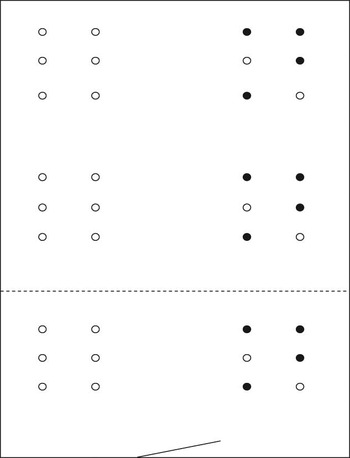
Non-social learning trials (days 1 to 5) allowed individual heifers to freely select among experiment foods without social interference or facilitation by peers. Twelve 6-l bowls with 65 g of food were placed 1 m apart in two groups of six bowls each; groups of bowls simulated food patches and were located on either side of the entrance to the 80 m2 arena (Figure 1). All bowls in one patch contained wheat straw, whereas bowls in the other had either wheat straw (two bowls) or air-dried ground locoweed (four bowls) (Figure 1). Each locoweed bowl contained the approximate weight (65 g dry matter (DM) basis) of 1 to 2 white locoweed plants in the seed pod stage (D. Thompson, unpublished data). Thus, locoweed patches simulated a field situation of low-to-moderate infestation with a density of 0.7 to 1.4 pl/m2 (Owen et al., Reference Owen, Torell, Graham and Ralphs1999). Half the animals in each treatment group were always exposed to the patch with locoweed on the left side of the arena, whereas the other half were exposed to patches in the opposite location to control for laterality bias.
Diagram of experimental arenas. Individual animals were exposed to the small arena (80 m2 below the dotted line) during non-social learning and testing phases. During social learning phase, pairs of animals in the interference treatment group were also exposed to the small arena, whereas pairs of animals in the social facilitation group were exposed to the entire area (240 m2) shown on the diagram. Half the heifers were exposed to patches with locoweed on the right-hand side of the arena, whereas the remaining half was offered locoweed bowls on the left (not shown in the diagram). Locoweed patches contained four bowls with air-dried ground locoweed (full circles), remaining patches only contained bowls with ground wheat straw (empty circles).

Each of the 16 heifers was exposed to the arena individually for 10 min daily on each of 5 days. Thus, a total number of 80 trials were conducted during this pre-treatment phase. The order in which treatment groups were led to the arena was rotated each day to control for potential time of day effects; individual heifers within each treatment group, however, were led to the arena in random order. Number and kind of bowls visited (bowls from which animals took at least one bite) by each heifer was recorded during trials. Wheat straw and locoweed refusals were weighed and used to calculate individual intake and preference indices ([locoweed or wheat straw intake/total intake]/[locoweed or wheat straw available/total food available]).
Social learning trials (treatment)
Social learning trials (days 6 to 10) consisted of pairing LA with LE of the same treatment group (social interference or social facilitation) and jointly exposing them to the experimental arena. This experimental phase provided the opportunity for heifers to learn about the foraging environment from peers that either avoided or selected white locoweed. Heifer pairs remained the same throughout this experiment phase, which included 40 10-min trials. Pairs of heifers that had been assigned to the social interference treatment (four pairs) were exposed to the small arena (80 m2). Layout of bowls in this arena was identical to the non-social learning phase; however, food in each bowl was tripled (195 g). Heifers that had been assigned to the social facilitation treatment pairs were exposed to an enlarged arena that had three times the area of the small arena (240 m2). The number of bowls in this arena was also tripled (n = 36), but each bowl contained the same amount of food (65 g) as had been offered during non-social learning trials. Therefore, pairs of animals in both treatment groups were exposed to the same overall amount of wheat straw and locoweed; however, feeding space and feeding stations (bowls) allotted to each heifer were increased. Maintaining food availability equal across treatments ensured control of its effects on individual diet selection patterns.
Social rank of individuals in each pair was visually assessed during social learning trials. A heifer was considered dominant if it consistently displaced its partner from feeding bowls during trials. Experimental control of this variable was achieved by including social rank of each individual (whether dominant or subordinate) as a co-variable in the statistical analysis of data (see below).
Half of the pairs in each group were exposed to the locoweed patches on the left and wheat straw patches on the right; the remaining half were exposed to food patches in the opposite location. The order in which pairs were exposed to the arena was randomized daily following the same procedure used in the non-social learning trials. Number and kind of bowls visited by individual heifers in a pair was recorded during trials. Refusals were collected and weighed after each trial to calculate overall intake of wheat straw and locoweed of each pair. Since individual intake was not measured, preference indices were not calculated for this experimental phase.
Testing trials (post-treatment)
Testing trials (days 11 to 15) allowed heifers to once again express their feeding preferences in a foraging environment free of social influences. Procedures followed during testing trials (n = 80) were the same as those used during the non-social learning phase. Again, animals were exposed individually for 10 min daily to the small arena (80 m2) with 12 bowls arranged in two patches on either side of the arena with 65 g of food in each. The procedure to determine the order in which heifers were led to the arena each day was the same as that used during non-social learning trial phase. Number and kind of bowls visited by individual heifers was again recorded during trials. Wheat straw and locoweed refusals were measured after each trial and were used to calculate intake and both locoweed and wheat straw preference indices.
Data analysis
Data from each 5-day phase were analyzed separately using a mixed-model repeated measures analysis of variance (ANOVA) in SAS 9.1 (SAS, 2006). The same heifers were measured over time, hence the use of repeated measures analysis. Individual heifers were considered a random effect. The fixed effects considered in the model were heifer category (LA v. LE), social learning treatment (interference v. facilitation) and trial day. The response variables considered were wheat straw and locoweed intake and preference indices. Models used to analyze data from the social learning and testing trials included an animal’s social rank as a co-variable. Social rank was coded as a dummy variable that was assigned a value of ‘1’ if an animal in any given LA–LE pair was dominant and a value of ‘0’ otherwise. Model selection from models with varying covariance structures was facilitated using information theoretic methods (Akaike’s Information Criterion; Akaike, Reference Akaike1973) to select the most parsimonious model. First order autoregressive covariance structure, which accounts for higher correlation between observations taken on the same subject at closer v. more distant time intervals (Littell et al., Reference Littell, Milliken, Stroup, Wolfinger and Schabenberger2006), was the covariance structure that best fit our data. Interactions among factors were examined. When interactions occurred, main effects were interpreted considering the form of interaction. Treatment effects were examined in the mixed modeling context; treatment means were compared using the lsmeans statement with the tdiff option in SAS 9.1 (SAS, 2006).
Analyses of number of wheat straw and locoweed bowls visited by individual heifers throughout the entire experiment were also conducted. As individual intake could not be measured during social learning trials and given that this variable and number of bowls visited were highly correlated (r values ranging from 0.82 to 0.91, P < 0.01), the latter was used as a surrogate for intake in this analysis. This allowed us to evaluate individual patterns of food selection throughout the experiment and to gain insight into the learning process during social learning trials. Therefore, mean number of bowls visited by individual heifers during each period was analyzed using a mixed-effects repeated measures ANOVA. Individual heifers were again considered a random effect. Animal category (LA v. LE), social interaction (interference v. facilitation), and trial (instead of day) were the factors included in this model. Treatment effects were once again examined in the mixed modeling context; treatment means were compared using the lsmeans statement with the tdiff option in SAS 9.1 (SAS, 2006).
Social learning trial data were also subjected to linear correlation analyses to determine whether the number of wheat straw and locoweed bowls visited by a locoweed eater and avoider in a pair were correlated. Data included in these analyses consisted of the number of wheat straw or locoweed bowls visited by a LA and its LE counterpart in each 10-min trial during the social learning phase of this experiment (i.e. 20 data points for each food type and treatment). The objective of this analysis was to infer association between daily feeding patterns of pairs of heifers in the social interference and social facilitation treatments. Positive correlation coefficients would be interpreted as indicating facilitation, whereas interference would be interpreted as indicating interference interactions. A value of P ⩽ 0.05 was used as the probability level to detect differences in all statistical tests conducted.
Results
White locoweed was harvested in two batches that contained 0.07% and 0.06% swainsonine on a DM basis, respectively. All animals fed actively during the 10-min trials; mean short-term feeding rate achieved by heifers during individual trials (approximately 10 g/min) was similar to values reported for cattle feeding coarse hay (Ginane and Petit, Reference Ginane and Petit2005). Thus, heifers exhibited adequate motivation to feed and actively select among the experimental foods offered.
Non-social learning trials (pre-treatment)
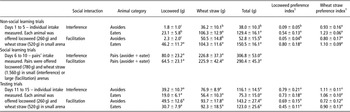
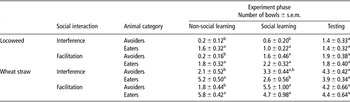
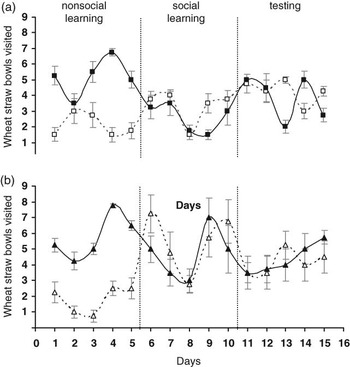
Heifers that had been classified as LA consumed negligible amounts of locoweed and exhibited detectably higher locoweed avoidance (preference indices ≈0) than did LE (Table 1). LA rarely visited locoweed bowls (Table 2, Figure 2), whereas LE visited on average almost two locoweed bowls per trial and ate 12 to 20 times more locoweed than their LA counterparts (Tables 1 and 2, Figure 2). LA also consumed less wheat straw and visited less wheat straw bowls than did LE, but exhibited similar preference (LE v. LA) for this food (Table 1). Although LE in the social interference treatment group consumed less locoweed than LE in the social facilitation group, LE and LA showed consistent food preferences regardless of treatment (social interference or facilitation; Table 1).
Mean intake and preference indices ± s.e.m. for all foods offered during 10-min trials to locoweed eaters and avoiders in the interference and facilitation treatment groups

Values followed by different letters indicate statistically detectable differences (P ⩽ 0.05) within food type (column) and experiment phase.
1Preference indices were calculated using the following equations: locoweed preference = ([locoweed intake/total intake]/[locoweed offered/ total food offered]); Wheat straw preference = ([wheat straw intake/total intake]/[wheat straw offered/ total food offered]).
Effects of social rank on response variables measured during social learning and testing phases of the experiment

Social rank was determined during social learning trials. A heifer was considered dominant if it consistently displaced its partner from feeding bowls during social learning trials. Social rank was treated as a co-variable in the mixed models used to analyze the data of the second two phases of the experiment (shown in this table) and was coded as a dummy variable that was assigned a value of ‘1’ if an animal in any given LA–LE pair was dominant and a value of ‘0’ otherwise.
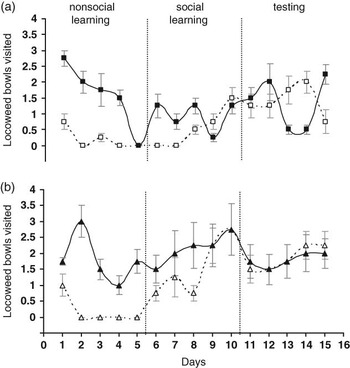
Mean number of locoweed bowls visited by heifers in the interference (a) and facilitation (b) treatment groups during non-social learning (tests with individual heifers), social learning (tests with heifer pairs) and testing (tests with individual heifers). Full symbols and solid lines represent heifers classified as locoweed eaters (LE), whereas open symbols and broken lines represent locoweed avoiders. Bars show standard error of means. Individual locoweed intake and number of locoweed bowls visited were highly correlated for both LE (r = 0.82; P < 0.01) and avoiders (r = 0.91; P < 0.01).

There was a detectable day effect over the 5 days of non-social learning trials (F (4, 32.4) = 9.03, P < 0.01) that was apparently associated with the cyclic pattern of locoweed intake observed in heifers in the LE group (Figures 2a, b). LE in both treatment groups exhibited overall higher food intake than did their avoider counterparts (Table 1).
Social learning trials (treatment)
Pairs subjected to the social interference and social facilitation treatments consumed similar amounts of locoweed and wheat straw during this treatment phase (Table 1). Interestingly, total intake of pairs during social learning trials was approximately 1.8 (social interference) and 1.4 (social facilitation) times higher than the sum of individual intake of eaters + avoiders during non-social learning trials (Table 1).
All four LA heifers in the social facilitation pairs were classified as dominant, whereas two social interference pairs included a dominant LA and two subordinate LA heifer. There was no detectable effect of social rank on the response variables measured during social learning trials (Table 2).
Number of locoweed bowls visited by LA and LE heifers in the social interference treatment group was similar to the number recorded during non-social learning trials (Table 3). Number of wheat straw bowls visited by LA in this treatment group, however, tended to be higher than during the previous phase. Conversely, LE visited detectably less wheat straw bowls than during non-social learning (Table 3). Heifers classified as LA continued to avoid locoweed bowls during the first 2 days of social learning trials, but more than doubled the number of wheat straw bowls visited on the first day of this phase (Figures 2a and 3a). There was no detectable correlation between the daily number of locoweed bowls visited by LA and LE in the social interference group (r = 0.15; P = 0.52). Conversely, daily number of wheat straw bowls visited by LA and LE was positively correlated (r = 0.65; P < 0.01).
Mean number of bowls visited ± s.e.m. for foods offered during 10-min trials to locoweed eaters and avoiders in the interference and facilitation treatment groups

Values followed by different letters indicate statistically detectable differences (P ⩽ 0.05) within rows (treatments).
LA in the social facilitation group visited a detectably higher number of locoweed and wheat straw bowls (six and three times as many, respectively) than they had visited during non-social learning trials (Table 3). There were no detectable differences, however, between the number of bowls visited by LE during this and the previous experiment phase (Table 3). LA visited locoweed bowls on the first day of social learning trials and appeared to show an increasing interest for locoweed as trials progressed (Figure 2b). On the first day of social learning trials, LA visited almost three times as many wheat straw bowls than they had visited, on average, on any single day of the previous phase (Figure 3a). There was a positive linear correlation between the daily number of wheat straw (r = 0.67; P < 0.01) and locoweed bowls (r = 0.70; P < 0.01) visited by LA and LE in the social facilitation group during this phase.
Mean number of wheat straw bowls visited by heifers in the interference (a) and facilitation (b) treatment groups during non-social learning (tests with individual heifers), social learning (tests with heifer pairs) and testing (tests with individual heifers). Full symbols and solid lines represent heifers classified as locoweed eaters (LE), whereas open symbols and broken lines represent locoweed avoiders. Bars show standard error of means. Individual wheat straw intake and number of wheat straw bowls visited were highly correlated for both LE (r = 0.87; P < 0.01) and avoiders (r = 0.86; P < 0.01).

Testing trials (post-treatment)
Distinct differences in locoweed intake and preference between LA and LE were no longer observed during this phase (Table 1). LA ingested detectably more locoweed and exhibited remarkably higher preference for this toxic weed compared with levels observed before social learning trials regardless of treatment group. LA also ingested detectably more wheat straw than during non-social learning trials, however, preference for this food item remained unchanged (Table 1). LE in the social interference group tended to consume less wheat straw during testing trials compared with non-social learning; however, preference for both locoweed and wheat straw was similar throughout the experiment (Table 1). Social rank of heifers once again had no detectable effect on the response variables measured during this experiment phase (Table 2). Differences in the number of bowls visited by LA and LE closely matched intake dynamics described above (Table 3). All heifers in the LA category exhibited an increase in locoweed intake and preference regardless of whether LA heifers were exposed to an interference- or facilitation-promoting social learning environment (Table 1).
Discussion
Our results suggest that exposure to a restricted feeding area delayed social induction of locoweed ingestion, but did not inhibit social learning altogether. LA appeared to learn from their LE counterparts to ingest locoweed regardless of the space and number of feeding stations allotted to individual heifers during social learning trials. Social rank of heifers did not appear to influence the social learning process in the conditions of our experiment.
Coussi-Korbel and Fragaszy (Reference Coussi-Korbel and Fragaszy1995) argued that social learning requires coordination of behavior among individuals and distinguished two forms of behavioral coordination: (i) complementary coordination, that results in behavioral asymmetry (i.e. the demonstrator seeks to prevent the observer from engaging in a given behavior); or (ii) isomorphic coordination, that leads to behavioral similarity (i.e. the observer copies the demonstrator’s behavior). The former is predicted to inhibit social learning (at least while behavioral inhibition conditions persist) while the latter is predicted to increase behavioral similarity between the demonstrator and the observer.
Lack of correlation between daily number of locoweed bowls visited during social learning trials by LA and LE in the social interference group suggests that a degree of complementary coordination of locoweed ingestion may have occurred in animals that were exposed to the small arena (social interference). Conversely, positive correlation during the same experiment period among LA and LE in the social facilitation treatment group suggests the occurrence of isomorphic coordination. Although a higher number of agonistic interactions were observed during social learning between pairs of heifers in the social interference treatment (Jackson, unpublished observation), space restrictions may have been insufficient to induce clear complementary coordination that would have led to complete inhibition of locoweed ingestion during that experiment phase.
Prior studies reporting social learning of foraging behavior in cattle (Howery et al., Reference Howery, Provenza, Banner and Scott1998; Bailey et al., Reference Bailey, Howery and Boss2000; Ksiksi and Laca, Reference Ksiksi and Laca2000) including those documenting social learning of toxic weed ingestion (Ralphs and Olsen, Reference Ralphs and Olsen1990; Ralphs et al., Reference Ralphs, Graham and James1994) did not manipulate environmental factors that alter group social dynamics nor did they identify the behavioral mechanisms that influence social facilitation during foraging. Nonetheless, an increase in interference interactions associated with feeding space restrictions has been well documented not only in confined calves (von Keyserlingk et al., Reference von Keyserlingk, Brusius and Weary2004) and adult cattle (Olofsson, Reference Olofsson1999; DeVries et al., Reference DeVries, von Keyserlingk and Weary2004; Huzzey et al., Reference Huzzey, DeVries, Valois and von Keyserlingk2006) but also in pastoral environments. For example, Walker and Heitschmidt (Reference Walker and Heitschmidt1989) reported that reductions in grazing space allowance (30 ha v. 10 ha paddocks) induced cattle to seek to maintain individual animal space and consequently provoked measurable changes in grazing behavior. Circumstantial evidence also suggests that ranchers that apply short duration grazing on locoweed infested pastures (i.e. animals are concentrated in relatively small areas for short periods of time) suffer less intoxication losses than those that use traditional season-long grazing in larger pastures (C. Allison, unpublished data).
We reasoned that LE in the social interference group (that had showed higher preference for locoweed during non-social trials) would prevent LA from sampling locoweed and would thus block social learning of its ingestion. It is possible that the visual stimulus of LE cattle feeding from locoweed bowls may have induced all LA heifers (particularly those in the social interference treatment) to increase their preference for locoweed during testing trials when social stimuli were removed. Bailey et al. (Reference Bailey, Howery and Boss2000) suggested that the sight of a demonstrator with its head lowered in feeding position may alert observers as to the availability of nutritious forage resources. In fact, social influences mediated by visual cues can be considerably more subtle; Kaminski et al. (Reference Kaminski, Riedel, Call and Tomasello2005) reported that gaze direction of peers can influence food selection in goats. Odors have also been shown to mediate social facilitation of novel food ingestion in the absence of visual stimuli in naïve rats that were: (i) allowed contact with a demonstrator that had recently ingested a novel food; or (ii) exposed to novel foods containing olfactory cues left behind by an experienced conspecific (Galef and Laland, Reference Galef and Laland2005 and references therein). Although, cattle are known to have highly developed chemosensory odor receptors, particularly odorant receptors in the main olfactory epithelium (Kaupp, Reference Kaupp2010), to date odor-mediated social facilitation of novel food ingestion has not been demonstrated in these species to our knowledge. More research is needed to determine the relative importance of sight v. flavor v. odor stimuli in eliciting social learning of food ingestion in cattle. If sight or odor are in fact the predominant stimuli, social learning should occur regardless of the behavioral coordination pattern (sensu Coussi-Korbel and Fragaszy, Reference Coussi-Korbel and Fragaszy1995) established between naïve and experienced individuals, as occurred in this experiment.
The weak social interference of toxic weed ingestion observed in this study could also be a consequence of the relative low preference for locoweed exhibited by LE heifers. In natural settings, the degree of competition for spatially concentrated food resources (as was the case in our social interference treatment) is assumed to be a function of the value of the contested food item to an individual (Pruetz and Isbell, Reference Pruetz and Isbell2000). Although LE heifers exhibited detectably lower avoidance for locoweed than their LA counterparts, they did not show a strong preference (indices >> 1) for this food item, and may have lacked motivation to preclude access of LA heifers to locoweed bowls. In addition to exhibiting relatively low preference for locoweed, LE in both treatments, but particularly those in the social interference group exhibited strong day-to-day variation in the amounts of locoweed ingested during trials. Days in which LE heifers consumed very little locoweed (such as day 9 in Figure 2a) may have created windows of relaxed interference which allowed LA heifers to access locoweed bowls; such opportunities were possibly sufficient to trigger a subsequent decrease in avoidance for this toxic weed in LA heifers.
Although the investigation of mechanisms underlying the innate differences in foraging behavior of LA and LE were not addressed in this study, our pre-treatment trials showed that LA not only consumed less white locoweed than their LE counterparts, they also consumed less wheat straw and thus, their overall intake during trials was lower. Interestingly, social dominance was not consistently associated with a heifer’s classification (LA v. LE), a phenomenon which suggests that LA were not socially less assertive than their LE counterparts, and that differences in foraging behavior were probably not related with their social rank. We hypothesize that the observed differences in feeding behavior of LA and LE may be associated with contrasting stress coping styles (sensu Koolhaas et al., Reference Koolhaas, Korte, DeBoer, Van Der Vegt, Van Reenen, Hopster, De Jong, Ruis and Blokhuis1999). LE appeared to resemble animals with a proactive stress coping style (Koolhaas et al., Reference Koolhaas, Korte, DeBoer, Van Der Vegt, Van Reenen, Hopster, De Jong, Ruis and Blokhuis1999) which are predicted to exhibit more aggressive foraging behaviors and less aversion to novelty. Locoweed avoiders, on the other hand, appeared to fit the description of the reactive stress copying style (Koolhaas et al., Reference Koolhaas, Korte, DeBoer, Van Der Vegt, Van Reenen, Hopster, De Jong, Ruis and Blokhuis1999), that is, associated with conservative withdrawal in situations of risk (more cautious foragers) and higher aversion to novelty. More research is needed to test this hypothesis under controlled conditions.
Collectively, our results suggest that social interference was insufficient to inhibit social learning in cattle, possibly because: (i) social transmission of feeding behaviors through visual or olfactory stimuli overrode momentary interference, (ii) preference for white locoweed of LE heifers was insufficient or (iii) periodic windows of relaxed interference occurred which may have allowed LA to become familiar with the toxic weed.
Conclusions
Manipulation of the feeding environment delayed, but did not inhibit social learning of toxic weed ingestion in this study. Reducing the size of the feeding area produced detectable differences in social interactions as evidenced by the lack of correlation between bowls of locoweed and wheat straw visited by LA and LE heifers in the social interference treatment group, and the positive correlation in the social facilitation group. Our results suggest that restriction of the area allocated to animals to feed in, such as placing animals in smaller white locoweed-infested pastures, is unlikely to inhibit social learning of toxic weed ingestion altogether.
Acknowledgements
This study was funded by the USDA-CSREES Locoweed Research Project and the New Mexico Agricultural Experiment Station. NMSU’s CLRC provided animals, pens and other facilities to conduct this experiment. Derek Walker and Drs Nathan Elam and Manny Encinias provided logistical support at CLRC to conduct our experiments. Sarah Davidson and Francisco Loya-Olguín provided valuable help in conducting trials. Drs Mike Ralphs and Mark Petersen provided helpful comments that helped improve our experiment design. We are thankful to Dr Dale Gardner who conducted the swainsonine analyses. Two anonymous reviewers provided comments and suggestions that greatly improved an earlier version of this manuscript.