Introduction
The population dynamics of parasites can be affected by a number of different biotic and abiotic factors. Male-biased parasitism is a good example of this and is known to occur in many mammalian host-parasite systems. This pattern of parasitism can and has been observed among ectoparasites, particularly within the obligatory permanent or semi-permanent blood-feeding mites, ticks, and sucking lice (Holdenried et al. Reference Holdenried, Evans and Longanecker1951; Ali and Sweatman Reference Ali and Sweatman1966; Hendricks Reference Hendricks1967; Pence et al. Reference Pence, Windberg, Pence and Sprowls1983; Krasnov et al. Reference Krasnov, Borders, Khokhlova and Morand2012). There are numerous behavioural factors of the host that could attribute to this bias, including sex biases in grooming, home range, and burrow use, as well as host immune function and physiology (Folstad and Karter Reference Folstad and Karter1992; Krasnov et al. Reference Krasnov, Borders, Khokhlova and Morand2012). Sub-adults and adult males are often more heavily parasitised possibly because of the naïve immune status of the sub-adults, the allocation of energy to development, and suppression of male immune factors by androgens and/or stress (Folstad and Karter Reference Folstad and Karter1992). This immune suppression may lead to reduced localised inflammation at feeding sites increasing the quality of the blood meal leading to higher parasite fecundity, reduced urge of the host to groom and overall increased survival of the lice. Sex-biases and other aspects of the population dynamics of parasites can also be influenced by season, as androgens, home range and other factors also vary seasonally (Krasnov et al. Reference Krasnov, Morand, Hawlena, Khokhlova and Shenbrot2005). However, little is known about population dynamics of ectoparasites living on hibernating hosts, where their active season is short, constraining the life history of both parasite and host (Lourenco and Palmeirim Reference Lourenco and Palmeirim2008).
The sucking lice (Phthiraptera: Anoplura) are wingless, obligate, permanent ectoparasitic insects of eutherian mammals. They live among the hair and on the skin of their mammalian hosts, feeding exclusively on blood circulating in shallow capillaries. Sucking lice are commonly encountered on mammals worldwide, but many questions about their ecology, population dynamics, vectorial capacity, and infestation parameters are understudied (Ferris Reference Ferris1951). The sucking lice display a high degree of host specificity and are often oligoxenous if not monoxenous (Kim and Ludwig Reference Kim and Ludwig1982; Kim Reference Kim1985). The louse, Linognathoides laeviusculus (Grube) (Phthiraptera: Anoplura: Polyplacidae), is found exclusively on holarctic ground squirrels (Kim et al. Reference Kim, Pratt and Strojanovich1986; Durden and Musser Reference Durden and Musser1994).
Richardson’s ground squirrel, Urocitellus richardsonii (Sabine) (Rodentia: Sciuridae), has been documented as a common host of L. laeviusculus (Burgess Reference Burgess1955; Hilton and Mahrt Reference Hilton and Mahrt1971). This ground squirrel is a semi-social, semi-fossorial sciurid (Michener and Koeppl Reference Michener and Koeppl1985) that exhibits a monoestrous reproductive cycle that occurs immediately after emergence from hibernation in the spring (Michener and Koeppl Reference Michener and Koeppl1985). Its annual cycle consists of a predictable and synchronous series of events that includes vernal emergence from hibernation, breeding, gestation, lactation, juvenile emergence, build-up and storage of fat, and immergence into hibernation (Michener Reference Michener1984). Dispersal is male-biased, with some females remaining in their natal colony (Holekamp Reference Holekamp1984). This squirrel has been reported to be infested by at least 16 different species of fleas, two species of lice, and four species of tick over their entire range in Canada (Kennedy and Newman Reference Kennedy and Newman1986).
Waterman et al. (Reference Waterman, Macklin and Enright2014) examined ectoparasite and endoparasite loads in 64 (32 male and 32 female) adult Richardson’s ground squirrels during their breeding season. Male squirrels, which may be investing energy aliquots heavily during the extremely competitive breeding season, had significantly higher infestation parameters for a parasitic nematode, Citellinema bifurcatum (Hall) (Rhabditida: Heligmosomidae), but there was no significant sex-bias in infestations of lice. In the present study, we extended the louse infestation data from Waterman et al. (Reference Waterman, Macklin and Enright2014), with data from an additional 150 Richardson’s ground squirrels trapped through the active season. The objective of our study was to examine louse population structure and size and the effects of seasonality and host sex on the infestation parameters of juvenile and adult squirrels. The highly synchronised seasonal cycle of Richardson’s ground squirrels, along with the squirrel’s rapid and regimented rate of development, afford us an ideal opportunity to observe variation in louse population dynamics among various members of hosts over time.
Materials and methods
Free-ranging Richardson’s ground squirrels were collected from Assiniboine Park Zoo in Winnipeg, Manitoba, Canada (49°52'8.47''N, 97°14'14.21''W), from the first emergence of males on 22 March 2010 until 17 September 2010, when few squirrels were observed above ground. Squirrels are routinely removed by zoo personnel to minimise the damage they cause to exhibits and facilities. Squirrels were trapped using Tomahawk© live traps (15×15×50 cm; Tomahawk Live Trap. Hazelhurst, Wisconsin, United States of America) baited with peanut butter. Although trapping was conducted throughout the active season, the interval between trapping dates fluctuated over the summer. Data from trap dates were pooled into nine discrete trapping periods. Each trapping period contained data from three consecutive dates, though intervals varied. Trapping was occasionally hindered for periods of time by unfavourable weather or availability of equipment.
Once trapped, individual squirrels were placed singly into canvas sacks, and taken to the zoo’s veterinary clinic where they were euthanised with a lethal dose of potassium chloride after being anesthetised by isoflurane or with a lethal dose of carbon dioxide delivered in a gassing chamber. All transport bags, traps, and the chambers were examined for lice. Once euthanised, squirrel age (juvenile or adult), sex, date of collection, trapping location within the zoo, and body mass were recorded. Each squirrel was then assigned a unique identification number. The relative age of each squirrel was determined by comparing its weight with the time of year it was caught. These data were included on a sheet that was placed with the squirrel into individual plastic bags that were frozen at −20 °C for a minimum of 48 hours, killing all lice. A total of 214 squirrels were collected.
Lice were removed by washing individual squirrels. Squirrels were thawed and placed in a bucket of warm water with a few drops of liquid detergent and the pelage was washed by hand. This process was repeated again in soapy water and then in clear water. Water from each wash was passed through a 90 μm mesh screen and the bucket was inspected for lice. Contents on the mesh screen were then washed into a plastic storage jar with 70% ethanol.
Every sample jar and lid was rinsed with ethanol into a clear gridded plastic dish (14 cm diameter). Lice were sorted by age, nymph or adult, and adults were then sexed before being counted. Lice were identified using Kim et al. (Reference Kim, Pratt and Strojanovich1986). Some specimens of each sex were cleared and fixed onto microscope slides for identification purposes (Richards Reference Richards1964). Voucher specimens mounted on microscope slides and vials containing preserved samples were deposited into the J.B. Wallis/R.E. Roughley Museum of Entomology, Department of Entomology, University of Manitoba (specimen identification numbers range from 0235013 to 0235022).
Quantitative Parasitology 3.0 (Rózsa et al. Reference Rózsa, Reiczigel and Majoros2000) was used to calculate infestation parameters and for statistical comparison using Fisher’s exact test. This software was designed to analyse aggregated parasite infestations and to compare infestations among different groups of hosts (Rózsa et al. Reference Rózsa, Reiczigel and Majoros2000). Quantitative Parasitology was also used to calculate the aggregation indices including the index of discrepancy, D, and k value of the distributions that best describe the distribution of parasites among a set of hosts (Poulin Reference Poulin1993). The 90% and 95% confidence intervals, using Sterns’ method, for intensity and prevalence of infestations respectively were also determined with this software. This research was conducted under a scientific permit from Manitoba Conservation and animal care protocol number F10-004 from the University of Manitoba.
Results
The body mass of squirrels ranged from 81 to 750 g, which appears to be normal for squirrels in this province (Lindsay Reference Lindsay1989). Adult squirrels weighed 267–750 g and 218–506 g for males and females, respectively. Juvenile squirrels weighed 81–435 g and 118–447 g for males and females, respectively. These weights are comparable to those reported in previous ground squirrel studies (Michener and Koeppl Reference Michener and Koeppl1985; Lindsay Reference Lindsay1989).
Thirty-six ground squirrels (23 males, 13 females) collected from 21 July to 17 September that had masses ranging from 272 to 652 g could not be definitively aged. Squirrels of known age included 98 juveniles (40 males, 58 females) and 80 adult squirrels (41 males, 39 females). There were 27 successful trapping dates over the season, which were pooled into groups of three for analysis, resulting in nine trapping periods.
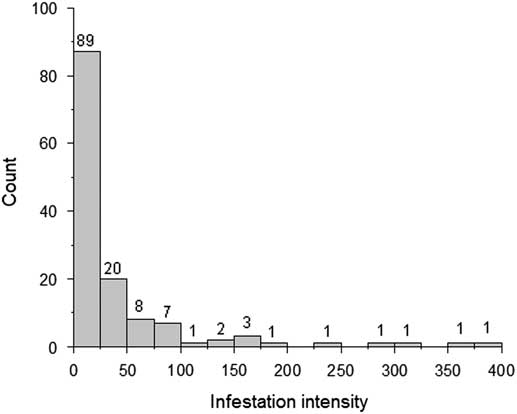
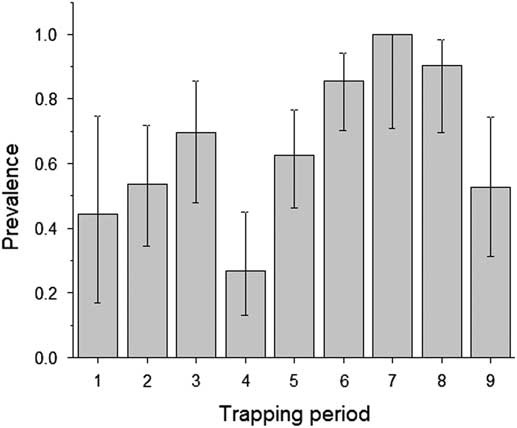
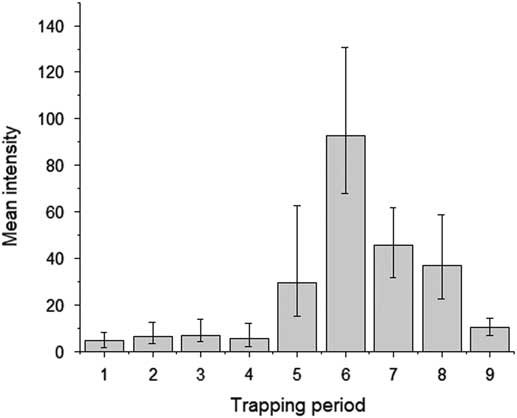
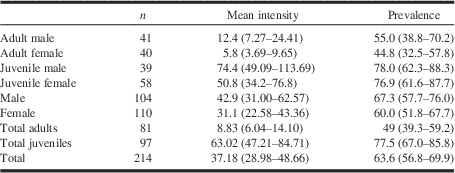
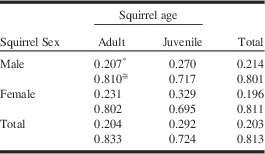
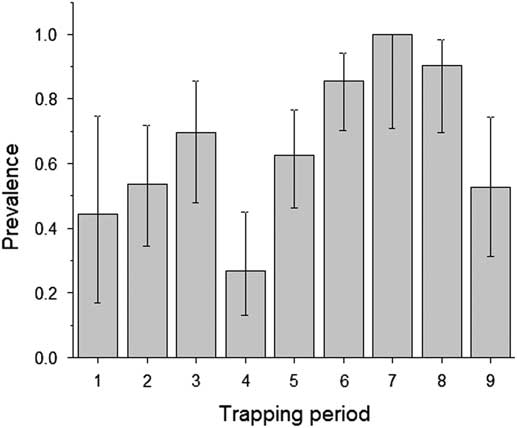
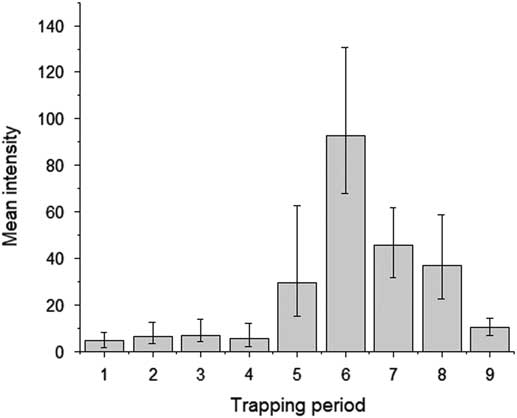
The only louse species collected was L. laeviusculus. Out of all hosts collected, 63.6% (95% confidence interval=56.8–69.9%) were infested with one to 381 L. laeviusculus. The mean intensity was 37.2 (90% confidence interval=29.0–48.7) lice per infested host (Table 1; Fig. 1). Overall, adult male squirrels had significantly higher intensities of infestation (Fishers’ exact test P⩽0.05) compared to adult females. Juvenile squirrels also had higher intensity and prevalence than adults but there was no significant difference between the sexes in juveniles (Table 1). There were two peaks in prevalence, the first in early April and the second in the middle of June (Fig. 2). Prevalence never dropped below 20% throughout the trapping season (Fig. 2). One peak in intensity was observed in the beginning of June (Fig. 3).
The intensity of infestation of the louse (Linognathoides laeviusculus) on 214 Richardson’s ground squirrels (Urocitellus richardsonii) in Manitoba, Canada, in 2010 (n=136). Count of individual squirrels in each bin is provided above the corresponding bar.

Change in prevalence of infestation with the louse (Linognathoides laeviusculus) on Richardson’s ground squirrels (Urocitellus richardsonii) in Manitoba, Canada over the 2010 trapping season. Ninety-five percent confidence intervals determined by Stern method are indicated for each trapping period. Date ranges for trapping periods are as follows – 1: 22–26 March; 2: 27–31 March; 3: 2–5 April; 4: 7 April to 20 May; 5: 21 May to 1 June; 6: 7–15 June; 7: 20–23 June; 8: 7–21 July; 9: 23 July to 17 September.
Change in mean intensity of infestations of the louse (Linognathoides laeviusculus) on Richardson’s ground squirrels (Urocitellus richardsonii) over the 2010 trapping season in Manitoba, Canada. Ninety per cent confidence intervals were determined by bootstrap analysis with 2000 replicates. Date ranges for trapping periods are as follows – 1: 22–26 March; 2: 27–31 March; 3: 2–5 April; 4: 7 April to 20 May; 5: 21 May to 1 June; 6: 7–15 June; 7: 20–23 June; 8: 7–21 July; 9: 23 July to 17 September.
Description of infestation parameters of the louse (Linognathoides laeviusculus) on Richardson’s ground squirrels (Urocitellus richardsonii) in Manitoba, Canada in 2010, separated by age and sex.

Notes: Individuals of indeterminable age have been included in the total calculations for their representative sex. n=number of squirrels in each subsample. Prevalence refers to the proportion of infested hosts while mean intensity is the average count of lice per infested host. In brackets are 95% and 90% confidence intervals for the prevalence and mean intensity, respectively.
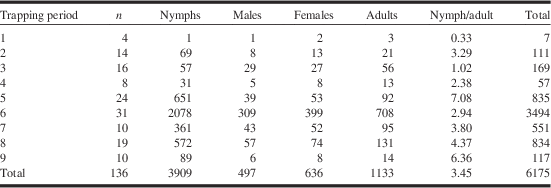
Collections that included male, female and juvenile lice were used to analyse the population structure of the louse. At the beginning of the trapping season, near the end of March, adult lice outnumbered juveniles, although both prevalence and intensity were low (Table 2). Louse infestations were highly aggregated in all host categories. All k values were less than 0.3 and D values were greater than 0.7. For all squirrels combined, k and D were 0.20 and 0.81, respectively (Table 3).
Number of lice (Linognathoides laeviusculus) infesting Richardson’s ground squirrels (Urocitellus richardsonii) in Manitoba, Canada during each trapping period in 2010.

Note: n=number of squirrels that had louse infestations consisting of at least one nymph, adult male, and adult female for the corresponding trapping periods.
Calculated coefficients of aggregation, D and k, for infestations of the louse (Linognathoides laeviusculus) infesting Richardson’s squirrel (Urocitellus richardsonii) separated by sex and age, Manitoba, Canada, 2010.

* Coefficient of aggregation, k.
≅ Index of discrepancy, D.
Discussion
The infestation parameters of the sucking lice infesting the Richardson’s ground squirrel fluctuated throughout the active season. The highly regimented changes in the seasonal activities of the squirrel and the intimate host-parasite relationship exhibited by the louse likely affected these fluctuations.
The composition of the louse community was not entirely expected. Linognathoides laeviusculus is widely distributed in North America, infesting at least 10 species of ground squirrels (Durden and Musser Reference Durden and Musser1994). It has been collected commonly on Richardson’s ground squirrel in Manitoba (T.D.G., personal observation). Given previous records of Enderleinellus suturalis (Osborn) infesting ground squirrels in Manitoba and elsewhere (Hendricks Reference Hendricks1967; Kim et al. Reference Kim, Pratt and Strojanovich1986; T.D.G., personal observation), its absence in our study was unexpected. This latter species infests at least 13 species of ground squirrels (Durden and Musser Reference Durden and Musser1994) ranging from Alaska to New Jersey, United States of America in the east and to Mexico in the south.
Because juvenile squirrels were infested simultaneously with both adults and nymphs of L. laeviusculus when they appeared above ground, it is difficult to discern at what stage of development the lice are transmitted. If nymphs are dispersing, it is possible that they had moulted to the adult stage before juvenile emergence. It is also possible that adult lice could be colonising the juvenile squirrels before emergence. Just after adult squirrel emergence from hibernation there was a comparatively higher ratio of adult lice than nymphs. The proportion of adult lice declined over the season as nymphs became more predominant. This decline was expected due to the hemimetabolous life cycle of the louse with all active stages of development being parasitic (Ferris Reference Ferris1951).
We found similar results to those of other studies on lice infesting North American ground squirrels. In a population of L. laeviusculus infesting California ground squirrels, Otospermophilus beecheyi (Richardson) (Rodentia: Sciuridae), in California, United States of America, intensity ranged from one to ~300 with most infestations consisting of fewer than 100 lice per host (Holdenried et al. Reference Holdenried, Evans and Longanecker1951; Durden Reference Durden1987). Young squirrels, when compared to older squirrels, had a higher abundance of lice. The seasonal dynamics of E. suturalis infesting 13-lined ground squirrel, Ictidomys tridecemlineatus (Mitchill) (Rodentia: Sciuridae), in Indiana, United States of America has also been studied (Hendricks Reference Hendricks1967). Although prevalence and mean intensity of infestations were lower for this louse than what we observed for L. laeviusculus, 20.5% and 5.9 lice per squirrel, respectively, other patterns remained consistent with our findings. Male squirrels had a significantly higher prevalence and mean intensity compared to females. Louse populations were comprised primarily of nymphs except in months shortly before and after hibernation. There was a dramatic decline in the proportion of nymphs, followed by a steady rise in prevalence and mean intensity observed during juvenile squirrel emergence. Finally, louse populations declined as squirrels entered hibernation.
The differences in infestation parameters for L. laeviusculus among the age groups and sexes of the hosts should, by definition, offer benefits to the louse or are a result of weaknesses in the hosts. We observed a sevenfold increase in intensity between adults and juveniles squirrels. It may be that these lice benefit by infesting dispersing squirrels for their own dispersal, as seen in sucking lice infesting eastern cottontail in Manitoba (Galloway Reference Galloway2012). In addition, male squirrels of both age groups had higher prevalence and intensity than their female counterparts. This sex-bias was only significant when comparing mean intensities within the adult age group. Although louse populations were low during the breeding period, adult male squirrels may be subjected to long-term stresses associated with androgens or other hormones that may suppress immunological integrity, resulting in an increase in louse infestation parameters (Folstad and Karter Reference Folstad and Karter1992; Roberts et al. Reference Roberts, Buchanan, Hasselquist and Evans2007). It is also possible that female squirrels may groom more or receive more allogrooming (Michener and Sheppard Reference Michener and Sheppard1972). The noticeable sex-biased parasitism demonstrated by louse infestation may be due to the intimate nature of the louse as a permanent ectoparasite and its reduced ability to cope with various acquired host defence mechanisms (Bell et al. Reference Bell, Stewart and Neslon1982). Male biased infestations have been demonstrated on many rodents for closely related louse species, including Enderleinellus kumadai (Kaneko) (Phthiraptera: Anoplura: Enderleinellidae) and Hoplopleura erismata (Ferris) (Phthiraptera: Anoplura: Hoplopleuridae) on Pallas’s squirrels, Callosciurus erythraeus (Pallas) (Rodentia: Sciuridae) (Dozieres et al. Reference Dozieres, Pisanue, Gerriet, Lapeyre, Stuyck and Chapuis2010), and E. suturalis on I. tridecemlineatus (Hendricks Reference Hendricks1967).
There were two distinct peaks in prevalence with a depression during midseason. This depression corresponded with the time just after squirrel parturition and ended late in the period of emergence of the juvenile squirrels (Michener and Koeppl Reference Michener and Koeppl1985), when the squirrel population became dominated by the younger cohort. Juvenile squirrels should be infested primarily from their mother during pre-emergence, and perhaps by sharing lice moving among siblings. Before juvenile emergence, mother and sibling squirrels of the same litter sharing the natal burrow are the only individuals that will have the close contact required for louse dispersal (Michener and Koeppl Reference Michener and Koeppl1985). Mean intensity of L. laeviusculus remained relatively low on adult squirrels until after juvenile emergence, when it rose from ~10 lice per host to ~90. This increase suggests that colonisation of juvenile squirrels is accomplished by the movement of relatively few lice from the mother and there is a lag period before the population begins to grow rapidly before gradually declining to levels seen at the beginning of the season on mature individuals. The second peak in prevalence may be due to the exponential growth of louse populations after colonisation of a naïve host. This fluctuation in mean intensities was also observed for E. suturalis on I. tridecemlineatus at approximately the same time of year (Hendricks Reference Hendricks1967). The resulting drop in the louse population can perhaps be explained by an increase in the acquired defence mechanism of the host that is triggered by age, experience, or the high level of louse infestation. It is possible that the immune system of the juvenile squirrels becomes fully activated or can receive a higher energy allotment later in the summer (Weil et al. Reference Weil, Martin and Nelson2006). Elevated intensities of louse infestation are seen as a major contributing factor for priming the host’s immune system and may have resulted in this change (Bell et al. Reference Bell, Stewart and Neslon1982).
The population structure of L. laeviusculus changed substantially through the year. After adult squirrel emergence, there were more adult lice than nymphs. This change suggests that there was a decreased rate of reproductive output and/or an increased mortality of nymphs during the hibernation period. The reduction in the number and qualities of the blood meals may be a contributing factor. When squirrels shunt peripheral blood during overwintering hibernation (Fishman and Lyman Reference Fishman and Lyman1961), food is probably reduced for these blood-feeding lice. Another explanation, which is not mutually exclusive, relates to the immune competence of the hosts at this time. Hibernating squirrels are either adults that may have encountered lice in previous years and have a fully developed immune system or juveniles that were more recently infested in the summer but have had time to mount a substantial immune response. Additionally, if squirrels that are in the poorest condition have the highest louse infestations going into hibernation, then a large portion of the louse population may die due to host mortality over the hibernation season. Such host mortality would result in a greater prevalence of lower intensity infestations. Lower intensity infestations could also be the result of more recent establishment and as a result have more of the dispersing louse age group, or could be comprised of the last survivors of a larger infestation with the majority of the louse cohort being adults (Marshall Reference Marshall1981). To understand more completely how hibernation affects the population dynamics of this louse species, a more extensive trapping regime and the use of infested squirrels in laboratory studies are required.
Acknowledgements
Thanks go to staff at Assiniboine Park Zoo who offered time and equipment for this study. Most notable are Dr. Chris Enright, Shelley Brown, and Philip King. In addition, the authors would like to thank R. Brown, S. Lavergne, T. Roth, A. Roth, J. McCarthy, and G. Macklin for assistance in the field. The authors acknowledge Manitoba Conservation and the University of Manitoba for approving permits for this study. Partial funding for this research came from Natural Sciences and Engineering Research Council of Canada Discovery Grants provided to T.D.G. and J.M.W.