1. Introduction
The economic reform of China which started in the late 1970s has been gradually transforming the previous central-planning economy to marketization. Emerging landscapes of economic centers are prominent, while agglomeration of resources in large cities keeps widening the rural–urban income gaps, producing increased social tension and conflicts, particularly in the periphery (Xu and Siikamäki, Reference Xu and Siikamäki2012). To address such disparities, China has initiated a series of economic reforms in the rural areas which occupy the majority of its population. The introduction of the household responsibility system to agriculture in the early 1980s has achieved great success in stimulating agricultural growth (Lin, Reference Lin1997). The recent tax-for-fee reform and subsequent abolition of agricultural taxes have captured the media spotlight as a possible means to improve rural livelihoods through the reduction of the excessive financial burden on farmers (Mushtaq et al., Reference Mushtaq, Khan, Dawe, Hanjra, Hafeez and Asghar2008; Alm and Liu, Reference Alm and Liu2013). As a key step toward rural land marketization, a comprehensive forestland tenure reform has also been initiated in the last decade, breaking up state-owned forestlands into household-level production units (Xu and Siikamäki, Reference Xu and Siikamäki2012). The rationale behind most reforms is to generate economic revenues for farmers by allowing them more economic freedom in production decision making. Institutional rearrangements practiced in these reforms directly call for better public rights in political participation, and consequent democracy, which may safeguard their enhanced economic interests.
A formal definition of democracy has received exhaustive research attention for over two thousand years (e.g., Aristotle, Reference Aristotle1995), yet agreement still seems far away, as the word ‘democracy’ is vague and practices are varied (Mulgan, Reference Mulgan1968). Nevertheless, modern discussions in political science have generally agreed that democracy can appropriately categorize any political system that is based on equality in voting in leader selection (Dahl Reference Dahl1998), constitutional existence of peaceful rivalry for temporary controlling power (Aron, Reference Aron1969), and a representative government that exercise policies to meet the majority needs according to the determinative plurality (Pennock, Reference Pennock1979; Schmitter and Karl, Reference Schmitter and Karl1991). Unlike most other countries, democracy as broadly defined above is first introduced in China at the village level, the lowest branch of Chinese government which directly accounts for local farm households, the basic unit of production activities in rural China. Therefore, possible impacts of democracy on household welfare may be best observed at this level.
Village democracy has been steadily introduced through political reforms. The 1982 Constitution (Article 111) for the first time introduced the villagers' committee (VC), defined as the self-governing body of villagers, consisting of three to seven seats that all villagers nominated by others could run for (Wang and Yao, Reference Wang and Yao2007). The Organic Law of the Villagers' Committee published in 1987 further authorized the establishment of villagers' representative assemblies (VRA). Unlike the VC, which directly results from village election, the VRA is responsible for organizing and managing voting in all village affairs. Both VCs and VRAs are now observed in most villages in China (Chan, Reference Chan2003). However, village democratization still faces implementation challenges. For example, as the Organic Law mandates the VC to work under the leadership of the Communist party committee, the members of which are usually appointed by higher authority (e.g., township), conflicts often emerge between the VC chairman and the party secretary (Guo and Bernstein, Reference Guo and Bernstein2004). While the central government encourages the party secretary to run for the VC chairman as a means of reconciling such conflicts, this would potentially recentralize the decision power and implicitly impose the higher government's opinions into village decisions, putting local interests at risk. Village democratization in China with its complexities and constraints thus provides us with a unique setting in which to study possible impacts of democracy on rural household welfare.
Previous studies have linked village democratization in China with profound changes, but few concluded that there was overall welfare improvement as benefit tradeoffs always exist between groups of varying economic interests (Zhang et al., Reference Zhang, Fan, Zhang and Huang2004; Wang and Yao, Reference Wang and Yao2007; Meng and Zhang, Reference Meng and Zhang2011). Mixed impacts have been found in administrative efficiency (Meng and Zhang, Reference Meng and Zhang2011), taxation structure (Zhang et al., Reference Zhang, Fan, Zhang and Huang2004), income inequality (Shen and Yao, Reference Shen and Yao2008) and village financial status (Wang and Yao, Reference Wang and Yao2007). However, little work has been done linking village democracy to the economic performance of potentially benefited sectors such as agriculture and forestry. Agriculture is the largest sector in rural China, feeding 20 per cent of the world's population by using 8 per cent of its arable land (Bräutigam, Reference Bräutigam2009). On the other hand, forestry is an emerging cash-generating sector for rural households as most household-level forest production has just started following the recent reform (Qin et al., Reference Qin, Carlsson and Xu2011), which can be more elastic to institutional factors such as democracy. This knowledge gap needs to filled, and possible lessons on how democracy benefits these foremost activities in rural China can be of policy value for other developing countries where democratization is under way.
While the linkage between village democracy and productivity is complicated, multiple perceivable pathways have been proposed in the literature. Democracy provides greater stability (Rodrik, Reference Rodrik1999) and also facilitates the adoption of modern technologies (Aghion et al., Reference Aghion, Alesina and Trebbi2007). Democracy can enhance land user rights and therefore incentivize long-term investment in production, which is important as the Chinese central government consciously opts to refrain from land privatization (Ho and Spoor, Reference Ho and Spoor2006). There is also evidence that elected village leaders are more accountable to villagers than government-appointed leaders in land reallocation decisions (Kennedy et al., Reference Kennedy, Rozelle and Shi2004). Village democracy also means reduction in arbitrary fee collection (Bernstein and Lü, Reference Bernstein and Lü2003), which would increase farmers' budget for agricultural inputs, and reduce corruption (Rivera-Batiz, Reference Rivera-Batiz2002). Moreover, democracy has been found to substantially increase the share of public expenditures in the village budget (Wang and Yao, Reference Wang and Yao2007), which could indirectly help farmers' production. Despite these points, the overall linkage between village democracy and agricultural and forest productivity is yet to be established, which directly motivated the current study.
We investigate the impacts of village democracy on rural household welfare in China from a technical efficiency perspective, since democracy as a set of institutional arrangements is more likely to act as a shifter of overall productivity rather than as a direct input. Efficient households may be able to produce more outputs with the same input levels. Therefore, higher efficiency almost always implies greater wealth and better household welfare (e.g., Bravo-Ureta et al., Reference Bravo-Ureta, Solís, Moreira López, Maripani, Thiam and Rivas2007; Villano et al., Reference Villano, Bravo-Ureta, Solís and Fleming2015). Using a recent household survey that covers both agricultural and forest production, we employ stochastic production frontier techniques as the main identification strategy, while carefully accounting for possible heterogeneity in production efficiency as well as stochastic disturbances among producers through error decomposition procedures. We find that better village democracy is significantly associated with farmers' production efficiency in both agriculture and forestry, through reduction of productivity variations. In a first study linking village democracy with production efficiency and household welfare in rural China, our joint consideration of both agriculture and forestry minimizes the possible bias associated with any partial equilibrium analysis.
2. Theoretical framework
Most economic theories represent household welfare in rural economies by the maximal utility achievable from optimal choices under a set of constraints. The decision maker is assumed to be the household head (the farmer hereafter). Unlike pure consumption decisions, rural households face a more complex problem as their consumption includes not only purchased goods but also own-produced commodities. Agricultural household models are well developed for both conventional agricultural and forest production (Singh et al., Reference Singh, Squire and Strauss1986; Amacher et al., Reference Amacher, Hyde and Joshee1993). Following this literature, we assume that a household maximizes its utility:
 $$U = U \lpar X_{a},X_{f},X_{c},l \rpar, $$
where the commodities are agricultural products, X
a
, forest products, X
f
, purchased goods from markets, X
c
, and leisure, l. The household produces either agricultural or forest products.Footnote
1
Production technologies for both sectors are assumed to be functions of variable inputs such as labor (L), capital (K) and land (A), household and other observed characteristics (H), and institutional environments that may shift productivity and are reflected by the degree of democracy (D). Unlike labor, capital or land that directly enter the production function as inputs, household characteristics and democracy would shift the overall productivity rather than acting as a direct input. Given this notion, the production function can be generally written in the following format, where
 ${\Delta}_{i} \lpar \cdot \rpar $
denotes the productivity shifter, and i denotes either agriculture (a) or forestry (f):
 $$Q_{i} = {\Delta}_{i} \lpar H,D \rpar \cdot Y_{i} \lpar L_{i},K_{i},A_{i} \rpar , i = a,f.$$
The household faces a time constraint and a cash income constraint in the utility maximization problem. The time constraint suggests that the time spent on either agricultural or forest production (T i ), or family labor, plus leisure (l), cannot jointly exceed the aggregate time available (T, e.g., 24 hours a day):
 $$T_{i} + l = T, i = a, f. $$
On the other hand, the cash income constraint is presented as:
 $$p_{c} X_{c} + p_{-i} X_{-i} = p_{i} \lpar Q_{i} - X_{i} \rpar - w \lpar L_{i} - T_{i} \rpar , i = a, f, $$
where p c , p i and p −i are price vectors for purchased goods, produced and purchased farm (either agricultural or forest) products, respectively; w is the wage for labor; and L i and T i and are total and family labor inputs, respectively. Capital cost does not need to be accounted for in this short-run analysis. There is hired labor if total labor exceeds family labor in either sector, or off-farm labor supply if the opposite is true.
The wage rate is assumed to be the same between agricultural and forest production, which reflects separability, the foremost issue to be addressed before empirical application. As pointed out by Strauss (Reference Strauss, Singh, Squire and Strauss1986), if the household maximizes utility subject to its full income and production function constraints with fixed prices, then the household's production and consumption decisions can be modeled as separable, even though they are simultaneously made. Separability therefore means that production decisions are made without consideration of consumption needs, and thus income from production is then an independent factor in determining the consumption demands of the household. Separability suitably describes rural China where most farmers are smallholders in both agricultural and forest production, and where labor markets are fully developed and have resulted in flexible and accessible labor migration to and from urban areas (Zhao, Reference Zhao1999, Reference Zhao2002). Therefore, we may reasonably consider the household problem as separable. By combining equations (3) and (4) we have a full income constraint (where −i indicates the sector other than i):
 $$p_{c} X_{c} + p_{i}X_{i} + p_{-i} X_{-i} + wl = wT + p_{i}Q_{i} - wL_{i}. $$
The household's problem then is simplified to maximizing the utility in equation (1) under the full income constraint in equation (5). Given separability, we can derive an indirect utility function as:
 $$V = V \lpar p_{c}, p_{a}, p_{f}, w, T, I^{\ast} \rpar , i = a, f, $$
where I* is the income maximized at the production stage and replaces the right-hand side of equation (5) in the utility maximization, a fundamental separability result. Village democracy is relevant to the indirect utility as income is a function of agricultural and forest production, both affected by village democracy. The impact of village democracy on household welfare, as measured by the indirect utility, is:
 $${\partial V \over \partial D} = {\partial V \over \partial I^{\ast}} \cdot {\partial I \over \partial Q_{i}} \cdot {\partial Q_{i} \over \partial D}, i = a, f. $$
From a computational perspective, we can take the derivative of (6) with respect to the democracy indicator, and rearrange given equation (2) and obtain:
 $${\partial V \over \partial D} = p_{i} {\cdot Y}_{i}^{\ast}\cdot {\partial {\Delta}_{i} \over \partial D}.$$
Equation (8) establishes the relationship between household welfare and village democracy through changes in productivity. The envelope theorem suggests that changes in input levels due to village democracy can be ignored at the margin. Therefore, the impact of village democracy on household welfare simply equals the contribution of democracy to productivity. The following discussion about production efficiency is easily relatable to (8) because anything that increases efficiency also raises productivity.
3. Empirical specification
As a set of institutional arrangements, democracy is more likely to shift productivity rather than acting directly as a variable input. Hence, we implement our empirical analysis using the stochastic production frontier which carefully accounts for productivity shifts in terms of the unobserved aspects of production efficiency. The stochastic production frontier model has been developed in Aigner et al. (Reference Aigner, Lovell and Schmidt1977) and Meeusen and van den Broeck (Reference Meeusen and van den Broeck1977). The basic idea is to capture technical inefficiency using a skewed error term, as technically inefficient households are always located inside the production possibility frontier. It also allows for a purely random shock that affects a household's position relative to the frontier through specification of a common two-sided error term. Empirical work has employed the stochastic production frontier model to study technical efficiency in developing countries (e.g., Binam et al., Reference Binam, Tonye, Wandji, Nyambi and Akoa2004; Pascual, Reference Pascual2005), but few have investigated how village democracy possibly alters production efficiency.
To formalize our procedure, we start from the production function conceptually specified in equation (2),
 $Q_{i} = {\Delta}_{i} \lpar H\comma \; D \rpar \cdot Y_{i} \lpar L_{i}\comma \; K_{i}\comma \; A_{i} \rpar \comma \; i = a\comma \; f$
. A decomposition is then assumed for productivity shifter,
 ${\Delta}_{i} \lpar H\comma \; D \rpar $
, to separate technical inefficiency errors from purely stochastic random shocks, with technical inefficiency modeled as a percentage reduction of output. The stochastic production function can be written as:
 $$Q_{i} = Y_{i} \lpar L_{i}, K_{i}, A_{i} \rpar \cdot \exp \lpar v_{i} \rpar \cdot \lambda_{i}, i = a, f,$$
where
 ${\Delta}_{i} \lpar H\comma \; D \rpar = \exp \lpar v_{i} \rpar \cdot \lambda_{i}$
. λ
i
is an inefficiency measure that lies between 0 (fully inefficient) and 1 (fully efficient). Any household in a sample with lower production efficiency, or higher inefficiency, generates a lower observed output level whenever λ
i
is lower. Conversely, v
i
aims to capture pure stochastic disturbances in production that are separate from efficiency shocks.
Empirical estimation is facilitated by taking the natural logarithm of equation (9):
 $$q_{i} = \ln \lsqb Q_{i} \lpar L_{i}, K_{i}, A_{i} \rpar \rsqb + v_{i} - u_{i}, i = a, f,$$
where
 $u_{i} = -\ln \lambda_{i}$
which is nonnegative by definition. The deterministic part of the production function,
 $\ln \lsqb Q_{i} \lpar L_{i}\comma \; K_{i}\comma \; A_{i} \rpar \rsqb $
, can take any well-specified form such as Cobb–Douglas or translog. Distributional assumptions concerning both error components need to be made, with that of v
i
usually being i.i.d. standard normal and that of u
i
being either i.i.d. half normal or i.i.d. exponential. The best specification can be chosen through use of the Akaike information criterion. Based on equation (10), the technical efficiency of each household can be defined as the ratio of the observed output level over the counterfactual output level without technical inefficiency.
The impacts of factors other than variable inputs are captured in u
i
and v
i
as productivity shifters. In our case, these factors include village democracy measures, household and other observed characteristics. We expect that the degree of democracy will affect production efficiency, and that we can partition household and other observed characteristics into two subsets,
 $H = \lsqb H_{u}\comma \; H_{v} \rsqb $
, where H
u
is supposed to affect productivity through efficiency change u
i
, and H
v
is supposed to affect productivity through unobserved random disturbances. Further, we assume exponential forms of such heteroscedasticity of both error variances following most of the literature (e.g., Reifschneider and Stevenson, Reference Reifschneider and Stevenson1991; Hadri et al., Reference Hadri, Guermat and Whittaker2003; Loureiro, Reference Loureiro2009). With
 $\delta_{i} = \lsqb \delta_{1i}\comma \; \delta_{2i} \rsqb $
and γ
i
denoting relative coefficients, these functions are written as
 $$\sigma_{ui}^{2} = \exp \lpar \delta_{1i}H_{u} + \delta_{2i} D \rpar , i = a, f$$
 $$\sigma_{vi}^{2} = \exp \lpar \gamma_{i} H_{v} \rpar , i = a, f.$$
Equations (10)–(12) jointly represent our empirical model. The empirical literature suggests that H u possibly includes farmer's age, gender, education (Binam et al., Reference Binam, Tonye, Wandji, Nyambi and Akoa2004; Pascual, Reference Pascual2005), health status and length of off-farm employment (Loureiro, Reference Loureiro2009; Chang and Wen, Reference Chang and Wen2011), while H v may include a set of dummies that capture some systematic differences across time and space (Hadri et al., Reference Hadri, Guermat and Whittaker2003; Loureiro, Reference Loureiro2009). Following this literature, we incorporate eight explanatory variables into H u , namely household size, the gender, age and education of household head along with their respective square terms, a dummy indicator that suggests if the household head has been suffering from chronic disease(s), and the length of time the household head stayed home in the surveyed year (as compared to off-farm employment in urban areas).Footnote 2 On the other hand, we only incorporate regional (provincial) dummies for H v given the cross-sectional nature of our data. δ2i captures possible impacts of village democracy on production efficiency and is of interest to us.
4. Data
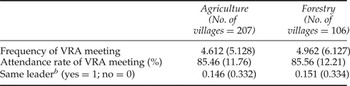
Our data come from a comprehensive field survey in 2011 that covered eight provinces in China: Anhui, Fujian, Hunan, Jiangxi, Liaoning, Shangdong, Yunnan and Zhejiang. Stratified sampling strategies were employed and information at both village and household levels is included. We incorporate three alternative measures of village democracy: the frequency of VRA meetings (Freq_VRA), attendance rates at VRA meetings (Att_VRA), as well as whether the VC chairman and the party secretary is the same person (Same_leader). These three measures differ from that used in earlier literature, which generally is a binary indicator of the existence of election to measure village democracy (Zhang et al., Reference Zhang, Fan, Zhang and Huang2004; Wang and Yao, Reference Wang and Yao2007; Meng and Zhang, Reference Meng and Zhang2011), for four reasons. First, as village election has quickly become a common practice in the last few decades in most Chinese villages, the election measure consequently observes no variation in our data. Secondly, village election may not always imply democracy in daily affairs. For example, if the party secretary is also elected as the VC chairman, the decision making of village affairs is still highly centralized. Thirdly, as compared to village leader election – which is mainly a political practice – the decision-making process in village affairs, which is the task of VRA and which often would involve economic activities, could be more relevant in our study focusing on agricultural and forest production. Finally, from an analytical perspective, even though VRAs already exist in most Chinese villages (Chan, Reference Chan2003), the frequency of meetings and attendance rates still vary, giving us data variation. Freq_VRA and Att_VRA should be positively correlated with the degree of democracy, while such correlation can be negative for Same_leader due to centralized decision power discussed above.
Details of production activities in agriculture and forestry are collected, where inputs include labor, capital (the monetary value of all other inputs) and land. Household-level information includes basic demographics such as household size and characteristics of household head such as gender, age, education, length of stay on-farm and health conditions (if he/she suffers from chronic disease). These human capital variables are incorporated as productivity shifters to predict the technical inefficiency in the stochastic production frontier setting (e.g., Binam et al., Reference Binam, Tonye, Wandji, Nyambi and Akoa2004; Loureiro, Reference Loureiro2009).
Due to clear differences between agricultural and forest production, we carry out empirical estimation separately (which also results from formal tests discussed below). A total of 1,400 households from 207 villages are included in agricultural production analysis and 371 households from 106 villages are included in forest production analysis.Footnote 3 Fewer households participated in forest production because timber harvesting as the major form of forest production does not occur on an annual basis. We consider both timber and non-timber forest-related production in our analysis.
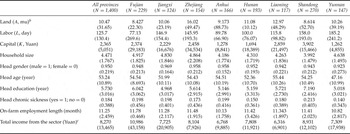
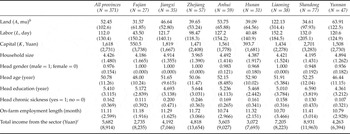
Table 1 summarizes measures of village democracy discussed above, where all of them appear to be very close across agriculture and forestry subsamples. Tables 2 and 3 present detailed information of production in the agricultural and forestry sectors, respectively, and the household characteristics for the total sample as well as by province. In agriculture, farm size does not vary much across provinces, yet labor and capital use do. Agricultural production in East and Central China is more capital intensive than in Yunnan, a province in Western China. Substitution between labor and capital is also evident in agriculture (agricultural production in Yunnan is the most labor intensive and the least capital intensive). Most household characteristics do not differ noticeably across provinces. In forest production (table 3), farm size varies much more, and households in the most capital-intensive province (Shandong) invest 600 per cent more in forest production than households in the least capital-intensive province (Hunan). The level of intensification in forest production is further found to be positively associated with forest income, while most household characteristics are similar in forestry.
Summary statistics of village democracy measures a

Notes:
a Standard deviations are reported in parentheses.
b Shows whether the VC chairman and the party secretary are the same person.
Summary statistics of agricultural production and household characteristics a

Notes:
a Standard deviations are reported in parentheses.
b 1 mu equals 0.067 ha.
c 1 Yuan equals US$0.155 in 2011 (using daily average exchange rates).
Summary statistics of forest production and household characteristics a

Notes:
a Standard deviations are reported in parentheses.
b 1 mu equals 0.067 ha.
c 1 Yuan equals US$0.155 in 2011 (using daily average exchange rates).
Although simple t-tests are not applicable due to overlapping observations (households that participated in both sectors), it is seen that, as compared to agriculture, forest production took place on much larger land areas but with smaller magnitudes of labor and capital inputs. Households in forest production are more likely to be headed by younger and less educated males who have a lower chance of having chronic health problems and spend more time in off-farm employment. Finally, household forest income averages about two-thirds the magnitude of agricultural income.
5. Results
Our empirical estimation starts with checking the OLS residuals of production function estimation with the Waldman (Reference Waldman1982) test. The premise of stochastic frontier analysis is that households are always located somewhere inside the production possibility frontier, and thus OLS residuals are expected to be negatively skewed. Another issue in empirical implementation is to specify the one-sided inefficiency term measuring technical efficiency, u i . Common options include half-normal, exponential and truncated normal. In our analysis, we select half-normal as the inefficiency term for both sectors based on the Akaike information criteria, and we therefore estimate the normal-half-normal model proposed in Aigner et al. (Reference Aigner, Lovell and Schmidt1977).
Among all inputs, labor and capital are potentially endogenous as both are associated with resource allocation decisions of the farmer. Specifically, we employ a control function approach suggested in Wooldridge (Reference Wooldridge2007) that suitably works for nonlinear models and tests for such endogeneity. Labor is first instrumented using the (exogenous) average wage for hired labor at the village level, while capital is instrumented using the asset quantile of the household. In all cases (agriculture and forestry with multiple village democracy measures), we cannot reject the null of exogeneity. Thus, treating them as exogenous is not likely to lead to biased results.
Concerning pooling or separating of agriculture and forestry subsamples, we incorporate a likelihood ratio test and compute the test statistic (Loureiro, Reference Loureiro2009):
 $$LR = -2\lcub \ln \lpar \lambda_{pool} \rpar - \lsqb \ln \lpar \lambda_{agriculture} \rpar + \ln \lpar \lambda_{forestry} \rpar \rsqb \rcub ,$$
where
 $ \ln \lpar \lambda_{pool} \rpar $
is the value of the maximized log-likelihood function using the pooled sample, and
 $ \ln \lpar \lambda_{agriculture} \rpar $
and
 $ \ln \lpar \lambda_{forestry} \rpar $
are maximized log-likelihood values using the respective agriculture and forestry subsamples. Under the null that coefficients are equal across models estimated using subsamples, the test statistic LR follows a χ2 distribution. Our computation shows the null is rejected with the LR statistic of 487.3 (with a p − value of 0.000). This result is consistent with our intuition that agricultural and forest production are in fact fundamentally different production processes and are better treated separately in our efficiency analysis.
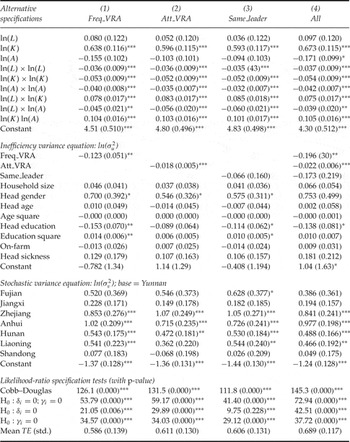
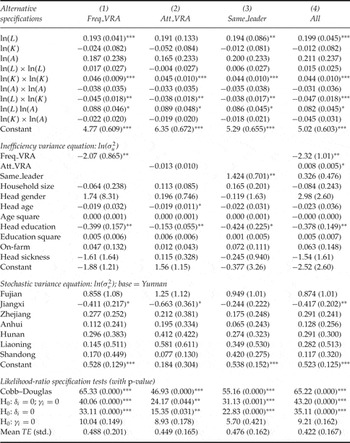
Tables 4 and 5 present our main estimation results for agriculture and forestry, respectively. In each sector, four models are estimated that alternatively incorporate the village democracy measures of Freq_VRA, Att_VRA, Same_leader and the combination of all. In all models presented, Cobb–Douglas technology was rejected against translog through likelihood-ratio tests; results of the latter are thus presented.
Stochastic production frontier estimation for agriculture (n = 1,400) a

Notes:
a Standard errors are reported in parentheses.
*, ** and *** indicate statistical significance at 10%, 5% and 1% levels, respectively.
Stochastic production frontier estimation for forestry (n = 371) a

Notes:
a Standard errors are reported in parentheses.
*, ** and *** indicate statistical significance at 10%, 5% and 1% levels, respectively.
All specifications for agriculture suggest the existence of heteroscedasticity in both error terms, except for model (3) (with Same_leader as village democracy measure) which cannot reject heteroscedasticity in the inefficiency term. Estimated mean technical efficiency ranges from 0.586 to 0.689. Across these regression models, only the coefficient of capital is positively significant among linear inputs, while decreasing returns to scale is suggested by all squared inputs which observe negative and significant coefficients. Moreover, substitution might occur between labor and land as reflected in the interactive term between these two inputs, while complementarity might exist between land and capital, and labor and capital.
Models (1) and (2) suggest that higher level of village democracy is associated with lower inefficiency variance in agricultural productivity, with village democracy measured by Freq_VRA and Att_VRA, respectively. These results are intuitive as villages with better democratic participation may better represent farmers' relative comparative advantages, which in turn facilitates greater production efficiency and specialization. However, a significant relationship is not found where Same_leader is employed as the village democracy measure, which might be explained by the fact that agricultural production is more stable as an institution, given that reforms have targeted this sector over a longer period of time, i.e., it is less affected by changes in village leader decisions. Model (4) incorporates all three measures. Freq_VRA and Att_VRA, but not Same_leader, are again found to be negative and significant. As we specify half-normal distribution for the inefficiency term where the mean is positively correlated with its variance, these results also suggest Freq_VRA and Att_VRA could improve farmers' technical efficiency in agricultural production through the reduction of its variance.
Among the covariates, the age of household head is negatively associated with technical efficiency with marginal significance, while education is found to improve technical efficiency in most cases. Most other hypothesized relationships are of expected signs (except for head gender), but none appears to be statistically significant. Also, households in most provinces observe larger stochastic variations as compared to those in Yunnan province (the base group). This makes sense as Yunnan is the only province included in our survey in west China where agriculture is more traditional.
Table 5 shows the stochastic frontier estimation results for the forestry sector. Unlike agriculture, forest production appears to be relatively homogeneous across provinces at least with regards to stochastic variances in production, as none of the models can reject the null of homoscedasticity of the stochastic variance. However, all models reject homoscedasticity of the inefficiency variance, suggesting a role that village democracy and other covariates play in the determination of technical efficiency. Estimated technical efficiency ranges from 0.422 to 0.488. Linear-term input coefficients are insignificant except for labor. Further, significant complementarity between labor and land area is found. These results imply that forest production at the household level in China is still very labor intensive. Increasing returns are found for capital, as inputs such as machinery are not commonly applied for small-scale production. This is further reflected in the substitutional effects between labor and capital.
Of special interest to us are the coefficients of village democracy measures in the forest production frontier, which appear to be statistically significant in models (1) and (3), individually employing Freq_VRA and Same_leader as village democracy measures, respectively, but not in model (2) with Att_VRA. Frequency of VRA meetings reduces inefficiency variance, while a same village leader increases it. Model (4) incorporates all three measures but suggests coefficient significance only for Freq_VRA, with that of Same_leader possibly masked. These results can again be interpreted as reduction and increase in inefficiency, respectively.
Other covariates are generally insignificant except for education level of the household head. Better education improves technical efficiency and reduces efficiency-based shocks on household production. This is the case in all of the estimated models.
6. Discussion
Estimation results clearly suggest the linkage between village democracy and technical efficiency in both agricultural and forest production: higher levels of village democracy improve technical efficiency. Most other covariates in inefficiency variance equations, although found significant in previous studies, appear to be insignificant in our case, once village democracy is properly controlled for. This is a significant finding and suggests that controlling for democracy across regions in a reforming economy has implications for not only correct and unbiased estimation of productivity effects, but is also required for correct interpretation of the importance of rural reforms to household welfare. Given that many developing countries are currently undergoing policy reforms toward more democratic local decision making, our model suggests the importance of using econometric models that allow for such complications.
To interpret our results in context, it merits comparing the results from agricultural and forest sectors. Unlike agriculture that takes place annually and at the household level for decades, forest production spans a multi-year rotation period and the products are more of a cash-generating nature. In the above results, estimated technical efficiency in forest production (0.422–0.488) is lower than that of agricultural production (0.586–0.689), suggesting that households are more inefficient relative to the forest production frontier than they are relative to the agricultural production frontier. This makes sense as forest production at the household level only started after the recent reform a decade ago (Qin et al., Reference Qin, Carlsson and Xu2011), and in most areas the use of machinery is uncommon. To illustrate this better, we specifically compare the estimated technical efficiencies of agricultural and forest production among participants of both sectors. A check of summary statistics reveals that these producers are roughly proportionally located throughout the surveyed provinces, and their socio-economic characteristics are similar to those of the single-sector producers. Estimated technical efficiencies of single- and dual-sector producers are reported in table 6. For dual-sector producers, agricultural production is more efficient than forest production in all cases (statistically significant at the 1 per cent level). Moreover, dual-sector and single-sector producers have no significant difference in estimated technical efficiency in agricultural production, while dual-sector producers are less efficient in forest production. This finding is interesting and can possibly be explained by the fact that most households are less experienced in forest production than in agricultural production.

Notes:
a Standard deviations are reported in parentheses.
b for dual-sector producers, agricultural production is more efficient than forest production in all cases (statistically significant at 1% level). Dual-sector and single-sector producers observe no significant difference in estimated technical efficiency in agricultural production, while dual-sector producers are less efficient in forest production (*** and ** indicate statistical significance at 1% and 5% levels, respectively).
The magnitudes of the variance-reduction effects of village democracy are much larger in forestry than in agriculture. This might be explained by the fact that trees represent long-term production, and thus risks associated with lower levels of democracy could be higher and can manifest themselves in terms of governmental expropriation and/or arbitrary fee collection. On the other hand, the finding that a same village leader jeopardizes technical efficiency in forestry but not agriculture is interesting. This result is likely associated with the fact that forestry is more of a cash-generating sector where conflicts of economic interests between farmers and village leaders could be more severe when those leaders must represent the political interests of the party. Also, since the forestland tenure reform just took place a decade ago, household production decisions are likely more vulnerable to policy instability.
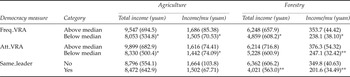
The importance of our efficiency findings can be gleaned through further investigating the extent to which village democracy alters household disposable income from agricultural and forest production. Income gains follow from productivity gains according to equation (8). As village democracy affects household welfare through the impact of changes in the inefficiency error, we make a direct comparison between the agricultural and forestry income of households living in villages with greater or poorer democracy institutions. Specifically, we group households into more democratic (i.e., with more frequent VRA meetings, higher VRA meeting attendance rates, and different village leaders) and less democratic using the cutoff of the median value of each indicator, and then compare agriculture and forestry income between the two groups.
The results are presented in table 7. Household total agricultural income differs significantly between more democratic and less democratic villages as measured by either Freq_VRA or Att_VRA indicators, with the difference ranging between 1,494 and 1,569 yuan (0.16 Yuan = US$1). This is nearly 20 per cent of the average annual total income in the sample from table 2. Such a pattern is also observed in the per area (mu) income for agriculture designed to control for any systematic difference in acreages between groups – in this case the difference ranges between 174 and 181 yuan per mu. The importance of democracy to higher incomes for forest production is even more dramatic. Income differences between more democratic and less democratic villages, using democracy measures Freq_VRA and Att_VRA, range from 1,389 to 2,341 yuan. At the top end this is of the order of nearly 50 per cent of total annual forestry income for our households. If we control for area, income in democratic villages is also significantly higher with democracy to the order of 116–148 yuan per mu.

Another interesting comparison exists between forestry and agriculture. It appears that the higher end of income differences is dominated by total household income for forestry, but on a per land unit basis the results for income are similar. This is intuitive as agriculture is practiced on higher land qualities and observes higher revenue per hectare, and thus we would expect less differences in the ranges once we consider these differences on a per land unit basis. However, our results show that efficiency gains are greater for forest production, suggesting that the higher total income we observe for the household, and the greater share of total income democracy is responsible for, is indeed an important effect for this sector. Clearly, democracy is important for both sectors but is critical for forest production related wealth.
While the findings are consistent and robust, we should caution against interpreting our results as causal. It would have been difficult to reveal causality with observed cross-sectional data, where many unobservables cannot be controlled for, and stochastic production frontier estimation, which is not aimed at full identification of causality. Therefore, while we show that one-way impacts of democracy on technical efficiency are likely, especially for forestry where household production started decades later than village democracy, our results should be rigorously treated as suggestive.
7. Concluding remarks
We analyze the impacts of village democracy on rural household welfare in China from a technical efficiency perspective. Using a unique recent household survey that covers both agriculture and forestry sectors, we provide micro-level evidence in China and confirm the important role that democratization has on productivity. Such linkages are consistently found to be positively significant for both agriculture and forestry, yet can be more meaningful in forestry which can be more vulnerable to policy instability or economic conflicts. Our analysis also offers important policy lessons for other developing countries where democratization is gradually taking place.
The confirmed positive associations between democratization and household welfare through technical efficiency improvements directly suggest the need for a higher level of democracy in developing countries like China. For most rural households, enhancements of economic performance in basic sectors that involve the majority of their resources can directly improve welfare. The primary focus for the government in village democratization should be encouragement of both the implementation and public participation in village democratic affairs such as VRA. Decentralized decision power can also be of vital impact in growing sectors such as forestry that call for better protection by political institutions. As a first study using micro-level data and with limitations, we show the need for further empirical investigations that potentially cover different countries and other sectors which potentially benefit from democratization.